

Recently, the Financial Oversight and Management Board published the Puerto Rico government’s financial report for the second quarter of the current fiscal year. On page 8 of that report, we found a chart showing Puerto Rico’s gross national product in constant 2017 dollars, between 1990 and 2025. Three clear trends emerge immediately across those 35 years.
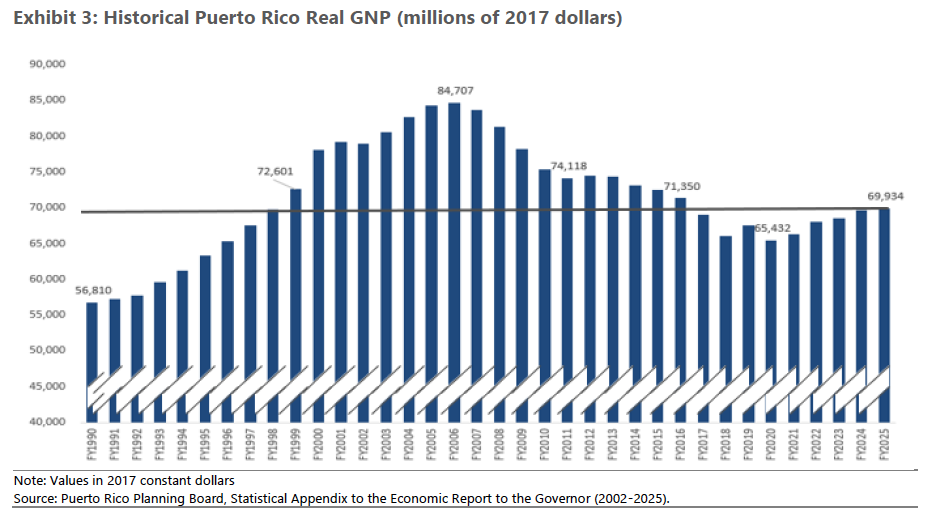
First, an upward trend between 1990 and 2006. Second, a downward trend between 2007 and 2020. And third, a modest rebound between 2021 and 2025. What stands out most, however, is that the GNP level in 2025 was the same as in 1998, just under $70 billion, in 2017 dollars. Although the economy grew in some years during that period (1998–2025), the overall trend is clearly one of stagnation at best and contraction at worst. That is the only economy a 26- or 27-year-old Puerto Rican has ever known. In 2016, we spoke of a lost decade; today we must speak of a generation of Puerto Ricans who have known only crisis.
Much has changed since 1998, and although the factors that contributed to this stagnation are many — the opening of India and China to the global market, the elimination of Section 936, the government’s bankruptcy, Hurricane María — the fact remains that during that period we also stopped investing in our physical infrastructure, particularly the electrical grid. Today, in a world of digital transactions and emerging artificial intelligence, we tend to underestimate the importance of physical infrastructure, but the reality is that access to reliable, low-cost energy is a necessary, though not sufficient, condition to reverse the contractionary trend of our economy.
The Puerto Rico government has already taken steps to promote new investment in our electrical system. Among these is Executive Order 2025-047 of September 22, 2025. The order modifies and extends the scope of the electrical system state of emergency and establishes an expedited process to evaluate and negotiate power purchase agreements for renewable energy projects that qualify for federal renewable energy investment tax credits, known as “ITCs.” To qualify for these credits, renewable energy projects must begin construction before July 4, 2026, or be operational on or before December 31, 2027.
Puerto Rico’s electrical system requires billions of dollars in investment. In the area of generation, the most effective strategy is to diversify energy sources and promote renewable energy to reduce our dependence on fossil fuels that we do not produce. And the fastest and most efficient way to implement that strategy is by approving utility-scale solar generation projects.
These projects have several advantages over those that use natural gas. The cost of solar panels and batteries has fallen significantly over the past decade. Meanwhile, the costs of natural gas generation projects have increased by 66% and the time to bring them online has increased by 23%, both between 2023 and 2025, according to a BloombergNEF analysis.
Second, natural gas generation depends on a vast global infrastructure to extract the gas, transport it to a port where it is liquefied, ship it to Puerto Rico, and regasify it upon arrival. Infrastructure that Puerto Ricans do not control, and whose use is subject to the economic and geopolitical shifts of the global market.
Finally, the availability of ITCs makes this investment even more attractive by effectively reducing construction costs. That reduction in infrastructure costs ultimately translates into cheaper energy, which in turn helps generate greater investment and economic activity. Everyone wins. What are we waiting for?
This content was translated from Spanish to English using artificial intelligence and was reviewed by a human editor before being published. The Spanish version of this column was originally published in El Nuevo Día on May 29, 2026.