
Upcoming Federal Priorities for Puerto Rico

Upcoming Federal Priorities for Puerto Rico

Published on May 9, 2024 / Leer en español

Director, Washington D.C. Office
SHARE

A brief note from yours truly:

I’m back! During the last two years, I served Puerto Rico from within the U.S. federal government.  I carried the work with a sense of pride and deep responsibility. It was the first Administration to appoint Senior Advisors across federal agencies to look out for Puerto Rico specifically.  And I was one of them.  Our collective efforts have undeniably ensured great strides in the Puerto Rico policy arena. Undoubtedly, as a wise Congresswoman once told me: “we have matured politically and are better prepared to flex our muscles to get attention”.

During my time at the U.S. Department of Housing and Urban Development (HUD), I worked tirelessly to ensure there was a recognition and deeper understanding of how historical circumstances, program shortcomings and cultural differences have resulted in an uneven playing field for Puerto Rico – and all U.S. territories.  While it’s been tough at times to tackle the deeply entrenched inadequacies, I’m proud of the progress we’ve made and the lessons we’ve learned. I remain hopeful that one day every federal agency will have dedicated personnel working to correct the many historical wrongs.

The Center for a New Economy’s (CNE) mission in DC is clear: shape and inform debates around Puerto Rico and put serious research and policy recommendations directly into the hands of decision-makers. But we are facing many challenges in doing this work. The political environment in Washington, DC has become increasingly contentious. For the most part, opposition to policy solutions stems from ideological stances rather than empirical evidence. Instead of fostering unity, it’s looking far more like the Divided States of America. For Puerto Rico policymaking, it’s a stark dichotomy:  either in favor of supporting its needs or you’re vehemently opposed to it.

At times, we find ourselves addressing urgent issues before even having the chance to propose solutions. Even now, after more than five years of laying the groundwork for Puerto Rico’s transition to SNAP, we’re faced with a proposal that not only denies access to SNAP but also slashes $700M from our existing program.

In the real world, challenges run even deeper. Before misinformation was widely promoted by social media and all the “clicks”, there was a whole effort to challenge knowledge altogether – to in fact, create ignorance: “via advertising, duplicitous press releases, funding of decoy research, establishment of scientific front organizations, manipulation of legislative agendas, organization of ‘friendly research’ for publication in popular magazines, and myriad additional projects from the dark arts of agnotology.” Those same mechanisms have grown exponentially and now infiltrate our daily lives. I was recently in NYC and came across this mosaic in one of MTA’s stations.

I stopped and thought of the implications of the iceberg analogy vis a vis our role in society.  Are we trusting our feelings above facts and evidence?  Imagine if we just trusted pilots to know what they are doing instead of requiring intensive training before putting our lives in their hands?

We are at a tipping point, grappling with deep ideological divisions, legislative gridlock, entrenched income inequality, and a global rise of authoritarianism. The role of think tanks is more important now than ever. And that’s why I’m back.

CNE has earned its reputation by doing the hard work and abstaining from politically-driven agendas. We are Puerto Rico’s objective brokers of expertise. We are here to help you understand issues and ideas through analysis.

“Getting and staying informed takes time and energy, but the results for individuals and the country make it worthwhile. When it comes to our obligation to be informed, those in the position to influence the views of others have a special responsibility to get their facts right and to distinguish carefully among facts, assessments, predictions, and recommendations.”

Richard Haas, Bill of Obligations


So, what’s next?

The way federal programs are designed in Congress requires Puerto Rico to repeatedly return to Congress every few years and put in our requests. That includes increased appropriations, changes to benefit levels, inclusion in certain programs we have been denied access to, and or, in addition to certain waivers for unreasonable requirements.  But that also lays out some predictability in our calendar.

Below is a list of federal policy issues that CNE will pursue over the coming years.
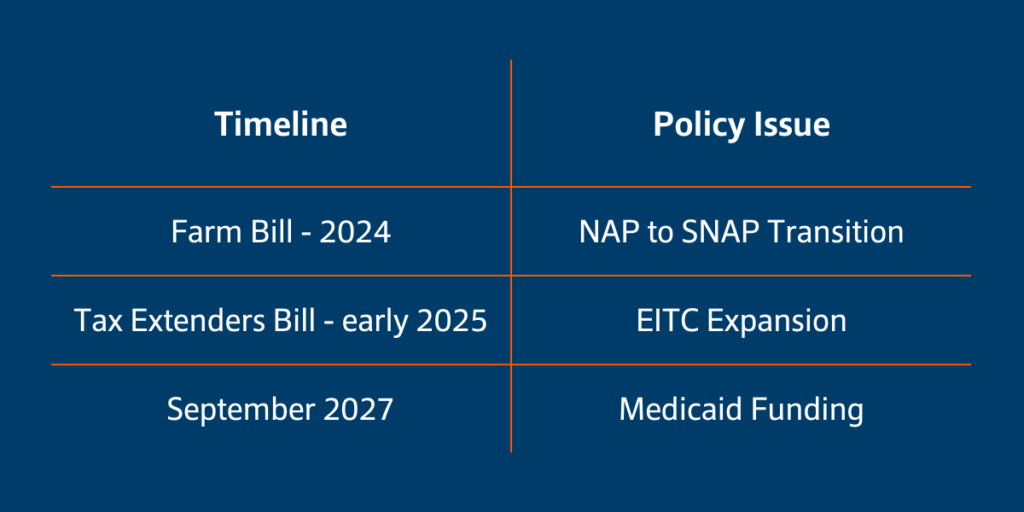
NAP to SNAP

The United States government balances food production and food access for people living in poverty through its Farm Bill, revisited every five years by Congress. In addition to its revisions to aid and subsidies provided to farmers and agricultural corporations due to technological advancements, environmental concerns, and consumer preferences, it is also an opportunity to look at and review the effectiveness of U.S. food security programs. It gives Puerto Rico a unique opportunity to advocate for its own needs.

For many years now, a wide coalition of actors from Puerto Rico and the U.S., both public and private, have come together to push for Puerto Rico’s full incorporation into the Supplemental Nutrition Assistance Program (SNAP). As a result of that collection of efforts, the Senate Chairwoman for the Agriculture Committee recently released a framework for the new legislation that authorizes Puerto Rico to transition to SNAP, allocates necessary funding to be able to do so, and mandates a Government Accountability Office (GAO) study on the adequacy and availability of nutrition programs in isolated US states and territories. This release, a response to the House proposal, aims to foster bipartisan collaboration for a successful legislative outcome, and we’re committed to being part of the process.

Click here to read the latest column by Sergio M. Marxuach, Policy Director.

Changes to the Tax Code

In December 2017, Congress passed the Tax Cuts and Jobs Act of 2017, known on the Hill as the TCJA.  While certain provisions of the TCJA were made permanent, many are slated to expire by December 31, 2025. This means Congress will need to negotiate another major tax package in 2025, opening the door for Puerto Rico to advocate for necessary federal tax adjustments.

One area we are paying close attention to is the federal supplement to the local Earned Income Tax Credit (EITC). In 2021, the American Rescue Plan Act (ARPA) included an annual, federal supplement that bolstered Puerto Rico’s local EITC program. Nationally, the EITC plays a crucial role in enhancing economic security, improving children’s educational performance and attainment, and enhancing overall family well-being.

The last three years have been somewhat experimental for Puerto Rico as it evaluates the uptake and effectiveness of the recent expansion. Early data demonstrates that nearly 125,000 individuals that directly benefited from the EITC have been able to overcome poverty because of the EITC and other important anti-poverty programs included in ARPA. This success provides a compelling case for expanding the program further.

Given how critical this program has been to alleviating poverty and boosting labor force participation, we will be working with other partners to prioritize increased funding for Puerto Rico’s EITC in the upcoming year’s tax bill discussions.  participation, we will be working with other partners to prioritize increased funding for Puerto Rico’s EITC in the upcoming year’s tax bill discussions. 

Medicaid Funding

Over the years, the federal government has financed healthcare programs for the poor differently between the U.S. states and its territories. After years of advocacy and unproductive cycles of insufficient block grants, Congress finally took action in 2022 by authorizing a five-year funding package with the highest-ever allotments for Puerto Rico’s Medicaid program. These unprecedented funding levels have allowed Puerto Rico to expand eligibility and services to those in greatest need.

While the five-year package represents an improvement over the previous short-term patches Puerto Rico had grudgingly become accustomed to, it remains temporary and is set to expire in September 2027. It was also not sufficient to cover all the programs provided in the U.S. For example, it does not cover long-term services and support (LTSS) and non-emergency medical transportation for Puerto Rico’s increasingly aging population.

We will continue to stress the importance of providing Puerto Rico with equitable, permanent, and open-ended Medicaid funding to ensure the health and well-being of its residents.

In addition to Puerto Rico’s inclusion in critical health and economic programs available to residents in the U.S. (territories not included), there are many other investigations and good policy we will dive deeper into and pursue.

Standing Up for Puerto Rico in Washington, D.C.

Standing Up for Puerto Rico in Washington, D.C.

Published on September 30, 2021 / Leer en español

Director, Washington D.C. Office
SHARE

2016 was a pivotal year for Puerto Rico.  The three branches of the federal government took direct action related to Puerto Rico.  The judicial branch, through two separate rulings issued by the U.S. Supreme Court, opined that Puerto Rico is not a sovereign territory and ultimately responds to the plenary powers of the U.S. Congress.  The legislative branch authored and voted for the Puerto Rico Oversight Management and Economic Stability Act, known as PROMESA, which gave the island access to a comprehensive restructuring process and established an oversight board to oversee Puerto Rico’s finances. The executive branch signed the law and subsequently appointed members to the new Financial Oversight and Management Board.

Though the troubles of the island had long been researched by our experts at the Center for a New Economy (CNE), it was evident this turning point underscored the need for a think tank dedicated to the island’s issues to be present in Washington, DC. and lend its voice to federal policymakers and lead to better decision-making.

The work began in earnest in the summer of 2018 with the addition of a full-time Office Director.  As I will highlight below, our accomplishments since then have ranged far and wide, exceeding even the goals laid out in CNE’s five-year strategic plan.  Back in 2019, the objective was to provide strategic research and guidance for congressional staff and federal agencies on policies related to Puerto Rico’s recovery, economic growth, and long-term sustainability, as well as proactively develop opportunities to influence federal policies that advance long-term economic development for Puerto Rico.

In a short three years, CNE has not only elevated and persuaded Congress and the Executive to more adequately address Puerto Rico’s challenges, but it has achieved substantial changes in federal law.

Shaping Federal Policy

The political environment in Washington, DC. has become increasingly contentious, and for the most part, opposition to policy solutions emanates from ideological postures rather than empirical evidence.  CNE has therefore been able to navigate this difficult environment by providing neutral evidence and research, thus allowing us to cultivate relationships and build bridges in DC.

As the first non-political representation from Puerto Rico in the federal capital, our unique expertise has allowed us to intimately shape and influence the policy discussions around Puerto Rico.  In addition to contributing to the public debate on public policy questions through the publication of various pieces, the DC office has served as a key liaison between Puerto Rico, the White House, Congress, and other DC stakeholders.

Earned Income Tax Credit

After many years of documenting evidence on the need to address high poverty rates and low labor force participation through individual tax credits, CNE’s push in Washington for a robust federal expansion of the local earned income tax credit successfully materialized.

On March 11, 2021, President Biden signed into law the American Rescue Plan Act of 2021, which included federal funding to expand Puerto Rico’s local earned income tax credit.  The federal supplement will help ensure the credit’s sustainability, provide a significant income boost to low- and moderate-income families, and serve as a powerful incentive to draw workers from the informal economy into the formal economy.  CNE, along with our partners and policy experts at the Center on Budget and Policy Priorities (CBPP), worked on the design of the credit that was ultimately enacted into law.

Temporarily Averting a Medicaid Cliff

Puerto Rico’s Medicaid program runs on a grossly underfinanced block grant.  For decades, Puerto Rico has received limited funding to run a bare-bones Medicaid program that provides only 10 out of 17 mandatory services. Congress’s unwillingness to provide adequate Medicaid resources on a consistent basis has furthered the exodus of healthcare providers and crippled services for patients, thereby increasing state Medicaid costs. In the past, temporary lifelines to Puerto Rico’s Medicaid program have prevented a total system collapse, but by the same token, these short-term extensions of supplemental funding have thwarted efforts to completely reform the system and make it more effective.

CNE has been carefully studying and working with government officials and partners on designing an adequate solution for Puerto Rico’s Medicaid program.  Our solution brings Puerto Rico’s federal Medicaid funding into full parity with how states are treated over time, in the form of uncapped federal funding and a federal medical assistance percentage (FMAP) calculated on basis of Puerto Rico’s per capita income relative to national per-capita income.  CNE’s advocacy has included an in-depth report on the need for ongoing, stable, and adequate funding for Puerto Rico’s Medicaid program, as well as multiple publications and videos on the need for permanent funding.  In 2019, CNE successfully advocated for a generous two-year incrementally increasing financing package. The latest short-term funding extension will expire in September of this year.  Absent Congressional action, Puerto Rico will likely be forced to make drastic cuts, reduce payment rates, and/or decrease the number of beneficiaries.

Assessing the Impact of the SSI

CNE was one of the first to raise the importance of the Supplemental Security Income (SSI), a program that provides cash assistance to the elderly, blind, and disabled individuals with limited resources to meet basic living expenses.  After a deep policy dive, in June, we released a short brief on the impact the federal program could have in Puerto Rico.  We complemented that effort with a short video that explained the benefits for a wider audience.  We continue having conversations with the House Ways and Means committee educating them on the program, and the nuances of Puerto Rico policymaking.  Acknowledging there are still a lot of unknowns on the extension and implementation of the program in Puerto Rico, CNE DC will continue to work with Congress and OMB to ensure the Social Security Administration has the necessary resources to extend benefits.

Manufacturing

Important shifts in federal policy given the pandemic have placed Puerto Rico at the center of several “reshoring” proposals to ensure that U.S. supply chains in critical areas like medical supplies and pharmaceutical manufacturing, where the island has a sizeable footprint, are safer and not disrupted.  As different actors sound the drum on the need to bring production back to Puerto Rico, CNE is uniquely equipped to spur a thoughtful reflection on the socioeconomic goals and objectives of pursuing such policies.  Beyond satisfying immediate national production needs, Puerto Rico’s policymakers must be keenly aware that the most impactful development gains that can be achieved from attracting foreign investment are reaped through the creation of linkages to the local economy that foment positive spillovers and learning opportunities.

Reconstruction

The process of rebuilding the island will take years and a full and sustained recovery will only be possible if Puerto Rico crafts a renewed development platform, renovates its productive, physical, and institutional infrastructure, and tackles long-standing structural inequities that have thwarted the advancement of economic opportunities for the majority of the population.

In an effort to examine the process to date, in 2019, CNE published Oversight that Works, a policy memo identifying key challenges in Puerto Rico’s recovery efforts, detailing the need for better accountability, transparency, and oversight practices in the island, and offering recommendations for effective oversight of federal disaster funds. Our work will be geared to ensure there is a space for elected officials, representatives of local communities, non-governmental organizations, academia, and other stakeholders to participate effectively in the reconstruction effort.

It is also necessary to ensure Puerto Rico has the ability to absorb and manage reconstruction funds so that the focus is less about the overall price tag, and more about where these monies are invested.  As we look to the future, we need to focus on establishing the right processes and practices that ensure an effective reconstruction process.  A successful recovery will remain elusive unless there is a collective commitment to develop a self-sustainable economy that can survive when disaster aid interventions cease.

Ongoing Work with the Administration

Shortly after the 2020 elections, CNE shared a Transition Memo with the new Administration, urging their focus on accelerating reconstruction efforts and providing the residents of Puerto Rico equal access to several federal programs — such as Medicaid, SSI, SNAP, and the EITC.

In addition to the expansion of Puerto Rico’s earned income tax credit (EITC) in the American Rescue Plan of 2021, President Joe Biden’s FY 2022 budget directly responds to our memo by including language specifically supporting full funding for Puerto Rico’s Medicaid program as well as “moving toward parity for other critical federal programs including Supplemental Security Income and the Supplemental Nutrition Assistance Program.”

Further, the DC office is repeatedly asked for their expertise and input.  Most recently, the office has personally briefed the Secretary of Education and a member of the National Economic Council to offer credible and sustainable solutions to Puerto Rico’s multiple and ongoing challenges.

The Work Ahead

Without a doubt, the uncertainty caused by several crises, layered on one over the other, is detrimental for everyone and it is especially for populations – like Puerto Rico – that have few resources to make ends meet. This has been compounded by structural funding limitations in Puerto Rico that constrain its ability to address current challenges, and importantly, prepare for future threats.

CNE’s work today is more important than ever before.  We have a unique opportunity to address widespread hardship and forge a path towards prosperity.