Where are the workers?

Where are the workers?

Published on June 3, 2022 / Leer en español

Visiting Fellow
SHARE

There are billions of dollars in federal funds available for recovery, but we do not have the workforce with the technical and professional skills needed to restore Puerto Rico.  There is a severe shortage of workers in many sectors, including health care, education, and construction.  A report by the U.S. Bureau of Labor Statistics (2021) stated that about 40,000 people are needed to work on the reconstruction.

The fiscal plan calls for improving technical education to ensure the economic growth needed to pay bondholders and achieve a sustainable recovery. Low education levels at a time when the global economy requires greater technical skills in the workforce could mean we cannot compete globally.

Postsecondary education improves economic opportunities for the individual and society.  While more than 50% of the population with a high school degree or less lives below the poverty line, two-thirds of those with some college courses are above the poverty line. Only 39% of adults over the age of 25 in Puerto Rico have an associate’s degree or higher, and access to a degree is highly unequal.

Much of the workforce we need are skilled, certified construction workers and medical personnel to care for our elderly. One of President Biden’s priorities is community colleges. They offer technical education, associate degrees, and in many cases the opportunity for students with educational or economic difficulties to complete a bachelor’s degree.  However, public community colleges are almost non-existent in Puerto Rico.

Education in Puerto Rico is very unequal.  At the elementary and secondary level, parents with financial resources enroll their children in private schools, while the poor are isolated in the public schools that have not been closed down, with in many cases a poor-quality education and limited resources.  In the postsecondary system, the opposite is true.  The public system is effective and selective, but it is shrinking. This could mean that only a privileged group of students would have access. For many low-income students, the private system is the only route to university. However, private universities are more expensive and perform worse in terms of retention and numbers of graduates than the public system.

How do we rebuild the middle class and provide opportunities for our young people in Puerto Rico? We need to develop opportunities for the future that allow for sustainable development by investing in our people. Postsecondary education is an economic growth strategy employed by the fastest growing countries in the world, such as South Korea, China, Germany, and the United States.  In Puerto Rico, postsecondary education must be part of a comprehensive regional economic development system.  However, the government in its growth plan and the Fiscal Oversight Board ignore the role that the University of Puerto Rico has played in transforming our society from agrarian to industrial and continue to cut its budget.  These cuts and their consequence on the availability of resources, personnel, and tuition increases are unprecedented in the United States.

A blueprint for economic growth requires addressing these issues. The postsecondary system in Puerto Rico needs the resources to produce the workforce of the future and strengthen the middle class, but it also needs clear goals for access, affordability, equity, and student success.  In addition, evaluating whether the practices and policies of the institutions meet these goals to improve student progress and demonstrate the great impact of these institutions on society is essential. We need strong institutions to develop our skills and respond to Puerto Rico’s needs.

CNE Review – November 2021

Published on November 18, 2021 / Leer en español

See all editions of the
CNE Review
SHARE

In This Issue

In this edition of the CNE Review, we are focusing on education and its role in economic development. In its broadest sense, economic development consists of creating the conditions necessary for human flourishing. Contrary to popular belief, development is not limited to economic growth nor mere increases in economic indicators, such as employment, income, or output.

It also requires, in the language of Amartya Sen and Martha Nussbaum, that a society’s growing wealth be utilized to provide at least five types of instrumental freedoms: (1) political freedoms (including civil rights, freedom from discrimination, and other human rights); (2) economic opportunity (fair access to economic resources); (3) freedom to improve one’s life chances and opportunity structures (through access to education, quality healthcare, and physical security); (4) freedom to participate in the governance of society (including access to government information, governmental openness and transparency, and protection from corruption); and (5) protection from basic material and physical wants (through social safety nets, unemployment insurance, and old age pensions).

Belinda Reyes, a CNE Visiting Fellow, explores some of those connections between higher education and economic development, specifically the issue of what can be done to provide young people with better opportunities on the island.

Professor Reyes is an Associate Professor at the Department of Latina and Latino Studies at San Francisco State and is an expert in demographics, education, immigration, urban economics, opportunity youth, and the social and economic progress of Latinx in the United States.  Her work explores the intersection of demographic change and policy to examine institutional policies and practices that limit opportunities and perpetuate unequal outcomes for people of color.  She holds a B.S. in economics from the University of Illinois at Urbana-Champaign and a Ph.D. in economics from the University of California, Berkeley. Please join us in welcoming her to CNE.

Finally, we remind our readers that CNE will soon be hosting its first conference since 2019. The Growth Policy Summit conference will be held on Friday, December 3 at the Sheraton Hotel in the Convention Center District. After fifteen years of stagnation, the bankruptcy of its government, the destruction caused by two hurricanes, and the effects of the global COVID-19 pandemic, it is time to start thinking about Puerto Rico’s future. Some of the issues to be addressed at the Growth Policy Summit include:

  • How do we get Puerto Rico back on a path towards growth?;
  • How do we leverage the reconstruction process?;
  • How have the government’s bankruptcy and the COVID-19 pandemic affected our ability to rebound?; and
  • How can we finally be successful in charting a new roadmap?

For more information, including registration for the conference, go to cnegps.com.

–Sergio M. Marxuach, Editor-in-Chief

Insights + Analysis from CNE

Investing in Ourselves: Post-Secondary Education for a Sustainable and Equitable Recovery

By Belinda I. Reyes, Ph.D., CNE Visiting Fellow

Puerto Rico is at a critical moment to recover from environmental disasters – hurricanes, earthquakes, and the COVID-19 pandemic – as well as a fifteen-year-long recession and fiscal crisis. Billions of federal funds are becoming available to rebuild our infrastructure.

Meanwhile, the Fiscal Oversight and Management Board for Puerto Rico (“FOMB”), given the authority by Congress to develop Fiscal Plans for the island, is only interested in the payment of the public debt and for five years has been imposing severe austerity measures and a payment plan that threatens the opportunity of a lifetime to rebuild our island.

We ask ourselves, how do we build a future with opportunities for young people on the island?

Young people need hope for the future and opportunities to prosper, and they are not finding them in Puerto Rico. We need to reconstruct our island by rebuilding our middle class and creating opportunities.

Keep reading for a summary of our policy brief. Click here to access the full text.

A 21st Century Model of Development for Our Current Realities

The late 20th century Thatcher/Reagan model of economic growth is increasingly questioned in light of its impact on poverty, inequality, and climate change. In the case of Puerto Rico, the economic strategy led to declining economic activity, inequality, and extreme poverty. Today over 40% of the population in the island lives below the poverty line, over three times the U.S.’s rate.

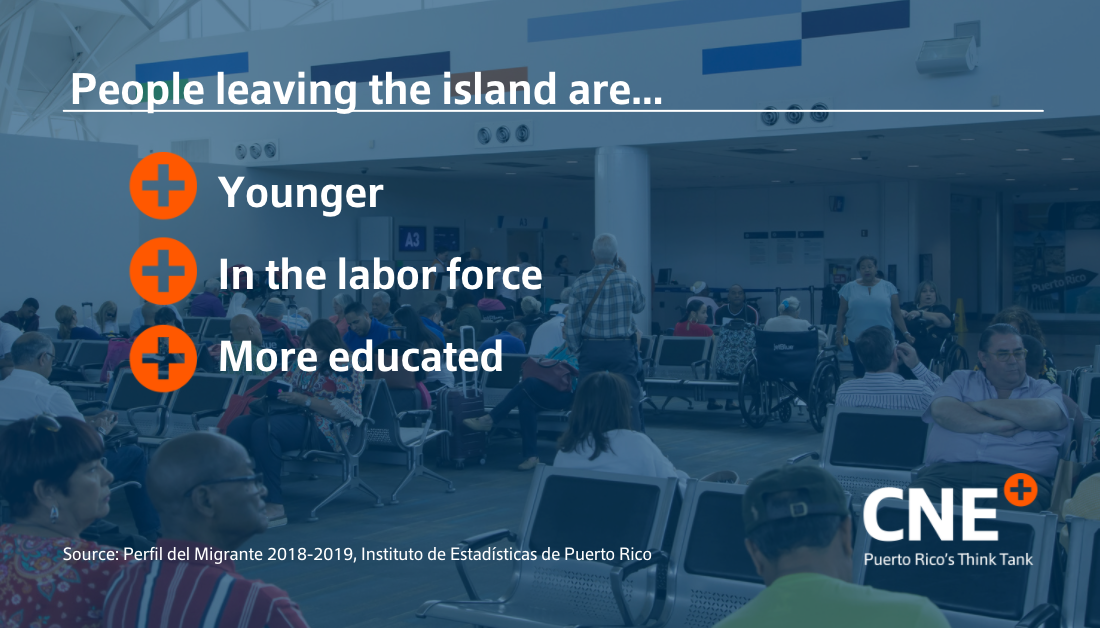
The economic collapse of the development model has resulted in extreme depopulation as people see no hope for the future in the island.  The most recent portrait of our migrants published by the Instituto de Estadisticas de Puerto Rico shows the people leaving the island were younger (31 versus 43 years old median age in the island), in the labor force (61% compared to 45% in the island) and slightly more educated than the average adult 25 and older in Puerto Rico (55% had some college education versus 51%).

We need a model of development for the 21st Century. Click here to read more examples of how we could overhaul our infrastructure and rebuild our middle class with a strong post-secondary educational system.

Growing the Economy from the Middle Out

The idea of growing the middle class to grow our economy is not new. Roosevelt’s New Deal was centered on providing opportunities and work for the people, through government support and investments in infrastructure. Currently, the Biden Administration is battling Congress to take the United States in that direction again with the Infrastructure, the American Families, and the Build-Back-Better Plans. While not everything in the plans will survive the battles in Congress, we can expect a major push to grow the middle class to bring back the U.S. economy.

Puerto Rico’s history is also an example of how education and the expansion of the middle class have been essential for economic growth. Since the 1960s, Puerto Rico had one of the greatest expansions in educational attainment in world history from 4.6 years for adults older than 25 years old to 11 years in 2000. This expansion in educational attainment accounted for as much as half of the increase in the output per worker between 1975 and 2000.

Click here to read more on how investments in education continue to contribute to the accumulation of human capital.

Budget Cuts Are Strangling the Public System

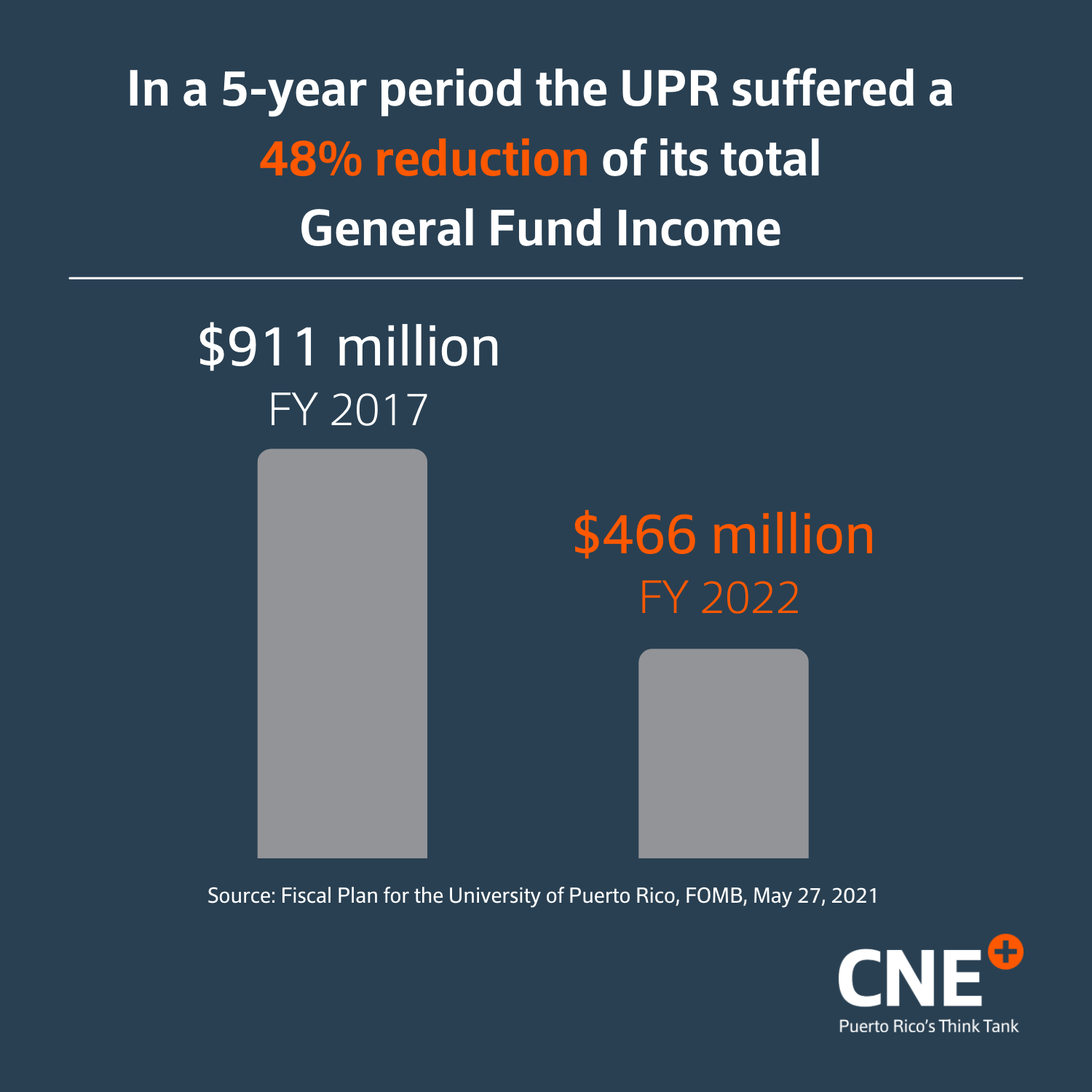
Meanwhile, the FOMB reduced the University of Puerto Rico (UPR) system General Fund Income by 48% in five years from $911 million in 2017 to $466 million in 2022. It is proposing to fix the General Fund Income at $500 million for the next five years. But it does not rule out the possibility of further cuts after 5 years. The FOMB hopes to offset these cuts with increased tuition, reductions in administration, freezing promotions, consolidation, and pension reform.

Not only are these changes impacting the viability of the institution, but also the opportunities for an education. The affordability of our system is one of the critical elements to grow the middle class on the island. Already in Puerto Rico education has become less affordable, even for those with financial aid. The cost of attendance has been increasing in private and public institutions for the last 10 years. Pell Grant no longer covers most costs for low-income students, and those that do not receive a full Pell Grant have a difficult time covering the increasing costs of education on the island.

Click to continue reading about the disparities in public institutions’ public support in the U.S. and Puerto Rico. 

A Master Plan for Higher Education

For the post-secondary educational system to have an impact on growth, it must have a sustainable budget and accompany major investment in infrastructure and housing in Puerto Rico, as is expected by the influx of federal funds. But there are also several reforms that need to take place within the educational system.

The public university system needs to be divorced from the political process. Higher learning in Puerto Rico cannot be tied to election cycles since it affects the institution’s capacity to execute long-term structural change if its leadership is interrupted every four years and there is no internal structure to give continuity to the plan. In addition to a sustainable budget, a governance structure that ensures the educational system’s quality, continuity, and independence is needed.

The UPR, as well as other higher learning institutions in the U.S., are experiencing declines in enrollment, which translates into lower budgets. COVID-19 has worsened the situation as we see by a 60% reduction in enrollment at the University of Puerto Rico, Rio Piedras. But at the same time, only 39% of the adults older than 25 in Puerto Rico have an associate degree or higher and the access to degrees is very unequal. Most Puerto Ricans do not complete postsecondary education, which results in lower productivity and wages.

How do we restructure the system to meet the educational needs of our population?  

By understanding the regional educational needs on the island, paying close attention to issues of equity, and developing plans for post-secondary education informed by research and community dialogue, we can link education to regional recovery to help foster sustainable growth in the island.

But without a fair agreement of the payment of the debt from the FOMB, the future of our children and their children would be foregone. Not only will this impact the island for generations to come, but it will also increase the trauma people are experiencing and the immigration to the United States. At least the diaspora counts with a voice and vote to pressure the U.S. Congress to finally give us the opportunity to prosper.

All of this and more will be discussed at CNE’s Growth Policy Summit on December 3, 2021, in the panel Education as a Driver of Economic Development featuring:

In the News

Click the image above to listen to José Delgado’s latest podcast featuring Miguel A. Soto-Class, CNE’s Founder and President, as they talk about CNE’s work and upcoming annual conference the Growth Policy Summit. Click here to register.

On Our Radar...

Fiscal Rules–Judge Laura Taylor Swain will hold ten days of court hearings this month to determine whether the Commonwealth’s Plan of Adjustment (“POA”) filed by the FOMB can be confirmed pursuant to Title III of PROMESA. The confirmation of a POA would mean the beginning of the end of Puerto Rico’s bankruptcy. As we start to look at a post-bankruptcy world, we think Puerto Rico should consider amending its Constitution to implement real limits on future indebtedness. This paper from the International Monetary Fund provides a useful summary of the kind of fiscal rules that could be implemented in Puerto Rico.

The Disappearance of Newspapers – Newspapers are closing down all over the United States, with dire results for democracy as people increasingly obtain their news from social media and other unreliable sources. By some accounts, more than a quarter of all U.S. newspapers have gone out of business during the last 15 years. This interesting piece in The Atlantic tells the fate of the once-mighty and influential Chicago Tribune, which has been gutted by the hedge fund Alden Global Capital.

Rising Anti-Democratic Opinion–A recent poll from the Public Religion Research Institute “paints a troubling portrait of a growing segment of the public that is increasingly unmoored from reality as it embraces conspiracy theories about child abduction and stolen elections”, according to reporting from The Hill. The survey found that “one in 5 Americans believe in the core tenet of the QAnon conspiracy that ‘there is a storm coming soon,’ while 1 in 6 believe the United States government is controlled by a group of Satan-worshipping pedophiles who run a global child sex-trafficking ring…The same share, 18 percent, say they agree with the statement that America has gotten so far off track that ‘true American patriots may have to resort to violence in order to save our country’”.

Investing in Ourselves: Post-Secondary Education for a Sustainable and Equitable Recovery

Investing in Ourselves: Post-Secondary Education for a Sustainable and Equitable Recovery

Published on November 17, 2021 / Leer en español

Visiting Fellow
DOWNLOAD
SHARE

Introduction

Puerto Rico is at a critical moment to recover from environmental disasters – hurricanes, earthquakes, and the COVID-19 pandemic – as well as a fifteen-year-long recession and fiscal crisis. Billions of federal funds are becoming available to rebuild our infrastructure.

Meanwhile, the Fiscal Oversight and Management Board for Puerto Rico (“FOMB”) given the authority by Congress to develop Fiscal Plans for the island is only interested in the payment of the public debt and for five years has been imposing severe austerity measures and a payment plan that threatens the opportunity of a lifetime to rebuild our island.

How do we build a future with opportunities for young people on the island?  

Already there are shortages of workers for many sectors. A recent report by the U.S. Bureau of Labor Statistics describes a need for some 40,000 workers for Puerto Rico’s reconstruction.[1]  And people continue to leave the island.

Young people need hope for the future and opportunities to prosper, and they are not finding them in Puerto Rico. We need to reconstruct our island by rebuilding our middle class and creating opportunities.

A 21st Century Model of Development for Our Current Realities

The late 20th century Thatcher/Reagan model of economic growth which focused on austerity measures, deregulation, low taxes, privatization, exports, and incentives for foreign investments to advance economic activity is increasingly questioned in light of its impact on poverty, inequality, and climate change. In the case of Puerto Rico, the economic strategy led to declining economic activity, inequality, and extreme poverty.  Today over 40% of the population in the island lives below the poverty line, over three times the U.S.’s rate.[2]

The economic collapse of the development model has resulted in extreme depopulation as people see no hope for the future on the island.  The most recent portrait of our migrants published by the Instituto de Estadisticas de Puerto Rico shows the people leaving the island were younger (31 versus 43 years old median age in the island), in the labor force (61% compared to 45% in the island) and slightly more educated than the average adult 25 and older in Puerto Rico (55% had some college education versus 51%).[3]

We need a model of development for the 21st Century. Covid-19 accelerated structural transformations that were slowly taking place in the global economy – increasing automation and AI[4]; the hybrid business landscape[5], the green economy, and the gig economy[6]. These new technologies require that we invest in education and the expertise required to design and produce “new, highly-profitable goods and services associated with the automation revolution[7].” The Bravo Family Foundation is counting on Puerto Rico as a hub of technological innovation and they are investing in local entrepreneurs[8]. We need trained engineers, programmers, software developers, and business people working on the future of innovation.

Puerto Rico is also innovating in construction using green materials such as recycled cargo containers for housing[9] and experimenting with the use of recycled tires for roads[10] and energy production[11]. Casa Pueblo[12] in Adjuntas and other emerging community efforts are providing examples of community energy projects that could a real alternative in rural communities[13]. We need skilled workers, scientists, and social entrepreneurs to take these experiments to scale.

With a strong post-secondary educational system responding to local recovery plans, we could overhaul our infrastructure and rebuild our middle class, who are truly the engine of growth in any economy.

Growing the Economy from the Middle Out

The idea of growing the middle class to grow our economy is not new. Roosevelt’s New Deal was centered on providing opportunities and work for the people, through government support and investments in infrastructure – roads, schools, public hospitals.

The Biden Administration is battling Congress to take the United States in that direction again with the Infrastructure, the American Families, and the Build-Back-Better Plans. As described by the White House, “The American Families Plan is a once-in-a-generation investment in the foundations of middle-class prosperity – education, health care, and child care”[14]. Not everything in the plan will survive the battles in Congress.  Nevertheless, we can expect a major push to grow the middle class to bring back the U.S. economy.

Puerto Rico’s history is also an example of how education and the expansion of the middle class have been essential for economic growth. Luis Munoz Marin emphasized development and social justice and expanded the middle class in Puerto Rico building our infrastructure and broadening education and health care on the island[15]. Since the 1960s, Puerto Rico had one of the greatest expansions in educational attainment in world history from 4.6 years for adults older than 25 years old to 11 years in 2000. This expansion in educational attainment accounted for as much as half of the increase in the output per worker between 1975 and 2000[16].

Investments in education contribute to the accumulation of human capital and countries that increased educational attainment the most during 1960 to 2000 were the fastest growing[17]. As the skills of the workforce increase, workers become more productive and able to absorb advancements in technology. Education also creates more job opportunities as entrepreneurship, innovation, and consumption increase and diversify. This is the approach taken by a growing number of economies[18]. In East Asia, South Korea, China, Germany, and the United States, among others, increasing educational attainment was a strategy for growth. Finally, education is becoming even more important as the technological and skilled requirements of the labor force increase worldwide. However, investments in education must increase access and ensure a fair distribution of opportunity or the system could exacerbate existing inequalities.

Budget Cuts Are Strangling the Public System

Meanwhile, the FOMB reduced the University of Puerto Rico (UPR) system General Fund Income by 48% in five years from $911 million in 2017 to $466 million in 2022[19] It is proposing to fix the General Fund Income at $500 million for the next five years. But it does not rule out the possibility of further cuts after 5 years. The FOMB hopes to offset these cuts with increased tuition, reductions in administration, freezing promotions, consolidation, and pension reform.

As expressed by Sergio Marxuach, “the FOMB has jumpstarted the most thorough restructuring of the UPR in more than half a century…. These cuts have been a direct hit to the financial viability of the University, have wreaked havoc on the University’s operations, and weakened the institution’s capacity to carry out its social mission…the FOMB has sought short-term fiscal balance over the long-term viability of Puerto Rico’s economy.”

Not only are these changes impacting the viability of the institution, but also the opportunities for an education. The affordability of our system is one of the critical elements to grow the middle class on the island. Average income per capita in Puerto Rico at $21,000 in 2020 is approximately one-third of the U.S. average and about 50% of that of the lowest-ranked state[20].

Already in Puerto Rico education has become less affordable, even for those with financial aid. The cost of attendance has been increasing in private and public institutions for the last 10 years.[21] Pell Grant no longer covers most costs for low-income students, and those that do not receive a full Pell Grant have a difficult time covering the increasing costs of education on the island.[22]

The FOMB argues that Puerto Rican public institutions disproportionately depend on public support, as compared to public higher learning institutions in the mainland. And while it is true that states, in general, have been reducing the support to public post-secondary institutes, the results have been disastrous for students’ success, particularly low-income students, which constitute the majority of Puerto Rico’s student population.  For example, studies of the decline in government support for higher education in California found that it resulted in a reduction in educational opportunities[23].

Dr. Hilda Colon Plumey, expressed in a conference of Excelencia en Educación about higher education in Puerto Rico, that the universities on the island have “been remarkably efficient at overcoming financial challenges posed internally and externally[24].” But we are approaching the point of no return when the outcomes can no longer be sustained.

A Master Plan for Higher Education

For the post-secondary educational system to have an impact on growth, it must have a sustainable budget and accompany major investment in infrastructure and housing in Puerto Rico, as is expected by the influx of federal funds. But there are also several reforms that need to take place within the educational system.

The public university system needs to be divorced from the political process. Higher learning in Puerto Rico cannot be tied to election cycles since it affects the institution’s capacity to execute long-term structural change if its leadership is interrupted every four years and there is no internal structure to give continuity to the plan. In addition to a sustainable budget, a governance structure that ensures the educational system’s quality, continuity, and independence is needed.

The UPR, as well as other higher learning institutions in the U.S., are experiencing declines in enrollment, which translates into lower budgets. COVID-19 has worsened the situation[25] as we see by a 60% reduction in enrolment at the University of Puerto Rico, Rio Piedras[26]. But at the same time, only 39% of the adults older than 25 in Puerto Rico have an associate degree or higher and the access to degrees is very unequal. Most Puerto Ricans do not complete postsecondary education, which results in lower productivity and wages.

How do we restructure the system to meet the educational needs of our population?

By understanding the regional educational needs on the island, paying close attention to issues of equity, and developing plans for post-secondary education informed by research and community dialogue, we can link education to regional recovery to help foster sustainable growth in the island.

But without a fair agreement of the payment of the debt from the FOMB, the future of our children and their children would be foregone. Not only will this impact the island for generations to come, but it will also increase the trauma people are experiencing and the immigration to the United States. At least the diaspora counts with a voice and vote to pressure the U.S. Congress to finally give us the opportunity to prosper.

Endnotes

[1] https://www.elvocero.com/gobierno/agencias/urge-la-contrataci-n-de-40-000-mil-trabajadores-para-las-obras-de-reconstrucci-n/article_c707fdec-314a-11ec-8e60-fbe5c43fe378.html?fbclid=IwAR2CChWNkUkncThVYhooJas7rnv4VWcC8_VsynQQqnm0Y_9rFQj7uBas8n8

[2] https://www.edexcelencia.org/research/publications/higher-education-puerto-rico-conditions-and-context-influencing-institutional and https://www.census.gov/library/publications/2021/demo/p60-273.html

[3] https://estadisticas.pr/files/Publicaciones/PM_2018-2019_1.pdf

[4] https://jia.sipa.columbia.edu/online-articles/job-terminator-automation-artificial-intelligence-and-future-work

[5] https://www.theatlantic.com/sponsored/citi-2018/the-american-economy-is-experiencing-a-paradigm-shift/2008/

[6] https://www.forbes.com/sites/forbescoachescouncil/2020/03/27/why-the-gig-economy-will-drive-the-future-of-employment/?sh=4048c0db4f52

[7] Ibid.

[8] https://www.bravofamilyfoundation.org/rising-entrepreneurs/

[9] https://www.fastcompany.com/90272170/these-houses-are-designed-to-help-puerto-rico-survive-future-storms

[10] https://www.24-7pressrelease.com/press-release/129807/us-company-helps-to-introduce-eco-friendly-paving-into-puerto-rico

[11] https://www.mdpi.com/2071-1050/6/5/3105/htm

[12] https://casapueblo.org/

[13] https://www.queremossolpr.com/

[14] https://www.whitehouse.gov/american-families-plan/

[15] Ibid.

[16] http://www.columbia.edu/~flr9/documents/Ladd_Rivera_Batiz_%20Education_Development.pdf and Bosworth and Collins in the same volume.

[17] Ibid.

[18] https://www.yumpu.com/en/document/read/22012279/education-as-an-engine-of-economic-development-columbia-

[19] https://grupocne.org/2021/08/17/cne-review-agosto-2021/

[20] https://www.edexcelencia.org/Higher-Education-Puerto-Rico-Conditions-Context-Influencing-Institutional-Resilience

[21] Ibid.

[22] Ibid.

[23]  https://www.ppic.org/publication/higher-education-in-california-investing-in-public-higher-education/ and https://www.ppic.org/publication/the-impact-of-budget-cuts-on-californias-community-colleges/, for example.

[24] https://www.edexcelencia.org/research/publications/higher-education-puerto-rico-conditions-and-context-influencing-institutional

[25] https://www.the74million.org/article/lennon-stanton-rising-hs-dropout-rates-declining-community-college-enrollment-are-twin-covid-crises-how-to-fix-the-broken-education-pipeline/

[26] https://www.noticel.com/upr/educacion/ahora/top-stories/20211007/el-estudiantado-de-la-upr-ha-mermado-en-60/