Quo Vadis, Electric System? A Contextual Perspective

Quo Vadis, Electric System? A Contextual Perspective

Published on May 4, 2022 / Leer en español

Director, Madrid Policy Bureau
SHARE

The recent electrical outage in Puerto Rico has again brought to the fore the inordinate delays in modernizing the system, the lack of coordination between public and private entities involved in the task, and the urgent need to reconstruct the electrical grid in the right direction once and for all. To the electrical system’s lack of reliability and the frustrating slowness of the reconstruction process, it is now necessary to add an additional challenge: the instability in the global natural gas markets caused by Russia’s invasion of Ukraine and the uncertainty that now surrounds this energy source.

The planning guidelines driving Puerto Rico’s electric transition anticipate no less than two decades of natural gas in the island’s energy mix; it can thus be expected that the electric bill will continue to be affected by its price swings. It is important to highlight that the price of fossil fuels has already caused the price of electricity in the island to surge from 17¢ Kw/h a 30¢ Kw/h in the past two years.  In this Apuntes desde Madrid I will take a look at what has happened in Europe regarding natural gas in order to reflect on the implications of the new global scenario in the future of Puerto Rico’s electrical system.

At least two more decades tied to natural gas

In January 2022 Puerto Rico produced most of its electricity using fossil fuels (57.8% oil, 25% natural gas), according to the U.S. Energy Information Administration (USEIA). Only 2.2% came from renewable sources produced by large-scale suppliers under contract with PREPA, even though  PR Law 17-2019 establishes a renewable energy generation goal of 40% for 2025 (60% for 2040 and 100% for 2050). It is interesting to note that the capacity of consumers to produce electricity (reflected in net metering statistics) increased from 202,992 MW (20,855 consumers) in 2020 to 315,671 MW (42,199 consumers) in January 2022. This would make distributed generation the third source of electricity in the island.

ELECTRICITY GENERATION (MW) / NET METERING CAPACITY  (MW)
JANUARY 2022
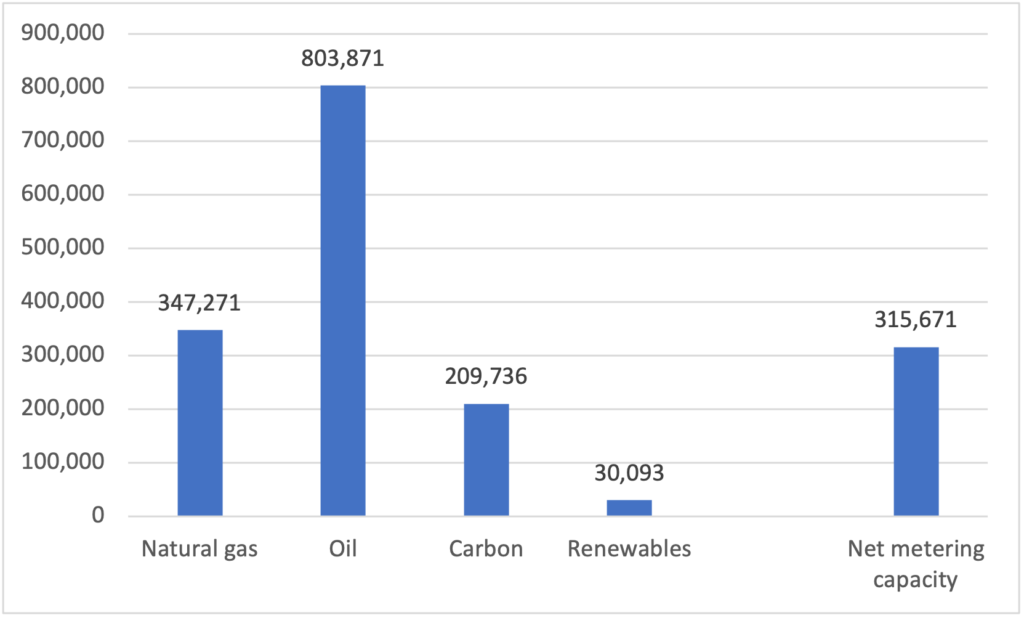
Source U.S. Energy Information Administration, EIA-923 and EIA-861

The future evolution of Puerto Rico’s electrical grid – contained in the Integrated Resource Plan (IRP) that PREPA submitted to the Puerto Rico Energy Bureau (PREB) in June 2019 and the Resolution that the PREB emitted in August 2020 – envisage natural gas as an important part of the island’s electrical infrastructure in the foreseeable future. Oil units will be retired as renewables are integrated into the system during the present decade (several of them do not comply with federal environmental standards) and the system’s transition will be anchored in natural gas. The selected planning scenario (Scenario 3 of the IRP) anticipates a significant penetration of renewable energy by 2038 (90% of installed capacity and 72% of generation) while continuing to rely on natural gas at least until 2040, according to a recent conversation with the PREB. The Bureau says that the transition will be anchored on existing gas facilities, although a new 300MW one could be built if the integration of renewables calendar fails.

This means that natural gas will be an important part of the electric bill in the foreseeable future (the yellow strip in the IRP graph below): consumers in the island will continue to be exposed to the fuel’s volatility in the global markets.

EXPECTED FOSSIL FUEL COSTS
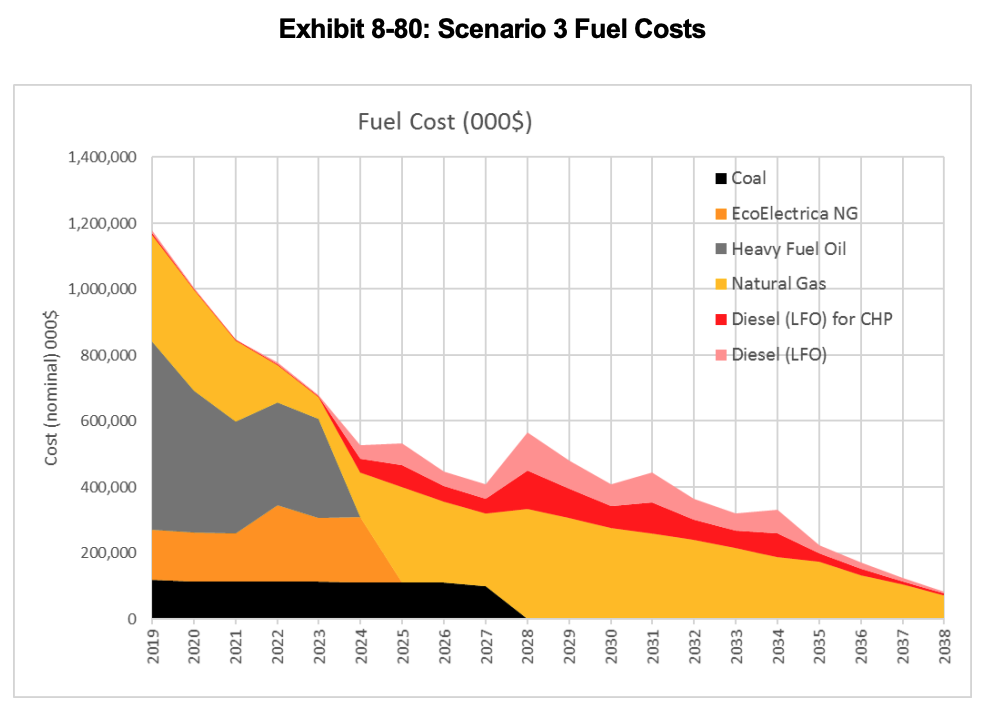
Source: Puerto Rico Integrated Resource Plan 2018-2019

Europe and the “shock” of prices for natural gas

The global spike in the prices of natural gas has been dramatic: in Europe, the juncture has been compared to the 1970s oil crisis (in Puerto Rico we have the remains of the former CORCO refinery as a reminder of the juncture). The signals of the gas crisis started well before Russia’s invasion of Ukraine, at the beginning of 2021, with increased demand due to the rapid post-pandemic economic recovery and a particularly harsh 2020/2021 winter. Geopolitical factors also came into play: during the last quarter of 2021, Russia, the European Union’s principal supplier, reduced by 25% its gas exports to Europe as a way of pressuring Germany to certify the controversial Nord Stream 2 underwater pipeline (the German government had halted approval for security and non-compliance reasons).

EVOLUTION OF THE PRICE OF NATURAL GAS IN EUROPE (DUTCH TTF)
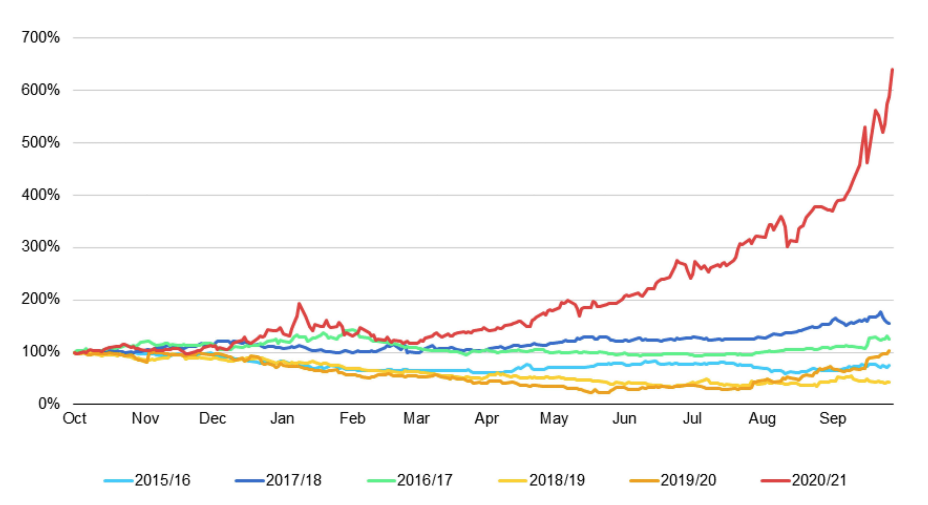
Source: International Energy Agency, Gas Market Report Q4-2021

The marked increase in the price of natural gas provoked in turn a dramatic increase in the price of electricity: in Germany and Spain, for example, prices for the last quarter of 2021 were three and four times those of 2019 and 2020. The European Union  (EU) has a marginalist structure that ties the price of electricity to the costliest source of energy; until now, it served as an incentive for investment in renewables, but it has now provoked an upward spiral in the price of electricity. The upward trend was aggravated by the invasion of Ukraine: in Spain, for example, on March 8 (two weeks after the invasion) residential consumers in the regulated market (those that do not have fixed-rate contracts and pay a daily market price) paid 95 ¢ of euro per kWh during the 7 PM tranche (about $1.03 kWh, more than three times the cost in Puerto Rico).

PRICE OF ELECTRICITY FOR RESIDENTIAL CONSUMERS
WITH NO FIXED RATE CONTRACT, MARCH 8 2022
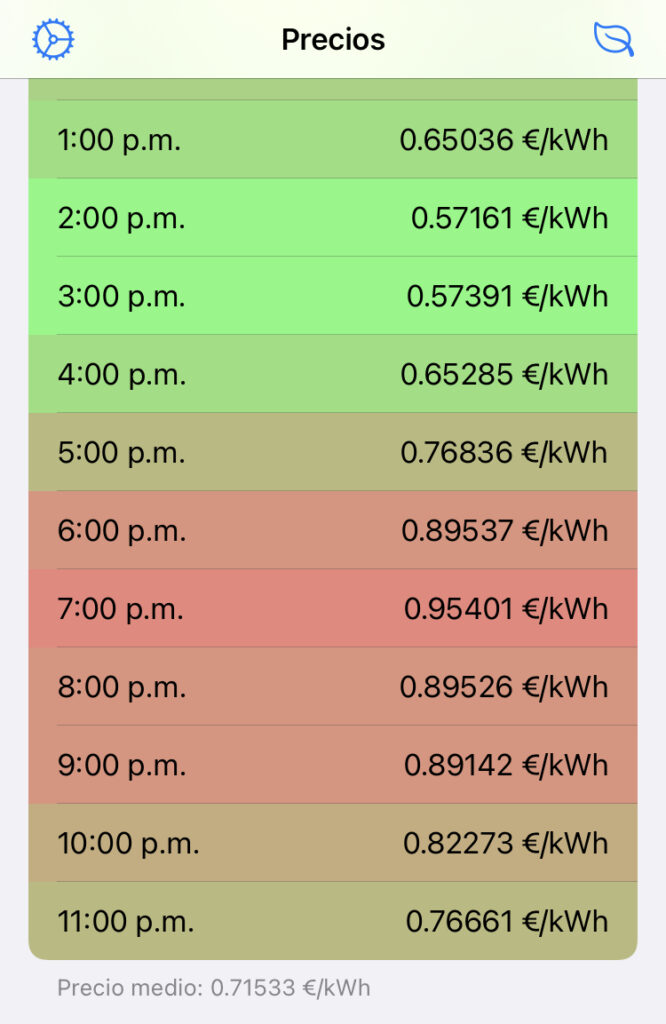
Source: PrecioLuz March 8, 2022

In Spain, the dramatic increase in the price of electricity provoked production stoppages in electro-intensive industries (steel mills, chemical plants), as well as enormous public pressure.  Social tensions have run high, and the fear of destabilization over the price of energy moved the Spanish government to approve a “crash programme” that included decreases in energy taxes (from 21 to 10%) in September of 2021 and, recently, credits and direct assistance to vulnerable businesses and consumers. The fiscal cost of the programme is € 24,000 million (about $ 25,300 million), a significant gap for the Spanish treasury (the spectre of the gilet jaunes, the French “yellow vests” has been all-too present in Spanish decision-making).  Both the International Energy Agency (IEA) and rating agency Fitch anticipate that the prices for natural and liquified gas will continue high for the remainder of 2022; managing the cost of electricity will continue to require significant political maneuvering.

Economic imperatives have intermingled with geopolitical ones aimed at reducing Europe’s dependency on Russian gas. Germany, for example, is considering the possibility of postponing the retirement of its carbon and nuclear plants and has started to build two liquified natural gas (LNG) terminals in order to receive supplies from alternative suppliers. The European Commission (EC) has launched an initiative to ensure gas supplies for the coming 2022 winter and to reduce demand for Russian gas to 1/3 of present demand by the end of the year (events seem to be overtaking the programme, as Russia has unilaterally stopped gas supplies to Poland and Bulgaria). The European Union (EU) has also started to diversify gas suppliers (the United States and Algeria figure prominently in the plan), increase its natural gas storage capacity, and implant block-purchase mechanisms similar to the one used for COVID-vaccine purchases.

Some think tanks such as the French Jacques De Lors understand that these short-term measures are not enough: the issue is not about finding new gas suppliers but about transitioning out from this energy source. The institute recommends accelerating the green transition: fast-forwarding the deployment of renewable sources; renovating buildings in order to reduce thermal needs (in Europe the need is to provide heat in winter; in Puerto Rico, the imperative is to cool interior environments); substituting grey with green hydrogen (hydrogen produced from green sources instead of gas); and excluding natural gas from sustainable finance taxonomies in order to minimize its attractiveness for investors.

Gonzalo Escribano, analyst at Spanish think tank Real Instituto Elcano understands that this new scenario opens the door for Spain to become a protagonist in Europe’s energy transition, particularly in the development and production of new technologies: green hydrogen (produced from renewable sources), marine eolic capacity (which harnesses wind in high seas), bio-combustibles (which is produced from organic residues or natural resources) and concentrated solar energy (which produces electricity from solar light using mirrors or lenses).

The transition to renewables: an expert’s opinion

Diego Rodríguez Rodríguez, professor at Universidad Complutense in Madrid and research associate at Spanish think tank FEDEA, understands that, even though in the short run the urgency to reduce dependency on Russia will slow the elimination of fossil fuels in Europe, the “shock” will actually accelerate the transition to renewable energy both in the medium and in the long-term. “We are in the process of abandoning natural gas”, Rodriguez recently told CNE, “there will be no more deployment of gas networks, except for hydrogen”.  The EU has recently launched RePowerEU, an initiative that will halve the consumption of natural gas by 2030 and that will accelerate the transition to renewable sources of energy. According to this new norm, all new gas infrastructure must eventually be converted to hydrogen.
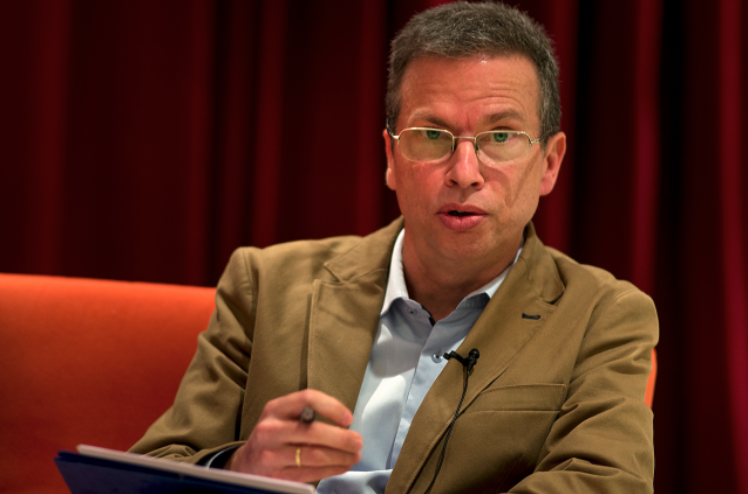
Diego Rodríguez Rodríguez,  Universidad Complutense and FEDEA

Rodríguez understands that the biggest challenges to achieving the transition will be administrative and technical since the funding will be readily available through the NextGen EU program (by contrast, in Puerto Rico, federal funding is geared towards reconstructing the grid, not towards new generation).  First, it will be necessary to break the bureaucratic bottlenecks in environmental assessments, which should be completed in five months instead of two years. Second, it will be necessary to deploy a robust electrical grid to integrate and transport new green generation.  As in Puerto Rico, the Spanish grid is operated by a private company, Red Eléctrica, but planning is made by public entities. Spain has recently approved a roadmap to renovate the Electrical Transport Grid which will entail a € 7,000 million investment (about $ 7,600 million) capable to integrate a new contingent of 37MW of renewable energy throughout the country. By 2026, 67% of electric generation should come from renewables, both land and marine-based (a timeline that is a decade and a half shorter than Puerto Rico’s).

Rodríguez highlights the similarities between Puerto Rico and the Canary Islands archipelago: as islands, both have isolated electrical systems. For both, transitioning the electrical systems towards renewables poses a challenge. Most of the electricity generated in the Canary archipelago is fossil-fuel-based (mainly petroleum) – 91% in Lanzarote, 57% in Tenerife. Several decades back, the Canary Islands discussed converting its electric infrastructure to gas, but the endeavor was abandoned for environmental and cost reasons (a local councilperson said last year that renewables had rendered gas obsolete). Rodriguez says that the archipelago seems to have missed the boat on gas: it will not convert existing petroleum-based plants and will instead use these existing thermal units as “back up” in its transition to renewables (in contrast to Puerto Rico, the islands do not register violations to sulfur dioxide air quality norms since 2011). By 2030 the islands must have reduced fossil-based electricity to 50%.

Renewable-based electricity is being integrated into the grid at an increasing pace, but it is still a small share of the archipelago’s mix, below the Spanish median, (17%, well above Puerto Rico). The islands face the environmental challenge of deploying solar panels and wind towers in landmasses of limited territorial extension (El Hierro, for example, is about half of Culebra). For Rodríguez, new technologies like marine eolic floating platforms (which allow deploying wind structures in deep waters) are the archipelago’s big hope and should be an important part of its energy transition: the first Spanish platform was tested and deployed in the archipelago’s waters.  Spain is planning to deploy fifteen floating eolic parks within the next decade and has earmarked € 200 million (about $ 217 million) for research and development of new marine-based new technologies.  Both Scotland and Holland are also betting heavily on marine eolic technologies.
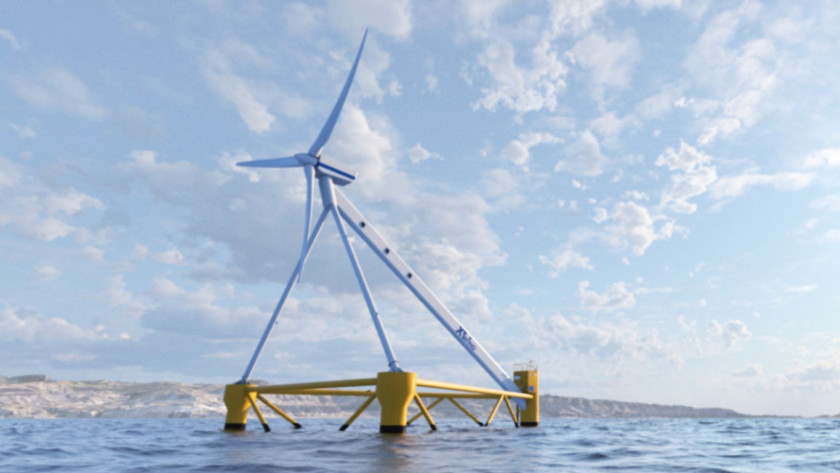
Floating eolic platform

And Puerto Rico?

Should Puerto Rico continue depending on a natural gas infrastructure for several decades, as is contemplated in the current planning? It will all depend, according to the PREB, on the celerity with which renewables are integrated into the system.  The Bureau recently named an independent coordinator to oversee the process, after determining that PREPA “fails to comply with important directives and milestones” and that it “is not capable of executing the renewables Procurement Plan”. The integration of 5,157.82 MW of renewable and storage resources is foreseen between December 2023 and May 2026; the first units to be retired will be oil-fired ones, several of which are in non-compliance with federal environmental standards. Moreover, would it be possible to incorporate locally-based governance, production, and R + D in new technologies?  Without a doubt, the reconstruction of the electric infrastructure opens the door for such an aspiration, but it will be necessary to leave behind outmoded paradigms, address coordination failures between actors, and bestow the process with a true sense of urgency.
Europe and the Russian Invasion: What’s at Stake

Europe and the Russian Invasion: What’s at Stake

Published on March 7, 2022 / Leer en español

Director, Madrid Policy Bureau
SHARE

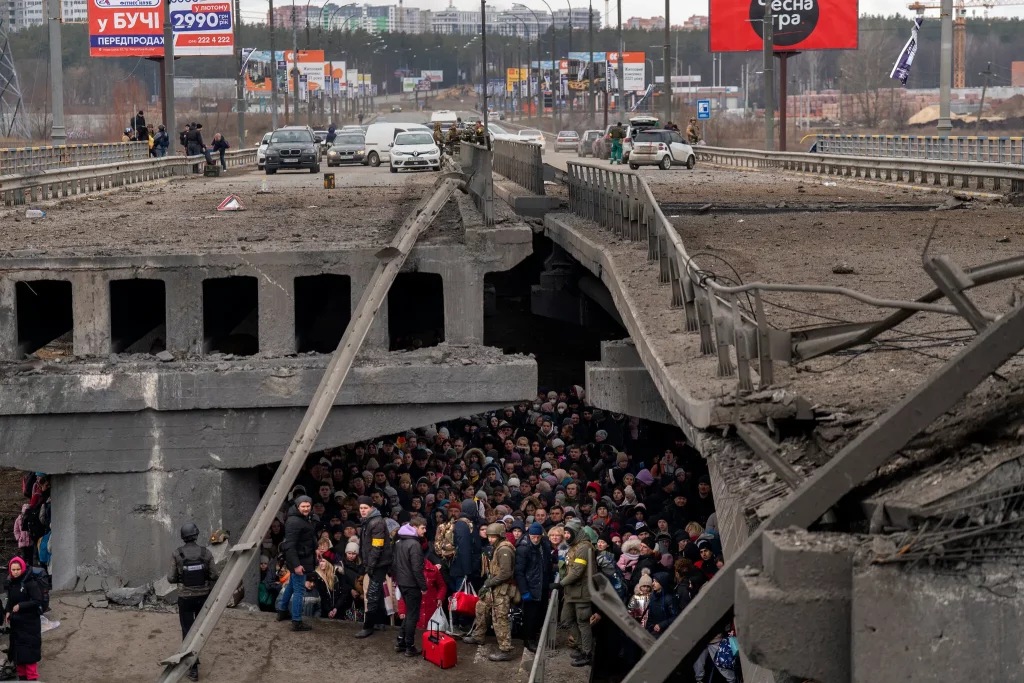
Europe is under siege. Or at least that is how it feels today, as I write this text. I am far away from Kyiv, but war trickles in, through street conversations around me: at lunch, a business man talks about “damn Putin”, while a taxi-driver curses NATO for not defending Ceuta and Melilla, Spain’s territories enclaved in Morocco, with the same sense of urgency. Ukraine is 2,300 miles away, but the effects of the invasion are slowly being felt in Madrid: the meat industry has alerted about a coming shortage of food for livestock, supermarkets have started to ration sunflower oil, and the cost of the kilowatt hour reached today 71¢ of euro (about .77¢ of dollar). If COVID had made life complicated for us, the Russian invasion has tossed into the air the few pieces that remained in our chess board.

In this Apuntes de Madrid  I will try to outline a European perspective about the implications of the conflict in Ukraine. I am aware that events are unfolding rapidly (as I write, the Russian President has threateningly said that economic sanctions seem to be “a declaration of war”). I will attempt, however, to offer context through some of the debates that are being held in European think-tanks and media. Throughout and at the end of the text, I insert links that might be of interest to those that want to continue delving into the topic from this optic.

Emilio-Morenatti/Associated Press

The End of the Post-Cold War Period

For Europe, Russia’s invasion of Ukraine marks a dramatic turning point: the end of what Carnegie Europe analyst Judy Dempsey considers has been a long period of self-deception. It is important to understand that during the last 70 years, European foreign policy has been conditioned by a sort of post-memory anchored on the collective trauma of the Second World War. To a certain extent, Europe as a whole has prioritized humanistic values (democracy, the rule of law, the welfare state) while avoiding the darkest realities of power (the development of a strong military defense component). This has made the European Union (EU) a moral or normative actor in the international arena, but has placed it in what Dutch philosopher and historian Luuk van Middelar considers is a psycho-political limbo, an ahistoric space devoid of real context.

For many decades, the EU and its member states banked on a policy of détente or distension with Russia through its so-called “soft power”, building economic and cultural ties while avoiding an escalation of potential conflicts. Ralf Fücks, from the Center for Liberal Modernity in Berlin, argues that this relationship has a strong emotional component: a mix of guilt (because of the Nazi invasion of Russia), fear (because of the Soviet occupation of the eastern part of Europe and the Cold War), and cultural admiration.

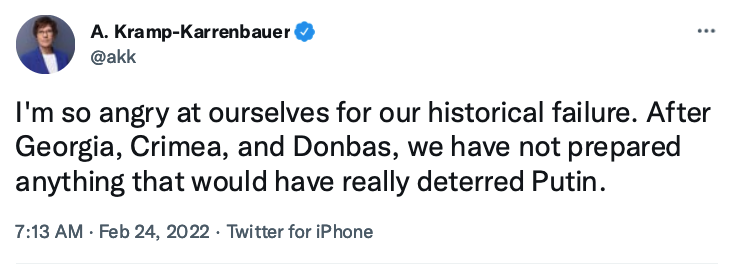
This is why, argues Fücks, in 2008 NATO (at the insistence of France and Germany) denied Ukraine and Georgia’s immediate admission into the alliance (“we should not push the Russians into a corner”); and that in 2014 the European response to the Russian annexation of Crimea was a rather limited one (freeze on certain assets, prohibition on certain imports from the region). John Lough, author of Germany’s Russia Problem: The Struggle for Balance in Europe, says that this also made Europe misinterpret or ignore the increasingly authoritarian and belligerent turn of its Russian neighbor.  “I am so angry at ourselves for our historical failure”, said on social media Annegret Kramp-Karrenbauer, Former Minister of Defense of Germany. Until the very last minute, the EU thought that the politics of appeasement and the economic ties – Europe was until the invasion Russia’s main commercial partner and represented 37.3% of its external trade – would function as deterrents for armed escalation and would pave the way for diplomacy and mediation.

The stupor and concern that is currently felt in European capitals cannot be stressed enough. Richard Roberts, editor of the French publication Telos, has said that the Russian invasion of Ukraine implies a return to the Soviet doctrine that culminated in the crushing of the 1968 Prague Spring: a doctrine based in the limited sovereignty of those that share territorial borders with Russia. German Chancellor Olaf Scholz has been more categorical: he has said that the invasion shatters the European security system that was forged by the Helsinki Accords after the Second World War.  And the Real Instituto Elcano, one of the main Spanish think tanks, has argued that the Russian aggression demolishes the current international order – based in the cooperation among states and the respect for rules – and substitutes it for one based on the imposition of the will of the strongest.

The conflict in Ukraine, then, constitutes a tectonic upheaval for the European Post-War worldview, a defining moment of change. This explains the EU’s determination to finance € 500 million in military armament to Ukraine (a “Hamiltonian” decision because of its centralizing effect, has said El País), the first time that the UE finances arms for a nation under attack. It also explains Germany’s momentous decision to rearm itself and to abandon its historical policy, forged at the end of the Second World War, of not sending armament to conflict zones. Ukraine seems to have become a sort of Rubicon that has pushed Europe into what Politico Europe calls a Zeitenwende, a historical turning point.

The Debate over Europe’s Strategic Sovereignty

The crisis has brought to the fore in European institutions the debate over “strategic sovereignty”, introduced in 2017 by French President Emmanuel Macron (current President of the European Council, which gathers the EU’s elected leaders). The notion propounds a “united and sovereign” Europe capable of acting according to its own interests “on the other side of the Atlantic or on the edges of Asia”. This means having an independent defense capability (in coordination but not limited or subordinated to NATO), the ability to compete economically with China and the USA, the capacity for digital innovation, a harmonized fiscal system, a common migratory policy, robust food security and convergence in social welfare policies.  This doctrine has already started to crystalize in Europe’s foreign trade: while the USA is waging a trade war with China, the Asiatic country is currently the main source of imports for Europe (22.4% vs. 11% from the USA) and the third partner for European exports (the USA leads with 18.4% vs. China’s 10.2%). As a matter of fact, China’s medical protection equipment was crucial for the successful management of the COVID pandemic in Europe, after the USA vetoed exports during the initial moments of the pandemic.

The Russian invasion of Ukraine has given the defensive aspect of this doctrine of strategic sovereignty a special sense of urgency. Josep Borell, High Representative for Foreign Affairs and Security Policy for the UE, has said the crisis has prompted “the birth of the geopolitical Europe”. Since last November 2021, Borell had alerted that “Europe is in danger”, but his words fell flat in the midst of post-pandemic fatigue. His Strategic Compass for the UE – approved in May 2021 by the European Council and about to be discussed by the defense ministers of the EU’s member states – proposes the creation of a 5,000-strong rapid-response UE military force, as well as the development of UE ground, air, sea, space and ciber military capabilities. The question remains if the UE (notorious for its bureaucratic slowness) will be able to act with the celerity and forcefulness with which events are unfolding in the East; and if the European citizenry will trust the UE as much as it has trusted NATO for its defensive security. At the moment, the UE’s defensive system depends on the individual capacity of member states and NATO. NATO, for its part, will hold sometime soon a strategic meeting that will be framed by the scars that the Trump era left in the alliance and the seemingly divergent interests of the allies (Europe is focused on Russia, the USA on China).

Uncertainty and the Costs for Europe

The sanctions will not only harm Russia, but will have economic costs for Europe as well. At a minimum, the Spanish think tank Funcas is anticipating a significant increase in the price of energy, greater inflationary pressures, an erosion of consumer spending capacity, disruptions in export markets and an erosion in investor confidence.  The impact will be uneven and may function like a house of cards: Germany is more dependent on natural gas and oil imports from Russia while Spain has a strong component of Russian tourism but depends on Germany for a significant amount of its exports. This uncertain panorama has led Nadia Calviño, Spanish Minister for Economic Affairs, to warn that the war threatens European post-pandemic recovery, propelled by the € 807 billion UE Recovery Plan.

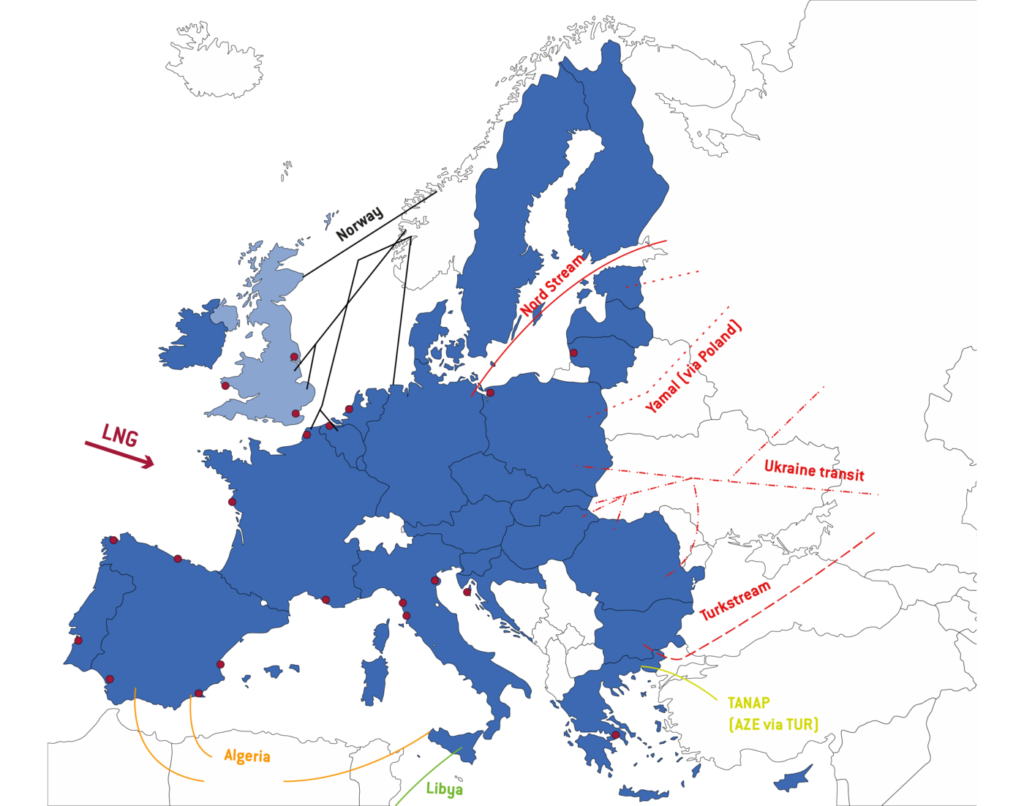
Main routes of natural gas imports into Europe. Source: Bruegel.

Energy is the most urgent and critical topic: Russia supplies the EU with 41% of its natural gas imports and 27% of its oil.  The EU knows that this energy dependency on Russia is the Achilles’ Heel of its package of economic sanctions: Luis Garicano, economist and member of the European Parliament, has argued that Russia’s expulsion of the financial transaction system SWIFT will only be partially effective as long as Europe continues to import Russian fuels to the tune of € 1 billion a day.

The transition away from Europe’s dependency on Russian fuel, however, will not be painless: before the invasion, Belgian think tank Bruegel had estimated that an abrupt cut in Russian energy supplies would force a decrease of 10 to 15% in energy demand in Europe, more if weather conditions were unfavorable.

Sources of natural gas imports by country. Source: Bruegel.

The International Energy Agency (IEA) has prepared a dossier with measures through which the EU can diminish its dependency from Russian fuels: search for alternative sources (the gas pipeline that runs through Spain could be key in increasing gas imports from North Africa to Europe), an increase in storage capacity to neutralize seasonal fluctuations in energy demand, maximizing other energy sources (renewables, bioenergy, nuclear), and increasing energy efficiency programs. These measures, however, would only achieve a reduction equivalent to 1/3 of annual fuel imports from Russia. The crisis, on the other hand, might bring unexpected silver linings (at a very high cost, though): a reform of the marginalist pricing system of European electrical markets (advocated by Spain since last year’s increases in the price of electricity) and the acceleration of the transition to renewable sources of energy.

Finally, the human cost: the High Commissioner for Refugees of the United Nations estimates that the number of displaced people by the conflict in Ukraine could be as high as 4 million, the largest exodus registered in the continent since the Second World War. More than a million and a half refugees have already crossed the border into the EU, half of them into Poland. Europe had virtually closed itself to refugees since the Syrian crisis of 2015 (in the past years, the dramatic influx of illegal migrants sailing from North Africa has overflowed Spain’s and Italy’s capacity to manage it) but the EU has announced that it will offer temporary protection (residency for 3 years) to those displaced by the conflict in Ukraine. €500 billion has also been budgeted by the EU to manage the human inflow. This change in policy (as dramatic as the turn towards rearmament) has provoked calls for consistency among intellectuals such as the Slovene Slavoj Žižek (in the days following Žižek’s plea, a North African migrant being beaten by Spanish police after jumping the border fence in Melilla has made headlines).

What will be the social and political implications of this tsunami for the EU’s member countries? Will it create more cohesion? Or more polarization? A survey by the European Council for Foreign Relations made in 7 EU countries shortly before the invasion found that a majority of citizens supported Ukraine’s defense through NATO or the EU; support was significantly lower if the defense had to be made by their own country.  How will this same citizenry react if the conflict escalates and becomes a prolonged one is still to be seen. Chatham House, an English think tank, found that economic disruptions and immigration flows – elements present in this juncture – are two types of shocks that function as social destabilizers, triggers for both Left and Right populist protest movements. The new era, indeed, is emerging as a quite complicated one for Europe.

Know more:

CNE Madrid Bureau: On Our Radar in 2022

CNE Madrid Bureau: On Our Radar in 2022

Published on January 18, 2022 / Leer en español

Director, Madrid Policy Bureau
SHARE

The beginning of a new year is always a good moment to pause for reflection, so we will take this opportunity to outline some of the global discussions that we will be following closely from Spain and that may shed light on key issues for Puerto Rico during this coming year.

The Price of Electricity and the Structure of the Electric System

Price increases in the electric bill are not exclusive to Puerto Rico. This year, Spain broke a disastrous record when the price of electricity reached a historic high: in December we paid over 50c euro per kw/hour in some time slots. This has ignited an important debate on fundamental aspects of the electric system:

  • The risks of continuing to rely on natural gas – in Europe, the price of natural gas increased six-fold during 2020. While renewables account for more than half of Spain’s electric generation capacity, in recent years the country has paradoxically increased its consumption of natural gas for electricity generation as it has moved to replace coal-fired generation with natural gas. The dramatic increase in the price of natural gas has led Spain to accelerate the transition to renewable energy sources: the country will devote 40% of its allocated European post-pandemic recovery funds to implement the so-called green or ecological transition. This process will undoubtedly provide lessons for Puerto Rico and for the reconstruction/transformation of the island’s energy system.
  • The costs of the transition to renewables – Over the past few years, the cost of electricity produced from renewable energy sources has become dramatically lower worldwide: it is increasingly cheaper than that from fossil fuels (see the report from the International Renewable Energy Agency here). However, the process is not devoid of short- and medium-term costs; in Europe there are ongoing discussions – with no consensus so far – on how to minimize their impact.  The carbon emissions tax – implemented in 19 European countries as a way to incentivize the decarbonization of their economies – was responsible for half of the increase in the price of electricity in Spain during 2021, according to a report by the Bank of Spain. Similarly, the country has yet to make significant investments in energy storage capacity. This has opened a debate on how to minimize the social costs of the energy transition, particularly among the most vulnerable consumers and industry sectors, something that could have important lessons for the island.

Public Spending and Fiscal Rules

In 2016, CNE proposed the adoption of local fiscal rules as an alternative to the imposition of a fiscal control board. Now that the debt restructuring process is coming to an end and the issue of fiscal responsibility will come back into focus, the ongoing debate in Europe could inform the discussion in the island.

Fiscal rules have been one of the mainstays of the European Union’s (EU) fiscal governance system. With the onset of the pandemic in 2020, however, the EU put fiscal rules on hold. The hiatus has served to intensify calls – led by France and Italy – to modify the system so that fiscal discipline, public spending regulation and debt control do not become straitjackets. Among the proposals are: simplifying the rules; strengthening the institutions in charge of compliance; making the fiscal space more flexible to allow for long-term structural investments; and ensuring its counter-cyclical use, creating margins during the peaks of the economic cycle in order to generate buffers for periods of deceleration.

For Spain – like for Puerto Rico – the way in which the rules are structured and the fiscal space they provide is crucial. Since the 2008 crisis, the country has been dealing with a reduction in the public capital stock that, according to the Economic and Social Council, must be remedied with increases in public investment in both infrastructure and the knowledge pool. At the same time, the expenses related to the protection of businesses and workers during the pandemic caused a significant increase in public debt (to 122% of Gross Domestic Product/GDP), which would require an extraordinary fiscal reduction effort if Europe were to enforce the current fiscal rules once again; these allow a debt level of only 60% of GDP.

Reconstruction and Transformation Programs

Spain – like Puerto Rico – is set to receive a massive influx of European post-pandemic reconstruction funds: €60 billion in non-refundable transfer payments to boost the country’s ecological and digital transformation.  During the year ahead, many of the questions that have been raised in the Spanish context and are relevant to Puerto Rico will be elucidated: does the country have the capacity to absorb an influx of funds of such a magnitude ? Will the strategic projects outlined by the government succeed in correcting the economy’s structural deficiencies?

Last December, during the CNE Growth Policy Summit 2021, we discussed this incipient debate with Ángel de la Fuente, Executive Director of Spanish think-tank FEDEA.  De la Fuente outlined some initial lessons that Puerto Rico can draw from Spain and the country’s efforts to transform its economy. These include: transitioning away from activities that have lost competitiveness; taking advantage of the new opportunities offered by a changing environment; and outlining plans in conjunction with social actors.

Click on the following image to hear Ángel de la Fuente
(video in Spanish)