Connecting the Dots of the Puerto Rico Electric Power System

Connecting the Dots of the Puerto Rico Electric Power System

Published on October 9, 2024 / Leer en español

Sergio portrait
Policy Director
DOWNLOAD
SHARE

Introduction

The performance of Puerto Rico’s electric power system has been deficient for many years now. For decades, the electric service provided by the Puerto Rico Electric Power Authority (“PREPA”) was inefficient, unreliable, and expensive, due to serial mismanagement, chronic corruption, rampant partisan politics, and the deferral of required maintenance and capital expenditures. The poor performance of the electric system intensified after PREPA’s bankruptcy and the widespread damage inflicted on the transmission and distribution network by Hurricane Maria, both in 2017.

During the last seven years the government of Puerto Rico has undertaken a massive effort to rebuild and modernize the system; privatize the operation and management of both the transmission and distribution grid and PREPA’s legacy generation assets; begin the twenty-five-year transition to generate 100% of the island’s electricity from renewable sources; and restructure PREPA’s financial obligations. Yet during the summer of 2024, most of these efforts to transform the electric power system appear to have been derailed, as the island was hit by rolling blackouts in the middle of one of the hottest summers in recent memory. Indeed, progress has slowed down almost to a standstill in some areas and, perhaps more worrisome, the government appears to be unable to discern a way to get out of the current quagmire.

Part of the problem is due to the sheer number of actors that have jurisdiction over at least one area of Puerto Rico’s energy system. As shown below, and in further detail in this webpage, we have identified at least 14 entities at the federal and state government levels and from the private sector that have some influence or control over at least a part of the transformation process. The coordination and synchronization of work efforts among and between these entities has proven difficult and continues to be a challenge, even seven years after PREPA’s bankruptcy and Hurricane Maria.

Another factor that has contributed to the slowdown of the system’s transformation is that such transformation consists in reality of several, complex, in many cases multi-billion dollar projects, each with many moving parts and which, in many cases, partially interlock and overlap with the others.

Short-Term Stabilization

First on this complicated agenda is the current effort to stabilize the system in the short term. As the U.S. Department of Energy (“DOE”), and others, have noted, Puerto Rico’s electric system is functional but fragile. On the generation side, Genera PR states that on any given day as much as 57% of the island’s generation capacity could be unavailable due to either forced outages (many due to time use limitations for lack of compliance with environmental rules and regulations) or for scheduled maintenance. In fact, in its PR100 Final Report, the DOE found that “additional generation capacity is needed immediately—on the scale of hundreds of megawatts—to achieve system adequacy and minimize outages.” (PR 100 Final Report, p. xxxvi). On the transmission and distribution side, it is well known that a lot of work remains to be done and that there are significant deficiencies in the lower-voltage (38kv) transmission network and with voltage control in some geographic areas, among other critical issues.

Stabilizing the system is the number one priority in the short term because, as things stand today, a cascading power system failure cannot be ruled out in the immediate future. Just to be clear, we are not saying that such a failure will occur but rather that it cannot be ruled out at this time. Therefore, all efforts should be directed at eliminating or least minimizing that catastrophic risk in the short term.

Permanent Work to Rebuild the System

At the same time that LUMA, Genera, and PREPA are working on stabilizing the system, projects to execute the permanent work to rebuild the damage caused by Hurricane Maria have been funded by FEMA (that is, FEMA has obligated funds for their execution) and according to COR3, at least 352 energy-related reconstruction projects are in some stage of execution. However, according to data provided by Mr. Manuel Laboy, Executive Director of COR3, at a public hearing of the U.S. House of Representatives Committee on Natural Resources, while a total of $16.299 billion has been allocated for permanent system reconstruction, FEMA had “obligated” only $4.834 billion, or 29%, and of that amount only about $1.272 billion, or 26%, had been disbursed (spent) as of mid-September 2024. In other words, seven years after Hurricane Maria, only 7.8% of the total funds allocated for the reconstruction of the electric system have been spent.

Source: Mr. Manuel Laboy Testimony before the U.S. House Committee on Natural Resources, September 26, 2024

The situation is even worse with respect to the $1.9 billion allocated by Congress to HUD’s CDBG-DR program for use in the reconstruction of the transmission and distribution system. According to recent press reports less than 1% of those funds have been spent.

To be fair, nobody expected this process to be finished in one or two years. However, according to most experts who have analyzed the execution of the reconstruction of the system, progress seems to have taken place at an unduly slow pace. We remind readers that this is due to several factors such as unduly burdensome bureaucratic requirements imposed on Puerto Rico by the Trump administration; FEMA’s decision to use an unproven process under section 428 of the Stafford Act to identify and approve funding for reconstruction projects; and the lack of coordination among and between federal and Puerto Rico government agencies, among other factors.

It is estimated that completing the permanent work to reconstruct the grid according to industry standards will take between 8 to 10 years and cost approximately $21 billion. We note that according to the DOE, only $15.4 billion of the $21 billion required have been identified as of March 2024 (PR100 Final Report, p. 408). That $15.4 billion amount includes spending for generation, transmission, and distribution system repairs and replacements, as well as on the Tranche 1 transmission network upgrades required to connect the first group of utility-scale renewable generation providers. The source of financing for the difference of approximately $6 billion is unknown as of the date of this document.

Transition to 100% Renewable Generation

The Puerto Rico Energy Public Policy Act of 2019 (“Act 17 of 2019”) requires that Puerto Rico meet 100% of its electricity needs with renewable energy by 2050. In order to reach that objective, Act 17 set the interim goals of 40% renewable generation by 2025; 60% renewable generation by 2040; the phaseout of coal-fired generation by 2028; and a 30% increase in energy efficiency by 2040.

By mid-2023, notwithstanding a significant increase in distributed solar PV generation (as opposed to utility-scale solar), only approximately 4% of the generation capacity available for the grid was from renewable sources. Furthermore, “achieving the 40% target by 2025 would represent an increase of at least 3 GW of additional renewable energy capacity if met with utility-scale solar” (PR100 Summary, p.1). According to the DOE, “deployment of renewables at a rate to achieve the 40% RPS goal would require a rapid rate of procurement of over 100 MW per month through 2025 from a level of minimal utility-scale build-out in recent years.” (PR 100 Final report, p. 229) This means that Puerto Rico is significantly behind schedule to meet the interim target of 40% renewable generation by 2025 and it is highly likely that Puerto Rico will miss this target.

Achieving this ambitious goal will require significant new investment to expand the transmission system; upgrade the distribution system; and replace all fossil fuel generation capacity with renewable generation during the next 25 years.

Transmission System Expansion to Integrate Renewable Generation

In terms of the transmission system, the interconnection of new renewable resources will require the construction of new tie lines to the bulk power system in Puerto Rico. The DOE assumed different entities would be responsible for funding those costs:

  1. As stated above, the Tranche 1 transmission network upgrade will be paid for with federal funds.
  2. For subsequent tranches “transmission costs were assumed to be financed by third-party renewable development sponsors and thus included in power purchase and operating agreements (PPOAs) until 2028.”
  3. Finally, commencing in 2028 PREPA “was assumed to be in a position to finance these investments due to its exit from bankruptcy and ability to access capital markets.” (PR100 Final Report, p. 408)

This means that private financing will have to be secured either via PPOAs or debt to be issued by PREPA. In both instances, these costs would be passed on to end customers through their bills. We also note that there is significant uncertainty regarding PREPA’s ability to issue new debt in the short to medium term. Right now PREPA does not have access to the capital markets as it is still undergoing a bankruptcy process. Given that situation, the DOE assumes PREPA will exit bankruptcy in 2024 and will have access to the capital markets by 2028 and, thus, the ability to finance upgrades to the transmission and distribution system going forward from 2028.

In our view, this assumption could be overly optimistic for several reasons. First, it is by no means clear that PREPA will exit bankruptcy in 2024. Even if a Plan of Adjustment of PREPA’s debt is certified by the Federal Court this year, several creditors have already indicated they will appeal such certification, potentially adding several years of litigation to this process.

Second, a restructured PREPA probably will be limited in its ability to issue new debt until the bonds issued as part of the current restructuring are paid in full. We don’t know yet what legal and financial conditions PREPA will have to satisfy (in the form of financial covenants limiting new debt issuance and/or legal or structural subordination requirements) in order to issue new debt after 2028. Finally, any announcement regarding the issuance of new debt by PREPA will probably face significant backlash from customers and other stakeholders who remember waste and mismanagement at the old PREPA.

Distribution System Upgrades

With respect to the upgrades to the distribution system, the DOE has stated that as new distributed energy resources (“DERs”) and electric vehicles (“EVs”) are deployed it will become necessary to upgrade parts of the distribution system. The DOE estimates there will be excess capacity and energy that cannot be integrated into the distribution system starting in 2037. For each scenario analyzed by the DOE, it assumed that these integration challenges would be mitigated by increasing the amount of bulk storage (batteries) on an incremental basis as renewable capacity expanded. This investment in incremental storage, which is expensive, was assumed to be procured via PPOAs. (PR100 Final Report, p. 409) This means that these costs will eventually be passed on to end customers through their bills.

Renewable Generation Capacity

Finally, with respect to new generation capacity, utility-scale generation as well as bulk storage resources are expected to be procured via PPOAs. (PR100 Final Report, p. 416) With respect to rooftop systems, the DOE “did not assume how those systems would be paid for or whether any public or federal funds would be allocated to pay for them.” (PR100 Final Report, p. 185)

Furthermore, we note that the DOE did not “examine any futures in which there is no central grid,” even under the scenario that assumes the maximum adoption of DERs. (PR100 Final Report, p. 184) This means that in the world analyzed by the PR100 Study, there will always be fixed and variable costs that will have to be paid or financed by all ratepayers in connection with the operation, maintenance, and future upgrading of a central grid.

This last point is important in the context of deciding how much to compensate net metering customers for the electricity they export to the system. While it may be true that the massive adoption of solar rooftop systems would probably generate significant positive non-cash externalities due to the reduction of fossil fuel emissions, the fact remains that LUMA would have to incur cash expenditures to maintain and operate the grid. Those costs should be allocated reasonably and fairly among all parties connected to the grid.

Rooftop Solar and Utility-Scale Solar Generation

The points regarding rooftop solar systems and the viability of a fully decentralized grid are important because some environmental groups in Puerto Rico have advocated for executing the transition to 100% renewable generation using only rooftop solar systems with no central grid, essentially creating an island-wide network of independently-owned and managed mini-grids. Adopting that model could increase the risks of inducing delays and increasing the cost of the transition to 100% renewable power for at least two reasons.

First, according to Bent Flyvbjerg, Oxford University professor and author of How Big Things Get Done (Macmillan Business, 2023), using proven, reliable off-the-shelf technology is one of the keys to executing big infrastructure projects on time and within budget. Newer unproven technology is not necessarily better. As far as we know, no jurisdiction with Puerto Rico’s population and industrial footprint has successfully accomplished a transition to 100% renewable power generation installing only rooftop solar systems on a decentralized grid (basically a grid made up of many mini-grids). Attempting to do so in Puerto Rico would increase the risk of execution failure significantly, as both delays and costs would probably increase over time and unexpected or unforeseen events occur along the way.

Second, according to Professor Flyvbjerg, modularity is another key to successfully executing large-scale infrastructure projects. Modularity, says Flyvbjerg, “is a clunky word for the elegant idea of big things made from small things. A block of Lego is a small thing, but by assembling more than nine thousand of them, you can build a scale model of the Colosseum in Rome. That’s modularity.” (How Big Things Get Done, p. 162) Modularity allows projects to get to scale fast, getting better, bigger, and cheaper as they do. It also enables experimentation. If something works, you keep it in the plan. If it doesn’t you “fail fast” and adjust the plan. You get smarter, designs improve. It also radically reduces execution risk. (How Big Things Get Done, p. 163 and 187)

The idea, then, is to start with “a small thing, a basic building block. Combine it with another and another until you have what you need. That’s how a single solar cell becomes a solar panel, which becomes a solar array, which becomes a megawatt solar farm.” (How Big Things Get Done, p. 157)

In this context, the idea of building out 700,000 rooftop solar systems to achieve the goal of 100% renewable generation is the opposite of modularity, as each rooftop system has to be custom-designed and built for each roof. Getting to scale will take longer, cost more, and eventually be subject to greater execution risk relative to using a modular approach.

To be clear, we are not advocating for the elimination of rooftop solar systems from the portfolio of technologies to achieve the 100% goal. Rather, we are arguing for finding the right balance between rooftop solar systems and large utility-scale solar generation as Puerto Rico transitions to 100% renewable generation. In this respect, we note that the rollout of large-scale solar projects is currently about two (close to three) years behind schedule. This delay in turn impacts the decommissioning of the PREPA legacy fossil fuel generation as large units cannot be taken offline until their replacement is ready.

Financial Restructuring

In July 2017, at the request of the Government of Puerto Rico, the Oversight Board filed a voluntary petition on behalf of PREPA for protection under Title III of PROMESA with the U.S. District Court. PREPA owes about $9 billion in outstanding bonds, has an unfunded pension liability of $3.8 billion, owes an additional $700 million to fuel line lenders, and several million more to many unsecured creditors.

According to the PREPA 2023 Fiscal Plan, “without restructuring its debt and other liabilities, PREPA would need to repay approximately $2.62 billion of scheduled legacy debt obligations over four years from FY2024 to FY2027 in addition to the roughly $4.83 billion of unpaid past and currently due amounts through the end of FY2023.” (PREPA 2023 Fiscal Plan, p. 140) Bringing PREPA’s unrestructured debt obligations to funded status in the near term would require rate increases of approximately 6 to 7 ¢/kWh in real dollars in the FY24- 27 period.

In the longer term, without any restructuring, PREPA’s estimated annual debt service obligation is approximately $1 billion per year based on amortization of all long-term financial liabilities at a 5.25% interest rate over 20 years.” (PREPA 2023 Fiscal Plan, p. 140) Under that scenario, the average residential customer who consumes 425 kWh per month would see its bill increase by approximately 26%.

In June 2023, the judge presiding over the proceedings determined that (1) bondholders had a lien only on certain PREPA revenues that had been deposited in debt service accounts and (2) there were significant risks associated with other remedies they may seek (for example, the appointment of a receiver). Therefore, she reduced the amount of their claim to $2.38 billion. About 25% of their original claim.

As expected a group of bondholders and other creditors appealed to the U.S. Court of Appeals for the First Circuit in Boston. The Court issued its opinion on June 12, 2024, and held that:

  1. Bondholders have a non-recourse claim on PREPA’s estate for the full principal [face] amount of the bonds, plus matured interest; and
  2. This claim is secured by PREPA’s Net Revenues — as that term is defined by the underlying bond agreement — and by liens on certain funds created by that bond agreement.

The Court did not decide what effect, if any, confirmation of a plan of reorganization will have on the bondholders’ security interest, nor did it attempt to estimate the economic value of that security interest.

Thus, the value of the bondholders’ claim is $8.5 billion plus matured interest. However, the Court went on to state that “this is NOT to say that the Bondholders must be paid $8.5 billion.” “Rather, it is to say that the Bondholders’ allowed claim on PREPA’s estate is in the order of $8.5 billion.” (FOMB v. Cortland Capital, p. 58)

The Court was quite clear that the Bondholders’ claim is secured only to the extent of the value of the Bondholders’ interest in the Net Revenues and the Sinking and Subordinate Funds. They own “Special Revenue Bonds.” This means that when a default occurs the Bondholders have NO claim (recourse) against the municipality’s [Puerto Rico’s] general fund or other non-pledged revenues or assets of the debtor (Section 927 Bankruptcy Code). Thus, if the value of Bondholders’ liens is less than the allowed claim amount, then the Bondholders are undersecured and they assume the risk that the revenues will not be enough to pay the bonds. (FOMB v. Cortland Capital p. 61)

Paying PREPA Bondholders with Money from the General Fund is a Bad Idea

This last point is why the proposal to pay off bondholders using funds from Puerto Rico’s general fund is a bad idea for at least two reasons. First, under that scenario, Bondholders would be paid using funds to which they have no right either under the bond offering documents or Section 927 of the U.S. Bankruptcy Code, which was incorporated by reference into PROMESA through Section 301(a) of that law. Second, such payment would set a dangerous precedent that could be used by other public utility creditors to demand repayment by claiming funds to which they do not have legal rights or recourse.

Operational Restructuring — LUMA

On June 22, 2020, PREPA and the Puerto Rico Public-Private Partnerships Authority (the “P3A” or “Administrator”) entered into an agreement for the Operation and Maintenance (“O&M” Agreement”) of PREPA’s Transmission and Distribution System (“T&D System”) with LUMA Energy, LLC, (“ManagementCo”) and LUMA Energy Servco, LLC (“ServCo”, and together with ManagementCo, the “Operator”).

Pursuant to the terms and conditions of the O&M Agreement, LUMA, among other things, is responsible for all electric transmission, distribution, load serving, and related activities for the safe and reliable operation and maintenance of the T&D system. These include system operator activities, engineering activities, maintenance of technical documentation, energy efficiency activities, planning, environmental and regulatory, legal services, and managing insurance and claims.

In exchange for providing those services, LUMA is entitled to receive certain compensation, depending on the execution phase of the O&M Agreement, as set forth in the chart below:

Source: FOMB, PREPA Certified Fiscal Plan for Fiscal Year 2021, p. 55

Effect of Supplemental Agreement

Right now, LUMA is operating in what is called the “Interim Period”, which will last, essentially, until the Title III case is finished. One of the conditions precedent to the effectiveness of the LUMA O&M Agreement is that PREPA’s debt restructuring be completed in a satisfactory manner. While the parties to the O&M Agreement could have agreed to waive that condition, the FOMB insisted on executing a Supplemental Agreement that provided for such waiver and other relatively technical amendments to the LUMA O&M Agreement.

The execution of the Supplemental Agreement and the creation of an “Interim Period” of operation apparently has caused some confusion among the public, leading some people to believe that the LUMA O&M Agreement is currently not in effect and LUMA is operating solely pursuant to the terms and conditions of the Supplemental Agreement. This is incorrect. Section 2.1 of the Supplemental Agreement states in the relevant part that:

“The O&M Agreement, except as supplemented and amended by this Supplemental Agreement, is in full force and effect and is in all respects hereby ratified and confirmed.”

You will rarely find a clearer sentence written by a corporate lawyer.

Furthermore, Section 3.1 clarifies that “Operator shall perform all services with respect to the T&D System constituting O&M Services under the O&M Agreement (the “Interim Period Services”), notwithstanding the fact that the Service Commencement Date has not yet occurred.”

Finally, another clause in that same Section 3.1 of the Supplemental Agreement, reiterates LUMA’s obligation to perform all the O&M services in accordance with the terms and conditions of the LUMA O&M Agreement: “Operator shall perform the Interim Period Services subject to the terms and conditions of the O&M Agreement, except as the same may be amended or supplemented by this Supplemental Agreement.”

Given the clarity of the language of the Supplemental Agreement, it is simply baffling to us why people keep repeating the falsehood that the LUMA O&M Agreement is not currently in full force and effect.

Second, we note that LUMA’s fixed annual fee is significantly higher under the Supplemental Agreement. For example, during FY21 it was $115 million (see chart above), while under the LUMA O&M Agreement, it would have been $70 million. The reason for this difference has never been made clear to us. In both cases, however, the annual fee is indexed to inflation using the CPI for the United States. Thus, the annual fee for FY25 should be approximately $135 million.

Failure to Define Key Metrics in the O&M Agreement

LUMA also could receive an Incentive Fee payment to the extent it achieves certain key performance metrics, as shown in the chart above. Unfortunately, these key performance metrics were not fully negotiated before the LUMA O&M Agreement was executed and entered into full force and effect. For some unknown reason, this crucial issue was left open and kicked down the road. Well, more than four years after the execution of the LUMA O&M Agreement, LUMA and the Puerto Rico Energy Bureau (“PREB”) have not yet reached an agreement on this important issue. CNE warned about the risks this scenario entailed when we published our initial analysis of the LUMA O&M Agreement back in August 2020.

What is clear is that the parties to the LUMA O&M Agreement entered into that Agreement based on certain premises shared by the parties and to achieve certain objectives that each of the parties wanted to realize. On the side of the Government of Puerto Rico, it is clear that it entered into the Agreement based on the premise that LUMA would be a more efficient operator of the T&D system (when compared to PREPA) and that such increased efficiency would generate significant savings for ratepayers in Puerto Rico. Specifically, the Government of Puerto Rico expected, at a minimum, that LUMA would:

  • Reduce the amount of energy lost during transmission and distribution;
  • Reduce the costs of operating the grid;
  • Reduce the frequency of service interruptions; and
  • Reduce the duration of service interruptions.

With respect to the first two objectives, the P3A estimated significant savings to be achieved by fiscal year 2024, as shown in the chart below:

Source: P3 Presentation, June 2020

According to the P3A, LUMA would generate $293 million in savings by FY27, compared to an annual fee of $141 million, resulting in a net benefit to Puerto Rico of approximately $150 million. As of this writing, more than three years after LUMA took over the management of the T&D system, we are not aware of any analysis confirming or verifying whether LUMA has in effect generated the forecasted savings.

Nor do we know of any statements by either the P3A or LUMA with regard to this issue, which in our view was the principal motivation to enter into the LUMA O&M Agreement, at least from the perspective of the Government of Puerto Rico. In the absence of the relevant information, we cannot reach any conclusions about this issue. But it is important to highlight that it is possible, if not outright probable, that LUMA may have failed to generate the forecasted savings, or any net savings [net of the annual Fixed Fee] for that matter, as of this writing.

With respect to the frequency and duration of outages, the most recent data published by the PREB indicates that both increased during FY23. In other words, the quality of the service, at least as measured by these two indicators, has gotten worse. In our view, this is the reason why there is so much frustration with LUMA at this moment. Just as in the case of the reconstruction after Hurricane Maria, we don’t think any objective observer would have concluded that LUMA would solve Puerto Rico’s transmission and distribution system problems in six months. But three years out (the first year was a transition period) people probably expected to see some progress, even if at a slow pace. Yet, the needle on these basic indicators appears to be moving in the other direction, that is, things are getting worse. Therefore, as of this writing, it appears that the objectives the Government of Puerto Rico wanted to achieve with the LUMA O&M Agreement are not being realized.

Events of Default Under the LUMA O&M Agreement

It is in this context then, when (1) we don’t know if LUMA has been able to operate the system more efficiently, reduce energy losses, and generate savings managing the T&D system; and (2) the quality of the service appears to be worsening, that some elected officials and other stakeholders have called for the cancellation or termination of the LUMA O&M Agreement.

Contracts usually can be terminated upon the occurrence of an event of default. In the case of the LUMA O&M Agreement, Section 14.1 describes each of the following as an Operator (LUMA) Event of Default:

  1. Involuntary Bankruptcy;
  2. Voluntary Bankruptcy;
  3. Failure to Provide or Maintain the Guarantee (if not cured within five days of notification by the Administrator);
  4. Failure to Perform a Material obligation (if not cured within 90 days of notification by the Administrator; but if the failure to perform is not curable then, under certain circumstances, it shall not constitute an event of default);
  5. Failure to Pay (if not cured within 60 days of notification by the Administrator);
  6. False or Inaccurate Representation or Warranty;
  7. Failure to Obtain or Maintain Insurance (if not cured within 10 business days of notification by the Administrator);
  8. Change of Control (not otherwise permitted by the O&M Agreement);
  9. Illegal Transfer (not otherwise in accordance with the O&M Agreement);
  10. Violation of Law (Operator is found or pleads guilty to certain crimes); or
  11. Failure to Meet a Minimum Performance Threshold for three or more consecutive years (unless failure to perform is excused by Force Majeure, an Outage Event, or Owner’s (PREPA’s) fault)

Termination of the O&M Agreement

Section 14.2, in turn, provides for the termination of the LUMA O&M Agreement in the case of a LUMA Event of Default. In general, this Section states that:

  1. Upon the occurrence of an Event of Default due to involuntary bankruptcy, a voluntary bankruptcy, or a violation of law, the O&M Agreement shall immediately terminate without further action by Administrator; and
  2. In the case of the occurrence of any other Event of Default by the Operator, the Administrator [the P3A] “may terminate this Agreement upon not less than one hundred twenty (120) days prior written notice to Operator, subject, to the extent required by Applicable Law, to the prior approval of PREB or the FOMB (if then in existence).”
  3. However, the termination of the O&M Agreement pursuant to Section 14.2 does not limit or impair LUMA’s “right to contest, pursuant to Article 15 (Dispute Resolution), whether an Operator Event of Default has occurred, or any of its other rights.”

In our view,  termination of the LUMA O&M Agreement upon a LUMA Event of Default, except in the case of a voluntary or involuntary bankruptcy or a violation of law by LUMA, would require the prior approval of the FOMB as long as (1) the FOMB is in existence and (2) PREPA continues to be a “Covered Territorial Instrumentality”, as such term is defined in PROMESA, which, in turn, is expressly included in the definition of “Applicable Law” in the LUMA O&M Agreement.

Additional Termination Rights

Section 14.5 provides additional termination rights to each of the P3A and LUMA in the following cases:

  1. The Sale of the T&D System (upon 120-day prior written notice);
  2. The Failure to Satisfy the Service Commencement Date Conditions;
  3. A Force Majeure Event extends for more than 18 consecutive months (upon 120-day prior written notice); or
  4. The Failure to Agree on a Budget during three or more consecutive years (upon 120-day prior written notice).

Finally, (1) PREPA has the right to terminate the O&M Agreement (upon 120-day prior written notice by PREPA) in the event that LUMA exceeds the approved Operating Budget during three or more consecutive years; and (2) LUMA has the right to terminate the O&M Agreement (upon 120-day prior written notice by the Operator) in the event of a change in Regulatory Law.

Termination Fee

The O&M Agreement also provides for the payment of a termination fee by PREPA to LUMA in the event of:

  1. The Commonwealth Puerto Rico enacts a law canceling or terminating the LUMA O&M Agreement;
  2. Termination of the O&M Agreement by either LUMA or the P3A due to the sale of the T&D System; or
  3. LUMA terminates the O&M Agreement due to certain changes in the applicable Regulatory Law.

In each of these cases, the termination fee to be paid would be equal to the sum of (a) the annual Fixed Fee and (b) the maximum Incentive Fee applicable for the Contract Year during which the O&M Agreement is terminated.

Section 14.6(c)(i) is clear, however, that PREPA shall have no obligation to pay the termination fee in any case other than in the three cases described in the prior paragraph. So it is not true that PREPA would have to pay a termination fee to LUMA in any and all cases if the O&M Agreement were to be terminated by the Government of Puerto Rico. Such fee would be payable only in the three limited circumstances described in the immediately preceding paragraph.

Some stakeholders have argued that no termination would be payable to LUMA, even in the cases covered by Section 14.6(c)(i) of the O&M Agreement, because such payment would be subject to PROMESA’s stay of creditor claims against PREPA.

In our view, this argument is incorrect for the following reason. Section 3.5 of the Supplemental Agreement states that:

“All amounts payable by Owner to Operator hereunder and under the O&M Agreement during the Interim Period shall be deemed to be administrative expenses of Owner.”

This is important because claims for administrative expenses, which are necessary to keep PREPA in operation, are not covered by the PROMESA stay. For example, EcoElectrica can charge and has a right to get paid for the electricity it may sell to PREPA on any given month.

Now let’s assume, for argument purposes, that early in 2025 the Puerto Rico Legislative Assembly passes a bill terminating the O&M Agreement and the new governor signs it into law. In that case, if the Title III case is still ongoing and the Interim Period is still in effect, then LUMA’s claim against PREPA for payment of the termination fee would not be covered by the PROMESA stay because (1) it would be an amount payable by the Owner pursuant to the O&M Agreement; (2) the claim would arise during the Interim Period; and (3) it would be deemed an administrative expense of the Owner pursuant to Section 3.5 of the Supplemental Agreement. Therefore, PREPA would have to pay the termination fee.

If on the other hand, PREPA has exited the Title III process by the time the hypothetical law terminating the O&M Agreement comes into effect, then the question regarding the applicability of the PROMESA stay would be moot, and PREPA would have to pay the termination fee as required by the plain text of Section 14.6(c)(i) of the LUMA O&M Agreement.

Dispute Resolution

Finally, it is important to remember that in the case the Government of Puerto Rico claims that LUMA has incurred in an Event of Default, LUMA has the right to contest, pursuant to a Dispute Resolution mechanism set forth in Article 15 of the O&M Agreement, whether an Event of Default has actually occurred. In general:

  • The Article 15 Dispute Resolution Process begins with a Notice of Dispute setting forth the subject of the Dispute Resolution Process. Once the Notice of Dispute is delivered, the Designated Persons of the parties have 30 days to negotiate in good faith a solution to the dispute.
  • If after 30 days of negotiations the dispute is still unresolved, then the parties have two options: (1) if it is a “Technical Dispute”, they must submit it to an independent expert who shall have 60 days to make his determination, which shall be binding upon the parties; or (2) if it is a dispute other than a Technical Dispute, then the dispute could be referred to Mediation by either the Administrator or the Operator.
  • If the parties choose Mediation, then the parties shall appoint a mediator, who shall have 90 days to mediate the dispute. If the dispute is not resolved within 90 days, then the Mediation process shall be terminated.
  • At this point either party may file a civil action seeking relief in the courts of the Commonwealth of Puerto Rico. It is not possible to forecast the duration of any civil litigation case, but it is safe to assume that any litigation regarding the termination of the LUMA O&M Agreement could last anywhere from several months to various years.
  • If the government of Puerto Rico obtains a decision in its favor, subject to any appeals, then it could proceed to terminate the O&M Agreement.

If the government of Puerto Rico successfully terminates the O&M Agreement due to an Operator Event of Default it is entitled, depending on the reason for the termination, to receive payment from LUMA of the Owner Termination Fee, which is equal to $20,000,000 in 2020 dollars, adjusted for inflation, if the termination occurs during the first five years of the term of the contract, or $10,000,000 in 2020 dollars, adjusted for inflation, if the termination occurs on any other year thereafter.

The termination of the LUMA O&M Agreement pursuant to Article 14 would also trigger the clock on the Back-End Transition period, which could last up to twelve months and during which LUMA would wind up its operations and transfer them to a successor operator. PREPA would also be responsible for paying a Back-End Transition Fee to cover the cost of LUMA’s operations during this period.

Operational Restructuring — Genera

On January 24, 2023, the Puerto Rico Power Electric Authority (“PREPA” or the “Owner”), the Puerto Rico Public-Private Partnerships Authority (the “P3 Authority” or the “Administrator”), and Genera PR LLC (the “Operator” or “Genera”), executed the Puerto Rico Thermal Generation Facilities Operation and Maintenance Agreement (the “Generation O&M Agreement”) setting forth the terms and conditions pursuant to which the Operator will operate, maintain, and eventually decommission certain Legacy Generation Assets owned by PREPA.

Genera is a wholly-owned subsidiary of New Fortress Energy (“NFE”). NFE, in turn, is “an integrated gas-to-power energy infrastructure company”, whose “business model spans the entire production and delivery chain from natural gas procurement and liquefaction to shipping, logistics, facilities and conversion or development of natural gas-fired power generation.”

Genera is being hired by PREPA, as owner of the Legacy Generation Assets, to provide (either directly or through subcontractors) four classes of services, namely: (i) the Mobilization Services, (ii) the O&M Services commencing on the Service Commencement Date, (iii) the Decommissioning Services, and (iv) the Demobilization Services. In exchange for providing those services, the Operator is entitled to receive certain compensation, subject to any applicable Incentive Payments or Penalties, during the term of the Generation O&M Agreement, which is initially expected to last ten (10) years.

The Generation O&M Agreement contains a fairly well-developed set of incentives, penalties, and performance metrics to evaluate the performance of the Operator. In this sense, the Generation O&M Agreement is an improvement over the LUMA O&M Agreement.

Indeed, the inclusion of measurable benchmarks, the requirement to engage in good faith negotiations with current PREPA employees, the cap on the fees that the Operator can earn during the Mobilization Period, and other requirements set forth in the Scope of O&M Services, for example, the obligation to develop a fully fleshed out communications plan prior to the handover of operations to the Operator, demonstrates that governments can and indeed do learn from prior experiences, notwithstanding what some critics may say or think to the contrary.

Expected Savings from the Generation O&M Agreement

That being said, though, the fact remains that executing and entering into the Generation O&M Agreement makes sense only if the expected savings to be generated exceed the expected costs of the agreement. The government of Puerto Rico has stated that it expects to generate “significant savings” from transferring the operation and management of the Legacy Generation Assets to Genera. However, the evidence it offers to back up that assertion is rather thin.

According to a report prepared by FTI Consulting (Exhibit B to the P3 Report), Genera estimates achievable O&M savings of $19 million per year, mostly from labor and more efficient maintenance activities. Genera also estimates fuel savings (without plant conversions or equipment replacement) of approximately $85 million per year, which would come from:

  • “Optimizing existing fuel contracts” ($56 million);
  • “Achieving better risk and credit terms on the existing oil contracts” ($20 million); and
  • “Making operational changes at the Legacy Generation Assets to increase fuel efficiency”
    ($9 million).

Genera also “believes” that, subject to PREB approval, “there are additional fuel savings”, in excess of $100 million, “achievable through fuel conversion of units”…These “conversions would involve commissioning of gas fuel operation for units that are dual fuel capable or conversions of units that are able to be converted.”

The “combined estimated savings from O&M and fuel range from $100 million to $200 million annually (including conversion savings if approved by PREB).” Those “savings would be shared 50%/50% between Genera and the electric ratepayers of Puerto Rico. That would result in $50 million to $100 million per year to Puerto Rico electric system customers.”

In sum, concludes FTI, “Puerto Rico is guaranteed a benefit and Genera’s incentive compensation pays for itself. Given the low fixed fee, high incentive fee component and the 50%/50% sharing of [the savings], Genera is more than motivated to perform and operate the plants well and as fuel-efficiently as possible.”

So, according to FTI’s analysis, this transaction is a clear win-win situation. We note, however, that there is significant uncertainty as to whether those savings would actually be realized given that they depend upon the execution of some rather vaguely defined “efficiencies” and the “optimization” of existing contracts. Furthermore, even if these savings are realized, are they, in fact, significant?

According to an unaudited financial report prepared by PREPA’s management for its governing board, it spent approximately $2.1 billion on fuel during fiscal year 2022, while total expenses for that year added up to $4 billion. Therefore, savings of $100 million are equivalent to 4.7% of fuel expense and 2.5% of total expenses for that period.

Those savings are worth something but they do not by any means represent a paradigm-shattering change.

Expected annual savings of $100 million probably will not be enough to even fully offset the debt service on PREPA’s restructured bonds, which we estimate as follows:

  • $5 billion in new bonds (@50% reduction)
  • 6% interest rate
  • $300 million annual debt service

Inherent Conflict of Interest

Furthermore, the Generation O&M Agreement is problematic for at least two reasons. First, the Agreement clearly allows the conversion of oil burning units to burn natural gas as a cost-saving initiative (subject to PREB approval), which would be contrary to the stated public policy goal of fully transitioning to renewable fuels by 2050 and creates an incentive for Genera to enter into related party transactions with its parent company for the purchase of natural gas. To be fair, the Agreement set forth a process to address conflicts of interest. It remains to be seen whether that mechanism will be implemented effectively.

Second, by allowing the switch to natural gas as a fuel cost-saving measure, the Generation O&M Agreement confronts Genera with a set of potentially incompatible incentives. On one hand, Genera gets to keep 50% of any fuel savings generated by its implementation of any Fuel Cost Savings Initiative. On the other hand, Genera keeps 50% of any savings it generates when the process of decommissioning a legacy asset ends up costing less than originally budgeted. This creates a disincentive for Genera to move quickly on the decommissioning of legacy assets, which at the end of the day will be the principal source of savings from this Agreement over the medium to long term.

However, we note that the Generation O&M Agreement has been in effect for only a little more than 18 months. So we don’t have enough data yet to pass judgment on Genera’s performance. Nonetheless, we need to keep an eye on how it addresses the conflict of interest inherent in the Generation O&M Agreement, under which a subsidiary of a fossil fuel company has been hired to decommission PREPA legacy assets and facilitate the build-out of large-scale renewable energy generation.

Conclusions and Net Assessment

Given all of the above, we reach the following conclusions:

  • First Priority: The stabilization of the electric system should be the number one priority in the short term.
  • Risk of a Cascading Power System Failure: given the current state of the system, the occurrence of a catastrophic event cannot be ruled out in the short term (2-3 years) unless drastic corrective measures are implemented soon.
  • LUMA O&M Agreement: it appears that the objectives the Government of Puerto Rico wanted to achieve with the LUMA O&M Agreement are not being realized.
  • It is Complicated: We are facing a cluster of complex multi-year, multi-billion dollar projects, each with many moving parts. Successful completion is probably beyond the current execution capability of the Puerto Rico government.
  • Who is in Charge?: Coordination and execution problems remain with no real solution in sight.
  • There are Many Tradeoffs: But it is unclear who makes the decisions and the criteria upon which they should be made to address these tradeoffs.
  • Cost: All of these processes are very expensive and we are still missing about $5 billion to finish the reconstruction of the grid and an additional $8 to $10 billion for the transition to 100% renewable generation.
  • Risk of Grid Defection/Death Spiral: Under several of the scenarios modeled by the DOE, the volume of electricity sales declines faster than the total cost required to serve customers. This cycle is called a “utility death spiral” and while a complete utility death spiral has yet to be experienced in the U.S. electricity sector, in the case of Puerto Rico this risk cannot be ruled out.
  • The DOE vaguely hinted as much when it stated that “PR100 analyzed a highly centralized utility in a future that was increasingly comprised of distributed and decentralized electricity resources which were neither owned nor controlled by the utility. Our analysis illustrates the implications of this seemingly dichotomous future: utility costs could not be reduced as quickly as retail sales resulting in higher retail rates.” (PR100 Final Report, p. 446)

The most likely scenario, in our view, is the following:

  • Slow progress on grid reconstruction limits progress on the transition to renewables.
  • Dependency on fossil fuels, mostly natural gas, increases just to keep the lights on.
  • The combination of those factors creates a chain of delays in the transition to 100% renewable generation, followed by failed and expensive efforts to catch up, followed by more delays and more spending on failed efforts to catch up. The transition to renewable generation languishes.
  • PREPA’s debt restructuring results in a rate increase of 3 to 4 cents per kWh to pay legacy debts.
  • Savings from LUMA and Genera O&M Agreements are not realized to the full extent of the original forecast, if at all.
  • Grid defection increases due to higher rates and an unreliable grid.
  • An increase in net metering customers further destabilizes the grid in certain areas of the island and leads to even higher rates.
  • By 2027/28 average rates exceed 35 cents/kWh.
  • Puerto Rico is far behind the milestones to reach the 100% goal by 2050.
CNE Review – May 2024

Published on May 22, 2024 / Leer en español

See all editions of the
CNE Review
SHARE

In This Issue

In late March the U.S. Department of Energy (“DOE”) released the final report of its study of Puerto Rico’s electric grid and its options for implementing a transition to 100% renewable generation by 2050. The final report entitled Puerto Rico Grid Resilience and Transitions to 100% Renewable Energy Study (“PR100 Study”) is (1) the product of a two-year effort carried out by several of the National Laboratories in conjunction with a broad group of Puerto Rican stakeholders; (2) a comprehensive diagnostic of Puerto Rico’s electric system; and (3) a wide-ranging analysis of the challenges to attain the goal of using only renewable energy sources for the generation of electricity in Puerto Rico.

We reviewed a summary of the main findings of the PR100 Study in a prior CNE Review. This time around we want to focus on a handful of issues that we believe merit further public discussion and analysis in Puerto Rico. Specifically, we will highlight (1) the complexity of achieving the 100% goal; (2) the need to make difficult tradeoffs and hard policy decisions to execute the transition; (3) the cost of the investments required to achieve this undertaking; (4) the economic impact of this process; and (5) some risks and uncertainties that remain to be addressed.

Click here to read our full analysis.

Insights + Analysis from CNE

By Sergio M. Marxuach, Policy Director

Five years ago, Puerto Rico enacted legislation setting the ambitious goal of generating 100% of its electricity from renewable sources by 2050 even as it rebuilt its electric grid, which was devastated by Hurricane María in 2017. This is a clear and compelling objective that is worth pursuing. Yet success is not guaranteed because it is also incredibly complicated. The policy questions require analyzing theoretical, technical, and economic constraints as well as making difficult tradeoffs among and between complex economic, technical, and social objectives. In addition, the technology is still evolving. In that sense, there is a tension between the technology that is already available now and the technology that is not yet viable or commercially available.

We also need to note that the transition to 100% renewable generation has a political economy dimension, as the old technology (and those who benefitted from it) is replaced by a still evolving new one (and those who stand to gain from it). Humanity’s natural resistance to change is thus reinforced by powerful economic and financial incentives.

Furthermore, during the last five years, Puerto Rico has fallen behind schedule to meet the interim objective of 40% renewable generation by 2025 due to bureaucratic and coordination failures. We are, therefore, at a critical juncture. We still have time to rebuild our electric grid and to completely switch away from fossil fuel generation by 2050. But achieving those objectives will require strategic thinking, skilled policymaking, competent execution, tactical dexterity, the ability to act collectively over the long term, and inspired leadership—resources that have been in short supply in Puerto Rico for at least a generation. Make no mistake, this endeavor will be challenging, hard, and expensive. There will be setbacks along the way. But it is the right thing for Puerto Rico to do for the generations yet to be born. So, we better get working if we are going to make it.

Before moving on with our analysis, we note that the PR100 Study’s final report is over 800 pages long. Unfortunately, a full analysis of such a comprehensive document is well beyond the scope of this monthly newsletter. We do encourage all interested parties to take a look at the document, which has been translated into Spanish, in case they want to obtain a more detailed analysis of any issue related to the transition to 100% renewable generation.

Section 1: It’s Complicated

Sometimes in the heat of public debate, it is easy to overlook the complexity of the process Puerto Rico is undertaking as it moves towards 100% renewable generation. This is a multi-year, multi-billion dollar process, with many moving parts. Meticulous resource, technical, and economic assessments need to be made, even as the technology itself is evolving. The Puerto Rico Electric Power Authority (“PREPA”), the legacy utility that still owns both the grid and a substantial fleet of fossil fuel generation, is currently undergoing a bankruptcy-like process to restructure its financial obligations. Several old-generation plants need to be decommissioned as renewable generation and large-scale battery storage systems have to be installed and interconnected to the grid. In addition, two new players, LUMA and Genera, are currently managing and operating the electric system, while the regulatory framework is relatively new and the main regulator, the Puerto Rico Energy Bureau, has only been in existence for ten years.

Click here to read more on the following issues:

  • Priority Number One: Stabilize the Grid
  • Too Many Cooks in the Kitchen
  • There is More than One Pathway to 100% Renewable Generation

Section 2: There Are Tradeoffs

As could be expected in a project as complicated as this one, there are multiple tradeoffs involved. Sometimes those tradeoffs are explicit, while others are implicit or ambiguous.

In Chapter 12 of the PR100 Final Report, the DOE compared and contrasted different scenarios to better understand the tradeoffs among and between them.

Click here to learn more about these tradeoffs and:

  • The Impact of Lower Retail Sales
  • The Impact of Different Levels of Distributed Solar PV

Section 3: It’s Expensive

The DOE did not perform an independent analysis of the costs required to bring the electric system “back into a state of good repair, but rather rel[ied] on the FOMB’s 2023 Certified Fiscal Plan for PREPA to identify both the level of investment and the sources of funds to cover that level investment.” (PR100 Final Report, p. 407) According to the DOE analysis, recovery-related investments total $15.441 billion, which includes spending on generation, transmission, and distribution system repairs and replacements, as well as on the Tranche 1 transmission network upgrades.

Notice that the $15.441 billion amount does not include the capital investment necessary to fund new generation as well as the upgrades and extensions of the transmission and distribution (“T&D”) system required to achieve the 100% goal by 2050 (with the exception of the Tranche 1 transmission system upgrade). One independent expert estimated additional T&D capital investments between 2030 and 2035 would add up to an additional $13.6 billion. (London Economics International, Critique of Government Parties’ Assertion that the 9019 Settlement Will Not Affect Non-settling Creditors and Would Avoid a Subsequent Title III Filing by PREPA, October 30, 2019, p. 97, Document #: 1890-1) Keep that in mind as we focus on the resources identified by the DOE to finance the recovery-related investments.

Click here to read more on this topic.

Section 4: Is it Good for the Economy?

The economic impact of the transition to 100% renewable generation, as modeled by the DOE, exhibits several tradeoffs that policymakers will need to take into account: (1) between construction and maintenance jobs; (2) among and between the costs and benefits of the different technologies; and (3) between short-term losses and long-term benefits in terms of employment and household income.

Click here to learn more.

Section 5: Risks and Uncertainties

Any process as complicated as the transition to 100% renewable generation will be full of risks and uncertainties. In this section, we highlight some of the most significant in our opinion.

Click here to read more on:

  • The Challenge of Stabilizing the System
  • Coordination Problems
  • Cost/Resiliency/Reliability Tradeoffs
  • Compensation for Net Energy Metering
  • Policy and Regulatory Constraints Regarding the Contribution of Distributed PV to Achieve the Renewable Portfolio Standards (“RPS”) Goals
  • Reaching 40% RPS by 2025 Appears Unfeasible
  • Obtaining Funding for the Grid Upgrade Remains Challenging
  • PREPA’s Access to Capital Markets
  • Uncertainty Regarding Energy Efficiency Measures and Electric Vehicles
  • Risk of Grid Defection/Death Spiral

On Our Radar…

Click the image above to learn more about our upcoming event in Madrid, Spain.

Let’s Get Going: Next Steps in Puerto Rico’s Energy Transformation

Let's Get Going: Next Steps in Puerto Rico’s Energy Transformation

Published on May 21, 2024 / Leer en español

Sergio portrait
Policy Director
DOWNLOAD
SHARE

Introduction

In late March the U.S. Department of Energy (“DOE”) released the final report of its study of Puerto Rico’s electric grid and its options for implementing a transition to 100% renewable generation by 2050. The final report entitled Puerto Rico Grid Resilience and Transitions to 100% Renewable Energy Study (“PR100 Study”) is (1) the product of a two-year effort carried out by several of the National Laboratories in conjunction with a broad group of Puerto Rican stakeholders; (2) a comprehensive diagnostic of Puerto Rico’s electric system; and (3) a wide-ranging analysis of the challenges to attain the goal of using only renewable energy sources for the generation of electricity in Puerto Rico.

We reviewed a summary of the main findings of the PR100 Study in a prior CNE Review. This time around we want to focus on a handful of issues that we believe merit further public discussion and analysis in Puerto Rico. Specifically, we will highlight (1) the complexity of achieving the 100% goal; (2) the need to make difficult tradeoffs and hard policy decisions to execute the transition; (3) the cost of the investments required to achieve this undertaking; (4) the economic impact of this process; and (5) some risks and uncertainties that remain to be addressed.

Before moving on with our analysis, we note that the final report is over 800 pages long. Unfortunately, a full analysis of such a comprehensive document is well beyond the scope of this policy brief. We do encourage all interested parties to take a look at the document, which has been translated into Spanish, in case they want to obtain a more detailed analysis of any issue related to the transition to 100% renewable generation.

Section 1: It’s Complicated

Sometimes in the heat of public debate, it is easy to overlook the complexity of the process Puerto Rico is undertaking as it moves towards 100% renewable generation. This is a multi-year, multi-billion dollar process, with many moving parts. Meticulous resource, technical, and economic assessments need to be made, even as the technology itself is evolving. The Puerto Rico Electric Power Authority (“PREPA”), the legacy utility that still owns both the grid and a substantial fleet of fossil fuel generation, is currently undergoing a bankruptcy-like process to restructure its financial obligations. Several old-generation plants need to be decommissioned as renewable generation and large-scale battery storage systems have to be installed and interconnected to the grid. In addition, two new players, LUMA and Genera, are currently managing and operating the electric system, while the regulatory framework is relatively new and the main regulator, the Puerto Rico Energy Bureau (“PREB”), has only been in existence for ten years.

Priority Number One: Stabilize the Grid

Furthermore, Puerto Rico is starting the transition to 100% renewable generation with an electric system that is fragile and functioning well below recommended industry standards. The first priority, therefore, should be to stabilize the system and bring it up to 21st-century standards. On the generation side, the DOE found that “the current Puerto Rico grid is not reliable and needs immediate additional capacity to meet an acceptable level of performance.” (PR 100 Final Report, p. 240) With respect to the transmission system, the DOE found that “the lower-voltage (38-kV) transmission network components are insufficient to handle the projected system transitions” and 38-kV network upgrades are necessary to support the projected buildout of renewable generation. (PR 100 Final Report, p. 241) Finally, with respect to the distribution system, the DOE highlights that some “feeders as they exist in Puerto Rico today operate outside” standard voltages and several mitigating actions would have to be implemented to avoid “backfeeding” and voltage violations as significant photovoltaic (“PV”) generation is connected to the system. (PR100 Final Report, p. 347). This means that both LUMA, the grid operator, and Genera, which manages PREPA’s legacy generation fleet, need to undertake substantial remedial actions even as the system is transitioning to renewable sources of energy. It is our understanding that both LUMA and Genera are undertaking remedial measures to stabilize the electric system in the short term.

Too Many Cooks in the Kitchen

A multiplicity of government agencies and entities, at both the federal and state levels, with sometimes overlapping and partially interlocking jurisdictions add a second layer of complexity to this process. Among those agencies and entities, we find the following:

  1. The U.S. Department of Energy (“DOE”) – Carried out the PR100 Study and was also allocated $1 billion by Congress to finance distributed energy projects at the community level in Puerto Rico.
  2. The Federal Emergency Management Agency (“FEMA”) – Administers and oversees the use of $13.7 billion allocated to rebuild the electric grid.
  3. The U.S. Department of Housing and Urban Development (“HUD”) – Is in charge of administering approximately $1.9 billion in CDBG funds to upgrade Puerto Rico’s energy system.
  4. Central Office for Recovery, Reconstruction, and Resiliency (“COR3”) – The main liaison between the government of Puerto Rico and FEMA. The COR3 is technically the grantee for most federal reconstruction funding.
  5. Puerto Rico Department of Housing (“DOH”) – Administers and oversees the use of CDBG funds in Puerto Rico.
  6. Puerto Rico Energy Bureau (“PREB”) – The independent regulator of Puerto Rico’s electric system. It has a statutory mandate to regulate the generation and sale of electricity in the island; to set rates; and to plan for the efficient long-term operation of the electric system, among other important matters.
  7. Puerto Rico Electric Power Authority (“PREPA”) – Puerto Rico’s legacy utility, currently in bankruptcy and the nominal owner of the assets of Puerto Rico’s electric system.
  8. LUMA – Private manager and operator of Puerto Rico’s electric grid. In charge of authorizing interconnections to the grid and dispatching electricity.
  9. Genera – Private manager and operator of PREPA’s legacy generation assets. In charge of decommissioning existing fossil-fuel generation and coordinating the ramp-up of new renewable generation resources.
  10. AES and EcoEléctrica – Independent power producers with an aggregate generation capacity of approximately 900 MW using coal and natural gas, respectively. The AES plant is statutorily required to be shut down in 2028.
  11. Public Private Partnership Administration (“P3A”) – Executes limited oversight functions pursuant to the operation and management agreements executed with each LUMA and Genera, respectively.
  12. Financial Oversight and Management Board (“FOMB”) – Represents PREPA in its bankruptcy process. Has oversight powers over PREPA pursuant to PROMESA. Certifies PREPA’s annual Fiscal Plan and its operating budget. Exercises authority under PROMESA to review certain contracts covered by that law. In the case of PREPA, it has been in charge of reviewing the terms and conditions of the power purchase agreements between developers of utility-scale renewable generation and PREPA.
  13. The United States District Court for the District of Puerto Rico (“Federal Court”) – Has jurisdiction over PREPA’s bankruptcy under Title III of PROMESA. It will eventually determine how much PREPA’s creditors can recover from the bankrupt utility and certify a Plan of Adjustment (“POA”). The POA will affect electricity rates in so far as it provides for the imposition of a special charge to repay bondholders and PREPA is otherwise unable to generate offsetting cost savings.

In addition, there are dozens of consultants, suppliers, rooftop solar systems vendors, developers of utility-scale renewable generation sites, trade organizations, NGOs, community-based organizations, and other stakeholders with a direct interest in the transition to 100% renewable generation.

The problem we see is that there appears to be little or no coordination among and between all these actors. In our view, the PREB, as Puerto Rico’s energy regulator, should be the principal player coordinating the upgrade of the grid, the decommissioning of PREPA’s legacy assets, the ramp-up of renewable generation both on rooftops and at the utility scale, and in general making the key decisions, in consultation with the relevant stakeholders, regarding the long-term transition to 100% renewable generation by 2050.

There is More than One Pathway to 100% Renewable Generation

A third layer of complexity arises from the multiple pathways and combinations of generation technology that are least potentially available to reach the 100% goal. To briefly recapitulate, the DOE analyzed three scenarios, all based on the utilization of “mature” renewable technologies (with the exception of biodiesel to provide firm dispatchable generation towards the end of the transition period) and which vary according to (1) the amount of distributed energy resources; (2) the amount of land available for utility-scale generation (Less Land or More Land); and (3) two load forecasts (a Mid Case and a Stress Case). In addition, the DOE also took into account the level of technological development (Conservative, Moderate, or Advanced) throughout the transition period, a variable that is exogenous to Puerto Rico.

The three scenarios are:

(1) the Economic Adoption of distributed energy resources (“DERs”), which assumes the adoption of DERs is based on financial savings to home and business owners and their deployment is extended to critical infrastructure such as fire stations and hospitals;

(2) the Equitable Adoption of DERs, which assumes the deployment of DERs beyond that of Scenario 1 to include remote areas and very low-income households (defined as households earning 0%–30% of area median income); and

(3) the Maximum Adoption of DERs, which assumes deployment of DERs on all suitable rooftops.

As stated above, each scenario has four variations: Less Land or More Land (regarding land use) and Mid Case or Stress Case (regarding load), for a total of twelve scenarios. Scenarios are labeled by number, land variation, and load variation. Thus, Scenario 1LS means: Scenario 1, Economic Adoption, Less Land, Stress load.

We note that the DOE did not “examine any futures in which there is no central grid,” even under Scenario 3, which assumes the maximum adoption of DERs. (PR100 Final Report, p. 184) This means that in the world analyzed by the PR100 Study, there will always be fixed and variable costs that will have to be paid or financed in connection with the operation, maintenance, and future upgrading of a central grid.

In addition, in Scenarios 2 and 3, the DOE:

…forced in the adoption of significantly higher amounts of rooftop PV to examine the impacts of these levels of adoption. In this analysis, we did not assume how those systems would be paid for or whether any public or federal funds would be allocated to pay for them. By definition, Scenarios 2 and 3 exceed what is likely to be adopted based on bill savings and resilience savings. (PR100 Final Report, p. 185)

This means difficult tradeoffs will have to be made among and between cost, resilience, land use, and economic impact.

Section 2: There Are Tradeoffs

As could be expected in a project as complicated as this one, there are multiple tradeoffs involved. Sometimes those tradeoffs are explicit, while others are implicit or ambiguous. For example, the DOE states that “accelerating the deployment of rooftop PV and storage will therefore accelerate increased resilience. This greater building-level resilience might reduce both the urgency to restore the grid after an outage and the resilience needs for the grid system.” (PR100 Final Report, p. 186)

Now, this statement could be interpreted in one of two ways. An optimistic or positive interpretation would be that increased rooftop solar and storage systems would increase resilience so much so as to render the restoration of the grid to a second order of priority during the recovery period immediately after a natural disaster. That would open up or make funding available to attend to other priorities during the immediate recovery period.

A more pessimistic or negative interpretation would focus on the potential perverse incentives created by additional resilience. Since a large number of people and critical infrastructures would not depend on the grid, government agencies may have less urgency in restoring grid-based service to those who have no choice but to be connected to the grid. Hence, the implicit tradeoff: more resiliency for those with access to DERs may imply longer recovery times for those still connected to the grid because restoring the grid would not be as urgent or important.

In Chapter 12 of the PR100 Final Report, the DOE compared and contrasted different scenarios to better understand the tradeoffs among and between them.

The Impact of Lower Retail Sales

First, the DOE sought to “better understand the impact of differences in demand for electricity.” Combining changes in loads with the impact of DERs on utility costs, allowed the DOE to “better understand the economic implications associated with changes in retail sales.” (PR100 Final Report, p. 435) They did this by comparing the impacts of what they call “the two bookend scenarios”, namely scenario 1MS (Economic Adoption, More Land, Stress Load), which results in the highest level of retail sales by the utility, and scenario 3MM (Maximum Adoption of DERs, More Land, Mid-Case Load), which results in the lowest level of utility retail sales. The results are quite interesting.

First, as shown in the figure below, utility “retail sales [in kWhs] in 2050 drop from 2020 levels by 55% for the lowest forecast (3MM) relative to falling 10% for the highest usage forecast (1MS).” (PR100 Final Report, p. 435) This means that under the Maximum Adoption Scenario, which maximizes rooftop solar systems, electricity sales by PREPA/LUMA/Genera decline significantly, as would be expected. Total system resiliency under this scenario is also expected to be greater.


Source: PR100 Final Report, p. 436

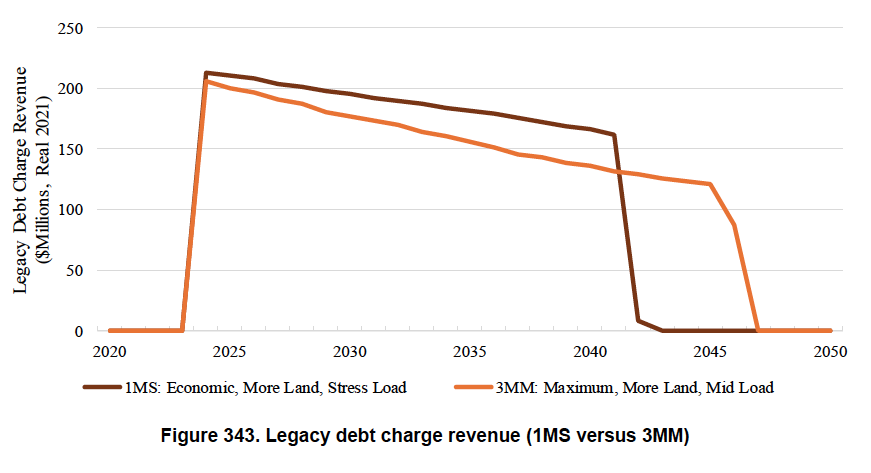
Second, the large reduction in retail sales by the utility between these two scenarios reduces the amount of revenue collected each year by the utility, again as would be expected. However, the sharp decline in retail sales has an adverse impact on the repayment schedule of PREPA’s legacy debt as renegotiated under the POA. According to the DOE analysis, revenues under the 3MM Scenario would decline by so much, that “the repayment date [of the restructured debt] was extended by 4 years for the 3MM scenario.” (PR100 Final report, p. 436) The figure below shows this impact:

Source: PR100 Final Report, p. 436

So, here is one clear tradeoff: more resiliency under Scenario 3MM results in (1) significantly less revenues for the utility and (2) an extension of the repayment term of the legacy debt.

Third, on the positive side, lower retail sales (in kWhs) also mean lower generation costs for the utility, which should translate into lower rates. However, the reduction in costs modeled by the DOE was not equivalent to the 55% reduction in sales in 2050 between the two scenarios under analysis for two reasons.

  • First, “as renewable energy penetration increased, the utility-owned fossil resources produced less energy overall but incurred additional cycling costs to manage the variability of the utility-scale renewable resources and, in conjunction with storage resources, was required to operate in ways that provided grid services that the utility-scale renewable energy resources could not.” (PR100 Final Report, p. 437)
  • Second, “the achievement of 100% [renewable portfolio standards] RPS in 2050 forced investment in a portfolio of new resources to provide the comparable grid services required to integrate distributed PV generation.” (PR100 Final Report, p. 437)

Notice another tradeoff here: maximum deployment of DERs significantly reduces the generation costs for the utility but those savings are partially offset by the need to incur additional investments to maintain system stability and reliability over the long term.

The net impact is that while utility electricity sales decline by approximately 55%, the utility revenue requirement (what the utility must charge to cover its costs) decreases by only 24% in the lower retail sales scenario (3MM) relative to the utility revenue requirement under the scenario with the highest sales (1MS). (PR100 Final Report, p. 437) Thus, lower sales under Scenario 3MM do result in an overall reduction in generation production costs but such a reduction is significantly lower than the decrease in total utility retail sales.

Fourth, this is where things get complicated. According to the DOE:

Because utility retail sales in the 3MM scenario declined so much more than utility costs, those costs had to be spread over a much smaller sales base to keep the utility financially healthy. This resulted in an increase in retail rates between 2025, when the electric system achieved a more reliable state of operation, and 2050: moving from 37¢/kWh to 56¢/kWh for the lowest retail sales level…In contrast, the retail rate level modestly drops between 2025 and 2045 for the highest retail sales level (34¢/kWh to 32¢/kWh) and then increases as the utility achieves 100% renewable energy penetration in 2050 (37¢/kWh). (PR100 Final Report, p. 438)

Thus, as shown in the figure below, the all-in average retail is significantly higher under scenario 3MM when compared to Scenario 1MS.


Source: PR100 Final Report, p. 438

As DERs are increasingly deployed under Scenario 3MM, utility costs decrease but, as stated above, by an amount lower than the decrease in total utility sales. As fewer customers remain totally dependent on the grid, total costs have to be apportioned over a smaller customer base, which results in higher rates relative to Scenario 1MS for all those dependent on the grid.

The Impact of Different Levels of Distributed Solar PV

The decision of how many resources should be dedicated to deploying either rooftop solar systems or utility-scale PV generation is one of the most intensely debated issues in Puerto Rico right now. Advocates for rooftop solar rightly emphasize the resiliency advantages of those systems, while advocates of more investment in utility-scale generation, relative to rooftop solar, emphasize the economies of scale and lower costs associated with larger solar generation facilities. To us, it is obvious that Puerto Rico needs both kinds of systems. So, in a certain sense, this is a false choice. But here we are.

Section 12.1.3.7 of the PR100 Final Report details the result of the DOE’s analysis of three scenarios that maintain constant both land use constraints and the load forecast while allowing for different levels of distributed/utility-scale solar PV generation. Those scenarios are 1LS (Economic Adoption, Less Land, Stress Load); 2LS (Equitable Adoption, Less Land, Stress Load); and 3LS (Maximum Adoption, Less Land, Stress Load). This analysis allows the DOE to assess the economic trade-offs associated with each of these scenarios in terms of the deployment of rooftop systems versus utility-scale generation.

The first thing they notice is that “increasing levels of distributed PV adoption under NEM [Net Energy Metering] resulted in increasing distributed PV production (MWh) that could not be integrated on the distribution system without additional infrastructure investments.” (PR100 Final Study, p. 441) As shown in the figure below, this means that as soon as 2037 “distribution system upgrades in the form of storage procured under [power purchase and operating agreements] PPOAs in addition to the requirements [to meet RPS goals] began to be needed to mitigate the integration challenges by the highest distributed PV adoption scenario under NEM.” (PR100 Final Study, p. 442)


Source: PR100 Final Report, p. 442

In terms of the impact on utility-owned generation costs, the DOE found that electricity from rooftop solar systems reduced the amount of utility-scale generation resources required to meet annual energy demand “but the increased level of variability introduced into the net load profile caused offsetting integration costs.” (PR100 Final Report, p. 442)


Source: PR100 Final Report, p. 443

As shown in the figure above, utility-owned generation costs decline modestly in Scenario 3LS relative to Scenario 1LS starting in 2025. However, the decline is “not as large, in percentage terms, as the reduction in retail sales between the two scenarios.” (PR100 Final Report, p. 442) Furthermore, (1) purchased power costs were “nearly identical” across all three scenarios and (2) starting in 2040, “both utility-owned generation and purchased power cost reductions were much smaller, in percentage terms, than the change in retail sales reductions from distributed PV between the highest and lowest level of distributed PV adoption.” (PR100 Final Report, p. 443)


Source: PR100 Final Report, p. 443

Finally, “at the levels of distributed PV penetration seen in the 3LS scenario, the utility incurred substantially more distributed PV integration costs under NEM that offset nearly all the savings from the lower electricity demand.” (PR100 Final Report, p. 443)

Just like in the previous analysis, the lower generation costs were offset by higher distribution system storage/battery costs required for the highest level of distributed PV under NEM. “As a result the total revenue requirement under the highest penetration level of distributed PV was only 1% lower than it is for the lowest penetration of distributed PV in 2050.” This means that the utility revenue requirement is essentially the same under the three scenarios, as shown in the figure below:


Source: PR100 Final Report, p. 444


Finally, “with nearly identical total revenue requirements, the 21% reduction in retail sales (1LS scenario versus 3LS scenario) in 2050 caused rates to be higher by 26” by 2050. See figure below.


Source: PR100 Final Report, p. 444

The tradeoffs, then, are very similar to those in the prior analysis of the “bookend scenarios.” In general, under Scenario 3 relative to Scenario 1 (with both land use constraints and loads held constant): (1) the system is more resilient as there is greater deployment of DERs; (2) retail sales (in kWh) decrease significantly; (3) costs also decrease but by less than the reduction in sales because there is a need to invest more in storage systems; (4) purchased power and operating costs are essentially the same under both scenarios; (5) the total utility revenue requirement remains basically unchanged; (6) lower retail sales under Scenario 3 with essentially the same costs as Scenario 1 translate into higher retail rates for consumers without access to a distributed solar PV system.

To be clear, CNE is not advocating for Scenario 1 over Scenario 3 or any other specific scenario for that matter. Our point is that there are tradeoffs that need to be taken into account by those responsible for managing and planning the electric system. Furthermore, those tradeoffs should be disclosed and clearly explained to the people of Puerto Rico. There are many benefits to having a more resilient system. There are also many costs that need to be incurred to achieve a higher level of resiliency. And those costs would disproportionally fall on those unable (for whatever reason) to install a rooftop solar system. If these facts are disclosed clearly and fairly by decision-makers and the decision is still made to implement Scenario 3, or something close to it, then so be it. But let’s be sure we can pay for it.

Section 3: It’s Expensive

The DOE did not perform an independent analysis of the costs required to bring the electric system “back into a state of good repair, but rather rel[ied] on the FOMB’s 2023 Certified Fiscal Plan for PREPA to identify both the level of investment and the sources of funds to cover that level investment.” (PR100 Final Report, p. 407) According to the DOE analysis, recovery-related investments total $15.441 billion, which includes spending on generation, transmission, and distribution system repairs and replacements, as well as on the Tranche 1 transmission network upgrades.

Notice that the $15.441 billion amount does not include the capital investment necessary to fund new generation as well as the upgrades and extensions of the transmission and distribution (“T&D”) system required to achieve the 100% goal by 2050 (with the exception of the Tranche 1 transmission system upgrade). One independent expert estimated additional T&D capital investments between 2030 and 2035 would add up to an additional $13.6 billion. (London Economics International, Critique of Government Parties’ Assertion that the 9019 Settlement Will Not Affect Non-settling Creditors and Would Avoid a Subsequent Title III Filing by PREPA, October 30, 2019, p. 97, Document #: 1890-1) Keep that in mind as we focus on the resources identified by the DOE to finance the recovery-related investments.

According to the DOE, the following sources of funds are available to cover the $15.441 billion spending on recovery-related investments:

  • $13.723 billion from FEMA
  • $0.500 billion from HUD
  • $0.285 billion dedicated by the Government of Puerto Rico from 2023 to 2025
  • $0.193 billion in insurance proceeds
  • $0.740 billion collected from ratepayers through 2034, financed via headroom in rates from 2020 to 2028, “at which point PREPA is assumed able to access capital markets after its exit from bankruptcy in 2024.” (PR100 Final report, p. 408)


Source: PR100 Final Report, p. 408

As stated above, there is also a need to make additional investments, beyond the recovery-related capital expenditures set forth above, in order to meet the Act 17 RPS requirements:

  • Transmission System Expansion: The interconnection of new renewable resources will require the construction of new tie lines to the bulk power system in Puerto Rico. The DOE assumed different entities would be responsible for covering those costs. First, as stated above, the Tranche 1 transmission network upgrade will be paid for with federal funds. Second, for subsequent tranches “transmission costs were assumed to be financed by third-party renewable development sponsors and thus included in power purchase and operating agreements (PPOAs) until 2028.” Third, commencing in 2028 PREPA “was assumed to be in a position to finance these investments due to its exit from bankruptcy and ability to access capital markets.” (PR100 Final Report, p. 408)
  • Distribution System Upgrades: As new DERs and EVs are deployed it will become necessary to upgrade parts of the distribution system. The DOE estimates there will be excess capacity and energy that cannot be integrated into the distribution system starting in 2037. For each scenario, the DOE assumed that these integration challenges would be mitigated by increasing the amount of bulk storage (batteries) on an incremental basis as renewable capacity expanded. This incremental storage was assumed to be procured via PPOAs. (PR100 Final Report, p. 409)
  • New Generation: Utility-scale generation as well as bulk storage resources are expected to be procured via PPOAs. (PR100 Final Report, p. 416) With respect to rooftop systems, the DOE, as stated above, “did not assume how those systems would be paid for or whether any public or federal funds would be allocated to pay for them.” (PR100 Final Report, p. 185)

In addition to the costs outlined above, operating the electric system requires paying for other costs such as fuel costs, legacy debt charges, Paygo pension payments, LUMA contract fees and fixed operation and maintenance (“O&M”) costs, Genera contract fees and legacy generation fixed O&M costs, PREPA Holdco fees, CILT and subsidies, and energy efficiency programs, among others.

PREPA, just like most utilities, recovers some costs via basic tariff charges, which are set during general rate cases, and other costs via rate riders that are updated on a more frequent basis. According to the DOE, “basic tariff charges differ by customer class while rate riders can be, and often are, universally applied to all customer classes.” (PR100 Final Report, p. 422)

The DOE assumed the following division between basic tariff charges and rate riders to estimate the utility revenue requirements going forward:


Source: PR100 Final Report, p. 423

We assume that the final allocation will be determined by the PREB but we notice that significant changes to PREPA’s current billing practices may be necessary to reconcile tradeoffs between solvency and equity objectives going forward.

Let’s take one issue that has been in the news recently to analyze some of the equity concerns that may arise going forward. Customers who currently participate in the Net Energy Metering program are compensated for their net energy exports to the grid at the same amount (per kWh) they are charged for their imports from the grid. This may result in an overpayment to those customers because, while it is true that every kWh exported by a NEM customer reduces PREPA’s variable costs (that is, PREPA avoids incurring these costs), there are some fixed costs that the utility has to incur to interconnect NEM customers to the grid. So, while fuel and purchased power costs (from AES and EcoElectrica) may be avoided, other costs such as debt service, pension payments, and the LUMA fees and fixed costs, for example, have to be paid regardless of how much electricity NEM customers export to the grid.

Therefore, net metering customers should be compensated at a rate per kWh equal to (x) the utility’s avoided costs (as defined by the PREB) minus (y) the utility’s fixed costs (as defined by the PREB). Some advocates for rooftop solar systems argue that overpaying net metering customers is justified as a matter of public policy because it helps to speed up the adoption of DERs. We don’t have an issue with that policy as long as it is (1) clearly and transparently stated and (2) customers understand that, everything else being equal, it would result in higher rates (even if only marginally) for those customers who do not participate in the net metering program because fixed costs will have to be recovered from a smaller customer base.

The DOE found that the utility revenue requirement, relative to the $3.2 billion collected in 2020, fluctuates across three time periods. First, there is a “rapid and substantial increase” in utility incurred costs in the first five years of the analysis, “ending at a level between $5.0 billion and $5.3 billion.” Then, between 2025 and 2045 the revenue requirement trends downward to between $3.9 billion and $4.7 billion. Finally, substantial costs have to be incurred to meet the 2050 objective, increasing the revenue requirement to between $4.3 billion and $5.4 billion. (PR100 Final report, p. 425)

The fluctuation in the utility revenue requirement, in turn, results in variations in the estimated all-in average retail rates over the next 25 or so years. According to the DOE:

  • Between 2020 and 2025, all-in average retail rates increased between roughly 65% to 80% from their starting level of 19.9 cents per kWh;
  • Then, between 2025 and 2045 rates either decreased by up to 0.4% per year or increased by as much as 1.5% per year, depending on the scenario; and
  • After 2045, rates increase again rising between 11% and 17% by 2050, again depending on the scenario. (PR100 Final report, p. 429)

The large increase in rates over the first five years of the transition is driven largely by the rapid short-term build-out of utility-scale generation. This build-out is driven, in turn, by two factors: (1) “meeting industry accepted [resource adequacy] performance; and (2) meeting the 40% RPS by 2025.” (PR100 Final report, p. 230) In order to assess the relative contribution of each of these factors to the 2025 build-out, the DOE ran a scenario variation that relaxed the 40% RPS requirement under the 1LS Scenario. They found that “this relaxation significantly changed the technologies and total capacity selected in the build-out relative to the 1LS results; however, the relaxed RPS total capital and operating costs results were within 1% of the 1LS results. This similar cost result suggests that the dramatic build-out of utility-scale generation is driven principally by the requirement to achieve system reliability rather than the requirement to meet the 40% RPS.” (PR100 Final report, p. 230)

In other words, the initial large increase in rates, estimated to be between 65% and 80% relative to 2020 rates, is to a large extent the legacy cost we all have to pay for the decades of corruption, mismanagement, negligent administration, political shenanigans, and postponed maintenance and capital expenditures at the old PREPA. Those who are prone to romanticize the old PREPA are well advised to keep this in mind before they wax poetic about the “good old days”.

Section 4: Is it Good for the Economy?

The DOE estimated the net economic impact of the transition by analyzing two sets of countervailing effects or impact channels on the economy. The first channel considers the stimulative or positive effects associated with higher construction (CapEx) investments and ongoing O&M expenditures for both (1) utility-scale generation, transmission, and distribution and (2) the increased adoption of distributed PV and storage. (PR100 Final Report, p. 486) These investments have positive impacts on employment, earnings, output, and total value added.

According to the DOE, construction and installation activities, which are temporary, create more than six times the number of jobs and earn more than the operation and maintenance efforts, on average. “However, O&M efforts create longer-lasting jobs with higher associated labor hours than temporary construction efforts.” (PR100 Final Report, p. 402) In addition, construction/installation jobs are subject to a “dramatic boom/bust cycle,” increasing rapidly at first to meet the 40% RPS requirement by 2025 and later the 100% RPS requirement by 2050. In contrast, there is more stability in O&M jobs as renewable energy assets are deployed over time. Finally, utility-scale solar supports 44% of all O&M jobs, on average, followed by residential solar with 31% of O&M jobs. (PR100 Final Report, p. 475) Notice the tradeoffs associated with each of the solar PV generation options.

The figure below shows the aggregate amounts of expected CapEx and O&M expenditures, adjusted for inflation, between 2025 and 2050:


Source: PR100 Final Report, p. 493

However, as we stated previously, the transition will be expensive and both households and businesses will face higher electricity prices. The second channel considers the contractionary or negative effects of higher electricity prices. In general, there are two important macroeconomic effects associated with higher electricity prices.

  • First, higher prices mean electricity expenditures increase as a share of total spending, reducing the consumption of other goods and services and, thus, overall economic activity decreases.
  • Second, as businesses face higher production costs, due to higher electricity prices, they increase the price of their products. Higher inflation leads to lower levels of consumption, production, and employment. Both effects reduce real household income. (PR100 Final Report, p. 486)

The figure below shows the projected average inflation-adjusted electricity rates between 2020 and 2050:


Source: PR100 Final Report, p. 495

Looking at both figures together we discern the following pattern:

  • A sharp increase in both capital spending and utility rates during the period between 2020 and 2025.
  • During the period between 2025 and 2045, there is less new capital spending relative to period 1, while the adoption of distributed PV increases. Real rates relative to 2025 stay flat or fall for most scenarios during this period, with the notable exception of Scenario 3MM.
  • Finally, during the last period between 2045 and 2050, there is another sharp increase in capital expenditures, accompanied by an increase in real rates under all scenarios.

The DOE then proceeded to “disentangle” the simultaneous positive effects due to higher spending from the negative effects of price increases. The figure below shows the dis-aggregated employment effects of the expenditure and price impacts for Scenarios 1LM and 3LS:


Source: PR100 Final Report, p. 497

Under Scenario 1LM in 2025, the investment needed to meet the 40% goal of Act 17 results in more than 16,000 new jobs (blue column). This positive impact, however, is more than offset by the negative effects of higher electricity prices, which induce a loss of 25,000 jobs. The same pattern is observed under Scenario 3LS in 2025.

By 2028, “the expenditure and price impacts are much smaller in magnitude than in Epoch 1. This is because there is relatively little new CapEx in this time frame, and electricity price changes are quite small relative to 2025.” (PR100 Final Report, p. 497)

The story is similar when analyzing the impact on household income. As shown in the figure below, economic activity and employment growth related to new expenditures lead to an increase in household income in 2025 under both Scenarios 1LM and 3LS. However, higher electricity prices over this period lead to a decline in real household income that more than offsets any income gains due to the increase in employment.


Source: PR100 Final Report, p. 498

In sum, according to the DOE model, “for 2025, although some households do benefit from the new jobs created by the CapEx and O&M expenditures, most households in Puerto Rico do not see much benefit; instead, they are adversely affected by the higher electricity prices in the early years.” (PR100 Final Report, p. 498) The DOE notes, though, that “while these adverse effects are substantial, it is important to remember that the 2025 scenario reflects a vastly improved electric system, with more reliability, capacity, and resiliency.” Once again, tradeoffs are unavoidable in this process.

Looking at the whole term of the transition, the economic impact, both on employment and household income, is expected to turn slightly to moderately positive, with some fluctuation depending on the scenario. In terms of the impact on employment, the figure below shows the employment impact for six scenarios out to 2050:


Source: PR100 Final Report, p. 499

  • During the first period up to 2025, there is a net decline in employment across all six scenarios, with the largest losses in 3LS (minus 15,894), reflecting the scenarios relatively high price increase and slightly lower CapEx expenditures. The smallest losses are in Scenario 1LM (minus 9,178). (PR100 Final Report, Appendix J, p. 743 and p. 728)
  • During the second period (2025-2045) employment “impacts are relatively small relative to 2025, reflecting low levels of new spending and small price changes”. (PR100 Final Report, p. 499) The employment impacts are positive across the entire second period for Scenarios 1LS, 1LM, 1MS, and 2LS. Beginning in 2035, “employment impacts for the scenarios with higher levels of distributed PV adoption (3LS and 3MM) turn slightly negative, reflecting relatively larger electricity price increases.” (PR100 Final Report, p. 500)
  • During the final period, between 2045 and 2050, there are significant positive employment impacts. “This reflects higher expenditures as the final investments are made to meet the 100% renewable goals.” In this period, electricity prices also increase, but by a smaller percentage than in Period 1, which means their effects are less detrimental. (PR100 Final Report, p. 500)

The forecast in terms of the impact on household income is fairly similar, as shown in the figure below:


Source: PR100 Final Report, p. 501

  • During the first period, all six scenarios reflect losses of real household income. The losses range from $580 million in Scenario 1LM to $864 million in Scenario 3LS. (PR100 Final Report, Appendix J, p. 728 and p. 743) In all six scenarios, the adverse impacts of simultaneous electricity price increases more than offset the gains in employment due to the additional CapEx.
  • After 2025 and up to 2045, Scenarios 1LS, 1LM, 1MS, and 2LS show relatively small increases in household income while Scenarios 3LS and 3MM show modest decreases between 2035 and 2045. In general, during this period there are much smaller net effects on real household income, as electricity price changes and CapEx are both much lower than in the first period.
  • During the third period, there are positive impacts on real household income across all six scenarios. “Like employment, these increases are largely due to the stimulative impacts of relatively high aggregate expenditures…which are partially, but not fully offset by the real electricity price increases in that time frame…Across the six scenarios, the average increase in real household income is $764 million.” (PR100 Final Report, p. 500.) During this period Scenario 3LS shows the highest increase in household income by 2050, $1.25 billion or 4.74% relative to 2025, while Scenario 3MM shows the lowest increase with $564 million or 2.14% also relative to 2025. (PR100 Final Report, Appendix J, p. 743 and p. 748)
  • In general, “increasing levels of distributed PV plus storage adoption were slightly more harmful to the economy relative to a higher reliance on utility-scale renewable energy resources.” (PR100 Final Report, p. 476)

In sum, the economic impact of the transition to 100% renewable generation, as modeled by the DOE, exhibits several tradeoffs that policymakers will need to take into account: (1) between construction and maintenance jobs; (2) among and between the costs and benefits of the different technologies; and (3) between short-term losses and long-term benefits in terms of employment and household income.

Section 5: Risks and Uncertainties

Any process as complicated as the transition to 100% renewable generation will be full of risks and uncertainties. In this section, we highlight some of the most significant in our opinion.

  • The Challenge of Stabilizing the System – Puerto Rico’s electric system is functional but fragile. At any given moment more than half of the PREPA’s legacy generation units could be offline either due to unscheduled repairs or because they are subject to time use limitations due to the failure to comply with environmental rules and regulations. On the transmission and distribution side, the PR100 Study has highlighted a significant problem with the lower-voltage (38-kV) transmission network as well as voltage control and backfeeding problems in the distribution system. These issues, by themselves, would present a formidable challenge to any utility to manage. When combined with the transition to full renewable generation the whole system is at risk of becoming unstable. Potentially catastrophic scenarios cannot be fully ruled out if things are not done the right way. Stabilizing the electric system in the short term is of paramount importance and should be the number one priority of policymakers right now.
  • Coordination Problems – Coordination among and between (1) federal agencies; (2) federal and Puerto Rico agencies; and (3) Puerto Rico state agencies and municipalities has been problematic ever since the recovery and reconstruction process started. To be fair, some of the initial coordination problems were the product of unreasonable terms and conditions imposed by the Trump administration to intentionally slow down the disbursement of funds to Puerto Rico. And certainly, administrative processes have improved over the last six or so years. Yet coordination problems still remain and have plagued policymaking regarding the reconstruction of the system, the procurement of utility-scale renewable generation, and the timeline for decommissioning fossil fuel legacy assets. In our view, the PREB should be the agency taking the lead in coordinating the actions of the multiple stakeholders in this process as well as the forum for resolving knotty policy and technical issues.
  • Cost/Resiliency/Reliability Tradeoffs – It is clear from the PR100 Final Report that there is a tradeoff between systemic resiliency and costs, both in terms of the rates paid by customers that remain dependent on the grid and in macroeconomic terms. Customer rates and negative short-term macroeconomic effects (in terms of lower employment and household income) tend to be higher under all variations of Scenario 3. In addition, system reliability could be compromised to the extent that excess PV capacity and energy cannot be integrated into the distribution system starting as soon as 2037. If the decision is made to prioritize and put a premium on resiliency rather than on lower costs, then that decision should be made and explained to customers as transparently and clearly as possible so they can plan accordingly.
  • Compensation for Net Energy Metering – Participants in the net metering program currently receive a full kilowatt-hour credit on their energy bills for every kilowatt hour they export to PREPA. This means that those customers do not pay the fixed costs of maintaining the electric grid. Therefore, PREPA’s operational and maintenance costs are disproportionately borne by customers unwilling or unable to participate in the net metering program. Act 17 required the PREB to undertake a study of the net metering program by April 2024 to determine whether the current system is adequately structured. However, that study has not been done. Unfortunately, this has become a political issue as the Puerto Rico legislative assembly has enacted another law that orders the PREB to postpone any such study until 2030 and the FOMB has taken the position that this constitutes an undue interference with the work of the PREB. Leaving political turf battles aside, we believe the NEM study should be executed as soon as possible and its findings should be made public and widely divulged. Again, if the policy decision is made to overcompensate participants in the net metering program to incentivize the installation of rooftop solar systems, then that decision should be explained clearly to all electric customers, including the disclosure that, everything else being equal, it would result in higher bills (even if only marginally) for customers that do not participate in the program.
  • Policy and Regulatory Constraints Regarding the Contribution of Distributed PV to Achieve the RPS Goals – The DOE configured its model to count generation from distributed PV toward the achievement of renewable generation goals. However, “the utility and operator do not yet have policies, metering, or an accounting method in place to do so. Further guidance and regulations on renewable energy certificates will clarify the contribution of distributed renewable generation toward the RPS.” (PR100 Final Report, p. 214) Additional policy guidance is also required to determine the amount of rooftop solar capacity and utility-scale PV generation that will be deployed to meet the statutory RPS requirements. The disagreement between the proponents of each option has caused undue delays in the deployment of renewable generation and only benefitted fossil fuel suppliers.
  • Reaching 40% RPS by 2025 Appears Unfeasible – According to the DOE analysis, “deployment of renewables at a rate to achieve the 40% RPS goal would require a rapid rate of procurement of over 100 MW per month through 2025 from a level of minimal utility-scale build-out in recent years. This rate of deployment would be challenging to achieve.” (PR100 Final Report, p. 229) While we appreciate the gracious and diplomatic drafting of the authors of the PR100 Final Report, the reality is that PREPA, LUMA, and Genera don’t have in place the operating framework to support this rapid build-out; the T&D system needs to be upgraded before this amount of capacity and energy can be integrated into the grid; and procurement has been slow due to policy disagreements and coordination problems. Therefore, the most likely scenario is that Puerto Rico will miss the 40% goal by 2025. Given that scenario, Puerto Rico will be better off extending the intermediate goals to reach 100% renewable generation by 2050 and doing things right rather than carelessly and unthinkingly rushing to meet the 40% goal.
  • Obtaining Funding for the Grid Upgrade Remains Challenging – The DOE estimates that recovery-related investments total $15.441 billion, including generation, transmission and distribution system repairs and replacements, as well as Tranche 1 transmission network upgrades. As we stated above, at least one independent expert estimated additional T&D capital investments between 2030 and 2035 would add up to an additional $13.6 billion. Even if we cut that estimate by half, given that it was made by a consultant hired for litigation purposes, obtaining $6.8 billion in additional financing will not be an easy task. According to the DOE, “capital costs for energy projects in Puerto Rico were significantly higher than they were in the 50 U.S. states. Local factors that lead to elevated costs include transportation of component parts and materials, persistent industry-wide supply chain issues from the COVID-19 pandemic, inflation, and international conflict.” (PR100 Final Report, p. 72) Furthermore, Puerto Rico regulatory requirements may affect the final cost of any given project. While some of these issues may eventually resolve themselves, currently a high level of uncertainty regarding the financing of capital expenditures remains.
  • PREPA’s Access to Capital Markets – Right now PREPA does not have access to the capital markets as it is still undergoing a bankruptcy process. Given that situation, the DOE assumes PREPA will exit bankruptcy in 2024 and will have access to the capital markets by 2028 and, thus, the ability to finance upgrades to the transmission and distribution system going forward from 2028. In our view, this assumption could be overly optimistic for several reasons. First, it is by no means clear that PREPA will exit bankruptcy in 2024. Even if a POA is certified by the Federal Court this year, several creditors have already indicated they will appeal such certification, potentially adding several years of litigation to this process. Second, a restructured PREPA will be limited in its ability to issue new debt until the bonds issued as part of the current restructuring are paid in full. We don’t know yet what legal and financial conditions PREPA will have to satisfy (in the form of financial covenants limiting new debt issuance and legal subordination requirements) in order to issue new debt after 2028. Finally, any announcement regarding the issuance of new debt by PREPA will probably face significant backlash from customers and other stakeholders who remember waste and mismanagement at the old PREPA.
  • Uncertainty Regarding Energy Efficiency Measures and EVs – There is significant uncertainty regarding the implementation of energy efficiency measures and the adoption of electric vehicles in Puerto Rico. These two factors impact load forecasts in opposite directions: increased energy efficiency reduces demand for electricity while relatively high adoption of EVs increases demand for electricity. In our view, the most likely scenario right now is that Puerto Rico will not meet its energy efficiency objective because it is not making the necessary investments to achieve it, while the adoption of EVs is likely to be at a lower rate than in the U.S. due to Puerto Rico’s lower wages and income.
  • Risk of Grid Defection/Death Spiral – Under several of the scenarios modeled by the DOE, the volume of electricity sales declines faster than the total cost required to serve customers. This means that the rate per kWh increases and adds to the financial burden of existing customers, leading to even more “grid defection” (mostly higher income individuals and industrial/commercial clients), which means the remaining costs of service are spread over an even smaller customer base, leading to even higher electricity rates, and so on. This cycle is called a “utility death spiral” and while a complete utility death spiral has yet to be experienced in the U.S. electricity sector, in the case of Puerto Rico this risk cannot be ruled out. The DOE vaguely hinted as much when it stated that “PR100 analyzed a highly centralized utility in a future that was increasingly comprised of distributed and decentralized electricity resources which were neither owned nor controlled by the utility. Our analysis illustrates the implications of this seemingly dichotomous future: utility costs could not be reduced as quickly as retail sales resulting in higher retail rates.” (PR100 Final Report, p. 446)

Conclusion

Five years ago, Puerto Rico enacted legislation setting the ambitious goal of generating 100% of its electricity from renewable sources by 2050 even as it rebuilt its electric grid, which was devastated by Hurricane María in 2017. This is a clear and compelling objective that is worth pursuing. Yet success is not guaranteed because it is also incredibly complicated. The policy questions require analyzing theoretical, technical, and economic constraints as well as making difficult tradeoffs among and between complex economic, technical, and social objectives. In addition, the technology is still evolving. In that sense, there is a tension between the technology that is already available now and the technology that is not yet viable or commercially available.

We also need to note that the transition to 100% renewable generation has a political economy dimension, as the old technology (and those who benefitted from it) is replaced by a still evolving new one (and those who stand to gain from it). Humanity’s natural resistance to change is thus reinforced by powerful economic and financial incentives. 

Furthermore, during the last five years, Puerto Rico has fallen behind schedule to meet the interim objective of 40% renewable generation by 2025 due to bureaucratic and coordination failures. We are, therefore, at a critical juncture. We still have time to rebuild our electric grid and to completely switch away from fossil fuel generation by 2050. But achieving those objectives will require strategic thinking, skilled policymaking, competent execution, tactical dexterity, the ability to act collectively over the long term, and inspired leadership—resources that have been in short supply in Puerto Rico for at least a generation. Make no mistake, this endeavor will be challenging, hard, and expensive. There will be setbacks along the way. But it is the right thing for Puerto Rico to do for the generations yet to be born. So, we better get working if we are going to make it.

Let’s get going.

Three key elements for an electric network that works

Three key elements for an electric network that works

Published on October 13, 2022 / Leer en español

Director, Madrid Policy Bureau
SHARE

The most recent massive outage caused by Hurricane Fiona in Puerto Rico, the disenchantment with LUMA’s performance, and the general frustration with the reconstruction and transformation process of the island’s electric infrastructure led me to ask two Spanish experts about the keys to having a functional electric system. In this Apuntes desde Madrid I spell out the learnings I derived from separate conversations with Diego Rodríguez Rodríguez, economist, professor at Universidad Complutense de Madrid and part of the Spanish think tank FEDEA; and with Ricardo Guerrero Lemus, applied physicist, professor, and part of the research group on renewable energies at Universidad de la Laguna in Tenerife, Canary Islands. Both hail from the Canary Islands Archipelago and thus understand the workings of isolated, antiquated and vulnerable island systems such as Puerto Rico’s.

The lessons point in three directions: normative (regulation, metrics), institutional (the effectiveness of government supervision, the collaboration between actors, innovation, research), and technical (digitalization, capacity of the network).

Electric outage in the aftermath of Hurricane Fiona. Image: El País

1. Spanish regulation establishes the guarantee of electric supply as a priority; non-compliance has concrete consequences for companies

The creation of an electricity market in 1977  after the integration of Spain into the European Union’s energy sector transformed the country’s electric sector from one in which one company, UNESA, coordinated the totality of the electric system and rates were fixed by the State, to a liberalized one in which private actors played within the framework of market competition. The regulatory framework associated with this change incorporated the notion of “supply guarantee”. This notion establishes the responsibility of these new actors to supply electric demand at all times and gives rise to a multiplicity of regulations that encompass from the generation of electricity in insular territories and the faculties of the operator of the electric grid during emergencies, to the ability of public administrations to impose sanctions against companies in cases of “energy zeros” (electric outages).

There are few “zeros” in Spain – the availability index in the peninsular network was of 98.5% in 2021 and the average time of outages was less than 25 seconds. Insular systems are more fragile: in 2021 the Canary Islands Archipelago had 4 electric outages of an average of 2.33 minutes each (Red Eléctrica, The Spanish Electricity Report). Outages, when they do happen, are severely sanctioned and include not only million-euro fines to companies, but compensation to consumers. During the last few years, the island of Tenerife, for example, has issued over € 64 million in sanctions for major “energy zeros”:

  • September 2019 – an electric interruption left the 950-thousand inhabitants of the island in the dark for 9 hours. Endesa, the company in charge of generation, and Red Eléctrica de España, the grid’s operator , were imposed fines of € 10 million and € 30 million Residents of urban areas were entitled to a € 21 credit for the electricity they did not receive (in Spain one pays not only for electricity consumed but for the maximum capacity the household can consume at any given moment). Consumers were urged to submit compensation claims for lost foodstuff or damaged appliances.
  • June 2020 – this time, Red Eléctrica was fined € 8 million for a 54 minute “zero” that affected almost 150-thousand consumers.
  • July 2020 – a “zero” of more than 16 hours brough a € 6 million fine to producer Unelco and another one of € 10 million to E-distribución Red, distribution company.

In Puerto Rico no fines have been imposed for outages (despite the fact that the law allows them): the April 2022 outage, for example, is still under evaluation by the Energy Bureau/Negociado de Energía (NEPR) as we write in October.

Click on the following video (in Spanish) to listen to Ricardo Guerrero Lemus about the guarantee of electric supply

2. The company in charge of the electric grid is actively supervised by the State and operates under clear performance parameters

In Spain, the operator of the electric network is a publicly-traded private company, Red Eléctrica de España (REE). Nonetheless, the Spanish state maintains a 20% participation through the Industrial Participation State Society/Sociedad Estatal de Participaciones Industriales (SEPI), a public corporation with investments in key sectors (naval construction, rural development, infrastructures, among others).  Supervision over REE is made by the Ministry of Ecologic Transition and Demographic Challenge/Ministerio de Transición Ecológica y Reto Demográfico, which is in charge of the energy sector, and the National Commission for Markets and Competition/Comisión Nacional de Mercados y Competencia (CNMC); supervision by both agencies is particularly active. In Puerto Rico, public oversight over the company in charge of the network (LUMA) falls on the Authority for Public Private Alliances/Autoridad para las Alianzas Público Privadas (AAPP) and the Energy Bureau/ Negociado de Energía de Puerto Rico (NEPR).  According to press reports, public oversight over LUMA has suffered from lack of coordination between these agencies, laxity, and, in some instances, lack of expertise.

Red Eléctrica’s remuneration system in Spain has been designed to incentivize good performance. Only operational costs related to “an efficient and well-managed company” are considered. Clear metrics have been incorporated into the system, including incentives related to compliance and penalties for failures in service.  In Puerto Rico, CNE has alerted about flaws in the contract subscribed between PREPA and LUMA and about the lack of precision of the performance parameters included in the contract.  The process to determine performance parameters for LUMA did not start in the NEPR until December 2020 – six months after the contract was signed – and even today, more than two years later, the process continues and is the subject of multiple motions and counter-motions. The performance report prepared in May 2022 by the NEPR (NEPR-MI-2019-007/June 2021-May 2022, 12-Month Metrics Summary) lacks data for almost 90 of the 565 parameters, both for generation and distribution, as well as in the area of financial performance. Specifically, in the area of transmission and distribution (in charge of LUMA), the NEPR found “compliance” in only 4 of the 14 parameters, “non-compliance” in 6, and lacked data for 4.

As a comparison:

  • Red Eléctrica manages 27,300 miles of electric circuits in Spain; LUMA manages 2,500 miles of transmission and distribution lines in Puerto Rico.
  • In Spain, Red Eléctrica has one operating group in charge of electricity transport and another one in charge of construction and maintenance of the transmission and distribution network; in Puerto Rico both functions have been delegated to LUMA.
  • During 2020-2022 Red Eléctrica de España’s yearly compensation for electricity transport was fixed at between € 71.8 y  € 74.6 million; that is, incentives could represent some € 2.8 million to the company. LUMA’s base compensation for this coming (first) year of the contract is set at $ 70 million in 2020 dollars adjusted for inflation; incentives can be of up to an additional $ 13 million. LUMA currently operates Puerto Rico’s grid under a Supplementary Agreement that allows it to receive a base compensation of  $115 million in 2020 dollars adjusted to inflation. The first adjustment for inflation has already resulted in an increase of  $7 million over the base compensation.

Click on the following video (in Spanish) to listen to Rodríguez Rodríguez about state supervision over the grid’s operator

3. Spain’s electric grid is digitalized and is managed transparently in order to facilitate the integration of renewables

The penetration of renewable sources for the generation of electricity in Spain has reached important levels: it represents 57% of installed capacity and 48% of produced electricity.  It thus exceeds the 39% of renewable electricity generated in the totality of the European market. In contrast, in the USA electricity generated from renewable sources stands at 24%; in Puerto Rico, renewable generation in large-scale facilities under contract by PREPA is of 2%.

These achievements in Spain have been possible, among other things, thanks to the creation of a pioneer system for managing the integration of renewable sources that has set the standard for Europe. Through the digitalization of the electric grid (a smart grid), Spain has an REE-operated Control Center for the Integration of Renewables that every 12 seconds obtains from renewable generation sources, information on their production, voltage and connection quality. Working in tandem with a state-of-the-art energy storage system, this digital control center brings stability to the generation of energy from renewable sources, which by nature fluctuates with climatic conditions. Moreover, information on connection nodules available for new connections to the grid is open-sourced, something that facilitates planning and the entry of new renewable generation suppliers (see for example, the list of the 920 nodules that were available on October 3 throughout the country).  Planning is a live, dynamic and continuous process: it integrates Autonomous Communities and private actors from the sector with proposals for expansion and enhancement of the grid (in 2019, 1,335 proposals were received, most of them related to renewables.

At the consumer level, the use of “smart” (digitized) electric meters for “net metering”, ie, the technical aspect, has run parallel to changes in regulation. These facilitate both the production of energy at the point of consumption, as well as the interconnection between consumers and prosumers (consumers that produce their own energy). The need for permitting for self-consumption facilities was eliminated, as well as the so-called “sun-tax”, which required prosumers to pay for their connection to the electric grid. Electric toll charges for use of low-voltage lines were also eliminated. Consumers continue to contribute to the electric system through a fixed potency charge that is included in their bills and is calculated by the National Commission for Markets and Competition based on the cost of maintaining and modernizing the distribution and transmission network. The juridical figure of an “energy community” was also created.  “Energy communities” can be of two types: a sort of cooperative in which partners put up capital to install an energy facility, or that of an association between a consumer who buys the electricity from a prosumer neighbor, all facilitated by the digitalization of the electric grid.

Click on the following video (in Spanish) to listen to Ricardo Guerrero Lemus on energy communities

This normative and technical push has coincided with massive European Union funding, a key element in growing self-consumption into a large massive scale. Grants are allowing consumers to amortize their investment in photovoltaic panels in three to five years, instead of one or two decades. The European Union has at least 12 funds available to promote the evolution of the energy sector. Spain has assigned  € 660 millions of these funds to the Autonomous Communities in order to facilitate self-consumption, which still has a relatively low level of penetration in the peninsula (the Spanish Photovoltaic Union/Unión Española Fotovoltaica says that there are only 150,000 self-consumption facilities in the country versus 2 million in Germany; in Puerto Rico self-consumption reached 18% in January 2022). It is expected that these regulatory changes and increased public funding will give impulse to the sector, something that is already occurring in the Canary Islands Archipelago.

The Canary Islands, like Puerto Rico, is still dependent on petroleum for most of its electric generation. Located near the African coast, its distance from the Iberian peninsula (more than 1,200 miles) makes its electric system an isolated one (like Puerto Rico’s). During the first five months of 2022, the Canary Islands Archipelago tripled its installed capacity for electric self-consumption (mostly solar), and although still small in numbers, the sector is expected to grow exponentially.  Local public administrations and universities have started betting strongly on renewable sources and the creation of prosumers. The islands have 4,800 yearly hours of solar light and 200 square km of idle surfaces (rooftops, parking spaces): some venture that self-generation could become a key anchor for the islands’ electric system.  The University of La Laguna, in Tenerife, for example, is actively undertaking research on renewable sources for energy and on the development of intelligent electric grids in island contexts.   It has also started an outreach effort with the island’s Town Hall to guide the population on the formation of energy communities and on the use of rooftops for the production of photovoltaic energy.