Donald Trump wants a safe and prosperous United States. These are core interests for any country, and in this regard, the new U.S. president is no different from any of his predecessors or current European leaders. What sets him apart is how he seeks to pursue these interests. Trump shows little regard for values, and his political instincts lean toward isolationism over international engagement, and protectionism over free trade. As for his approach, he favors deals and transactions over crafting rules, working through international organizations, or traditional diplomacy.
With Trump in the White House and his disruptive approach to global affairs, everything suggests that the U.S. may be undergoing its most significant foreign policy shift since 1945. His second term in office could fundamentally reshape how future generations of American politicians, military leaders, business executives, and citizens interpret the country’s strategic priorities—both domestically and internationally. These priorities increasingly focus on China and the Indo-Pacific region, a trend that has been brewing for years and has bipartisan support in Washington. However, for the first time, the future foundations of U.S.-Europe relations are under debate. For decades, the U.S. invested unprecedented resources and reputation in Europe, motivated by national interest, prosperity, and economic growth, and Europe remains grateful. Yet, the new administration seems willing to abandon that investment and break ties with its European allies.
Perhaps Europeans have taken for granted for too long that Atlanticism was the cornerstone of U.S. foreign policy. Like a long-standing marriage, what once seemed obvious now needs to be clearly redefined—or risk falling apart.
The U.S. administration has begun to tighten the screws on trade. The European Union—one of the world’s most open regions to trade and investment and a staunch advocate of economic interdependence through rules—seems prepared to negotiate a mutually beneficial deal that Trump can present as a victory to his voters. However, the EU also wants to make it clear that pushing Europe too hard could backfire, potentially hurting U.S. interests. One strategy that seems to be gaining ground is to let the cost of U.S. tariffs fall on American businesses and households, hoping that domestic backlash will put pressure on Trump. Yet, what matters most to Trump 2.0 is power. Therefore, any European response must be rooted primarily in power rather than economics, rules, or U.S. domestic politics. Trade is just one piece of the broader challenges he is throwing Europe’s way.
Donald Trump has also challenged Europe’s territorial sovereignty—by suggesting the annexation of Greenland; its digital model—by attacking European tech regulations; and its political party systems—by courting far-right European political forces. He is also pressuring Ukraine and its European supporters to agree to a peace deal favorable to Russia, while hinting at withdrawing significant parts of the U.S. security commitments on the continent.
Trump is determined to exploit Europe’s economic, technological, political, and security vulnerabilities for coercive purposes because he believes Europe neither holds “the cards” nor has the will to play them—a euphemism he uses to refer to power and influence. But Europe does have cards to play, and they should carefully consider how to strengthen its hand and use them effectively.
Europe possesses the economic strength of a collective GDP, a vast internal market, along with labor and technology resources that complement the U.S. While Europe may not be a primary exporter of raw materials like the U.S., it serves as an indispensable intermediary—meaning that a break with Europe could make it much harder for the U.S. to sell its resources globally. Thanks to European contributions, NATO achieves both American and European objectives at an acceptable cost, not to mention that Europe’s geography allows the U.S. to project power to several critical theaters. Moreover, European companies are integrated into the U.S. defense supply chain—one-quarter of the F-35 fighter jet’s components are manufactured in Europe.
Faced with the new administration, Europe’s goal should be to develop a clear and realistic strategy for the transatlantic game that Donald Trump has initiated. Europeans must determine in which areas they should continue to align with Washington, where the relationship needs to be rebalanced, and where they should distance themselves from the U.S. The answers, however, are not easy.
This content was translated from Spanish to English using artificial intelligence and was reviewed by a human editor before being published.
Europe is under siege. Or at least that is how it feels today, as I write this text. I am far away from Kyiv, but war trickles in, through street conversations around me: at lunch, a business man talks about “damn Putin”, while a taxi-driver curses NATO for not defending Ceuta and Melilla, Spain’s territories enclaved in Morocco, with the same sense of urgency. Ukraine is 2,300 miles away, but the effects of the invasion are slowly being felt in Madrid: the meat industry has alerted about a coming shortage of food for livestock, supermarkets have started to ration sunflower oil, and the cost of the kilowatt hour reached today 71¢ of euro (about .77¢ of dollar). If COVID had made life complicated for us, the Russian invasion has tossed into the air the few pieces that remained in our chess board.
In this Apuntes de Madrid I will try to outline a European perspective about the implications of the conflict in Ukraine. I am aware that events are unfolding rapidly (as I write, the Russian President has threateningly said that economic sanctions seem to be “a declaration of war”). I will attempt, however, to offer context through some of the debates that are being held in European think-tanks and media. Throughout and at the end of the text, I insert links that might be of interest to those that want to continue delving into the topic from this optic.
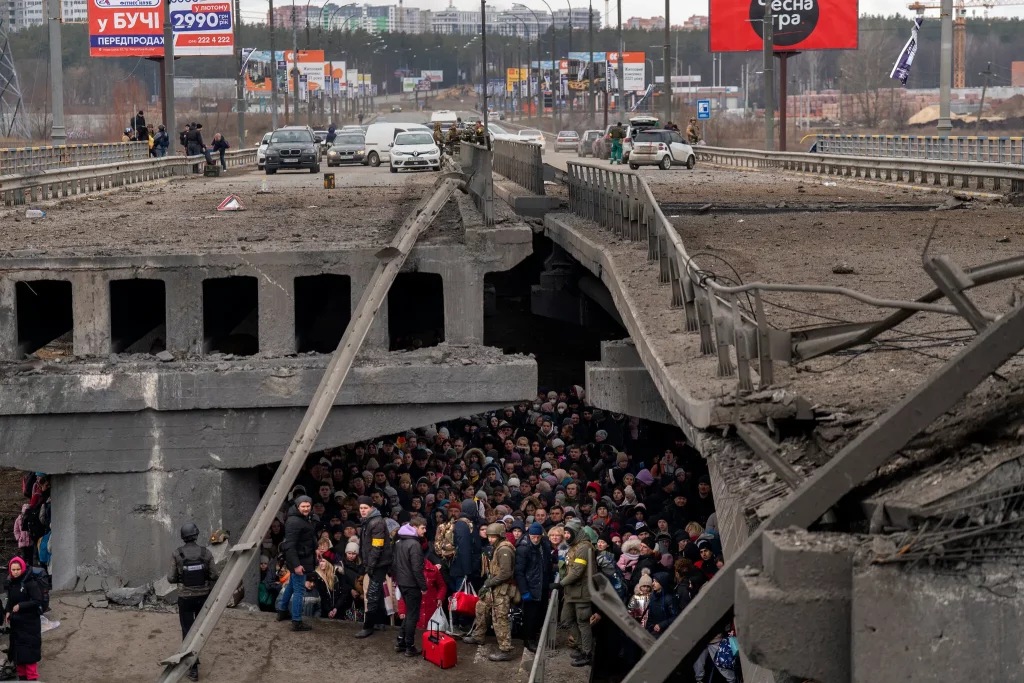
Emilio-Morenatti/Associated Press
The End of the Post-Cold War Period
For Europe, Russia’s invasion of Ukraine marks a dramatic turning point: the end of what Carnegie Europe analyst Judy Dempsey considers has been a long period of self-deception. It is important to understand that during the last 70 years, European foreign policy has been conditioned by a sort of post-memoryanchored on the collective trauma of the Second World War. To a certain extent, Europe as a whole has prioritized humanistic values (democracy, the rule of law, the welfare state) while avoiding the darkest realities of power (the development of a strong military defense component). This has made the European Union (EU) a moral or normative actor in the international arena, but has placed it in what Dutch philosopher and historian Luuk van Middelar considers is a psycho-political limbo, an ahistoric space devoid of real context.
For many decades, the EU and its member states banked on a policy of détente or distension with Russia through its so-called “soft power”, building economic and cultural ties while avoiding an escalation of potential conflicts. Ralf Fücks, from the Center for Liberal Modernity in Berlin, argues that this relationship has a strong emotional component: a mix of guilt (because of the Nazi invasion of Russia), fear (because of the Soviet occupation of the eastern part of Europe and the Cold War), and cultural admiration.
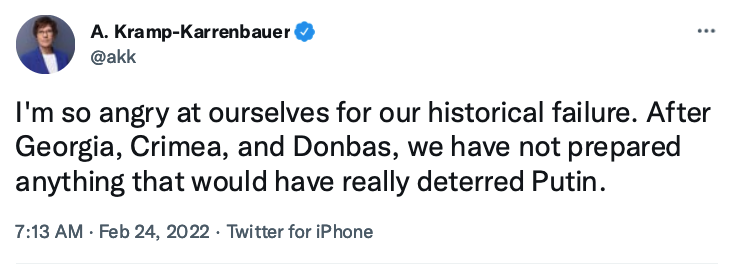
This is why, argues Fücks, in 2008 NATO (at the insistence of France and Germany) denied Ukraine and Georgia’s immediate admission into the alliance (“we should not push the Russians into a corner”); and that in 2014 the European response to the Russian annexation of Crimea was a rather limited one (freeze on certain assets, prohibition on certain imports from the region). John Lough, author of Germany’s Russia Problem: The Struggle for Balance in Europe, says that this also made Europe misinterpret or ignore the increasingly authoritarian and belligerent turn of its Russian neighbor. “I am so angry at ourselves for our historical failure”, said on social media Annegret Kramp-Karrenbauer, Former Minister of Defense of Germany. Until the very last minute, the EU thought that the politics of appeasement and the economic ties – Europe was until the invasion Russia’s main commercial partner and represented 37.3% of its external trade – would function as deterrents for armed escalation and would pave the way for diplomacy and mediation.
The stupor and concern that is currently felt in European capitals cannot be stressed enough. Richard Roberts, editor of the French publication Telos, has said that the Russian invasion of Ukraine implies a return to the Soviet doctrine that culminated in the crushing of the 1968 Prague Spring: a doctrine based in the limited sovereignty of those that share territorial borders with Russia. German Chancellor Olaf Scholz has been more categorical: he has said that the invasion shatters the European security system that was forged by the Helsinki Accords after the Second World War. And the Real Instituto Elcano, one of the main Spanish think tanks, has argued that the Russian aggression demolishes the current international order – based in the cooperation among states and the respect for rules – and substitutes it for one based on the imposition of the will of the strongest.
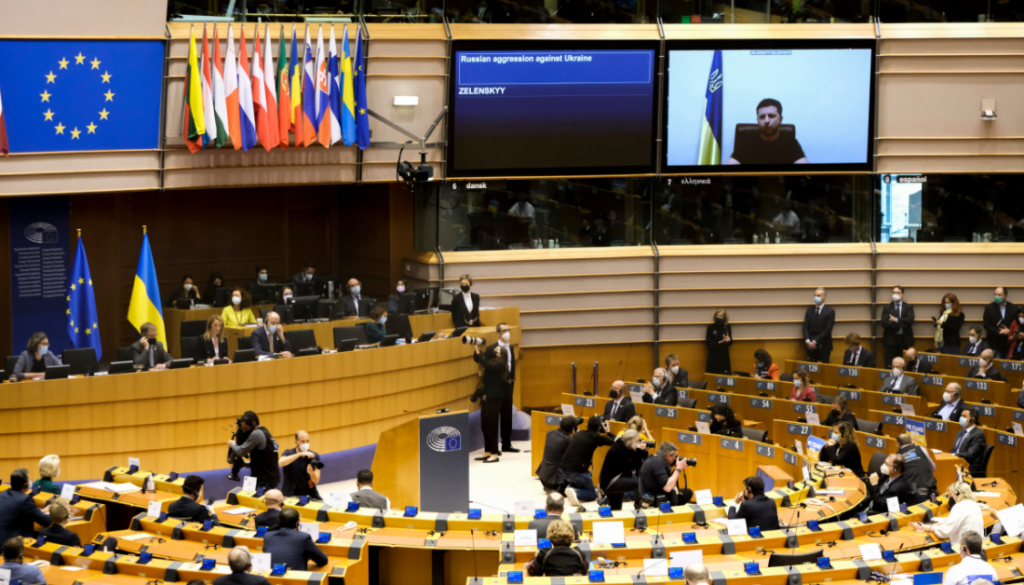
The conflict in Ukraine, then, constitutes a tectonic upheaval for the European Post-War worldview, a defining moment of change. This explains the EU’s determination to finance € 500 million in military armament to Ukraine (a “Hamiltonian” decision because of its centralizing effect, has said El País), the first time that the UE finances arms for a nation under attack. It also explains Germany’s momentous decision to rearm itself and to abandon its historical policy, forged at the end of the Second World War, of not sending armament to conflict zones. Ukraine seems to have become a sort of Rubicon that has pushed Europe into what Politico Europe calls a Zeitenwende, a historical turning point.
The Debate over Europe’s Strategic Sovereignty
The crisis has brought to the fore in European institutions the debate over “strategic sovereignty”, introduced in 2017 by French President Emmanuel Macron (current President of the European Council, which gathers the EU’s elected leaders). The notion propounds a “united and sovereign” Europe capable of acting according to its own interests “on the other side of the Atlantic or on the edges of Asia”. This means having an independent defense capability (in coordination but not limited or subordinated to NATO), the ability to compete economically with China and the USA, the capacity for digital innovation, a harmonized fiscal system, a common migratory policy, robust food security and convergence in social welfare policies. This doctrine has already started to crystalize in Europe’s foreign trade: while the USA is waging a trade war with China, the Asiatic country is currently the main source of imports for Europe (22.4% vs. 11% from the USA) and the third partner for European exports (the USA leads with 18.4% vs. China’s 10.2%). As a matter of fact, China’s medical protection equipment was crucial for the successful management of the COVID pandemic in Europe, after the USA vetoed exports during the initial moments of the pandemic.
The Russian invasion of Ukraine has given the defensive aspect of this doctrine of strategic sovereignty a special sense of urgency. Josep Borell, High Representative for Foreign Affairs and Security Policy for the UE, has said the crisis has prompted “the birth of the geopolitical Europe”. Since last November 2021, Borell had alerted that “Europe is in danger”, but his words fell flat in the midst of post-pandemic fatigue. His Strategic Compass for the UE – approved in May 2021 by the European Council and about to be discussed by the defense ministers of the EU’s member states – proposes the creation of a 5,000-strong rapid-response UE military force, as well as the development of UE ground, air, sea, space and ciber military capabilities. The question remains if the UE (notorious for its bureaucratic slowness) will be able to act with the celerity and forcefulness with which events are unfolding in the East; and if the European citizenry will trust the UE as much as it has trusted NATO for its defensive security. At the moment, the UE’s defensive system depends on the individual capacity of member states and NATO. NATO, for its part, will hold sometime soon a strategic meeting that will be framed by the scars that the Trump era left in the alliance and the seemingly divergent interests of the allies (Europe is focused on Russia, the USA on China).
Uncertainty and the Costs for Europe
The sanctions will not only harm Russia, but will have economic costs for Europe as well. At a minimum, the Spanish think tank Funcas is anticipating a significant increase in the price of energy, greater inflationary pressures, an erosion of consumer spending capacity, disruptions in export markets and an erosion in investor confidence. The impact will be uneven and may function like a house of cards: Germany is more dependent on natural gas and oil imports from Russia while Spain has a strong component of Russian tourism but depends on Germany for a significant amount of its exports. This uncertain panorama has led Nadia Calviño, Spanish Minister for Economic Affairs, to warn that the war threatens European post-pandemic recovery, propelled by the € 807 billion UE Recovery Plan.
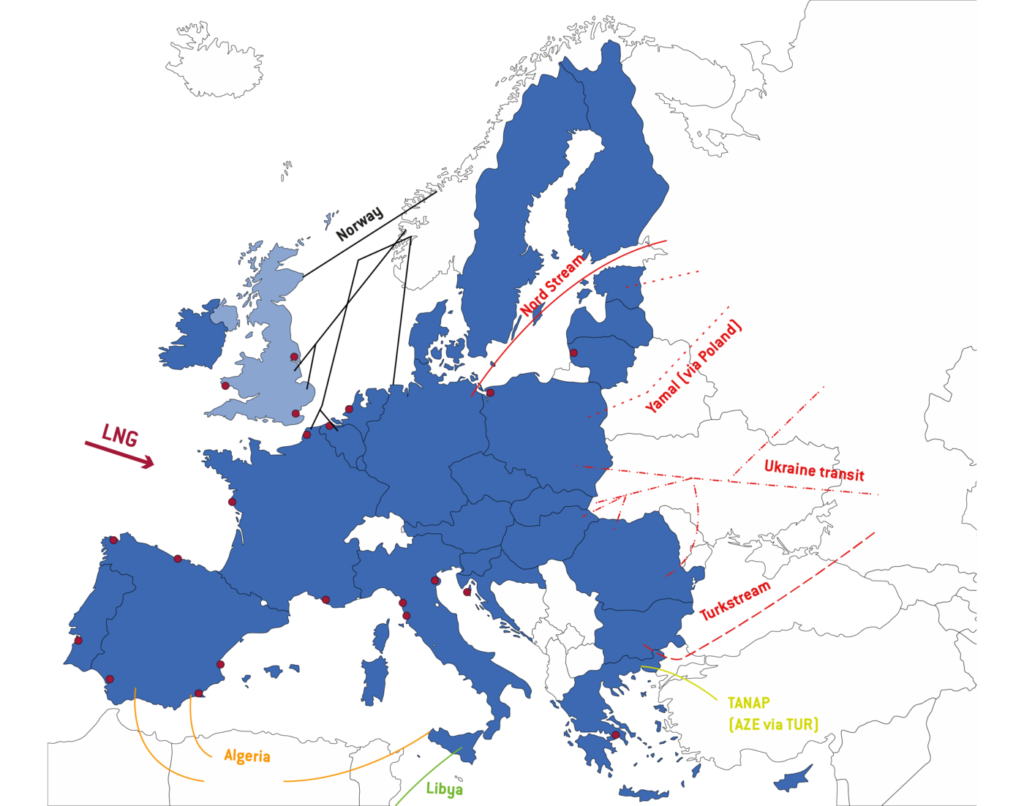
Main routes of natural gas imports into Europe. Source: Bruegel.
Energy is the most urgent and critical topic: Russia supplies the EU with 41% of its natural gas imports and 27% of its oil. The EU knows that this energy dependency on Russia is the Achilles’ Heel of its package of economic sanctions: Luis Garicano, economist and member of the European Parliament, has argued that Russia’s expulsion of the financial transaction system SWIFT will only be partially effective as long as Europe continues to import Russian fuels to the tune of € 1 billion a day.
We need sanctions that collapse the Russian state in days, not those that take effect in years. The loophole created by energy payments keeps the Russian economy going. Stopping all trade will save lives and money. In this video, I explain the current impact of sanctions. pic.twitter.com/4X5YBSZytu
The transition away from Europe’s dependency on Russian fuel, however, will not be painless: before the invasion, Belgian think tank Bruegel had estimated that an abrupt cut in Russian energy supplies would force a decrease of 10 to 15% in energy demand in Europe, more if weather conditions were unfavorable.
Sources of natural gas imports by country. Source: Bruegel.
The International Energy Agency (IEA) has prepared a dossier with measures through which the EU can diminish its dependency from Russian fuels: search for alternative sources (the gas pipeline that runs through Spain could be key in increasing gas imports from North Africa to Europe), an increase in storage capacity to neutralize seasonal fluctuations in energy demand, maximizing other energy sources (renewables, bioenergy, nuclear), and increasing energy efficiency programs. These measures, however, would only achieve a reduction equivalent to 1/3 of annual fuel imports from Russia. The crisis, on the other hand, might bring unexpected silver linings (at a very high cost, though): a reform of the marginalist pricing system of European electrical markets (advocated by Spain since last year’s increases in the price of electricity) and the acceleration of the transition to renewable sources of energy.
Finally, the human cost: the High Commissioner for Refugees of the United Nations estimates that the number of displaced people by the conflict in Ukraine could be as high as 4 million, the largest exodus registered in the continent since the Second World War. More than a million and a half refugees have already crossed the border into the EU, half of them into Poland. Europe had virtually closed itself to refugees since the Syrian crisis of 2015 (in the past years, the dramatic influx of illegal migrants sailing from North Africa has overflowed Spain’s and Italy’s capacity to manage it) but the EU has announced that it will offer temporary protection (residency for 3 years) to those displaced by the conflict in Ukraine. €500 billion has also been budgeted by the EU to manage the human inflow. This change in policy (as dramatic as the turn towards rearmament) has provoked calls for consistency among intellectuals such as the Slovene Slavoj Žižek (in the days following Žižek’s plea, a North African migrant being beaten by Spanish police after jumping the border fence in Melilla has made headlines).
What will be the social and political implications of this tsunami for the EU’s member countries? Will it create more cohesion? Or more polarization? A survey by the European Council for Foreign Relations made in 7 EU countries shortly before the invasion found that a majority of citizens supported Ukraine’s defense through NATO or the EU; support was significantly lower if the defense had to be made by their own country. How will this same citizenry react if the conflict escalates and becomes a prolonged one is still to be seen. Chatham House, an English think tank, found that economic disruptions and immigration flows – elements present in this juncture – are two types of shocks that function as social destabilizers, triggers for both Left and Right populist protest movements. The new era, indeed, is emerging as a quite complicated one for Europe.
It seems like it was only yesterday we were hearing for the first time about a strange new virus that affected the respiratory system. The past two years have gone by in a blur of adaptation (social distancing, wearing masks, using Zoom, mass vaccinations), upended routines (working from home, long-distance learning), and much COVID-related suffering.
As we begin the new year, you would be justified in being perhaps just a touch apprehensive about what 2022 has in store. No one really knows when the pandemic will be “over” (if we can use that term) and its economic, political, and social effects will play out only after several years. In light of such uncertainty, it is perfectly normal to be anxious about, well, pretty much everything.
Yet, as 2022 begins there is reason to believe that while we may need to keep adapting to new realities, the new year may also bring some positive developments for Puerto Rico. With that in mind, we present some themes to watch out for in 2022.
The Pandemic – The SARS-CoV-2 virus has consistently confounded some of the brightest scientific minds since it was first identified two years ago. It is also true, though, that our knowledge about the virus has grown exponentially during that time. In addition, we also have a better clinical understanding of the disease’s progression and have developed vaccines as well as new treatments for COVID-19. Nonetheless, we still have a ways to go before we can claim that COVID-19 is just another disease we can live with, like the flu. This is particularly true in the global South, where vaccination rates are still pitifully low. In the meantime, we know what we have to do: wear masks, keep social distancing, get vaccinated, and carry on.
Puerto Rico’s Debt Restructuring – After five years of litigation and negotiation, Judge Laura Taylor Swain has confirmed a Plan of Adjustment for the debt of Puerto Rico’s central government. The proposed Plan of Adjustment is not perfect and it has been the subject of significant criticism. But it does offer some debt relief and lifts the bankruptcy cloud from Puerto Rico, which should be a net positive for people looking at potential investment in Puerto Rico. It is a really difficult task to determine, with any certainty, whether the proposed plan is adequate, the time horizon is too long and there are too many variables. We believe that both the best case scenario put forward by the FOMB and the worst case scenario favored by those who oppose the Plan are unlikely to occur. In real life, it is likely some things will be in our favor and others against. The difficulty lies in forecasting which variables will go which way. What we do know, is that everything depends on jumpstarting economic growth and that depends, in the short term, on the Hurricane Maria reconstruction process and, over the long term, on developing and implementing an economic growth plan for Puerto Rico.
Hurricane Maria Reconstruction – It appears that 2022 will finally be the year when we start to see some significant new spending on reconstruction projects, especially in the housing and energy sectors. Hopefully, some of the obstacles imposed by the federal government have been cleared and the money can start flowing. Some difficult decisions regarding what gets rebuilt and what not and about energy generation technologies still lie ahead, though. In this sense, some of the most difficult questions in the reconstruction process are not technical but rather political in nature, as different groups vie with each other to push their own (interested) vision of how the reconstruction should play out.
Mid-Term Elections – The entire U.S. House of Representatives and about a third of the Senate are up for reelection this fall. Most analysts and polls forecast that Republicans will gain control of at least one Congressional chamber, if not both. If that scenario is realized, any pending federal legislation extending or increasing federal spending in Puerto Rico, for example, extending SSI benefits to Puerto Rico or increasing the federal share (FMAP) of Medicaid costs, could be in jeopardy. In addition, under a Republican majority, Puerto Rico could even face the rescission of budgetary authority for certain programs or the reduction of funds already appropriated for certain uses. Thus, it is important that the Pierluisi administration move aggressively to push the Puerto Rican agenda in Washington, D.C. during the next few months. Once campaigning starts in earnest after the summer break, it may be too late.
Inflation – Consumer prices are increasing at a rate not seen in forty years. This is due, in part, to the success of economic support measures in propping up demand when the COVID-19 pandemic struck. Central bankers provided huge amounts of liquidity to financial markets. Governments borrowed on a scale unseen since the second world war. In the United States alone, budget deficits exceeded 12% of GDP in both 2020 and 2021. All this stimulus prevented demand from plunging. Supply has been a different story, as the pandemic disrupted production worldwide. Supply chain bottlenecks and scrambled logistic networks led to unprecedented backlogs and delays, even as demand for physical goods increased relative to demand for services as people sheltered in place. Hence the price increases. In addition, firms in the developed world face a labor shortage, as workers, for reasons we don’t really fully understand, don’t return to work—there are 3.6 million fewer people working in the United States today than in February 2020. Economists disagree (big surprise here) as to whether this recent inflationary trend is a temporary or permanent phenomenon. On the former camp are those who emphasize supply dislocations that should eventually reverse themselves, while those on the latter side point to the risk of an inflationary wage spiral taking hold. Jay Powell, chairman of the Federal Reserve, stated recently that he (and the Fed Board of Governors) are uncomfortable with current price trends and the expectation is that interest rate increases are in the offing. It remains to be seen whether the Fed can tame inflationary pressures without inducing a recession or provoking a plunge in asset prices.
The Return of Geopolitics – As 2022 begins, Russia is threatening to invade Ukraine, China is taking an increasingly assertive position in the South China Sea, and North Korea has tested new missiles. In addition, illiberal autocratic forces seem to be on the rise around the world. The strength of these movements will be tested in general elections in Brazil, France, Hungary, and in the midterms in the United States. At the same time, China is increasingly confident that its system is superior at promoting stability, growth, and innovation, especially in contrast with a divided and dysfunctional United States. Any intensification of the rivalry between China and the U.S. will affect us, as Puerto Rico’s future, for better or worse, is tied to the United States.
The first month of the year is a good time to review, so we take this opportunity to outline some of the discussions that we will be following closely from Spain that may shed light on key issues for Puerto Rico during this year that has just begun.
Click the video to watch highlights from the Growth Policy Summit 2021
On Our Radar...
Conflicts to Watch in 2022 – The Biden administration is confronting several acute humanitarian crises this year amid growing tensions with China, Iran, and Russia, according to the Council on Foreign Relations’ (CFR) fourteenth annual Preventive Priorities Survey. The survey “finds an alarming trend: severe food shortages, diminished foreign aid, political instability, and deteriorating economic conditions are accelerating humanitarian and refugee crises around the world.”
Schools and COVID – ”Children face learning loss, with studies showing that they are behind in math and reading, and face setbacks in social-emotional development due to disrupted in-person instructional time. A third-grader hasn’t had regular school since kindergarten, for example. A 12th-grader hasn’t had a regular year since ninth grade. Missed milestones for younger children include skills like learning to work in groups, lining up and moving into classrooms and eating lunch in cafeterias,” according to a recent story from the Wall Street Journal.
The Decline of American Conservatism – Writer David Brooks laments the current state of the American conservative movement in general, and the Republican Party in particular, in this interesting essay for The Atlantic.
The beginning of a new year is always a good moment to pause for reflection, so we will take this opportunity to outline some of the global discussions that we will be following closely from Spain and that may shed light on key issues for Puerto Rico during this coming year.
The Price of Electricity and the Structure of the Electric System
Price increases in the electric bill are not exclusive to Puerto Rico. This year, Spain broke a disastrous record when the price of electricity reached a historic high: in December we paid over 50c euro per kw/hour in some time slots. This has ignited an important debate on fundamental aspects of the electric system:
The risks of continuing to rely on natural gas – in Europe, the price of natural gas increased six-fold during 2020. While renewables account for more than half of Spain’s electric generation capacity, in recent years the country has paradoxically increased its consumption of natural gas for electricity generation as it has moved to replace coal-fired generation with natural gas. The dramatic increase in the price of natural gas has led Spain to accelerate the transition to renewable energy sources: the country will devote 40% of its allocated European post-pandemic recovery funds to implement the so-called green or ecological transition. This process will undoubtedly provide lessons for Puerto Rico and for the reconstruction/transformation of the island’s energy system.
The costs of the transition to renewables – Over the past few years, the cost of electricity produced from renewable energy sources has become dramatically lower worldwide: it is increasingly cheaper than that from fossil fuels (see the report from the International Renewable Energy Agency here). However, the process is not devoid of short- and medium-term costs; in Europe there are ongoing discussions – with no consensus so far – on how to minimize their impact. The carbon emissions tax – implemented in 19 European countries as a way to incentivize the decarbonization of their economies – was responsible for half of the increase in the price of electricity in Spain during 2021, according to a report by the Bank of Spain. Similarly, the country has yet to make significant investments in energy storage capacity. This has opened a debate on how to minimize the social costs of the energy transition, particularly among the most vulnerable consumers and industry sectors, something that could have important lessons for the island.
Public Spending and Fiscal Rules
In 2016, CNE proposed the adoption of local fiscal rules as an alternative to the imposition of a fiscal control board. Now that the debt restructuring process is coming to an end and the issue of fiscal responsibility will come back into focus, the ongoing debate in Europe could inform the discussion in the island.
Fiscal rules have been one of the mainstays of the European Union’s (EU) fiscal governance system. With the onset of the pandemic in 2020, however, the EU put fiscal rules on hold. The hiatus has served to intensify calls – led by France and Italy – to modify the system so that fiscal discipline, public spending regulation and debt control do not become straitjackets. Among the proposals are: simplifying the rules; strengthening the institutions in charge of compliance; making the fiscal space more flexible to allow for long-term structural investments; and ensuring its counter-cyclical use, creating margins during the peaks of the economic cycle in order to generate buffers for periods of deceleration.
For Spain – like for Puerto Rico – the way in which the rules are structured and the fiscal space they provide is crucial. Since the 2008 crisis, the country has been dealing with a reduction in the public capital stock that, according to the Economic and Social Council, must be remedied with increases in public investment in both infrastructure and the knowledge pool. At the same time, the expenses related to the protection of businesses and workers during the pandemic caused a significant increase in public debt (to 122% of Gross Domestic Product/GDP), which would require an extraordinary fiscal reduction effort if Europe were to enforce the current fiscal rules once again; these allow a debt level of only 60% of GDP.
Reconstruction and Transformation Programs
Spain – like Puerto Rico – is set to receive a massive influx of European post-pandemic reconstruction funds: €60 billion in non-refundable transfer payments to boost the country’s ecological and digital transformation. During the year ahead, many of the questions that have been raised in the Spanish context and are relevant to Puerto Rico will be elucidated: does the country have the capacity to absorb an influx of funds of such a magnitude ? Will the strategic projects outlined by the government succeed in correcting the economy’s structural deficiencies?
Last December, during the CNE Growth Policy Summit 2021, we discussed this incipient debate with Ángel de la Fuente, Executive Director of Spanish think-tank FEDEA. De la Fuente outlined some initial lessons that Puerto Rico can draw from Spain and the country’s efforts to transform its economy. These include: transitioning away from activities that have lost competitiveness; taking advantage of the new opportunities offered by a changing environment; and outlining plans in conjunction with social actors.
Click on the following image to hear Ángel de la Fuente
(video in Spanish)

 Main routes of natural gas imports into Europe. Source:

 Conflicts to Watch in 2022 – The Biden administration is confronting several acute humanitarian crises this year amid growing tensions with China, Iran, and Russia, according to the Council on Foreign Relations’ (CFR) fourteenth annual Preventive Priorities Survey. The