
Published on November 20, 2025 / Leer en español
In This Issue
The global COVID-19 pandemic triggered a re-evaluation of the role of the state in the economy and called into question the benefits of complex, fragile, and overly-globalized supply chains. These actions, in turn, led many governments to reassess the role of national industrial policies.
It is important to clarify, though, that the meaning of the term “industrial policy” has expanded since the early post-war era. Modern industrial policy can be described as a process of discovery and continuous learning that requires close collaboration and coordination between the public sector, the private sector, academia, labor unions, and other non-governmental organizations to generate a structural economic transformation in the medium and long term.
In this edition of the CNE Review, we present a data-driven methodology to start crafting a modern industrial policy for Puerto Rico. This methodology, based on measures of economic complexity developed by Ricardo Hausmann, Cesar Hidalgo, and others, would help Puerto Rico identify high-value-added areas where it is currently competitive, as well as other products that use similar inputs but that it is currently not producing. In addition, the analysis executed by CNE’s Enrique Figueroa also highlights other high-value-added production sectors that are currently largely unconnected or isolated from other productive activities on the island. The idea is to help policymakers working together with the private sector to (1) identify those sectors with the highest probability of generating high-value-added activities and innovation and (2) develop an industrial strategy that focuses on growing those sectors and activities.
If Puerto Rico truly wishes to straighten the course of its economy, and create good jobs, it is imperative to design a modern industrial policy that puts us at the forefront of global economic activity. The conclusion of the government’s bankruptcy, the roll-out of the reconstruction efforts, the end of the COVID-19 pandemic, and the intellectual turn in support of a more economically active state, all converge to create the opportunity of a generation for Puerto Rico to turn around its economy and start a process that would generate long-term economic growth and development. The implementation of the economic complexity methodology we present here is the first but very important step in developing a 21st-century industrial policy for Puerto Rico. It is incumbent on all of us to get that process going.
–Sergio M. Marxuach, Editor-in-Chief
Insights + Analysis from CNE
By Enrique A. Figueroa Grillasca, Research Associate
What is Economic Complexity?
Traditional indicators measure how much an economy produces.
Economic Complexity measures what it produces and how sophisticated that production is.
This approach rests on three core ideas:
1. Knowledge is the real wealth: Growth happens when an economy expands its collective know-how across people, firms, and institutions.
2. Development is a learning process: Economies grow by learning to produce increasingly complex products.
3. Learning follows a path: Countries grow into industries related to what they already make, not by leaping into unrelated sectors overnight.
Economic Complexity is a treasure map of where opportunities lie. It can reveal:
- Which sectors have the strongest potential for growth
- Which partnerships make strategic sense
- Which investments align with emerging industrial policy
- Which industries could anchor new clusters on the island
Read more on the basics of Economic Complexity.
How We Measure It
Using network analysis to decipher international trade data, Economic Complexity tools allow us to map a country’s productive capabilities using two powerful visual frameworks:
The Product Space: a global map of related products.
The Diversification Frontier: a chart showing which of the country’s industries are both feasible and high-value.
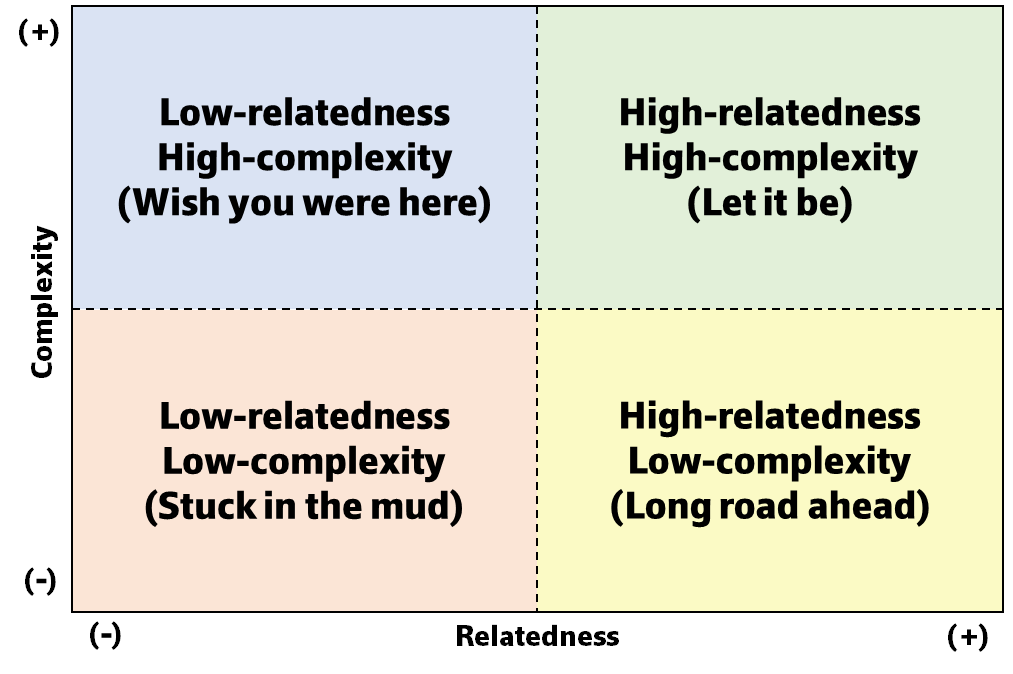
Diversification Frontier Quadrants (Hidalgo, 2023)
Read more on how Economic Complexity is measured.
What the Data Shows About Puerto Rico
Puerto Rico’s economy is more sophisticated than its size or income would suggest.
Key findings:
- Puerto Rico ranks 10th in the U.S. in Economic Complexity.
- Pharmaceuticals and chemicals account for over 80% of exports.
- The island commands major global market shares, for example, approximately 20% of global insulin exports, 90% of total U.S. sulfonamides exports, and about 10% of bulk hormones exported globally.
The Diversification Frontier reveals that Puerto Rico has “hidden capabilities” that could unlock new, high-value sectors, reducing its concentration in pharmaceuticals and building new industrial clusters.
Click to read more on Puerto Rico’s economy through the complexity lens.
Policy Recommendations: A Roadmap for Action
To move toward a modern industrial policy, Puerto Rico must make Economic Complexity part of everyday decision-making.
Key Recommendations:
- Measure and publish complexity metrics regularly: Integrate them into the Puerto Rico Planning Board and the Department of Economic Development and Commerce’s annual economic reporting.
- Train government agencies: Build the technical and analytical capacity needed to use these tools across administrations.
- Engage the private sector: Create a standing dialogue to validate opportunities and align incentives.
- Align incentives with complexity goals: Reward investments that expand the island’s productive knowledge and diversify exports.
On Our Radar
With the recent issuance of Executive Order 2025‑053, Puerto Rico’s government has opened a window to institutionalize a coordinated, metrics-driven economic development strategy involving government, business, and academia. Our economic complexity methodology uniquely aligns with this mandate, and we’ve already started gathering stakeholders.

During a recent working session with leaders from Puerto Rico’s private sector, Rafael Vélez-Domínguez, President of the Puerto Rico Manufacturers Association, said the tool provides “a roadmap for Puerto Rican industry not only to adapt but to lead with innovation and added value. Today more than ever, we are taking firm steps to transform our strengths into real opportunities and work through public-private collaboration to position Puerto Rico as a competitive industrial hub in the region”.