
Published on March 25, 2026 / Leer en español
In This Issue
In this edition of the CNE Review, our Policy Director Sergio M. Marxuach analyzes the PREPA Title III bankruptcy case as it enters its ninth year: still unresolved, and with enormous consequences for Puerto Rico’s electricity rates, grid investment, and economic future.
We also include a Data Snapshot showing how the size of a potential settlement would translate directly into costs for ratepayers.
Finally, in our On Our Radar section, we share a recent article on technology and the economy that caught our attention this month.
Insights + Analysis from CNE
PREPA Title III: Threading the Needle
Por Sergio M. Marxuach, Policy Director
Nine years into PREPA’s Title III bankruptcy proceeding, there is still no agreement between the Financial Oversight and Management Board and the utility’s major creditor groups. The stakes could not be higher: how this case is resolved will shape Puerto Rico’s electricity rates, its capacity to attract private investment in renewable energy, and the long-term viability of the grid itself.
A November 2024 First Circuit ruling changed the landscape. The court affirmed that bondholders hold an $8.5 billion claim secured by a lien on PREPA’s net revenues, but also clarified that their actual recovery depends on what those revenues turn out to be, and that they have no recourse to any other government assets. Both sides, in other words, had something to celebrate.
The single most consequential variable is time. Every year that PREPA remains in bankruptcy is a year in which grid investment is deferred, federal incentives go unused, costly litigation drags on, transition to renewables is delayed, work on the master Integrated Resource Plan stalls, and the island’s population and economic base continue to erode – reducing the very revenue base that is expected to service PREPA’s restructured debt.
The analysis in this brief identifies two bookend scenarios. At the low end, the FOMB’s proposed 23-cent recovery, roughly $2.3 billion in new bonds, would add an estimated 1.6 cents per kWh to customer bills. At the high end, full repayment of $11 to $12 billion would require surcharges of 6 to 9 or more cents per kWh, pushing blended rates to 34 to 37 cents and almost certainly triggering a rate-revenue death spiral that would accelerate grid defection, erode the revenue base, and ultimately make the plan unworkable.
The window for a reasonable settlement is narrow, and every year of delay is itself a cost Puerto Rico cannot afford.
Data Snapshot
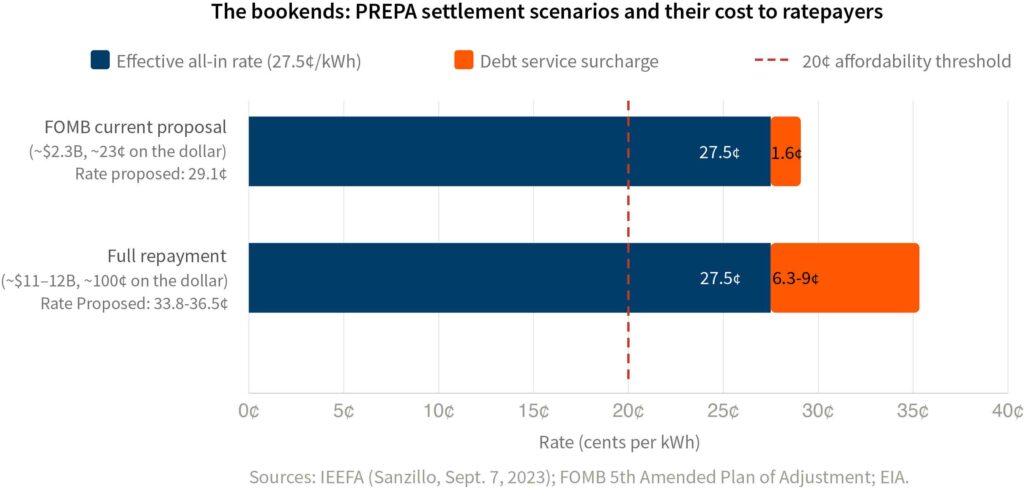
Puerto Rico already pays 27.5 cents per kWh (including provisional charges approved by the regulator at the end of 2025), well above the 20-cent affordability threshold recognized by both the Legislature and the Oversight Board. The size of PREPA’s bankruptcy settlement will directly determine how much higher the rates go. These two scenarios illustrate the range of outcomes analyzed in the brief, from the FOMB’s current proposal to full repayment, and what each would cost ratepayers every month. For a full analysis, read the brief.
On Our Radar
The Anthropic Economic Index: AI’s Uneven Footprint on Labor Markets – Anthropic’s January 2026 Economic Index report — the most comprehensive empirical analysis to date of how artificial intelligence (AI) is reshaping labor markets — finds that nearly half of all occupations now see Claude being used for at least a quarter of their tasks, up from 36% when the Index was first introduced. The pattern of use has also shifted: augmentation (52% of interactions) has now overtaken automation (45%), suggesting that workers are increasingly using AI to extend their capabilities rather than simply replacing discrete tasks. Estimated productivity gains, when adjusted for model reliability on complex tasks, are projected at approximately one percentage point of annual labor productivity growth over the next decade.
Critically, the Index also surfaces a structural concern: Claude disproportionately handles higher-skill tasks within any given occupation, meaning that when those tasks are displaced, the remaining work is systematically less complex — a dynamic the report terms net occupational deskilling. AI adoption remains highly uneven, strongly correlated with per capita income across countries, and concentrated within the top decile of task types. For policymakers in Puerto Rico and across the Caribbean, the Index’s findings underscore both the transformative potential and the distributional risks of AI adoption in lower-income, service-dependent economies.