Actualización sobre la Autoridad de Energía Eléctrica de Puerto Rico

Actualización sobre la Autoridad de Energía Eléctrica de Puerto Rico

Publicado el 11 de septiembre de 2023 / Read in English

Sergio portrait
Director de Política Pública
COMPARTA

Introducción

Décadas de corrupción, mala administración, decisiones de negocios influenciadas por la política y la postergación del mantenimiento crítico y los gastos de capital requeridos ocasionaron la quiebra de la Autoridad de Energía Eléctrica de Puerto Rico (“AEE”) en el verano de 2017. Los huracanes de septiembre de 2017 y los terremotos de 2020 debilitaron aún más la ya frágil infraestructura de transmisión y distribución eléctrica.

Ahora en 2023, la reconstrucción y transformación del sistema eléctrico de Puerto Rico está entrando en una etapa crítica, ya que varios procesos importantes -la reestructuración operacional y financiera de la AEE; el inicio de proyectos a gran escala para reconstruir la red; y la redacción de un nuevo Plan Integrado de Recursos- convergen en un momento clave.

Sin embargo, las discrepancias políticas existentes sobre el alcance del uso de gas natural durante la transición a una generación basada 100% en energía renovable y el debate sobre las ventajas y limitaciones de instalar capacidad de generación distribuida (principalmente sistemas solares en techos con baterías) en lugar de proyectos a gran escala han generado retrasos en el despliegue de nueva capacidad de generación renovable y suponen un grave riesgo para la capacidad de Puerto Rico de cumplir con sus objetivos de energía renovable.

Reestructuración operativa

La reestructuración de las operaciones de la AEE se encuentra en una etapa bastante avanzada tras la ejecución de dos acuerdos para privatizar la operación y administración de (1) la red de transmisión y distribución (“T&D”) de la AEE y (2) los activos legados de generación (“LGA”, por sus siglas en inglés).

LUMA, un consorcio canadiense/estadounidense, ha estado a cargo de las operaciones de despacho de energía y de mantener la estabilidad del sistema de T&D desde julio de 2021. La transferencia a LUMA de los activos de T&D no estuvo libre de dificultades y la empresa se enfrentó a graves problemas durante su primer año de operaciones. Recientemente, sin embargo, el sistema de transmisión y distribución parece haber ganado cierta estabilidad, aunque la duración y la frecuencia de los apagones imprevistos siguen estando muy por encima de la media en comparación con compañías similares en Estados Unidos.

Igual de importante es que LUMA es la principal entidad encargada de trabajar con FEMA en el rediseño y reconstrucción del sistema de T&D. Este proceso ha tomado más tiempo de lo esperado en parte debido a los procedimientos especiales impuestos por FEMA (Sección 428 de la Ley Stafford), en parte debido a la curva de aprendizaje de LUMA con respecto al sistema energético de Puerto Rico, y en parte también debido a la multiplicidad de planes/propuestas para reconstruir la red. Según el Plan Fiscal más reciente de la AEE, “desde el comienzo del Año Fiscal 2023, LUMA ha sometido un total de 341 alcances de trabajo (SOW, por sus siglas en inglés) a FEMA para proyectos de T&D que representan un estimado de $7,100 millones en actividades de reconstrucción”. (Plan Fiscal de la AEE, pág. 98) No está claro en el Plan Fiscal cuántos de estos SOW han sido “aprobados” o en qué etapa del proceso de trabajo se encuentra (planificación, diseño, en progreso o finalizados) cada uno.

A principios de este año, el gobierno de Puerto Rico seleccionó a Genera PR, una filial de New Fortress Energy (una compañía de gas natural), para administrar y operar la flota de LGA de la AEE. Como parte del acuerdo, Genera está obligada a realizar algunos gastos de capital a corto plazo (financiados por FEMA) para estabilizar el sistema, generar ahorros mediante la renegociación de los contratos de combustible y, finalmente, comenzar la decomisación de las LGA.

Aunque el gobierno tiene grandes esperanzas de generar ahorros mediante el aumento de la eficiencia del sistema y la renegociación de los contratos de combustible, los verdaderos ahorros vendrán de la decomisación de la envejecida flota de generación de combustible fósil de la AEE. Es poco probable, sin embargo, que esos ahorros se realicen a corto plazo porque (1) la generación de combustible fósil puede ser decomisada sólo cuando haya suficiente capacidad renovable nueva para reemplazarla y ese proceso ha tomado más tiempo de lo esperado; y (2) Genera, como subsidiaria de una compañía de gas natural, puede tener un incentivo para prolongar la vida de la flota de generación existente (bajo el pretexto de que no hay suficiente generación renovable disponible) y comprarle el gas natural requerido a su compañía matriz.

Reestructuración financiera

La AEE ha estado en negociaciones con sus acreedores desde julio de 2017. Sin embargo, seis años de duras negociaciones intermitentes no han dado lugar hasta la fecha a un plan integral de ajuste certificado por la corte de las obligaciones de la AEE. Actualmente, la AEE debe alrededor de $9,000 millones en bonos pendientes, tiene un pasivo de pensiones no financiado de $3,800 millones y debe $700 millones adicionales a los prestamistas de la línea de combustible y varios millones más a acreedores no garantizados.

Según el Plan Fiscal de la AEE, “sin reestructurar su deuda y otros pasivos, la AEE tendría que pagar aproximadamente $2,620 millones de obligaciones de deuda heredadas programadas en cuatro años desde el año fiscal 2024 hasta el año fiscal 2027, además de los aproximadamente $4,830 millones de montos vencidos y actualmente vencidos hasta el final del año fiscal 2023″. Pagar las obligaciones de deuda no reestructuradas de la AEE a corto plazo requeriría aumentos de tarifa de aproximadamente 6 a 7 ¢/kWh en dólares reales en el período de AF24 a AF27. A largo plazo, sin ninguna reestructuración, la obligación anual estimada del servicio de la deuda de la AEE sería de aproximadamente $1,000 millones al año, basada en la amortización de todos los pasivos financieros a largo plazo a una tasa de interés de 5.25% durante 20 años”. (Plan Fiscal de la AEE, pág. 140) Bajo ese escenario, el cliente residencial promedio que consume 425 kWh al mes vería su factura aumentar en aproximadamente 26%. Claramente, ese es un escenario insostenible dado el estancamiento de la economía de Puerto Rico y las altas tasas de pobreza.

El proceso legal continúa conforme a los procedimientos establecidos por el Título III de la Ley para la Supervisión, Administración y Estabilidad Económica de Puerto Rico (“PROMESA”, por sus siglas en inglés). En junio de 2023, la jueza que preside el proceso determinó que los bonistas sólo tenían un gravamen parcial sobre los ingresos de la AEE y que existían riesgos significativos asociados con otros remedios que pudieran solicitar (por ejemplo, el nombramiento de un síndico). Por lo tanto, estimó el valor de su reclamación en $2,380 millones.

El 25 de agosto de 2023, la Junta de Supervisión y Administración Financiera para Puerto Rico (“JSAF”) anunció que había “presentado el tercer Plan de Ajuste enmendado para reducir más de $10,000 millones del total de reclamaciones afirmadas por varios acreedores contra la AEE en casi un 80%, al equivalente de $2,500 millones, excluyendo las obligaciones de pensiones”. (Comunicado de prensa de la JSAF, 25 de agosto de 2023) Según la JSAF, el valor nominal de la deuda de los bonistas se reduciría de $8,400 millones a aproximadamente $2,400 millones. Los bonistas que apoyen el plan recuperarían (en forma de nuevos bonos) el 12.5% de su reclamo original, mientras que los bonistas que no estén de acuerdo con el plan propuesto recuperarían el 3.5% de su reclamo. Los acreedores generales no asegurados recuperarían, se supone que en efectivo, aproximadamente el 13.5% de sus reclamaciones iniciales. Las negociaciones continúan con los representantes de los pensionados de la AEE y otros beneficiarios del plan de retiro.

La JSAF estima que el acuerdo con los bonistas y otros acreedores (excluidos los jubilados) supondría un aumento medio del 5% en la factura mensual de electricidad. Este estimado aumentará sin duda, dependiendo del acuerdo sobre las pensiones. En el momento de escribir estas líneas, un grupo relativamente grande de bonistas ha anunciado su oposición al plan propuesto y es probable que acaben presentando un recurso ante el Tribunal de Apelaciones del Primer Circuito de Estados Unidos. Mientras tanto, la jueza del caso de Título III ha anunciado marzo de 2024 como fecha límite para certificar el plan de ajuste de la AEE.

Nuevo Plan Integrado de Recursos

La Ley 57 de 2014 requiere que la AEE, ahora LUMA como su agente, prepare un Plan Integrado de Recursos (“PIR”) para un período de planificación de 20 años y lo actualice cada tres años. La ley define un PIR como “un plan de recursos que considerará todos los recursos razonables, incluyendo tanto el suministro de energía (por ejemplo, generación a escala de servicios públicos) como la demanda de energía (por ejemplo, eficiencia energética, respuesta a la demanda y generación distribuida), para satisfacer las necesidades actuales y futuras proyectadas del sistema energético de Puerto Rico y sus clientes al menor costo razonable”. (Plan Fiscal de la AEE, pp. 26 y 27) En abril de 2022, el Negociado de Energía de Puerto Rico (el “NEPR”) extendió la fecha límite para la radicación del próximo PIR, estableciendo que LUMA radicará el próximo PIR a más tardar el 1 de marzo de 2024.

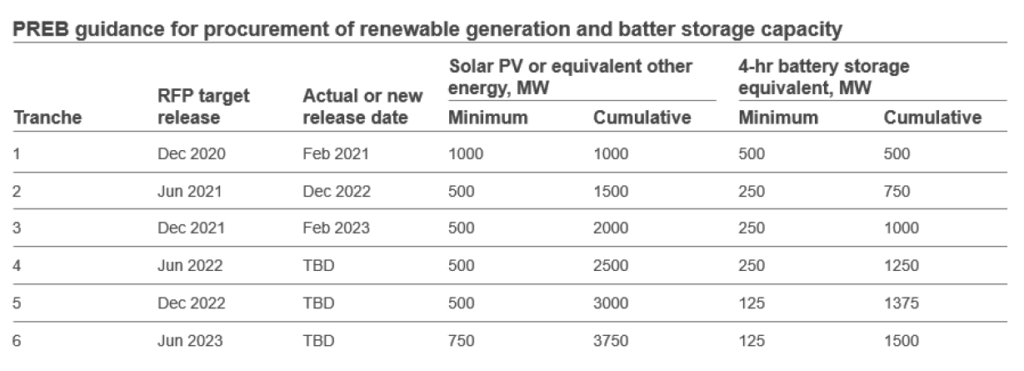
El PIR es un documento clave ya que, de acuerdo con la ley de Puerto Rico, establece el calendario y la secuencia para alcanzar el objetivo de generación 100% renovable para 2050. Lamentablemente, los objetivos intermedios fijados en el PIR actualmente en vigor (aprobado en 2020) no se han cumplido. Como puede observarse en la siguiente tabla, el proceso de contratación de generación renovable a gran escala tiene aproximadamente dos años de retraso:


Fuente: Plan Fiscal de la AEE 2023-24, p. 85.

Según el Plan Fiscal, “la AEE ha renegociado o completado la adquisición de 844.8 MW de nueva capacidad de generación renovable.  Sin embargo, al concluir el segundo trimestre de 2023, ninguno de estos proyectos ha alcanzado el cierre financiero o comenzado la construcción, lo que resulta en retrasos significativos en comparación con los plazos de adquisición y desarrollo establecidos por el NEPR”. (Plan Fiscal de la AEE, pág. 26) Además, “el 26 de abril de 2023 el NEPR emitió una orden requiriendo una investigación exhaustiva del proceso de adquisición del Tramo (“Tranche”) 1 de energía renovable y almacenamiento en baterías debido a los retrasos persistentes. La orden del NEPR establece que los retrasos en el proceso de adquisición del Tramo 1 “podrían afectar” las metas regulatorias de energía renovable a corto, mediano y largo plazo”. (Plan Fiscal de la AEE, pág. 54)

Dados los retrasos ocurridos durante el proceso del Tramo 1, el NEPR decidió nombrar a un “coordinador independiente”, Acción Group, LLC, para llevar a cabo las RFP de los Tramos 2 y 3. Al momento de redactar este informe, no tenemos claro quién dirige y opera Acción Group. Además, las RFP de los Tramos 4 a 6 se han pospuesto indefinidamente.

Con respecto a las instalaciones solares en los techos, LUMA afirma haber conectado a más de 50,000 clientes, que representan 300 MW de capacidad de generación, desde que se hizo cargo de la operación del sistema de T&D en 2021. (Plan Fiscal de la AEE, pág. 19) El Departamento de Energía de los Estados Unidos (“DOE”, por sus siglas en inglés) estima que, para junio de 2023, había un total de 85,661 interconexiones solares de techo en Puerto Rico. Si bien estas estadísticas muestran cierto progreso en la interconexión de sistemas solares sobre techos, también ponen de relieve la lentitud de la transición, ya que la AEE tiene más de 1,000,000 de clientes.

Reconstrucción del sistema de T&D

Según el Plan Fiscal, “al 2 de junio de 2023, la AEE ha recibido más de $15,000 millones de fondos federales en total. Aproximadamente $12,000 millones de fondos de FEMA están obligados para trabajos permanentes y se ha recibido la aprobación para proyectos que ascienden a aproximadamente $2,300 millones. El resto del financiamiento federal obligado incluye aproximadamente $2,400 millones de financiamiento de FEMA para trabajos de emergencia, aproximadamente $600 millones de financiamiento de FEMA para costos de administración y aproximadamente $2,300 millones de financiamiento de CDBG”. (Plan Fiscal de la AEE, pág. 87) Por lo tanto, en términos de fondos para la reconstrucción de la red, sólo el 19% de los fondos de FEMA ha sido “aprobado” para ser gastado.

En términos del número de proyectos de trabajo permanente para reconstruir la red, una presentación reciente del DOE indica que para julio de 2023, había 220 proyectos de mejoras a la red en el “pipeline” de FEMA; 134 proyectos de mejoras a la red habían sido “aprobados” por FEMA; y 60 mejoras a la red habían “comenzado a construirse”. La presentación del DOE no establece el número total de proyectos de mejora de la red necesarios para la reconstrucción de toda la red.

Independientemente de la métrica que utilicemos, la conclusión parece ser que el proceso de reconstrucción de la red ha avanzado a un ritmo relativamente lento. Varios factores explican esta situación. En primer lugar, no está claro, al menos para los observadores externos, qué plan de modernización de la red es el que va a implantarse: hay un plan diseñado por la AEE, está el actual PIR, está el plan de remediación del sistema de LUMA y está el plan de modernización de la red que está desarrollando el DOE en el momento de escribir estas líneas. No nos queda claro cómo cada uno de estos planes se relaciona con el otro ni cuál tiene precedencia en caso de conflictos entre ellos.

En segundo lugar, tanto la AEE como FEMA han acordado construir una importante capacidad de generación nueva basada en gas natural en la antigua central de Palo Seco. Esta inversión de aproximadamente $900 millones ha sido cuestionada por los ambientalistas como innecesaria y quizás hasta ilegal dado el requisito estatutario de alcanzar una generación 100% renovable para 2050 en Puerto Rico. Los defensores, por otro lado, argumentan que esta nueva capacidad de generación con combustible fósil es necesaria para estabilizar el sistema y crear un “puente” hacia la generación renovable en toda la isla. Es importante abordar este asunto político lo antes posible para evitar más retrasos.

Por último, existe un fuerte desacuerdo entre los defensores de la generación renovable distribuida y los que favorecen las instalaciones centralizadas de generación solar a gran escala. Los defensores de los sistemas solares en techos argumentan que hay suficientes techos en Puerto Rico para instalar suficiente capacidad como para hacer innecesaria la construcción de instalaciones solares a gran escala en Puerto Rico.

Los defensores de las instalaciones solares a gran escala argumentan que un sistema basado únicamente en techos sería inestable dada la demanda energética de Puerto Rico, tarda demasiado tiempo en llegar a una escala económica y no tiene en cuenta las necesidades de (1) las personas que viven en unidades multifamiliares, (2) los clientes comerciales y (3) las operaciones industriales y manufactureras. El DOE, en un informe provisional, concluyó que Puerto Rico necesita ambos tipos de sistemas.

Este debate es más que un mero desacuerdo sobre política pública porque la decisión política influirá en el diseño de la nueva red. Si el gobierno de Puerto Rico decide depender mayormente de sistemas solares distribuidos en los techos, la red tendrá que diseñarse de una manera; mientras que si decide depender mayormente de la generación solar centralizada a escala la red tendrá que diseñarse de otra manera. Parece que el DOE ha llegado a la conclusión de que la nueva red puede diseñarse para dar cabida tanto a la generación solar distribuida en los techos, que es buena para las comunidades aisladas y de difícil acceso, como a la generación a gran escala, que puede proporcionar cargas base estables al sistema. Por desgracia, el informe final del DOE sobre el diseño de la red no estará listo hasta diciembre de este año. Por tanto, parece poco probable que este desacuerdo político se resuelva antes de esa fecha.

Puerto Rico Electric Power Authority Update

Puerto Rico Electric Power Authority Update

Published on September 11, 2023 / Leer en español

Sergio portrait
Policy Director
SHARE

Introduction

Decades of corruption, mismanagement, politically influenced business decisions, and postponing critical maintenance and required capital expenditures resulted in the bankruptcy of the Puerto Rico Electric Power Authority (“PREPA”) in the summer of 2017. The hurricanes of September 2017 and the earthquakes of 2020 further weakened PREPA’s already fragile infrastructure.

Now in 2023, the reconstruction and transformation of Puerto Rico’s electric power system is entering a critical stage, as several important processes—PREPA’s operational and financial restructuring; the commencement of large-scale projects to rebuild the grid; and the elaboration of a new Integrated Resource Plan—converge at a key point in time.

However, existing policy disagreements regarding the extent of the use of natural gas during the transition to 100% renewable generation and the ongoing debate about the advantages and limitations of installing distributed generation capacity (mostly rooftop solar systems with batteries) instead of utility-scale projects have generated delays in the rollout of new renewable generation capacity and pose a serious risk to Puerto Rico’s ability to meet its renewable energy objectives.

Operational Restructuring

The restructuring of PREPA’s operations is at a fairly advanced stage after the execution of two agreements to outsource the operation and management of PREPA’s (1) transmission and distribution (“T&D”) grid and (2) legacy generation assets (“LGA”).

LUMA, a Canadian/American consortium, has been in charge of energy dispatch operations and maintaining the stability of the T&D system since July 2021. The transfer to LUMA of the T&D assets was bumpy and the company faced severe problems during its first year of operations. Recently, however, the T&D system has appeared to gain some stability although rolling blackouts and unplanned outage rates are still significantly above average when compared with similar utilities in the mainland.

Equally important is that LUMA is the main entity in charge of working with FEMA on the redesign and rebuilding of the T&D system. This process has taken longer than expected in part due to special procedures imposed by FEMA (Section 428 of the Stafford Act), in part due to LUMA’s learning curve with respect to Puerto Rico’s energy system, and partly also due to the multiplicity of plans/proposals to rebuild the grid. According to PREPA’s most recent Fiscal Plan, “since the start of Fiscal Year 2023, LUMA has submitted a total of 341 SOWs [scopes of work] to FEMA for T&D projects representing an estimated $7.1 billion in reconstruction activities.” (PREPA Fiscal Plan, p. 98) It is not clear from the Fiscal Plan how many of these SOWs have been approved or in what stage of the work process they are (planning, design, in progress, or finalized).

Early this year the government of Puerto Rico selected Genera PR, a subsidiary of New Fortress Energy (a natural gas company), to manage and operate PREPA’s aging fleet of LGAs. As part of the agreement, Genera is required to make some short-term capital expenditures (funded by FEMA) to stabilize the system, generate savings from renegotiating fuel contracts, and eventually commence decommissioning the LGAs.

Although the government has high hopes for generating savings from increasing system efficiencies and the renegotiation of fuel contracts, the real savings will come from decommissioning PREPA’s aging fleet of fossil fuel generation. It is unlikely, though, that those savings will be realized in the short-term because (1) fossil fuel generation can be decommissioned only when there is enough new renewable capacity to replace it and that process has taken longer than expected; and (2) Genera, as a subsidiary of a natural gas company, may have an incentive to prolong the life of the existing generation fleet (under the pretense that there is insufficient renewable generation available) and purchase the required natural gas from its parent company.

Financial Restructuring

PREPA has been in negotiations with its creditors since July 2017. However, six years of tough on-and-off negotiations have not yet yielded a court-certified plan of adjustment of PREPA’s liabilities. PREPA currently owes about $9 billion in outstanding bonds, has an unfunded pension liability of $3.8 billion, owes an additional $700 million to fuel line lenders, and several million more to other unsecured creditors.

According to the PREPA Fiscal Plan, “without restructuring its debt and other liabilities, PREPA would need to repay approximately $2.62 billion of scheduled legacy debt obligations over four years from FY2024 to FY2027 in addition to the roughly $4.83 billion of unpaid past and currently due amounts through the end of FY2023. Bringing PREPA’s unrestructured debt obligations to funded status in the near term would require rate increases of approximately 6 to 7 ¢/kWh in real dollars in the FY24- 27 period. In the longer term, without any restructuring, PREPA’s estimated annual debt service obligation is approximately $1 billion per year based on amortization of all long-term financial liabilities at a 5.25% interest rate over 20 years.” (PREPA Fiscal Plan, p. 140) Under that scenario, the average residential customer who consumes 425 kWh per month would see its bill increase by approximately 26%. Clearly, that is an unsustainable scenario given Puerto Rico’s stagnant economy and high poverty rates.

The legal process continues pursuant to the procedures established by Title III of the Puerto Rico Oversight, Management, and Economic Stability Act (“PROMESA”). In June 2023, the judge presiding over the proceedings determined that bondholders had only a partial lien on PREPA’s revenues and that there were significant risks associated with other remedies they may seek (for example, the appointment of a receiver). Therefore, she estimated the value of their claim at $2.38 billion.

On August 25, 2023, the Financial Oversight and Management Board for Puerto Rico (“FOMB”) announced that it had “filed the third amended Plan of Adjustment to reduce more than $10 billion of total asserted claims by various creditors against the Puerto Rico Electric Power Authority (PREPA) by almost 80%, to the equivalent of $2.5 billion, excluding pension liabilities.” (FOMB Press Release, August 25, 2023) According to the FOMB, the face value of bondholder debt would be reduced from $8.4 billion to approximately $2.4 billion. Bondholders who support the plan would recover (in the form of new bonds) 12.5% of their original asserted claim, while bondholders who do not agree to the proposed plan would recover 3.5% of their asserted claim. General unsecured creditors would recover, presumably in cash, approximately 13.5% of their initial claims. Negotiations continue with representatives of PREPA’s pensioners and other retirement plan beneficiaries.

The FOMB estimates the settlement with bondholders and other creditors (excluding the pensioners) would result in a 5% increase in monthly electricity bills, on average. That estimate will certainly increase, depending on the pension settlement. As of this writing a relatively large group of bondholders has announced their opposition to the proposed plan and we can expect them to eventually file an appeal with the U.S. Court of Appeals for the First Circuit. In the meantime, the Title III judge has announced March 2024 as the deadline for certifying PREPA’s plan of adjustment.

New Integrated Resource Plan

Act 57 of 2014 requires PREPA, now LUMA as its agent, to prepare an Integrated Resource Plan (“IRP”) for a 20-year planning period and to update it every three years. The law defines an IRP as “a resource plan that shall consider all reasonable resources, including both energy supply (e.g. utility-scale generation) and energy demand (e.g. energy efficiency, demand response, and distributed generation), to satisfy the current and projected future needs of Puerto Rico’s energy system and its customers at the lowest reasonable cost.” (PREPA Fiscal Plan, p. 26) In April 2022, the Puerto Rico Energy Bureau (the “PREB”) extended the deadline for the next IRP filing, resolving that LUMA shall file the next IRP by no later than March 1, 2024.

The IRP is a key document since, pursuant to Puerto Rico law, it sets forth the timetable and sequence for achieving the objective of 100% renewable generation by 2050. Unfortunately, the intermediate objectives set in the IRP currently in effect (approved in 2020) have not been met. As can be seen in the chart below, the procurement process for large-scale renewable generation is approximately two years behind schedule:


Source: PREPA Fiscal Plan 2023-24, p. 85.

According to the Fiscal Plan, “PREPA has renegotiated or completed the procurement of 844.8 MW of new renewable generation capacity.  However, as of the close of the second quarter of 2023, none of these projects have reached financial close or commenced construction, resulting in significant delays as compared to PREB-established procurement and development timelines.” (PREPA Fiscal Plan, p. 26) Furthermore, “on April 26, 2023 PREB issued an order requiring a sweeping investigation into the Tranche 1 renewable energy and battery storage procurement process due to persistent delays. The PREB order states that the delays in the Tranche 1 procurement process “could affect” renewable energy regulatory goals in the short-, medium- and long-term.” (PREPA Fiscal Plan, p. 54)

Given the delays that occurred during the Tranche 1 process, the PREB decided to appoint an “independent coordinator”, Acción Group, LLC, to carry out the Tranche 2 and Tranche 3 RFPs. It is not clear to us who manages and operates Acción Group as of this writing. In addition, RFPs for tranches 4 through 6 have been postponed indefinitely.

With respect to rooftop solar installations, LUMA claims to have connected over 50,000 customers, representing 300 MW of generation capacity, since it took over the operation of the T&D system in 2021. (PREPA Fiscal Plan, p. 19) The U.S. Department of Energy (“DOE”) estimates that, as of June 2023, there were 85,661 rooftop solar interconnections in Puerto Rico. While these statistics show some progress in the interconnection of rooftop solar systems, they also highlight the slow rate of the transition, as PREPA has more than 1,000,000 clients.

Reconstruction of the T&D System

According to the Fiscal Plan, “as of June 2, 2023, PREPA has been awarded over $15 billion of federal funding in total. Approximately $12 billion of FEMA funding is obligated for permanent work and has received approval for projects amounting to approximately $2.3 billion. The remaining obligated federal fundings include approximately $2.4 billion FEMA funding for emergency work, approximately $600 million FEMA funding for management costs, and approximately $2.3 million CDBG funding.” (PREPA Fiscal Plan, p. 87) Thus, in terms of funding for the rebuilding of the grid, only 19% has been “approved” to be spent.

In terms of the number of permanent work projects to rebuild the grid, a recent DOE presentation states that as of July 2023, there were 220 grid improvement projects in FEMA’s “pipeline”; 134 grid improvement projects had been “approved” by FEMA; and 60 grid improvements had “broken ground”. The DOE presentation did not set forth the total number of grid improvement projects that comprise the rebuilding of the entire grid.

Regardless of the metric we use, the conclusion appears to be that the grid reconstruction process has proceeded at a relatively slow pace. Several factors explain this situation. First, it is not clear, at least to outside observers, which grid modernization plan is the one that should be implemented: there is a plan designed by PREPA, there is the current IRP, there is LUMA’s system remediation plan, and there is the grid modernization plan being developed by the DOE as of this writing. It is not clear to us how each of these plans relates to the other nor which has precedence in the case of conflicts among and between them.

Second, both PREPA and FEMA have agreed to build out significant new generation capacity based on natural gas at the old Palo Seco plant site. This investment of approximately $900 million has been questioned by environmentalists as unnecessary and perhaps even unlawful given Puerto Rico’s legal requirement to transition to 100% renewable generation by 2050. Proponents, on the other hand, argue that this new fossil fuel generation is necessary to stabilize the system and to provide a “bridge” to full renewable generation on the island. It is important to address this policy issue as soon as possible to avoid further delays.

Finally, there is a strong disagreement among and between proponents of renewable generation regarding the issue of distributed generation versus centralized utility-scale solar farms. Proponents of rooftop solar systems argue there are sufficient roofs in Puerto Rico to install enough capacity so as to render unnecessary the buildout of large utility-scale solar farms in Puerto Rico.

Proponents of large-scale solar facilities argue that a system based solely on rooftops would be unstable given Puerto Rico’s energy demand, takes too long to bring up to scale, and does not take into account the needs of (1) people who live in multifamily units, (2) commercial clients, and (3) industrial and manufacturing operations. The DOE, in an interim report, concluded that Puerto Rico needs both kinds of systems.

This debate is more than a mere policy disagreement because the policy decision will influence the design of the new grid. If the government of Puerto Rico decides to rely mostly on distributed rooftop solar systems, the grid has to be designed in one way; while if it decides to rely mostly on centralized utility-scale solar generation, the grid has to be designed in another way. It appears the DOE has concluded that the new grid can be designed to accommodate both distributed rooftop solar generation, which is good for hard-to-reach, isolated “last-mile” communities, and large-scale utility generation, which can provide stable base loads to the system. Unfortunately, the DOE final report on grid design will not be ready until December of this year. So, it appears unlikely this policy disagreement will be solved before then.

CNE Review – marzo 2023

Publicado el 16 de marzo de 2023 / Read in English

Ver todas las ediciones del
CNE Review
COMPARTA

EDICIÓN ESPECIAL

La transformación del sistema energético de Puerto Rico y el contrato de Genera

En esta edición del CNE Review, le damos un vistazo a la transformación del sector eléctrico de Puerto Rico. En primer lugar, presentamos un resumen de los siguientes procesos en curso: la reestructuración de la deuda de la AEE, la reconstrucción del sistema energético de Puerto Rico, la transición a una nueva operadora de la red y el Proyecto PR100.

A esta actualización le sigue un informe de política pública que examina lo que se conoce como “el contrato de Genera” o el Acuerdo de Operación y Mantenimiento de las Instalaciones de Generación Térmica de Puerto Rico. Nuestro director de Política Pública analizó en detalle más de 600 páginas entre el contrato, el Informe del Comité de Alianzas Público-Privadas y otros documentos complementarios para destacar los aspectos más críticos de la transacción para nuestros lectores.

CNE ha elaborado consistentemente los análisis más completos de los procesos de transformación de la AEE, proveyendo investigación, perspectivas y recomendaciones no partidistas a los legisladores, los medios de comunicación y al público en general. Este valioso trabajo sólo es posible gracias a nuestros donantes. Gracias por apoyar nuestro trabajo.

La transformación energética de Puerto Rico: ¿Dónde estamos?

Por Sergio M. Marxuach, director de Política Pública

El acceso a electricidad asequible, limpia y confiable es necesario para el crecimiento sostenible a largo plazo de la economía puertorriqueña. Este proceso de transformación comenzó formalmente con la promulgación de la Ley 57 del 17 de mayo de 2014, que creó la Comisión de Energía de Puerto Rico (ahora el Negociado de Energía de Puerto Rico) para reglamentar la generación, transmisión, distribución y venta de electricidad en Puerto Rico.

Desde entonces, se han promulgado otras leyes y reglamentos para establecer la política energética a largo plazo de Puerto Rico; exigir la separación de las operaciones verticalmente integradas de la Autoridad de Energía Eléctrica de Puerto Rico (“AEE”); y ampliar la instalación de capacidad de generación utilizando fuentes de energía renovables. De hecho, Puerto Rico se ha comprometido a satisfacer sus necesidades de electricidad con un 100% de energía renovable para 2050, junto con la realización de objetivos interinos del 40% para 2025, el 60% para 2040, la eliminación gradual de la generación a base de carbón para 2028, y una mejoría del 30% en la eficiencia energética para 2040.

Además de toda esa actividad legislativa y reglamentaria, actualmente están en curso los siguientes procesos:

Reestructuración de la deuda de la AEE – Tras años de mala administración, la AEE (a través de la Junta de Supervisión y Administración Financiera, “JSAF”) radicó en julio de 2017 una petición para reestructurar sus obligaciones financieras mediante el procedimiento similar al de quiebra provisto por el Título III de la Ley de Supervisión, Administración y Estabilidad Económica de Puerto Rico (“PROMESA”, por sus siglas en inglés). Tras seis años de arduas negociaciones, la mayoría de los acreedores no han llegado a un acuerdo consensuado con la JSAF. El 9 de febrero de 2023, la JSAF radicó una propuesta enmendada del Plan de Ajuste para reducir las obligaciones de la AEE aproximadamente en un 50%. Dada la falta de acuerdo entre las partes, es probable que algunas de las cuestiones jurídicas subyacentes tengan que ser litigadas antes de que cualquier propuesta de plan de ajuste sea confirmada por el Tribunal. Este proceso de litigio, incluyendo cualquier apelación, podría tomar de 12 a 18 meses adicionales.

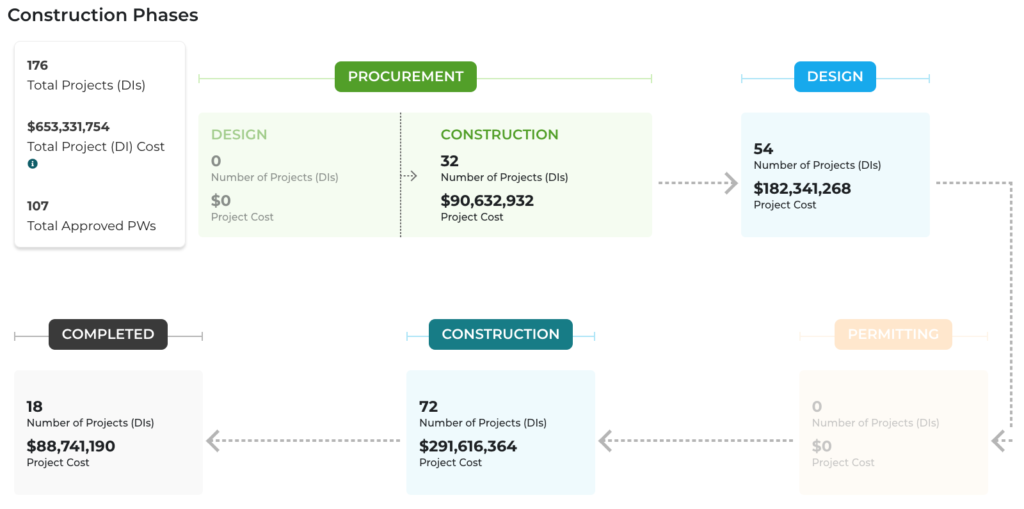
Reconstrucción del sistema energético de Puerto Rico – El huracán María devastó la red eléctrica de Puerto Rico en septiembre de 2017. El gobierno federal, a través de FEMA y HUD, ha asignado aproximadamente $12,000 millones, en su mayoría para la reconstrucción de la red eléctrica. Sin embargo, según datos de la Oficina Central de Recuperación, Reconstrucción y Resiliencia, al 6 de marzo de 2023, solo se habían completado 18 proyectos de reconstrucción de obras permanentes en el sector energético, para un total de $88,741,190 (ver la gráfica a continuación para más detalles). A este ritmo, se tardarían más de 100 años en completar la reconstrucción de la red eléctrica de Puerto Rico. Para ser justos, el retraso en el gasto de estos fondos se ha debido en parte a la imposición de requisitos burocráticos federales onerosos y en algunas instancias sin precedentes a Puerto Rico. No obstante, más de cinco años después del huracán María, la cantidad de dinero gastada en la reconstrucción de la red eléctrica sigue siendo bien poca.


Fuente: Oficina Central de Recuperación, Reconstrucción y Resiliencia Transición a una nueva operadora de la red – El 22 de junio de 2020, la AEE, la Autoridad para las Alianzas Público-Privadas de Puerto Rico (la “Autoridad P3”), LUMA Energy LLC, y LUMA Energy ServCo, LLC (“LUMA”), suscribieron un Acuerdo de Operación y Mantenimiento de Transmisión y Distribución (el “Acuerdo de O&M de T&D”), según el cual LUMA opera, mantiene y moderniza el sistema de transmisión y distribución de la AEE, durante un período de 15 años. La transición de la AEE a LUMA ha sido tempestuosa, por no decir otra cosa, debido en parte a la inexperiencia del gobierno de Puerto Rico en la administración de este tipo de acuerdos y en parte por la arrogancia de LUMA y su subestimación de la complejidad y la dificultad de las tareas que se comprometía a realizar en virtud del Acuerdo de O&M de T&D. Sin embargo, la red eléctrica, que para ser justos se encuentra en bastante mal estado, parece haberse estabilizado desde principios de 2023. Proyecto PR 100 – El 2 de febrero de 2022, el Departamento de Energía de EE.UU. (“DOE”, por sus siglas en inglés) puso en marcha el Estudio de Resiliencia de la Red de Puerto Rico y Transición a un 100% de Energía Renovable (“PR100”). Se trata de un “estudio de dos años realizado por la Oficina de Despliegue de la Red del DOE y seis laboratorios nacionales para analizar en detalle las propuestas impulsadas por varias partes interesadas para lograr un futuro de energía limpia en Puerto Rico. El PR100 conlleva cinco actividades, con énfasis en modelar y analizar escenarios que cumplan los objetivos de energía renovable de Puerto Rico y alcancen los objetivos de recuperación a corto plazo y la resiliencia energética a largo plazo”. En enero de 2023, el DOE presentó un informe de progreso de un año. Se espera que el informe final y las recomendaciones se hagan públicos en diciembre de 2023 o principios de 2024.

Análisis de CNE

Análisis del Acuerdo de Operación y Mantenimiento de las Instalaciones de Generación Térmica de Puerto Rico

Por Sergio M. Marxuach, director de Política Pública

El 24 de enero de 2023, la Autoridad de Energía Eléctrica de Puerto Rico (la “AEE” o la “Propietaria”), la Autoridad para las Alianzas Público-Privadas de Puerto Rico (“P3A” o la “Administradora”), y Genera PR LLC (la “Operadora” o “Genera”), firmaron el Acuerdo de Operación y Mantenimiento de las Instalaciones de Generación Térmica de Puerto Rico (el “Acuerdo de O&M de Generación”) estableciendo los términos y condiciones bajo los cuales la Operadora operará, mantendrá y eventualmente desmantelará ciertos Activos Legados de Generación propiedad de la AEE. La ejecución del Acuerdo de O&M de Generación es el paso más reciente en la transformación a largo plazo del mercado de electricidad de Puerto Rico.

En el informe de política pública presentamos un análisis de los principales componentes del acuerdo, incluyendo la estructura básica de la transacción; la compensación de la Operadora (incluyendo los incentivos y penalidades); el ahorro estimado que se generará como resultado de la contratación de una operadora privada para operar y mantener los Activos Legados de Generación; el desmantelamiento previsto de la mayoría de las instalaciones existentes que actualmente utilizan combustibles fósiles para generar electricidad en Puerto Rico; y la estructura del mercado eléctrico de Puerto Rico. A continuación, algunos de los aspectos más destacados.

La estructura del acuerdo

Los costos energéticos en Puerto Rico son muy elevados ya que dependemos de centrales de generación anticuadas que queman principalmente combustibles fósiles, lo que representa el 70% de los costos operativos. El Acuerdo establece el plan para la transición a la generación de energía renovable (y/o gas natural e hidrógeno) que podría proporcionar una reducción significativa en el costo de la energía a largo plazo, dependiendo de cómo se logre este difícil y complejo proceso de desmantelamiento de la generación de combustibles fósiles mientras se despliega simultáneamente la generación renovable a gran escala. El contrato, de más de 300 páginas, establece las condiciones según las cuales Genera operará, mantendrá y, en su momento, desmantelará determinadas centrales eléctricas.

Genera fue contratada para prestar, directamente o a través de subcontratistas, cuatro tipos de servicios: Servicios de Movilización, Servicios de Operación y Mantenimiento, Servicios de Desmantelamiento y Servicios de Desmovilización. A cambio de la prestación de estos servicios, la Operadora tiene derecho a recibir ciertas compensaciones, sujetas a cualquier incentivo o penalidad aplicable.

Los ahorros previstos

El gobierno de Puerto Rico ha afirmado que espera que este acuerdo genere ahorros significativos. Sin embargo, a corto plazo, los ahorros estimados por Genera serán insuficientes para ofrecer cualquier ahorro a los consumidores, aun partiendo de la premisa que la deuda de la AEE se reduce aproximadamente en un 50% a $5,000 millones y paga un 6% de interés anual, lo que significa que los consumidores tendrán que pagar $300 millones anuales para pagar el servicio de la deuda reestructurada. Genera estima, según se establece en un informe de FTI Consulting, que los “ahorros estimados combinados de O&M y combustible oscilan entre $100 millones y $200 millones anuales (incluyendo los ahorros de la conversión a gas natural si son aprobados por el NEPR)”. Según los términos del Acuerdo de O&M de Generación esos “ahorros se repartirían al 50%/50% entre Genera y los consumidores de Puerto Rico. Esto supondría entre $50 y $100 millones al año para los clientes del sistema eléctrico de Puerto Rico”. La metodología utilizada por Genera para calcular esos ahorros previstos no se expone en el informe de FTI, por lo que no puede evaluarse adecuadamente.

Genera insiste en señalar el ahorro potencial que se obtendría de la conversión de las centrales que queman petróleo a instalaciones que quemen gas natural. Tales conversiones generarían aproximadamente el 50% del ahorro total previsto del acuerdo. Dado que Genera es una filial propiedad 100% de New Fortress Energy, una compañía que produce y suministra gas natural, surge un claro conflicto de intereses. Sin embargo, el acuerdo incluye una política abarcadora para abordar los conflictos de intereses. Queda por ver hasta qué punto se hará cumplir y se aplicará esa política. Además, el Acuerdo no identifica quién pagaría los gastos de capital necesarios para tales conversiones ni explica cómo se verán afectados los ahorros previstos una vez que se tome en cuenta el costo del capital.

Lo bueno y lo malo

Varios elementos del acuerdo nuevo son claramente superiores al contrato de LUMA. Entre ellos podemos mencionar que:

  • la estructura de compensación está bien desarrollada y supone una mejoría significativa con respecto al contrato de LUMA, que era deficiente en este aspecto.
  • incluye puntos de referencia claros para medir el desempeño de Genera,
  • filtros más fuertes para analizar las transacciones con compañías afiliadas y partes relacionadas, incluyendo una política integral para abordar los conflictos de interés de la organización;
  • el requisito de entablar negociaciones de buena fe con los empleados actuales de la AEE para minimizar la curva de aprendizaje de la nueva operadora;
  • y un tope fijo en los honorarios que la Operadora puede ganar durante el Período de Movilización

Todos apuntan a la conclusión de que este contrato ofrece mejores protecciones al pueblo de Puerto Rico de algunos de los riesgos que se podrían anticipar de esta transacción.

Otros aspectos del contrato no son tan buenos. Por ejemplo:

  • La mayoría de los servicios serán provistos por subcontratistas (¿no sería más eficiente contratarlos directamente?);
  • El análisis del los ahorros previstos es clarmente deficiente y nos gustaría ver un examen más riguroso de esos supuestos ahorros; y
  • No nos queda claro que la estructura de mercado que resultará llevará a precios más bajos, generará eficiencias y/o producirá aumentos significativos en el bienestar del consumidor.

Cabe destacar: Comprar localmente

Una característica novedosa (para Puerto Rico) del Acuerdo de O&M de Generación es que requiere que Genera utilice esfuerzos “comercialmente razonables” para asegurar que las compañías locales, o compañías extranjeras con una presencia significativa en Puerto Rico, sean incluidas en el proceso de adquisición de materiales y servicios bajo el acuerdo. Además, exige a Genera que realice esfuerzos “comercialmente razonables” para seleccionar como subcontratistas a compañías establecidas en Puerto Rico o compañías que tengan “una presencia significativa en el Estado Libre Asociado de Puerto Rico”. Estas disposiciones, si se aplican, tienen el potencial de generar actividad económica local y permitir que las compañías y los trabajadores locales obtengan una valiosa experiencia trabajando en un complejo proyecto de varios años de duración.

En relación con el estado actual, ¿estará el mercado eléctrico de Puerto Rico en mejores condiciones bajo Genera?

Probablemente sí, pero ese punto de comparación es muy bajo. Todos los que han analizado objetivamente el desempeño de la AEE durante los últimos 30 ó 40 años han llegado a la conclusión de que es un desastre, el equivalente financiero y operativo de un caos total. Según ese criterio, intentar algo nuevo, por descabellado que parezca, probablemente representará un progreso.

Sin embargo, si ponemos un punto de comparación más alto, si nos preguntamos si esta transacción ayudará realmente a Puerto Rico a alcanzar sus objetivos de generar electricidad a un costo asequible, más limpia y confiable, entonces la respuesta no está tan clara, porque lo bueno está de hecho mezclado con lo malo. El hecho es que hay mucha incertidumbre en torno a esta transacción y es difícil evitar la inquietante sensación de que se nos está presentando un fait-accompli sobre una base de tómalo o déjalo.

Mantener el estado actual, sin embargo, no es una opción. La verdadera cuestión es si existe una alternativa mejor a un acuerdo negociado en este caso. La respuesta, teniendo en cuenta todas las circunstancias, parece ser no. Las alternativas disponibles parecen ser (1) peores, por ejemplo, resucitar la AEE; (2) poco realistas, por ejemplo, la creación de una nueva entidad similar a la Autoridad del Valle de Tennessee para proveer electricidad en Puerto Rico; o (3) francamente utópicas, como esquemas extremistas que recuerdan el Gran Salto Adelante de Mao.

Tras evaluar los riesgos y beneficios del Acuerdo de O&M de Generación nos enfrentamos a un dilema en el sentido clásico de tomar una decisión sin buenas opciones. Pero en una situación sin opciones objetivamente buenas, asumir un riesgo calculado puede ser, quizá, la mejor opción.

En nuestro radar…

Tasas de interés – Jay Powell, presidente de la Junta de Gobernadores del Sistema de la Reserva Federal, testificó ante el Comité de Banca, Vivienda y Asuntos Urbanos del Senado de Estados Unidos. En su testimonio, el Sr. Powell reiteró el compromiso de la Reserva Federal de mantener la inflación en el 2% a largo plazo. Sin embargo, “con la inflación muy por encima de nuestro objetivo a largo plazo del 2% y con un mercado laboral que sigue extremadamente apretado, el Comité Federal de Mercado Abierto ha seguido endureciendo su posición sobre la política monetaria, aumentando las tasas de interés en 4 puntos porcentuales y medio durante el pasado año. Seguimos anticipando que los continuos aumentos en los valores esperados para el tipo de los fondos federales serán apropiados para alcanzar una posición en la política monetaria que sea suficientemente restrictiva para devolver la inflación al 2% con el tiempo”. En palabras más sencillas, esto significa que la Reserva Federal seguirá aumentando los tipos de interés hasta que la inflación disminuya hasta alcanzar su objetivo de política pública a largo plazo del 2%. La verdadera pregunta es si la Reserva Federal será capaz de lograrlo sin provocar una recesión. Solo el tiempo dirá.

El límite de la deuda – El 19 de enero de 2023, Estados Unidos alcanzó su límite de deuda legal de $31.4 billones (“trillions”) “y el Tesoro anunció un ‘periodo de suspensión de emisión de deuda’ durante el cual, según la ley actual, puede tomar ‘medidas extraordinarias’ bien establecidas para pedir prestados fondos adicionales sin incumplir el límite de la deuda.” La Oficina Presupuestaria del Congreso (CBO, por sus siglas en inglés) estima que “si el límite de la deuda se mantiene sin cambios, la capacidad del gobierno para pedir prestado utilizando medidas extraordinarias se agotará entre julio y septiembre de 2023, es decir, en el cuarto trimestre del año fiscal en curso”. La fecha de agotamiento proyectada es incierta porque el calendario y la cantidad de recaudaciones de ingresos y desembolsos durante los meses intermedios podrían diferir de las proyecciones de la CBO”. Los republicanos de la Cámara de Representantes han declarado que no votarán a favor de aumentar el límite de endeudamiento a menos que el gobierno de Biden acepte recortes profundos en el gasto del gobierno federal (que pueden o no incluir el gasto en defensa, según a quién se pregunte en el bando republicano). La Casa Blanca, por su parte, ha declarado que no negociará nada que no sea un proyecto de ley de límite de deuda “limpio”. Es decir, una ley que aumente el límite de deuda sin condicionarlo a recortes de gastos. De momento, ambos partidos se mantienen firmes en sus posiciones iniciales. Un reciente informe de Moody’s Analytics concluye que no aumentar o suspender el límite de deuda tendría consecuencias nefastas para la economía estadounidense y mundial.

Solvencia de Medicare – La Administración Biden ha anunciado una propuesta para prolongar la solvencia del programa Medicare durante al menos 25 años mediante (1) el aumento de la tasa tributaria de Medicare sobre los ingresos superiores a $400,000; (2) el cierre de dispensas al pago de los impuestos existentes de Medicare; y (3) la acreditación de los ahorros de las reformas de los medicamentos recetados al Fondo Fiduciario del Seguro Hospitalario de Medicare. Hasta ahora, los republicanos del Congreso no parecen estar interesados en seguir esta ruta.

CNE Review – March 2023

Published on March 16, 2023 / Leer en español

See all editions of the
CNE Review
SHARE

SPECIAL EDITION

Puerto Rico’s Energy Transformation
and the Genera Agreement

In this edition of the CNE Review, we take a look at the ongoing transformation of Puerto Rico’s electricity sector. First, we present a summary of the following ongoing processes: the restructuring of PREPA’s debt, the reconstruction of Puerto Rico’s energy system, the transition to a new grid operator, and Project PR100. That update is followed by a policy brief that examines what has come to be known as “the Genera contract” or the Puerto Rico Thermal Generation Facilities Operation and Maintenance Agreement. Our Policy Director analyzed over 600 pages between the contract, Partnership Committee Report, and other complementary documents in detail to highlight the transaction’s most critical aspects for our readers.CNE has consistently delivered the most comprehensive analysis of PREPA’s transformation processes providing non-partisan research, insights, and recommendations to policymakers, media outlets, and the public. This valuable work is only possible thanks to our sponsors. Thank you for supporting our work.

Puerto Rico’s Energy Transformation: Where are we now?

By Sergio M. Marxuach, Policy Director

Access to affordable, clean, and reliable electricity is necessary for the long-term sustainable growth of the Puerto Rican economy. This transformation process began in earnest with the enactment of Act 57 of May 17, 2014, which created the Puerto Rico Energy Commission (now the Puerto Rico Energy Bureau) to regulate the generation, transmission, distribution, and sale of electricity in Puerto Rico. Since then, other laws and regulations have been enacted to establish Puerto Rico’s long-term energy policy; require the unbundling of the vertically integrated operations of the Puerto Rico Electric Power Authority (“PREPA”); and expand the installation of generation capacity using renewable energy sources. In fact, Puerto Rico has committed to meeting its electricity needs with 100% renewable energy by 2050, along with realizing interim goals of 40% by 2025, 60% by 2040, the phaseout of coal-fired generation by 2028, and a 30% improvement in energy efficiency by 2040. In addition to all that legislative and regulatory activity, the following processes are currently ongoing:

Restructuring PREPA’s Debt – After years of mismanagement, PREPA (through the Fiscal Oversight and Management Board, “FOMB”) filed a petition to restructure its financial obligations through the bankruptcy-like procedure provided by Title III of the Puerto Rico Oversight, Management, and Economic Stability Act (“PROMESA”) in July 2017. After six years of tough negotiations, a majority of the creditors have not reached a consensual agreement with the FOMB. On February 9, 2023, the FOMB filed an amended proposed Plan of Adjustment to reduce PREPA’s obligation approximately by 50%. Given the lack of agreement among the parties, it is likely that some of the underlying legal issues will have to be litigated before any proposed plan of adjustment is confirmed by the Court. This litigation process, including any appeals, could take an additional 12 to 18 months.

Reconstruction of Puerto Rico’s Energy System – Hurricane Maria devastated Puerto Rico’s electric system in September 2017. The federal government, through FEMA and HUD, has allocated approximately $12 billion, mostly for the reconstruction of the electric grid. However, according to data from the Puerto Rico Central Office for Recovery, Reconstruction, and Resiliency, only 18 permanent work reconstruction projects in the energy sector, totaling $88,741,190, had been completed as of March 6, 2023 (see the chart below for more detail). At this pace, it would take over 100 years to complete the reconstruction of the Puerto Rico electric grid. To be fair, the delay in spending these funds has been partly due to the imposition of burdensome and sometimes unprecedented federal bureaucratic requirements on Puerto Rico. Nonetheless, more than five years after Hurricane Maria the amount of money spent on rebuilding the electric grid remains eye-watering small.


Source: Puerto Rico Central Office for Recovery, Reconstruction and Resiliency Transition to a New Grid Operator – On June 22, 2020, PREPA, the Puerto Rico Public-Private Partnerships Authority (the “P3 Authority”), LUMA Energy LLC, and LUMA Energy ServCo, LLC (“LUMA”), entered into a Transmission and Distribution Operation and Maintenance Agreement (the “T&D O&M Agreement”), pursuant to which LUMA will operate, maintain, and modernize PREPA’s transmission and distribution system, during a period of 15 years. The transition from PREPA to LUMA has been tempestuous, to say least, due partly to the inexperience of the government of Puerto Rico in managing these kinds of agreements and partly to LUMA’s arrogance and its misjudgment of the complexity and the difficulty of the tasks it was agreeing to undertake pursuant to the T&D O&M Agreement. However, the electric grid, which to be fair is in quite a poor condition, appears to have stabilized since the beginning of 2023. Project PR 100 – On February 2, 2022, the U.S. Department of Energy (“DOE”) launched the Puerto Rico Grid Resilience and Transitions to 100% Renewable Energy Study (“PR100”). This is a “2-year study by DOE’s Grid Deployment Office and six national laboratories to comprehensively analyze stakeholder-driven pathways to Puerto Rico’s clean energy future. PR100 entails five activities, with an emphasis on modeling and analyzing scenarios that meet Puerto Rico’s renewable energy targets and achieve short-term recovery goals and long-term energy resilience.” In January 2023, the DOE presented a one-year progress report. The final report and recommendations are expected to be made public by December 2023 or early 2024.

Insights + Analysis from CNE

Analysis of PREPA Legacy Assets Public-Private Partnership Agreement

By Sergio M. Marxuach, Policy Director

On January 24, 2023, the Puerto Rico Power Electric Authority (“PREPA” or the “Owner”), the Puerto Rico Public-Private Partnerships Authority (the “P3 Authority” or the “Administrator”), and Genera PR LLC (the “Operator” or “Genera”), executed the Puerto Rico Thermal Generation Facilities Operation and Maintenance Agreement (the “Agreement”) setting forth the terms and conditions pursuant to which the Operator will operate, maintain, and eventually decommission certain Legacy Generation Assets owned by PREPA. The execution of this Agreement is the most recent step in the long-term transformation of the Puerto Rico electricity market. In the Policy Brief, we present an analysis of the principal components of the Agreement, including the basic structure of the transaction; the compensation of the Operator (including any incentives and penalties provided for therein); the estimated savings to be generated as a result of hiring a private operator to operate and maintain the Legacy Generation Assets; the planned decommission of most of the existing facilities that currently use fossil fuels to generate electricity in Puerto Rico; and the resulting structure of Puerto Rico’s electricity market. Keep scrolling for some highlights.

The Structure of the Agreement

Energy costs in Puerto Rico are very high since we depend on old power plants that burn mostly fossil fuels, which represents 70% of operational costs. The Agreement lays out the blueprint for a transition to renewable energy generation (and/or natural gas and hydrogen) which could provide a significant reduction in the cost of energy in the long term, depending on how this difficult and complex process of decommissioning fossil fuel generation while simultaneously deploying large scale renewable generation is implemented. The 300+ page contract lays out the terms and conditions pursuant to which Genera will operate, maintain and eventually decommission certain power plants.Genera was hired to provide, directly or through subcontractors, four types of services: Mobilization Services, Operation and Maintenance Services, Decommissioning Services, and Demobilization Services. In exchange for providing these services, the Operator is entitled to receive certain compensation, subject to any applicable incentive payments or penalties.

The Expected Savings

The government of Puerto Rico has stated that it expects this Agreement to generate significant savings. Yet, in the short term, the savings estimated by Genera will be insufficient to provide any savings to consumers even if PREPA’s debt is cut approximately by 50% to $5 billion and pays 6% interest, which means consumers will need to pay $300 million annually to service the restructured debt. Genera estimates, as set forth in a report by FTI Consulting, that the “combined estimated savings from O&M and fuel range from $100 million to $200 million annually (including fuel conversion savings if approved by PREB).” Under the terms of the Agreement, those “savings would be shared 50%/50% between Genera and the consumers of Puerto Rico. That would result in $50 million to $100 million per year to Puerto Rico electric system customers.” The methodology used by Genera to calculate those expected savings is not provided in the FTI report, so it cannot be properly evaluated. Genera insists on pointing to potential savings to be extracted from the conversion of oil-burning plants to facilities that burn natural gas. Such conversions would generate approximately 50% of total expected savings from the agreement. Given that Genera is a wholly-owned subsidiary of New Fortress Energy, a company that produces and delivers natural gas a clear conflict of interest arises. The Agreement, however, includes a fully-developed policy to address organizational conflicts of interest. It remains to be seen how thoroughly will that policy be enforced and implemented. In addition, the Agreement does not identify who would pay for the capital expenditures necessary for such conversions nor does it explain how expected savings will be affected once the cost of capital is taken into account.

Pros and Cons

Several elements of the new agreement are clearly superior to the LUMA Agreement. Among these we can mention:

  • a well-developed system of incentives and penalties to motivate the Operator;
  • the inclusion of clear benchmarks to measure Genera’s performance;
  • stronger filters to analyze transactions with affiliates and related parties, including a fully fleshed-out policy to address organizational conflicts of interest;
  • the requirement to engage in good faith negotiations with current PREPA employees so as to minimize the learning curve of the new operator; and
  • setting a cap on the fees that the Operator can earn during the Mobilization Period.

All point to the conclusion that this is an agreement that offers better protections to the people of Puerto Rico from some of the foreseeable risks associated with this transaction. Other aspects of the agreement are not as good. For example:

  • most of the services will be provided by subcontractors (wouldn’t it be more efficient just to contract directly with them?);
  • the analysis of the expected savings is clearly deficient and we would like to see a more rigorous examination of those professed savings; and
  • it is not clear to us that the resultant market structure will lead to lower prices, generate allocative efficiencies, and/or produce significant increases in consumer welfare.

Of Note: Buy Local Provisions

A novel feature of the Agreement is that it requires Genera to use “commercially reasonable” efforts to ensure that local companies, or foreign companies with a significant presence in Puerto Rico, are included in the procurement process for materials and services under the agreement. In addition, it requires Genera to use “commercially reasonable” efforts to select companies established under the Commonwealth of Puerto Rico or companies that have “a significant presence in the Commonwealth of Puerto Rico” as material subcontractors. These provisions, if implemented, have the potential to generate local economic activity and allow local firms and workers to obtain valuable experience working on a complex multi-year project.

So, relative to the status quo, is the post-Genera electricity market in better shape in Puerto Rico?

Probably yes, but that is an awfully low bar. Everybody who has objectively analyzed PREPA’s performance over the last 30 or 40 years has concluded that it is a mess, the financial and operational equivalent of a long-smoldering dumpster fire. By that standard, trying anything new, no matter how outlandish it may seem, would probably constitute progress. However, if we set a higher bar, if we ask whether this transaction will really help Puerto Rico achieve its long-standing goals of generating affordable, cleaner, and reliable electricity, then the answer is not quite as clear, for the good is indeed mingled with the ill. The fact is that there is a lot uncertainty surrounding this transaction and it is hard to avoid the unsettling feeling we are being presented with a fait-accompli on a take it or leave it basis. Maintaining the status quo, though, is not an option. The real question is whether there is a better alternative to a negotiated agreement in this instance. The answer, when taking into account the totality of the circumstances, appears to be no. The available alternatives seem to be (1) worse, for example, resuscitating PREPA; (2) unrealistic, entailing, for instance, the creation of a new Tennessee Valley Authority-like entity to provide electricity in Puerto Rico; or (3) downright utopian, involving extremist schemes reminiscent of Mao’s Great Leap Forward.After assessing the risks and benefits of the Generation O&M Agreement we face a dilemma in the classical sense of making a decision with no good options. But in a situation with no objectively good options, taking a calculated risk may, perhaps, be the best option.

On Our Radar…

Interest Rates – Jay Powell, Chair of the Board of Governors of the Federal Reserve System, recently testified before the Committee on Banking, Housing, and Urban Affairs of the U.S. Senate. In his statement, Mr. Powell reiterated the Federal Reserve’s commitment to keeping inflation at 2% over the long run. However, “with inflation well above our longer-run goal of 2 percent and with the labor market remaining extremely tight, the FOMC has continued to tighten the stance of monetary policy, raising interest rates by 4-1/2 percentage points over the past year. We continue to anticipate that ongoing increases in the target range for the federal funds rate will be appropriate in order to attain a stance of monetary policy that is sufficiently restrictive to return inflation to 2 percent over time.” In plain English, this means the Federal Reserve will keep increasing interest rates until inflation decreases to its policy target of 2%. The real question is whether the Fed will be able to accomplish this without triggering a recession. Only time will tell.

The Debt Limit – On January 19, 2023, the United States reached its statutory debt limit of $31.4 trillion “and the Treasury announced a ‘debt issuance suspension period’ during which, under current law, it can take well-established ‘extraordinary measures’ to borrow additional funds without breaching the debt ceiling.” The Congressional Budget Office estimates that “if the debt limit remains unchanged, the government’s ability to borrow using extraordinary measures will be exhausted between July and September 2023—that is, in the fourth quarter of the current fiscal year. The projected exhaustion date is uncertain because the timing and amount of revenue collections and outlays over the intervening months could differ from CBO’s projections.” House Republicans have stated they will not vote to increase the debt limit unless the Biden administration agrees to broad-based spending cuts (which may or may not include defense spending depending on who you ask on the Republican side). The White House, for its part, has stated it will not negotiate anything other than a “clean” debt limit bill. That is, a bill increasing the debt limit without any spending cuts attached. So far, both parties are holding fast to their initial positions. A recent report from Moody’s Analytics concludes that the failure to increase or suspend the debt limit would have dire consequences on the U.S. and global economy.

Medicare Solvency – The Biden Administration has announced a proposal to extend the solvency of the Medicare program by at least 25 years by (1) increasing the Medicare tax rate on income over $400,000; (2) closing loopholes in existing Medicare taxes; and (3) crediting savings from prescription drug reforms to the Medicare Hospital Insurance Trust Fund. So far, the Republicans in Congress appear to be uninterested in pursuing this path.

Analysis of PREPA Legacy Assets Public-Private Partnership Agreement

Analysis of PREPA Legacy Assets Public-Private Partnership Agreement

Published on March 15, 2023

Sergio portrait
Policy Director
DOWNLOAD
SHARE

Introduction

On January 24, 2023, the Puerto Rico Power Electric Authority (“PREPA” or the “Owner”), the Puerto Rico Public-Private Partnerships Authority (the “P3 Authority” or the “Administrator”), and Genera PR LLC (the “Operator” or “Genera”), executed the Puerto Rico Thermal Generation Facilities Operation and Maintenance Agreement (the “Generation O&M Agreement”) setting forth the terms and conditions pursuant to which the Operator will operate, maintain, and eventually decommission certain Legacy Generation Assets owned by PREPA.

The execution of the Generation O&M Agreement is the most recent step in the long-term transformation of the Puerto Rico electricity market. Some of the highlights of that transformation process are:

  • The enactment of Act 57 on May 17, 2014, creating the Puerto Rico Energy Commission (now the Puerto Rico Energy Bureau or the “PREB”) to regulate the electricity market in Puerto Rico, among other things;
  • The filing of a petition to restructure PREPA’s financial liabilities pursuant to Title III of the Puerto Rico Oversight, Management, and Economic Stability Act (“PROMESA”) in July 2017, a proceeding that is still pending resolution before the United States District Court for the District of Puerto Rico;
  • The enactment of Act 120 on June 21, 2018 to “establish a path for a more reliable, efficient, and low-cost electric system”;
  • The enactment of Act 17 of April 11, 2019 setting forth “the Puerto Rico Energy Public Policy”; and
  • The execution of the Transmission and Distribution Operation and Management Agreement (the “T&D O&M Agreement”) entered into on June 22, 2020, by and among PREPA, the Administrator, LUMA Energy LLC and LUMA Energy ServCo, LLC (collectively, the “T&D Operator” or “LUMA”), pursuant to which the T&D Operator “shall operate, maintain, and modernize PREPA’s transmission and distribution system (the “T&D System”).

This ten-year transformation process was prompted by PREPA’s failure to provide affordable, reliable, and efficient electric service to the people of Puerto Rico after decades of mismanagement, corruption, and non-compliance with applicable laws, regulations, and industry standards.

Indeed, according to the P3 Authority PREPA currently faces significant operational challenges, including in the following areas:

  • Safety — Since 2003, “PREPA’s safety performance has been more than five times worse that the industry average. Incident Rates for T&D and generation on an annual basis have ranged from 11.0 to 19.0, and averaged approximately 15.0; this compares to a U.S. average for public power [companies] of approximately 4.92.”[1]
  • Reliability — PREPA’s plants operate with Forced Outage Rates that are up to five times worse than the industry average and at low Equivalent Availability Factors, which increases “the likelihood of forced outages leading to an interruption of the delivery of electricity to customers. Indeed, some of these outages resulted in inadequate generation supply and significant loss of adequate power supply to meet customer demand.”[2]
  • Generation Resource Adequacy — Puerto Rico has inadequate supply resources to meet expected demand. In fact, “the load loss expectation for Puerto Rico for 2023 was calculated at 8.81 days per year, which is 88 times higher than the utility industry benchmark of 1 day in 10 years or 0.10 days per year. This means that there will be 8.81 days per year when demand will not be met by generation supply.”[3]
  • Environmental Compliance — PREPA’s record of environmental compliance has been deficient, not to say outright awful. Throughout its history it has failed to comply with the Clean Air Act, the Clean Water Act, the Mercury and Air Toxics Standards, and with several other air and water environmental rules and regulations. As a result, the “Legacy Generation Assets continue to operate at significantly lower capacity than their nameplate capacity and suffer from long-standing operational deficiencies and disrepair.”[4]
  • Corruption — PREPA has long been a source of private and public corruption in the island. PREPA’s suppliers, in many cases thanks to their political donations and influence, have benefited from contracts to provide goods and services to the public utility, sometimes at inflated, not to say borderline extortionate, prices. See, for example, the nefarious history of PREPA’s fuel and equipment procurement practices.[5]

It has become fashionable in certain circles of the self-described political avant-garde to claim that PREPA was once considered the “crown jewel” of Puerto Rico’s government (a particularly obnoxious figure of speech given our colonial history). A closer look at the historical record, though, reveals that for many years appointment to senior management positions at PREPA depended more on partisan politics than on personal merit. Technical and managerial decisions, in turn, were often subordinated to short-term political interests. PREPA survived for decades largely by postponing capital expenditures, delaying payment to suppliers, using accounting gimmicks to muddle its true financial condition, and by borrowing billions at relatively low, tax-exempt rates in the U.S. municipal bond markets, in many cases just to make the debt service on other maturing debt. That all these shenanigans eventually ended in a bankruptcy filing should not be surprising to anyone that was paying attention. Nonetheless, it is still difficult to think of other monopolies that have managed to bankrupt themselves, with the exception, perhaps, of the state-owned enterprises in the former Soviet Union.

Given all of the above, the incontrovertible conclusion is that PREPA simply cannot continue operating the way it has up until now. It has become a decrepit, some would say half-dead, zombie public utility that stifles economic activity in Puerto Rico. The time has come to take drastic action with respect to PREPA, as it has proven incapable of reforming itself and has been immune to the efforts of several administrations to modernize and improve its operations. Those who would infuse this moribund public corporation with the breath of new life bear the burden of proof to demonstrate by a preponderance of the evidence why that should be the case.

In this Policy Brief, we will present an analysis of the principal components of the Generation O&M Agreement, including the basic structure of the transaction; the compensation of the Operator (including any incentives and penalties provided for therein); the estimated savings to be generated as a result of hiring a private operator to operate and maintain the Legacy Generation Assets; the planned decommission of most of the existing facilities that currently use fossil fuels to generate electricity in Puerto Rico; and the resulting structure of Puerto Rico’s electricity market.

Structure of the Generation O&M Agreement

Genera is a wholly-owned subsidiary of New Fortress Energy (“NFE”). NFE, in turn, is “an integrated gas-to-power energy infrastructure company”, whose “business model spans the entire production and delivery chain from natural gas procurement and liquefaction to shipping, logistics, facilities and conversion or development of natural gas-fired power generation.”[6]

Genera is being hired by PREPA, as owner of the Legacy Generation Assets, to provide (either directly or through subcontractors) four classes of services, namely: (i) the Mobilization Services, (ii) the O&M Services commencing on the Service Commencement Date, (iii) the Decommissioning Services, and (iv) the Demobilization Services. In exchange for providing those services, the Operator is entitled to receive certain compensation, subject to any applicable Incentive Payments or Penalties, during the term of the Generation O&M Agreement, which is initially expected to last ten (10) years.

The Mobilization Services

The Operator is required to provide a specific set of services during the period between the Effective Date of the Generation O&M Agreement and the O&M Services Commencement Date, which is expected to be about 100 days after the Effective Date (the “Target Service Commencement Date”). The Mobilization Services, which are described in the Mobilization Plan outline set forth in Annex VII to the Generation O&M Agreement, are intended to “ensure an orderly transfer of the care, custody and control of the Legacy Generation Assets to Operator”.[7]

Those services include, among others, the evaluation and hiring of personnel; the hiring of subcontractors, if any; executing the tasks set forth in the Handover Checklist included in Annex VII; obtaining the requisite insurance; preparing a Procurement Manual; developing a Communications Plan; preparing a Fuel Optimization Plan, setting forth the Fuel Cost Savings Initiatives; and preparing a Federally Funded Generation Project Plan “listing and describing those projects proposed by Operator for priority in the receipt of any funding for the Legacy Generation Assets, received or to be received by or for the benefit of Owner from any U.S. federal agency.”[8]

During the Mobilization Period the Operator is entitled to be reimbursed for all reasonable costs and expenses (including the compensation of current employees of the Operator and any subcontractors) incurred during the course of providing the Mobilization Services, subject to a cap of $15 million. [9] If the Target Service Commencement Date is delayed by 90 days or more, except in the case of a Force Majeure Event or an event caused by Owner’s fault, then the Operator shall pay damages to PREPA in the amount of $1 million per week for each week the Target Service Commencement Date is further delayed, up to a maximum of $15 million.[10]

The O&M Services

Commencing on the Service Commencement Date, Operator shall (i) provide management, operation, maintenance, repair, restoration, replacement, and other related services for the Legacy Generation Assets, as well as any optimization procedures (including for improving fuel and efficiency) approved by the PREB, and (ii) establish policies, programs and procedures with respect thereto, to the extent not already established.[11]

The scope of the O&M Services is set forth in Annex IX to the Generation O&M Agreement. These services include, but are not limited to, the following:

(1) day-to-day operation and maintenance (including any major maintenance) services, including operation of the Legacy Generation Assets to generate electricity and deliver it into the T&D System;

(2) identifying, justifying and managing any required maintenance capital expenditures;

(3) providing routine inspections of the Legacy Generation Assets;

(4) providing annual operating tests (the Annual Performance Test) of the Legacy Generation Assets in coordination with T&D Operator;

(5) establishing appropriate and customary safety work rules and practices;

(6) developing an operation and maintenance training program;

(7) provisioning, storing and maintaining the inventory of spare and consumable parts, including Capital Spare Parts, for the Legacy Generation Assets;

(8) establishing and maintaining a computerized maintenance management system for the Legacy Generation Assets;

(9) performing scheduled and emergency maintenance, repair and replacement of equipment, including any balance of plant equipment, painting, and cleaning, among others;

(10) managing Planned Outages, Unplanned Outages and Forced Outages and restoration of power supply to the transmission grid;

(11) coordinating business continuity and emergency planning and storm restoration and recovery in coordination with T&D Operator;

(12) procuring and managing water or auxiliary power supply, as applicable;

(13) maintaining and repairing fuel and water systems, including tanks, pumps, filters, and piping, as required;

(14) procuring and managing the delivery and quality testing of fuel;

(15) liaising with the T&D Operator or any of their assignees or successors regarding dispatch, dispatch planning and related T&D system matters and providing required information;

(16) interfacing with and providing reports to regulators including PREB and with environmental compliance agencies such as the EPA, the Puerto Rico Department of Natural and Environmental Resources, the Occupational Safety and Health Administration and others, as may be required;

(17) obtaining, complying with and maintaining licenses, permits, consents and the Consent Decree, as necessary;

(18) providing periodic reports regarding programmed and non-programmed operations, maintenance, repairs, services and modifications performed and to be performed;

(19) preparing for and assisting in, or subcontracting for and overseeing, the decommissioning of the relevant plants as outlined in the Integrated Resource Plan (including any future integrated resource plans) in coordination with PREPA/the T&D Operator, Owner and PREB;

(20) participating in emergency planning and drills led by the T&D Operator, as needed;

(21) conducting emergency planning and drills independent of T&D Operator;

(22) assisting with the transition of the plants to third parties or to new uses (synchronous condensers, etc.) to the extent certain of the plants are removed from the O&M Agreement; and

(23) developing and maintaining a good neighbor program.[12]

Genera has already stated it will make extensive use of subcontractors to perform the O&M Services; specifically it intends to hire the PIC Group, “a global power and energy service provider”, and Black & Veatch, “an engineering, procurement, and consulting construction firm”.

Compensation for the O&M Services

Pass-Through Expenditures — The Operator shall be reimbursed for any reasonable and documented costs and expenses incurred by the Operator in connection with the performance of its obligations pursuant to the Generation O&M Agreement, including employee compensation, the cost of all subcontracted and seconded employees, the cost of professional services, insurance premiums, any taxes owed to the Commonwealth or any municipality, and fuel costs, among other costs and expenditures set forth in Annex XII to the Generation O&M Agreement.

However, Pass Through Expenditures do not include Disallowed Costs, as such term is defined in Section 7.7(a) of the Generation O&M Agreement, including but not limited to, any costs incurred as a consequence of the Operator’s gross negligence or willful misconduct; any fines or penalties imposed on the Operator by a governmental body; any expenditures in excess of the approved Operating Budget then in effect; or Operator Overhead costs which are included in the applicable Service Fee.[13]

O&M Fixed Fee — In addition, in exchange for providing the O&M Services, the Operator is entitled to receive an annual O&M Fixed Fee in the amount of $22.5 million, adjusted for inflation (subject to a 3% annual cap), during the term of the Generation O&M Agreement.[14]

Adjustments to the O&M Fixed Fee Upon Decommissioning of Assets — Commencing in contract year 6, the O&M Fixed Fee shall be gradually reduced to take into account the decommissioning of generation assets, subject to a $5 million floor. The amount of this reduction is calculated pursuant to a formula set forth in Section I.B. of Annex II to the Generation O&M Agreement. Incentive Payments and Penalties are also adjusted on a pro-rata basis as the O&M Fee is gradually adjusted to account for the decommissioning of the Legacy Generation Assets.

O&M Services Incentives and Penalties — During each contract year the Operator is (i) eligible to receive additional financial compensation in the form of an Incentive Payment and (ii) subject to the payment of potential Penalties, in each case based on the Operator’s performance in providing the O&M Services. For each contract year the aggregate amount of any Incentive Payments minus any Penalties shall not exceed $100,000,000, provided, however, that any excess over that amount carries over to the next contract year.[15] An amount equal to the maximum amount of the Incentive Payments available in any given Contract Year shall be included in the Operating Budget for that year. If any Penalties are determined to be due, then in accordance with Section 7.1(c)(v) of the Generation O&M Agreement, PREPA shall deduct the Penalty from the next payment of the applicable Service Fee due to the Operator following such determination.

The Operator’s performance of the O&M Services will be evaluated in six categories: (1) Operation Cost Efficiency, (2) Equivalent Availability Factor (“EAF”), (3) Safety Compliance, (4) Environmental Compliance, (5) Reporting Obligations and (6) Fuel Savings, as set forth in Section III.B of Annex II to the Generation O&M Agreement.

  1. Operation Cost Efficiency — The Operator’s cost efficiency will be measured using the applicable Operating Budget as the benchmark. Operator shall receive an O&M Incentive Payment based on a percentage of the total amount of cost savings achieved by the Operator in the delivery of the O&M Services, if any, as compared to the approved Operating Budget. The measurement parameter for this Incentive Payment consists of actual expenditures incurred as a percentage (%) of the approved Operating Budget, where actual savings equal the Operating Budget minus actual expenditures. The table below sets forth the criteria for payment:
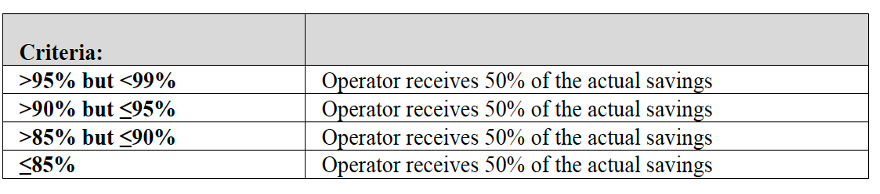

Source: Section III.B.1. of Annex II to the Generation O&M Agreement

  1. Equivalent Availability Factor — In general, the availability factor of a power plant is the amount of time that it is able to produce electricity over a certain period, divided by the amount of the time in the period. For purposes of the Generation O&M Agreement, the term Equivalent Availability Factor (“EAF”) is defined as:

EAF = (AH-EPDH-EUDH) x 100 %
PH

where:

    • AH = Available Hours
    • EPDH= Equivalent Planned Derated Hours
    • EUDH = Equivalent Unplanned Derated Hours
    • PH = Period Hours or number of hours that the Legacy Generation Asset was in active state

For every contract year, the target EAF will be calculated for each baseload and peaking unit pursuant to an annual performance test to be carried out pursuant to Section 5.22 of the Generation O&M Agreement.[16] Incentive Payments or Penalties, as the case may be, will be calculated in accordance with the criteria set forth below.

For Baseload Units:
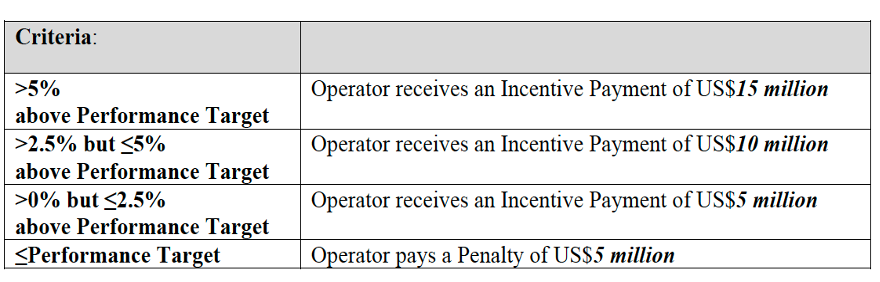

Source: Section III.B.2. of Annex II to the Generation O&M Agreement

For Peaking Units:
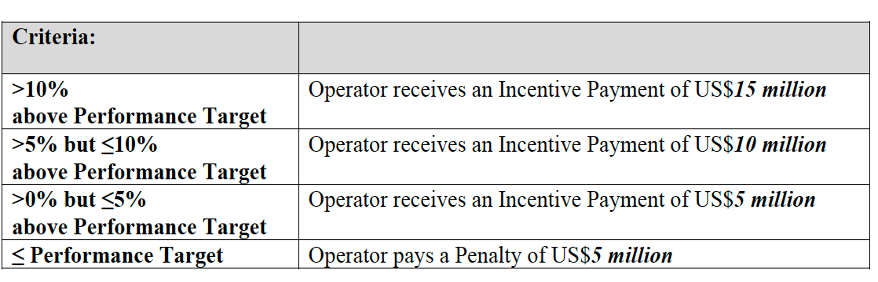

Source: Section III.B.2. of Annex II to the Generation O&M Agreement

The Minimum Performance Threshold for the annual EAF for the applicable Baseload Units and for the Peaking Units shall be established pursuant to Section 5.22 of the Generation O&M Agreement. Failure by the Operator to achieve either Minimum Performance Threshold in two (2) consecutive Contract Years shall trigger a Minimum Performance Threshold Default pursuant to Section 14.1(l) of the Generation O&M Agreement.[17]

  1. Safety Compliance — Operator shall receive an Incentive Payment or be subject to a Penalty based on its performance for each contract year with respect to the safety compliance targets described below.

OSHA Lost Time Incidents (“LTI”):


Source: Section III.B.3. of Annex II to the Generation O&M Agreement

OSHA Recordable Injury or Illness (“I&I”):


Source: Section III.B.3. of Annex II to the Generation O&M Agreement

OSHA Fatality or Severe Injury:


Source: Section III.B.3. of Annex II to the Generation O&M Agreement

For each contract year, the maximum aggregate Penalty that the Operator may incur shall be US$100,000, in each case with respect to the parameters of the Safety Compliance category. The payment of penalties by Operator on any of the safety compliance measurement parameters in two (2) consecutive Contract Years shall trigger a Minimum Performance Threshold Default pursuant to Section 14.1(l) of the Generation O&M Agreement.

  1. Environmental Compliance — The Operator shall receive an Incentive Payment or be subject to a Penalty based on its performance with respect to the environmental targets described below.

Violation of Consent Decrees and/or Notice of Violations (NOVs):


Source: Section III.B.4. of Annex II to the Generation O&M Agreement

For each contract year, the maximum aggregate Penalty that the Operator may incur shall be US$100,000, in each case with respect to the parameters of the Environmental Compliance category. The payment of a Penalty by Operator under the Environmental Compliance category for two (2) consecutive contract years shall trigger a Minimum Performance Threshold Default pursuant to Section 14.1(l) of the Generation O&M Agreement.

  1. Reporting Obligations — Operator shall be subject to a charge based on its timeliness in responding to a reasonable request for information from the Administrator. For every fifteen (15) sequential days during which the Operator fails to provide a response to Administrator, Operator shall pay a penalty of US$100,000, up to a maximum aggregate of $1 million for each contract year.[18]
  2. Fuel Optimization — Operator shall receive a “Fuel Optimization Payment” of fifty percent (50%) of any Actual Fuel Savings achieved during the relevant contract year.[19] For the purpose determining Actual Fuel Savings and the corresponding Fuel Optimization Payment for any contract year that commences after one or more Fuel Cost Savings Initiatives have been implemented or are otherwise already accounted for in the relevant Budget, the Budgets for such contract year(s) shall include an addendum setting forth hypothetical budget allocations for the Fuel Costs that would be incurred in the absence of the Fuel Cost Savings Initiatives.[20] The detailed methodologies to be used to calculate Actual Fuel Savings and any Fuel Optimization Payment shall be included in the Fuel Optimization Plan to be developed during the Mobilization Period.

Decommissioning Services

In general, the Decommissioning Services are services provided pursuant to the Generation O&M Agreement to complete the dismantlement and removal of the structures comprising PREPA’s Legacy Generation Assets, and all other activities indispensable for the retirement, dismantlement, decontamination or storage of the legacy generation assets.

At any point after the Service Commencement Date, the Administrator may deliver to the Operator a decommissioning notice to commence the Decommissioning Services for one or more of the Legacy Generation Assets. In addition, in the event that the Operator determines that all or a portion of a Legacy Generation Asset cannot continue to be safely operated and maintained, the Operator may deliver to the Administrator and the PREB a request to commence Decommissioning Services for the applicable Legacy Generation Asset.[21]

Once the parties agree that a Legacy Generation Asset or Assets will be decommissioned, then the Operator shall prepare a Decommissioning Plan consistent with the Decommissioning Plan outline set forth in Annex XV to the Generation O&M Agreement.

The Decommissioning Plan shall provide for:

  • the permitting, demolition, decontamination, waste disposal and dismantling/or preparation for conversion to such other future use as the Administrator and the PREB may designate, as applicable, of the Legacy Generation Asset, and waste disposal, for achievement of end-state conditions within a prescribed time;
  • the development of the Decommissioning Budget, as set forth in Section 16.2 of the Generation O&M Agreement;
  • reasonably acceptable arrangements to facilitate the transition of the Operator employees, into new jobs or industries, including a training and/or severance plan (to be funded by the Owner) for any Operator Employees not hired into a successor job or industry; and
  • a timeline setting forth when Decommissioning Services shall be provided, including the date on which the Decommissioning Services shall commence and the date on which the Decommissioning Services for such legacy generation asset shall be completed.[22]

Compensation for Decommissioning Services

Once an asset has been selected for decommissioning the parties have to agree on the Decommissioning Budget for that asset. The Decommissioning Budget, subject to the approval of the Administrator and in certain cases the PREB, will include all the Pass-Through Expenditures the Operator expects to incur in connection with the decommissioning process.

The Owner then will pay the Operator all Pass-Through Expenditures required to perform the Decommissioning Services and shall continue to pay the O&M Fixed Fee in full (subject to any applicable adjustments) for the duration of the term of the Generation O&M Agreement.

The Operator could earn an Incentive Payment or incur a Penalty based on the Operator’s performance of the Decommissioning Services.[23]

Decommissioning Services Incentives and Penalties — The Operator’s performance of the Decommissioning Services will be evaluated in the category of Operation Cost Efficiency. Upon completion of the Decommissioning Services with respect to any decommissioned legacy asset:

  • If (i) the Operator’s actual expenditures are consistent with or exceed the estimates included in the applicable Decommissioning Budget and (ii) the Operator successfully completes the applicable Decommissioning Services on or before the relevant Decommissioning Completion Date, no Incentive Payment shall be applicable.
  • If (i) the Operator’s actual expenditures are below the estimates included in the applicable Decommissioning Budget and (ii) the Operator successfully completes the applicable Decommissioning Services on or before the relevant Decommissioning Completion Date, the Operator shall be eligible to receive a Decommissioning Incentive Payment consisting of a percentage of the actual cost reduction as compared to the estimates included in the applicable Decommissioning Budget.[24]

The performance of the Operator in executing the Decommissioning Services will be measured by calculating the actual expenditures as a percentage (%) of the approved Decommissioning Budget, where actual savings equal the Decommissioning Budget minus actual expenditures, as set forth in the table below:
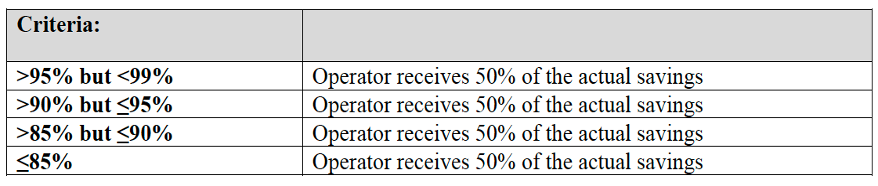

Source: Section III.C.1. of Annex II to the Generation O&M Agreement

  • If the Decommissioning Services with respect to a Legacy Generation Asset are not completed by the applicable Decommissioning Completion Date, then Operator shall be subject to a Decommissioning Penalty consisting of one million dollars ($1,000,000) for each week by which the completion of the Decommissioning Services is delayed past the applicable Decommissioning Completion Date, up to a maximum of fifteen million dollars ($15,000,000) in the aggregate across all Legacy Generation Assets and Generation Sites.[25]
  • In the event the Operator (i) exceeds the costs and expenses included in the applicable Decommissioning Budget and/or (ii) fails to complete the Decommissioning Services before the Decommissioning Completion Date for any two (2) Legacy Generation Assets, the Administrator may, in its sole discretion, engage an independent third party to perform any future Decommissioning Services with respect to any Legacy Generation Assets without either Party incurring, or becoming liable for, the payment of any penalty, premium or termination fee.

Demobilization Services

The Operator shall provide certain Demobilization Services upon the expiration or early termination of the Generation O&M Agreement to ensure the orderly transfer of any remaining Legacy Generation Asset from the Operator to the Owner or to a successor operator. The Operator has agreed to perform the Demobilization Services in accordance with a Demobilization Plan to be developed in accordance with the requirements set forth in Annex XVI to the Generation O&M Agreement.

In general, “the Demobilization Plan shall enable the seamless, safe, and effective transfer of the Legacy Generation Assets to the Owner, the Administrator, or their successor operator. The Operator’s principal objective shall be to complete any demobilization activities in the time frame and on the terms that are most suitable to Owner and Administrator in a way that will achieve an orderly handover or return of the Legacy Generation Assets.”[26]

Compensation for the Demobilization Services

During the Demobilization Period, which is estimated to last about a year, the Operator is entitled to receive a “Demobilization Service Fee”. The Demobilization Service Fee shall be an aggregate amount equal to:

  • the hourly fully allocated cost rate for each category of Operator employee or Affiliate personnel providing Demobilization Services multiplied by
  • the number of hours worked by each Operator employee or Affiliate personnel in such category providing Demobilization Services, plus
  • ten percent (10%) of the product of (i) and (ii), plus
  • all other reasonable and documented costs and expenses incurred by Operator (without markup for Operator profit) that are necessary and reasonable in the course of providing the Demobilization Services and/or implementing the Demobilization Plan, including the cost of any Subcontractors providing Demobilization Services.[27]

Expected Savings

As we have seen above, the Generation O&M Agreement contains a fairly well-developed set of incentives, penalties, and performance metrics to evaluate the performance of the Operator. In this sense, the Generation O&M Agreement is an improvement over the T&D O&M Agreement.

Indeed, the inclusion of measurable benchmarks, the requirement to engage in good faith negotiations with current PREPA employees, the cap on the fees that the Operator can earn during the Mobilization Period, and other requirements set forth in the Scope of O&M Services, for example the obligation to develop a fully fleshed out communications plan prior to the handover of operations to the Operator, demonstrates that governments can and indeed do learn from prior experiences, notwithstanding what anti-government zealots may say or think to the contrary.

Having said that, though, the fact remains that executing and entering into the Generation O&M Agreement makes sense only if the expected savings to be generated exceed the expected costs of the agreement. The government of Puerto Rico has stated that it expects to generate “significant savings” from transferring the operation and management of the Legacy Generation Assets to Genera. However, the evidence it offers to back up that assertion is rather thin, as we will demonstrate below.

The P3 Authority hired FTI Consulting (“FTI”) to carry out an analysis of the expected benefits of selecting a third party operator for the Legacy Generation Assets. FTI set forth its findings in a report (the “FTI Report”) that is included as Exhibit B to the P3 Report, which the P3 Authority is statutorily required to prepare and publish in connection with the execution of any public-private partnership transaction.

According to the FTI Report:

  • Genera estimates achievable O&M savings of $19 million per year, mostly from labor and more efficient maintenance activities.
  • Genera also estimates fuel savings (without plant conversions or equipment replacement) of approximately $85 million per year, “which would come from optimizing existing fuel contracts” ($56 million), “achieving better risk and credit terms on the existing oil contracts” ($20 million), and “making operational changes at the Legacy Generation Assets to increase fuel efficiency” ($9 million).
  • Genera also “believes” that, subject to PREB approval, “there are additional fuel savings”, in excess of $100 million, “achievable through fuel conversion of units”…These “conversions would involve commissioning of gas fuel operation for units that are dual fuel capable or conversions of units that are able to be converted.”
  • The “combined estimated savings from O&M and fuel range from $100 million to $200 million annually (including conversion savings if approved by PREB).” Under the terms of the Generation O&M Agreement those “savings would be shared 50%/50% between Genera and the electric ratepayers of Puerto Rico. That would result in $50 million to $100 million per year to Puerto Rico electric system customers.”
  • In sum, concludes FTI, “Puerto Rico is guaranteed a benefit and Genera’s incentive compensation pays for itself. Given the low fixed fee, high incentive fee component and the 50%/50% sharing of [the savings], Genera is more than motivated to perform and operate the plants well and as fuel-efficiently as possible.”[28]

So, according to FTI’s analysis this transaction is a clear win-win situation and everybody will live happily ever after the Effective Date. Pardon our skepticism, but it seems to us that FTI is being too clever by half, as the British would say.

First, FTI relies on representations made by Genera to the Partnership Committee and the P3 Authority and their advisors. There is no indication, at least in the text of the FTI Report, that FTI carried out an independent evaluation or executed any standalone due diligence to validate or verify Genera’s claims of expected savings.

Second, even if it is arguably reasonable to take Genera’s representations at face value, FTI should have requested that Genera provide the documentation of the methodology it used to calculate those expected savings. However, the FTI Report includes no explanation of the assumptions, the methodology used, or the variables analyzed by Genera to estimate expected savings. The people of Puerto Rico, in essence, are being asked to believe these ostensible savings on faith alone.

Third, Puerto Rico is a “price taker” in the global oil and natural gas markets due to the relatively small volume of fuel it buys. And while we don’t doubt the negotiating acumen of NFE’s traders, there are limits to how much savings can be generated from obtaining “better risk credit and credit terms”. Even NFE’s most perspicacious traders are subject to the capricious ebbs and flows of the global oil and natural gas markets.

In this context, it is relevant to point out that Section 9.2(b) of the Generation O&M Agreement politely prohibits Genera, NFE, and their affiliates from engaging in business with any person located, organized, or resident in a Sanctioned Country, which is defined in Section 20.2(g)(iv) of the Generation O&M Agreement as “the Crimea (sic), Cuba, Iran, North Korea and Syria.” We note, though, that Russia is conspicuously absent from this list. This omission, we assume, is probably nothing more than just a harmless drafting lapse that obviously will be remedied by counsel in due course.

Fourth, Genera insists on pointing to potential savings to be extracted from the conversion of existing oil-burning plants to facilities that burn natural gas. In fact, according to the FTI report, such conversions would generate approximately 50% of total expected savings from the Generation O&M Agreement. Genera and FTI, however, are silent as to who would pay for the capital expenditures necessary to convert existing oil-burning units to burn natural gas.

To be sure, pursuant to Section 5.6(b) of the Generation O&M Agreement Genera may “propose to PREB certain capital improvements, taking into account the Integrated Resource Plan and the Federally Funded Generation Project Plan, that would be (x) federally funded and owned by Owner, (y) made, owned and funded by Owner or (z) made, owned and funded by Operator or its designated Affiliate.” However, Genera and FTI fail to disclose, in the case of capital improvements not financed by the federal government, (i) how the profile of expected savings is affected once the expected cost of capital is taken into account and (ii) how the expected useful life of a legacy asset converted to burn natural gas would be extended in order to amortize the capital expenditure over time — an extension that, presumably, would be in contravention of the stated objective of decommissioning most of the Legacy Generation Assets as soon as possible.

Furthermore, Genera, as we stated above, is a wholly-owned subsidiary of NFE, which is a “full service” natural gas company that operates along the entire supply chain, from procurement, to shipping, to the development of natural gas-fired power generation. This presents at least two conflicts of interest.

First, it would be only natural for Genera to seek to do business with its parent company or its affiliates and there will be pressure to accept whatever terms are imposed by the “friends of the house.”

To be fair, the Generation O&M Agreement sets forth in Annex VI a fully developed policy to address organizational conflicts of interest arising from or in connection with affiliate or related-party transactions, including the requirement to hire a third party to execute the procurement process in certain cases (yet more evidence that governments do learn). It remains to be seen, though, whether this process will be thoroughly and consistently implemented and enforced throughout the term of the Generation O&M Agreement.

The other conflict arises from the fact that Fuel Cost Savings Initiatives is defined in the Generation O&M Agreement to mean any initiatives undertaken by the Operator, its Affiliates or Subcontractors in connection with the Generation O&M Agreement, that reduce Fuel Costs, including by:

  • improving the fuel efficiency of any Legacy Generation Assets;
  • converting any Legacy Generation Assets to be able to operate on any new alternative fuel(s) (including natural gas and hydrogen);
  • supplementing Legacy Generation Assets with power generation equipment at or in the vicinity of the relevant Generation Site that is more fuel efficient and/or operates on any new alternative fuel(s) (including natural gas and hydrogen);
  • reducing transportation, testing, delivery or storage (including tank maintenance) costs; or
  • pursuing savings opportunities related to credit and portfolio optimization, in each case whether such initiatives are implemented as Pass-Through Expenditures, at the Operator’s cost as the Operator’s own capital improvements pursuant to Section 5.6(b), by replacement or renegotiation of Fuel Contracts or Facility Contracts, or otherwise.

This definition poses several problems. First, it clearly allows the conversion of oil burning units to burn natural gas as a cost-saving initiative (subject to PREB approval), which would be contrary to the stated public policy goal of fully transitioning to renewable fuels by 2050.

Second, by allowing the switch to natural gas as a fuel cost saving measure, the Generation O&M Agreement confronts Genera with a set of potentially incompatible incentives. On one hand, Genera gets to keep 50% of any fuel savings generated by its implementation of any Fuel Cost Savings Initiative. On the other hand, Genera keeps 50% of any savings it generates when the process for decommissioning a legacy asset ends up costing less than originally budgeted.

In most, if not all instances, the amount of money represented by the right to get paid 50% of any realized fuel cost savings will exceed the amount of money represented by the right to get paid 50% of the savings generated from successfully decommissioning a legacy asset 10 or 15% under budget. Thus, Genera probably will have a strong preference for projects that switch generation units to burning natural gas, especially if the fuel is provided by NFE or any of its affiliates , and against decommissioning assets that could be converted to burn natural gas. It will be up to the P3 Authority and the PREB to prevent this risk from becoming a reality.

Third, the definition of Fuel Cost Savings Initiatives also includes any savings generated by switching to the burning of hydrogen. Now, this is interesting because NFE stated in its annual report for the year ended December 31, 2021 “that low-cost hydrogen will play an increasingly significant role as a carbon-free fuel to support renewables and displace fossil fuels across power, transportation and industrial markets.”

To that end, NFE has formed a new division, which it calls Zero, “to evaluate promising technologies and pursue initiatives that will position us to capitalize on this emerging industry.” In addition, it has signed an agreement “to transition a power plant to be capable of burning 100% green hydrogen over the next decade”, and it has made its “first hydrogen-related investment in H2Pro, an Israel-based company developing a novel, efficient, and low-cost green hydrogen production technology.”[29]

Source: Michael Kobina and Stephanie Gil, Green Hydrogen: A key investment for the energy transition, World Bank Blogs, June 23, 2022

However, true green hydrogen production, which consists of using renewably generated electricity to split water molecules into hydrogen and oxygen (see chart above), is not yet a commercially viable technology. Most of the current hydrogen production in the world consists of so-called “gray hydrogen”, which is produced by splitting natural gas into carbon dioxide and hydrogen. This process is energy intensive and emits a significant amount of CO2. “Blue” hydrogen is sometimes presented as an alternative. The process for making blue hydrogen is the same as the one for making gray hydrogen, with the difference that the resultant CO2 is “captured” and stored underground and thus is not released into the atmosphere. Most environmental groups, however, are skeptical about the alleged benefits of producing gray or blue hydrogen.

The risk for Puerto Rico here is twofold. First, we have to be vigilant that the island is not used once again as a “laboratory” for testing some half-baked harebrained idea, the brainchild of some demented trafficker of high-tech scams out on the prowl to make a quick buck in the crumbling colonial backwaters of the American Empire, and which imposes high costs and produces little or no benefits for Puerto Rico’s residents — as has happened so often in our history.[30]

And, second, if the production of green hydrogen eventually becomes commercially feasible, we have to ensure that both the technology and the know-how is transferred to Puerto Rican firms and engineers so the island does not end depending yet again on a resource we do not produce and do not control to generate our energy.

Finally, even if it is true that the implementation of the Generation O&M Agreement generates savings of $200 million per year and half of that amount is passed on to Puerto Rican ratepayers, is that amount “significant”? According to an unaudited financial report prepared by PREPA’s management for its governing board, it spent approximately $2.1 billion on fuel during fiscal year 2022, while total expenses for that year added up to $4 billion.[31] Therefore, savings of $100 million are equivalent to 4.7% of fuel expense and 2.5% of total expenses for that period.

Those savings are worth something but they do not by any means represent a paradigm-shattering change. To put this issue in perspective, the amount of expected savings ($100 million) probably will not be enough to fully offset the debt service on PREPA’s restructured bonds, which is estimated will be around $300 million per year, depending on the details of the final deal to be entered into with bondholders under the aegis of the Title III court.[32]

The objective truth is that Puerto Rico’s electricity costs will not decrease significantly until most of PREPA’s Legacy Generation Assets are decommissioned and replaced with new generation capacity using renewable sources. According to PREPA’s Certified Fiscal Plan for Fiscal Year 2022 generation “expenses are projected to decline over the Certified Fiscal Plan period as PREPA-owned generation units are retired, and the mix shifts to third-party owned generation, specifically renewable generation, which will be contracted through PPAs”.[33] Interestingly, neither the P3 Report nor the FTI Report provide an estimate of those savings.

Numerous factors have contributed to delaying the transition to and deployment of renewable generation in Puerto Rico: PREPA’s bankruptcy; lack of access to capital; federal and state bureaucratic requirements; the loss of state capacity to perform complex tasks due to years of austerity policies; the political influence of groups with fossil fuel interests; disagreements among advocates for renewable power who favor building utility-scale capacity and those who propose rooftop-based solar systems (we need both); and a general lack of coordination among and between government agencies, private sector stakeholders, local and community leaders, representatives of NGOs, and other non-profit entities which promote their own projects in a zero-sum fashion.

To be fair, we should not underestimate the difficulty and complexity of decommissioning fossil fuel generation while simultaneously deploying large scale renewable generation. As shown in the chart below, which is from PREPA’s Management Presentation to participants in the RFP process for awarding the Generation O&M Agreement, the scale of the transition to renewable generation is enormous. And while the timeline needs to be updated, it does makes us wonder whether the government of Puerto Rico has the requisite state capacity to execute this mega-project on time, on budget, and delivering the estimated benefits.
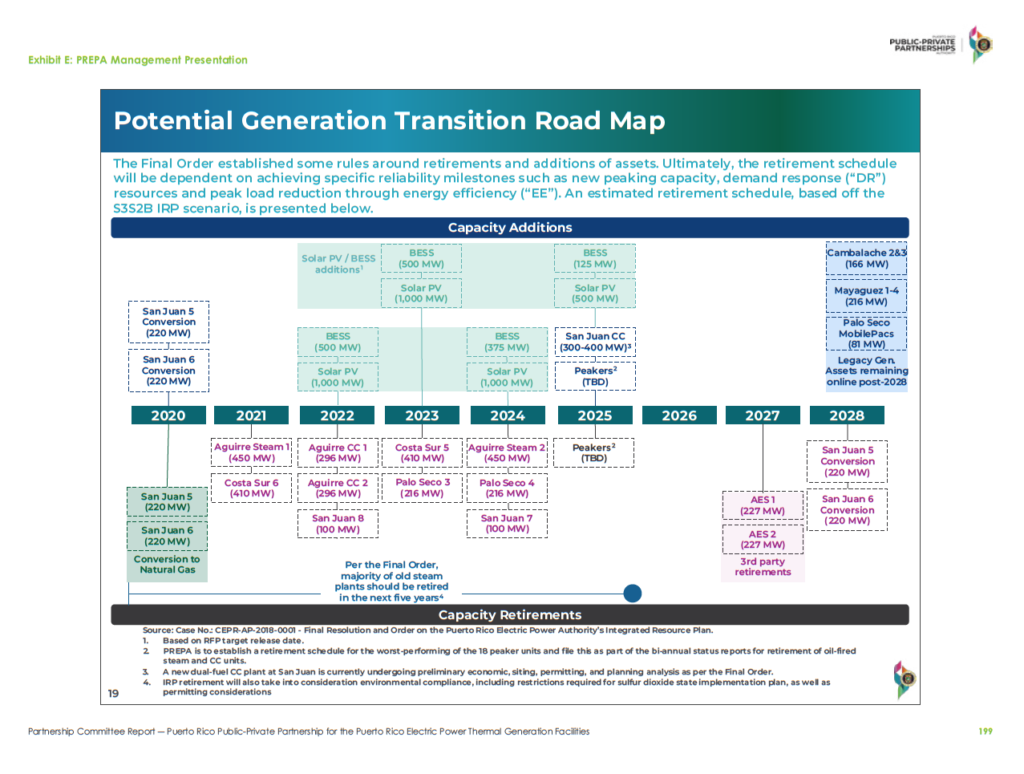

Source: Exhibit E to the P3 Report, p. 19.

Finally, we note that this “potential transition road map” prepared by PREPA includes the addition of up to 400 MW of new combined cycle capacity using natural gas in the San Juan plant, presumably to be paid by the federal government, and forecasts the continued used of legacy assets in Cambalache, Mayaguez, and Palo Seco beyond 2028.

Market Structure

Act 17-2019 calls for “transitioning from the current, vertically integrated monopoly comprising PREPA, to an energy system with multiple players as well as changes to the roles and responsibilities that have historically been concentrated within PREPA, and their reallocation across multiple entities.” According to that Act, one of the objectives of unbundling PREPA’s vertically integrated monopoly is to introduce an element of competition into Puerto Rico’s electricity market. To that end, according to the P3 Report, the Legacy Generation Assets Project is “intended to ‘promote market competition’ by harnessing private sector creativity and resources to help fully deliver on economic, infrastructure, and societal goals identified by the Government.”[34]

At first glance it appears that the execution of the T&D O&M Agreement and the Generation O&M Agreement satisfies the basic requirements of Act 17. While PREPA retains the naked title to the transmission and distribution system and to the legacy generation assets (for purposes of qualifying for federal funding), their respective day to day operation and management have been unbundled and legally transferred to two private operators.
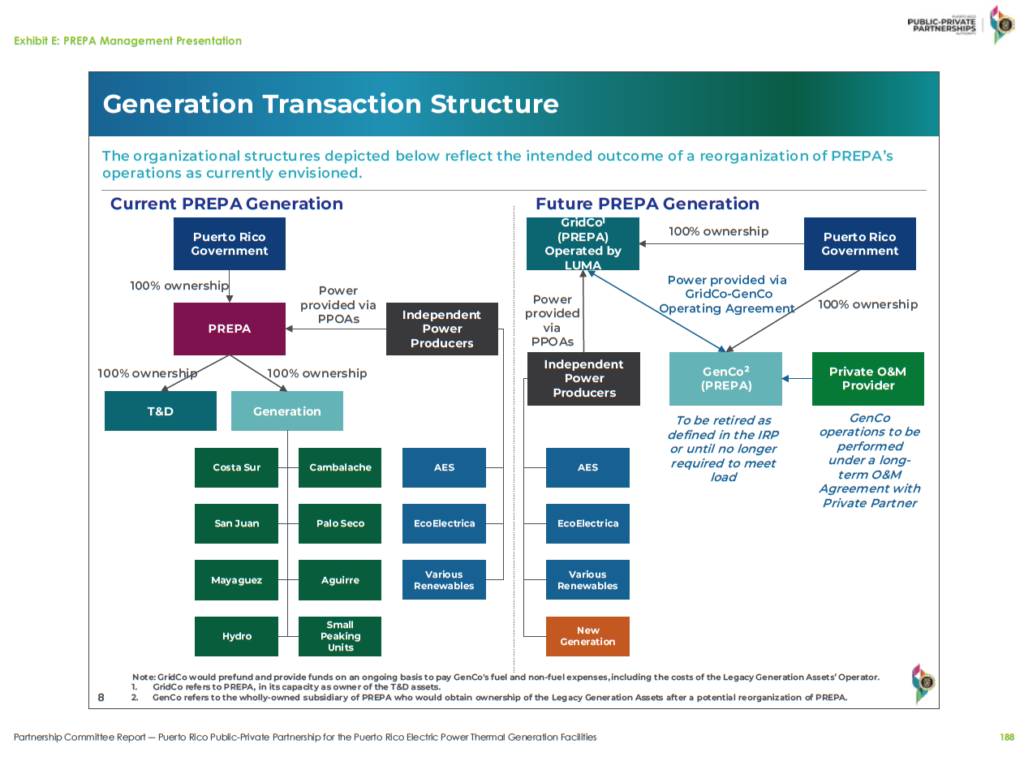

Source: Exhibit E to the P3 Report, p. 8.

However, a closer look at the structure of Puerto Rico’s electric power market after the execution of the T&D and the Generation agreement makes us wonder whether it achieves the policy objectives set forth in Act 17.

First, as shown in the chart above, after the Service Commencement Date of the Generation O&M Agreement, Puerto Rico would have an oligopoly of utility-scale generation companies: Genera, AES, EcoEléctrica, various renewable generators, and whatever new renewable generation is eventually deployed. On oligopoly can be defined as “an economic condition where only a few companies sell substantially similar or standardized products” and “oligopoly markets often exhibit the lack of competition, high prices and low output of monopoly markets.”[35]In oligopolistic markets, prices tend to be set by the firm with the largest market share. In the instant case, the generation market in Puerto Rico will be dominated, at least during the next five years, by Genera which will be operating the most inefficient, and hence the most costly, generation fleet in the island. Thus, we can expect the transfer of the operation and management of PREPA’s generation assets to have only a marginal, if any, effect on prices and reliability, at least in the medium-term.

Second, those oligopoly producers can sell their product (electricity) only to LUMA. Therefore, LUMA will have a monopsony with respect to independent power producers in Puerto Rico. A monopsony can be defined as “a market condition in which there is but one buyer for a particular commodity.”[36]Monopsonies can result in lower wages for workers, lower quality products, and higher prices for the consumer. Now, LUMA would probably argue that these risks are mitigated because they are required to buy power from independent power producers that have long-standing power purchase agreements (“PPAs”) with PREPA, in the case of AES and EcoElectrica, or that will be negotiated in the future, in the case of new entrants to the market. In any event, LUMA would argue, everything is subject to regulation by the PREB. That is true up to a point and good as far as it goes, but the situation could still lead to any number of market failures. For example, if a corporate affiliate of LUMA or Genera, or of their respective parent companies, wins the bid to build and operate the new combined cycle units (up to 400 MW) that will be located in the San Juan plant, what’s to stop LUMA or Genera from granting priority to their affiliate in connecting and dispatching electricity to T&D System?

Third, to complicate matters even further, LUMA has a monopoly on the other side of the market, namely the sale of electricity to retail, commercial, and industrial clients. Consumers in Puerto Rico can only buy electricity from LUMA, unless they set up their own generation capacity (in which case they can sell any excess generation, if they have net metering capabilities, only to LUMA).

While it is true that Puerto Rico has developed regulations to allow “wheeling” (the direct sale of excess electricity generated by say a manufacturing firm with in-house industrial scale generation to another industrial client), to our knowledge there has been little no wheeling sales executed in Puerto Rico. A single company, therefore, exercises de facto control of both sides of the electricity market in Puerto Rico: generators can sell and buyers can buy electricity only from LUMA. We question whether that result was intended by the drafters of Act 17.

Given this complicated market structure, any element of market competition will be promoted only indirectly if and when the time comes to renegotiate existing, or to negotiate any prospective, power purchase agreements between LUMA and independent power producers. We note that neither the P3 Report nor the FTI Report analyze whether competition prompted by the new market structure for the electricity sector in Puerto Rico would generate lower prices for ratepayers in the island.

In sum, the resulting market structure is fertile ground for any number of anticompetitive practices, such as collusion, price fixing, exclusive dealing, and price discrimination, among others, to arise. To prevent LUMA from unduly exercising its market power it will be necessary (1) to closely supervise the implementation of the T&D O&M Agreement; (2) for the PREB to conduct robust regulatory oversight of LUMA; (3) to establish a well-regulated and orderly wheeling market in Puerto Rico; and (4) to consider creating an independent system operator that would be in charge of managing the economic dispatch of generation units and supervising interconnections with the T&D System.

Buy Local Provisions

A novel feature (for Puerto Rico) of the Generation O&M Agreement is that it requires Genera to use “commercially reasonable” efforts to ensure that local companies, or foreign companies with a significant presence in Puerto Rico, are included in the procurement process for materials and services under the agreement.[37] In addition, the Generation O&M Agreement requires Genera to use “commercially reasonable” efforts to select companies established under the Commonwealth of Puerto Rico or companies that have “a significant presence in the Commonwealth of Puerto Rico” as material subcontractors.[38] These provisions, if implemented, have the potential to generate local economic activity and allow local firms and workers to obtain valuable experience working on a complex multi-year project.

Conclusion

Shakespeare’s words to the effect that “the web of our life is of a mingled yarn, good and ill together”, are perhaps an apt description of the Generation O&M Agreement.[39]

Several elements of the new agreement are clearly superior to the LUMA T&D O&M Agreement. Among these we can mention a well-developed system of incentives and penalties to motivate the Operator; the inclusion of clear benchmarks to measure Genera’s performance; stronger filters to analyze transactions with affiliates and related-parties, including a fully fleshed-out policy to address organizational conflicts of interest; the requirement to engage in good faith negotiations with current PREPA employees so as to minimize the learning curve of the new operator; and setting a cap on the fees that the Operator can earn during the Mobilization Period; all point to the conclusion that this is an agreement that offers better protections to the people of Puerto Rico from some of the foreseeable risks associated with this transaction.

Other aspects of the agreement are not as good. For example, most of the services will be provided by subcontractors (wouldn’t it be more efficient just to contract directly with them?); the analysis of the expected savings is clearly deficient and we would like to see a more rigorous examination of those professed savings; and it is not clear to us that the resultant market structure will lead to lower prices, generate allocative efficiencies, and/or produce significant increases in consumer welfare.

So, relative to the status quo, is the post-Genera electricity market in better shape in Puerto Rico? Probably yes, but that is an awfully low bar. Everybody who has objectively analyzed PREPA’s performance over the last 30 or 40 years has concluded that it is mess, the financial and operational equivalent of a long-smoldering dumpster fire. By that standard, trying anything new, no matter how outlandish it may seem, would probably constitute progress.

However, if we set a higher bar, if we ask whether this transaction will really help Puerto Rico achieve its long-standing goals of generating affordable, cleaner, and reliable electricity, then the answer is not quite as clear, for the good is indeed mingled with the ill. The fact is that there is a lot uncertainty surrounding this transaction and it is hard to avoid the unsettling feeling we are being presented with a fait-accompli on a take it or leave it basis.

Maintaining the status quo, though, is not an option. The real question is whether there is a better alternative to a negotiated agreement in this instance. The answer, when taking into account the totality of the circumstances, appears to be no. The available alternatives seem to be (1) worse, for example, resuscitating PREPA; (2) unrealistic, entailing, for instance, the creation of a new Tennessee Valley Authority-like entity to provide electricity in Puerto Rico; or (3) downright utopian, involving extremist schemes reminiscent of Mao’s Great Leap Forward.[40]

After assessing the risks and benefits of the Generation O&M Agreement we face a dilemma in the classical sense of making a decision with no good options. But in a situation with no objectively good options, taking a calculated risk may, perhaps, be the best option. Again, in the words of the Bard of Avon: “there is a tide in the affairs of men which, taken at the flood, leads on to fortune; omitted, all the voyage of their life is bound in shallows and in miseries. On such a full sea are we now afloat, and we must take the current when it serves, or lose our ventures.”[41]

Endnotes

[1] Puerto Rico Public-Private Partnerships Authority, Partnership Committee Report regarding the Puerto Rico Public-Private Partnership for the Puerto Rico Electric Power Thermal Generation Facilities, October 17, 2022, amended January 18, 2023 (the “P3 Report”), p. 16.

[2] P3 Report, p. 17-18.

[3] P3 Report, p. 18.

[4] P3 Report, p. 19.

[5]See Beatriz de la Torre, “AEE pasa con fichas”, El Vocero, 21 de marzo de 2013; “Nebuloso financiamiento de ‘mareducto’”, El Vocero, 23 de mayo de 2013; and “Denuncian ‘chanchullo’ en AEE”, El Vocero, 22 de julio de 2013; and  Mary Williams Walsh, “At Puerto Rico’s Power Company, A Recipe for Toxic Air, and Debt”, New York Times, February 15, 2016; and “In Scandal at Puerto Rico Utility, Ex-Fuel Buyer Insists He Took No Bribes”, New York Times, March 2, 2016.

[6] New Fortress Energy, Inc., Annual Report for the Year Ended December 31, 2021, filed with the United States Securities and Exchange Commission on Form 10-K, p. 3.

[7] Generation O&M Agreement, Section 4.1(a).

[8] Generation O&M Agreement, Section 4.2(u).

[9] Generation O&M Agreement, Section 4.6(b).

[10] Generation O&M Agreement, Section 4.8(a).

[11] Generation O&M Agreement, Section 5.1.

[12] Section 1.A. of Annex IX to the Generation O&M Agreement.

[13] Generation O&M Agreement, Section 7.7(a).

[14] Section 1.A. of Annex II to the Generation O&M Agreement.

[15] Section III.B of Annex II to the Generation O&M Agreement.

[16] Generation O&M Agreement, Section 5.22.

[17] Section III.B.2. of Annex II to the Generation O&M Agreement.

[18] Section III.B.5. of Annex II to the Generation O&M Agreement.

[19] Section III.B.6.(a) of Annex II to the Generation O&M Agreement.

[20] Section III.B.6.(c) of Annex II to the Generation O&M Agreement.

[21] Generation O&M Agreement, Section 16.1(a).

[22] Generation O&M Agreement, Section 16.1(b).

[23] Generation O&M Agreement, Section 16.2(d).

[24] Section III.C.1. of Annex II to the Generation O&M Agreement.

[25] Section III.C.1. of Annex II to the Generation O&M Agreement.

[26] Section 1 of Annex XVI to the Generation O&M Agreement.

[27] Generation O&M Agreement, Section 17.3(b).

[28] FTI Consulting, Benefits of a Third-Party Generation Operator of the Puerto Rico Legacy Generation Assets, September 22, 2022, p. 18-19, included as Exhibit B to the Partnership Committee Report regarding the Puerto Rico Public-Private Partnership for the Puerto Rico Electric Power Thermal Generation Facilities, October 17, 2022, amended January 18, 2023.

[29] New Fortress Energy, Inc, Annual Report for the Year Ended December 31, 2021, filed with the United States Securities and Exchange Commission on Form 10-K, p. 16.

[30] See Juan R. Torruella, “Why Puerto Rico Does Not Need Further Experimentation with its Future: A Reply to the Notion of Territorial Federalism”, Harvard Law Review Forum, Vol. 131, No. 3, (January, 2018).

[31] Puerto Rico Electric Power Authority, Monthly Report to the Governing Board: June 2022, p. 7, available at https://aeepr.com/es-pr/investors/FinancialInformation/Monthly%20Reports/2022/June%202022.pdf

[32] Assuming PREPA’s bonded debt is cut approximately by 50% to $5 billion and a 6% coupon.

[33] 2022 Certified Fiscal Plan for the Puerto Rico Electric Power Authority As certified by the Financial Oversight and Management Board for Puerto Rico on June 28, 2022, p. 164.

[34] P3 Report, p. 29.

[35] Black’s Law Dictionary, Sixth Edition, (St. Paul, MN; West Publishing Co., 1990), p. 1086.

[36] Black’s Law Dictionary, Sixth Edition, (St. Paul, MN; West Publishing Co., 1990), p. 1007.

[37] Generation O&M Agreement, Section 21.19(c).

[38] Generation O&M Agreement, Section 21.19 (d).

[39] William Shakespeare, All’s Well that Ends Well, Act IV, Sc. 3, (1603-1604).

[40] Julia Lovell, Maoism: A Global History, (London: The Bodley Head, 2019), pp. 133-168.

[41] William Shakespeare, Julius Caesar, Act IV, Sc. 2 (1599).