CNE Review – November 2025

Published on November 20, 2025 / Leer en español

See all editions of the
CNE Review
SHARE

In This Issue

The global COVID-19 pandemic triggered a re-evaluation of the role of the state in the economy and called into question the benefits of complex, fragile, and overly-globalized supply chains. These actions, in turn, led many governments to reassess the role of national industrial policies.

It is important to clarify, though, that the meaning of the term “industrial policy” has expanded since the early post-war era. Modern industrial policy can be described as a process of discovery and continuous learning that requires close collaboration and coordination between the public sector, the private sector, academia, labor unions, and other non-governmental organizations to generate a structural economic transformation in the medium and long term.

In this edition of the CNE Review, we present a data-driven methodology to start crafting a modern industrial policy for Puerto Rico. This methodology, based on measures of economic complexity developed by Ricardo Hausmann, Cesar Hidalgo, and others, would help Puerto Rico identify high-value-added areas where it is currently competitive, as well as other products that use similar inputs but that it is currently not producing. In addition, the analysis executed by CNE’s Enrique Figueroa also highlights other high-value-added production sectors that are currently largely unconnected or isolated from other productive activities on the island. The idea is to help policymakers working together with the private sector to (1) identify those sectors with the highest probability of generating high-value-added activities and innovation and (2) develop an industrial strategy that focuses on growing those sectors and activities.

If Puerto Rico truly wishes to straighten the course of its economy, and create good jobs, it is imperative to design a modern industrial policy that puts us at the forefront of global economic activity. The conclusion of the government’s bankruptcy, the roll-out of the reconstruction efforts, the end of the COVID-19 pandemic, and the intellectual turn in support of a more economically active state, all converge to create the opportunity of a generation for Puerto Rico to turn around its economy and start a process that would generate long-term economic growth and development. The implementation of the economic complexity methodology we present here is the first but very important step in developing a 21st-century industrial policy for Puerto Rico. It is incumbent on all of us to get that process going.

–Sergio M. Marxuach, Editor-in-Chief

Insights + Analysis from CNE

By Enrique A. Figueroa Grillasca, Research Associate

What is Economic Complexity?

Traditional indicators measure how much an economy produces.

Economic Complexity measures what it produces and how sophisticated that production is.

This approach rests on three core ideas:

1. Knowledge is the real wealth: Growth happens when an economy expands its collective know-how across people, firms, and institutions.

2. Development is a learning process: Economies grow by learning to produce increasingly complex products.

3. Learning follows a path: Countries grow into industries related to what they already make, not by leaping into unrelated sectors overnight.

Economic Complexity is a treasure map of where opportunities lie. It can reveal:

  • Which sectors have the strongest potential for growth
  • Which partnerships make strategic sense
  • Which investments align with emerging industrial policy
  • Which industries could anchor new clusters on the island

Read more on the basics of Economic Complexity.

How We Measure It

Using network analysis to decipher international trade data, Economic Complexity tools allow us to map a country’s productive capabilities using two powerful visual frameworks:

The Product Space: a global map of related products.

The Diversification Frontier: a chart showing which of the country’s industries are both feasible and high-value.


Diversification Frontier Quadrants (Hidalgo, 2023)

Read more on how Economic Complexity is measured.

What the Data Shows About Puerto Rico

Puerto Rico’s economy is more sophisticated than its size or income would suggest.

Key findings:

  • Puerto Rico ranks 10th in the U.S. in Economic Complexity.
  • Pharmaceuticals and chemicals account for over 80% of exports.
  • The island commands major global market shares, for example, approximately 20% of global insulin exports, 90% of total U.S. sulfonamides exports, and about 10% of bulk hormones exported globally.

The Diversification Frontier reveals that Puerto Rico has “hidden capabilities” that could unlock new, high-value sectors, reducing its concentration in pharmaceuticals and building new industrial clusters.

Click to read more on Puerto Rico’s economy through the complexity lens.

Policy Recommendations: A Roadmap for Action

To move toward a modern industrial policy, Puerto Rico must make Economic Complexity part of everyday decision-making.

Key Recommendations:

  1. Measure and publish complexity metrics regularly: Integrate them into the Puerto Rico Planning Board and the Department of Economic Development and Commerce’s annual economic reporting.
  2. Train government agencies: Build the technical and analytical capacity needed to use these tools across administrations.
  3. Engage the private sector: Create a standing dialogue to validate opportunities and align incentives.
  4. Align incentives with complexity goals: Reward investments that expand the island’s productive knowledge and diversify exports.

Click to read more about our policy recommendations.

On Our Radar

With the recent issuance of Executive Order 2025‑053, Puerto Rico’s government has opened a window to institutionalize a coordinated, metrics-driven economic development strategy involving government, business, and academia. Our economic complexity methodology uniquely aligns with this mandate, and we’ve already started gathering stakeholders.


During a recent working session with leaders from Puerto Rico’s private sector, Rafael Vélez-Domínguez, President of the Puerto Rico Manufacturers Association, said the tool provides “a roadmap for Puerto Rican industry not only to adapt but to lead with innovation and added value. Today more than ever, we are taking firm steps to transform our strengths into real opportunities and work through public-private collaboration to position Puerto Rico as a competitive industrial hub in the region”.

Economic Complexity: Using Data to Identify Puerto Rico’s Opportunities

Economic Complexity: Using Data to Identify Puerto Rico’s Opportunities

Published on November 14, 2025 / Leer en español

Enrique 2025
Research Associate
DOWNLOAD
SHARE

Introduction

2026 will mark a decade since the Financial Oversight and Management Board (FOMB) was tasked with managing Puerto Rico’s fiscal affairs. Back in 2015, the consensus in Washington was that Puerto Rico needed a comprehensive restructuring mechanism paired with strong fiscal oversight. Through the Puerto Rico Oversight, Management and Economic Stability Act (PROMESA), it was able to renegotiate the largest municipal bankruptcy in U.S. history, reducing the debt burden by over $30 billion. While this represents significant progress, the jury is still out on whether the level of debt relief achieved is sufficient for long-term fiscal and economic sustainability. Further, other critical challenges remain, including unresolved issues like the debt of the Electric Power Authority.

Beyond that, the question before us now is not only how to restore fiscal balance, but how to reignite economic growth. How do we move from stabilization to transformation? How do we move beyond survival and towards prosperity? How do we unlock Puerto Rico’s full potential?

At the Center for a New Economy (CNE), we have long argued that the answers lie in the evidence before us. We build upon what we know. We grow where opportunity lies. What Puerto Rico needs is a modern industrial policy: a forward-looking strategy grounded in data that channels local capabilities, forges stronger links between global and local firms, and turns today’s challenges into a generational opportunity for long-term growth.

In this policy brief, we propose Economic Complexity as an analytical tool to do just that. This framework can inform Puerto Rico’s future growth areas by characterizing the knowledge embedded in our economy and illuminating areas of potential growth. This knowledge would form the foundation for industrial policy and give policymakers an empirical basis for decision-making.

A development strategy for Puerto Rico grounded in economic complexity would not start from scratch; it builds upon existing strengths to develop new activities in commerce, manufacturing, and services. Our approach is predicated on cross-sector collaboration to share information and work toward a common vision of prosperity. The time is ripe for growth; let’s work together to build a more dynamic and prosperous future.

The Basics of Economic Complexity

Economic Complexity analysis is a conceptual framework used to assess a region’s productive capacities and the similarities between goods in the productive capacities required to make them. By studying the goods produced in a region and how those compare across the globe, economic complexity analysis can reveal the underlying knowledge embedded in an economy.

At the heart of this analysis are two core concepts: country capacity, which represents the knowledge, institutions, and infrastructure in a region; and product relatedness, which captures how similar or complementary different products are in terms of the inputs, knowledge, and capacities they require to be produced. Understanding these concepts enables policymakers to:

  1. Set clear, objective goals and track progress over time.
  2. Strategically invest limited resources where they will have the greatest impact.
  3. Identify feasible and high impact opportunities for diversification.

Economic Complexity Theory gives us a framework through which to understand development by looking at the composition and sophistication of what a region produces rather than relying solely on traditional economic measures. While indicators like gross domestic product (GDP), foreign direct investment (FDI), and trade balances capture the size and flow of economic activity, on their own they reveal little about the knowledge and capabilities embedded in an economy. By examining the Economic Complexity of their jurisdictions, policymakers can gain insights into the underlying knowledge that drives production.

Economic Complexity Theory emerged from research at Harvard University and MIT in the late 2000s. Economists Ricardo Hausmann, César Hidalgo, and their colleagues developed this framework by applying network science and complexity theory to economic development (Hausmann & Hidalgo, 2009). Their research showed that a region’s prosperity depends not just on how much it produces, but on what it produces. Reconciling a fundamental gap in classical economics, this approach has since been adopted by numerous governments and international organizations, including Mexico’s Secretariat of the Economy[1], the European Commission[2], the World Bank[3], and the OECD[4], as tools for designing more effective development strategies.

Economic Complexity Theory is founded on three basic principles:

First, a region’s productive capacity is defined by its knowledge, in simpler terms, places produce what they know how to make. In this context, productive capacity refers to the collection of goods and services an economy could produce if it optimally employed its accumulated capabilities, skills, and institutional capacity.

Second, economic development is a learning process. Since knowledge is productive capacity, expanding the base of knowledge in an economy is how it grows.

Third, learning is path-dependent, in other words, what we already know informs what we can learn (Hidalgo, 2021; Balland et al., 2022). Just as it’s easier (harder) to learn Spanish (Mandarin) if you already know Italian, it would be easier (harder) for an economy to diversify into making liquor[5] (rubber gloves[6]) if it already produces wine[7].

     1) Knowledge as Productive Capacity

The first principle, knowledge as productive capacity, states that economic production requires specific know-how distributed across society. This knowledge exists in three distinct forms: embodied in people as expertise and skills, embedded in products as design and functionality, and encoded in institutions as processes and organizational capabilities (Blackler, 1995). When we say a region “knows how to make” something, we mean it possesses this distributed network of capabilities and resources at its disposal to use in the production of goods and services (Hidalgo, 2023). No single person holds all the knowledge required to produce complex goods like pharmaceuticals. Instead, it requires skilled workers who understand chemical processes; organizations with robust quality control protocols and experts to monitor them; institutions with regulatory expertise; and specialized equipment manufactured by experts in entirely different fields.

The understanding of knowledge as productive capacity highlights the foundational role of learning in economic growth. Joseph Stiglitz argues that “what truly separates developed from less-developed countries is not just a gap in resources or output but a gap in knowledge,” (Stiglitz & Greenwald, 2014) suggesting that an economy’s growth largely depends on how it closes these knowledge gaps. Since an economy’s productive capacity depends on its collective knowledge, economic development is fundamentally a learning process that builds this knowledge over time.

     2) Economic Development is a Learning Process

The second principle, economic development is a learning process, establishes that growth occurs as an economy expands its knowledge base over time. Development isn’t simply about accumulating physical capital or resources, but rather about enhancing the capabilities that allow an economy to produce increasingly sophisticated goods and services (Balland et al., 2022). By viewing development as a learning process, we can better understand why effective development strategies should prioritize knowledge acquisition and capability building rather than focusing solely on capital accumulation, job creation, or market access.

What makes this insight so powerful is that it explains why seemingly similar countries with comparable resources achieve vastly different economic outcomes. The difference lies in how they mobilize distributed knowledge across people, products, and institutions. Consider Taiwan’s electronics industry. They started with simple assembly operations in the 1960s, and over time, workers and managers gradually mastered increasingly complex production techniques, eventually enabling the country to become a global leader in semiconductors. Taiwan’s development wasn’t simply about adding more factories or workers, but about continuously expanding what these workers and firms knew and fostering an environment that institutionalized that knowledge (Chang & Shih, 2005).

Rather than viewing poor countries as simply lacking resources, we understand they lack specific productive knowledge that must be systematically accumulated, coordinated, and mobilized (Hausmann et al., 2024). Policy implications extend beyond debating levels of protectionism or liberalization to focus on two fundamental questions:

How do societies best acquire, retain, and build upon productive knowledge?

How can education systems, industrial policies, and institutional designs accelerate learning processes?

The answers depend critically on each economy’s starting point, because new knowledge builds upon existing knowledge (Hausmann & Hidalgo, 2009).

     3) Learning is path dependent

The third principle, learning is path dependent, explains why economic development follows specific trajectories rather than random paths. Economies tend to diversify into activities related to their existing productive structure rather than jumping to entirely new areas (Pinheiro et al., 2018). The underlying mechanism is straightforward: new capabilities are built most effectively upon existing ones, or in other terms, the cost of diversifying into related products is lower than developing unrelated capacities from scratch (Alshamsi et al., 2018). Path dependency explains why oil-rich countries rarely become software powerhouses and why attempts to create silicon valleys from scratch often fail (Hausmann & Hidalgo, 2009; Hidalgo, 2021).

This path-dependent view adds nuance to the idea of “leapfrogging” strategies, where developing nations catch up through implementing new advanced technologies skipping ‘inferior’/less-efficient ones, often promoted in development literature. Many traditional approaches suggest developing economies can simply adopt the latest technologies by opening markets and attracting foreign investment. However, Economic Complexity Theory suggests that successful diversification typically occurs through incremental steps along paths that share common capabilities (Alshamsi et al., 2018; Hidalgo, 2023). This concept of relatedness provides a practical metric for identifying strategic opportunities by measuring the similarity between different productive activities.

These three core principles, knowledge as productive capacity, learning as development, and path-dependent learning, form the theoretical foundation of Economic Complexity Theory. Together, they explain why economies develop along specific trajectories and why some are more successful than others at generating sustainable growth. But how can we measure these abstract concepts and, more importantly, make them practical and useful to policymakers, industry leaders, and entrepreneurs?

How is Economic Complexity Measured?

Different products require different types of knowledge, and this knowledge is reflected in the kinds of products countries are able to produce. These differences can be inferred by analyzing these production patterns across countries, giving us a view of both the complexity of economies and the sophistication of products.

The starting point for Economic Complexity measurements is a binary matrix, a grid of yes/no (1/0) responses, showing which countries have demonstrated ability to competitively produce specific products. This matrix is constructed using export data and a measure called Revealed Comparative Advantage (RCA):

An RCA greater than 1 indicates that a country likely has a comparative advantage in producing that product, and the corresponding cell in the matrix is marked 1; otherwise, it is 0 (Mealy et. al., 2019). From this matrix, two fundamental measures are calculated:

  1. Diversity: The number of products a country produces with comparative advantage
  2. Ubiquity: The number of countries that make a product with comparative advantage

While diversity provides some insight into a country’s capabilities, it doesn’t distinguish between complex and simple products. Similarly, ubiquity gives some indication of a product’s complexity but doesn’t account for the sophistication of the countries producing it. To address this, Economic Complexity indices use an iterative algorithm called the Method of Reflections that refines these measures by repeatedly adjusting Product and Country complexities by their counterpart’s average until they converge to a stable value (Hausmann & Hidalgo, 2009).

Economic Complexity analysis relies on four primary metrics that help quantify an economy’s productive knowledge:

Economic Complexity Index (ECI), which measures the knowledge intensity of an economy by analyzing the diversity and ubiquity of its exports. A high ECI indicates that an economy produces sophisticated products that few other countries make.

Product Complexity Index (PCI) measures the knowledge implied in the production of a specific product. Products with high PCI values need rare capabilities found in few countries and are typically higher value than those with lower PCI.

Relatedness (Proximity) measures similarity between products based on how frequently they are co-exported by the same countries. Values range from 0 to 1, with higher values indicating products require more similar capabilities.

Revealed Comparative Advantage (RCA) indicates whether a country exports more of a product (as a percentage of total exports) than the global average. Products with RCA > 1 represent areas where a country has demonstrated an ability to produce competitively in global markets (Mealy et. al., 2019).

The Product Space – Understanding the Spatial Analogy at the Heart of Economic Complexity

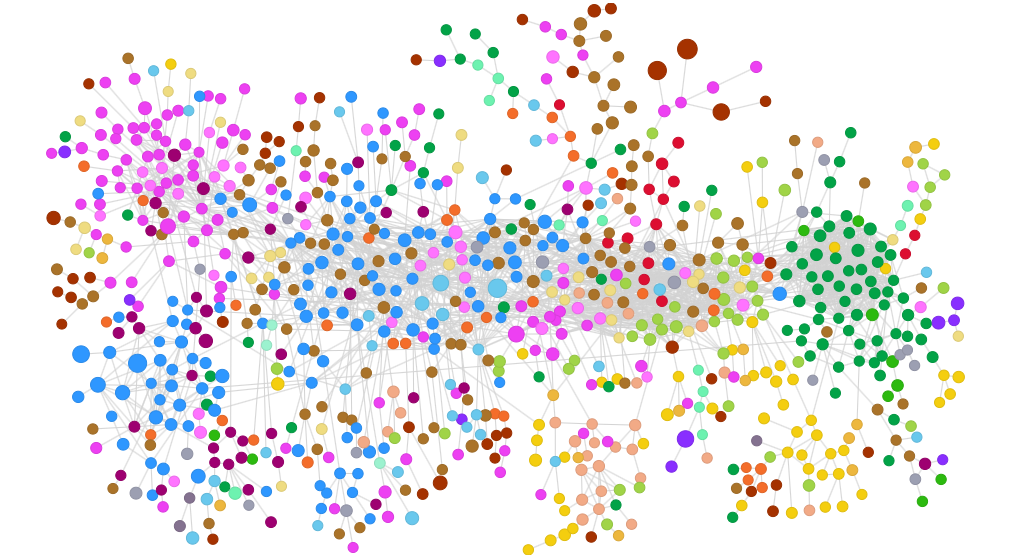
Using the Economic Complexity Index, Product Complexity Index, Relatedness, and RCA metrics described above, complexity researchers have created detailed network representations of goods. These visualizations transform abstract economic data into more digestible spatial maps that help policymakers understand their economies and what they make. Fundamentally, this spatial analogy uses concepts of physical space like distance and position to represent the relationships between products. In philosophy, mathematics and data science, spatial analogies help visualize or contextualize complex relationships that would otherwise be difficult to comprehend. For example, we use a spatial analogy when we say two colors, like pink and purple, are ‘close’ to each other, or purple is ‘between’ red and blue.

Figure 1: Global Product Space – 2023

Source: OEC Product Space Image, 2025

Applying this logic to products, we can represent similarities in production requirements as a network called the Product Space. This network connects products based on how frequently countries export both items with comparative advantage (RCA > 1). When visualized, the Product Space reveals a structure of dense and sparse areas. The center contains tightly connected clusters of sophisticated products like machinery, electronics, and chemicals. The periphery holds more isolated products such as raw agricultural goods and mineral resources. Certain products share many capabilities with others (appearing densely connected) while some require unique capabilities and remain distant from other products (Simoes & Hidalgo, 2011).

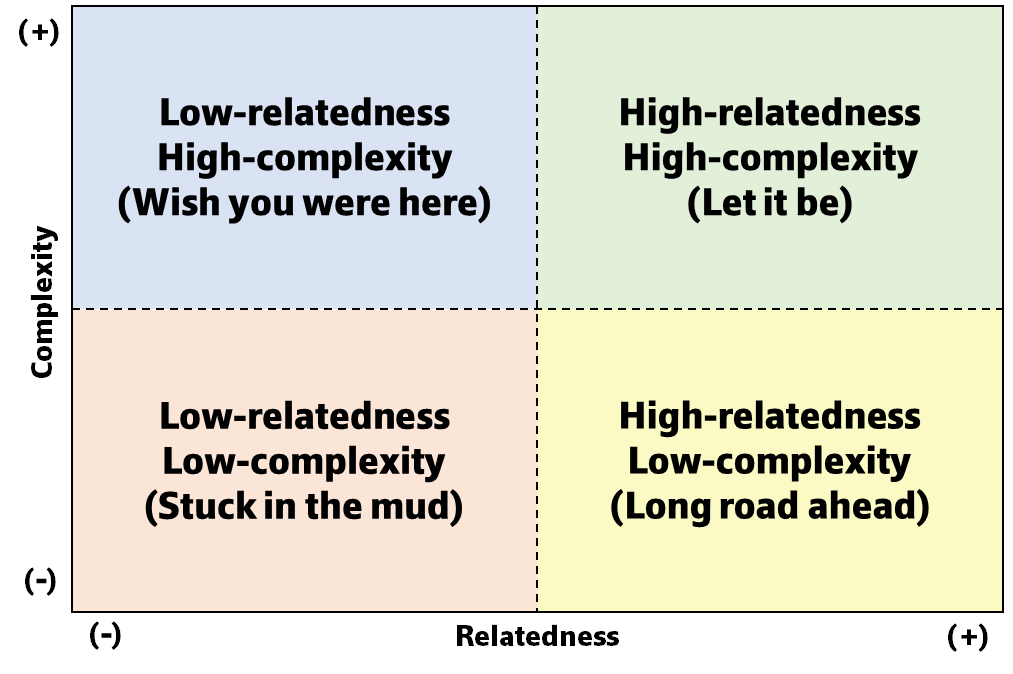
Complementing the Product Space is the Diversification Frontier, which maps products along two critical dimensions: their complexity (vertical axis) and their relatedness to a country’s existing capabilities (horizontal axis). The resulting chart can be divided into four quadrants, each with distinct strategic implications and a fun nickname from Hidalgo (2023):

  1. High Complexity, High Relatedness (top-right quadrant): Contains products that are both valuable (complex) and accessible given existing capabilities. Called the “Let it be” quadrant, these represent ideal opportunities where diversification is both feasible and desirable.
  2. High Complexity, Low Relatedness (top-left quadrant): Contains attractive products in terms of value that would be difficult to produce given current capabilities. Called the “Wish you were here” quadrant, these represent stretch goals and opportunities for unrelated diversification.
  3. Low Complexity, Low Relatedness (bottom-left quadrant): Contains products that are neither particularly valuable nor easily accessible. Called the “Stuck in the mud” quadrant, these typically offer little strategic value.
  4. Low Complexity, High Relatedness (bottom-right quadrant): Contains products with lower complexity value but are nonetheless accessible. Called the “Long road ahead” quadrant, these might represent easier diversification options but with limited value.

Figure 2: Diversification Frontier Quadrants

Source: Hidalgo, 2023

The Product Space and Diversification Frontier provide complementary views of an economy and the capacities therein. The Product Space shows the overall landscape of products and an economy’s position within it. At the same time, the Diversification Frontier describes the specific country/region’s production and offers a strategic framework for identifying specific diversification targets by balancing feasibility with desirability. These tools help move economic complexity theory from abstract mathematics into practical policy guidance, enabling policymakers to identify strategic pathways that leverage existing capabilities while building toward more complex, higher-value activities.

Puerto Rico’s Economy through the Complexity Lens

When viewed through the lens of Economic Complexity, Puerto Rico’s economy shows surprising strengths. In 2022, Puerto Rico ranked 10th among states and territories in the U.S. in terms of its economic complexity.[8] Its established capabilities are in several highly sophisticated industries, particularly pharmaceutical manufacturing, provide strong potential for diversification into other high-complexity sectors. Yet, this potential can only be unlocked through better alignment between public and private sector efforts and a shared vision for the future.

Figure 3 shows Puerto Rico’s Diversification Frontier in 2023. As described in the previous section, the diversification frontier maps Puerto Rico’s export products according to their complexity (vertical axis) and relatedness to current capabilities (horizontal axis) with the size of points representing 2023 exports of the product and colors showing their HS Section. We use the ECI for Puerto Rico and average relatedness to set the boundaries between high and low complexity/relatedness.

Figure 3: Puerto Rico Diversification Frontier – 2023

The dashboard is optimized for desktop use. To view it in fullscreen mode, press the icon   in the lower right corner.

Sources: CEPII – BACI: International Trade Database,  U.S. Census Bureau – USA Trade Online, and author’s calculation

Puerto Rico’s Diversification Frontier reveals a notable concentration of products in the high complexity region. Within the high-complexity/high-relatedness quadrant, Puerto Rico shows strengths in pharmaceutical and chemical products including packaged medicaments, vaccines, blood products, antisera, toxins, and cultures, and hormones. These high-value products form the core of Puerto Rico’s export profile, with chemical products making up roughly 83% of exports, and just the three product categories mentioned above accounting for over 75% of total exports in 2023.

Looking at the high-complexity/low-relatedness, we find sophisticated products that would typically be challenging to develop given Puerto Rico’s current export basket. In most economies at similar development levels, this quadrant would be sparsely populated. Puerto Rico’s larger-than-typical presence here suggests unique capabilities that enable potential “strategic jumps” into complex new sectors despite lower relatedness. While these products represent greater development challenges than those in the high-complexity/high-relatedness quadrant, they offer valuable opportunities that could reduce Puerto Rico’s concentration in pharmaceuticals and chemicals. Identifying and supporting firms in these sectors is critical to achieving a more sustainable development.

By looking at trends in global trade, we also find several products that show significant growth potential, with other protein & polypeptide hormones growing 70.8% in 2023, electric motor vehicles 57%, and polypeptide hormones 38%. This indicates both expanding global demand and potential for Puerto Rico to position itself in sophisticated and expanding markets by producing those goods or intermediate goods that are components of these.

However, capitalizing on these opportunities requires the kind of sustained, coordinated effort that has been lacking. Even successful clusters like the aerospace hub in Aguadilla, which houses major companies like Pratt & Whitney, Honeywell, and Lockheed Martin, have struggled to reach their full potential due to inconsistent policy support and fragmented private sector coordination.

What This Means for Business Leaders:

  • Your specialized knowledge may be more valuable than you think
  • Opportunities exist beyond pharma in related high-tech sectors
  • Collaboration between local firms and the government could unlock new markets

With regards to its strengths, Puerto Rico demonstrates global leadership in specific pharmaceutical niches, commanding dominant market shares in products like insulin (20.7%), and adrenal cortical hormones (14.9%). The island’s positioning in the high complexity/high relatedness quadrant reflects deep, established capabilities in sophisticated pharmaceuticals and chemicals manufacturing. Even more promising, Puerto Rico’s unusual abundance of products in the high complexity/low relatedness quadrant suggests hidden capabilities that could enable some quick wins.

However, these strengths coexist with structural vulnerabilities. Puerto Rico’s export concentration in pharmaceuticals is extremely high. This creates acute sector-specific risk where pharmaceutical industry shocks could significantly impact the broader economy. Hurricane Maria demonstrated this when it disrupted Baxter International’s IV fluid production facilities in Puerto Rico, forcing the FDA to authorize emergency imports from multiple countries to address critical shortages of IV fluids that affected the U.S. healthcare system. The concentration extends beyond products to knowledge; a loss of pharmaceutical expertise would leave few viable alternatives for the island’s economy. Scale limitations in diversified production compound this challenge; while Puerto Rico produces sophisticated non-pharmaceutical goods, most generate minimal export revenues, limiting their potential as economic alternatives. Only ten products demonstrate significant comparative advantage (RCA > 1) with substantial export volumes, suggesting limited breadth in competitive capabilities. Furthermore, some key specializations show declining performance, with insulin exports falling 58.1% and adrenal cortical hormones declining 5.1%, potentially signaling eroding competitiveness in these core areas.

Puerto Rico’s complexity profile thus presents both significant opportunity and pressing urgency for economic planning. It underscores the need for evidence-based decision-making and cross-sector coordination that Economic Complexity analysis can help build. The island possesses sophisticated capabilities that are hard to find elsewhere, yet these are concentrated in ways that could create systemic risk. The challenge lies in leveraging existing capacities and unusual potential for high-value unrelated diversification to build resilience against over-dependence on a narrow set of sectors. Our analysis suggests Puerto Rico is uniquely positioned for growth, but it will require deliberate and sustained policy intervention. Economic Complexity analysis can provide the objective, data-driven framework needed to guide this collective effort.

Policy Recommendations

The following recommendations focus on establishing Economic Complexity Analysis as a formal component of Puerto Rico’s economic policymaking framework. Rather than proposing specific sectoral investments or long-term development strategies, these recommendations aim to introduce economic complexity tools and metrics into existing government institutions, creating the analytical foundation for more informed future policy decisions. This approach recognizes that sustainable economic transformation requires first building institutional capacity to measure, monitor, and understand the island’s productive capabilities. By integrating these tools, policymakers will acquire more sophisticated tools to track economic progress, identify strategic opportunities, and make development decisions grounded in empirical analysis rather than influence, expediency or outdated development orthodoxies.

Create, Monitor, and Publish Complexity Metrics for PR

The Puerto Rico Planning Board (JP) and Department of Economic Development and Commerce (DDEC) must collaborate to establish annual or quarterly reporting of Economic Complexity metrics. Systematic tracking would provide objective benchmarks for evaluating whether Puerto Rico’s economy is successfully achieving its development goals and acquiring new and more sophisticated capacities. These statistics and analyses should also be formally integrated in the annual economic reports to the governor and legislative assembly. Collecting and preparing the necessary data, performing all the analyses and effectively presenting them will require a modest initial investment, but these costs pale in comparison to the economic losses from continued policy incoherence and missed diversification opportunities that have characterized Puerto Rico’s development approach for decades.

Train Development Agencies on Economic Complexity Analysis

Key staff at Puerto Rico’s economic development agencies need technical training to collect, prepare, and analyze the data required for complexity measurements. This capacity building should focus on 1) technical skills to deliver reporting, and 2) analytical skills to interpret and integrate this information into economic policy. Publishing complexity metrics for Puerto Rico alone is insufficient for transforming the way economic policy is made on the island. Staff at development agencies like JP and DDEC or promotion agencies like InvestPR must be able to understand these concepts and use them to craft policy. With personnel at multiple levels trained in these concepts, these agencies can maintain consistent analytical capabilities regardless of political changes, ensuring that institutional knowledge about Puerto Rico’s productive capabilities and strategic opportunities is preserved and enhanced over time.

Private Sector Engagement

Successful implementation also requires buy-in from Puerto Rico’s business community. The government should organize regular forums where complexity analysis findings are shared with industry leaders, gathering their feedback on identified opportunities and constraints. These sessions would serve dual purposes: validating the analysis against private sector experience and building confidence in complexity metrics as objective tools rather than political instruments. Clear communication about how these tools work, emphasizing their basis in global trade patterns rather than subjective assessments, will be crucial for overcoming skepticism and encouraging private investment aligned with complexity-informed goals.

Align Incentives with Complexity Related Outcomes

Future tax incentives, subsidies and development initiatives should incorporate complexity criteria into their targeting, eligibility requirements and benefit structures. Rather than offering blanket incentives to any export activity, new programs could provide enhanced benefits for activities that increase economic complexity, either by adding new high-complexity products to Puerto Rico’s export basket or strengthening capabilities in strategic sectors identified through complexity analysis. This approach would channel public resources toward diversification efforts most likely to generate sustainable economic growth.

Limitations and Future Work

While economic complexity measures can provide more tools for policymakers and researchers to understand our economy, Puerto Rico’s economic statistics are known to be distorted by income shifting, transfer pricing and other distortions primarily stemming from tax accounting strategies which see multinational firms overrepresenting incomes originating from the island. In the past CNE has shown how these distortions impact national accounts and output figures.[9] These same distortions are present, and in cases like pharmaceutical products amplified, in Puerto Rico’s export data.

We are working on applying previously used methods to adjust exports to address these distortions and further refine our estimates of economic complexity in Puerto Rico. Additionally, we would like to expand our work in this area by studying the development impact potential of industries and applying more intricate analyses that are based on economic complexity measures.

Conclusion

Economic Complexity Analysis offers a powerful lens through which to understand Puerto Rico’s economy and a practical framework to transform how Puerto Rico approaches economic development. As the island moves forward into a post-PROMESA future, the question becomes how to channel our capacities into sustained prosperity. By measuring the knowledge embedded in production, tracking the relatedness between different economic activities, and identifying feasible pathways for diversification, these tools can replace the ad-hoc, influence-driven development strategies that have repeatedly failed to generate sustainable growth.

Puerto Rico’s economic complexity reveals both immediate opportunities and long-term potential. The unusual abundance of high-complexity products suggests that opportunities for diversification beyond pharmaceuticals are abundant. Products like printed circuit boards, industrial printers, and specialized chemicals represent more than export opportunities; they signal the presence of sophisticated knowledge that could be the cornerstones of new industrial clusters. This requires Puerto Rico to build the modern industrial policy needed to plant the seeds for tomorrow’s economic growth.

By establishing complexity metrics as a standard component of economic reporting, training government personnel in these methods, and engaging the private sector in discussions, Puerto Rico can build the institutional capacity for evidence-based policymaking. These steps require no massive fiscal outlays or radical policy shifts, only the time to learn these tools and a commitment to ground economic decisions in objective analysis.

The urgency of this transformation cannot be overstated. Each year of continued policy incoherence creates more missed opportunities and deepening vulnerability. But the complexity framework offers hope: Puerto Rico possesses more sophisticated productive capabilities than most economies at similar levels of development. The challenge lies not in building these capabilities from scratch but in deploying them strategically to create a more resilient, diversified, and sustainable economy.

The tools exist, the capabilities are present, and the opportunities are identifiable. What remains is the institutional will to transform Puerto Rico’s approach to economic development from one driven primarily by clientelism, political partisanship, federal transfers, and influence peddling to one guided by empirical evidence and strategic vision. This transformation is the first step in moving Puerto Rico from survival to prosperity, from managing decline to unlocking growth.

References

Aktug, M., Podat, S., & Basoglu, A. (2025, February). Fiscal Policy as a Driver of Economic Complexity: Evidence from Selected OECD Countries. Journal of the Knowledge Economy. doi:10.1007/s13132-024-02551-2

Alshamsi, A., Pinheiro, F., & Hidalgo, C. (2018, April 6). Optimal diversification strategies in the networks of related products and of related research areas. Nature Communications, 9. doi:10.1038/s41467-018-03740-9

Balland, P.-A., Broekel, T., Diodato, D., Giuliani, E., Hausmann, R., & David Rigby, N. O. (2022, April). The new paradigm of economic complexity. Research Policy, 51, 104450. doi:10.1016/j.respol.2021.104450

Blackler, F. (1995). Knowledge, Knowledge Work, and Organizations: An Overview and Interpretation. In The Strategic Management of Intellectual Capital and Organizational Knowledge (Vol. 16, pp. 47-64). Oxford University Press, New York, NY. doi:10.1093/oso/9780195138665.003.0003

CEPII. BACI: International Trade Database at the Product Level, version 202601, years 2023 and 2024.

Hausmann, R., & Hidalgo, C. A. (2009, June 30). The building blocks of economic complexity. Proceedings of the National Academy of Sciences, 106, 10570-10575. doi:10.1073/pnas.0900943106

Hausmann, R., Yildirim, M. A., Chacua, C., Hartog, M., & Matha, S. G. (2024). Innovation Policies Under Economic Complexity. SSRN Electronic Journal. doi:10.2139/ssrn.4814938

Hidalgo, C. A. (2021, January). Economic complexity theory and applications. Nature Reviews Physics, 3, 92–113. doi:10.1038/s42254-020-00275-1

Hidalgo, C. A. (2023, November). The policy implications of economic complexity. Research Policy, 52, 104863. doi:10.1016/j.respol.2023.104863

Mealy, P., Farmer, J. D., & Teytelboym, A. (2019). Interpreting Economic Complexity. Science Advances, 5. doi:10.1126/sciadv.aau1705

Observatory of Economic Complexity (2024). HS6 Product Data. HS6 Product Data. Observatory of Economic Complexity. Data retrieved through OEC API. Retrieved Mar 15, 2025, from https://api.oec.world/

Observatory of Economic Complexity (2024). Puerto Rico Exports Data. Puerto Rico Exports Data. Observatory of Economic Complexity. Data retrieved through OEC API. Retrieved Mar 15, 2025, from https://api.oec.world/

Observatory of Economic Complexity (2024). Puerto Rico Product Map Visualization. Puerto Rico Product Map Visualization. Observatory of Economic Complexity.

Observatory of Economic Complexity (2024). U.S. National and State Data. US National and State Data. Observatory of Economic Complexity. Data retrieved through OEC API. Retrieved Mar 15, 2025, from https://api.oec.world/

Observatory of Economic Complexity (2024). World Trade Data. World Trade Data. Observatory of Economic Complexity. Data retrieved through OEC API. Retrieved Mar 15, 2025, from https://api.oec.world/

Pinheiro, F. L., Alshamsi, A., Hartmann, D., Boschma, R., & Hidalgo, C. A. (2018). Shooting High or Low: Do Countries Benefit from Entering Unrelated Activities? Retrieved from http://econ.geo.uu.nl/peeg/peeg1807.pdf

Rutar, T. (2023, September). What is neoliberalism really? A global analysis of its real-world consequences for development, inequality, and democracy. Social Science Information, 62, 295–322. doi:10.1177/05390184231202950

Simoes, A. J., & Hidalgo, C. A. (2011). The Economic Complexity Observatory: An Analytical Tool for Understanding the Dynamics of Economic Development.

Stiglitz, J., & Greenwald, B. (2014, June 24). Creating a Learning Society. Columbia University Press. doi:10.7312/columbia/9780231152143.003.0013

Teixeira, D. M., Lara, H., & Filho, F. (2023). Public Policy Insights for a New Developmental Strategy From the Relations Between Sustainability and Economic Complexity. Development Macroeconomics Bulletin, 3, 39-46.

U.S. Census Bureau. USA Trade Online: State Exports by HS Commodities, years 2023 and 2024.

U.S. Food and Drug Administration. (2017, November 14). FDA works to help relieve the IV fluid shortages in wake of Hurricane Maria. FDA Drug Safety and Availability.

U.S. Food and Drug Administration. (2017, October 24). Examining HHS Public Health Preparedness and Response: 2017 Hurricane Season. Congressional Testimony.

Endnotes

[1] Economic Complexity Explorer | Data México. https://www.economia.gob.mx/datamexico/en/profile/economic_complexity/1

[2] Handbook of Economic Complexity for Policy | European Commission. https://publications.jrc.ec.europa.eu/repository/handle/JRC138666

[3] Thinking about Development Differently: Complexity and Network-based Approaches for Policy | World Bank. https://www.worldbank.org/en/events/2025/05/05/thinking-about-development-differently-complexity-and-network-based-approaches-for-policy

[4] New Approaches to Economic Challenges | OECD. https://www.oecd.org/naec/newapproachestoeconomicchallenges-complexityoftheeconomy.htm

[5] HS4 22.08 – Spirits, liqueurs and other spirituous beverages. PCI = -0.41

[6] HS4 40.15 – Apparel and clothing accessories made of rubber. PCI = -0.41

[7] HS4 22.04 – Wine of fresh grapes, including fortified wines. PCI = -0.82

[8] Ranking of U.S. states and territories by 2022 ECI calculated at the HS4 product level using HS Rev 22.

[9] See chapter 2 of Collins, Bosworth & Soto-Class (2006) for more details.

The Rum Excise Tax Cover-Over: A proposal for investing in the future of Puerto Rico

The Rum Excise Tax Cover-Over: A proposal for investing in the future of Puerto Rico

Published on July 16, 2025 / Leer en español

Sergio portrait
Policy Director
DOWNLOAD
SHARE

In our latest policy brief, we break down the origins of the rum cover-over, how the money flows, where it goes, and how to make the most of it. 

Spoiler alert: CNE proposes an innovative alternative: the creation of the Puerto Rico Economic Development Fund for the 21st Century (PREDF), modeled after Alaska’s successful Permanent Fund. 

Executive Summary

For over a century, the federal government has refunded to Puerto Rico the federal excise tax revenues collected on rum sold in the mainland U.S. This refund, known as the rum excise tax cover-over, brings approximately $200 million annually into Puerto Rico’s general fund, even after subsidies to local rum producers and other allocations. The recently enacted domestic policy bill increases the amount annually refunded to Puerto Rico by approximately $100 million. 

This policy brief proposes redirecting that additional annual income stream into a new investment vehicle, the Puerto Rico Economic Development Fund for the 21st Century (PREDF). Modeled after the successful Alaska Permanent Fund, the PREDF would gradually build long-term capital to finance economic development and reduce dependence on federal transfers. 

The proposal calls for: 

  • Seeding the PRDEF exclusively with the portion of rum excise tax “cover-over” revenue that would otherwise be deposited into Puerto Rico’s general fund. All distributions currently required by law that are already supporting economic development efforts—such as those to local rum producers, science and technology initiatives, conservation efforts, and other statutory allocations—would remain unchanged. This revenue stream is expected to increase to $13.25 per proof gallon after December 31, 2025. 
  • Establishing the fund through a constitutional amendment to ensure its independence and long-term viability. 
  • Using the fund for co-investments and industrial policy initiatives that aim to restructure Puerto Rico’s economy toward greater productivity and resilience. 

While the fund would start modestly, its long-term goal is to become a self-sustaining engine for economic transformation, enabling Puerto Rico to invest in its future rather than relying on external support and would complement any industrial policy implemented by Puerto Rico.

The shift will require political will, fiscal discipline, and public consensus, but it offers a rare opportunity to turn a federal funding stream into a tool for self-directed, long-term development. 

CNE Review – December 2024

Published on December 5, 2024 / Leer en español

See all editions of the
CNE Review
SHARE

In This Issue

When we consider the many challenges Puerto Rico’s economy faces, one question often stands out: how do we restore growth? This question is at the core of our thinking at CNE.

A key ingredient for success is garnering consensus across all sectors of society around a shared growth strategy.

In the past couple of years, there has been a growing interest between the private sector and the government around strengthening domestic supply chain production. And that is generally because the pandemic revealed the vulnerabilities of global economic interdependence. We can all recall the shortages of essential household goods. Since then, support to bring back (or reshore) critical industries has grown across the political spectrum. Even in a deeply divided Congress, members came together to pass fundamental legislation that invests directly in research and development and incentivizes reshoring manufacturing production to the United States and its territories.

For Puerto Rico, these trends create a unique opportunity. Federal funds have temporarily ignited some economic activity, but achieving long-term growth requires a more resilient self-sustaining model. Puerto Rico has many assets: remarkable local talent, a strong entrepreneurial spirit, and a commitment to excellence.  Now is the time to harness these strengths.

This brief explores how the design of a new industrial policy could create good-paying jobs, reduce dependency on federal funds, and along the way, build a new, thriving economy.

A new economy is possible.

Insights + Analysis from CNE

By Sergio M. Marxuach, Policy Director

In the current global context, Puerto Rico faces the next stage in its economic development. After 15+ years of economic stagnation, a fiscal and debt crisis, the bankruptcy of its government, the damage caused by Hurricanes Irma and María in 2017 and a series of earthquakes beginning in December 2019, and the pain inflicted by the COVID-19 pandemic, Puerto Rico has a once in a generation opportunity to turn its economy around.

First, the debt restructuring process is over. The certified Plan of Adjustment provided significant debt relief to the island by cutting the Commonwealth’s debt by approximately 50%. The jury is still out on whether this amount of debt relief is sufficient. What is clear is that the medium to long-term viability of the Plan depends on jumpstarting economic growth in Puerto Rico.

Second, the Biden Administration has been willing to disburse the money (in excess of $20 billion) appropriated by Congress several years ago to finance hurricane reconstruction efforts, which will allow Puerto Rico to significantly upgrade a large part of its physical infrastructure endowment to 21st century standards in a relatively short period of time (or so we hope).

Finally, the intellectual and political turn towards a more activist state affords Puerto Rico the necessary policy space to develop and implement creative solutions to its economic problems. The zeitgeist is favorable for the development and implementation of a carefully crafted industrial policy for Puerto Rico. Although several key actors have initiated efforts to stimulate growth in individual sectors, no one is looking at the entire puzzle. Here we would do well to follow the advice of Michael Spence when he said “we shouldn’t slip into the mistake of equating something useful, like financial-sector development or anything else, with a sufficient condition for growth.” Without an integrated approach, we risk missing key opportunities for alignment between sectors, along with the lasting synergies that accompany these efforts.

Similarly, we shouldn’t make the mistake of equating a set of structural reforms with an economic strategy. Simply stated, the structural reforms set forth in the Fiscal Plan are not guaranteed to generate the economic growth Puerto Rico requires, both for increasing the living standards of its people and to pay off its restructured debt, unless they are embedded or framed within a larger economic strategy or vision.

What Puerto Rico needs, then, is an industrial policy.

New Thinking on Industrial Policy

Over the last decade or so, several scholars have challenged the traditional paradigm of industrial policy as limited to activities mostly related to fixing market failures and coordination problems (click here to learn about the origins of industrial policy).

The objectives of a modern industrial policy are not limited to promoting the transition from a traditional agricultural economy to a modern industrial economy based on manufacturing, but rather it seeks to identify economic sectors, for instance, high technology agriculture, advanced or specialized services, or sophisticated manufacturing, in which a country has an opportunity to create greater added value and thus generate economic growth, as well as new and better jobs.

In this sense, modern industrial policy can be described as a process of discovery and continuous learning that requires close collaboration and coordination between the public sector, the private sector, academia, labor unions, and other non-governmental organizations, in order to generate a structural economic transformation in the medium and long term. 

Click here for more on modern industrial policy.

Strategic Components

According to Professor Robert Devlin, effective industrial policies have at least three elements in common:

  1. Establishing a national strategic vision for the medium and long term
  2. Engaging in effective collaboration with the private sector
  3. Executing industrial policy consistently over time

In addition to these elements, implementing a successful industrial policy in the 21st century requires a fair apportionment of both risks and rewards between the state and the private sectors.

It is necessary to think of industrial policy as an interactive process of strategic cooperation between the private sector and government; which on the one hand, serves to elicit information on business opportunities and constraints and, on the other hand, generates policy initiatives in response. The challenge is to find a middle ground for government bureaucrats between full autonomy and full embeddedness in the private sector. Give too much autonomy to the bureaucrats and you minimize corruption but fail to provide what the private sector really needs. But if bureaucrats become too embedded with the private sector, then they may end up in the pocket of business interests and rent seekers.

Click here to learn more about each of these components.

Reasons for Failure

Industrial policy can fail due to multiple causes. For example, in some countries, the capacity of the state or the private sector to implement a given industrial policy could be overestimated. In other countries, the cause of the failure lies in the extreme politicization of the process and the denial of spaces for participation in the development of the strategy to the political opposition or representatives of other important sectors. Finally, failure can result from the lack of an independent system for evaluating and measuring results.

How do these play out? Click here to learn how.

Traditional Objections in Puerto Rico

When talking about industrial policy in Puerto Rico, two objections immediately arise:

  1. The first is that Puerto Rico does not have the political powers or the economic resources to carry out an industrial policy.
  2. The second is that the concept of industrial policy is foreign to the political economy of the United States.

Why are both of these objections false? Click here to find out.

The Opportunity of a Generation for Puerto Rico

The Opportunity of a Generation for Puerto Rico

Published on December 4, 2024 / Leer en español

Sergio portrait
Policy Director
DOWNLOAD
SHARE

Introduction

At the end of the Second World War the United States together with a handful of allies undertook the hard task of establishing a new rules-based order to promote international diplomacy and multilateral security (the United Nations and NATO); reestablish orderly international capital flows (the IMF); jumpstart international investment (the World Bank); and foster international trade (the General Agreement on Tariffs and Trade). Building these institutions, among others, was a long process subject to many setbacks. Yet, over the long term, it was largely successful.

In domestic policy terms, most nations in the West adopted a version of a managed or “mixed” economy with a relatively large welfare state, implementing industrial policies to favor “national champions”, promoting export-led growth policies, and incurring significant spending on defense and infrastructure. These mixed economies avoided the “waste of Great Depressions through activist fiscal and monetary policies to keep production near capacity, total demand near to the economy’s productive potential, and employment nearly full.”[1]

In the United States, which was somewhat more averse to direct state intervention in the economy, the government still invested significantly in defense technologies, infrastructure (the national highway system for example), basic science research, and intervened indirectly in the market through government guarantees of private debts. Furthermore, if you “add a progressive tax system, federal and state efforts to increase access to education, robust regulation of the economy, and expansionary fiscal and monetary policies…you have an American mixed economy that looks different from those of continental Europe or Great Britain…but is not in any sense a smaller or less comprehensive set of governmental interventions in the economy.”[2]

The Reagan/Thatcher Era 

However, by the mid-1970s, the postwar social contract regarding state intervention in the economy through Keynesian counter-cyclical policies, strong regulation of the economy, state-ownership of enterprises (mostly in Europe), a large welfare state, and the “idea of social progress as a collective project” was increasingly questioned.[3] The combination of high inflation and unemployment, low productivity growth, outright economic recession and stagnation, price controls, deindustrialization, and the poor performance of nationalized industries, essentially “discredited what was increasingly seen as an unworkably interventionist approach to the economy.”[4]

The crisis of the existing economic order in conjunction with the political unrest generated by opposition to the Vietnam War, the Watergate scandal, racial conflict in the cities, and the unfulfilled expectations of the Great Society programs, generated a reaction, variously called “the Reagan Dispensation”; the “Reagan-Thatcher Counterrevolution”, or the “Neoliberal Order”.[5]

The neoliberal or Thatcher/Reagan model was based, at least at the level of political rhetoric, on privatization, low taxes, deregulation, cutting back the social safety net, balanced budgets, trade liberalization, the implementation of strongly pro-market “structural reforms”, the maximization of “shareholder value”, and limited government intervention in the economy.

President Reagan tried to implement this neoliberal vision with the support of movement partisans, conservative academics, and inside-the-beltway think tanks, which provided a lot of the policy ideas floated during the 1980s. By the time he left office, though, his legacy was mixed. Reagan did succeed in lowering taxes, reducing or eliminating some regulatory schemes, and cutting a few social assistance programs. But his broader attacks on the welfare state, the size and scope of the U.S. government, and deficit spending fell flat or outright failed.

Where President Reagan did achieve an unalloyed victory was at the level of political discourse and values. His vision, in the words of Mark Lilla, was very attractive to the “relatively affluent, hyperindividualized, and suburbanized society America had become.” Furthermore, it reinforced the feeling that “Americans no longer needed one another as much or owed much to one another.”[6]

The “market” became the measure of all social values. This vision also became very popular across corporate boardrooms, where many C-level executives started preaching the virtues of Hayek and Friedman, the “efficiency” of downsizing, outsourcing, and offshoring, and generally focusing on maximizing “shareholder value” at the expense of corporate obligations to other social stakeholders and the communities (and the nation) where these companies operated.

Globalization in High Gear 

After 1991, globalization forces (increases in the flows of goods, services, capital, and people) went into high drive, with the lowering of transaction costs associated with the end of the Cold War and qualitative and quantitative innovations in information technology, transportation, and telecommunications, facilitating the transfer of massive amounts of financial capital and direct investment flows from the United States and other countries to Eastern Europe, Russia (for a few years), China, and India.

According to Gerstle, during the 1990s alone, China’s exports quintupled, while world trade in manufactured goods doubled in the 1990s and doubled again in the 2000s. Furthermore, between roughly 1985 and 2005, “capital flows as a percentage of world income soared to nearly 20 percent from under 10 percent during the early part of the twentieth century.”[7] In sum, “capitalism had become aggressively global in a way it had not been since the First World War.”[8] It is safe to say the globalization cycle was then at a high point.

However, there were costs. By some estimates, “import competition from China between 1999 and 2011 may have cost in the range of 2 to 2.4 million jobs, which was roughly half of the actual job losses in manufacturing over that period.”[9] This was largely foreseeable. According to Richard Freeman, the opening of the former Soviet bloc, China, and India in the 1990s duplicated the size of the global pool of labor from approximately 1.46 billion workers to 2.93 billion.[10] This massive increase in the amount of available labor worldwide shifted the global balance of power between capital and labor in favor of capital. American firms rushed to invest overseas to take advantage of low-wage labor. This large investment outflow resulted in the hollowing out of America’s industrial base and caused many low-wage workers to lose ground as real wages stagnated for decades.

During the period roughly between 1991 and the Great Recession of 2007-08 income and wealth inequality in the United States increased to pre-1930 levels, and “vast sections of the country had become deserted, heartbroken, and angry.”[11] The 2008 financial crisis only highlighted the existing fractures in the neoliberal model and stressed the need for massive government intervention, in the form of extremely low interest rates, and the enactment of the Troubled Asset Relief Program and the American Recovery and Reinvestment Act, among other measures. The neoliberal dream was wilting away.

The Backlash Since 2008 

Since the 2008 financial crisis, critics from both the left and the right have acutely questioned the Thatcher/Reagan model of economic growth. And several trends are currently converging, both worldwide and in Puerto Rico, to create the conditions for a rethinking of the process of economic growth and development.

First, in retrospect, it has become obvious that the Thatcher/Reagan model is a tautology. Its internal logic essentially states that the “way to have an economy like Denmark’s is to become Denmark”. In other words, it suffers from one of the “most common misconceptions of economic development theories: the misguided notions that economic prosperity can only occur in places with an excellent business environment and that growth is the result of painful and politically difficult reforms.”[12] Indeed, the challenge for policy practitioners is to jumpstart economic growth and development precisely in places where, by definition, the preconditions for success are missing or suboptimal.

Second, the Thatcher/Reagan model approach to economic growth is ahistorical and failed to take into account local conditions. In the words of economist Dani Rodrik, it favored a simplistic “cookbook recipe” approach to economic growth. This limitation was highlighted as early as 2008 in The Growth Report: Strategies for Sustained Growth and Inclusive Development, drafted by the Commission on Growth and Development led by Nobel Prize-winning economist, Michael Spence.

While the Commission identified some stylized facts associated with sustained and inclusive growth, namely, access to capital in all its forms, openness to the global economy, macroeconomic stability, robust spending in innovation, research, and development, and stable institutions, it also pointed out that:

We do not know the sufficient conditions for growth. We can characterize the successful economies of the postwar period, but we cannot name with certainty the factors that sealed their success, or the factors they could have succeeded without. It would be preferable if it were otherwise. Nonetheless, the commissioners have a keen sense of the policies that probably matter— the policies that will make a material difference to a country’s chances of sustaining high growth, even if they do not provide a rock-solid guarantee. Just as we cannot say this list is sufficient, we cannot say for sure that all the ingredients are necessary…A list of ingredients is not a recipe, and our list does not constitute a growth strategy.[13]

Yet the Thatcher/Reagan model was based precisely on this kind of one-size-fits-all formula and on the premise that economic growth is nothing more than the sum of the aggregate effects of a disparate set of structural reforms, which if implemented would somehow generate growth anywhere and everywhere, regardless of local conditions, history, or institutional framework.

It should not be surprising, then, that these policies did not yield the widespread growth its proponents promised. For instance, Professor James K. Galbraith describes the European experience with structural reforms in the following terms:

Europe’s economy today makes nonsense of claims that “structural reform” is the key to growth. Structural reform has been tried throughout Europe; it has produced growth nowhere. Granted, the enactments often fall short of the promises; but each shortfall and each failure to show results sparks a call for more reforms—the true mark of fanaticism. The governments that continue to comply do so cynically: in Greece to escape (unsuccessfully, so far) from the bailout; in Italy to strengthen Mr. Renzi’s EU negotiating stance. Very few in countries stricken by structural reforms delude themselves into thinking they will work.[14]

Furthermore, both the IMF and the OECD have also concluded that supply-side structural reforms have, at best, a marginal effect on growth, and at worst, no or negative effects on medium to long-term growth rates. [15]

Yet, by deepening existing inequalities and eroding the social safety net, structural reform programs created the conditions for the emergence of anti-system politics that have fueled the political polarization and social unrest we have seen around the globe and which have been articulated in the United States, specifically, first by the Tea Party and the Occupy Wall Street movements, and more recently, by the conservative populism of the Republican Party and by a radically progressive faction within the Democratic Party. [16]

The Post-COVID Reassessment 

The global COVID-19 pandemic triggered a re-evaluation of the role of the state in the economy and called into question the benefits of overly-globalized supply chains. Many households (though by no means all) in the highly developed economies managed to escape the worst economic effects of the pandemic only due to the timely implementation of robust fiscal and monetary policy support. While on the supply side, many multinational firms began to consider simplifying as well as adding a layer of redundancy to their supply chains.

These actions, in turn, led many governments to reassess the role of national industrial policies, not only as part of traditional Great Power geopolitical competition but also as a matter of securing access to both key intermediate inputs and final products in the case of a global emergency. The COVID-19 pandemic made it painfully clear that there are problems that require the collaboration of government and the private sector when just letting the “market work its magic” is not enough. The development of the COVID-19 vaccine is a good example. Addressing the challenges of climate change is another.

Since 2021 the U.S. has started to turn away from the neoliberal dogma as Congress enacted about $1.1trillion in direct spending and approximately $551 billion in tax credits to: address the remaining challenges of the COVID-19 pandemic; revitalize the U.S. semiconductor industry; jumpstart the green energy economy; and modernize a significant part of America’s infrastructure, through the American Rescue Plan, the CHIPS and Science Act, the Inflation Reduction Act, and the Bipartisan Infrastructure Act.

The Opportunity for Puerto Rico 

It is, then, in this global context that Puerto Rico faces the next stage in its economic development. After 15+ years of economic stagnation, a fiscal and debt crisis, the bankruptcy of its government, the damage caused by Hurricanes Irma and María in 2017 and a series of earthquakes beginning in December 2019, and the pain inflicted by the COVID-19 pandemic, Puerto Rico has a once in a generation opportunity to turn its economy around.

First, the debt restructuring process is over. The certified Plan of Adjustment provided significant debt relief to the island by cutting the Commonwealth’s debt by approximately 50%. The jury is still out on whether this amount of debt relief is sufficient. What is clear is that the medium to long-term viability of the Plan depends on jumpstarting economic growth in Puerto Rico.

Second, the Biden Administration has been willing to disburse the money (in excess of $20 billion) appropriated by Congress several years ago to finance hurricane reconstruction efforts, which will allow Puerto Rico to significantly upgrade a large part of its physical infrastructure endowment to 21st century standards in a relatively short period of time (or so we hope).

Finally, the intellectual and political turn towards a more activist state affords Puerto Rico the necessary policy space to develop and implement creative solutions to its economic problems. The zeitgeist is favorable for the development and implementation of a carefully crafted industrial policy for Puerto Rico. Although several key actors have initiated efforts to stimulate growth in individual sectors, no one is looking at the entire puzzle. Here we would do well to follow the advice of Michael Spence when he said “we shouldn’t slip into the mistake of equating something useful, like financial-sector development or anything else, with a sufficient condition for growth.”[17] Without an integrated approach, we risk missing key opportunities for alignment between sectors, along with the lasting synergies that accompany these efforts.

Similarly, we shouldn’t make the mistake of equating a set of structural reforms with an economic strategy. Simply stated, the structural reforms set forth in the Fiscal Plan are not guaranteed to generate the economic growth Puerto Rico requires, both for increasing the living standards of its people and to pay off its restructured debt, unless they are embedded or framed within a larger economic strategy or vision. What Puerto Rico needs, then, is an industrial policy.

New Thinking on Industrial Policy 

Over the last decade or so, several scholars have challenged the traditional paradigm of industrial policy as limited to activities mostly related to fixing market failures and coordination problems. Indeed, many countries are pursuing innovation-led “smart” growth, which requires certain types of long-run strategic investments. Mariana Mazzucato, among others, argues that “such investments require public policies that aim to create markets, rather than just ‘fixing’ market failures (or system failures).” The countries following this path, have “public agencies [that] not only ‘de-risked’ the private sector, but also led the way in terms of shaping and creating new technological opportunities and market landscapes” while finding “ways in which both risks and rewards can be shared so that ‘smart’ innovation-led growth can also result in ‘inclusive’ growth.”[18]

A few years ago, we had the opportunity to meet with one of those scholars who are rethinking the field of industrial policy. Robert Devlin was then a professor at the Johns Hopkins School of Advanced International Studies and the co-author of the book Breeding Latin American Tigers: Operational Principles for Rehabilitating Industrial Policies (UNECLAC /World Bank, 2011). In this book, Professor Devlin sets forth a comparative analysis of the industrial policies implemented in Australia, the Czech Republic, Finland, Ireland, South Korea, Malaysia, New Zealand, Singapore, Spain, and Sweden; identifies common principles among them; and proposes various ways to implement those principles in Latin America.

First, it is important to clarify that the meaning of the term “industrial policy” has expanded since the early post-war era. It now generally refers broadly to a group of institutions, programs, and public and private organizations working together to achieve an economic transformation in a given country or region.

Furthermore, the objectives of a modern industrial policy are not limited to promoting the transition from a traditional agricultural economy to a modern industrial economy based on manufacturing, but rather it seeks to identify economic sectors, for instance, high technology agriculture, advanced or specialized services, or sophisticated manufacturing, in which a country has an opportunity to create greater added value and thus generate economic growth, as well as new and better jobs.

In this sense, modern industrial policy can be described as a process of discovery and continuous learning that requires close collaboration and coordination between the public sector, the private sector, academia, labor unions, and other non-governmental organizations, in order to generate a structural economic transformation in the medium and long term. 

Three Strategic Components 

According to Devlin, effective industrial policies have at least three elements in common. First, it is necessary to establish a national strategic vision for the medium and long term. Second, effective collaboration with the private sector, broadly defined, is a critical element. And third, consistency in the execution of industrial policy over time is essential for success.

The first component, the strategic vision, in turn, requires a deep and intellectually honest analysis of the country’s economic situation, its advantages and disadvantages, areas of opportunity, and the capacity of its institutions and organizations to learn, collaborate, and evolve.

After carrying out this introspection exercise, the objective is to determine the strategic orientation of industrial policy in the medium and long term. Devlin has cataloged four strategic orientations, which are not mutually exclusive: (1) the attraction of foreign direct investment; (2) the internationalization of small and medium-sized national companies; (3) the promotion of exports; and (4) innovation.

The capabilities identified in the first part of the analysis determine the strategic orientation of the industrial policy. Thus, we see that some of the ten countries analyzed by Devlin, such as Ireland and Singapore, decided to work on all four strategic directions at the same time, while others such as Australia and Sweden were more selective and decided to focus their resources on only one or two strategic areas.

The second element — collaboration with the private sector — is extremely complex since it requires the capacity on the part of the state to coordinate initiatives and programs, first, among and between the different government agencies in charge of industrial policy and, second, among and between those agencies and key actors in the private sector.

In Ireland, for example, the office of the Prime Minister, coordinates this work, with the help of a permanent secretariat, the National Economic and Social Council, the National Economic and Social Forum, the Department of Enterprise, Trade and Employment, the organization “Enterprise Ireland”, the Irish Development Agency, Forfás, a kind of government “think tank”, and the Advisory Council on Science, Technology and Innovation, among other agencies. Each of these agencies implements a part of the socioeconomic development plan that is updated every three years.

The state, in addition, must have the capacity to establish a productive collaborative relationship with employers, academics, union leaders, and other organizations. The participation of private sector organizations is very important because, while the state retains the power to implement public policy, it is the private sector that has the knowledge and information about the potential of new opportunities for economic development. However, the state, while establishing cooperation mechanisms with the private sector, also has to ensure the common good and avoid rent-seeking or the capture of state institutions by private actors. Executing all these functions is an extremely complex task.

And precisely, the third element is the execution of industrial policy. According to Devlin, it is at this stage that many governments fail catastrophically. A country can design the best economic strategy in the world, but if its state institutions and the private sector cannot execute it, then the effort will not have any significant impact on the economy.

Again, it is necessary to think of industrial policy as an interactive process of strategic cooperation between the private sector and government; which on the one hand, serves to elicit information on business opportunities and constraints and, on the other hand, generates policy initiatives in response. The challenge is to find a middle ground for government bureaucrats between full autonomy and full embeddedness in the private sector. Give too much autonomy to the bureaucrats and you minimize corruption but fail to provide what the private sector really needs. But if bureaucrats become too embedded with the private sector, then they may end up in the pocket of business interests and rent seekers.

And One More 

In addition to the elements set forth by Devlin, implementing a successful industrial policy in the 21st century requires a fair apportionment of both risks and rewards between the state and the private sectors. According to Mazzucato:

Having a vision of which way to drive an economy requires direct and indirect investment in particular areas, not just creating the conditions for change. Crucial choices must be made, the fruits of which will create some winners, but also many losers…This situation suggests that it is necessary for such investments to be made in a portfolio approach with some of the upside gains covering the downside losses. In other words, if the public sector is expected to fill in for the lack of private venture capital (VC) money going to early-stage innovation, it should at least be able to benefit from the wins, as private VC does. Otherwise, the funding for such investments cannot be secured.[19]

In an economic environment where the government shapes markets, relying solely on tax revenues may not be sufficient to continually fund a dynamic industrial policy that entails making high-risk investments, many of which will probably fail. Therefore, as Dani Rodrik has suggested, using a portfolio approach to industrial policy means the state should be “able to reap a reward from the wins, in order to fund the losses and the next round. Such direct return-generating mechanisms must be explored, including retaining equity, a share of the IPR [intellectual property rights], and income-contingent loans.”[20]

Reasons for Failure 

Industrial policy can fail due to multiple causes. For example, in some countries, the capacity of the state or the private sector to implement a given industrial policy could be overestimated. This lack of capacity in turn produces an implementation gap between the plan’s objectives and the economic reality. That gap, eventually, translates into distrust, apathy, and skepticism between the various social actors and the government.

In other countries, the cause of the failure lies in the extreme politicization of the process and the denial of spaces for participation in the development of the strategy to the political opposition or representatives of other important sectors. It is this participation deficit that eventually causes what Devlin calls the “refounding syndrome” that occurs when a political party comes to power and feels compelled to eliminate all the initiatives of the previous government as it perceives them as illegitimate. A phenomenon with which we are, unfortunately, quite familiar in Puerto Rico.

Finally, failure can result from the lack of an independent system for evaluating and measuring results. In a process as complicated as this, it is inevitable that mistakes will be made or the potential of an economic sector to be overestimated. The important thing is to identify the error in a timely manner, analyze what and why it happened, and promptly redirect resources to other sectors with greater potential. In other words, the key is to “fail fast”.

Traditional Objections in Puerto Rico 

When talking about industrial policy in Puerto Rico, two objections immediately arise, both of which are false. The first is that Puerto Rico does not have the political powers or the economic resources to carry out an industrial policy. In fact, Puerto Rico has spent decades negotiating investment agreements with multinational companies and, in terms of resources, the consolidated budget already allocates billions of dollars, both in direct spending and tax incentives, for “economic development”. Where Puerto Rico has failed has been in establishing linkages between the foreign and domestic sectors, in enabling effective knowledge transfers to domestic producers, and in efficiently coordinating government spending on economic development, which is generally carried out in a fragmented way.

The second objection is that the concept of industrial policy is foreign to the political economy of the United States. This statement could not be further from the truth. From its inception to the present day, both the federal government and many states have implemented various kinds of industrial policies, either in a formal and structured way or in an informal and tacit manner. For example, on December 5, 1791, Alexander Hamilton presented to Congress his “Report on the Subject of Manufactures” recommending an economic policy to stimulate the economic growth and industrialization of the newly created nation and which set American economic policy at least through the Civil War.

In more recent times, U.S. industrial policy has been carried out through various agencies, such as NASA, the Department of Defense, and the National Institutes of Health. In fact, many scientific advances, from the creation of the Internet and GPS to basic research in biology and chemistry for the production of medicines, have been funded or partially subsidized by the federal government. On the other hand, at the state level, almost all states, both large ones like Florida and Texas, and small ones like South Carolina, have developed industrial policies to grow and develop the state economy, and in some cases, the surrounding region.

Conclusion

In summary, if Puerto Rico truly wishes to straighten the course of its economy, it is imperative to design a modern industrial policy that puts us at the forefront of global economic activity. The end of the government’s bankruptcy; the full roll-out of the reconstruction efforts; the end of the COVID-19 pandemic; and the intellectual turn in support of a more economically active state, all converge to create the opportunity of a generation for Puerto Rico to turn around its economy and start a process that would generate long-term economic growth and development. It would be a pity if we let this opportunity go to waste.

Endnotes

[1] Stephen S. Cohen and J. Bradford DeLong, The End of Influence: What Happens When Other Countries Have the Money, (Basic Books, New York, 2010), p. 36.

[2] Id. at p. 43.

[3] Mark Mazower, Dark Continent: Europe’s Twentieth Century, (Vintage Books, New York, 2000), pp. 327-360.

[4] Martin Wolf, The Crisis of Democratic Capitalism, (Penguin Press, New York, 2023), p. 57.

[5] I use the term neoliberalism reluctantly, as it has been defined in any number of sometimes contradictory ways over time. See, for example, Harold James, The War of Words: A Glossary of Globalization, (Yale University Press, New Haven, 2021), pp. 237-261; Mark Lilla, The Once and Future Liberal: After Identity Politics, (HarperCollins, New York, 2017); Wolf, The Crisis of Democratic Capitalism; Gary Gerstle, The Rise and Fall of the Neoliberal Order: America and the World in the Free Market Era, (Oxford University Press, New York, 2022); and Sebastian Edwards, The Chile Project: The Story of the Chicago Boys and the Downfall of Neoliberalism, (Princeton University Press, Princeton, 2023).

[6] Lilla, The Once and Future Liberal, p. 38.

[7] Michael Weinstein, “Introduction”, Globalization: What’s New?, (Columbia University Press, New York, 2005), p. 2.

[8] Gary Gerstle, The Rise and Fall of the Neoliberal Order: America and the World in the Free Market Era, (Oxford University Press, New York, 2022), pp. 145-146.

[9] Wolf, The Crisis of Democratic Capitalism, pp. 141-142.

[10] Richard Freeman, “The Great Doubling: The Challenge of the New Global Labor Market”, in Ending Poverty in America: How to Restore the American Dream, edited by John Edwards, Marion Crain, and Arne Kallenberg, (New Press, New York, 2007), p. 55.

[11] Mark Lilla, The Once and Future Liberal: After Identity Politics, (HarperCollins, New York, 2017), p. 52.

[12] Justin Yifu Lin and Célestine Monga, Beating the Odds: Jump-Starting Developing Countries, (Princeton University Press, Princeton, 2017), p. 6.

[13] Commission on Growth and Development, The Growth Report: Strategies for Sustained Growth and Inclusive Development, (World Bank, Washington, DC, 2008), p. 33.

[14] James K. Galbraith, Welcome to the Poisoned Chalice: The Destruction of Greece and the Future of Europe, (Yale University Press, New Haven, 2016), p. 43.

[15] See, for example, Dereck Anderson, Bergljot Barkbu, Luisine Lusinyan, y Dirk Muir, “Assessing the Gains from Structural Reforms for Jobs and Growth” in Jobs and Growth: Supporting the European Recovery, (International Monetary Fund, Washington, DC, 2014); Romain Duval, Davide Furceri, Alexander Hijzen, João Jalles and Sinem Kiliç Celiç, “Time for a Supply-Side Boost? Macroeconomic Effects of Labor and Product Market Reforms in Advanced Economies” in World Economic Outlook (International Monetary Fund, Washington DC, April 2016), p. 103; Luiza Antoun de Almeida and Vybhavi Balasundharam, On the Impact of Structural Reforms on Output and Employment: Evidence from a Cross-country Firm-level Analysis, IMF Working Paper, WP/18/73, April 2018, p. 13; and Ana Fontura Gouveia, Silvia Santos, and Inês Gonçalves, The Impact of Structural Reforms on Productivity: The Role of the Distance to the Technological Frontier, OECD Productivity Working Papers No. 8, May 2017, p. 13.

[16] See Jonathan Hopkin, Anti-System Politics: The Crisis of Market Liberalism in Rich Democracies, (Oxford University Press, New York, 2020).

[17] Commission on Growth and Development, p. 33.

[18] Mariana Mazzucato, From Market Fixing to Market Creating: A New Framework for Economic Policy, University of Sussex, Science Policy Research Unit, Working Paper Series, SWPS 2015-25 (September), p. 1.

[19] Id. at p. 13.

[20] Dani Rodrik, “Green Industrial Policy”, Oxford Review of Economic Policy, Volume 30, Number 3, 2014, pp. 469–491.

CNE Review – April 2023

Published on April 21, 2023 / Leer en español

See all editions of the
CNE Review
SHARE

Special Edition
Puerto Rico at a Crossroads
And Lessons from Latin America

CNE has partnered with the Yale Economic Growth Center (“YEGC”), the Tobin Center for Economic Policy at Yale University (“TCEP”), and the Yale Center for the Study of Race, Indigeneity, and Transnational Migration (“RITM”) to work on identifying the policies, programs, and strategic investments that will be necessary to restart sustainable economic growth in Puerto Rico. On April 6 and 7, we held the first of what we hope will be several engagements with the YEGC, the TCEP, and RITM by bringing together scholars from Puerto Rico and the United States to collaborate in a series of dialogues or knowledge exchanges where lessons from theory and practice could be drawn, where successful examples from the island and the rest of the world could be discussed, and where opportunities for their implementation could be considered. Specifically, the dialogues held in early April focused on four key areas: fiscal policy, human capital and labor markets, inequality, and trade policy.

During the evening of April 6, professors Gustavo Bobonis of the University of Toronto and Harold Toro of the University of Notre Dame, together with Mike Soto, president of CNE, Deepak Lamba Nieves, CNE’s Research Director, and Sergio Marxuach, Policy Director at CNE, collectively provided an update of the current situation in Puerto Rico to several of the participants in the conference.

On the morning of April 7, at a session held in the new facilities of the TCEP at Yale University, Martin Guzmán, professor of economics and public policy at Columbia University and Andrew Metrick, professor of finance and management at Yale University, led a discussion of Puerto Rico’s fiscal situation, its most recent fiscal plan, and its implications for future growth.

That roundtable was followed by Professor Bobonis’s presentation of some of the results of a random control trial he has been leading and which is designed to test the efficacy of certain interventions to improve the administrative and management capabilities of public school directors in Puerto Rico. Professor Christopher Neilson from Yale then provided an interesting analysis and description of similar policy interventions in Chile.

Next, Professor Zadia Feliciano from Queens College of the City University of New York and Professor Amit Khandelwal from Yale engaged in a lively analysis of the consequences of the elimination of section 936, discussed the importance of similar tax incentives to grow the manufacturing sector in Puerto Rico, and reviewed the types of incentives that have been successful in other jurisdictions.

Finally, the morning session concluded with a presentation by Professor Toro about inequality in Puerto Rico and a response from Orazio Attanasio, Cowles Professor of Economics at Yale, who focused on the different types of inequality (income, wealth, health, political power) and their impact on economic growth.

During the afternoon, we held a session with presentations from Professor Attanasio of some findings of the Latin America and Caribbean Inequality Review (“LACIR”), a large-scale scholarly project to understand inequality in the Latin American and Caribbean region and Professor Raquel Fernandez from New York University, who spoke about the intersection of educational and gender inequality and presented some very interesting findings on these areas from the LACIR project.

These interesting presentations were followed by a keynote lecture by Joseph E. Stiglitz, Nobel laureate and professor of economics at Columbia University, entitled Austerity, Climate Change, and Colonialism in Puerto Rico. Professor Guzmán closed up the afternoon with some remarks regarding the effectiveness (or lack thereof) of several structural economic reforms that have been proposed by the Financial Oversight and Management Board for Puerto Rico.

Puerto Rico’s economy has undergone a long dark winter since 2006. During the last 15 years, the island’s real Gross National Product (“GNP”) has declined by 22%; total employment has decreased by 17.2%; and its population has shrunk by 14.5%. That kind of deep secular decline is the product of a multiplicity of interacting factors.

First, during the early years of the 21st century, it became evident that Puerto Rico’s “economic model” had run its course. Those advantages that were specific to Puerto Rico in the early post-war period had either disappeared, in the case of cheap labor, or ceased to be unique to Puerto Rico, in the case of a stable exchange rate.

Second, the tax advantages Puerto Rico enjoyed under Section 936 of the U.S. Internal Revenue Code were phased out by 2006; government employment was pushed to its upper limits; public indebtedness reached unsustainable levels; and federal transfers to the island depend on and are subject to the political dynamic in Washington, where Puerto Rico has only nominal representation.

Third, the intensification of global capital, trade, and migratory flows eroded the advantages tied to Puerto Rico’s special access to the U.S. market, which drove Puerto Rico’s postwar growth, without giving rise to new opportunities that Puerto Rico was able to capitalize on, given its subordinated political status.

Finally, the island experienced a series of shocks that further undermined economic activity and growth. Congress appointed an unelected Oversight Board in 2016 to implement a fiscal consolidation program and the island’s central government filed for a bankruptcy-like process in 2017 to restructure its debt. That same year, Hurricanes Irma and Maria wreaked havoc on the island’s public and private infrastructure, damage that was compounded by several earthquakes in 2020. And, in addition to all of the above, the island was also hit hard by the COVID-19 pandemic between 2020 and 2022.

However, after 15 years of stagnation, a series of events have converged to create a propitious environment to turn around Puerto Rico’s economy. The process to restructure the island’s central government public debt has ended. The court-certified Plan of Adjustment provides significant debt relief and substantial fiscal space to the island by cutting the Commonwealth’s debt by approximately 50%. The Biden administration has proven to be willing to accelerate the disbursement of federal funds to finance hurricane reconstruction efforts. The worst of the COVID-19 pandemic appears to be over. And, finally, the intellectual and political turn towards a more activist state — as evidenced by the enactment of the Bipartisan Infrastructure Act, the CHIPS and Science Act, and the Inflation Reduction Act — affords Puerto Rico the necessary policy space to develop and implement creative solutions to its economic problems.

It is in this context that CNE partnered with the YEGC, the TCEP, and RITM.

All things considered, we had a productive two days of analysis, dialogue, and deep thinking about Puerto Rico’s economy, activities that are oftentimes belittled in the island’s public discourse. While it has become commonplace to say that “Puerto Rico doesn’t need any more studies”, the fact is that there are a lot of things about the island’s economy that we only partially understand and some others that we really do not know at all. This conference, then, was a first important step in what will be a multi-year effort, led by CNE, to fill these intellectual lacunae and develop evidence-based policies to jumpstart sustainable economic growth in Puerto Rico.

Obviously, there is still a lot of work that remains to be done to turn around Puerto Rico’s economy. But there is reason to believe that the island’s long cold economic winter is finally coming to an end. It is only fitting and proper then that this conference took place in early spring, the eternal season of renewal and rebirth.

–Sergio M. Marxuach, Editor-in-Chief

CNE Review – May 2022

Published on May 23, 2022 / Leer en español

See all editions of the
CNE Review
SHARE

In This Issue

Several positive trends are clearly converging in 2022 to create the opportunity of a generation for Puerto Rico to turn around its economy and start a process that would generate long-term economic growth and development.

In this edition of the CNE Review, we take a look at the current conditions, the risks, and the context in which these trends are developing.

In sum, our net assessment is that, notwithstanding the existence of certain substantial risks, current conditions are auspicious for undertaking a broad-based economic development effort in Puerto Rico. However, that will happen only if we design an economic strategy that allows Puerto Rico to take advantage of this opportunity. Economic growth will not happen on its own. We need to take concrete, affirmative actions to make the most of the current situation.

To that end, CNE will be convening a broad group of stakeholders from academia, government, the private sector, and NGOs over the next few weeks to jumpstart a process that, hopefully, will generate the long-term economic growth and development we so desperately need. Stay tuned.

–Sergio M. Marxuach, Editor-in-Chief

Insights + Analysis from CNE

2022 – The Opportunity of a Generation for Puerto Rico

By Sergio M. Marxuach, Policy Director

After 15 years of economic stagnation, a fiscal and debt crisis, the bankruptcy of its government, the damage caused by Hurricanes Irma and María in 2017 and a series of earthquakes in 2020, and the pain inflicted by the COVID-19 pandemic, Puerto Rico has a once in a generation opportunity to turn its economy around.

  1. The debt restructuring process is over. The certified Plan of Adjustment provides significant debt relief to the island by cutting the Commonwealth’s debt by approximately 50%. It is quite difficult, though, to determine today whether this amount of debt relief is sufficient. What is clear is that the medium to long-term viability of the Plan depends on jumpstarting economic growth in Puerto Rico.
  1. The Biden Administration has been willing to disburse the money appropriated by Congress five years ago. These funds will finance hurricane reconstruction efforts, which will allow Puerto Rico to significantly upgrade a large part of its physical infrastructure endowment in a relatively short period of time.
  1. There is reason to believe, or at least hope, that the worst of the pandemic may be ending soon. While the risk of the emergence of a new variant is still, and will probably always be, present, it is also true that humankind has made tremendous progress in understanding the clinical evolution of this disease and developed in record time both vaccines and new treatments that reduce the incidence of severe symptoms, hospitalizations, and deaths.
  1. The intellectual and political turn towards a more activist state affords Puerto Rico the necessary policy space to develop and implement creative solutions to its economic problems. The spirit of the times is favorable for the development and implementation of a carefully crafted economic strategy for Puerto Rico. In this sense, it is important to note that while the Pierluisi Administration and the Financial Oversight and Management Board (the “FOMB”) have proposed new economic incentives and the implementation of structural reforms, respectively, both efforts fall well short of crafting an economic strategy for Puerto Rico.

These efforts are certainly significant and seek to address important issues, but are inadequate on the whole, because both the government of Puerto Rico and the FOMB are looking at only some pieces of the puzzle, and no one is looking at the entire puzzle. Here we would do well to follow the advice of Michael Spence when he said “we shouldn’t slip into the mistake of equating something useful, like financial-sector development or anything else, with a sufficient condition for growth.” (Commission on Growth and Development, p. 33.)

Similarly, we shouldn’t make the mistake of equating a set of quite disparate and perhaps marginally effective structural reforms with an economic strategy. Simply stated, the structural reforms favored by the FOMB and set forth in the Fiscal Plan are second-order issues and will not generate the long-term economic growth Puerto Rico requires, both for increasing the living the standards of its people and to pay off its restructured debt, unless they are embedded or framed within a larger economic strategy or vision.

While the trends mentioned above are generally positive, the current economic environment is also characterized by significant uncertainty and downside risks. Click the button below to read more on these risks and the context in which these trends are taking place.

On Our Radar...

The Brave New World of Artificial Intelligence – Advances in the development of new applications of artificial intelligence (“AI”) technology have the potential to create new ways of knowing and understanding reality and to disrupt many fields of human endeavor. Yet, AI, just like any other technology, can be used for both good or evil. This series of stories in the MIT Technology Review takes a look at some of the more controversial aspects of AI, specifically, “how AI is impoverishing the communities and countries that don’t have a say in its development—the same communities and countries already impoverished by former colonial empires.” The authors, however, “also suggest how AI could be so much more—a way for the historically dispossessed to reassert their culture, their voice, and their right to determine their own future.”

The Return of Wars of Conquest? – There have been many wars since the end of World War 2. Very few of those conflicts, however, involved the outright conquest of another internationally recognized country. That is why Russia’s invasion of Ukraine has been so shocking. “Now, with Russia’s invasion, the norm against territorial conquest has been tested in the most threatening and vivid way since the end of World War II. The war in Ukraine is reminiscent of a previous, more violent era. If the global community allows Russia to subsume Ukraine, states may more frequently use force to challenge borders, and wars may break out, former empires may be reinstated, and more countries may be brought to the edge of extinction”, writes Tanisha M. Fazal in Foreign Affairs.

White Christian America Fights Back – The political turmoil unleashed by a leaked draft of a U.S. Supreme Court opinion overturning Roe v. Wade has focused on its implications for reproductive freedom and other rights anchored on the same constitutional basis. It also highlights, according to Ronald Brownstein writing in The Atlantic, a “deeper phenomenon in American politics: the urgency and ambition of the Republican drive to lock into law the cultural priorities of its preponderantly white, Christian, and older electoral coalition at a moment of rapid demographic change.”

2022 – The Opportunity of a Generation for Puerto Rico

2022 – The Opportunity of a Generation for Puerto Rico

Published on May 22, 2022 / Leer en español

Sergio portrait
Policy Director
DOWNLOAD
SHARE

Introduction

Several trends are currently converging, both worldwide and in Puerto Rico, to create the conditions for a rethinking of the process of economic growth and development. Since the 2008 financial crisis, critics from both the left and the right have questioned the prevailing Washington Consensus, also known as the neoliberal or Thatcher/Reagan model of economic growth, which is based on privatization, low taxes, deregulation, cutting back the social safety net, trade liberalization, strongly pro-market structural reforms, and limited government intervention in the economy. That model has several defects that, over time, have worked to discredit it.

Failure of the Washington Consensus

In terms of its internal logic, the Washington Consensus is a tautology, it essentially states that the “way to have an economy like Denmark’s is to become Denmark”. In other words, it suffers from one of the “most common misconceptions of economic development theories: the misguided notions that economic prosperity can only occur in places with an excellent business environment and that growth is the result of painful and politically difficult reforms.”[1] However, the challenge for policy practitioners is to jumpstart economic growth and development precisely in places where, by definition, the preconditions for success are missing or suboptimal.

Second, the Washington Consensus approach to economic growth is ahistorical and failed to take into account local conditions. In the words of economist Dani Rodrik, it favored a simplistic “cookbook recipe” approach to economic growth. This limitation was highlighted as early as 2008 in The Growth Report: Strategies for Sustained Growth and Inclusive Development, drafted by the Commission on Growth and Development led by Nobel Prize-winning economist, Michael Spence. While the Commission identified some stylized facts associated with sustained and inclusive growth, namely, access to capital in all its forms, openness to the global economy, macroeconomic stability, robust spending in innovation, research, and development, and stable institutions; it also pointed out that:

We do not know the sufficient conditions for growth. We can characterize the successful economies of the postwar period, but we cannot name with certainty the factors that sealed their success, or the factors they could have succeeded without. It would be preferable if it were otherwise. Nonetheless, the commissioners have a keen sense of the policies that probably matter— the policies that will make a material difference to a country’s chances of sustaining high growth, even if they do not provide a rock-solid guarantee. Just as we cannot say this list is sufficient, we cannot say for sure that all the ingredients are necessary…A list of ingredients is not a recipe, and our list does not constitute a growth strategy.[2]

Yet the Washington Consensus was based precisely on this kind of one-size-fits-all formula and on the premise that economic growth is nothing more than the sum of the aggregate effects of a disparate set of structural reforms, which if implemented would somehow generate growth anywhere and everywhere, regardless of local conditions, history, or institutional framework.

It should not be surprising, then, that these policies did not yield the widespread growth its proponents promised. For instance, professor James K. Galbraith describes the European experience with structural reforms in the following terms:

Europe’s economy today makes nonsense of claims that “structural reform” is the key to growth. Structural reform has been tried throughout Europe; it has produced growth nowhere. Granted, the enactments often fall short of the promises; but each shortfall and each failure to show results sparks a call for more reforms—the true mark of fanaticism. The governments that continue to comply do so cynically: in Greece to escape (unsuccessfully, so far) from the bailout; in Italy to strengthen Mr. Renzi’s EU negotiating stance. Very few in countries stricken by structural reforms delude themselves into thinking they will work.[3]

Furthermore, both the IMF and the OECD have also concluded that supply-side structural reforms have, at best, a marginal effect on growth, and at worst, no or negative effects on medium to long-term growth rates. [4]

Yet, by deepening existing inequalities and eroding the social safety net, structural reform programs created the conditions for the emergence of an anti-system politics that have fueled the political polarization and social unrest we have seen around the globe and which have been articulated in the United States, specifically, first by the Tea Party and the Occupy Wall Street movements, and more recently, by the conservative populism of Donald Trump and by a radically progressive faction within the Democratic Party.

Finally, the global COVID-19 pandemic has triggered a re-evaluation of the role of the state in the economy and called into question the benefits of globalized supply chains and just in time inventory management practices.

We must keep in mind that many households (though by no means all) in the highly developed economies have managed to escape the worst economic effects of the pandemic due to the timely implementation of robust fiscal and monetary policy support policies by governments around the world. While on the supply side, many multinational firms are considering simplifying as well as adding a layer of redundancy to their supply chains. These events, in turn, have led many governments to reconsider the role of national industrial policies, not only as part of traditional Great Power geopolitical competition but also as a matter of securing access to both key intermediate inputs and final products in the case of a global emergency.

The Opportunity for Puerto Rico

It is, then, in this global context that Puerto Rico faces the next stage in its economic development. After 15 years of economic stagnation, a fiscal and debt crisis, the bankruptcy of its government, the damage caused by Hurricanes Irma and María in 2017 and a series of earthquakes in 2020, and the pain inflicted by the COVID-19 pandemic, Puerto Rico has a once in a generation opportunity to turn its economy around.

First, the debt restructuring process is over. The certified Plan of Adjustment provides significant debt relief to the island by cutting the Commonwealth’s debt by approximately 50%. It is quite difficult, though, to determine today whether this amount of debt relief is sufficient. What is clear is that the medium to long-term viability of the Plan depends on jumpstarting economic growth in Puerto Rico.

Second, the Biden Administration has been willing to disburse the money appropriated by Congress five years ago to finance hurricane reconstruction efforts, which will allow Puerto Rico to significantly upgrade a large part of its physical infrastructure endowment in a relatively short period of time.

Third, there is reason to believe, or at least hope, that the worst of the pandemic may be ending soon. While the risk of the emergence of a new variant is still, and will probably always be, present, it is also true that humankind has made tremendous progress in understanding the clinical evolution of this disease and developed in record time both vaccines and new treatments that reduce the incidence of severe symptoms, hospitalizations, and deaths.

Finally, the intellectual and political turn towards a more activist state affords Puerto Rico the necessary policy space to develop and implement creative solutions to its economic problems. The zeitgeist is favorable for the development and implementation of a carefully crafted economic strategy for Puerto Rico. In this sense, it is important to note that while the Pierluisi Administration and the Financial Oversight and Management Board (the “FOMB”) have proposed new economic incentives and the implementation of structural reforms, respectively, both efforts fall well short of crafting an economic strategy for Puerto Rico.

These efforts are certainly significant and seek to address important issues, but are inadequate on the whole, because both the government of Puerto Rico and the FOMB are looking at only some pieces of the puzzle, and no one is looking at the entire puzzle. Here we would do well to follow the advice of Michael Spence when he said “we shouldn’t slip into the mistake of equating something useful, like financial-sector development or anything else, with a sufficient condition for growth.”[5]

Similarly, we shouldn’t make the mistake of equating a set of quite disparate and perhaps marginally effective structural reforms with an economic strategy. Simply stated, the structural reforms favored by the FOMB and set forth in the Fiscal Plan are second-order issues and will not generate the long-term economic growth Puerto Rico requires, both for increasing the living the standards of its people and to pay off its restructured debt, unless they are embedded or framed within a larger economic strategy or vision.

There is a High Level of Uncertainty and Many Risks but They are Manageable

While the trends mentioned above are generally positive, the current economic environment is also characterized by significant uncertainty and downside risks.

First, inflation is currently at levels not seen since the late 1970s and early 1980s. Price increases are driven, in part, by strong consumer demand in the post-pandemic period; supply-chain disruptions; logistical bottlenecks; China’s zero-COVID policy which has shut down significant manufacturing capacity in that country; and commodity shortages and higher oil and gas prices due to the invasion of Ukraine by Russia.

The “good news” here is that demand should start to weaken as households spend any excess disposable income they have available from the COVID-19 related government programs and the supply side logjams should resolve to the extent that demand decreases and firms review their inventory and supply-chain operations. The war in Ukraine, though, remains a wild card as there appears to be no clear off-ramp for the parties to negotiate a settlement at this time.

Second, there is a significant risk of a recession within the next 18 months. While there is not much that monetary policy can do with respect to commodity prices or supply chain disruptions, the Federal Reserve really has no other option but to tighten monetary policy because the current rate of price inflation is politically untenable. As interest rates increase, we would expect demand for credit to decrease as car loans, mortgages, and carrying credit card balances all become more expensive. In addition, some new investments in machinery, equipment, and construction may become financially unviable when taking into account the higher cost of capital.

The Puerto Rican economy will certainly be negatively affected by higher interest rates. However, the negative impact of tightening monetary policy could be partially offset by the ramping up of federal spending for reconstruction projects in Puerto Rico. To be clear, we are not saying that Puerto Rico’s economy will emerge unscathed if there is a recession in the U.S. or world economy in the coming 18 months. Nor are we saying that federal reconstruction spending will completely offset the effects of a broad economic slowdown or that such spending is a sustainable long-term economic growth strategy. Our point is that to the extent federal reconstruction spending is executed in a timely fashion and in accordance with Congressional mandates that require providing a preferential option to local contractors in such spending, then Puerto Rico would have a cushion to partially offset any economic contraction in the short-term.

Finally, there are risks endogenous to the Puerto Rican economy, mostly on the fiscal side. Among those risks, we find a potential shortfall in federal Medicaid funding for Puerto Rico; the end of the federal policy allowing U.S. manufacturing companies in Puerto Rico to take a credit at the federal level for excise taxes paid pursuant to Act 154; and the slow roll-out of reconstruction funds. To the extent any of those risks materialize, then the island’s fiscal situation could be destabilized.

Conclusion

In sum, our net assessment of the current situation is that, notwithstanding the existence of certain substantial risks, current conditions are auspicious for undertaking a broad-based economic development effort in Puerto Rico. Several positive trends are clearly converging in 2022 to create the opportunity of a generation for Puerto Rico to turn around its economy and start a process that would generate long-term economic growth and development.

However, that will happen only if we design an economic strategy that allows Puerto Rico to take advantage of this opportunity. Economic growth will not happen on its own. We need to take concrete, affirmative actions to make the most of the current situation.

To that end, CNE will be convening a broad group of stakeholders from academia, government, the private sector, and NGOs over the next few weeks to jumpstart a process that, hopefully, will generate the long-term economic growth and development we so desperately need. Stay tuned.

Endnotes

[1] Justin Yifu Lin and Célestine Monga, Beating the Odds: Jump-Starting Developing Countries, (Princeton University Press, Princeton, 2017), p. 6.

[2] Commission on Growth and Development, The Growth Report: Strategies for Sustained Growth and Inclusive Development, (World Bank, Washington, DC, 2008), p. 33.

[3] James K. Galbraith, Welcome to the Poisoned Chalice: The Destruction of Greece and the Future of Europe, (Yale University Press, New Haven, 2016), p. 43.

[4] See, for example, Dereck Anderson, Bergljot Barkbu, Luisine Lusinyan, y Dirk Muir, “Assessing the Gains from Structural Reforms for Jobs and Growth” in Jobs and Growth: Supporting the European Recovery, (International Monetary Fund, Washington, DC, 2014); Romain Duval, Davide Furceri, Alexander Hijzen, João Jalles and Sinem Kiliç Celiç, “Time for a Supply-Side Boost? Macroeconomic Effects of Labor and Product Market Reforms in Advanced Economies” in World Economic Outlook (International Monetary Fund, Washington DC, April 2016), p. 103; Luiza Antoun de Almeida and Vybhavi Balasundharam, On the Impact of Structural Reforms on Output and Employment: Evidence from a Cross-country Firm-level Analysis, IMF Working Paper, WP/18/73, April 2018, p. 13; and Ana Fontura Gouveia, Silvia Santos, and Inês Gonçalves, The Impact of Structural Reforms on Productivity: The Role of the Distance to the Technological Frontier, OECD Productivity Working Papers No. 8, May 2017, p. 13.

[5] Commission on Growth and Development, p. 33.