Comments to the U.S. Census Bureau on the Proposed Rule for the 2030 Census

Comments to the U.S. Census Bureau on the Proposed Rule for the 2030 Census

Published on October 23, 2026

Sergio portrait
Policy Director
DOWNLOAD
SHARE

U.S. Census Bureau
U.S. Department of Commerce
4600 Silver Hill Road
Designation: ADDEMO/FRN
Washington, DC 20746

Submitted electronically via the Federal eRulemaking Portal (www.regulations.gov)

Re: Comments of the Center for a New Economy on the Proposed Rule, “Decennial Census of the Population of Americans; Proposed Residence Criteria and Proposed Regulations for Demographic Questions,” 91 Fed. Reg. 57,524 (Sept. 10, 2026); Docket No. USBC-2026-0628; RIN 0607-AA75

To the Census Bureau:

The Center for a New Economy (“CNE”) respectfully submits these comments on the proposed rule that would add 15 C.F.R. Parts 60 and 70 to govern the decennial census (the “Proposed Rule”).[1] CNE is a not-for-profit, nonpartisan think tank based in San Juan, Puerto Rico. Our research on Puerto Rico’s public finances, health care financing, energy, and federal–territorial affairs relies on decennial census counts and on the statistical products built on them, including the Puerto Rico Community Survey (“PRCS”) and the Census Bureau’s annual population estimates.

CNE opposes the Proposed Rule as drafted. The more than three million residents of Puerto Rico are enumerated in every decennial census under the same statutory authority the Proposed Rule invokes, yet the Proposed Rule does not mention Puerto Rico once, and the accompanying Preliminary Regulatory Impact Analysis (“PRIA”) mentions it only in passing.[2] That omission is not a mere technicality. It leaves the public unable to determine which rules will govern the 2030 Census of Puerto Rico, and the Bureau has given no indication that it considered how its two central innovations—(1) a day-count residence standard “evidenced by” tax records, which the preamble indicates the Bureau would obtain from the IRS, and (2) a prohibition on race and ethnicity questions—would operate in a jurisdiction where most residents owe no federal income tax on Puerto Rico–source income and many file no federal return, where a large share of addresses cannot be reliably matched to a dwelling, where tens of thousands of people move between the island and the States each year and many more move back and forth within the year, and where the decennial census is the only full-count source of demographic data. The count that results will set, for the next decade, the population base for Puerto Rico’s legislative districts, the PRCS, federal formula funding, and the island’s certified fiscal plan.

These comments address three specific defects of the Proposed Rule:

  1. The Proposed Rule does not state whether or how Parts 60 and 70 apply to Puerto Rico.
  2. The residence standard in proposed § 60.2, a day count “evidenced by” tax records, is structurally mismatched to Puerto Rico’s tax system, address frame, and migration patterns.
  3. Proposed Part 70 would eliminate Puerto Rico’s only full-count race and ethnicity benchmark, and could thin its small-area tables, without any analysis of the impact on Puerto Rico.

These comments are limited to the Proposed Rule’s effects on Puerto Rico. CNE’s silence on other aspects of the Proposed Rule should not be construed or interpreted as agreement with them.

1. The Proposed Rule Does Not State Whether or How It Governs the Census of Puerto Rico

Congress has directed that each census authorized under chapter 5 of Title 13 of the U.S. Code shall include the Commonwealth of Puerto Rico.[3] Puerto Rico has been included in every decennial census since 1910.[4] The Proposed Rule rests on 13 U.S.C. § 141, which is part of that same chapter.[5]

The Proposed Rule’s justification, however, is framed almost entirely around apportionment among the States. The preamble describes apportionment as the “sole Constitutional purpose” of the decennial census;[6] proposed § 60.1 defines the residence criteria as those needed to count each individual “for purposes of apportionment”;[7] and proposed § 70.1 justifies the question restrictions by reference to “congressional apportionment.”[8] None of these rationales reaches Puerto Rico, which has no apportioned seats.

The operative text, by contrast, is broader than its rationale. The summary describes residence criteria that determine where to count people “throughout the United States,” and proposed § 70.2(a) extends the question ban to “any questionnaire used for the enumeration of the population.”[9] One purpose the rule itself names also cuts against the apportionment framing. Proposed § 70.3(a) directs the Bureau to prioritize the accuracy of the count “for purposes of apportionment and (re)districting,”[10] and Puerto Rico’s Constitution requires that its legislative districts be revised after each decennial census.[11] The rule thus recognizes at least one use of the count that applies fully in Puerto Rico, yet says nothing about whether or how it would apply to Puerto Rico.

The Proposed Rule also abandons the definitional clarity of the criteria it would replace. The 2020 residence criteria defined “stateside” as the 50 States and the District of Columbia, expressly classified Puerto Rico as “outside the United States” solely for purposes of those criteria, and noted that redistricting data include Puerto Rico’s resident population.[12] The Proposed Rule retains the term “stateside census” in proposed § 60.5(a), but defines neither “stateside” nor “United States” and offers no explanation for dropping the prior definitions.[13]

At least three readings of the Proposed Rule are therefore available: (i) Parts 60 and 70 govern the Puerto Rico enumeration in full; (ii) neither part applies, and the enumeration will be governed by criteria that have not been published; or (iii) Part 70 applies through its “any questionnaire” language while Part 60, limited by its apportionment purpose, does not. The preamble’s regulatory analyses do not resolve the question; they address small governmental entities, States, and tribes, but not territories.[14] Under any of these readings, the Proposed Rule would affect how Puerto Ricans are counted: at a minimum, Part 60’s day count would decide whether residents who divide their time between the island and the States are counted in a State or in Puerto Rico (Part II.C).

The only indications of the Bureau’s intent appear outside the rule, in the PRIA, which observes that “the decennial census includes all 50 states, Puerto Rico, the District of Columbia, and the U.S. Island Areas” and states in a footnote that the Bureau conducts the census in Puerto Rico “operationally the same as the stateside decennial census.”[15] The same footnote describes Puerto Rico as “an Island Area under 13 U.S.C. § 191,” a characterization the statute does not support. Section 191 does not use the term, and it treats Puerto Rico differently from the Virgin Islands, Guam, and the Northern Mariana Islands by omitting it from subsection (b), which allows the Secretary to rely on census information collected by those territories’ governors.[16] The PRIA’s very next footnote lists the Island Areas without listing Puerto Rico.[17] If the Bureau intends Parts 60 and 70 to govern the Puerto Rico enumeration, then the rule itself must state so clearly.

CNE therefore respectfully requests that the Bureau:

  1. State expressly whether, and to what extent, Parts 60 and 70 govern the 2030 Census of Puerto Rico.
  2. If the Bureau intends either part to apply, publish a supplemental notice that addresses the Puerto Rico–specific issues set out in Parts II and III of these comments and invite comment on them.
  3. If neither part is intended to apply, publish for notice and comment the residence criteria and questionnaire content that will govern the Puerto Rico enumeration, with definitions of “stateside” and “United States” at least as clear as those in the 2020 criteria.

2. The Residence Standard in Proposed § 60.2 Is Structurally Mismatched to Puerto Rico

To the extent Part 60 governs the census of Puerto Rico, as the PRIA’s description of the Puerto Rico enumeration suggests, its proposed residence standard would fail there for the reasons that follow. Proposed § 60.2(a) provides that a person’s usual residence “should be consistent with, and evidenced by, their tax records (e.g., tax returns, W-2 forms).” The Bureau states that the weight it assigns to tax and other administrative records will be “situation dependent,” taking into account each data element’s “purpose, timing, and reliability.”[18] Puerto Rico is a situation in which that standard has unusually little to work with, for two independent reasons, and the day-count test to which that standard is attached raises a third problem, discussed in Part II.C.

A. Residents’ Puerto Rico–source income is, by design, outside the federal income tax, and many residents file no federal return.

Under section 933 of the Internal Revenue Code, income from Puerto Rico sources is excluded from the federal gross income of bona fide residents of Puerto Rico.[19] Such residents generally must file a federal income tax return only if their income subject to U.S. tax (income from sources outside Puerto Rico or wages as a federal government employee working in Puerto Rico) exceeds the applicable filing threshold, or if they wish to claim certain federal tax credits. Residents report their Puerto Rico–source income instead to the Puerto Rico Department of the Treasury (“Hacienda”).[20]

Some island residents do file federal returns, but federal filing turns on income source and credit eligibility, not on where a person lives. For a resident whose income is entirely from Puerto Rico sources, the absence of a federal return is the expected result and says nothing about their residence. Since tax year 2021, moreover, families with children have had reason to file to claim the refundable Child Tax Credit,[21] so federal returns now cover some households, such as families with children, far better than others, such as retirees and workers without children. That makes them a biased measure of residence.

The Proposed Rule does not address this issue. The only legal channel for tax data it describes is 26 U.S.C. § 6103(j)(1), which governs federal returns and return information.[22] Its list of the records available to the Bureau includes “certain state, local, and tribal records,” but is silent as to territorial records.[23] Although Title 13 permits the Secretary to acquire records from other units of government,[24] the Proposed Rule does not say whether the Bureau holds or intends to seek Hacienda data, under what agreement, or with what coverage.

The principal wage record that crosses the federal–territorial line is Form 499R-2/W-2PR, which employers in Puerto Rico file with Hacienda and transmit to the Social Security Administration.[25] The Proposed Rule’s reference to “W-2 forms” does not state whether Form 499R-2/W-2PR qualifies. Even if it does, it covers only wage employment. It says nothing about residents without wage income during the enumeration period, such as retirees and dependents, or about workers in the informal economy. One econometric study estimated that sector at about 36 percent of Puerto Rico’s GDP in 2014, and a recent field survey of low-income communities found more employment than official statistics report.[26]

Notably, the Bureau’s own assessment of the 2010 Census of Puerto Rico recommended that the Bureau “[r]esearch the coverage of administrative records” for the Puerto Rico enumeration.[27] Neither the Proposed Rule nor the PRIA cites or summarizes any such research. The PRIA analyzes the residence criteria principally in terms of which foreign citizens would be excluded from apportionment; it does not discuss the tax-record standard, the coverage of the records on which that standard depends, or the standard’s effect on where residents are counted.[28]

B. Puerto Rico’s address system thwarts reliable matching of records to dwellings.

A records-based residence standard is only as reliable as the link between a record’s address and a housing unit. In Puerto Rico that link is weak, and the Bureau has documented the reasons for that weakness. According to the Bureau’s 2010 assessment, 36 percent of the Puerto Rico Master Address File (“MAF”) units had non-city-style addresses at the start of 2010 Census operations, and 25 percent still did at the end.[29] Even in the San Juan-Caguas-Guaynabo metropolitan area, only about 77 percent of addresses were classified as city-style.[30] By comparison, a 2013 Bureau study of administrative-record matching found that non-city-style addresses made up about 3 percent of the roughly 225 million MAF addresses eligible for matching nationwide.[31] The Bureau has also described the features that weaken matching on the island: rural-route addresses, several houses on a single family lot sharing one address, and cluster-box addresses whose numbers and street names do not identify the location of the associated housing units.[32]

These features matter because administrative-record matching works almost exclusively on city-style addresses. In the Bureau study just cited, which matched the Bureau’s Statistical Administrative Records System to the MAF, 99 percent of the matched records had an address sourced from the IRS. Of roughly 119 million unit-level matches, only about 3,100 involved non-city-style addresses.[33] The Bureau’s current address guidelines for Puerto Rico state that it does not attempt to match or add to the MAF any record containing only non-city-style address information.[34] And the Bureau acknowledges that variant forms of the same Puerto Rico address can generate duplicate MAF records.[35] Variant forms can arise even for city-style addresses, because a complete Puerto Rico address often includes the name of an urbanization, which the Postal Service treats as “an important part of the address,” but which administrative records may omit or record inconsistently.[36]

The 2030 Local Update of Census Addresses (LUCA) operation, in which eligible governments, including Puerto Rico’s municipios as county equivalents, may review the address list and suggest additions and corrections between October 2027 and March 2028, is the principal opportunity for local governments to close these gaps before the count. The Bureau’s published description of that operation refers to “descriptive information about the location where people live” and to geographic coordinates, but it does not address Puerto Rico or non-city-style addresses.[37]

The 2020 Census bears out the risk. Following Hurricane María, the Bureau enumerated all of Puerto Rico through its Update Leave operation.[38] The Post-Enumeration Survey then estimated a net overcount of 5.7 percent, or about 174,000 people, and erroneous enumerations of 9.8 percent, or about 319,000. Those erroneous enumerations included an estimated 9.1 percent, or about 294,000, duplicate records, and a Bureau official explained that the duplicates went undetected in part because “[w]e didn’t have the same quality of administrative records in Puerto Rico to conduct that unduplication effort.”[39] The net figure masks errors in both directions: the survey also estimated that the census omitted about 217,000 residents entirely, 7.1 percent of the population the survey estimated. The 2020 net overcount was not statistically different from the 4.5 percent overcount measured in 2010, so the problem predates Hurricane María.[40]

Puerto Rico’s coverage problem, in other words, was not the number of people counted but records that could not be reconciled with one another or with dwellings: real residents were missed while others were counted twice, and the administrative records needed to reconcile them were weaker on the island than in the States. A tax-record standard keyed to mailing addresses would not cure that problem. It is more likely to compound it, either by leaving out residents whose records cannot be matched without corroborating evidence of residence, or by placing them at a mailing address in a different block, barrio, or municipio. CNE is not aware of any Bureau analysis of how the tax-record standard would perform in Puerto Rico. The available evidence, including the Bureau’s own coverage and address data, indicates that it would increase both omissions and misplacements.

C. The day-count test does not account for residents who divide their time between Puerto Rico and the States.

The tax-record standard is attached to a new residence test. Under proposed § 60.2, a person’s usual residence is the residence at which the person has “lawfully spent the greatest number of days” during a “census enumeration period” running from January 3 to April 1, and a person spends a day at a residence by being “physically and lawfully present there” for at least one hour.[41] The 2020 criteria, by contrast, counted people at “the place where a person lives and sleeps most of the time.”[42] The preamble ties the January 3 start date to the congressional term under the Twentieth Amendment, a rationale grounded in congressional representation, and states that the Bureau “intends to consider tax records filed after April 1 insofar as they are probative” of residence during the period.[43] Beyond stating that “[a] person may spend a certain day at more than one residence,” the Proposed Rule does not address people who divide their time between residences or who move during the period. Unlike the 2020 criteria, which counted people who could not identify where they live most of the time “where they are staying on Census Day,” it provides no fallback rule for ties, and it does not say what records would establish how many days a person spent at a given address.[44]

That gap is particularly important in Puerto Rico. Migration between the island and the States is large and runs in both directions. In 2024, an estimated 38,000 people moved from Puerto Rico to the States and about 24,000 moved from the States to Puerto Rico, and since 2005 about 68 percent of those moving to the island have been return migrants born there.[45] Those annual estimates capture only changes of residence. They do not capture residents who move back and forth during the year, a pattern of circular migration that researchers have long documented.[46] For each such resident, the proposed test would turn on where the person spent more days between January 3 and April 1.

If Part 60 governs the census of Puerto Rico, then that determination would decide where on the island a person is counted. It would also decide whether the person is counted in a State, and therefore in the apportionment base, or in Puerto Rico. The 2020 criteria drew that line expressly, treating Puerto Rico as “outside the United States.”[47] The Proposed Rule keeps the “stateside census” language of § 60.5(a), which turns on where a person was “living outside the United States on Census Day,” but drops the definition, and it does not say whether a person is “living” outside the United States on Census Day by reference to § 60.2’s count of days or by some other measure.[48] The records on which the Proposed Rule would rely are of little use in making these determinations on the island: federal returns record addresses and income sources rather than days present, the Proposed Rule describes no access to Hacienda returns (Part II.A), and many island addresses cannot be reliably tied to a dwelling (Part II.B). And because dependents without a consistent separate residence would be counted at whichever of their providers’ usual residences they spent the most days, the same uncertainty would extend to children.[49]

D. Errors in the base count would propagate through Puerto Rico’s statistics, funding, and representation.

Errors in the decennial base do not remain isolated in the decennial file. PRCS weights are controlled to the Bureau’s official population estimates,[50] which are carried forward from the decennial base. In Puerto Rico, where migration flows are large (Part II.C), errors in that base compound over the decade, and the PRIA itself acknowledges that without new decennial data to recalibrate those estimates, ACS weights and estimates become less reliable.[51] Puerto Rico’s official labor statistics rest on the same base. Puerto Rico is outside the Current Population Survey,[52] which is designed to represent each State and the District of Columbia; its labor force estimates come instead from the Encuesta de Grupo Trabajador, a household survey whose results are controlled each year to population estimates by age and sex that the Puerto Rico Institute of Statistics prepares from the 2020 Census.[53]

In fiscal year 2021, 353 federal assistance listings used Decennial Census Programs data, in whole or in part, to distribute more than $2.8 trillion.[54] In Puerto Rico, those data also determine which areas qualify for Community Development Block Grant area-benefit activities, through low- and moderate-income summary data that HUD derives from five-year ACS estimates, which for Puerto Rico are PRCS estimates.[55] Tract-level income and poverty estimates from the PRCS also determine eligibility for place-based incentives, including the New Markets Tax Credit, HUBZone designations (for which a special Puerto Rico rule expires in December 2027), and, beginning in 2027, qualified opportunity zones. The statutory rule that deemed every low-income census tract in Puerto Rico an opportunity zone is repealed effective December 31, 2026, so Puerto Rico tracts will no longer be designated automatically; they must qualify on PRCS income and poverty estimates and be nominated, as tracts in the States are.[56] The certified fiscal plan of the Financial Oversight and Management Board for Puerto Rico also builds its population projections on census results, and the projected rate of population change drives its forecasts of several revenue streams, including excise revenues from alcoholic beverages, tobacco, and petroleum.[57]

The Constitution of Puerto Rico requires that the island’s senatorial and representative districts be reviewed after each decennial census, a review conducted with Census Bureau population figures.[58] Because the constitutional board that redraws the island’s 8 senatorial and 40 representative districts assigns territory down to the barrio level, households omitted or placed at the wrong address under Part 60 would distort the districts drawn from the 2030 Census, which would govern elections beginning in 2032.[59] The Proposed Rule’s statement that any effect on governmental entities would be “indirect”[60] does not account for any of these channels as they operate in Puerto Rico.

CNE therefore respectfully requests that the Bureau:

  1. Provide that, in Puerto Rico, the absence of a federal income tax return shall not be treated as evidence against residence.
  2. Confirm that Form 499R-2/W-2PR is a “W-2 form” acceptable for purposes of proposed § 60.2(a).
  3. State whether it will use Hacienda or other territorial records and, if so, under what authority and agreement and with what safeguards.
  4. Before relying on any administrative source in Puerto Rico, publish that source’s coverage and address-match rates for the island, together with the current share of Puerto Rico MAF units with non-city-style addresses.
  5. Retain self-response and field enumeration as the primary evidence of residence wherever records cannot be matched to a dwelling.
  6. Conduct a Post-Enumeration Survey for Puerto Rico in 2030 and report omissions, erroneous enumerations, and duplicates separately, as it did for 2020.
  7. Because proposed § 60.2(a) would make address-matched records evidence of residence, confirm that, in the 2030 LUCA operation, submissions from Puerto Rico that identify housing units by physical description or geographic coordinates will be used to add and locate units, notwithstanding the statement in the Bureau’s Minimum Address Data Submission Guidelines for Puerto Rico that it does not match or add records containing only non-city-style address information.
  8. (i) Explain how the day count in proposed § 60.2 would determine whether a person who divides time between Puerto Rico and the States is counted in what proposed § 60.5(a) calls the “stateside census” or in the census of Puerto Rico, including whether a person whose day count favors a Puerto Rico residence is “living outside the United States on Census Day,” given that Part 60 does not define “United States”; (ii) identify the records that would establish days present; and, absent that explanation, (iii) apply a single rule on both sides of that line: the 2020 standard of “the place where a person lives and sleeps most of the time,” with the 2020 fallback to where the person is staying on Census Day.

3. Proposed Part 70 Would Eliminate Puerto Rico’s Only Full-Count Demographic Benchmark Without Considering Puerto Rico

A. Part 70 would change Puerto Rico’s questionnaire without consulting Puerto Rico or weighing the reliance interests built on it.

By its terms, proposed § 70.2(a) bars race and ethnicity questions on “any questionnaire used for the enumeration of the population,” language broad enough to reach Puerto Rico’s questionnaire (see Part I). Before 2000, Puerto Rico’s questionnaire was developed with the Puerto Rico Planning Board, the Government of Puerto Rico’s liaison under a 1958 Memorandum of Agreement with the Bureau; the race question had been dropped from it in 1960, and it did not include the Hispanic-origin question asked in the States. For Census 2000, the Government of Puerto Rico asked the Bureau to use the same questionnaire content as in the States, and since then Puerto Rico’s questionnaire, data processing, and data products have tracked those of the States.[61]

Part 70 would take away by regulation the race and Hispanic-origin content that Puerto Rico requested, without mentioning that history and without indicating whether the Government of Puerto Rico was consulted. That the prohibition would also apply in the States does not settle the point. Whatever its reasons, Puerto Rico’s request gave the island the same race and Hispanic-origin data the States receive, now spanning three decennial censuses and two decades of PRCS estimates. Losing those data would also cost Puerto Rico more than the States: the island has few other sources of race data, and the surname-based method used elsewhere to estimate race cannot distinguish Puerto Rico’s residents by race (Part III.B). An agency that changes course must show awareness that it is doing so and take serious reliance interests into account.[62] The Proposed Rule and the PRIA do neither as to Puerto Rico.

B. The 2020 results make a comparable 2030 count indispensable.

Puerto Rico’s race data changed sharply between 2010 and 2020. The share of residents identifying as White alone fell from 75.8 percent to 17.1 percent, and nearly half of the population identified with two or more races.[63] The Bureau has attributed the nationwide 2010–2020 shifts largely to improvements in question design, data processing, and coding, and has said that comparisons between 2020 and 2010 race data “should be made with caution.”[64] Others have attributed part of Puerto Rico’s shift to changing self-identification, including campaigns urging residents to embrace their African heritage.[65] Which explanation holds for Puerto Rico is an open empirical question. A 2030 full count under comparable methods is the only full-count way to answer it. Part 70 would leave Puerto Rico with a single, methodologically discontinuous full-count observation and no full-count means of resolving it. As one scholar of race in Puerto Rico, Yarimar Bonilla, has asked: “Will we see an intensification of this pattern, or will 2020 have been kind of a blip moment?”[66] The answer matters beyond social science research.

Apart from the decennial census and the PRCS sample, Puerto Rico has few sources of race data; the government does not collect racial data on populations such as people who are homeless or incarcerated, and during the COVID-19 pandemic there was, as the Associated Press reported, “no racial data on coronavirus testing, hospitalizations or fatalities” on the island.[67] A comparable decennial count is the only full-count benchmark for the size and distribution of Puerto Rico’s population by race. Section 70.2 would also eliminate the Hispanic-origin question, including its “Puerto Rican” response. Although nearly all residents identify as Hispanic, that question is the only full-count source on the composition of the island’s Hispanic population, including the size of its Dominican and other communities, at the municipio and tract level. It is also the only full-count source identifying people of Puerto Rican origin in the States.[68]

The PRCS cannot fill that role. Proposed § 70.4 preserves race and ethnicity questions on the American Community Survey and similar surveys, but the PRCS samples approximately 36,000 addresses a year, and its person weights are controlled to population estimates by total population, age, and sex, not by race or ethnicity.[69] Its race and ethnicity estimates for municipios, barrios, and tracts would therefore be sample estimates with no full-count benchmark against which to evaluate them.

The PRIA concedes this point. It acknowledges that decennial population totals for race and ethnicity groups are more reliable than ACS estimates, that ACS one-year estimates are available only for areas of at least 65,000 people, and that dropping race and ethnicity from the 2030 questionnaire would force estimates onto outdated or less accurate data because there are “no other comparably accurate, comprehensive, and reliable sources of this information.”[70] Only 11 of Puerto Rico’s 78 municipios had 65,000 or more residents in the 2020 Census.[71] Yet the PRIA’s distributional analysis names only the Island Areas, where the ACS is not conducted on an ongoing basis,[72] and it proposes consultation only with tribes, on the ground that the ACS cannot produce accurate estimates for small tribal populations.[73] The PRIA offers no reason why the reasoning that leads the Bureau to consult tribes does not also lead it to consult the Government of Puerto Rico.

The PRIA also identifies, but does not assess, a further category of cost. It acknowledges that the intercensal race and ethnicity estimates built on decennial counts serve as “population controls for major federal surveys” and as “denominators for crucial social and economic indicators,” and that without decennial race and ethnicity data those estimates would rest on “outdated and/or less accurate data.”[74]

The same benchmarks are also used to test statistical models and automated decision systems, including those built with artificial intelligence, for bias. Testing whether a system treats a group fairly requires knowing who belongs to the group; where records do not say, analysts infer it from census distributions of race and ethnicity by surname and geography. As the National Institute of Standards and Technology has observed, “[d]emographic group membership, necessary for bias testing purposes, is often inferred using the Bayesian improved surname geocoding (BISG) process.”[75] The Centers for Medicare & Medicaid Services developed and distributes a version of that method for comparing the health care received by Medicare beneficiaries of different racial and ethnic groups, and fair-lending regulators have used it because lenders generally may not ask applicants for non-mortgage credit their race or ethnicity.[76] Weaker census benchmarks mean a weaker ability to detect discriminatory outcomes. The Bureau “seeks public comment on . . . the various ways in which Census data is utilized across the country,”[77] yet the PRIA does not address these uses.

The gap is widest in Puerto Rico. The Consumer Financial Protection Bureau’s published version of that method covers only “the contiguous U.S., Alaska, and Hawaii,”[78] and it treats Hispanic origin as a category separate from race.[79] Because nearly all of Puerto Rico’s residents identify as Hispanic,[80] the method cannot distinguish them by race or color. Testing for disparities by race and color on the island therefore relies more heavily on direct population benchmarks, and for municipios, barrios, and tracts the decennial census is the only full-count source of them. Part 70 would remove that benchmark where it is least replaceable.

C. Proposed § 70.3(b) threatens small-area tables and does not say how it applies to Puerto Rico.

Proposed § 70.3(b) provides that the Bureau “shall not disclose or publish any individual demographic data if such disclosure or publication necessitates introducing uncertainty into the population count data, at either the national or the state level.”[81] The Proposed Rule does not define “individual demographic data.” The preamble acknowledges that in 2020 the Bureau introduced uncertainty into population counts below the state level, and it cites a Department order prohibiting noise infusion.[82] Because the 2020 masking was applied to published tables, the provision appears aimed at those tables, not only at records about individuals. If counts cannot be perturbed, then confidentiality must be protected by other means, most plausibly by suppressing or coarsening demographic tables. That burden would fall hardest on small geographies, including the municipio, barrio, tract, and block tables used by planners, municipal governments, and disaster-recovery programs in Puerto Rico. The Bureau treated Puerto Rico as a state equivalent for 2010 Census data products,[83] but proposed § 70.3(b) does not say whether Puerto Rico is “the state level” for this purpose.

D. The PRIA’s own cost-benefit framework weighs against applying Part 70 in Puerto Rico.

The PRIA’s own framework also weighs against applying Part 70 in Puerto Rico. It identifies two core benefits: a more accurate count for apportionment, which has no application in Puerto Rico, and reduced disclosure risk, which it does not evaluate for Puerto Rico.[84] The costs it describes, by contrast, would fall on Puerto Rico in full. The PRIA’s remaining benefit, reduced respondent burden, is modest (it removes the race and Hispanic-origin items from the short form) and cannot offset the loss of the only full-count race and ethnicity data for Puerto Rico. The only alternative the PRIA considers is no action.[85] It does not consider applying Part 70 differently in Puerto Rico, although OMB Circular A-4, on which the PRIA relies, directs agencies to consider different requirements for different geographic regions where benefits and costs vary significantly by region.[86]

CNE therefore respectfully requests that the Bureau:

  1. Exclude the Puerto Rico enumeration from proposed § 70.2(a) and retain the race and Hispanic-origin questions on Puerto Rico’s questionnaire; in any event, consult the Government of Puerto Rico, including the Puerto Rico Planning Board and the Puerto Rico Institute of Statistics, before applying any part of Part 70 to Puerto Rico.
  2. State whether Puerto Rico is “the state level” under proposed § 70.3(b), and publish the disclosure avoidance approach it would apply to Puerto Rico’s small-area tables.
  3. Explain how comparable municipio-, tract-, and block-level race and ethnicity data for Puerto Rico would be produced after 2030.
  4. Assess, in the final regulatory impact analysis, the cost of degraded race and ethnicity benchmarks for statistical models and automated decision systems, including the methods used to test those systems for bias, and the consequences for Puerto Rico.

Conclusion

The Proposed Rule would change how more than three million residents of Puerto Rico are counted, where they are placed, and what is known about them, yet it is defective in each of the three respects identified at the outset. First, it never states whether or how Parts 60 and 70 govern the census of Puerto Rico (requests (1)–(3)). Second, its proposed residence standard rests on federal tax records that many residents of Puerto Rico are not required to file; on addresses that often cannot be matched to a dwelling; and on a day count that does not account for residents who divide their time between the island and the States (requests (4)–(11)). Third, Part 70 would eliminate Puerto Rico’s only full-count race and ethnicity benchmark, and could thin its small-area tables, without any analysis of those losses and without any indication that the Government of Puerto Rico was consulted (requests (12)–(15)).

A final rule adopted on this record could govern the census of Puerto Rico without any analysis of its effects there. CNE therefore respectfully requests the Bureau to withdraw the Proposed Rule or, at a minimum, to re-propose it with an express statement of its application to Puerto Rico, an analysis of its effects there, and consultation with the Government of Puerto Rico. CNE would welcome the opportunity to provide additional information and can be reached at the contact information below.

Respectfully submitted,

/s/Sergio M. Marxuach
Policy Director and General Counsel
Center for a New Economy


Endnotes

[1] Decennial Census of the Population of Americans; Proposed Residence Criteria and Proposed Regulations for Demographic Questions, 91 Fed. Reg. 57,524 (proposed Sept. 10, 2026) (to be codified at 15 C.F.R. pts. 60, 70) [hereinafter Proposed Rule].

[2] U.S. Census Bureau, Preliminary Regulatory Impact Analysis: Decennial Census of the Population of Americans; Proposed Residence Criteria and Proposed Regulations for Demographic Questions, Docket No. 260903-0005 (Docket ID USBC-2026-0628-0002) (posted Sept. 10, 2026), https://www.regulations.gov/document/USBC-2026-0628-0002 [hereinafter PRIA].

[3] 13 U.S.C. § 191(a).

[4] U.S. Census Bureau, 2010 Census of Puerto Rico Assessment Report, 2010 Census Planning Memoranda Series No. 238, at 2 (Sept. 18, 2012) [hereinafter 2010 Puerto Rico Assessment].

[5] Proposed Rule, 91 Fed. Reg. at 57,529 (authority for proposed Part 60: 13 U.S.C. §§ 4, 141); id. at 57,530 (authority for proposed Part 70: 13 U.S.C. §§ 4, 5, 141).

[6] Id. at 57,524.

[7] Proposed 15 C.F.R. § 60.1, 91 Fed. Reg. at 57,529.

[8] Proposed 15 C.F.R. § 70.1, 91 Fed. Reg. at 57,530.

[9] Proposed Rule, 91 Fed. Reg. at 57,524 (summary); proposed 15 C.F.R. § 70.2(a), 91 Fed. Reg. at 57,530.

[10] Proposed 15 C.F.R. § 70.3(a), 91 Fed. Reg. at 57,530.

[11] P.R. Const. art. III, § 4.

[12] Final 2020 Census Residence Criteria and Residence Situations, 83 Fed. Reg. 5525, 5526 n.1, 5533 n.9 (Feb. 8, 2018).

[13] Proposed 15 C.F.R. § 60.5(a), 91 Fed. Reg. at 57,529–30.

[14] Proposed Rule, 91 Fed. Reg. at 57,528.

[15] PRIA, supra note 2, at 12, 14 & n.12.

[16] 13 U.S.C. § 191(a)–(b).

[17] PRIA, supra note 2, at 14 n.13.

[18] Proposed 15 C.F.R. § 60.2(a), 91 Fed. Reg. at 57,529; Proposed Rule, 91 Fed. Reg. at 57,528 n.7.

[19] 26 U.S.C. § 933(1).

[20] Internal Revenue Serv., Publ’n 1321, Special Instructions for Bona Fide Residents of Puerto Rico Who Must File a U.S. Individual Income Tax Return (rev. Oct. 2025).

[21] Internal Revenue Serv., More Puerto Rico Families Qualify for Child Tax Credit (May 16, 2022), https://www.irs.gov/newsroom/more-puerto-rico-families-qualify-for-child-tax-credit.

[22] Proposed Rule, 91 Fed. Reg. at 57,529 n.17.

[23] Id. at 57,526.

[24] 13 U.S.C. § 6(b).

[25] Internal Revenue Serv., Form W-3 (PR), Transmittal of Withholding Statements (2026) (directing employers to send Forms 499R-2/W-2PR to the Social Security Administration).

[26] Segundo Castro-González & Julio C. Medina León, Economic Crisis’s Influence over the Quantification of Puerto Rico’s Shadow Economy: Parsimonious Econometric Proposal, 19 J. Applied Bus. & Econ., no. 8, 2017, at 59 (estimating Puerto Rico’s shadow economy at 36.47% of GDP in 2014); José Caraballo-Cueto, Informal Labor Markets After Disasters: Evidence from Rural and Urban Low-Income Communities in Puerto Rico, 107 Soc. Sci. Q. e70148 (2026).

[27] 2010 Puerto Rico Assessment, supra note 4, at xii.

[28] PRIA, supra note 2, at 11–13.

[29] 2010 Puerto Rico Assessment, supra note 4, at xi. These figures count Master Address File units with non-city-style addresses. They do not capture city-style addresses that fail to match because of local address formats, and local estimates of structures lacking an address that federal systems can validate are higher. See, e.g., Puerto Rico Cuenta, Impacto en PR, https://prcuenta.com/impacto (last visited Oct. 21, 2026) (citing estimates by iCasaPR that 40 to 60 percent of structures lack such an address).

[30] 2010 Puerto Rico Assessment, supra note 4, at xii.

[31] Christine Gibson Tomaszewski, Updating the U.S. Census Bureau’s Master Address File via Administrative Records, in JSM Proceedings, Government Statistics Section 3638, 3640 tbl.1 (Am. Statistical Ass’n 2013).

[32] 2010 Puerto Rico Assessment, supra note 4, at 31.

[33] Tomaszewski, supra note 31, at 3641 tbl.3, 3643.

[34] U.S. Census Bureau, Minimum Address Data Submission Guidelines – Puerto Rico, https://www2.census.gov/geo/pdfs/partnerships/data_guidelines/Minimum_Address_Guidelines_PR.pdf (last visited Oct. 16, 2026).

[35] U.S. Census Bureau, Puerto Rico Community Survey: Accuracy of the Data (2024), at 23 [hereinafter PRCS Accuracy].

[36] U.S. Postal Serv., Publ’n 28, Postal Addressing Standards § 295.5, https://pe.usps.com/text/pub28/28c2_045.htm (last visited Oct. 21, 2026).

[37] U.S. Census Bureau, Local Update of Census Addresses (LUCA) Operation, https://www.census.gov/programs-surveys/decennial-census/about/luca.2030.html (last updated Aug. 12, 2026).

[38] U.S. Census Bureau, 2020 Census Plans for the Commonwealth of Puerto Rico, 2020 Census Memorandum Series No. 2018.13 (2018).

[39] Press Release, U.S. Census Bureau, Census Bureau Releases Results of Post-Enumeration Survey for Puerto Rico From 2020 Census (Aug. 16, 2022) (reporting an estimated 9.1% or 294,000 duplicate records); Nicole Acevedo, 2020 Census Overcounted People in Puerto Rico, Hinting at Larger Population Loss, NBC News (Aug. 17, 2022) (quoting Timothy Kennel, U.S. Census Bureau).

[40] U.S. Census Bureau, 2020 Census Post-Enumeration Survey in Puerto Rico slides 11–15 (Sept. 2022), https://www.census.gov/content/dam/Census/newsroom/press-kits/2022/09142022-presentation-2020-pes-pr-english.pdf (estimating 217,000 omissions, 7.1% of the survey’s population estimate); Press Release, U.S. Census Bureau, supra note 39 (reporting that the 2020 overcount was not statistically different from the 4.5% overcount in 2010); see also Fin. Oversight & Mgmt. Bd. for P.R., Second Revised 2024 Fiscal Plan for Puerto Rico 36 (certified June 19, 2026) [hereinafter Fiscal Plan] (attributing Puerto Rico’s historical overcounts to “challenges linked to Puerto Rico’s administrative records, which make de-duplication of responses more difficult than on the U.S. mainland”).

[41] Proposed 15 C.F.R. § 60.2(a)–(c), 91 Fed. Reg. at 57,529.

[42] Final 2020 Census Residence Criteria and Residence Situations, 83 Fed. Reg. at 5526.

[43] Proposed Rule, 91 Fed. Reg. at 57,526.

[44] Proposed 15 C.F.R. § 60.2(b), 91 Fed. Reg. at 57,529; Final 2020 Census Residence Criteria and Residence Situations, 83 Fed. Reg. at 5533.

[45] Inst. de Estadísticas de P.R., Perfil del Migrante 2023-2024, at 5–6, 15, 39 tbl.A1 (Apr. 29, 2026) (estimates from the American Community Survey and the Puerto Rico Community Survey).

[46] See Jorge Duany, Mobile Livelihoods: The Sociocultural Practices of Circular Migrants Between Puerto Rico and the United States, 36 Int’l Migration Rev. 355 (2002).

[47] Final 2020 Census Residence Criteria and Residence Situations, 83 Fed. Reg. at 5533 n.9.

[48] Proposed 15 C.F.R. § 60.5(a), 91 Fed. Reg. at 57,529–30.

[49] Proposed 15 C.F.R. § 60.3(a)–(b), 91 Fed. Reg. at 57,529.

[50] PRCS Accuracy, supra note 35, at 11, 15.

[51] PRIA, supra note 2, at 12–13.

[52] U.S. Bureau of Lab. Stat., Effects of Hurricanes Harvey, Irma, and Maria on BLS Data Collection and Reporting, https://www.bls.gov/bls/hurricanes-harvey-irma-maria.htm (last updated Jan. 30, 2019) (“Puerto Rico conducts its own monthly household survey, patterned after the Current Population Survey, to produce labor force information.”).

[53] U.S. Bureau of Lab. Stat., Current Population Survey, https://www.bls.gov/cex/cecomparison/cps_profile.htm (last modified Jan. 24, 2023) (describing a sample designed “to represent each state and the District of Columbia”); P.R. Dep’t of Lab. & Hum. Res., Empleo y Desempleo en Puerto Rico (Encuesta de Grupo Trabajador): Agosto 2026 (Sept. 18, 2026), https://mercadolaboral.pr.gov/lmi/pdf/Default/Grupo%20Trabajador/EMPLEO%20Y%20DESEMPLEO%20EN%20PUERTO%20RICO.pdf.

[54] Ceci Villa Ross, U.S. Census Bureau, Uses of Decennial Census Programs Data in Federal Funds Distribution: Fiscal Year 2021 (Working Paper, June 2023).

[55] U.S. Dep’t of Hous. & Urb. Dev., Notice CPD-24-04, Low- and Moderate-Income Summary Data Updates (June 6, 2024) (describing summary data based on 2016–2020 ACS five-year estimates, except for American Samoa, Guam, the Northern Mariana Islands, and the U.S. Virgin Islands, which use the 2020 Island Areas Census); U.S. Census Bureau, Puerto Rico Community Survey, https://www.census.gov/programs-surveys/acs/about/puerto-rico-community-survey.html (last visited Oct. 21, 2026) (describing the PRCS as “part of the Census Bureau’s American Community Survey, customized for Puerto Rico”).

[56] Cmty. Dev. Fin. Insts. Fund, U.S. Dep’t of the Treasury, CDFI Fund to Release Updated Program Eligibility Information: 2016-2020 American Community Survey Census Bureau Data (June 30, 2022); Off. of Tax Analysis, U.S. Dep’t of the Treasury, Eligibility Criteria for Determining Census Tracts Eligible to be Nominated as 2027 Qualified Opportunity Zones (Mar. 2026) (applying 2020–2024 ACS five-year estimates to tracts in the 50 States, the District of Columbia, and Puerto Rico); 26 U.S.C. § 1400Z-1(b)(3), repealed by Pub. L. No. 119-21, § 70421(a)(3), (a)(5)(B), 139 Stat. 72, 223–24 (2025) (effective Dec. 31, 2026); 13 C.F.R. § 126.103 (2026) (defining HUBZones to include qualified census tracts, which HUD designates using census household income and poverty data, and suspending the 20 percent population limit for Puerto Rico’s metropolitan areas until December 22, 2027); HUBZone and Puerto Rico Oversight, Management, and Economic Stability Act (PROMESA) Amendments, 82 Fed. Reg. 48,903 (Oct. 23, 2017) (implementing PROMESA § 412(a)).

[57] Fiscal Plan, supra note 40, at 36–37 & exh. 20.

[58] P.R. Const. art. III, § 4; Junta Constitucional de Revisión de los Distritos Senatoriales y Representativos de Puerto Rico, Principios para la Revisión de los Distritos Senatoriales y Representativos (Nov. 16, 2021).

[59] Así quedó el nuevo mapa electoral de distritos senatoriales y representativos, Noticel (July 21, 2022) (describing the map, in effect for the 2024 and 2028 elections, and its assignment of individual barrios to districts).

[60] Proposed Rule, 91 Fed. Reg. at 57,528.

[61] 2010 Puerto Rico Assessment, supra note 4, at 2–3, 8; Dánica Coto, Puerto Rico Ponders Race Amid Surprising Census Results, Associated Press (Oct. 15, 2021) (reporting that “[f]rom 1960 to 2000, the island conducted its own census and never asked about race”).

[62] FCC v. Fox Television Stations, Inc., 556 U.S. 502, 515 (2009); Encino Motorcars, LLC v. Navarro, 579 U.S. 211, 221–22 (2016).

[63] Damayra Figueroa-Lazu, Jennifer Hinojosa & Yarimar Bonilla, Ctr. for Puerto Rican Studies, Hunter Coll., Puerto Rico’s 2020 Race/Ethnicity Decennial Analysis (2022) (analyzing 2010 and 2020 Census redistricting data); see also U.S. Census Bureau, 2020 Census Redistricting Data (Pub. L. 94-171), tbl. P1 (Puerto Rico).

[64] Nicholas Jones, Rachel Marks, Roberto Ramirez & Merarys Ríos-Vargas, U.S. Census Bureau, 2020 Census Illuminates Racial and Ethnic Composition of the Country (Aug. 12, 2021).

[65] Coto, supra note 61 (reporting that “grass-roots organizations in Puerto Rico launched campaigns to urge people to embrace their African heritage”).

[66] Id. (quoting Yarimar Bonilla).

[67] Id. (reporting the absence of racial data on COVID-19 outcomes).

[68] U.S. Census Bureau, 2020 Census Informational Questionnaire question 8, https://www2.census.gov/programs-surveys/decennial/2020/technical-documentation/questionnaires-and-instructions/questionnaires/2020-informational-questionnaire-english_DI-Q1.pdf (Hispanic-origin question, including “Yes, Puerto Rican”); see supra note 61 and accompanying text.

[69] PRCS Accuracy, supra note 35, at 6, 16.

[70] PRIA, supra note 2, at 12–15.

[71] U.S. Census Bureau, 2020 Census Redistricting Data (Pub. L. 94-171), tbl. P1 (Puerto Rico municipios).

[72] PRIA, supra note 2, at 17.

[73] Id. at 10, 14–15.

[74] Id. at 15.

[75] Reva Schwartz et al., Nat’l Inst. of Standards & Tech., Special Publ’n 1270, Towards a Standard for Identifying and Managing Bias in Artificial Intelligence 30 (Mar. 2022), https://nvlpubs.nist.gov/nistpubs/SpecialPublications/NIST.Sp.1270.pdf.

[76] Ctrs. for Medicare & Medicaid Servs., Chronic Conditions Warehouse, Medicare Bayesian Improved Surname Geocoding (MBISG) File User Guide §§ 2.0, 3.4 (version 1.4, June 2026); Research Data Assistance Ctr., Medicare Bayesian Improved Surname Geocoding (MBISG) Data Now Available (Mar. 27, 2024) (describing MBISG as “developed by CMS”); Consumer Fin. Prot. Bureau, Using Publicly Available Information to Proxy for Unidentified Race and Ethnicity 3–4, 7–8 (Summer 2014), https://files.consumerfinance.gov/f/201409_cfpb_report_proxy-methodology.pdf; 12 C.F.R. § 1002.5(b).

[77] PRIA, supra note 2, at 9.

[78] Consumer Fin. Prot. Bureau, supra note 76, at 8 n.15.

[79] Id. at 7 & n.9.

[80] U.S. Census Bureau, 2020 Census Redistricting Data (Pub. L. 94-171), tbl. P2, Hispanic or Latino, and Not Hispanic or Latino by Race (Puerto Rico) (98.9% Hispanic or Latino).

[81] Proposed 15 C.F.R. § 70.3(b), 91 Fed. Reg. at 57,530.

[82] Proposed Rule, 91 Fed. Reg. at 57,527; id. at 57,529 n.13 (citing Department Administrative Order 216-26); see U.S. Dep’t of Com., Dep’t Admin. Order 216-26, Disclosure Avoidance for Statistical Products (effective June 4, 2026).

[83] 2010 Puerto Rico Assessment, supra note 4, at ix, 28.

[84] PRIA, supra note 2, at 16.

[85] Id. at 16–17.

[86] Off. of Mgmt. & Budget, Exec. Off. of the President, Circular A-4, Regulatory Analysis 8 (Sept. 17, 2003); see PRIA, supra note 2, at 6 n.1.
Exodus of Doctors: A Problem That Defies Simple Solutions

Exodus of Doctors: A Problem That Defies Simple Solutions

Published on March 5, 2023 / Leer en español

Director, Madrid Policy Bureau
SHARE

The emigration of doctors out of Puerto Rico has raised alarms in some sectors. Many link it to the multiple problems that patients currently face with the island’s health system: lack of medical specialists in some disciplines, months-long waits for appointments, days lost in crowded medical offices, and uncertainty about the capacity of the system to adequately meet the ever-more complex health conditions of the island’s population.

According to Health Department officials, more than 8,000 doctors have ceased to practice in Puerto Rico in the past thirteen years. If we accept these numbers, the island would have lost 46% of its doctors in little more than one decade. We don’t know how much of this loss is due to emigration, or how much to deaths or retirement, but in 2017 the Department of Economic Development and Commerce (DEDC) approved the Incentives Law for the Retention and Return of Medical Professionals (Law 14) to halt, through a reduced 4% income tax rate, what it considers is an “accelerated and worrisome” migratory exodus among the island’s doctors. By 2018, 1953 medical specialists had benefited from the incentive, whose cost to the public treasury in 2021 was of $237.5 million, according to an analysis developed by Espacios Abiertos.

This fiscal incentive, however, does not seem to have been enough to curtail the shortage of doctors in Puerto Rico. According to the Financial Oversight and Management Board for Puerto Rico (FOMB), Puerto Rico currently has 72 medical areas “unattended”, with a scarcity of professionals in areas as diverse as primary medicine, mental health, or specialized medicine.  It is interesting to note that the FOMB’s 2022 Fiscal Plan foresees the need for five structural reforms (human capital and social assistance, education, ease of conducting business, energy, and infrastructure), but does not include among these a comprehensive reform of the island’s health system. The Board’s recommendations focus on important albeit individual reforms to the island’s management of the federal Medicaid program, such as increasing reimbursement rates for providers and expanding eligibility levels for patients. Sixty percent (60%) of Puerto Rico’s population receive health services through Medicaid, CHIP, Medicare, and the Veteran’s Health Administration.

It is important to assess if there are other types of policies – beyond reforming the island’s administration of the federal health programs – that could or should be developed. A robust health system is necessary not only to care for an aging population, but constitutes a key pillar of any economic development strategy that involves strengthening and attracting human capital.

How to address the shortage of health professionals in Puerto Rico from a systemic or integrated point of view? In this View from Madrid I will examine some global trends about the so-called “doctor drain”; I will look into the policies implemented in Spain, from where I write this text; will contrast these measures with the situation in the USA; and will examine alternative ways to organize the health system.

The circulatory flow of doctors at a global level

According to the World Health Organization (WHO), the scarcity of health professionals is a global phenomenon, linked not only to the migration of doctors, but to demographic changes in the midst of individual societies and to technical advancements in the health-care field.

Around the world, the number of doctors and nurses who have migrated out of their country of origin has increased 60% in the past years. India, China, Pakistan, Germany, Rumania and the United Kingdom are the countries of origin from which more doctors have emigrated to work in another country. Australia, Switzerland, Israel, Ireland and Canada are the receiving countries with the highest proportion of doctors born out of the country. In the USA, where most Puerto Rico doctors migrate, almost one out of three medical practitioners is foreign-born.

The migration of professionals per se is not necessarily a negative phenomenon – it can generate, for example, flows of remittances to the home country and international networks of knowledge exchange. But in societies with fragile health systems, the exodus of professionals can indeed become problematic and cause a quasi-collapse of their health systems, with the concomitant loss of lives among the population.

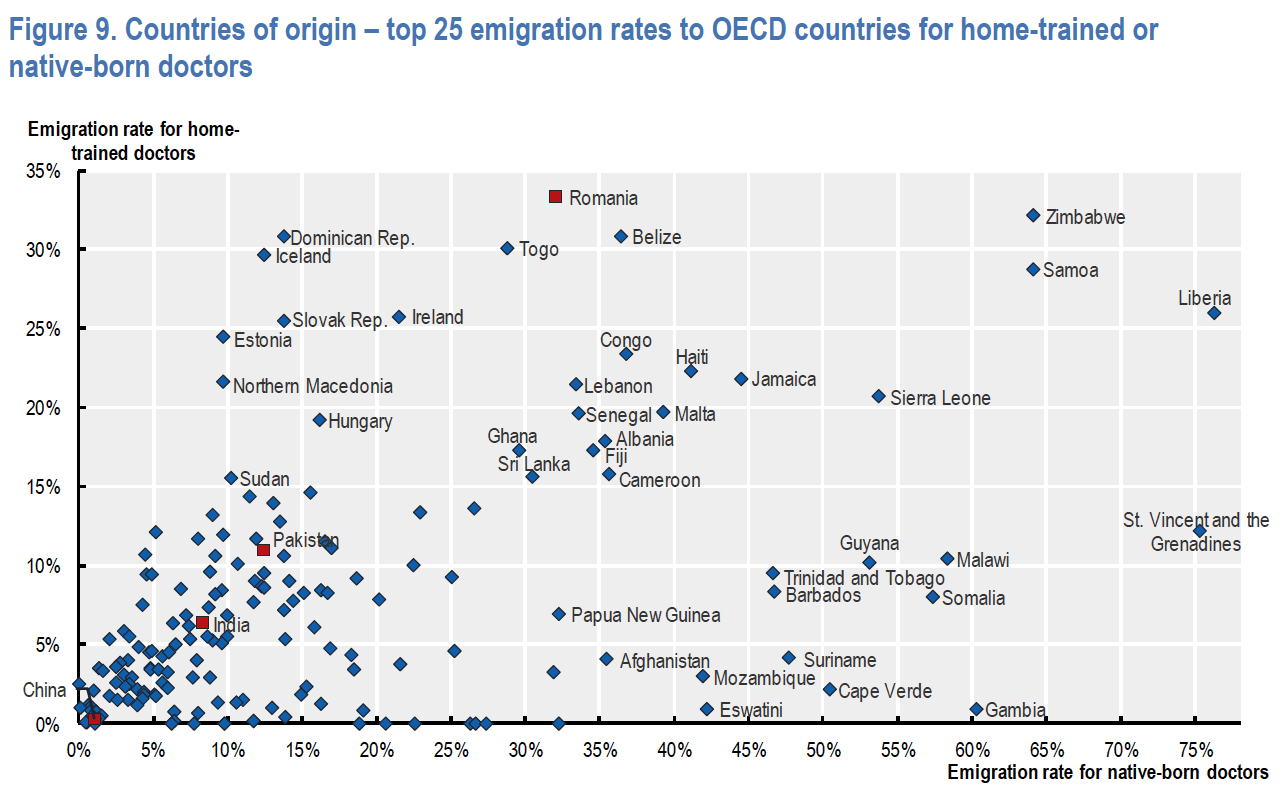
Although we do not know of a formal census of doctors born or trained in Puerto Rico who are working outside the island, it is useful to examine global trends. Half of the countries that belong to the Organization for Economic Co-operation and Development (OECD), have less than 10% of its native doctors working outside the country. Spain has 3% of its native doctors working out of the country; Dominican Republic, has around 15%; Mozambique, Surinam, Barbados and Jamaica, around 45%; Samoa, 65% (see the OECD graph below). The OECD notes that Caribbean countries have been particularly affected by the emigration of its native doctors, with rates of between 50 and 75%, that is, between five and seven times the norm for half of OECD countries.

The OECD uses two parameters to evaluate the migration of doctors: those born in a country and those trained there. Source: International migration and movement of doctors to and within OECD countries, OECD Health Working Papers No. 126, p. 27.

The magnitude of this circulatory flow and its impact both in origin and receiving countries has made the mobility of health professionals a priority for entities like WHO and the OECD. These organizations have begun to look at the migratory phenomenon at a global scale. In the same vein, the European Union (EU) commissioned in 2021 – after the shock produced by the pandemic – a study on the planning systems its members have developed for their individual health labor forces – doctors, nurses and midwives. The study found that although three out of four European countries have indeed developed labor planning systems for their health structures, there are notable problems in terms of data, planning models, scarcity in certain specialties, geographical imbalances, shortages in training programs, and gaps in personnel retention systems.

In Puerto Rico, would it not be appropriate to look at the problem of scarcity of doctors and health professionals in a such a broad, systemic manner?

“Exodus of doctors”, structural imbalances and policy measures in Spain

In Spain the “exodus of doctors” has recently become a visible source of news (see for example, here and here). The Spanish health system is considered one of the best in the world, but, as has happened globally, the pandemic has left behind enormous systemic stress. In the Spanish Public Health System (“la Sanidad Pública”), 42% of patients still have access to their primary doctor the same day or the day after requesting an appointment. Wait times for specialists, however, have increased to a mean of three months, with significant differences among autonomous communities (AACC). The Basque Country registers a month-long wait; Catalonia, Aragón and Canarias, between four and five months.

It is important to note that the Spanish health system is based in the universal coverage of its population; is anchored in an extensive network of public primary facilities and hospitals; is financed by tax-revenues which the central State then distributes to the 19 autonomous communities and cities, which are the ones that then manage the system at a regional level; and coexists with an efficient and robust private insurance sector, which after the pandemic has reached 30% of penetration among the population.

In contrast to Puerto Rico, private health insurance in Spain generally works as a complement to the public health system, that is, as a system of double coverage that allows access to services not covered by the public health plan (dental or chiropractic care for example) or as a way to speed up access to specialists. Private health insurance tends to be circumscribed to civil servants, judges and military personnel, who through a system of “mutualities”, can indeed choose to substitute the public health plan for private health coverage; to the employees of large corporations who receive private health insurance as part of their benefit packages; and to the more affluent population who buys private insurance on an individual or family level.

In Spain, private health companies have their own centers for medical attention, emergency facilities and hospitals. Plans, however, are less costly than in the USA or Puerto Rico, as treatment for catastrophic or complex conditions (cancer, for example), although included in the more comprehensive private policies, tend to be referred or transferred to the public system. Likewise, most innovative last-generation treatments and cutting-edge technologies tend to be available in the private health system on a pay-for-service basis, while being available for free to participants in the public health-care system. According to the Ministry of Health, 73% of Spanish health expenditures are made by the public system (about €88,000 million or $95,000 million) versus 27% of private health expenditures (€32,000 million).

Since last year, the Spanish public health system has been shaken by strikes, protests and complaints from its doctors. These stress that the increase in patient-care quotas (up to 70 patients in one working day), the lack of investment in physical facilities and the disinvestment in primary care (which handles 80% of the health ailments of the population), has oversaturated the system. This has led to renewed public discussion about the “exodus of doctors”. The Medical College Organization claims that each year a larger number of doctors request the homologation of titles conducive to work in other EU countries. Nevertheless, the number of certificates actually requested – 4,130 in 2021 – represents only 2.1% of the 192,484 doctors that the Spanish Ministry of Health identifies as active practitioners in the country. As a matter of fact, the final migratory flow is substantially lower: between 2011 and 2020 the annual average of emigrating doctors was of 438. This would mean that the human resources shortages affecting the Spanish public health system cannot be adjudicated to the emigration of doctors, and that the phenomenon is actually one piece of a larger puzzle.

Sergi Jiménez-Martín, health economist, professor at Pompeu Fabra University and associate researcher at the Spanish think tank FEDEA, says that in the context of a common market – such as Spain and the EU or Puerto Rico and the USA – it is actually impossible to curtail the emigration of health personnel, particularly in a situation of low compensation, labor instability and poor working conditions in the country of origin. In Spain, one of the policy responses during the decade of 2000 was to facilitate the immigration of foreign-born doctors – particularly from Latin America – allowing for their direct recruitment abroad; relaxing the requirements for studying and doing their training residencies in Spain; and accrediting medicine titles obtained abroad. According to a 2015 study conducted by Universidad Complutense de Madrid, 12.5% of all registered medical practitioners in Spain were foreign-born.

Other policy measures have addressed the system’s structural human resources imbalances, always from a systemic or integral point of view. Since 2007 the Spanish Health Ministry has commissioned several studies in order to project the demographic and epidemiologic evolution of the population, quantify the future need of primary care doctors and medical specialists, and identify public policies to address the demand for health personnel. Even though the migratory flow of doctors does not seem to be large, these studies anticipate that, due to the aging process of the country’s population, by 2027 Spain will face a global deficit of 9,000 doctors. To this effect, during the past fifteen years the Council of Universities (composed by the Ministry of Education and the Council of University Chancellors) has increased the number of new university slots available for medicine studies (an increase of 44% between 2007 and 2022); has increased the number of MIR positions (the equivalent of our medical practices in the country’s hospitals); and has increased the number of doctors trained in other countries that are accepted for medical practice in Spain. The latest 2022 study emphasizes that after the shock of the pandemic, it will be necessary to implement additional measures: improve compensation packages, ensure labor stability through long-term contracts, and increase incentives for posts in rural or unattended areas.

Álvaro Hidalgo, health economist and director of the Efficiency-Based Practice of Medicine Chair for HM Hospitals, one the main private hospital networks in Spain, stresses the importance of non-economic aspects in retention schemes for doctors: the possibility of being trained in the desired specialty area (i.e., the strength and variety of medical practices), of working with cutting-edge technology, and of participating in research and clinical trials conducive to long-term experience and prestige.

What about provider rates of private plans in Spain?

In Spain, 30% of doctors work with the private health system. The rates paid by private insurers – one of the most contentious elements in Puerto Rico – are similar to those paid in the island: €18 for a patient visit to a cardiologist (about $ 19), €21 for one to a traumatologist, or €27 for a gynecologist (see the digital platform Baremos Médicos for more examples).

Sample of a private insurer providers’ rates chart, 2022, Spain. Source: https://baremosmedicos.com/knowledge-base/cardiologia-salus-2022

Why, then is the private health component in Spain not undergoing a crisis? Because many doctors combine posts in the public health system with contracts in private facilities: that is, the income from private insurers represents a complement to their regular income. And because the structure under which a doctor operates in Spain is substantially different from that of a doctor in Puerto Rico or the USA: many see their private patients in the insurer’s medical facilities, which means that they do not have the cost structure associated to an individually-run medical practice.

In contrast, the way medical services are organized in the USA and Puerto Rico imposes a costly structure on medical practitioners. According to a 2012 study commissioned by the Puerto Rico College of Doctors and Surgeons:

  • 49% of doctors surveyed paid $100,000 annually in employee salaries
  • The median rent for office space was of about $51,600 per year; mortgage payments were of about $90,000
  • The median investment in purchase, repair and maintenance of medical equipment was of $135,000 per year
  • Most paid between $100,000 and $300,000 per year in malpractice insurance

To all this, it would be necessary to add the $150,000 – $250,000 in student debt with which the average doctor starts its career in Puerto Rico and the USA.  The cost of medicine school in the USA can oscillate between $159,000 (in a public university for residents of the state) and $256,000 (in a private university for non-residents). In Spain, in contrast, the total cost of 6 years of medicine school can range between $7,000 – $10,000 in a public university (higher ranked than private institutions) and of $54,000 – $130,000 in a private institution. Like health, education is considered one of the key anchors of the European welfare state.

The health system in the USA vs. its counterparts

Both Jiménez and Hidalgo point to the fact the USA’s health system – around which Puerto Rico’s is modeled – is a costly one. The reasons, they explain, are diverse: laissez faire in prices for both prescription drugs and medical equipment (they are regulated in Spain); the decentralization of medical and hospital providers (which duplicates administrative structures and requires providers to individually amortize costly staff and equipment); and the high remuneration received by doctors. In the USA, the average salary of a doctor is of $339,000  while in Spain it is €54,000 at the beginning of his/her career (about $58,000), €104,000 at the end. Puerto Rico falls between the two poles: according to the Puerto Rico Labor Department, the average salary for an internist in Puerto Rico is $78,700, $121,120 for those in the highest salary percentile.

These factors make the USA’s health model less cost-efficient than those of other countries. A survey prepared by the OECD in September of 2022 found that:

  • The USA spends two and a half more per capita in health than its G7 counterparts: 17% of its Gross Domestic Product (GDP) versus 8.7% in the case of Italy and 11.7% in the case of Germany.
  • This, however, is not translated in more health resources for the population: the USA has 2.8 hospital beds per 100,000 inhabitants versus 4.4 for the totality of OECD members. Likewise, it has 2.6 doctors per 100,000 inhabitants versus 3.6 for the OECD group.
  • This larger healthcare expense is not necessarily translated into better health outcomes for the population: the USA has a higher survival rate for breast cancer patients than the OECD average (90.2% vs 84.3%), but has worse indexes in terms of effective primary care (almost double of avoidable hospital admissions for diabetes, 226 vs. 127 cases per 100,000 inhabitants, for example).
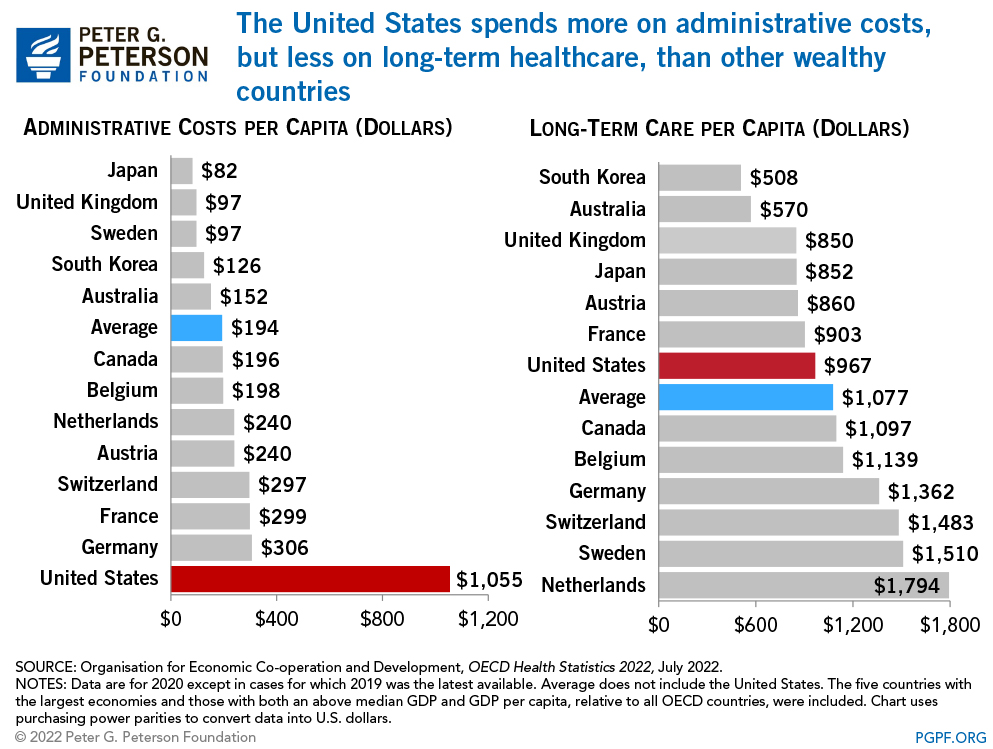
  • Administrative costs for the USA’s health system are five times those of its G7 counterparts, and in general, prices for health services tend to be 27% more expensive. This makes a visit to a family doctor three times more costly in the USA than in other G7 countries.

Source: Peter G Peterson Foundation, https://www.pgpf.org/blog/2022/07/how-does-the-us-healthcare-system-compare-to-other-countries

This means that health services in Puerto Rico are organized around an inherently costly health model. Jiménez thinks that, in the face of rate restrictions imposed by federal programs, an increase in tariff rates for providers serving private (individual and group) clients might not be the best idea. First, these represent only a third of the private insurance market in the island, and second, it would make insurance plans even more costly than what they are today in the island.

Rethinking the health system

Continuing to advocate for larger access to federal funding is an obvious way to address the problem, but, one may ask, should not the organization and structure of the health system itself be rethought? This is the conclusion reached by three researchers of the University of Chicago and Harvard University, who in a recently published study in January 2023 suggest that the best way to address the current failings in the USA’s health system could be the establishment of some type of universal health coverage that would allow a centralized administrative approach.  Katherine Baicker, Amitabh Chandra and Mark Shepard argue that this would open the possibility of expanding the population that has access to health services (in the USA 27.5 million people, or 10.2% of the population, are currently uninsured); lower administrative costs for the totality of the system; and open the possibility of developing new provider compensation schemes based on quality and innovation (rather than on the market power of insurers and large providers).  They point to the fact that, contrary to popular belief:

  • Universal coverage and centralized planning systems are not necessarily based on public facilities managed by governments: there are a wide variety of practices, from Canada’s and the United Kingdom’s single payer system, to the Netherlands’ and Switzerland’s regulated markets based on private insurance and private providers.
  • Universal health coverage is considered a social minimum base and coexists with private providers and insurers. France, for example, has a package of generous benefits in its universal coverage, but requires co-pays from beneficiaries; many then opt for a private health plan to cover these out-of-pocket payments (almost 90% of the population has some kind of private complementary plan). Germany, for its part, has not only supplementary private insurance plans, but allows these to actually substitute public health coverage (see for example, these two WHO compilations – here and here – for more examples).
  • The system’s regulatory entity does not necessarily have to be a government agency, but may be formed by some kind of medical or private actor overseeing board.

Since the approval of the federal Affordable Care Act (ACA), better known as “Obama Care”, in 2010, several states in the USA have attempted to implement reforms to their state health systems with varied results. Twenty-one (21) states have unsuccessfully introduced state legislation to create single payer health systems and achieve universal coverage for their populations. These attempts, however, have come into conflict with federal legislation governing private health plans paid by companies and employers (ERISA). Professors Erin Brown and Elizabeth McCuskey call this jurisdictional clash a “trap of federalism” and have proposed federal law be modified: federalism, they argue, should allow states to innovate, test and learn from experimental models.

Another three states (Colorado, Nevada and Washington) have implemented more modest reforms: state health coverage anchored in the possibility offered by ACA of expanding Medicaid and establishing subsidies for private coverage. These are not universal plans and rely on the states contracting private insurers to offer the population options supervised by the government (like Plan Vital in Puerto Rico). They are sold through the state exchange markets created by ACA, from which Puerto Rico and the other territories were excluded.

Conclusion

Does Puerto Rico have some sort of judicial, political and fiscal space to reform its current health system? Could the so-called “exodus of doctors” be the spearhead to develop, in terms of public policy, a wide assessment of the island’s health system and its professionals, and evaluate how prepared the system is to address the population’s current and future health needs? Is there both will and capacity to turn Puerto Rico’s health government agencies into centers for policy innovation – like Massachusetts did in 2006 with its pioneering health reform? That is, is there the institutional will and capacity to transcend the mere administration of federal funds? The conversation is complex indeed, but with no doubt, it is worthwhile starting it.

CNE Review – June 2022

Published on June 30, 2022 / Leer en español

See all editions of the
CNE Review
SHARE

We dedicate this issue of the CNE Review to our founding Chairman, Churchill G. Carey, Jr. Church was a towering figure in the housing field in Puerto Rico for many decades and an inspiration to all who knew him. CNE would not exist except for his generosity and support. Our work in the housing sector is a direct result of Church’s influence and is inspired by his passion for Puerto Rico. Church would have been 80 in July. He was a great friend and mentor and we miss him.

In This Issue

This month the CNE Review will take a look at some of the issues affecting the housing market in Puerto Rico. Housing is not just a place to shelter from the elements, as important as that function is. In the words of my colleague Raúl Santiago-Bartolomei, “housing provides the security and minimum foundation needed for the material well-being of families in Puerto Rico. It is also the basic unit that defines the social fabric of communities.”

Yet, for decades in Puerto Rico, there has been a deficit of safe, accessible housing for low and medium-income families. Even prior to the 2017 hurricanes and the 2020 earthquakes, households facing tenure insecurity and informal settlements were a common occurrence in Puerto Rico and shared several characteristics, such as lack of formalized land tenure, location in third party public and/or private land, as well as housing originally built as makeshift structures.

The natural disasters of the past few years have added yet another layer of insecurity to Puerto Rico’s already precarious housing situation. According to my colleague Deepak Lamba-Nieves, “the combined impacts of hurricanes Irma and María exacted a disastrous toll on Puerto Rico’s housing sector. Over 725,000 households reported damages to their dwellings, representing close to 60% of occupied housing units in the island.” Unfortunately, five years after the 2017 storms made landfall, little progress has been made in repairing the island’s damaged housing stock as shown in CNE’s Housing Reconstruction Monitoring Dashboard ­– an interactive and dynamic tool that provides detailed data, at the municipal level, on housing damages and reconstruction investments related to Hurricanes Irma and María. The Dashboard, created and maintained by CNE, enables the public to track the housing reconstruction efforts and raises awareness of the needed investments to effectively repair the widespread damage caused by the 2017 storms. This platform is an outgrowth of the first research project summarized below that focuses on analyzing the provision of emergency housing relief through FEMA’s Individual Assistance Program.

On the positive side, though, it appears that bureaucratic and political barriers have been removed to spend the approximately $20 billion in CDBG-DR funds allocated by Congress for housing reconstruction in Puerto Rico. This effort, in addition to being important in and of itself, is a core part of a broader hurricane reconstruction effort that will set the foundation for long-term growth in Puerto Rico. Getting reconstruction right is necessary for the long-term sustainability of Puerto Rico’s economy and housing is a key component of reconstruction.

Finally, as you read about Raul and Deepak’s research about housing in Puerto Rico, keep in mind that housing markets are fiendishly difficult to analyze and understand. Remember that basic economy theory about how markets work assumes that goods and products in any given market are essentially fungible and easy to supply. Few goods can be further away from that premise than housing.

Indeed, the housing market in Puerto Rico has been out of balance for decades now. Again, in the words of Raúl, in the past “there was a surplus of market-priced properties that no one bought, and a deficit of social and affordable housing that no one was supplying. Today, there is a surplus of properties being bought at prices above appraisal and an even worse deficit of affordable and social housing that nobody is supplying.” Fixing that imbalance will be a long, complex endeavor.

Without further ado, I leave you with a summary of the important work Raúl and Deepak are undertaking in the housing area. I hope you find it thoughtful and informative.

Let’s get to it.

–Sergio M. Marxuach, Editor-in-Chief

Insights + Analysis from CNE

Puerto Rico’s Housing Situation Five Years After Hurricane María

By Deepak Lamba-Nieves, Ph.D., CNE Research Director & Churchill G. Carey, Jr. Chair in Economic Development Research and Raúl Santiago-Bartolomei, Ph.D., CNE Research Fellow & Assistant Professor at the Graduate School of Planning of the UPR-RP

The combined impacts of hurricanes Irma and María exacted a disastrous toll on Puerto Rico’s housing sector. Over 725,000 households reported damages to their dwellings, representing close to 60% of occupied housing units on the island. These storm damages came on top of a range of housing problems that have been developing over the course of many years. Land tenure and titling issues are common, partly due to the fact that Puerto Rico has consistently failed to produce sufficient affordable housing units for a large portion of the population. Increased production in certain segments and underproduction of social housing, over time, has led to a large number of vacant housing units, a growing affordability crisis, and very long waiting lists for public housing and Section 8 vouchers. Moreover, the vast number of homes located in flood zones, lacking insurance and built without complying with building codes increased the vulnerability of hundreds of thousands of families prior to the hurricanes making landfall.

Unfortunately, five years after the 2017 storms made landfall, little progress has been made to address the island’s housing needs. In fact, the situation has gotten more precarious, especially for low-income families seeking affordable homes, given a 22% increase in housing prices from 2018 until 2021. In past years, there was a surplus of market-priced properties that no one bought, and a deficit of social and affordable housing that no one was supplying. Today, there is a surplus of properties being bought at prices above appraisal, and an even worse deficit of affordable and social housing that nobody is supplying.

Since 2018, CNE’s Blueprint Initiative has provided a platform for productive conversations and knowledge exchanges on issues of land ownership, accessibility, and safe housing.  Given our dire housing situation, our primary objective is to bring together existing efforts and strategic thought partners to devise a collective roadmap for the reconstruction and beyond. To achieve this, we have been conducting research on a range of post-disaster housing topics, developing interactive tools, and organizing events for the wider public.

Below is a brief review of the ongoing and completed research we have been working on for the past years.

1. Who Gets Emergency Housing Relief? An Analysis of FEMA Individual Assistance Data After Hurricane María

In the months after Hurricane María’s devastation of Puerto Rico, press outlets and advocacy groups documented how Puerto Rico’s experience with housing repair and reconstruction programs was rife with complaints and inconsistencies regarding approval of applications and denial of support, especially among vulnerable communities. CNE produced a research paper, published in Housing Policy Debate, that contributes to the critical task of revealing post-disaster damages and reconstruction trends through a detailed examination of housing and personal property damages and benefits received through the Federal Emergency Management Agency (FEMA)’s Individual Assistance (IA) Program after Hurricane María. We also examined if housing needs were equitably addressed by placing attention on whether poor households, or those located in very vulnerable communities with inadequate infrastructure and precarious socioeconomic conditions, known locally as Special Communities, were unfavorably served.


Heatmap of total household damage, as estimated by FEMA’s Individual Assistance program. Source: FEMA & Puerto Rico Planning Board.

Overall, poor households and those living in Special Communities were not likely to be excluded from receiving emergency aid. In fact, they were more likely to have been inspected and receive monetary assistance. But CNE did find that land tenure status matters, and is a major factor to determine the likelihood that an applicant household can access FEMA funds. Applicants with what FEMA terms “unknown tenure” fare worse off than homeowners.

Particularly notable was the relationship between poverty and “pending housing need”—which is the difference between the FEMA damage estimates and the FEMA award given to an applicant—. Interestingly, households under the federal poverty line had higher pending housing needs compared to non-poor households. This is particularly worrisome because poor households are less likely to receive other forms of aid in the immediate period following a disaster, like SBA loans, and are thus left in a temporal limbo and susceptible to displacement, until other major reconstruction programs come on line.

2. Tracking Neighborhood Change in Geographies of Opportunity: A Case Study of San Juan, Puerto Rico

Previous studies on disasters and long-term housing reconstruction in the United States show that the recovery process of neighborhoods evolves in a highly unequal manner within cities. Research conducted in Miami, Galveston, and New Orleans demonstrates that natural disasters are followed by high rates of housing market volatility, property abandonment, and gentrification waves. Considering that disasters can affect housing markets and lead to neighborhood change, with this research project, CNE identified whether these kinds of local-level transformations were observed in the San Juan Metropolitan Area (SJMA) following Hurricane María. Our analysis centered on neighborhood changes, their relationship with storm impacts, and the spatial distribution of opportunities—namely, access to jobs, education, and safety.

Our results, published in the Lincoln Institute for Land Policy working paper series, show that:

(1) Pending housing needs were more acute in neighborhoods with increased poverty concentration, furthering socioeconomic segregation in post-disaster SJMA.

(2) Storm impacts are also associated with higher housing prices and sales in certain areas. Rent increases were also observed in neighborhoods with a higher percentage of damaged units.

(3) Similarly, some neighborhoods also experienced increased vacancy rates as a result of storm damages. This finding demonstrates that the impact of storm damages on neighborhoods varies. While some neighborhoods experience gentrification pressures, others have experienced increased decline.

We also created an opportunity score that ranks neighborhoods in the SJMA given their access to jobs, education, and safety, and tested the relationship between the score and measures of neighborhood change.  This exercise revealed that access to opportunities is closely related to increases in housing prices, socioeconomic segregation, and vacancy rates. These research findings have numerous policy implications for the post-disaster reconstruction process.  For example, given that housing in high-opportunity areas is increasingly less tenable for low-income households, the government of Puerto Rico should prioritize locating affordable units, financed with federal recovery dollars, in these areas. At the same time, low-opportunity areas should be given priority for infrastructure improvements, community lifelines, hazard mitigation, workforce development, and local business aid spending programs.

Median unit price between 2016 and 2019 for the San Juan Metropolitan Area at Census tract level.
Source: Puerto Rico Community Survey and Luis Abreu & Associates

3. Upcoming Project: Housing, Disasters and Displacement

Building on the research conducted on FEMA’s Individual Assistance Program, CNE is currently working on a project—in collaboration with Elora Lee Raymond from Georgia Tech’s School of City and Regional Planning—that examines the relationship between post-disaster reconstruction efforts and migration patterns in Puerto Rico. Academic inquiries regarding population movements following Hurricane María have yielded estimates that range from over 400,000 persons leaving the island, to just over 120,000 individuals moving out in the year following the catastrophic event. While these studies paint a broad-brush picture of movement and population loss, they do not provide a detailed understanding of the migration push factors, including those related to pre-storm vulnerabilities, storm exposure, damages, and federal response, at the community or neighborhood level. We tackle these issues through an in-depth analysis of three primary sources of data: the Federal Reserve Bank of New York/Equifax Consumer Credit Panel data, FEMA Individual Assistance applicant records, and the 5-year estimates from the Puerto Rico Community Survey.

Although we’re still fine-tuning our statistical models, we’ve found interesting patterns regarding post-disaster moves. To give you an idea of the overall trends, the overwhelming majority of people in our study sample did not move following hurricane María. However, of those who moved, most did so within their municipality. A smaller proportion moved within Puerto Rico but outside their municipality, and an even smaller percentage moved outside the island. This confirms the findings in the academic literature which suggests that most moves following a disaster are short distance. With regards to returns, the trends show that most of those who moved do not return to their community of origin after two years.

4. Upcoming Project: Short-Term Rentals in Puerto Rico

CNE’s most recent research project is an in-depth examination of the short-term rental market in Puerto Rico. Over the past five years or so, numerous press reports and community advocates have been highlighting how increases in rents and housing prices are contributing to gentrification pressures and the displacement of long-term residents, especially low- and moderate-income neighbors. Building on our work on “geographies of opportunity”, which demonstrated that Hurricane María was an inflection point that has led to significant changes in Puerto Rico’s housing markets, we are interested in gaining an in-depth understanding of how the rapid expansion of short-term property rentals (through platforms like Airbnb, Home Away, etc.) has contributed to distinct neighborhood changes in a growing number of communities. Our goal is to provide some general trends and patterns, from 2014 until before the global pandemic struck, and carefully assess how these kinds of real estate investments are contributing to gentrification and displacement pressures.

Some early results of our analysis show that for every 10% increase in the total number of units dedicated to short-term rentals in a neighborhood:

  • Median rents increase by at least 5%
  • Unit purchase price (in dollars per square foot) increases by 23%
  • Sales volume in a neighborhood increases by 1%

Short term-rental units as percent of total housing units
Source: AirDNA and Puerto Rico Community Survey

Puerto Rico’s Housing Situation Five Years After Hurricane María

Puerto Rico’s Housing Situation Five Years After Hurricane María

Published on June 29, 2022 / Leer en español

Deepak portrait
Research Director
Research Fellow
SHARE

The combined impacts of hurricanes Irma and María exacted a disastrous toll on Puerto Rico’s housing sector. Over 725,000 households reported damages to their dwellings, representing close to 60% of occupied housing units on the island. These storm damages came on top of a range of housing problems that have been developing over the course of many years. Land tenure and titling issues are common, partly due to the fact that Puerto Rico has consistently failed to produce sufficient affordable housing units for a large portion of the population. Increased production in certain segments and underproduction of social housing, over time, has led to a large number of vacant housing units, a growing affordability crisis, and very long waiting lists for public housing and Section 8 vouchers. Moreover, the vast number of homes located in flood zones, lacking insurance and built without complying with building codes increased the vulnerability of hundreds of thousands of families prior to the hurricanes making landfall.

Unfortunately, five years after the 2017 storms made landfall, little progress has been made to address the island’s housing needs. In fact, the situation has gotten more precarious, especially for low-income families seeking affordable homes, given a 22% increase in housing prices from 2018 until 2021. In past years, there was a surplus of market-priced properties that no one bought, and a deficit of social and affordable housing that no one was supplying. Today, there is a surplus of properties being bought at prices above appraisal, and an even worse deficit of affordable and social housing that nobody is supplying.

Since 2018, CNE’s Blueprint Initiative has provided a platform for productive conversations and knowledge exchanges on issues of land ownership, accessibility, and safe housing.  Given our dire housing situation, our primary objective is to bring together existing efforts and strategic thought partners to devise a collective roadmap for the reconstruction and beyond. To achieve this, we have been conducting research on a range of post-disaster housing topics, developing interactive tools, and organizing events for the wider public.

Below is a brief review of the ongoing and completed research we have been working on for the past years.

1. Who Gets Emergency Housing Relief? An Analysis of FEMA Individual Assistance Data After Hurricane María

In the months after Hurricane María’s devastation of Puerto Rico, press outlets and advocacy groups documented how Puerto Rico’s experience with housing repair and reconstruction programs was rife with complaints and inconsistencies regarding approval of applications and denial of support, especially among vulnerable communities. CNE produced a research paper, published in Housing Policy Debate, that contributes to the critical task of revealing post-disaster damages and reconstruction trends through a detailed examination of housing and personal property damages and benefits received through the Federal Emergency Management Agency (FEMA)’s Individual Assistance (IA) Program after Hurricane María. We also examined if housing needs were equitably addressed by placing attention on whether poor households, or those located in very vulnerable communities with inadequate infrastructure and precarious socioeconomic conditions, known locally as Special Communities, were unfavorably served.


Heatmap of total household damage, as estimated by FEMA’s Individual Assistance program. Source: FEMA & Puerto Rico Planning Board.

Overall, poor households and those living in Special Communities were not likely to be excluded from receiving emergency aid. In fact, they were more likely to have been inspected and receive monetary assistance. But CNE did find that land tenure status matters, and is a major factor to determine the likelihood that an applicant household can access FEMA funds. Applicants with what FEMA terms “unknown tenure” fare worse off than homeowners.

Particularly notable was the relationship between poverty and “pending housing need”—which is the difference between the FEMA damage estimates and the FEMA award given to an applicant—. Interestingly, households under the federal poverty line had higher pending housing needs compared to non-poor households. This is particularly worrisome because poor households are less likely to receive other forms of aid in the immediate period following a disaster, like SBA loans, and are thus left in a temporal limbo and susceptible to displacement, until other major reconstruction programs come on line.

2. Tracking Neighborhood Change in Geographies of Opportunity: A Case Study of San Juan, Puerto Rico

Previous studies on disasters and long-term housing reconstruction in the United States show that the recovery process of neighborhoods evolves in a highly unequal manner within cities. Research conducted in Miami, Galveston, and New Orleans demonstrates that natural disasters are followed by high rates of housing market volatility, property abandonment, and gentrification waves. Considering that disasters can affect housing markets and lead to neighborhood change, with this research project, CNE identified whether these kinds of local-level transformations were observed in the San Juan Metropolitan Area (SJMA) following Hurricane María. Our analysis centered on neighborhood changes, their relationship with storm impacts, and the spatial distribution of opportunities—namely, access to jobs, education, and safety.

Our results, published in the Lincoln Institute for Land Policy working paper series, show that:

(1) Pending housing needs were more acute in neighborhoods with increased poverty concentration, furthering socioeconomic segregation in post-disaster SJMA.

(2) Storm impacts are also associated with higher housing prices and sales in certain areas. Rent increases were also observed in neighborhoods with a higher percentage of damaged units.

(3) Similarly, some neighborhoods also experienced increased vacancy rates as a result of storm damages. This finding demonstrates that the impact of storm damages on neighborhoods varies. While some neighborhoods experience gentrification pressures, others have experienced increased decline.

We also created an opportunity score that ranks neighborhoods in the SJMA given their access to jobs, education, and safety, and tested the relationship between the score and measures of neighborhood change.  This exercise revealed that access to opportunities is closely related to increases in housing prices, socioeconomic segregation, and vacancy rates. These research findings have numerous policy implications for the post-disaster reconstruction process.  For example, given that housing in high-opportunity areas is increasingly less tenable for low-income households, the government of Puerto Rico should prioritize locating affordable units, financed with federal recovery dollars, in these areas. At the same time, low-opportunity areas should be given priority for infrastructure improvements, community lifelines, hazard mitigation, workforce development, and local business aid spending programs.

Median unit price between 2016 and 2019 for the San Juan Metropolitan Area at Census tract level.

Source: Puerto Rico Community Survey and Luis Abreu & Associates

3. Upcoming Project: Housing, Disasters and Displacement

Building on the research conducted on FEMA’s Individual Assistance Program, CNE is currently working on a project—in collaboration with Elora Lee Raymond from Georgia Tech’s School of City and Regional Planning—that examines the relationship between post-disaster reconstruction efforts and migration patterns in Puerto Rico. Academic inquiries regarding population movements following Hurricane María have yielded estimates that range from over 400,000 persons leaving the island, to just over 120,000 individuals moving out in the year following the catastrophic event. While these studies paint a broad-brush picture of movement and population loss, they do not provide a detailed understanding of the migration push factors, including those related to pre-storm vulnerabilities, storm exposure, damages, and federal response, at the community or neighborhood level. We tackle these issues through an in-depth analysis of three primary sources of data: the Federal Reserve Bank of New York/Equifax Consumer Credit Panel data, FEMA Individual Assistance applicant records, and the 5-year estimates from the Puerto Rico Community Survey.

Although we’re still fine-tuning our statistical models, we’ve found interesting patterns regarding post-disaster moves. To give you an idea of the overall trends, the overwhelming majority of people in our study sample did not move following hurricane María. However, of those who moved, most did so within their municipality. A smaller proportion moved within Puerto Rico but outside their municipality, and an even smaller percentage moved outside the island. This confirms the findings in the academic literature which suggests that most moves following a disaster are short distance. With regards to returns, the trends show that most of those who moved do not return to their community of origin after two years.

4. Upcoming Project: Short-Term Rentals in Puerto Rico

CNE’s most recent research project is an in-depth examination of the short-term rental market in Puerto Rico. Over the past five years or so, numerous press reports and community advocates have been highlighting how increases in rents and housing prices are contributing to gentrification pressures and the displacement of long-term residents, especially low- and moderate-income neighbors. Building on our work on “geographies of opportunity”, which demonstrated that Hurricane María was an inflection point that has led to significant changes in Puerto Rico’s housing markets, we are interested in gaining an in-depth understanding of how the rapid expansion of short-term property rentals (through platforms like Airbnb, Home Away, etc.) has contributed to distinct neighborhood changes in a growing number of communities. Our goal is to provide some general trends and patterns, from 2014 until before the global pandemic struck, and carefully assess how these kinds of real estate investments are contributing to gentrification and displacement pressures.

Some early results of our analysis show that for every 10% increase in the total number of units dedicated to short-term rentals in a neighborhood:

  • Median rents increase by at least 5%
  • Unit purchase price (in dollars per square foot) increases by 23%
  • Sales volume in a neighborhood increases by 1%

Short term-rental units as percent of total housing units
Source: AirDNA and Puerto Rico Community Survey

CNE Review – November 2021

Published on November 18, 2021 / Leer en español

See all editions of the
CNE Review
SHARE

In This Issue

In this edition of the CNE Review, we are focusing on education and its role in economic development. In its broadest sense, economic development consists of creating the conditions necessary for human flourishing. Contrary to popular belief, development is not limited to economic growth nor mere increases in economic indicators, such as employment, income, or output.

It also requires, in the language of Amartya Sen and Martha Nussbaum, that a society’s growing wealth be utilized to provide at least five types of instrumental freedoms: (1) political freedoms (including civil rights, freedom from discrimination, and other human rights); (2) economic opportunity (fair access to economic resources); (3) freedom to improve one’s life chances and opportunity structures (through access to education, quality healthcare, and physical security); (4) freedom to participate in the governance of society (including access to government information, governmental openness and transparency, and protection from corruption); and (5) protection from basic material and physical wants (through social safety nets, unemployment insurance, and old age pensions).

Belinda Reyes, a CNE Visiting Fellow, explores some of those connections between higher education and economic development, specifically the issue of what can be done to provide young people with better opportunities on the island.

Professor Reyes is an Associate Professor at the Department of Latina and Latino Studies at San Francisco State and is an expert in demographics, education, immigration, urban economics, opportunity youth, and the social and economic progress of Latinx in the United States.  Her work explores the intersection of demographic change and policy to examine institutional policies and practices that limit opportunities and perpetuate unequal outcomes for people of color.  She holds a B.S. in economics from the University of Illinois at Urbana-Champaign and a Ph.D. in economics from the University of California, Berkeley. Please join us in welcoming her to CNE.

Finally, we remind our readers that CNE will soon be hosting its first conference since 2019. The Growth Policy Summit conference will be held on Friday, December 3 at the Sheraton Hotel in the Convention Center District. After fifteen years of stagnation, the bankruptcy of its government, the destruction caused by two hurricanes, and the effects of the global COVID-19 pandemic, it is time to start thinking about Puerto Rico’s future. Some of the issues to be addressed at the Growth Policy Summit include:

  • How do we get Puerto Rico back on a path towards growth?;
  • How do we leverage the reconstruction process?;
  • How have the government’s bankruptcy and the COVID-19 pandemic affected our ability to rebound?; and
  • How can we finally be successful in charting a new roadmap?

For more information, including registration for the conference, go to cnegps.com.

–Sergio M. Marxuach, Editor-in-Chief

Insights + Analysis from CNE

Investing in Ourselves: Post-Secondary Education for a Sustainable and Equitable Recovery

By Belinda I. Reyes, Ph.D., CNE Visiting Fellow

Puerto Rico is at a critical moment to recover from environmental disasters – hurricanes, earthquakes, and the COVID-19 pandemic – as well as a fifteen-year-long recession and fiscal crisis. Billions of federal funds are becoming available to rebuild our infrastructure.

Meanwhile, the Fiscal Oversight and Management Board for Puerto Rico (“FOMB”), given the authority by Congress to develop Fiscal Plans for the island, is only interested in the payment of the public debt and for five years has been imposing severe austerity measures and a payment plan that threatens the opportunity of a lifetime to rebuild our island.

We ask ourselves, how do we build a future with opportunities for young people on the island?

Young people need hope for the future and opportunities to prosper, and they are not finding them in Puerto Rico. We need to reconstruct our island by rebuilding our middle class and creating opportunities.

Keep reading for a summary of our policy brief. Click here to access the full text.

A 21st Century Model of Development for Our Current Realities

The late 20th century Thatcher/Reagan model of economic growth is increasingly questioned in light of its impact on poverty, inequality, and climate change. In the case of Puerto Rico, the economic strategy led to declining economic activity, inequality, and extreme poverty. Today over 40% of the population in the island lives below the poverty line, over three times the U.S.’s rate.

The economic collapse of the development model has resulted in extreme depopulation as people see no hope for the future in the island.  The most recent portrait of our migrants published by the Instituto de Estadisticas de Puerto Rico shows the people leaving the island were younger (31 versus 43 years old median age in the island), in the labor force (61% compared to 45% in the island) and slightly more educated than the average adult 25 and older in Puerto Rico (55% had some college education versus 51%).

We need a model of development for the 21st Century. Click here to read more examples of how we could overhaul our infrastructure and rebuild our middle class with a strong post-secondary educational system.

Growing the Economy from the Middle Out

The idea of growing the middle class to grow our economy is not new. Roosevelt’s New Deal was centered on providing opportunities and work for the people, through government support and investments in infrastructure. Currently, the Biden Administration is battling Congress to take the United States in that direction again with the Infrastructure, the American Families, and the Build-Back-Better Plans. While not everything in the plans will survive the battles in Congress, we can expect a major push to grow the middle class to bring back the U.S. economy.

Puerto Rico’s history is also an example of how education and the expansion of the middle class have been essential for economic growth. Since the 1960s, Puerto Rico had one of the greatest expansions in educational attainment in world history from 4.6 years for adults older than 25 years old to 11 years in 2000. This expansion in educational attainment accounted for as much as half of the increase in the output per worker between 1975 and 2000.

Click here to read more on how investments in education continue to contribute to the accumulation of human capital.

Budget Cuts Are Strangling the Public System

Meanwhile, the FOMB reduced the University of Puerto Rico (UPR) system General Fund Income by 48% in five years from $911 million in 2017 to $466 million in 2022. It is proposing to fix the General Fund Income at $500 million for the next five years. But it does not rule out the possibility of further cuts after 5 years. The FOMB hopes to offset these cuts with increased tuition, reductions in administration, freezing promotions, consolidation, and pension reform.

Not only are these changes impacting the viability of the institution, but also the opportunities for an education. The affordability of our system is one of the critical elements to grow the middle class on the island. Already in Puerto Rico education has become less affordable, even for those with financial aid. The cost of attendance has been increasing in private and public institutions for the last 10 years. Pell Grant no longer covers most costs for low-income students, and those that do not receive a full Pell Grant have a difficult time covering the increasing costs of education on the island.

Click to continue reading about the disparities in public institutions’ public support in the U.S. and Puerto Rico. 

A Master Plan for Higher Education

For the post-secondary educational system to have an impact on growth, it must have a sustainable budget and accompany major investment in infrastructure and housing in Puerto Rico, as is expected by the influx of federal funds. But there are also several reforms that need to take place within the educational system.

The public university system needs to be divorced from the political process. Higher learning in Puerto Rico cannot be tied to election cycles since it affects the institution’s capacity to execute long-term structural change if its leadership is interrupted every four years and there is no internal structure to give continuity to the plan. In addition to a sustainable budget, a governance structure that ensures the educational system’s quality, continuity, and independence is needed.

The UPR, as well as other higher learning institutions in the U.S., are experiencing declines in enrollment, which translates into lower budgets. COVID-19 has worsened the situation as we see by a 60% reduction in enrollment at the University of Puerto Rico, Rio Piedras. But at the same time, only 39% of the adults older than 25 in Puerto Rico have an associate degree or higher and the access to degrees is very unequal. Most Puerto Ricans do not complete postsecondary education, which results in lower productivity and wages.

How do we restructure the system to meet the educational needs of our population?  

By understanding the regional educational needs on the island, paying close attention to issues of equity, and developing plans for post-secondary education informed by research and community dialogue, we can link education to regional recovery to help foster sustainable growth in the island.

But without a fair agreement of the payment of the debt from the FOMB, the future of our children and their children would be foregone. Not only will this impact the island for generations to come, but it will also increase the trauma people are experiencing and the immigration to the United States. At least the diaspora counts with a voice and vote to pressure the U.S. Congress to finally give us the opportunity to prosper.

All of this and more will be discussed at CNE’s Growth Policy Summit on December 3, 2021, in the panel Education as a Driver of Economic Development featuring:

In the News

Click the image above to listen to José Delgado’s latest podcast featuring Miguel A. Soto-Class, CNE’s Founder and President, as they talk about CNE’s work and upcoming annual conference the Growth Policy Summit. Click here to register.

On Our Radar...

Fiscal Rules–Judge Laura Taylor Swain will hold ten days of court hearings this month to determine whether the Commonwealth’s Plan of Adjustment (“POA”) filed by the FOMB can be confirmed pursuant to Title III of PROMESA. The confirmation of a POA would mean the beginning of the end of Puerto Rico’s bankruptcy. As we start to look at a post-bankruptcy world, we think Puerto Rico should consider amending its Constitution to implement real limits on future indebtedness. This paper from the International Monetary Fund provides a useful summary of the kind of fiscal rules that could be implemented in Puerto Rico.

The Disappearance of Newspapers – Newspapers are closing down all over the United States, with dire results for democracy as people increasingly obtain their news from social media and other unreliable sources. By some accounts, more than a quarter of all U.S. newspapers have gone out of business during the last 15 years. This interesting piece in The Atlantic tells the fate of the once-mighty and influential Chicago Tribune, which has been gutted by the hedge fund Alden Global Capital.

Rising Anti-Democratic Opinion–A recent poll from the Public Religion Research Institute “paints a troubling portrait of a growing segment of the public that is increasingly unmoored from reality as it embraces conspiracy theories about child abduction and stolen elections”, according to reporting from The Hill. The survey found that “one in 5 Americans believe in the core tenet of the QAnon conspiracy that ‘there is a storm coming soon,’ while 1 in 6 believe the United States government is controlled by a group of Satan-worshipping pedophiles who run a global child sex-trafficking ring…The same share, 18 percent, say they agree with the statement that America has gotten so far off track that ‘true American patriots may have to resort to violence in order to save our country’”.

Investing in Ourselves: Post-Secondary Education for a Sustainable and Equitable Recovery

Investing in Ourselves: Post-Secondary Education for a Sustainable and Equitable Recovery

Published on November 17, 2021 / Leer en español

Visiting Fellow
DOWNLOAD
SHARE

Introduction

Puerto Rico is at a critical moment to recover from environmental disasters – hurricanes, earthquakes, and the COVID-19 pandemic – as well as a fifteen-year-long recession and fiscal crisis. Billions of federal funds are becoming available to rebuild our infrastructure.

Meanwhile, the Fiscal Oversight and Management Board for Puerto Rico (“FOMB”) given the authority by Congress to develop Fiscal Plans for the island is only interested in the payment of the public debt and for five years has been imposing severe austerity measures and a payment plan that threatens the opportunity of a lifetime to rebuild our island.

How do we build a future with opportunities for young people on the island?  

Already there are shortages of workers for many sectors. A recent report by the U.S. Bureau of Labor Statistics describes a need for some 40,000 workers for Puerto Rico’s reconstruction.[1]  And people continue to leave the island.

Young people need hope for the future and opportunities to prosper, and they are not finding them in Puerto Rico. We need to reconstruct our island by rebuilding our middle class and creating opportunities.

A 21st Century Model of Development for Our Current Realities

The late 20th century Thatcher/Reagan model of economic growth which focused on austerity measures, deregulation, low taxes, privatization, exports, and incentives for foreign investments to advance economic activity is increasingly questioned in light of its impact on poverty, inequality, and climate change. In the case of Puerto Rico, the economic strategy led to declining economic activity, inequality, and extreme poverty.  Today over 40% of the population in the island lives below the poverty line, over three times the U.S.’s rate.[2]

The economic collapse of the development model has resulted in extreme depopulation as people see no hope for the future on the island.  The most recent portrait of our migrants published by the Instituto de Estadisticas de Puerto Rico shows the people leaving the island were younger (31 versus 43 years old median age in the island), in the labor force (61% compared to 45% in the island) and slightly more educated than the average adult 25 and older in Puerto Rico (55% had some college education versus 51%).[3]

We need a model of development for the 21st Century. Covid-19 accelerated structural transformations that were slowly taking place in the global economy – increasing automation and AI[4]; the hybrid business landscape[5], the green economy, and the gig economy[6]. These new technologies require that we invest in education and the expertise required to design and produce “new, highly-profitable goods and services associated with the automation revolution[7].” The Bravo Family Foundation is counting on Puerto Rico as a hub of technological innovation and they are investing in local entrepreneurs[8]. We need trained engineers, programmers, software developers, and business people working on the future of innovation.

Puerto Rico is also innovating in construction using green materials such as recycled cargo containers for housing[9] and experimenting with the use of recycled tires for roads[10] and energy production[11]. Casa Pueblo[12] in Adjuntas and other emerging community efforts are providing examples of community energy projects that could a real alternative in rural communities[13]. We need skilled workers, scientists, and social entrepreneurs to take these experiments to scale.

With a strong post-secondary educational system responding to local recovery plans, we could overhaul our infrastructure and rebuild our middle class, who are truly the engine of growth in any economy.

Growing the Economy from the Middle Out

The idea of growing the middle class to grow our economy is not new. Roosevelt’s New Deal was centered on providing opportunities and work for the people, through government support and investments in infrastructure – roads, schools, public hospitals.

The Biden Administration is battling Congress to take the United States in that direction again with the Infrastructure, the American Families, and the Build-Back-Better Plans. As described by the White House, “The American Families Plan is a once-in-a-generation investment in the foundations of middle-class prosperity – education, health care, and child care”[14]. Not everything in the plan will survive the battles in Congress.  Nevertheless, we can expect a major push to grow the middle class to bring back the U.S. economy.

Puerto Rico’s history is also an example of how education and the expansion of the middle class have been essential for economic growth. Luis Munoz Marin emphasized development and social justice and expanded the middle class in Puerto Rico building our infrastructure and broadening education and health care on the island[15]. Since the 1960s, Puerto Rico had one of the greatest expansions in educational attainment in world history from 4.6 years for adults older than 25 years old to 11 years in 2000. This expansion in educational attainment accounted for as much as half of the increase in the output per worker between 1975 and 2000[16].

Investments in education contribute to the accumulation of human capital and countries that increased educational attainment the most during 1960 to 2000 were the fastest growing[17]. As the skills of the workforce increase, workers become more productive and able to absorb advancements in technology. Education also creates more job opportunities as entrepreneurship, innovation, and consumption increase and diversify. This is the approach taken by a growing number of economies[18]. In East Asia, South Korea, China, Germany, and the United States, among others, increasing educational attainment was a strategy for growth. Finally, education is becoming even more important as the technological and skilled requirements of the labor force increase worldwide. However, investments in education must increase access and ensure a fair distribution of opportunity or the system could exacerbate existing inequalities.

Budget Cuts Are Strangling the Public System

Meanwhile, the FOMB reduced the University of Puerto Rico (UPR) system General Fund Income by 48% in five years from $911 million in 2017 to $466 million in 2022[19] It is proposing to fix the General Fund Income at $500 million for the next five years. But it does not rule out the possibility of further cuts after 5 years. The FOMB hopes to offset these cuts with increased tuition, reductions in administration, freezing promotions, consolidation, and pension reform.

As expressed by Sergio Marxuach, “the FOMB has jumpstarted the most thorough restructuring of the UPR in more than half a century…. These cuts have been a direct hit to the financial viability of the University, have wreaked havoc on the University’s operations, and weakened the institution’s capacity to carry out its social mission…the FOMB has sought short-term fiscal balance over the long-term viability of Puerto Rico’s economy.”

Not only are these changes impacting the viability of the institution, but also the opportunities for an education. The affordability of our system is one of the critical elements to grow the middle class on the island. Average income per capita in Puerto Rico at $21,000 in 2020 is approximately one-third of the U.S. average and about 50% of that of the lowest-ranked state[20].

Already in Puerto Rico education has become less affordable, even for those with financial aid. The cost of attendance has been increasing in private and public institutions for the last 10 years.[21] Pell Grant no longer covers most costs for low-income students, and those that do not receive a full Pell Grant have a difficult time covering the increasing costs of education on the island.[22]

The FOMB argues that Puerto Rican public institutions disproportionately depend on public support, as compared to public higher learning institutions in the mainland. And while it is true that states, in general, have been reducing the support to public post-secondary institutes, the results have been disastrous for students’ success, particularly low-income students, which constitute the majority of Puerto Rico’s student population.  For example, studies of the decline in government support for higher education in California found that it resulted in a reduction in educational opportunities[23].

Dr. Hilda Colon Plumey, expressed in a conference of Excelencia en Educación about higher education in Puerto Rico, that the universities on the island have “been remarkably efficient at overcoming financial challenges posed internally and externally[24].” But we are approaching the point of no return when the outcomes can no longer be sustained.

A Master Plan for Higher Education

For the post-secondary educational system to have an impact on growth, it must have a sustainable budget and accompany major investment in infrastructure and housing in Puerto Rico, as is expected by the influx of federal funds. But there are also several reforms that need to take place within the educational system.

The public university system needs to be divorced from the political process. Higher learning in Puerto Rico cannot be tied to election cycles since it affects the institution’s capacity to execute long-term structural change if its leadership is interrupted every four years and there is no internal structure to give continuity to the plan. In addition to a sustainable budget, a governance structure that ensures the educational system’s quality, continuity, and independence is needed.

The UPR, as well as other higher learning institutions in the U.S., are experiencing declines in enrollment, which translates into lower budgets. COVID-19 has worsened the situation[25] as we see by a 60% reduction in enrolment at the University of Puerto Rico, Rio Piedras[26]. But at the same time, only 39% of the adults older than 25 in Puerto Rico have an associate degree or higher and the access to degrees is very unequal. Most Puerto Ricans do not complete postsecondary education, which results in lower productivity and wages.

How do we restructure the system to meet the educational needs of our population?

By understanding the regional educational needs on the island, paying close attention to issues of equity, and developing plans for post-secondary education informed by research and community dialogue, we can link education to regional recovery to help foster sustainable growth in the island.

But without a fair agreement of the payment of the debt from the FOMB, the future of our children and their children would be foregone. Not only will this impact the island for generations to come, but it will also increase the trauma people are experiencing and the immigration to the United States. At least the diaspora counts with a voice and vote to pressure the U.S. Congress to finally give us the opportunity to prosper.

Endnotes

[1] https://www.elvocero.com/gobierno/agencias/urge-la-contrataci-n-de-40-000-mil-trabajadores-para-las-obras-de-reconstrucci-n/article_c707fdec-314a-11ec-8e60-fbe5c43fe378.html?fbclid=IwAR2CChWNkUkncThVYhooJas7rnv4VWcC8_VsynQQqnm0Y_9rFQj7uBas8n8

[2] https://www.edexcelencia.org/research/publications/higher-education-puerto-rico-conditions-and-context-influencing-institutional and https://www.census.gov/library/publications/2021/demo/p60-273.html

[3] https://estadisticas.pr/files/Publicaciones/PM_2018-2019_1.pdf

[4] https://jia.sipa.columbia.edu/online-articles/job-terminator-automation-artificial-intelligence-and-future-work

[5] https://www.theatlantic.com/sponsored/citi-2018/the-american-economy-is-experiencing-a-paradigm-shift/2008/

[6] https://www.forbes.com/sites/forbescoachescouncil/2020/03/27/why-the-gig-economy-will-drive-the-future-of-employment/?sh=4048c0db4f52

[7] Ibid.

[8] https://www.bravofamilyfoundation.org/rising-entrepreneurs/

[9] https://www.fastcompany.com/90272170/these-houses-are-designed-to-help-puerto-rico-survive-future-storms

[10] https://www.24-7pressrelease.com/press-release/129807/us-company-helps-to-introduce-eco-friendly-paving-into-puerto-rico

[11] https://www.mdpi.com/2071-1050/6/5/3105/htm

[12] https://casapueblo.org/

[13] https://www.queremossolpr.com/

[14] https://www.whitehouse.gov/american-families-plan/

[15] Ibid.

[16] http://www.columbia.edu/~flr9/documents/Ladd_Rivera_Batiz_%20Education_Development.pdf and Bosworth and Collins in the same volume.

[17] Ibid.

[18] https://www.yumpu.com/en/document/read/22012279/education-as-an-engine-of-economic-development-columbia-

[19] https://grupocne.org/2021/08/17/cne-review-agosto-2021/

[20] https://www.edexcelencia.org/Higher-Education-Puerto-Rico-Conditions-Context-Influencing-Institutional-Resilience

[21] Ibid.

[22] Ibid.

[23]  https://www.ppic.org/publication/higher-education-in-california-investing-in-public-higher-education/ and https://www.ppic.org/publication/the-impact-of-budget-cuts-on-californias-community-colleges/, for example.

[24] https://www.edexcelencia.org/research/publications/higher-education-puerto-rico-conditions-and-context-influencing-institutional

[25] https://www.the74million.org/article/lennon-stanton-rising-hs-dropout-rates-declining-community-college-enrollment-are-twin-covid-crises-how-to-fix-the-broken-education-pipeline/

[26] https://www.noticel.com/upr/educacion/ahora/top-stories/20211007/el-estudiantado-de-la-upr-ha-mermado-en-60/