Selected Highlights of the Fiscal Plan for Fiscal Year 2022

Selected Highlights of the Fiscal Plan for Fiscal Year 2022

Published on February 23, 2022 / Leer en español

Sergio portrait
Policy Director
DOWNLOAD
SHARE

Introduction

On January 27, 2022, the Financial Oversight and Management Board (“FOMB”) for Puerto Rico certified a new Fiscal Plan for Fiscal Year 2022. The main objective of revising the Fiscal Plan was to adapt it to the terms and conditions set forth in the Plan of Adjustment for the Commonwealth of Puerto Rico confirmed by Judge Laura Taylor Swain on January 18, 2022.

In this policy brief, we highlight some of the most important components of the Fiscal Plan.

The Big Picture

The revised Fiscal Plan includes changes to both revenues and expenses and also includes the debt service on the Commonwealth’s restructured debt according to the Plan of Adjustment. The chart below shows the most important changes to the expected Commonwealth surplus relative to the prior version of the Fiscal Plan in 2021.
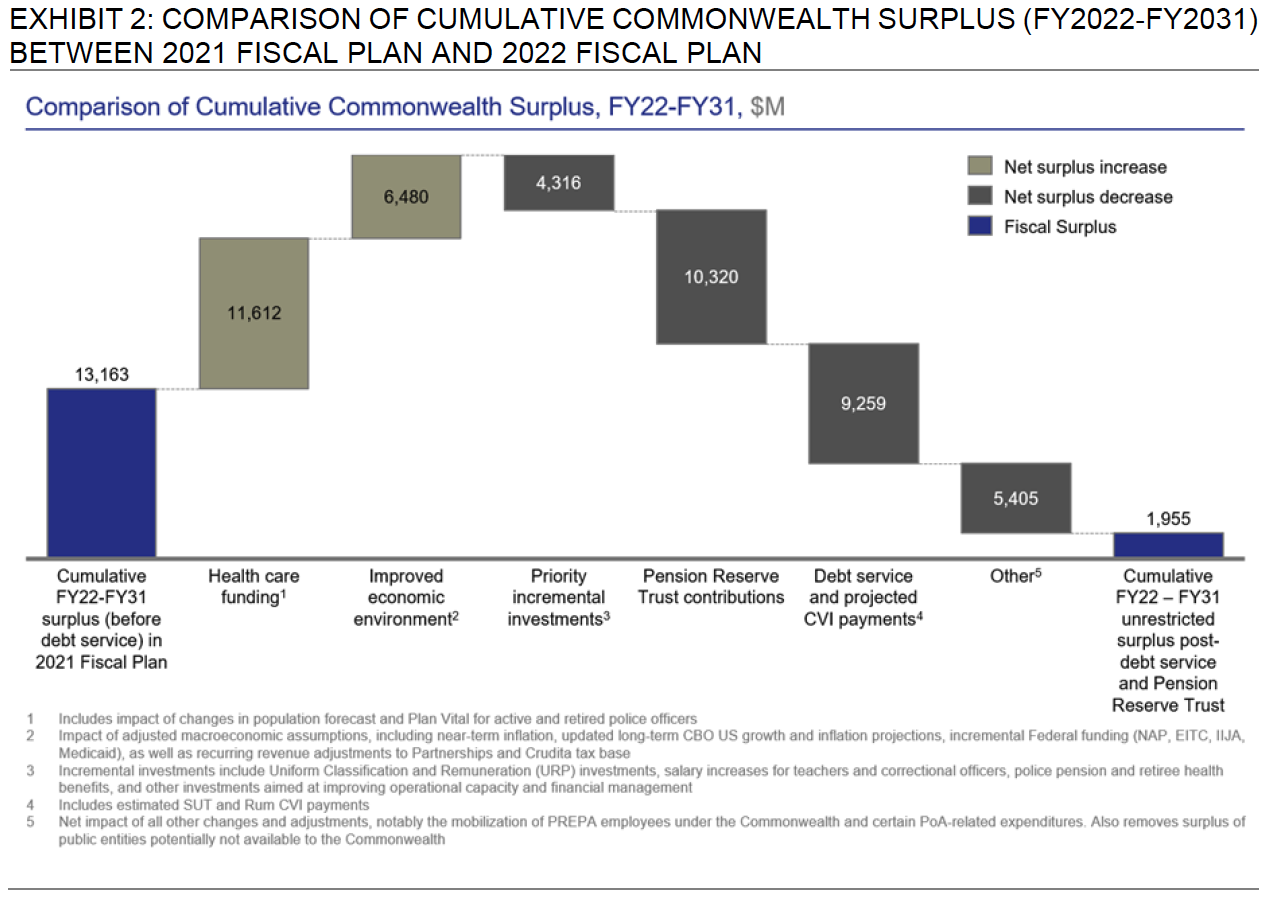

Source: FOMB, Certified Fiscal Plan for Fiscal Year 2022, p. 15.

On the revenue side, the most significant changes are an “increase” in federal funding for Medicaid of $11.6 billion during the next ten fiscal years and an additional $6.5 billion from “improved local revenue collections as a result of higher-than-expected overall U.S. growth, increased local consumption and economic activity enabled by enhanced income support programs.”

On the expense side, the largest increase is due to contributions adding up to $10.3 billion over the next ten fiscal years to a new pension reserve trust fund created as part of the agreement with pensioners pursuant to the Plan of Adjustment. We note that these payments are in addition to annual pension payments of approximately $2.3 billion under the current pay-as-you-go system.

The other big change on the expense side is the debt service on the restructured debt and any payments due pursuant to the Contingent Value Instruments (“CVIs”) to be issued on the effective date of the Plan of Adjustment. The FOMB estimates regular debt service and payments on the CVIs, which are made only if revenues from the SUT and rum excise taxes exceed a pre-established benchmark, to sum up to $9.3 billion during the FY2022-FY2031 period.

See the table below for a breakdown of the projected costs associated with the Plan of Adjustment.
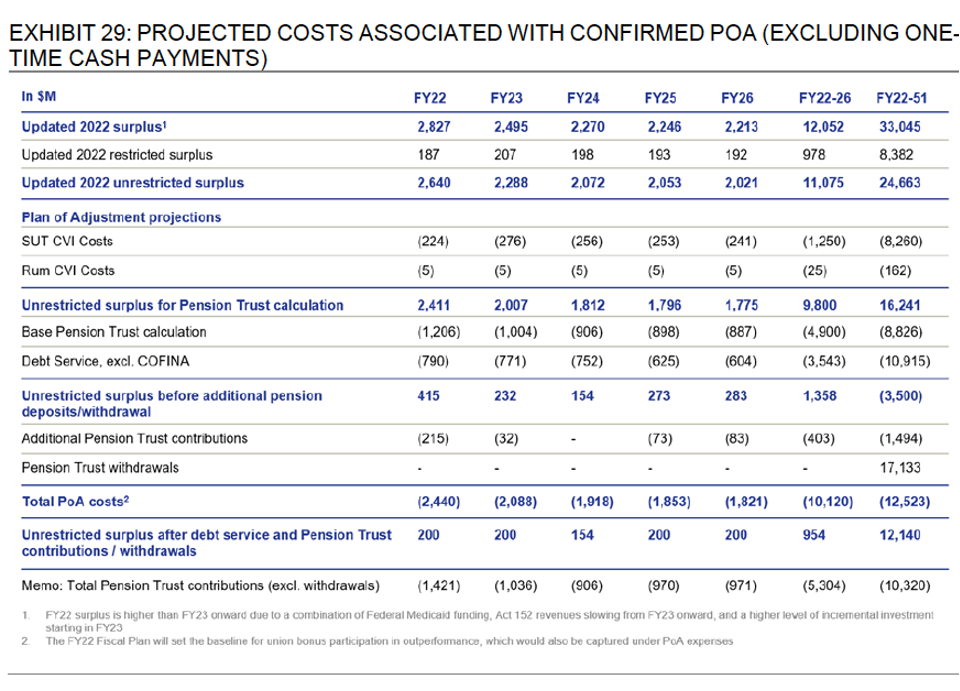

Source: FOMB, Certified Fiscal Plan for Fiscal Year 2022, p. 71.

Notice that expected unrestricted surpluses at the end of the next five fiscal years are estimated to average $190 million per year. This means the government of Puerto Rico has very little leeway if actual revenues are substantially below expectations, expenses significantly exceed the budgeted amount, or a combination of both lower revenues and higher expenses occurs.

Structural Reforms

The Fiscal Plan for FY22, just like previous iterations, incorporates the effects of structural reforms in the areas of (1) human capital and welfare benefits, (2) K-12 education, (3) ease of doing business, (4) the power (energy) sector, and (5) infrastructure that, according to the FOMB, “will enable Puerto Rico to begin to grow again based on competitiveness, countering the negative growth trajectory that has plagued the Island for over a decade, and reducing the dependence on federal funds to stimulate economic development.” The chart below sets forth the FOMB’s estimated impact of these structural reforms.
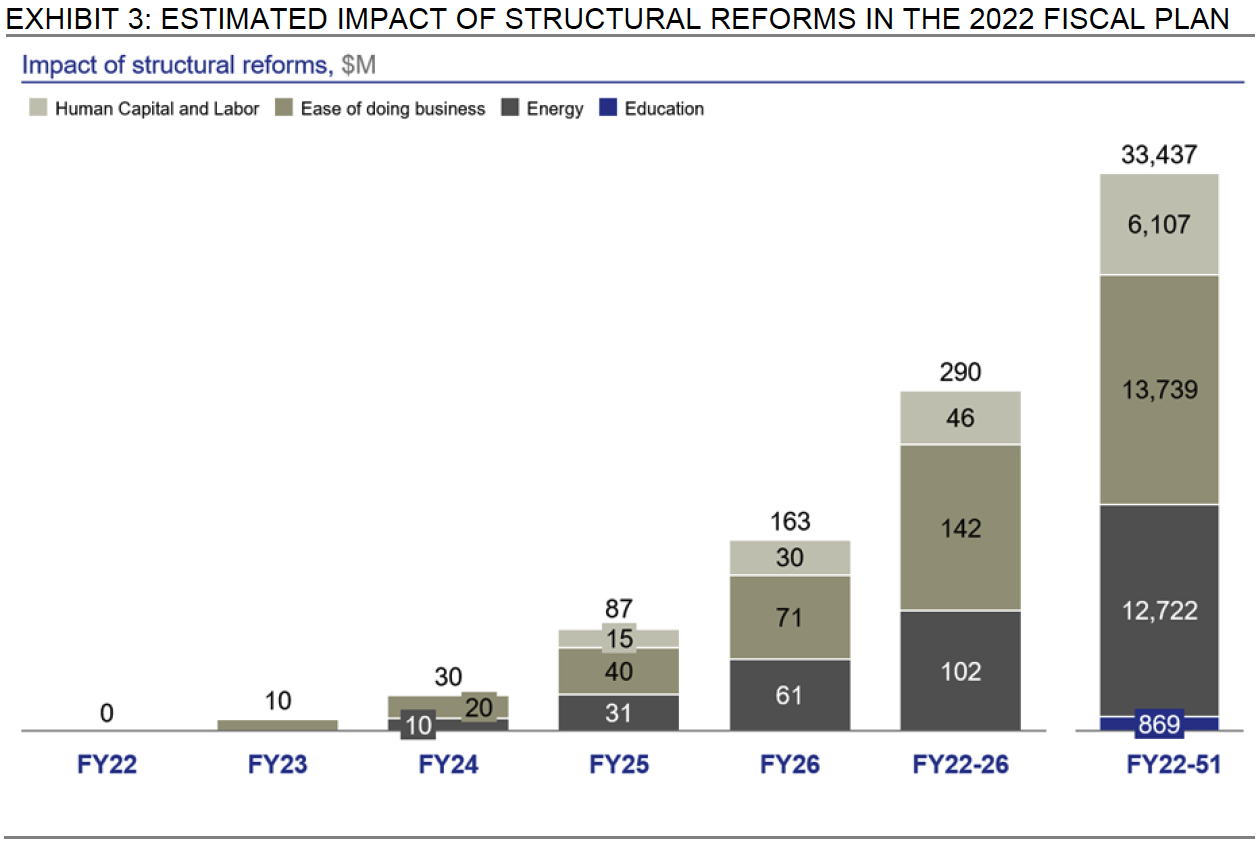

Source: FOMB, Certified Fiscal Plan for Fiscal Year 2022, p. 17.

The problem is that these policies usually do not yield the widespread growth its proponents promise. For example, professor James K. Galbraith in his book, Welcome to the Poisoned Chalice: The Destruction of Greece and the Future of Europe (Yale, 2016), describes the European experience with structural reforms in the following terms:

Europe’s economy today makes nonsense of claims that “structural reform” is the key to growth. Structural reform has been tried throughout Europe; it has produced growth nowhere. Granted, the enactments often fall short of the promises; but each shortfall and each failure to show results sparks a call for more reforms—the true mark of fanaticism. The governments that continue to comply do so cynically: in Greece to escape (unsuccessfully, so far) from the bailout; in Italy to strengthen Mr. Renzi’s EU negotiating stance. Very few in countries stricken by structural reforms delude themselves into thinking they will work.

Furthermore, both the IMF and the OECD have concluded that supply-side structural reforms have, at best, a marginal effect on growth, and at worst, no or negative effects on medium to long-term growth rates.

It is highly unlikely, then, that these “structural reforms” will generate the economic growth forecasted by the FOMB’s advisors. Here we would do well to follow the advice of Michael Spence when he said “we shouldn’t slip into the mistake of equating something useful, like financial-sector development or anything else, with a sufficient condition for growth.”

Similarly, we shouldn’t make the mistake of equating a set of quite disparate and perhaps marginally effective structural reforms with an economic strategy. Simply stated, the structural reforms favored by the FOMB and set forth in the Fiscal Plan are second-order issues and will not generate the economic growth Puerto Rico requires, both for increasing the living standards of its people and to pay off its restructured debt, unless they are embedded or framed within a larger economic strategy or vision.

Debt Restructuring

The Commonwealth’s Plan of Adjustment decreases the government’s obligations by approximately 48%, without taking into account potential recoveries through payment on the CVIs. Total debt relief, then, is significant but not as high as the FOMB claims, nor is it as low or trivial as the detractors of the plan allege. The chart below summarizes the debt recovery by creditor type.
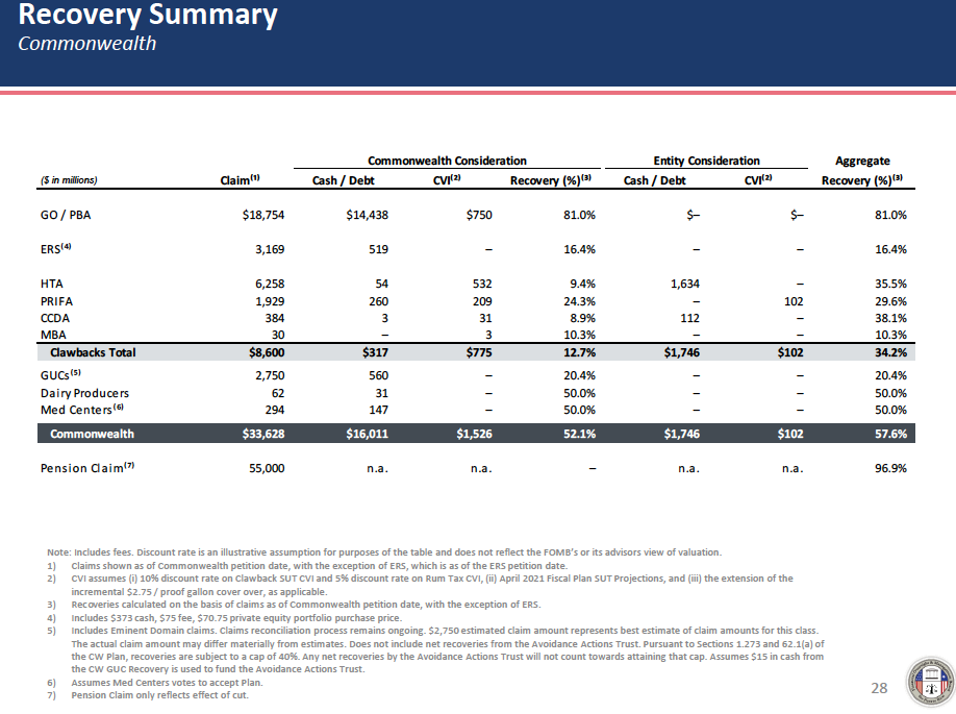

Source: FOMB, Plan of Adjustment Overview, p. 28.

Perhaps more important, from an annual budgeting perspective, the Plan of Adjustment reduces GO debt service considerably, from a pre-PROMESA annual average of $1.33 billion to a post-restructuring annual average of $666 million. As shown in the chart below, total GO/COFINA debt service never exceeds $1.15 billion, or approximately 1.6% of FY21 GNP, during the next 30 years.
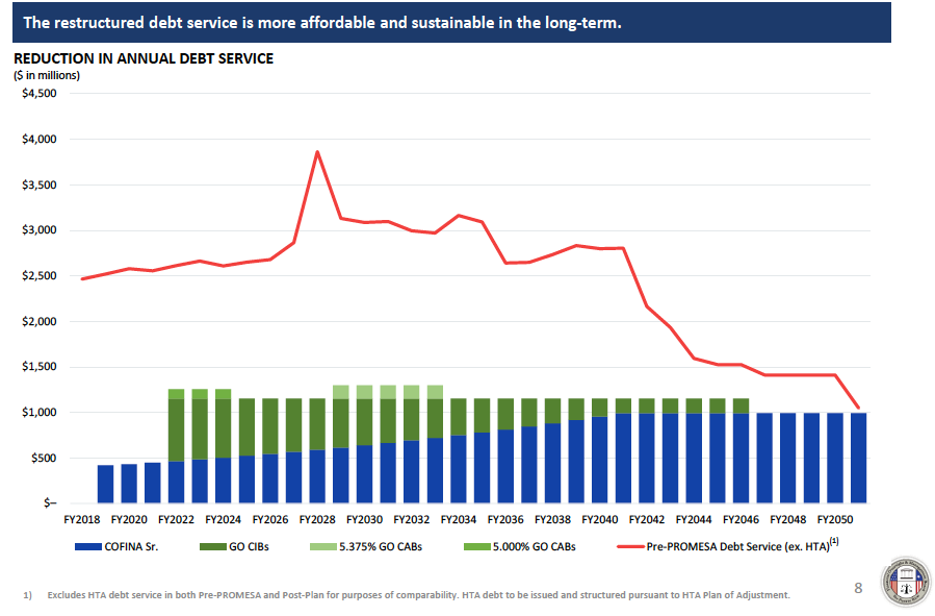


Source: FOMB, Plan of Adjustment Overview, p. 8.

The Plan of Adjustment also includes several debt management concepts to limit further indebtedness in the future. These limitations are:

  • Maximum annual debt service on all net-tax supported debt is limited to 7.94% or lower than the prior year’s debt policy revenues (basically the general fund plus certain special revenue funds);
  • Any new long-term borrowing must be for capital improvements only;
  • Newly issued debt must begin to amortize within two to five years of issuance;
  • Newly issued debt must have a maximum maturity of 30 years or less; and
  • The refinancing of any debt must provide cash flow savings in every fiscal year and produce positive present value savings.

Finally, the 2022 Fiscal Plan “does not anticipate the Commonwealth borrowing for any purpose over the next five years.”

Medicaid

On October 1, 2021, federal funding for Puerto Rico’s Medicaid program was scheduled to revert to its historical level, arbitrarily capped at $406 million for FY22, and subject to a federal matching share of 55%. However, in September 2021, the Centers for Medicare and Medicaid Services (“CMS”) issued an interpretation of the Medicaid funding cap provision for Puerto Rico under Section 1108(g) of the Social Security Act that increased the allotted cap for FY2022 to $2.943 billion. CMS further stipulated in this letter that the cap should continue to grow by the medical care component of the CPI-U each federal fiscal year thereafter. The chart below shows the baseline federal funding for Medicaid, the Children’s Health Insurance Program (“CHIP”), and Enhanced Allotment Program (“EAP”) for prescription drug coverage.
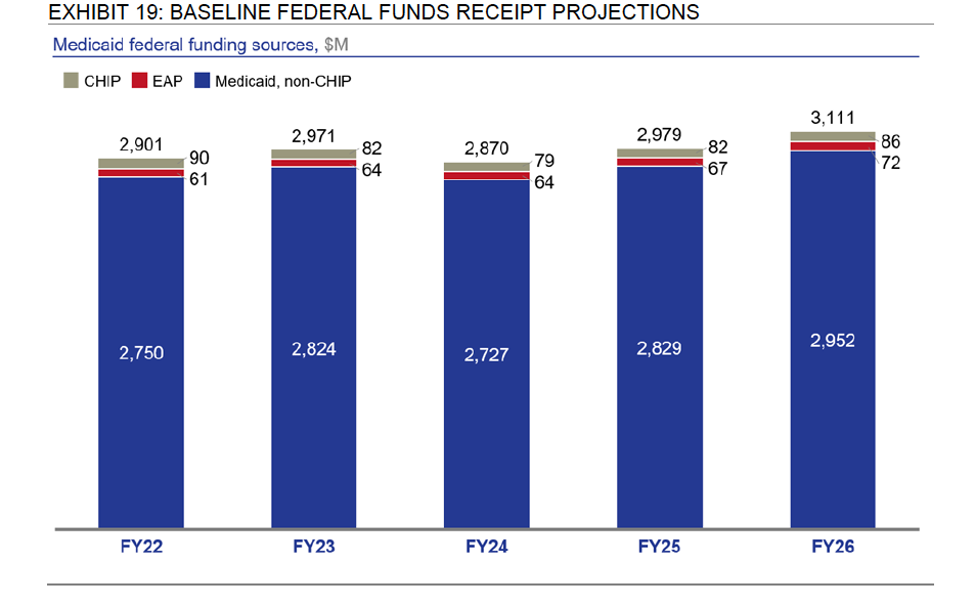

Source: FOMB, Certified Fiscal Plan for Fiscal Year 2022, p. 53.

The FOMB considers the CMS administrative interpretation to be a “long-term solution for Medicaid funding for the Commonwealth.” We respectfully disagree. First, the CMS letter is just an administrative interpretation. It is not a binding administrative order, rule, or regulation. It is certainly not a law. Both the GAO and the ranking minority member in the House Energy and Commerce Committee have stated they disagree with the CMS interpretation. Therefore, this policy could be reversed or withdrawn at any time by CMS or it can be overridden by legislation at any moment, especially if the Republicans obtain a majority in Congress after the mid-term elections.

Second, the letter does not change the FMAP, the federal cost share of the program, which is currently set at 55% and can be modified only through legislation. That means that in order to maximize federal funding the Puerto Rican government will be increasing benefits and adding new enrollees into the system. Therefore, if the federal government reverses the CMS interpretation or decides to legislate a significantly lower allotment for Puerto Rico, the Commonwealth government would be in the uncomfortable position of either (1) cutting back benefits or reducing beneficiaries or (2) substantially reducing other spending to pay for the Medicaid program, since the federal share would still be set at 55%.

Finally, the reduction in the amount required to be budgeted by the Commonwealth for Medicaid has “liberated” approximately $800 million which has enabled the legislative assembly to revert to its old profligate ways. In our opinion, those funds could have been put to better use by creating a budget stabilization fund or to restore, at least partially, the General Fund allocation for the University of Puerto Rico.

Pensions

The Fiscal Plan has been amended to reflect certain reforms made to the Commonwealth’s retirement plans. Among these are (1) enrolling certain employees in the federal Social Security program; (2) freezing the existing defined benefit plans currently in effect for teachers and judges; (3) reaching a settlement, resulting in a one-time payment of $1.376 billion, with employees who had accounts under the System 2000 Plan and whose contributions were not duly credited; and (4) budgeting the required funds to make pension payments on a pay-as-you-go basis. The costs/savings associated with these reforms are set forth in the chart below.
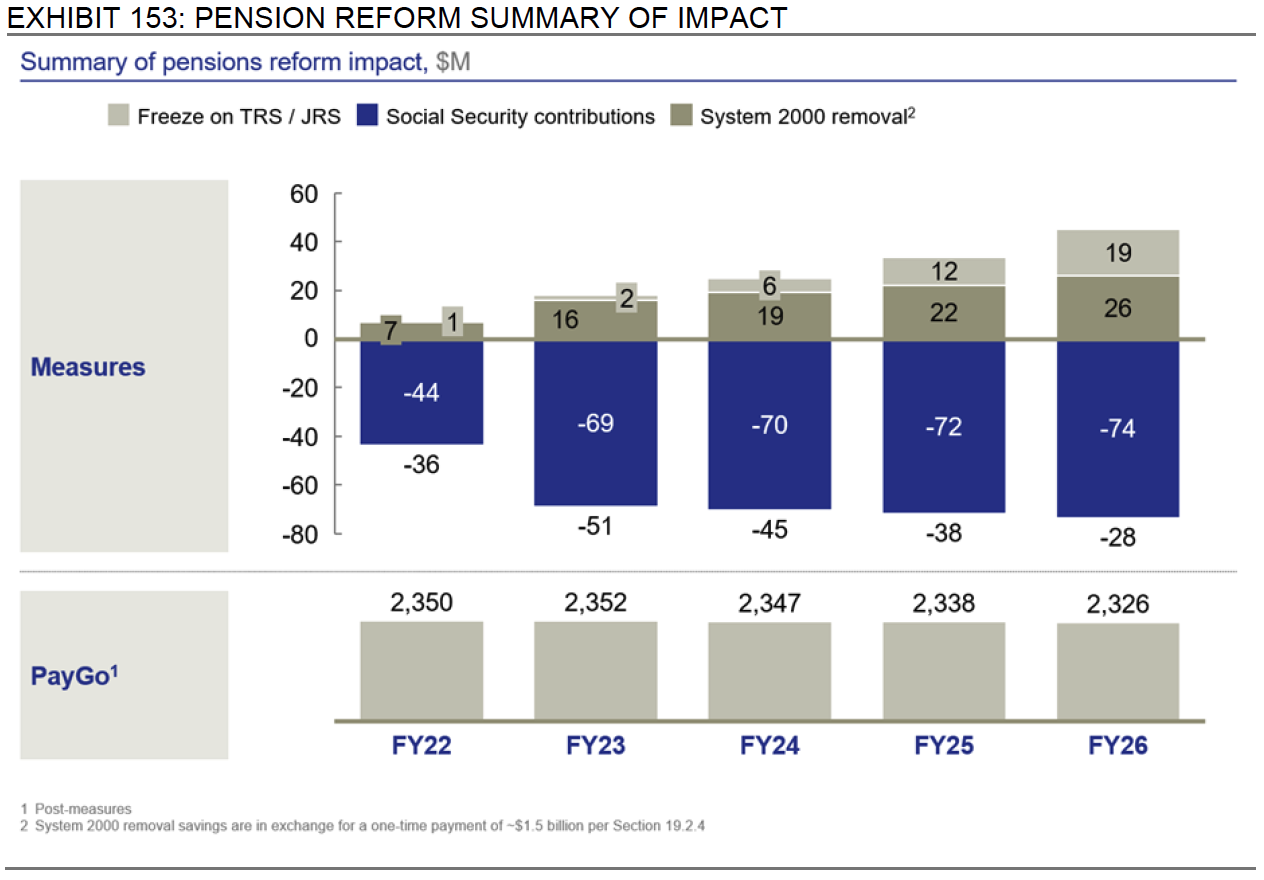
Source: FOMB, Certified Fiscal Plan for Fiscal Year 2022, p. 320.

The Fiscal Plan also provides for (1) the elimination of the proposed 8.5% reduction in the pension benefit of current retirees and (2) the creation of a pension reserve trust “to ensure that future PayGo benefits can be supported regardless of the future economic or political situation in the Commonwealth.”

Funding for the pension reserve trust is to be provided according to a formula based on the Commonwealth’s annual surpluses. The FOMB estimates that those pension trust contributions will average $1.03 billion annually during the next ten fiscal years. Therefore, total pension costs (PayGo plus trust deposits) during the FY2022-FY2031 period will average more than $3 billion per year. This means pension-related payments will be the largest single General Fund expenditure item during this ten-year period.

To be clear, we are not arguing in favor of reducing pensions. We do want to highlight, though, that this $3 billion per year is the cost we are paying now due to decades of mismanagement, for the many years government agencies failed to make the required pension contributions, and for the multiple times that the central government “borrowed” from the retirement fund and never repaid the “loan”.

It is important also to highlight the tradeoffs embedded in the Fiscal Plan. For example, the true cost of the retirement system for FY22 is as follows:

  • System 2000 Settlement: $1.376 billion (one time item)
  • FY22 Deposit to Pension Reserve Trust: $1.420 billion
  • PayGo payments to current retirees: $2.350 billion
  • Total for FY22: $5.146 billion

Compare that with a general fund allocation to the University of Puerto Rico of $467 million for FY2022.

University of Puerto Rico

Perhaps no other government agency’s funding has been cut as much as the budget of the University of Puerto Rico (“UPR”). The UPR’s General Fund allocation has been reduced from $911 million in FY2017 to $466 million in FY22, a reduction of $445 million, or 48%. As shown in the chart below, the FY22 Fiscal Plan includes a modest increase in this allocation from $466 million to $500 million in FY23. General Fund appropriations for the university are then held at a constant $500 million, in nominal terms, thereafter.
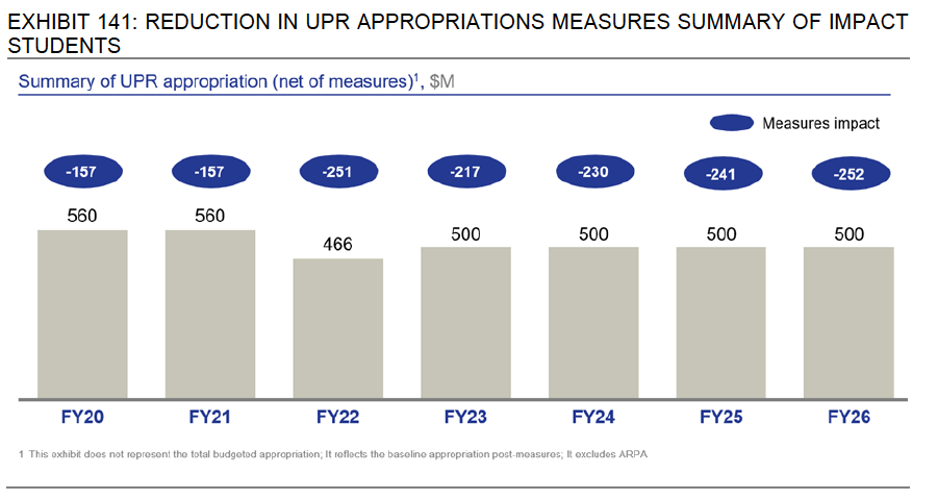

Source: FOMB, Certified Fiscal Plan for Fiscal Year 2022, p. 301.

It is difficult to understand this massive reduction in the General Fund appropriation for the most important higher education institution in Puerto Rico. Some argue that the budgetary reduction is justified by the reduction in student enrollment. However, a quick look at the data demonstrates this is a false statement. According to data released by the UPR, student enrollment has decreased from 46,325 during fiscal year 2017 to 35,623 during FY22, a reduction of 10,702 students, or 23%. The 48% reduction in General Fund appropriations is, therefore, completely disproportionate to the decline in enrollment.

Furthermore, if the FOMB is really counting on improving human capital in Puerto Rico as an engine for growth in the future, then dismantling the UPR is outright counterproductive. Therefore, we recommend that, if the projected savings in the Commonwealth’s contribution to the operation of the Medicaid program are in fact realized, at least a portion of the funds that become available to the Commonwealth be allocated to the University of Puerto Rico.

Note from the Author

“They Have Learned Nothing and They Have Forgotten Nothing”

The title phrase is traditionally attributed to French statesman Charles-Maurice de Talleyrand, in reference to the obdurate behavior of the restored Bourbon dynasty after the fall of Napoleon. After the Revolution of 1789, the subsequent terror of the Jacobins, and the rise and fall of an emperor who sought to conquer half of Europe, the reinstated monarchy pretended to rule as if nothing had happened, picking up things just where they left them in 1789…with predictable results.

In recent times, the phrase has been used to characterize politicians and policymakers who seek to stand athwart history, insisting against all advice and evidence on preserving the disastrous ways of the past, seeking to stop political and economic change at all costs, just to end up repeating the same mistakes of old. History shows such folly can be quite expensive, in terms of both blood and treasure.

Unfortunately for Puerto Rico, we have recently seen a set of political “leaders” demonstrate that they have learned nothing and forgotten nothing since the governor of Puerto Rico declared our public debt to be “unpayable” in 2015. After seven years of default, bankruptcy, federal legislation that stripped away Puerto Rico’s capacity to develop and implement fiscal policy, the imposition of an unelected oversight board, and a prolonged court-supervised process to restructure Puerto Rico’s debt, a group of legislators is acting like they have learned nothing from that experience.

The Puerto Rico Legislative Assembly recently considered House Joint Resolution 278 to implement changes to the current budget in light of the approval and certification of both the Plan of Adjustment for the Commonwealth government and the Fiscal Plan for Fiscal Year 2022. Among other things, we have seen the return of pork-barrel politics, the use of non-recurrent funds to cover recurring spending, and the reallocation of funds earmarked for the public health plan based on the mistaken premise that the Biden Administration has devised a permanent long-term solution for funding Puerto Rico’s Medicaid program. They clearly have learned nothing and forgotten nothing.

To be fair, the executive branch is not exempt from this affliction either. Witness the fiscal gimmicks it has implemented to fund a salary increase of $1,000 per month for public school teachers. Just to be clear, we do not oppose increasing the salaries of public school teachers. The Fiscal Plan for FY22 actually included funding for a permanent monthly increase of $470 per month (in two phases). What we oppose, because it is just plain bad policy, is using non-recurring funding from the American Rescue Plan Act (“ARPA”) to top-off the increase to $1,000 per month for only two years. What happens then in 2024? Again, learned nothing, forgotten nothing.

Finally, don’t be surprised if you hear politicians in Puerto Rico start using the phrase “this time is different” in the context of Puerto Rico’s public finances. As Carmen Reinhart and Kenneth Rogoff state in their book, This Time is Different: Eight Centuries of Financial Folly, “the most commonly repeated and most expensive investment advice ever given…stems from the perception that ‘this time is different’”. Indeed, the single worst thing we can do as we start to turn the corner out of bankruptcy and the hurricane reconstruction efforts begin in earnest, is to return to the ways of the past, the ways of accounting shenanigans, deceptive budgeting, and unrealistic economic growth and revenue projections, because “this time is different”. It never is.
CNE Review – September 2021

Published on September 16, 2021 / Leer en español

See all editions of the
CNE Review
SHARE

In This Issue

In this September issue of the CNE Review we seek to answer the following questions:

  • What is the current situation of the economy of Puerto Rico?
  • How do the three systemic shocks ­– the government bankruptcy, the hurricanes, and the pandemic – that have affected the island interact with each other?
  • What are some of the main risks to Puerto Rico’s economic growth in the short term?
  • What factors can stimulate or depress economic growth?

The agenda for Puerto Rico is full, to say the least. We hope the breakdown and brief analysis we provide in this CNE Review will be helpful to you in making sense of a complicated situation.

Keep reading for a summary of our policy brief. Click here to access the full text.

Insights + Analysis from CNE

The Threefold Challenge to the Puerto Rican Economy

By Sergio M. Marxuach, Policy Director

The Puerto Rican economy is simultaneously recovering from three systemic shocks:

The COVID-19 pandemic, which has adversely affected economic activity since the spring of 2020, is still an ongoing, developing event.
Four years after Hurricanes Irma and Maria, Puerto Rico is still recovering from the considerable damage inflicted by these storms.

Finally, the government of Puerto Rico is entering a critical phase of its debt restructuring process as ballots will be sent soon to creditors so they can vote on the Plan of Adjustment (“POA”) negotiated by the Fiscal Oversight and Management Board (“FOMB”). If certified by the court, Puerto Rico’s bankruptcy will be officially over and the POA will govern Puerto Rico’s fiscal policy for the next 25 years.

The COVID-19 Pandemic

In June 2020, the International Monetary Fund (“IMF”) described the COVID-19 pandemic as a “crisis like no other”. A year later, the direst predictions have not been realized, thanks in large part to unprecedented policy support from the public sector. It would be a mistake, though, to assume the crisis is over.

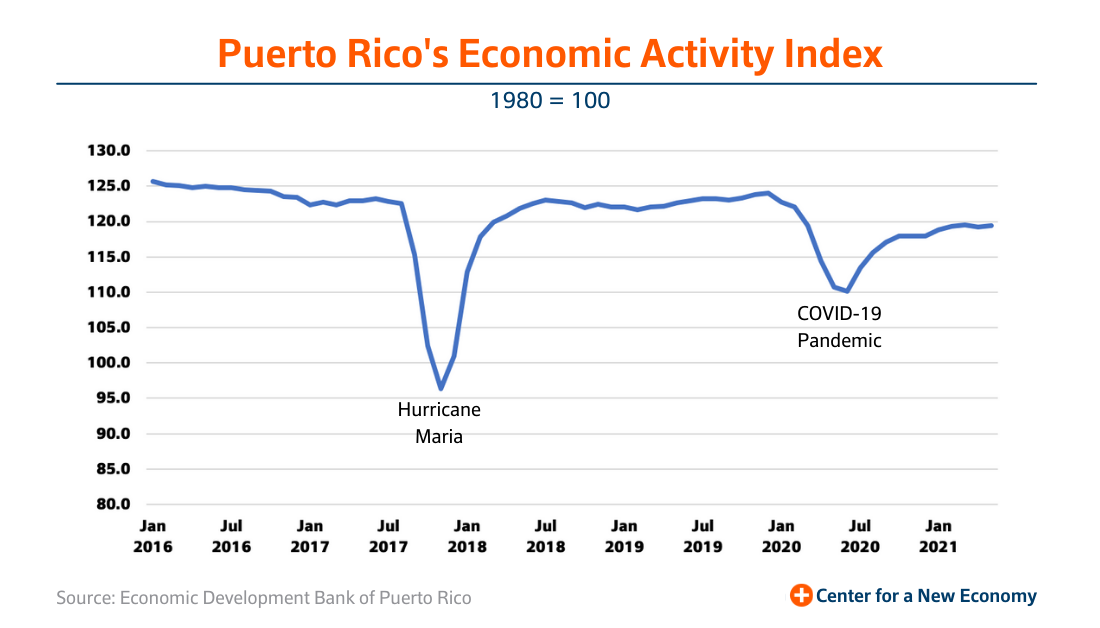
In Puerto Rico, just like in the rest of the world, the impact of the COVID-19 pandemic was swift and severe. According to data from the Puerto Rico Economic Development Bank, the Puerto Rico Economic Activity Index decreased from 122.1 in February of 2020 to 110.1 in June 2020, a decrease of 12 points or approximately 9.8%. As of June 2021, the index had a value of 118.9 points, which means we have made up for about two-thirds of the loss in economic activity. Keep in mind that this relatively rapid recovery is due largely to the positive effect of federal spending related to the COVID-19 pandemic.

Click here to read more about the effects of the pandemic on total employment in Puerto Rico and how federal pandemic funding may further impact recovery.

Hurricane Maria Reconstruction

Four years after Hurricane Maria wreaked havoc on the island and generated some $90 billion in damages, the pace of reconstruction remains slow. While Congress has allocated $64 billion for disaster relief and recovery operations in the island, as of June 30, 2021, only $18.6 billion, or approximately 29%, has been spent. Furthermore, some of the most important work, such as refurbishing and modernizing the electric grid, has not yet begun.

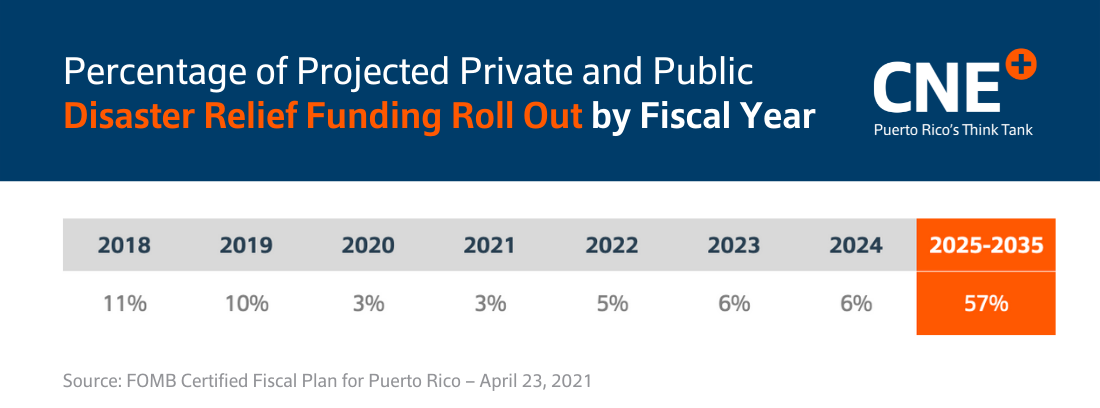
According to the FOMB, the pace of federal disbursements, and hopefully the reconstruction work, should pick up during the next couple of years, as shown in the table below. We note, though, that the bulk of recovery funding, some $47.44 billion, or approximately 57% of total funding, is scheduled to be disbursed during the ten-year period between 2025 and 2035.

This delayed disbursement schedule presents several risks for Puerto Rico. However, the main risk could be the creation of a false sense of complacency as the economy begins to grow when the federal money starts to flow.

Click here to learn the two reasons why it would be a mistake to believe that our economic problems will be over once the disbursement of federal reconstruction funding begins in earnest.

The Fiscal Plan and the POA

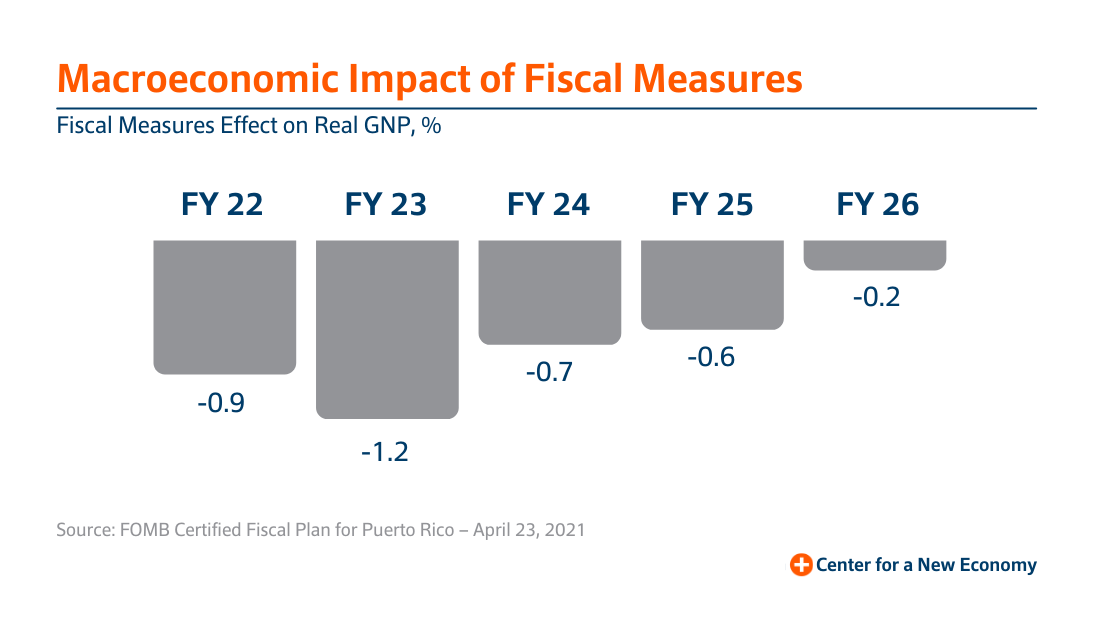
The Fiscal Plan certified by the FOMB for the central government sets in motion policies that have inconsistent effects on the real economy. First, the FOMB continues with the implementation of fiscal austerity measures, which it estimates will reduce GNP by 0.9%, 1.2%, and 0.7% during fiscal years 2022 (ongoing), 2023, and 2024, respectively. In their view, this fiscal consolidation is necessary to balance the budget in the short term. Note that the fiscal consolidation scheduled for FY2023 is particularly deep.

On the other side of the equation, the FOMB is promoting the implementation of “structural reforms” in the areas of social welfare, energy, and ease of doing business, which it estimates will have a cumulative positive impact equal to 0.75% of GNP by fiscal year 2026. Therefore, the net effect of the Fiscal Plan is a net drag on economic activity in the absence of other expansionary policy measures. The FOMB, however, believes that fiscal drag is reduced or eliminated completely when it factors in federal spending related to (1) the COVID-19 pandemic and (2) the reconstruction of the damage caused by Hurricane Maria. That bet, though, is not a sure thing. As we stated above, most of the COVID-19 funds have been spent already and the bulk of the reconstruction money is scheduled to be disbursed after FY 2025.

Because the Fiscal Plan is the master document upon which the long-term Plan of Adjustment is based, it is important to understand how this game of fiscal weights and counterweights plays out. Click here to learn more.

Conclusion

Puerto Rico’s short-term economic performance is overshadowed by a large cloud of uncertainty, as the island’s government concurrently addresses the impacts of three systemic shocks: the COVID-19 pandemic, Hurricane Maria, and the bankruptcy of the central government. Each of these processes generates its own set of risks, which oftentimes could interact among and between them in complex ways.

At a deeper level, however, it is worrisome that economic growth in the short term depends mostly on the receipt of federal transfers that we do not control. We worry that these expenditures will have a temporary positive impact on the economy that may set back efforts to develop a medium/long-term economic strategy or plan for Puerto Rico. Let’s avoid that trap and keep focused on addressing the structural factors that are the root cause of Puerto Rico’s long-term economic stagnation.

Welcome to a Brave New World

The CNE 2021 Growth Policy Summit will be held on December 3, 2021 and will bring together a dynamic mix of thought-leaders, policy-makers, and global innovators not only to spur thoughtful discussion and debate but more importantly, to provoke action and broad engagement.

Save the date, and join us in deciphering how to best leverage Puerto Rico’s resources and transform our economic model.

On Our Radar...

Afghanistan – Twenty years after 9/11 and the beginning of the war in Afghanistan there has been a lot of pontificating about American hubris. But, while that critique may be applicable to the war in Iraq, it is inappropriate in the case of Afghanistan. As historian Robert Kagan reminds us, it was fear, not hubris that led the U.S. into Afghanistan. I know this to be true because I was living and working in Manhattan when the attacks took place. Today, though, “the feelings and perceptions of threat that led them to war in Afghanistan have faded, and all that is left are the consequences of that decision, the costs in lives and money, the inevitably mixed and uncertain results, and the unanswerable question: Was it all worth it?”

End of Pandemic Unemployment Benefits – According to a recent analysis by the Wall Street Journal, “states that ended enhanced federal unemployment benefits early have so far seen about the same job growth as states that continued offering the pandemic-related extra aid.” This means the causes holding back workers from jumping into the labor market lie elsewhere.

The End of Reaganomics? – The $3.5 trillion spending package currently under consideration by Congress would be “the most significant expansion of the nation’s safety net since the war on poverty in the 1960s, devising legislation that would touch virtually every American’s life, from conception to aged infirmity”, according to this analysis by the New York Times. If enacted, it would also mark the end of 40 years of Thatcher/Reagan economic policies that led to increasing inequality, stagnating incomes for the middle class, and depleted government resources.

The Threefold Challenge to the Puerto Rican Economy

The Threefold Challenge to the Puerto Rican Economy

Published on September 15, 2021 / Leer en español

Sergio portrait
Policy Director
DOWNLOAD
SHARE

Introduction

The Puerto Rican economy is simultaneously recovering from three systemic shocks:

  • The COVID-19 pandemic, which has adversely affected economic activity since the spring of 2020, is still an ongoing, developing event. We really don’t know what the recovery from a global pandemic looks like, how long it will take, or which long-term structural shifts will flow from it.
  • Four years after Hurricanes Irma and Maria, Puerto Rico is still recovering from the considerable damage inflicted by these storms. While a lot of work has been done over the last four years, the remaining agenda of rebuilding schools, roads, and public health facilities and of mitigating existing risks to life and limb, is quite challenging.
  • Finally, the government of Puerto Rico is entering a critical phase of its debt restructuring process as ballots will be sent soon to creditors so they can vote on the Plan of Adjustment (“POA”) negotiated by the Fiscal Oversight and Management Board (“FOMB”). The POA has to be, among other things, in compliance with the Fiscal Plan for the central government and found by the court to be viable and in the best interests of the creditors. If certified by the court, Puerto Rico’s bankruptcy will be officially over and the POA will govern Puerto Rico’s fiscal policy for the next 25 years.

So, the agenda for Puerto Rico is full, to say the least. We hope the breakdown and brief analysis of these threefold challenges we provide in this brief will be helpful to you in making sense of a complicated situation.

The COVID-19 Pandemic

In June 2020, the International Monetary Fund (“IMF”) described the COVID-19 pandemic as a “crisis like no other”. At that time approximately 90% of the world economies went into recession simultaneously, the highest share since 1871; global GDP was expected to decline by 4.9%, and the expectations were for forgone production to add up to trillions of losses and millions of jobs destroyed.

A year later, the direst predictions have not been realized, thanks in large part to unprecedented policy support from the public sector. In the United States alone, Congress has authorized approximately $5 trillion in new pandemic-related spending, while the Federal Reserve has provided the financial system with an additional $4 trillion in liquidity. As a result, economic activity, income, and savings in the U.S. are already at or above pre-pandemic levels.

It would be a mistake, though, to assume the crisis is over. Total employment in the U.S. is currently some six million jobs below its February 2020 level; millions of renters risk losing their homes as moratoria on evictions end (or are found to be otherwise illegal); and the inflation rate is at levels unseen in a generation.

In Puerto Rico, just like in the rest of the world, the impact of the COVID-19 pandemic was swift and severe. As shown in the chart below, total non-farm employment decreased from 887,300 in March 2020 to 766,800 in April 2020, a loss of 120,500 jobs, or approximately 13.5% of the total. By June 2021, total employment had recuperated to about 853,800, which means we have made up for about two-thirds of the loss in employment.

Source: U.S. Bureau of Labor Statistics

In terms of economic activity, the story is quite similar. According to data from the Puerto Rico Economic Development Bank, the Puerto Rico Economic Activity Index decreased from 122.1 in February of 2020 to 110.1 in June 2020, a decrease of 12 points or approximately 9.8%. As of June 2021, the index had a value of 118.9 points, which, again, means we have made up for about two-thirds of the loss in economic activity.

Keep in mind that this relatively rapid recovery is due largely to the positive effect of federal spending related to the COVID-19 pandemic. According to the FOMB, Puerto Rico is expected to receive $43.5 billion in federal assistance related to COVID-19 over the FY2020—FY2023 period. The most recent Fiscal Plan for the Commonwealth estimates that “around 60% of this income support funding will be spent”, while the “remaining 40% of funds is projected to be saved and/or used to pay down debt, and then is spent over a 30 -year period according to the long -term consumption smoothing concept”. Thus, most of the economic support provided by this spending is already “baked-in” into current economic indicators.

In the short term, however, the COVID-19 pandemic is the most significant source of economic risk and uncertainty. While we have learned a substantial amount about the SARS-CoV-2 virus over the last eighteen months, the virus has also consistently confounded the best scientific minds on the planet. We are now in a race against the virus, trying to vaccinate the largest amount of people around the world before the virus evolves a vaccine-resistant variant. To the extent significant pockets of unvaccinated populations remain in the U.S. and around the world this risk will increase.

Eventually, though, we can expect the COVID-19 virus to reach a sort of equilibrium with its human hosts. For many experts, that will occur when the amount of people who have acquired immunity to the virus, either through vaccination or prior infection, is high enough to make this virus look more like the seasonal flu. It is unknown exactly when that will happen, but recent events in Florida, Mississippi, and Texas show we are still far from reaching that point. Until then, we will continue to see significant economic disruptions, recurring demand-supply imbalances, and periodic shipping logjams, with many governments continuously tightening and loosening restrictions on business and economic activity as the virus continues to wax and wane in accordance with its own evolutionary logic.

Hurricane Maria Reconstruction

Four years after Hurricane Maria wreaked havoc on the island and generated some $90 billion in damages, the pace of reconstruction remains slow — while Congress has allocated $64 billion for disaster relief and recovery operations in the island, as of June 30, 2021, only $18.6 billion, or approximately 29%, has been spent. Furthermore, some of the most important work — refurbishing and modernizing the electric grid; rebuilding schools, housing, roads, bridges, and healthcare facilities; and undertaking mitigation activities to increase resiliency and reduce the risk exposure of vulnerable populations — has not yet begun.

According to the FOMB, the pace of federal disbursements, and hopefully the reconstruction work, should pick up during the next couple of years. As shown in the table below, the Board expects disaster recovery expenditures to amount to $3.95 billion, $5.31 billion, and $4.68 billion for each of fiscal years 2022, 2023, and 2024, respectively. That would be equivalent to 5.6%, 7.5%, and 6.6% of nominal GNP in 2020. We note, though, that the bulk of recovery funding, some $47.44 billion, is scheduled to be disbursed during the ten-year period between 2025 and 2035.

Source: FOMB Certified Fiscal Plan for Puerto Rico – April 23, 2021

This delayed disbursement schedule presents several risks for Puerto Rico. For example, Congress may reprogram funding allocated for disaster recovery in the island, while the economic impact during any given year is diluted as funds are spent over 15 years. Conversely, the extended timeline may allow Puerto Rico to properly implement procurement regulations, auditing controls, and other compliance mechanisms required by the federal government and to avoid a foreseeable shortage of the skilled labor required for some of these large infrastructure projects.

In the end, however, the main risk regarding the Hurricane Maria reconstruction could be the creation of a false sense of complacency as the economy begins to grow when the federal money starts to flow. It would be a mistake to believe that our economic problems will be over once the disbursement of federal reconstruction funding begins in earnest for at least two reasons.

First, all that economic activity will be financed with federal funds transferred to Puerto Rico’s government instead of locally generated resources. It may be easy to forget that once the good times are rolling and erroneously believe the reconstruction is driven by the strengthening of the Puerto Rican economy, when in fact it is powered by Congressional largesse.

Second, the reconstruction process, by its nature, is designed to rebuild and repair what was damaged or destroyed by Hurricane Maria. In that sense, its main objective is to restore Puerto Rico’s capital endowment to its pre-hurricane state. The reconstruction of damaged or lost assets does not constitute a net addition to the island’s long-term productive capacity.

The Fiscal Plan and the POA

The Fiscal Plan certified by the FOMB for the central government sets in motion policies that have inconsistent effects on the real economy. First, the FOMB continues with the implementation of fiscal austerity measures, which it estimates will reduce GNP by 0.9%, 1.2%, and 0.7% during fiscal years 2022 (ongoing), 2023, and 2024, respectively. In their view, this fiscal consolidation is necessary to balance the budget in the short term. Note that the fiscal consolidation scheduled for FY2023 is particularly deep.

Source: FOMB Certified Fiscal Plan for Puerto Rico – April 23, 2021

On the other side of the equation, the FOMB is promoting the implementation of “structural reforms” in the areas of social welfare, energy, and ease of doing business, which it estimates will have a cumulative positive impact equal to 0.75% of GNP by fiscal year 2026. It is unclear, though, whether the government of Puerto Rico has the capability to implement these policies and, if implemented, whether they will have the economic impact forecasted by the FOMB.

In general, then, the certified fiscal plan would be a net drag on economic activity in the absence of other expansionary policy measures. The FOMB, however, believes that fiscal drag is reduced or eliminated completely when it factors in federal spending related to (1) the COVID-19 pandemic and (2) the reconstruction of the damage caused by Hurricane Maria.

Source: FOMB Certified Fiscal Plan for Puerto Rico – April 23, 2021

That bet, though, is not a sure thing. As we stated above, most of the COVID-19 funds have been spent already and the bulk of the reconstruction money is scheduled to be disbursed after FY 2025. Other risks to the Fiscal Plan include the potential loss of excise tax revenues from Act 154 and the loss or reduction of federal Medicaid funds. How this game of fiscal weights and counterweights plays out is important because the Fiscal Plan is the master document upon which the long-term Plan of Adjustment is based.

The POA will govern the restructuring of the central government obligations with 69 different classes of creditors and will determine Puerto Rico’s fiscal policy for the next 25 years. At the time of this writing, we don’t have all the information necessary to calculate a weighted average recovery, but creditor recovery rates range from 10% for certain unsecured creditors to 91.5% for government retirees. Some creditors will receive cash, others a combination of cash and new bonds, and still others will receive contingent value instruments, whose repayment depends on achieving certain revenue targets.

The POA will also require the government of Puerto Rico to pay annual debt service on the new bonds of approximately $1 billion and make yearly pension payments of about $2 billion, relative to a FY2022 general fund budget of approximately $10 billion. A full analysis of the POA is beyond the scope of this CNE Review but we should note that everything depends upon jumpstarting economic growth in Puerto Rico, which is necessary to generate the required government revenues to comply with the POA. And economic growth in the short term depends on the disbursement and successful management of federal funds and, to a lesser extent, the implementation of the “structural reforms” favored by the FOMB.

Conclusion

Puerto Rico’s short-term economic performance is overshadowed by a large cloud of uncertainty, as the island’s government concurrently addresses the impacts of three systemic shocks: the COVID-19 pandemic, Hurricane Maria, and the bankruptcy of the central government. Each of these processes generates its own set of risks, which oftentimes could interact among and between them in complex ways. For example, the implementation of fiscal measures to balance the budget could affect the capacity of the state to manage complex projects, while supply chain bottlenecks and inflation due to the COVID-19 pandemic may delay Hurricane Maria’s reconstruction efforts.

At a deeper level, however, it is worrisome that economic growth in the short term depends mostly on the receipt of federal transfers that we do not control. We worry that these expenditures will have a temporary positive impact on the economy that may set back efforts to develop a medium/long-term economic strategy or plan for Puerto Rico. Let’s avoid that trap and keep focused on addressing the structural factors that are the root cause of Puerto Rico’s long-term economic stagnation.