The Supreme Court’s Removal Decisions and What They Mean for Puerto Rico

The Supreme Court's Removal Decisions and What They Mean for Puerto Rico

Published on June 30, 2026 / Leer en español

Sergio portrait
Policy Director
SHARE

On June 29, 2026, the Supreme Court issued two removal-power decisions that point in opposite directions. Together, they raise a direct question about the tenure protection of the Financial Oversight and Management Board (“FOMB” or “Board”) for Puerto Rico’s seven appointed members, whom PROMESA permits the President to “remove 
 only for cause.”

In Trump v. Slaughter, the Court held that the for-cause limitation on the President’s power to remove Commissioners of the Federal Trade Commission is “contrary to the separation of powers enshrined in the Constitution,” effectively overruling Humphrey’s Executor v. United States. 

In Trump v. Cook, decided the same day, the Court declined to permit the immediate removal of Federal Reserve Governor Lisa D. Cook, holding both that she had not received due process and that the Government’s reading would “transform the Federal Reserve’s for-cause protection into at-will employment—an interpretive leap out of step with the statute Congress enacted and our Nation’s tradition of central banking protected from political interference.” 

Neither decision is squarely controlling, because the FOMB is neither the FTC nor the Federal Reserve. By statute the Board “shall not be considered to be a department, agency, establishment, or instrumentality of the Federal Government,” and is instead “an entity within the territorial government.”  The answer must therefore be reached by analogy and, more importantly, through the distinctive Article IV lens the Supreme Court has already applied to this very Board. 

On balance, the for-cause protection in PROMESA § 101(e)(5)(B) is more likely than not to survive Slaughter, but for a reason different from, and stronger than, the FTC-versus-Fed framing. The decisive point is that, in Financial Oversight & Management Board for Puerto Rico v. Aurelius Investment, LLC, the Court held that FOMB members exercise “primarily local” powers and so are not “Officers of the United States,” and Justice Thomas, concurring in the judgment, described them as “Article IV executives” who “do not exercise the national executive power.” 

The removal principle reaffirmed in Slaughter is rooted in Article II’s vesting of “the executive Power” in the President and his duty to “take Care that the Laws be faithfully executed”—as confirmed by the Decision of 1789, historical practice, and the Court’s removal precedents—and it reaches only those who wield the executive power of the United States. Because Aurelius holds that FOMB members do not wield that power, the structural premise of the Slaughter rule is absent, and Congress’s plenary authority over the territories under the Territory Clause supplies an independent basis for the tenure protection. 

This conclusion is quite uncertain: it depends on the durability of Aurelius and on how the majority chooses to characterize a “territorial” Board that administers a federal statute. A reasonable jurist could reach the opposite result by treating the FOMB as functionally indistinguishable from the FTC. 

What is clear is that Puerto Rico enters this legal uncertainty at a critical moment. The Board’s tenure protection is one piece of a larger institutional architecture; and the durability of that architecture matters for everything from debt restructuring to the pace of federal recovery spending. CNE will be monitoring developments closely and will publish updated analysis as the legal landscape evolves. 

The Morning After: When the Board Leaves Puerto Rico

The Morning After: When the Board Leaves Puerto Rico

Published on June 25, 2026 / Leer en español

Rosanna
President
SHARE

Ten years have passed since Congress passed PROMESA and, with it, imposed a Fiscal Oversight Board on Puerto Rico. There will be no shortage of events, speeches, and protests to debate what a decade of external control over our public finances has meant.

It is a necessary conversation, and I hope it serves to address a troubling notion: the idea that we depend on the Board to manage our finances, to give us direction, and to develop the technical expertise our government needs. While it is true that the Board plays an active role on all those fronts, that does not mean we are incapable of doing those things ourselves.

What is troubling is that, after ten years, we seem to have internalized the idea that solutions must come from the outside because we frequently rely on them; the dependence has started to feel normal.

When did we start losing the conviction that Puerto Rico can do great things? They are not easy. They require discipline, effort, and perseverance. But as my grandfather used to say: “mĂĄs vale maña que fuerza”, which loosely translates to wit will take you further than muscle.

In 2016, Congress decided that Puerto Rico needed external oversight to correct years of fiscal disorder. It was an imposed solution. A punitive response to a real problem. And although the Board has played a decisive role in our public finances over the past decade, it has left a fundamental task unfinished: developing our institutional capacity to govern ourselves better.

The question we must ask ourselves is not when the Board will leave. The question is what will remain when it does.

Will we have a legislature capable of imposing fiscal discipline without external oversight? Agencies that plan beyond the next electoral cycle? Public officials with the proper tools and resources to administer and be accountable efficiently? Citizens who understand how fiscal decisions affect their opportunities and quality of life?

After a decade of external oversight, little has been done to advance that work.

And time is of the essence.  Puerto Rico still faces significant fiscal risks. Federal recovery funds will not last forever, especially if we keep dragging our feet in putting them to use. Beyond that, our situation is nothing short of outrageous: there are families and businesses that have gone months, not days, without something as basic as running water. And the problem runs much deeper. The fragility of the electrical grid continues to limit economic growth, drive up operating costs for businesses, and disrupt the daily lives of thousands of families.

As if that were not enough, uncertainty over the future funding of essential programs such as Medicaid remains. None of that will disappear when the Board leaves.

Faced with these challenges, resignation is a tempting response. We often repeat that “Puerto Rico will never change.” But resignation is not a diagnosis; it’s a bad habit.

What we need is not another layer of oversight, surveillance, or control. What we need is to strengthen the institutions we already have. Lasting reforms are not the ones imposed from the outside. They are the ones built from within, by those who know our realities and how our government works. They are the ones that become everyday practice and survive changes in administration.

We must prepare for the morning after the Board leaves. Not because its departure will solve our problems, but because Puerto Rico cannot indefinitely depend on others to make its decisions.

That work has to start now. Transformations imposed by force rarely produce lasting, meaningful results. For that, you need something more complex, more subtle, and more valuable: capacity, learning, and above all, the will to do it.

That is why, as my grandfather used to say, wit will take you further than muscle.


This content was translated from Spanish to English using artificial intelligence and reviewed by a human editor before publishing. The Spanish version of this column was originally published in El Nuevo Día on June 25, 2026.

CNE Review – March 2026

Published on March 25, 2026 / Leer en español

See all editions of the
CNE Review
SHARE

In This Issue

In this edition of the CNE Review, our Policy Director Sergio M. Marxuach analyzes the PREPA Title III bankruptcy case as it enters its ninth year: still unresolved, and with enormous consequences for Puerto Rico’s electricity rates, grid investment, and economic future.

We also include a Data Snapshot showing how the size of a potential settlement would translate directly into costs for ratepayers.

Finally, in our On Our Radar section, we share a recent article on technology and the economy that caught our attention this month.

Insights + Analysis from CNE

PREPA Title III: Threading the Needle

By Sergio M. Marxuach, Policy Director

Nine years into PREPA’s Title III bankruptcy proceeding, there is still no agreement between the Financial Oversight and Management Board and the utility’s major creditor groups. The stakes could not be higher: how this case is resolved will shape Puerto Rico’s electricity rates, its capacity to attract private investment in renewable energy, and the long-term viability of the grid itself.

A November 2024 First Circuit ruling changed the landscape. The court affirmed that bondholders hold an $8.5 billion claim secured by a lien on PREPA’s net revenues, but also clarified that their actual recovery depends on what those revenues turn out to be, and that they have no recourse to any other government assets. Both sides, in other words, had something to celebrate.

The single most consequential variable is time. Every year that PREPA remains in bankruptcy is a year in which grid investment is deferred, federal incentives go unused, costly litigation drags on, transition to renewables is delayed, work on the master Integrated Resource Plan stalls, and the island’s population and economic base continue to erode – reducing the very revenue base that is expected to service PREPA’s restructured debt.

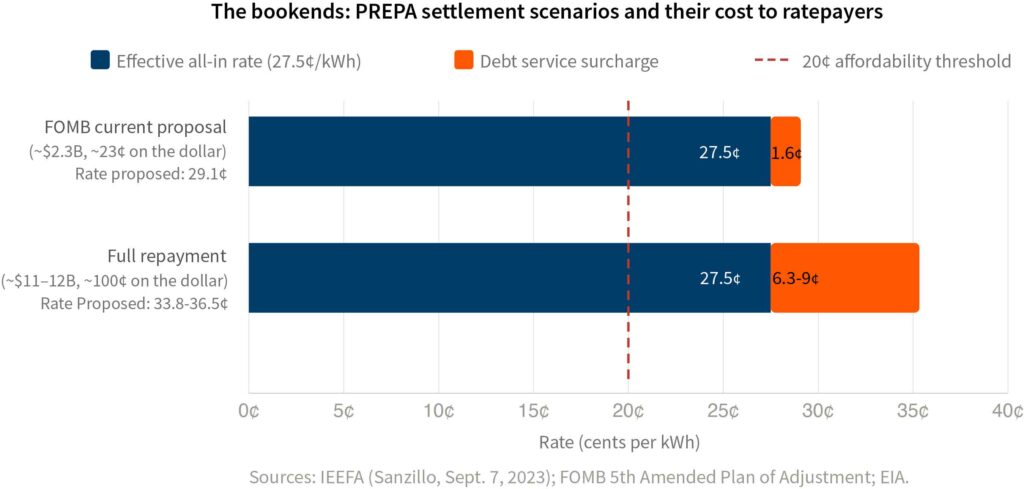
The analysis in this brief identifies two bookend scenarios. At the low end, the FOMB’s proposed 23-cent recovery, roughly $2.3 billion in new bonds, would add an estimated 1.6 cents per kWh to customer bills. At the high end, full repayment of $11 to $12 billion would require surcharges of 6 to 9 or more cents per kWh, pushing blended rates to 34 to 37 cents and almost certainly triggering a rate-revenue death spiral that would accelerate grid defection, erode the revenue base, and ultimately make the plan unworkable.

The window for a reasonable settlement is narrow, and every year of delay is itself a cost Puerto Rico cannot afford.

Data Snapshot

Puerto Rico already pays 27.5 cents per kWh (including provisional charges approved by the regulator at the end of 2025), well above the 20-cent affordability threshold recognized by both the Legislature and the Oversight Board. The size of PREPA’s bankruptcy settlement will directly determine how much higher the rates go. These two scenarios illustrate the range of outcomes analyzed in the brief, from the FOMB’s current proposal to full repayment, and what each would cost ratepayers every month. For a full analysis, read the brief.

On Our Radar

The Anthropic Economic Index: AI’s Uneven Footprint on Labor Markets – Anthropic’s January 2026 Economic Index report — the most comprehensive empirical analysis to date of how artificial intelligence (AI) is reshaping labor markets — finds that nearly half of all occupations now see Claude being used for at least a quarter of their tasks, up from 36% when the Index was first introduced. The pattern of use has also shifted: augmentation (52% of interactions) has now overtaken automation (45%), suggesting that workers are increasingly using AI to extend their capabilities rather than simply replacing discrete tasks. Estimated productivity gains, when adjusted for model reliability on complex tasks, are projected at approximately one percentage point of annual labor productivity growth over the next decade.

Critically, the Index also surfaces a structural concern: Claude disproportionately handles higher-skill tasks within any given occupation, meaning that when those tasks are displaced, the remaining work is systematically less complex — a dynamic the report terms net occupational deskilling. AI adoption remains highly uneven, strongly correlated with per capita income across countries, and concentrated within the top decile of task types. For policymakers in Puerto Rico and across the Caribbean, the Index’s findings underscore both the transformative potential and the distributional risks of AI adoption in lower-income, service-dependent economies.

Written Statement for Legislative Hearing: Puerto Rico’s Fiscal Recovery Under PROMESA and the Road Ahead

Written Statement for Legislative Hearing: Puerto Rico’s Fiscal Recovery Under PROMESA and the Road Ahead

Published on July 16, 2025 / Leer en español

Sergio portrait
Policy Director
DOWNLOAD
SHARE

Sergio M. Marxuach provided the following written testimony for the “Puerto Rico’s Fiscal Recovery Under PROMESA and the Road Ahead” hearing held on July 16, 2025, by the Subcommittee on Indian and Insular Affairs of the US House of Representatives Committee on Natural Resources.


Rep. Jeff Hurd
Chairman
Indian and Insular Affairs Subcommittee
House Committee on Natural Resources
U.S. House of Representatives
1324 Longworth House Office Building
Washington, DC 20515

Rep. Teresa Leger Fernandez
Ranking Member
Indian and Insular Affairs Subcommittee
House Committee on Natural Resources
U.S. House of Representatives
1324 Longworth House Office Building
Washington, DC 20515


Chairman Hurd, Ranking Member Leger Fernandez, and members of the Indian and Insular Affairs Subcommittee, the Center for a New Economy (“CNE”) welcomes and thanks you for the opportunity to submit our comments on the effectiveness of the Puerto Rico Oversight, Management and Economic Stability Act of 2016 (“PROMESA”) nine years after its enactment.

CNE is Puerto Rico’s think tank, an independent, nonpartisan group that informs current debates based on hard data and robust empirical research of Puerto Rico’s most pressing and complex challenges. For over 25 years, CNE has carefully studied the issues affecting Puerto Rico and has been a front row witness to the effects of policies implemented by state and federal government officials.

Back in 2015, CNE was among the first voices to alert about Puerto Rico’s impending economic and fiscal crisis. We testified before Puerto Rico’s legislative assembly and the U.S. Congress on the complexity of its debt structure; the possible economic fallout and the need to adopt policies to enable growth; and Puerto Rico’s inability to restructure its own debt as a result of amendments made to the U.S. Bankruptcy Code in 1984. At the time Puerto Rico’s fiscal crisis was actively being discussed in Washington, DC, CNE argued that unless Congress provided Puerto Rico with effective tools to bolster its economy, little would change.[1]

Congress responded to Puerto Rico’s fiscal crisis by enacting PROMESA, which was signed by President Obama on June 30, 2016. At that time, the Puerto Rican economy had stopped growing for approximately a decade; the central government had incurred in chronic budget deficits for years; the island’s total bonded debt of $72 billion exceeded its gross national product; and the government pension system was insolvent, adding an extra $55 billion in unfunded liabilities to Puerto Rico’s long-term obligations. PROMESA provided an orderly process for the restructuring of that indebtedness in exchange for the appointment by federal officials of an undemocratic oversight board. This arrangement was far from optimal but it was what the American political process could produce at that time.

Nine years after the enactment of PROMESA, we find that Puerto Rico has made some progress in restructuring its debt obligations and implementing budget and financial controls. However, the Commonwealth’s government is not yet up to date in its required financial reporting and it still has failed to develop and implement an effective economic growth strategy. We note, in addition, that progress has been very slow and expensive and Puerto Rico still has a long way to go before it can claim to be in compliance with the requirements for termination of the Financial Oversight and Management Board (“FOMB”) pursuant to the criteria set forth in PROMESA.

Debt Restructuring

Puerto Rico publicly admitted in June 2015 that its debt burden was unsustainable, after years of (1) stagnant economic growth; (2) overstating tax revenues; (3) understating or disguising expenditures; (4) running relatively large concealed budget deficits; (5) widespread government corruption; and (6) relying on accounting gimmicks, and a whole arsenal of clever but ultimately futile financially engineered “solutions”, such as forward bond refundings, back-loaded “scoop and toss” bond refinancings, assorted swaps, capitalized interest payments, and other short-term, expensive liquidity fixes.

While it is true that Puerto Rico’s capacity to repay its debt ultimately depended on restoring economic growth in the island, its government realized that there could be no economic recovery without debt sustainability and that, in turn, was not possible without significantly restructuring at least some of its debt. At that time, however, Puerto Rico did not have access to an orderly mechanism, either local or federal, to restructure its public indebtedness. It could be argued, then, that PROMESA’s principal objective was to provide that orderly mechanism for debt restructuring.

In this respect, we can state that after nine years Puerto Rico has made significant progress. According to the FOMB, through the mechanisms provided by Title III and Title VI of PROMESA, “total debt and other claims were reduced by $42 billion, while debt service savings through maturity are estimated at $73 billion.”[2] Furthermore, the Commonwealth’s debt service is now made up of level annual payments, which allows the government to manage cash and plan effectively to meet its obligations.

We note, though, that while PROMESA has delivered significant debt relief to Puerto Rico, it remains to be seen whether both its total debt burden and its annual debt service are sustainable over the long term. A 2018 analysis by Pablo Gluzmann, Martin Guzman, and Joseph Stiglitz, concluded that Puerto Rico needed substantial debt relief, in the order of an 80% reduction of principal, on average, in order to grow its economy and service its debt without incurring in a new event of default within five years of its debt restructuring.[3] When Puerto Rico finalized the restructuring of its central government debt in March 2022, the FOMB estimated that total debt was cut by about half, while debt service had been reduced by about 53% over thirty years. More recently, the GAO estimates that in FY2022 Puerto Rico’s total debt burden amounted to 47 percent and 67 percent of the island’s GDP and GNP, respectively.[4] We also note that as of this writing, the restructuring of the debt issued by the Puerto Rico Electric Power Authority is still ongoing and it is unknown when that process will be finalized.

In sum, then, Puerto Rico obtained significant debt relief through the PROMESA Title III and Title VI mechanisms, though it fell well short of the recommendations made by Gluzmann, et. al. Thus, the jury is still out with respect to Puerto Rico’s financial sustainability in the long term.

Time and Expense

Back in 2016, the CBO estimated that it would take the oversight board two years and about $350 million in administrative costs to restructure Puerto Rico’s debt. It also estimated that the board would be in operation until approximately 2022, adding some $20 million in operating costs, at which time it would terminate pursuant to PROMESA.[5] Nine years out, the FOMB is still in operation, Puerto Rico’s debt has not been restructured in full, it is unclear whether the island has managed to develop and implement any of its annual budgets since 2016 in compliance with the modified accrual accounting principles mandated by PROMESA, and its total administrative, consulting, legal, and operating costs have exceeded $2 billion, according to a report by Espacios Abiertos.[6] Thus, the process has taken much longer and cost significantly more than initially estimated by Congress.

The work of the FOMB has also been costly in terms of the forgone opportunity to build state capacity in the government of Puerto Rico. State capacity has been defined as “the ability of the state to collect taxes, enforce law and order, and provide public goods.”[7] Declining state capacity in the United States and elsewhere in the world has led to decreasing trust in government and “a growing impatience with the often messy and muddled workings of democracy.”[8]

In Puerto Rico, declining state capacity in the form of inadequate financial management and oversight, coupled with unsustainable borrowing practices, contributed directly to Puerto Rico’s fiscal crisis.[9] Therefore, one of the objectives of the FOMB should be to help Puerto Rico build up state capacity to implement adequate financial and fiscal practices on its own. To the extent that outside advisors and consultants are used to modernize and implement Puerto Rico’s financial controls and management systems, there is a risk that career government employees do not develop the necessary administrative and management skills, and Puerto Rico will end up facing another fiscal crisis in a few years. It is in the best interest of Puerto Rico, then, that the FOMB ensure there is an orderly and effective knowledge transfer process from external consultants to government employees in AAFAF, the Puerto Rico Treasury Department, and the Puerto Rico Office of Management and Budget.

Annual Budgeting and Debt Policy

To be fair, the government of Puerto Rico has made some progress regarding its budgeting practices when compared with the pre-2016 budgeting process. The annual exercise of drafting a fiscal plan for the central government and the most important component units under the aegis of the FOMB has increased the transparency and visibility of government revenue and expenditure procedures. Since 2017, the FOMB has developed budgets in coordination with the government of Puerto Rico based on:

  • “Revenue forecasts based on key macroeconomic indicators to prevent over-estimation;
  • Spending estimates that incorporate feedback from all stakeholders;
  • Expenses detailed at a level that enables sufficient control and full accounting of costs;
  • Frequent reporting on actual spending compared to budgeted amounts; and
  • Clearly defined budget enforcement and reporting roles and responsibilities.”[10]

There are also some indications that the Commonwealth’s government has strengthened its fiscal position. According to the GAO, Puerto Rico reported a combined surplus of $1.9 billion during fiscal year 2022, in contrast with deficits of $424 million and $2.3 billion during fiscal years 2021 and 2020, respectively.[11] If the surplus for FY22 is certified by the FOMB, it would be the first surplus officially registered by the Commonwealth since the enactment of PROMESA.

We note, though, that notwithstanding this apparent progress, the FOMB has expressed concerns about Puerto Rico’s ability to remain fiscally responsible. The island’s legislature, on several occasions since 2016, has tried to enact legislation that increased expenses or decreased revenues significantly without legislating offsetting measures. Puerto Rico’s legislature should adopt strict pay-as-you-go requirements to limit excessive spending in the future. We share the concerns expressed by the FOMB, as it appears local politicians have learned nothing and forgotten nothing during the last ten difficult years, stubbornly clinging to the harmful fiscal policies and deficient financial practices of the pre-2016 past and which ultimately led Puerto Rico to file for bankruptcy in 2017.

The GAO also notes as a positive development the creation of the Legislative Assembly Budget Office or Oficina de Presupuesto de la Asamblea Legislativa (“OPAL”). The OPAL, created in 2023, provides analysis of the fiscal impact of proposed legislation and “these estimates can help the legislature better understand how proposed measures would affect levels of revenue or expenses.”[12] Review of proposed legislation by OPAL, however, is not mandatory and is at the discretion of the Puerto Rico legislature. During FY24, OPAL produced 185 estimates, including estimates for 11 bills that became law, while 180 laws were enacted without estimates.[13] Despite its limited use, though, the creation of OPAL, in our opinion, is a significant positive step on the road to fiscal responsibility.

The adoption in 2022 of a debt management policy to limit tax-supported borrowing by the Commonwealth was another step in the right direction. This policy “(1) requires that new long-term issuances of tax-supported debt must be for capital improvements or refinancing for savings and (2) specifies that maximum annual tax-supported debt service cost cannot exceed 7.94 percent of the average debt policy revenues from the preceding 2 fiscal years.”[14] Puerto Rico has not issued any new tax-supported debt, other than debt related to the restructuring, since 2022. This debt policy, or one similar to it, should eventually be included in the Puerto Rico Constitution to eliminate the old ineffective “debt-limit” and provide a strong safeguard against excessive or inappropriate borrowing in the future. In addition, Puerto Rico’s debt policy should be revised to avoid pro-cyclical effects in the future and supplemented with robust legislative pay as you go rules. We note that CNE proposed a similar restriction back in 2016 in the form of a fiscal responsibility rule for Puerto Rico aimed at strengthening long-term fiscal discipline.[15]

Timely Financial Reporting and the Implementation of Financial Control Remain Challenging

Puerto Rico has made significant progress in updating its financial reports since 2016. Notwithstanding that progress, however, the Commonwealth’s financial statements for fiscal years 2021 and 2022 were issued with significant delays, about 22 months after the end of their respective fiscal years. As of June 2025, it had not yet issued its statements for fiscal years 2023 and 2024.

In addition to problems with the timeliness of its financial statements, the GAO also highlighted issues with audit opinions (lack of sufficient evidence to conclude that certain financial balances and activities in the Puerto Rico unemployment insurance fund were free of material misstatement); troublesome audit findings that have remained unsolved for at least two years; and a series of questioned costs in several agencies.[16]

To address those issues, Puerto Rico has undertaken the implementation of a government-wide enterprise resource planning system, which should streamline its financial, supply chain, human capital management, and payroll systems. This streamlined reporting system should “resolve a significant portion of Puerto Rico’s issues with financial reporting and internal controls.”[17] Unfortunately, its implementation since 2022 has been uneven and the government has faced extensive delays in its rollout. A revised implementation schedule will prioritize the financial management and the supply chain modules.

What Remains to be Done

Looking back over the last nine years, it is clear that a lot of work has been done to put Puerto Rico’s fiscal house in order. It is also clear that a lot remains to be done. Finalizing the restructuring of the debt issued by the Puerto Rico Electric Power Authority (“PREPA”) is at the top of that list of pending issues. Resolving the issue of PREPA’s debt is crucial to accelerate progress on the reconstruction of the electric grid and the transition to 100% renewable generation. The adoption by Puerto Rico of pay-as-you-go rules when enacting tax or spending bills is another item high on the to-do list of the island’s government.

At a macro level, it is important to make better use of PROMESA’s Title V to jumpstart economic development projects. PROMESA included a couple of provisions to promote economic growth in Puerto Rico, but most of those initiatives, like those set forth in the Congressional report issued in 2016 pursuant to section 409 of PROMESA, seem to have fallen by the wayside.[18] It is high time to retake this economic agenda. Do not be mistaken, we are aware that developing and implementing an economic growth agenda is ultimately a task that falls on Puerto Rico’s government. All we are saying here is that to the extent PROMESA provides, directly or indirectly, some tools to foster economic growth, then Puerto Rico should actively use them.

Finally, it is also important to determine what needs to be done to satisfy the conditions for the termination of the FOMB. The oversight board was never meant to be a permanent fixture overseeing the government of Puerto Rico, but rather a temporary (and undemocratic) safeguard while the island restructured its debts and regained its fiscal stability. Section 209 of PROMESA states that:

An Oversight Board shall terminate upon certification by the Oversight Board that—

  • the applicable territorial government has adequate access to short-term and long-term credit markets at reasonable interest rates to meet the borrowing needs of the territorial government; and

(2) for at least 4 consecutive fiscal years—

  • the territorial government has developed its Budgets in accordance with modified accrual accounting standards; and
  • the expenditures made by the territorial government during each fiscal year did not exceed the revenues of the territorial government during that year, as determined in accordance with modified accrual accounting standards.

Nine years after PROMESA, Puerto Rico does not have access to either short- or long-term credit markets. We also do not have enough information to determine at this time whether (1) the government of Puerto Rico has developed any of its budgets since 2016 in accordance with modified accrual accounting standards; and (2) any of the Commonwealth’s budgets since 2016 have closed with a deficit or a surplus, as determined in accordance with modified accrual accounting standards. We strongly urge the FOMB to make those determinations public as soon as possible.

Conclusion

In sum, the implementation of PROMESA, like most complicated federal legislation, has been a mixed bag. Puerto Rico has made significant progress in restructuring its debt, but it is still working on PREPA’s restructuring, one of the most important remaining transactions affecting the island’s future economic growth. The Commonwealth has also made significant progress with respect to financial reporting, the implementation of internal controls, and the enactment of a debt policy to limit future indebtedness, but it still needs to issue its financial reports for fiscal years 2023 and 2024; it is behind schedule in the implementation of a government-wide enterprise resource planning system; and has not adopted comprehensive pay as you go rules to control spending. In addition, the restructuring process has proven to be a lot more expensive and taken much longer than most assumed back in 2016.

Looking forward, it is worrisome that we cannot yet determine with any certainty when the conditions for the termination of the FOMB will be satisfied. The operation of the FOMB is expensive, undemocratic, and, as we stated above, it was never meant to be a permanent fixture of the landscape. PROMESA and the FOMB are an imperfect political solution to what was, back then, an admittedly difficult emergency. As Puerto Rico finishes restructuring its debt and stabilizing its fiscal situation, it is time to start thinking seriously about winding down the operations of the Oversight Board.

We thank the Chairman and the Committee once again for the opportunity to participate in this important public policy debate, hope this testimony is useful for the Committee’s work, and look forward to answering any questions that Committee Members may deem appropriate.

Respectfully submitted,

/s/Sergio M. Marxuach
Policy Director
Center for a New Economy

Endnotes

[1] Sergio Marxuach, Testimony Before the United States Senate Committee on Finance Public Hearing on Financial and Economic Challenges in Puerto Rico, September 29, 2015, https://grupocne.org/2015/09/29/testimony-before-the-us-senate-finance-committee/

[2] Financial Oversight and Management Board, Annual Report FY-2024, p. 25.

[3]  Pablo Gluzmann, Martin Guzman and Joseph E. Stiglitz, An Analysis of Puerto Rico’s Debt Relief Needs to Restore Debt Sustainability, January 2018, Espacios Abiertos, San Juan, PR.

[4] U.S. Government Accountability Office, U.S. Territories: Public Debt and Economic Outlook – 2025 Update, June 2025, p. 15.

[5] Congressional Budget Office, Cost Estimate of H.R. 5278 Puerto Rico Oversight, Management, and Economic Stability Act, June 3, 2016.

[6] Espacios Abiertos, The Cost of the Board’s Consultants: A Bill Paid by the People That Never Ends, February 12, 2025, https://espaciosabiertos.org/the-cost-of-the-boards-consultants-a-bill-paid-by-the-people-that-never-ends/

[7] Brink Lindsey, State Capacity: What It Is: How We Lost It, And How to Get it Back, Niskanen Center, November 2021, p. 1.

[8] Id.

[9] The third factor contributing to the island’s fiscal crisis, long-term economic stagnation, is also indirectly related to declining state capacity.

[10] Financial Oversight and Management Board, Fiscal Plan for Puerto Rico, Certified by the Financial Oversight and Management Board, June 5, 2024, p. 22.

[11] GAO, U.S. Territories: Public Debt and Economic Outlook – 2025 Update, p. 16.

[12] Id. at p. 23.

[13] Id.

[14] Id. at p. 22.

[15] Deepak Lamba Nieves and Sergio M. Marxuach, There Is Another Way: A Fiscal Responsibility Law for Puerto Rico, February 2016, https://grupocne.org/wp-content/uploads/2016/02/2016_01_FiscalRulesPR-1.pdf

[16] GAO, U.S. Territories: Public Debt and Economic Outlook – 2025 Update, p. 28.

[17] Id. at p. 29.

[18] Congressional Task Force on Economic Growth in Puerto Rico, Report to the House and Senate, December 20, 2016 https://www.finance.senate.gov/imo/media/doc/Bipartisan%20Congressional%20Task%20Force%20on%20Economic%20Growth%20in%20Puerto%20Rico%20Releases%20Final%20Report.pdf


Participation in The Brookings Institution 11th Annual Municipal Finance Conference

Participation in The Brookings Institution 11th Annual Municipal Finance Conference

Published on July 19, 2022

Sergio portrait
Policy Director
SHARE

Watch Sergio M. Marxuach’s participation in the panel Puerto Rico’s Bankruptcy: Lessons Learned for the Island and for the Muni Market as part of The Brookings Institution’s 11th Annual Municipal Finance Conference.

Panel Moderator:
Michelle Kaske (Bloomberg)

Other Panelists:
John Ceffalio (CreditSights)
Natalie Jaresko (Financial Oversight and Management Board for Puerto Rico)
David Skeel (University of Pennsylvania Carey Law School)

CNE Review – May 2022

Published on May 23, 2022 / Leer en español

See all editions of the
CNE Review
SHARE

In This Issue

Several positive trends are clearly converging in 2022 to create the opportunity of a generation for Puerto Rico to turn around its economy and start a process that would generate long-term economic growth and development.

In this edition of the CNE Review, we take a look at the current conditions, the risks, and the context in which these trends are developing.

In sum, our net assessment is that, notwithstanding the existence of certain substantial risks, current conditions are auspicious for undertaking a broad-based economic development effort in Puerto Rico. However, that will happen only if we design an economic strategy that allows Puerto Rico to take advantage of this opportunity. Economic growth will not happen on its own. We need to take concrete, affirmative actions to make the most of the current situation.

To that end, CNE will be convening a broad group of stakeholders from academia, government, the private sector, and NGOs over the next few weeks to jumpstart a process that, hopefully, will generate the long-term economic growth and development we so desperately need. Stay tuned.

–Sergio M. Marxuach, Editor-in-Chief

Insights + Analysis from CNE

2022 – The Opportunity of a Generation for Puerto Rico

By Sergio M. Marxuach, Policy Director

After 15 years of economic stagnation, a fiscal and debt crisis, the bankruptcy of its government, the damage caused by Hurricanes Irma and MarĂ­a in 2017 and a series of earthquakes in 2020, and the pain inflicted by the COVID-19 pandemic, Puerto Rico has a once in a generation opportunity to turn its economy around.

  1. The debt restructuring process is over. The certified Plan of Adjustment provides significant debt relief to the island by cutting the Commonwealth’s debt by approximately 50%. It is quite difficult, though, to determine today whether this amount of debt relief is sufficient. What is clear is that the medium to long-term viability of the Plan depends on jumpstarting economic growth in Puerto Rico.
  1. The Biden Administration has been willing to disburse the money appropriated by Congress five years ago. These funds will finance hurricane reconstruction efforts, which will allow Puerto Rico to significantly upgrade a large part of its physical infrastructure endowment in a relatively short period of time.
  1. There is reason to believe, or at least hope, that the worst of the pandemic may be ending soon. While the risk of the emergence of a new variant is still, and will probably always be, present, it is also true that humankind has made tremendous progress in understanding the clinical evolution of this disease and developed in record time both vaccines and new treatments that reduce the incidence of severe symptoms, hospitalizations, and deaths.
  1. The intellectual and political turn towards a more activist state affords Puerto Rico the necessary policy space to develop and implement creative solutions to its economic problems. The spirit of the times is favorable for the development and implementation of a carefully crafted economic strategy for Puerto Rico. In this sense, it is important to note that while the Pierluisi Administration and the Financial Oversight and Management Board (the “FOMB”) have proposed new economic incentives and the implementation of structural reforms, respectively, both efforts fall well short of crafting an economic strategy for Puerto Rico.

These efforts are certainly significant and seek to address important issues, but are inadequate on the whole, because both the government of Puerto Rico and the FOMB are looking at only some pieces of the puzzle, and no one is looking at the entire puzzle. Here we would do well to follow the advice of Michael Spence when he said “we shouldn’t slip into the mistake of equating something useful, like financial-sector development or anything else, with a sufficient condition for growth.” (Commission on Growth and Development, p. 33.)

Similarly, we shouldn’t make the mistake of equating a set of quite disparate and perhaps marginally effective structural reforms with an economic strategy. Simply stated, the structural reforms favored by the FOMB and set forth in the Fiscal Plan are second-order issues and will not generate the long-term economic growth Puerto Rico requires, both for increasing the living the standards of its people and to pay off its restructured debt, unless they are embedded or framed within a larger economic strategy or vision.

While the trends mentioned above are generally positive, the current economic environment is also characterized by significant uncertainty and downside risks. Click the button below to read more on these risks and the context in which these trends are taking place.

On Our Radar...

The Brave New World of Artificial Intelligence – Advances in the development of new applications of artificial intelligence (“AI”) technology have the potential to create new ways of knowing and understanding reality and to disrupt many fields of human endeavor. Yet, AI, just like any other technology, can be used for both good or evil. This series of stories in the MIT Technology Review takes a look at some of the more controversial aspects of AI, specifically, “how AI is impoverishing the communities and countries that don’t have a say in its development—the same communities and countries already impoverished by former colonial empires.” The authors, however, “also suggest how AI could be so much more—a way for the historically dispossessed to reassert their culture, their voice, and their right to determine their own future.”
The Return of Wars of Conquest? – There have been many wars since the end of World War 2. Very few of those conflicts, however, involved the outright conquest of another internationally recognized country. That is why Russia’s invasion of Ukraine has been so shocking. “Now, with Russia’s invasion, the norm against territorial conquest has been tested in the most threatening and vivid way since the end of World War II. The war in Ukraine is reminiscent of a previous, more violent era. If the global community allows Russia to subsume Ukraine, states may more frequently use force to challenge borders, and wars may break out, former empires may be reinstated, and more countries may be brought to the edge of extinction”, writes Tanisha M. Fazal in Foreign Affairs.

White Christian America Fights Back – The political turmoil unleashed by a leaked draft of a U.S. Supreme Court opinion overturning Roe v. Wade has focused on its implications for reproductive freedom and other rights anchored on the same constitutional basis. It also highlights, according to Ronald Brownstein writing in The Atlantic, a “deeper phenomenon in American politics: the urgency and ambition of the Republican drive to lock into law the cultural priorities of its preponderantly white, Christian, and older electoral coalition at a moment of rapid demographic change.”

2022 – The Opportunity of a Generation for Puerto Rico

2022 – The Opportunity of a Generation for Puerto Rico

Published on May 22, 2022 / Leer en español

Sergio portrait
Policy Director
DOWNLOAD
SHARE

Introduction

Several trends are currently converging, both worldwide and in Puerto Rico, to create the conditions for a rethinking of the process of economic growth and development. Since the 2008 financial crisis, critics from both the left and the right have questioned the prevailing Washington Consensus, also known as the neoliberal or Thatcher/Reagan model of economic growth, which is based on privatization, low taxes, deregulation, cutting back the social safety net, trade liberalization, strongly pro-market structural reforms, and limited government intervention in the economy. That model has several defects that, over time, have worked to discredit it.

Failure of the Washington Consensus

In terms of its internal logic, the Washington Consensus is a tautology, it essentially states that the “way to have an economy like Denmark’s is to become Denmark”. In other words, it suffers from one of the “most common misconceptions of economic development theories: the misguided notions that economic prosperity can only occur in places with an excellent business environment and that growth is the result of painful and politically difficult reforms.”[1] However, the challenge for policy practitioners is to jumpstart economic growth and development precisely in places where, by definition, the preconditions for success are missing or suboptimal.

Second, the Washington Consensus approach to economic growth is ahistorical and failed to take into account local conditions. In the words of economist Dani Rodrik, it favored a simplistic “cookbook recipe” approach to economic growth. This limitation was highlighted as early as 2008 in The Growth Report: Strategies for Sustained Growth and Inclusive Development, drafted by the Commission on Growth and Development led by Nobel Prize-winning economist, Michael Spence. While the Commission identified some stylized facts associated with sustained and inclusive growth, namely, access to capital in all its forms, openness to the global economy, macroeconomic stability, robust spending in innovation, research, and development, and stable institutions; it also pointed out that:

We do not know the sufficient conditions for growth. We can characterize the successful economies of the postwar period, but we cannot name with certainty the factors that sealed their success, or the factors they could have succeeded without. It would be preferable if it were otherwise. Nonetheless, the commissioners have a keen sense of the policies that probably matter— the policies that will make a material difference to a country’s chances of sustaining high growth, even if they do not provide a rock-solid guarantee. Just as we cannot say this list is sufficient, we cannot say for sure that all the ingredients are necessary
A list of ingredients is not a recipe, and our list does not constitute a growth strategy.[2]

Yet the Washington Consensus was based precisely on this kind of one-size-fits-all formula and on the premise that economic growth is nothing more than the sum of the aggregate effects of a disparate set of structural reforms, which if implemented would somehow generate growth anywhere and everywhere, regardless of local conditions, history, or institutional framework.

It should not be surprising, then, that these policies did not yield the widespread growth its proponents promised. For instance, professor James K. Galbraith describes the European experience with structural reforms in the following terms:

Europe’s economy today makes nonsense of claims that “structural reform” is the key to growth. Structural reform has been tried throughout Europe; it has produced growth nowhere. Granted, the enactments often fall short of the promises; but each shortfall and each failure to show results sparks a call for more reforms—the true mark of fanaticism. The governments that continue to comply do so cynically: in Greece to escape (unsuccessfully, so far) from the bailout; in Italy to strengthen Mr. Renzi’s EU negotiating stance. Very few in countries stricken by structural reforms delude themselves into thinking they will work.[3]

Furthermore, both the IMF and the OECD have also concluded that supply-side structural reforms have, at best, a marginal effect on growth, and at worst, no or negative effects on medium to long-term growth rates. [4]

Yet, by deepening existing inequalities and eroding the social safety net, structural reform programs created the conditions for the emergence of an anti-system politics that have fueled the political polarization and social unrest we have seen around the globe and which have been articulated in the United States, specifically, first by the Tea Party and the Occupy Wall Street movements, and more recently, by the conservative populism of Donald Trump and by a radically progressive faction within the Democratic Party.

Finally, the global COVID-19 pandemic has triggered a re-evaluation of the role of the state in the economy and called into question the benefits of globalized supply chains and just in time inventory management practices.

We must keep in mind that many households (though by no means all) in the highly developed economies have managed to escape the worst economic effects of the pandemic due to the timely implementation of robust fiscal and monetary policy support policies by governments around the world. While on the supply side, many multinational firms are considering simplifying as well as adding a layer of redundancy to their supply chains. These events, in turn, have led many governments to reconsider the role of national industrial policies, not only as part of traditional Great Power geopolitical competition but also as a matter of securing access to both key intermediate inputs and final products in the case of a global emergency.

The Opportunity for Puerto Rico

It is, then, in this global context that Puerto Rico faces the next stage in its economic development. After 15 years of economic stagnation, a fiscal and debt crisis, the bankruptcy of its government, the damage caused by Hurricanes Irma and MarĂ­a in 2017 and a series of earthquakes in 2020, and the pain inflicted by the COVID-19 pandemic, Puerto Rico has a once in a generation opportunity to turn its economy around.

First, the debt restructuring process is over. The certified Plan of Adjustment provides significant debt relief to the island by cutting the Commonwealth’s debt by approximately 50%. It is quite difficult, though, to determine today whether this amount of debt relief is sufficient. What is clear is that the medium to long-term viability of the Plan depends on jumpstarting economic growth in Puerto Rico.

Second, the Biden Administration has been willing to disburse the money appropriated by Congress five years ago to finance hurricane reconstruction efforts, which will allow Puerto Rico to significantly upgrade a large part of its physical infrastructure endowment in a relatively short period of time.

Third, there is reason to believe, or at least hope, that the worst of the pandemic may be ending soon. While the risk of the emergence of a new variant is still, and will probably always be, present, it is also true that humankind has made tremendous progress in understanding the clinical evolution of this disease and developed in record time both vaccines and new treatments that reduce the incidence of severe symptoms, hospitalizations, and deaths.

Finally, the intellectual and political turn towards a more activist state affords Puerto Rico the necessary policy space to develop and implement creative solutions to its economic problems. The zeitgeist is favorable for the development and implementation of a carefully crafted economic strategy for Puerto Rico. In this sense, it is important to note that while the Pierluisi Administration and the Financial Oversight and Management Board (the “FOMB”) have proposed new economic incentives and the implementation of structural reforms, respectively, both efforts fall well short of crafting an economic strategy for Puerto Rico.

These efforts are certainly significant and seek to address important issues, but are inadequate on the whole, because both the government of Puerto Rico and the FOMB are looking at only some pieces of the puzzle, and no one is looking at the entire puzzle. Here we would do well to follow the advice of Michael Spence when he said “we shouldn’t slip into the mistake of equating something useful, like financial-sector development or anything else, with a sufficient condition for growth.”[5]

Similarly, we shouldn’t make the mistake of equating a set of quite disparate and perhaps marginally effective structural reforms with an economic strategy. Simply stated, the structural reforms favored by the FOMB and set forth in the Fiscal Plan are second-order issues and will not generate the long-term economic growth Puerto Rico requires, both for increasing the living the standards of its people and to pay off its restructured debt, unless they are embedded or framed within a larger economic strategy or vision.

There is a High Level of Uncertainty and Many Risks but They are Manageable

While the trends mentioned above are generally positive, the current economic environment is also characterized by significant uncertainty and downside risks.

First, inflation is currently at levels not seen since the late 1970s and early 1980s. Price increases are driven, in part, by strong consumer demand in the post-pandemic period; supply-chain disruptions; logistical bottlenecks; China’s zero-COVID policy which has shut down significant manufacturing capacity in that country; and commodity shortages and higher oil and gas prices due to the invasion of Ukraine by Russia.

The “good news” here is that demand should start to weaken as households spend any excess disposable income they have available from the COVID-19 related government programs and the supply side logjams should resolve to the extent that demand decreases and firms review their inventory and supply-chain operations. The war in Ukraine, though, remains a wild card as there appears to be no clear off-ramp for the parties to negotiate a settlement at this time.

Second, there is a significant risk of a recession within the next 18 months. While there is not much that monetary policy can do with respect to commodity prices or supply chain disruptions, the Federal Reserve really has no other option but to tighten monetary policy because the current rate of price inflation is politically untenable. As interest rates increase, we would expect demand for credit to decrease as car loans, mortgages, and carrying credit card balances all become more expensive. In addition, some new investments in machinery, equipment, and construction may become financially unviable when taking into account the higher cost of capital.

The Puerto Rican economy will certainly be negatively affected by higher interest rates. However, the negative impact of tightening monetary policy could be partially offset by the ramping up of federal spending for reconstruction projects in Puerto Rico. To be clear, we are not saying that Puerto Rico’s economy will emerge unscathed if there is a recession in the U.S. or world economy in the coming 18 months. Nor are we saying that federal reconstruction spending will completely offset the effects of a broad economic slowdown or that such spending is a sustainable long-term economic growth strategy. Our point is that to the extent federal reconstruction spending is executed in a timely fashion and in accordance with Congressional mandates that require providing a preferential option to local contractors in such spending, then Puerto Rico would have a cushion to partially offset any economic contraction in the short-term.

Finally, there are risks endogenous to the Puerto Rican economy, mostly on the fiscal side. Among those risks, we find a potential shortfall in federal Medicaid funding for Puerto Rico; the end of the federal policy allowing U.S. manufacturing companies in Puerto Rico to take a credit at the federal level for excise taxes paid pursuant to Act 154; and the slow roll-out of reconstruction funds. To the extent any of those risks materialize, then the island’s fiscal situation could be destabilized.

Conclusion

In sum, our net assessment of the current situation is that, notwithstanding the existence of certain substantial risks, current conditions are auspicious for undertaking a broad-based economic development effort in Puerto Rico. Several positive trends are clearly converging in 2022 to create the opportunity of a generation for Puerto Rico to turn around its economy and start a process that would generate long-term economic growth and development.

However, that will happen only if we design an economic strategy that allows Puerto Rico to take advantage of this opportunity. Economic growth will not happen on its own. We need to take concrete, affirmative actions to make the most of the current situation.

To that end, CNE will be convening a broad group of stakeholders from academia, government, the private sector, and NGOs over the next few weeks to jumpstart a process that, hopefully, will generate the long-term economic growth and development we so desperately need. Stay tuned.

Endnotes

[1] Justin Yifu Lin and Célestine Monga, Beating the Odds: Jump-Starting Developing Countries, (Princeton University Press, Princeton, 2017), p. 6.

[2] Commission on Growth and Development, The Growth Report: Strategies for Sustained Growth and Inclusive Development, (World Bank, Washington, DC, 2008), p. 33.

[3] James K. Galbraith, Welcome to the Poisoned Chalice: The Destruction of Greece and the Future of Europe, (Yale University Press, New Haven, 2016), p. 43.

[4] See, for example, Dereck Anderson, Bergljot Barkbu, Luisine Lusinyan, y Dirk Muir, “Assessing the Gains from Structural Reforms for Jobs and Growth” in Jobs and Growth: Supporting the European Recovery, (International Monetary Fund, Washington, DC, 2014); Romain Duval, Davide Furceri, Alexander Hijzen, JoĂŁo Jalles and Sinem Kiliç Celiç, “Time for a Supply-Side Boost? Macroeconomic Effects of Labor and Product Market Reforms in Advanced Economies” in World Economic Outlook (International Monetary Fund, Washington DC, April 2016), p. 103; Luiza Antoun de Almeida and Vybhavi Balasundharam, On the Impact of Structural Reforms on Output and Employment: Evidence from a Cross-country Firm-level Analysis, IMF Working Paper, WP/18/73, April 2018, p. 13; and Ana Fontura Gouveia, Silvia Santos, and InĂȘs Gonçalves, The Impact of Structural Reforms on Productivity: The Role of the Distance to the Technological Frontier, OECD Productivity Working Papers No. 8, May 2017, p. 13.

[5] Commission on Growth and Development, p. 33.

CNE Review – February 2022

Published on February 24, 2022 / Leer en español

See all editions of the
CNE Review
SHARE

In This Issue

On January 27, 2022, the Financial Oversight and Management Board (“FOMB”) for Puerto Rico certified a new Fiscal Plan for Fiscal Year 2022. The main objective of revising the Fiscal Plan was to adapt it to the terms and conditions outlined in the Plan of Adjustment for the Commonwealth of Puerto Rico confirmed by Judge Laura Taylor Swain on January 18, 2022.

In this edition of the CNE Review, we highlight some of the most important components of the Fiscal Plan, including:

  • Structural Reforms
  • Debt Restructuring
  • Medicaid
  • Pensions
  • University of Puerto Rico

Keep reading for a summary of our analysis or click here to access the full text.

Finally, don’t miss out on the Note from the Editor.

Insights + Analysis from CNE

Selected Highlights of the Fiscal Plan for Fiscal Year 2022

By Sergio M. Marxuach, Policy Director

The Big Picture

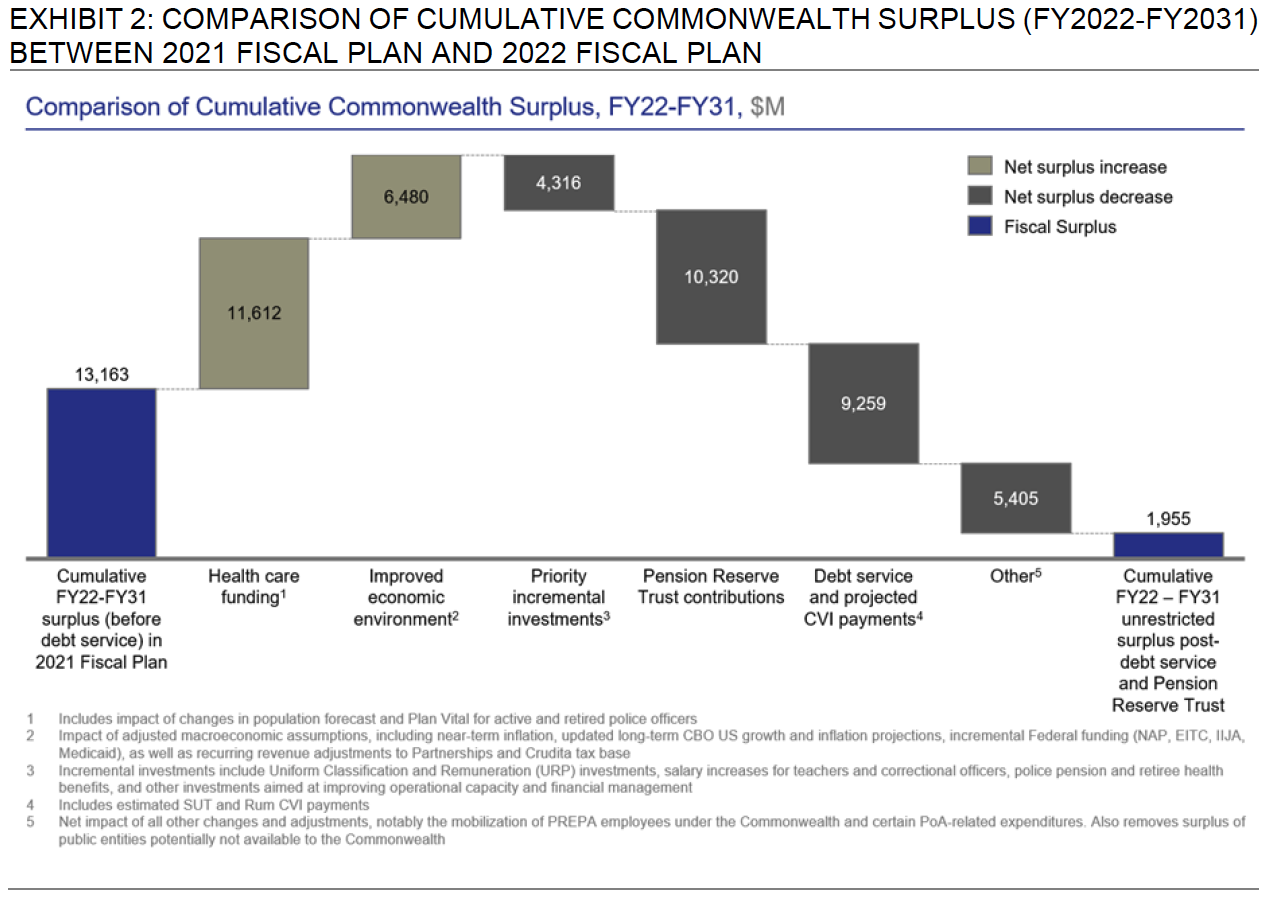
The revised Fiscal Plan includes changes to both revenues and expenses and also includes the debt service on Puerto Rico’s restructured debt according to the Plan of Adjustment. The chart below shows the most important changes to the expected surplus relative to the prior version of the Fiscal Plan in 2021. Click here for an analysis of the most significant changes.

Source: FOMB, Certified Fiscal Plan for Fiscal Year 2022, p. 15.

Expected unrestricted surpluses at the end of the next five fiscal years are estimated to average $190 million per year. This means the government of Puerto Rico has very little leeway if actual revenues are substantially below expectations, expenses significantly exceed the budgeted amount, or a combination of both lower revenues and higher expenses occurs.

Click here for a detailed breakdown of the projected costs associated with the Plan of Adjustment.


Structural Reforms

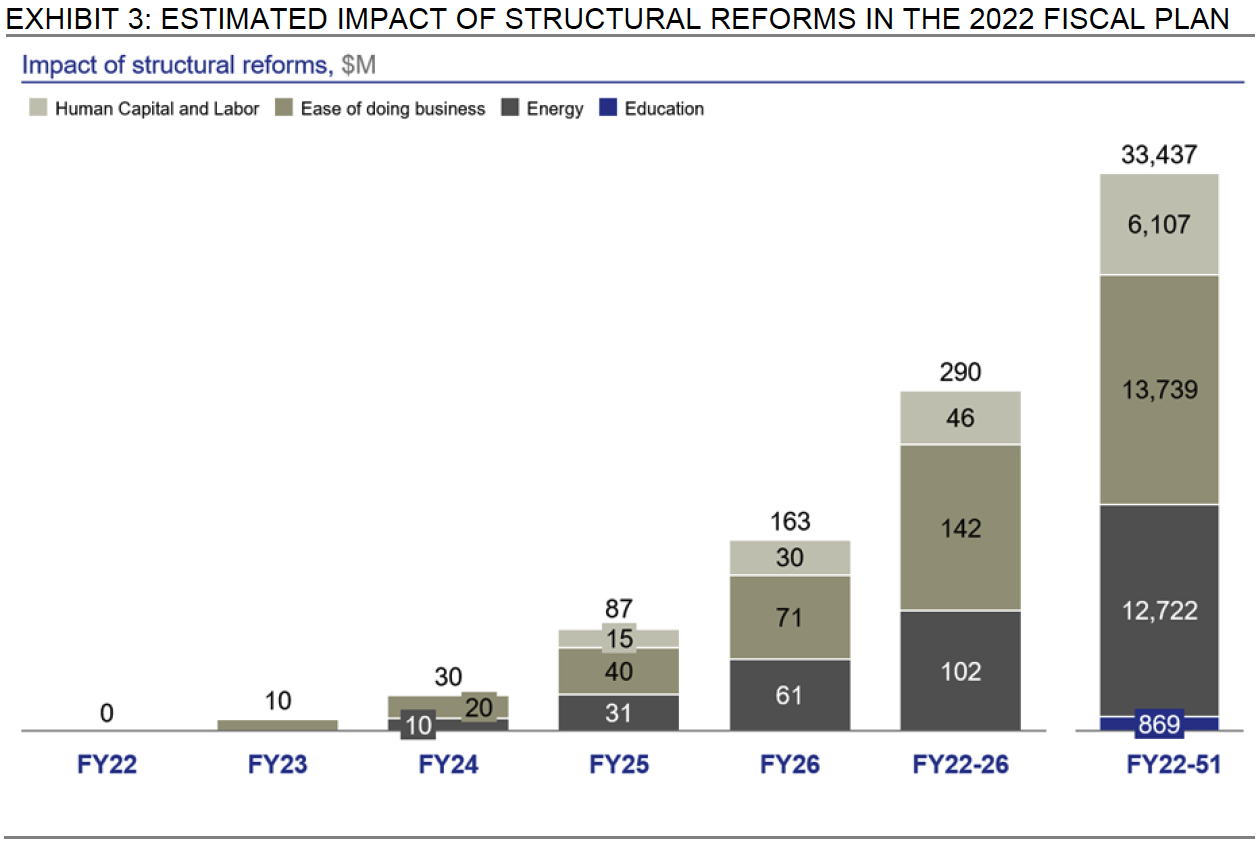
The Fiscal Plan for FY22, just like previous iterations, incorporates the effects of structural reforms in the areas of (1) human capital and welfare benefits, (2) K-12 education, (3) ease of doing business, (4) the power (energy) sector, and (5) infrastructure that, according to the FOMB, “will enable Puerto Rico to begin to grow again based on competitiveness, countering the negative growth trajectory that has plagued the Island for over a decade, and reducing the dependence on federal funds to stimulate economic development.” The chart below recaps the FOMB’s estimated impact of these structural reforms.

Source: FOMB, Certified Fiscal Plan for Fiscal Year 2022, p. 17.

However, the structural reforms favored by the FOMB and set forth in the Fiscal Plan are second-order issues and will not generate the economic growth Puerto Rico requires, both for increasing the living standards of its people and to pay off its restructured debt, unless they are embedded or framed within a larger economic strategy or vision.

Click here for more on why these policies usually do not yield the widespread growth its proponents promise.


Debt Restructuring

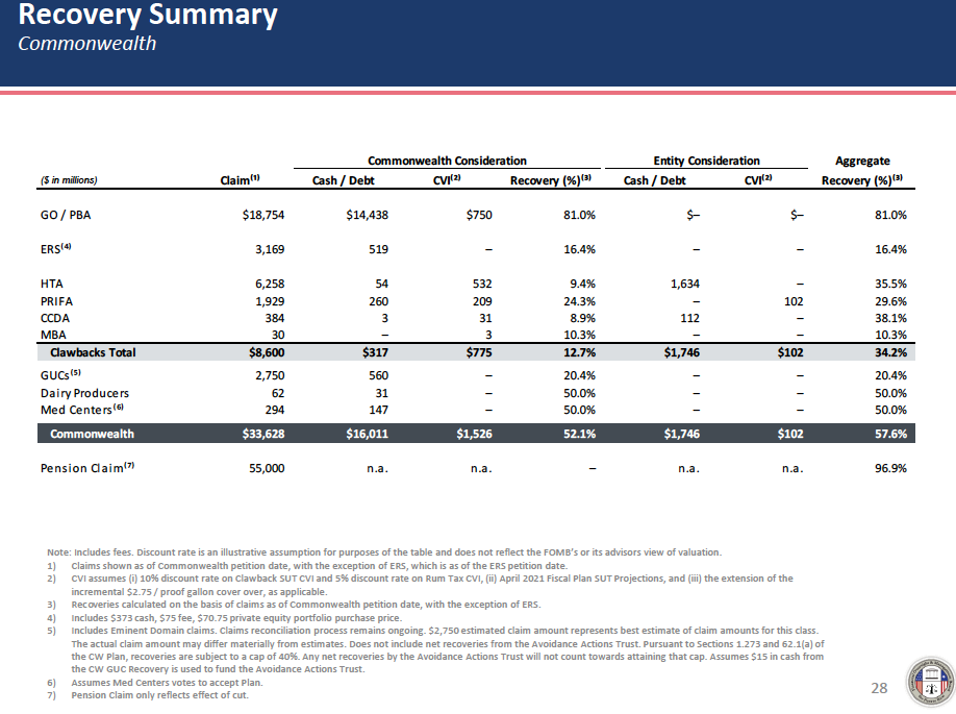
The Plan of Adjustment decreases the government’s obligations by approximately 48%, without taking into account potential recoveries through payment on the Contingent Value Instruments (“CVIs”). Total debt relief, then, is significant but not as high as the FOMB claims, nor is it as low or trivial as the detractors of the plan allege. The chart below summarizes the debt recovery by creditor type.

Source: FOMB, Plan of Adjustment Overview, p. 28.

Perhaps more important, from an annual budgeting perspective, the Plan of Adjustment reduces GO debt service considerably from a pre-PROMESA annual average of $1.33 billion to a post-restructuring annual average of $666 million. Total GO/COFINA debt service never exceeds $1.15 billion, or approximately 1.6% of FY21 GNP, during the next 30 years.

Also noteworthy, the 2022 Fiscal Plan “does not anticipate the Commonwealth borrowing for any purpose over the next five years.”

Click here for a list of debt management concepts included in the Plan of Adjustment to limit further indebtedness in the future.


Medicaid

In September 2021, the Centers for Medicare and Medicaid Services (“CMS”) issued an interpretation of the Medicaid funding cap provision for Puerto Rico that, among other things, increased the allotted cap for FY2022 to $2.943 billion.

The FOMB considers the CMS administrative interpretation to be a “long-term solution for Medicaid funding for the Commonwealth.” We respectfully disagree for the following reasons:

  1. The CMS letter is not a binding administrative order, rule, regulation or law. Therefore, this policy could be reversed or withdrawn at any time.
  2. The administrative interpretation does not, and cannot, change the Federal Medical Assistance Percentage (55% FMAP), which could result in the government having to cut back benefits or reduce other spending to pay for the Medicaid program if the CMS interpretation is reversed.

Finally, the reduction in the amount required to be budgeted for Medicaid has “liberated” approximately $800 million which has enabled the legislative assembly to revert to its old profligate ways. In our opinion, those funds could have been put to better use by creating a budget stabilization fund or to restore, at least partially, the General Fund allocation for the University of Puerto Rico.

Click here for more on Medicaid.


Pensions

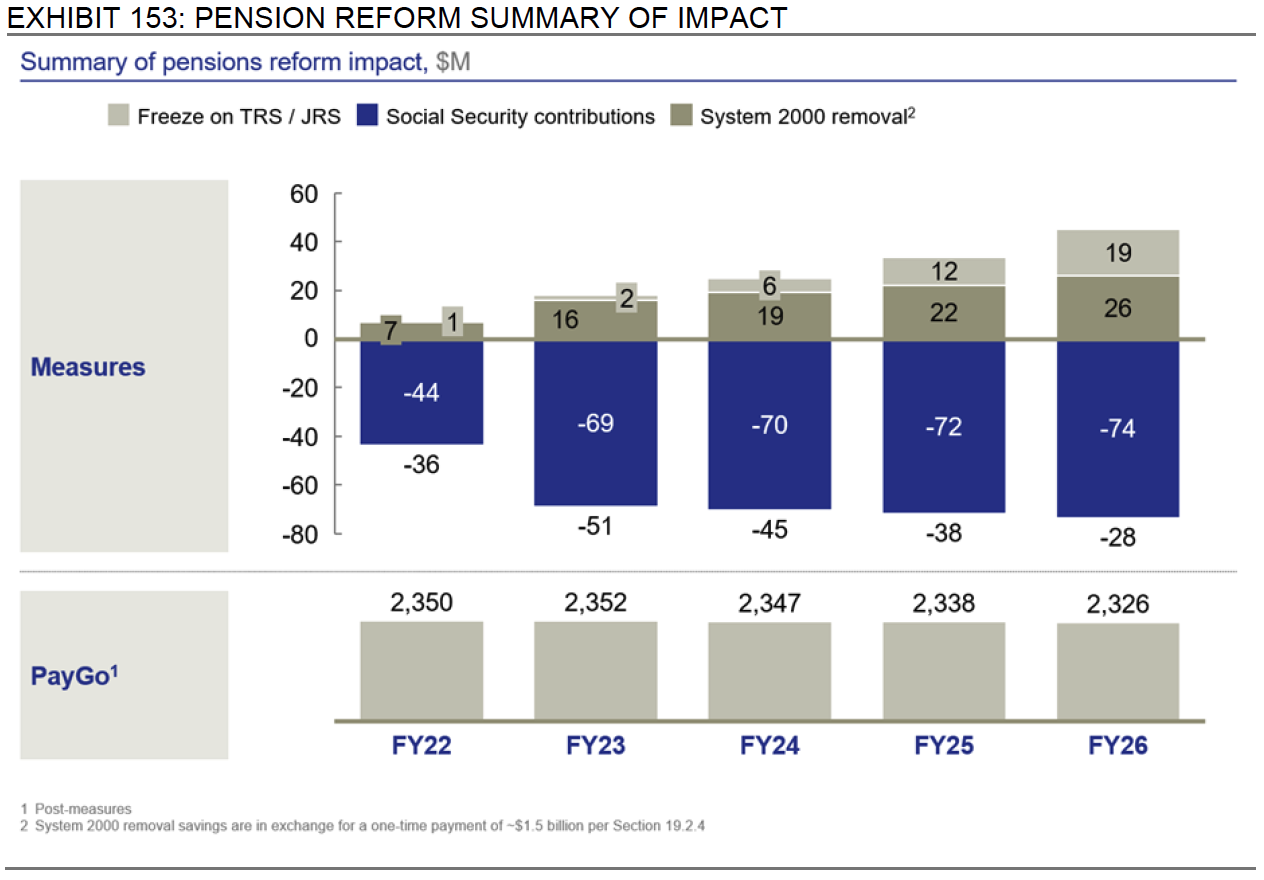
The Fiscal Plan has been amended to reflect certain reforms made to Puerto Rico’s retirement plans. The costs/savings associated with these reforms are outlined in the chart below.

Source: FOMB, Certified Fiscal Plan for Fiscal Year 2022, p. 320.

Total pension costs (PayGo plus trust deposits) during the FY2022-FY2031 period will average more than $3 billion per year. This means pension-related payments will be the largest single General Fund expenditure item during this ten-year period.

To be clear, we are not arguing in favor of reducing pensions. We do want to highlight, though, that this $3 billion per year is the cost we are paying now due to decades of mismanagement, for the many years government agencies failed to make the required pension contributions, and for the multiple times that the central government “borrowed” from the retirement fund and never repaid the “loan”.

Click here for details on the pension reforms and tradeoffs included in the Fiscal Plan.


University of Puerto Rico

Perhaps no other government agency’s funding has been cut as much as the budget of the University of Puerto Rico (“UPR”). The UPR’s General Fund allocation has been reduced by $445 million, or 48%.

It is difficult to understand this massive reduction in the General Fund appropriation for the most important higher education institution in Puerto Rico. Some argue that the budgetary reduction is justified by the reduction in student enrollment. However, a quick look at the data demonstrates this is a false statement. According to data released by the UPR, student enrollment has decreased from 46,325 during FY 2017 to 35,623 during FY22, a reduction of 23%. The 48% reduction in General Fund appropriations is, therefore, completely disproportionate to the decline in enrollment.

Furthermore, if the FOMB is really counting on improving human capital in Puerto Rico as an engine for growth in the future, then dismantling the UPR is outright counterproductive. Therefore, we recommend that, if the projected savings in the contribution to the operation of the Medicaid program are in fact realized, at least a portion of the funds that become available be allocated to the University of Puerto Rico.

Click here for more on the UPR.

Note from the Editor

“They Have Learned Nothing and They Have Forgotten Nothing”

The title phrase is traditionally attributed to French statesman Charles-Maurice de Talleyrand, in reference to the obdurate behavior of the restored Bourbon dynasty after the fall of Napoleon. After the Revolution of 1789, the subsequent terror of the Jacobins, and the rise and fall of an emperor who sought to conquer half of Europe, the reinstated monarchy pretended to rule as if nothing had happened, picking up things just where they left them in 1789
with predictable results.

In recent times, the phrase has been used to characterize politicians and policymakers who seek to stand athwart history, insisting against all advice and evidence on preserving the disastrous ways of the past, seeking to stop political and economic change at all costs, just to end up repeating the same mistakes of old. History shows such folly can be quite expensive, in terms of both blood and treasure.

Unfortunately for Puerto Rico, we have recently seen a set of political “leaders” demonstrate that they have learned nothing and forgotten nothing since the governor of Puerto Rico declared our public debt to be “unpayable” in 2015. After seven years of default, bankruptcy, federal legislation that stripped away Puerto Rico’s capacity to develop and implement fiscal policy, the imposition of an unelected oversight board, and a prolonged court-supervised process to restructure Puerto Rico’s debt, a group of legislators is acting like they have learned nothing from that experience.

The Puerto Rico Legislative Assembly recently considered House Joint Resolution 278 to implement changes to the current budget in light of the approval and certification of both the Plan of Adjustment for the Commonwealth government and the Fiscal Plan for Fiscal Year 2022. Among other things, we have seen the return of pork-barrel politics, the use of non-recurrent funds to cover recurring spending, and the reallocation of funds earmarked for the public health plan based on the mistaken premise that the Biden Administration has devised a permanent long-term solution for funding Puerto Rico’s Medicaid program. They clearly have learned nothing and forgotten nothing.

To be fair, the executive branch is not exempt from this affliction either. Witness the fiscal gimmicks it has implemented to fund a salary increase of $1,000 per month for public school teachers. Just to be clear, we do not oppose increasing the salaries of public school teachers. The Fiscal Plan for FY22 actually included funding for a permanent monthly increase of $470 per month (in two phases). What we oppose, because it is just plain bad policy, is using non-recurring funding from the American Rescue Plan Act (“ARPA”) to top-off the increase to $1,000 per month for only two years. What happens then in 2024? Again, learned nothing, forgotten nothing.

Finally, don’t be surprised if you hear politicians in Puerto Rico start using the phrase “this time is different” in the context of Puerto Rico’s public finances. As Carmen Reinhart and Kenneth Rogoff state in their book, This Time is Different: Eight Centuries of Financial Folly, “the most commonly repeated and most expensive investment advice ever given
stems from the perception that ‘this time is different’”. Indeed, the single worst thing we can do as we start to turn the corner out of bankruptcy and the hurricane reconstruction efforts begin in earnest, is to return to the ways of the past, the ways of accounting shenanigans, deceptive budgeting, and unrealistic economic growth and revenue projections, because “this time is different”. It never is.

CNE in the News

Click the video below to watch Sergio M. Marxuach’s participation in a recent installment of Jay Fonseca’s series “Los Datos son los Datos” where they discussed the new Fiscal Plan and its impact on Puerto Rico.