Upcoming Federal Priorities for Puerto Rico

Upcoming Federal Priorities for Puerto Rico

Published on May 9, 2024 / Leer en español

Director, Washington D.C. Office
SHARE

A brief note from yours truly:

I’m back! During the last two years, I served Puerto Rico from within the U.S. federal government.  I carried the work with a sense of pride and deep responsibility. It was the first Administration to appoint Senior Advisors across federal agencies to look out for Puerto Rico specifically.  And I was one of them.  Our collective efforts have undeniably ensured great strides in the Puerto Rico policy arena. Undoubtedly, as a wise Congresswoman once told me: “we have matured politically and are better prepared to flex our muscles to get attention”.

During my time at the U.S. Department of Housing and Urban Development (HUD), I worked tirelessly to ensure there was a recognition and deeper understanding of how historical circumstances, program shortcomings and cultural differences have resulted in an uneven playing field for Puerto Rico – and all U.S. territories.  While it’s been tough at times to tackle the deeply entrenched inadequacies, I’m proud of the progress we’ve made and the lessons we’ve learned. I remain hopeful that one day every federal agency will have dedicated personnel working to correct the many historical wrongs.

The Center for a New Economy’s (CNE) mission in DC is clear: shape and inform debates around Puerto Rico and put serious research and policy recommendations directly into the hands of decision-makers. But we are facing many challenges in doing this work. The political environment in Washington, DC has become increasingly contentious. For the most part, opposition to policy solutions stems from ideological stances rather than empirical evidence. Instead of fostering unity, it’s looking far more like the Divided States of America. For Puerto Rico policymaking, it’s a stark dichotomy:  either in favor of supporting its needs or you’re vehemently opposed to it.

At times, we find ourselves addressing urgent issues before even having the chance to propose solutions. Even now, after more than five years of laying the groundwork for Puerto Rico’s transition to SNAP, we’re faced with a proposal that not only denies access to SNAP but also slashes $700M from our existing program.

In the real world, challenges run even deeper. Before misinformation was widely promoted by social media and all the “clicks”, there was a whole effort to challenge knowledge altogether – to in fact, create ignorance: “via advertising, duplicitous press releases, funding of decoy research, establishment of scientific front organizations, manipulation of legislative agendas, organization of ‘friendly research’ for publication in popular magazines, and myriad additional projects from the dark arts of agnotology.” Those same mechanisms have grown exponentially and now infiltrate our daily lives. I was recently in NYC and came across this mosaic in one of MTA’s stations.

I stopped and thought of the implications of the iceberg analogy vis a vis our role in society.  Are we trusting our feelings above facts and evidence?  Imagine if we just trusted pilots to know what they are doing instead of requiring intensive training before putting our lives in their hands?

We are at a tipping point, grappling with deep ideological divisions, legislative gridlock, entrenched income inequality, and a global rise of authoritarianism. The role of think tanks is more important now than ever. And that’s why I’m back.

CNE has earned its reputation by doing the hard work and abstaining from politically-driven agendas. We are Puerto Rico’s objective brokers of expertise. We are here to help you understand issues and ideas through analysis.

“Getting and staying informed takes time and energy, but the results for individuals and the country make it worthwhile. When it comes to our obligation to be informed, those in the position to influence the views of others have a special responsibility to get their facts right and to distinguish carefully among facts, assessments, predictions, and recommendations.”

Richard Haas, Bill of Obligations


So, what’s next?

The way federal programs are designed in Congress requires Puerto Rico to repeatedly return to Congress every few years and put in our requests. That includes increased appropriations, changes to benefit levels, inclusion in certain programs we have been denied access to, and or, in addition to certain waivers for unreasonable requirements.  But that also lays out some predictability in our calendar.

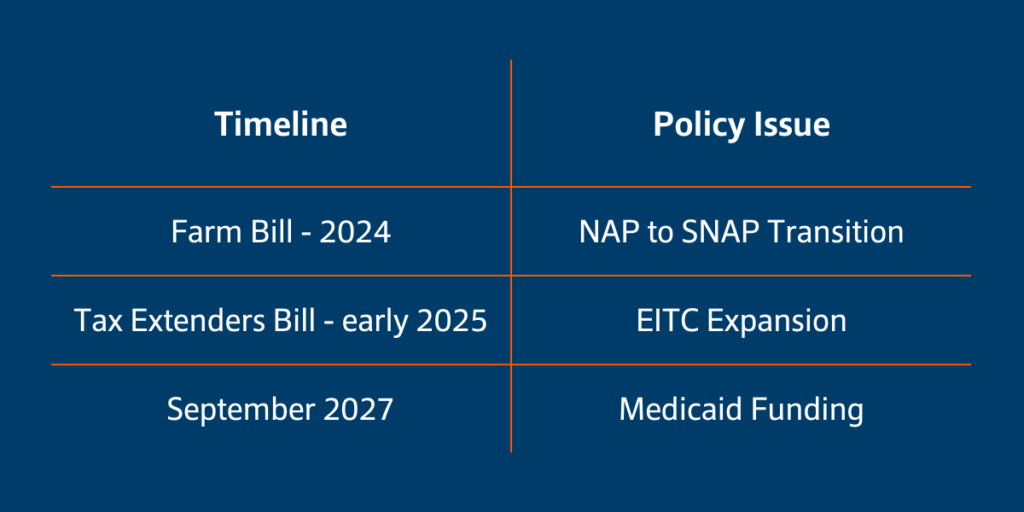
Below is a list of federal policy issues that CNE will pursue over the coming years.

NAP to SNAP

The United States government balances food production and food access for people living in poverty through its Farm Bill, revisited every five years by Congress. In addition to its revisions to aid and subsidies provided to farmers and agricultural corporations due to technological advancements, environmental concerns, and consumer preferences, it is also an opportunity to look at and review the effectiveness of U.S. food security programs. It gives Puerto Rico a unique opportunity to advocate for its own needs.

For many years now, a wide coalition of actors from Puerto Rico and the U.S., both public and private, have come together to push for Puerto Rico’s full incorporation into the Supplemental Nutrition Assistance Program (SNAP). As a result of that collection of efforts, the Senate Chairwoman for the Agriculture Committee recently released a framework for the new legislation that authorizes Puerto Rico to transition to SNAP, allocates necessary funding to be able to do so, and mandates a Government Accountability Office (GAO) study on the adequacy and availability of nutrition programs in isolated US states and territories. This release, a response to the House proposal, aims to foster bipartisan collaboration for a successful legislative outcome, and we’re committed to being part of the process.

Click here to read the latest column by Sergio M. Marxuach, Policy Director.

Changes to the Tax Code

In December 2017, Congress passed the Tax Cuts and Jobs Act of 2017, known on the Hill as the TCJA.  While certain provisions of the TCJA were made permanent, many are slated to expire by December 31, 2025. This means Congress will need to negotiate another major tax package in 2025, opening the door for Puerto Rico to advocate for necessary federal tax adjustments.

One area we are paying close attention to is the federal supplement to the local Earned Income Tax Credit (EITC). In 2021, the American Rescue Plan Act (ARPA) included an annual, federal supplement that bolstered Puerto Rico’s local EITC program. Nationally, the EITC plays a crucial role in enhancing economic security, improving children’s educational performance and attainment, and enhancing overall family well-being.

The last three years have been somewhat experimental for Puerto Rico as it evaluates the uptake and effectiveness of the recent expansion. Early data demonstrates that nearly 125,000 individuals that directly benefited from the EITC have been able to overcome poverty because of the EITC and other important anti-poverty programs included in ARPA. This success provides a compelling case for expanding the program further.

Given how critical this program has been to alleviating poverty and boosting labor force participation, we will be working with other partners to prioritize increased funding for Puerto Rico’s EITC in the upcoming year’s tax bill discussions.  participation, we will be working with other partners to prioritize increased funding for Puerto Rico’s EITC in the upcoming year’s tax bill discussions. 

Medicaid Funding

Over the years, the federal government has financed healthcare programs for the poor differently between the U.S. states and its territories. After years of advocacy and unproductive cycles of insufficient block grants, Congress finally took action in 2022 by authorizing a five-year funding package with the highest-ever allotments for Puerto Rico’s Medicaid program. These unprecedented funding levels have allowed Puerto Rico to expand eligibility and services to those in greatest need.

While the five-year package represents an improvement over the previous short-term patches Puerto Rico had grudgingly become accustomed to, it remains temporary and is set to expire in September 2027. It was also not sufficient to cover all the programs provided in the U.S. For example, it does not cover long-term services and support (LTSS) and non-emergency medical transportation for Puerto Rico’s increasingly aging population.

We will continue to stress the importance of providing Puerto Rico with equitable, permanent, and open-ended Medicaid funding to ensure the health and well-being of its residents.

In addition to Puerto Rico’s inclusion in critical health and economic programs available to residents in the U.S. (territories not included), there are many other investigations and good policy we will dive deeper into and pursue.

Food Security for Puerto Rico Now

Food Security for Puerto Rico Now

Published on May 8, 2024 / Leer en español

Sergio portrait
Policy Director
SHARE

Federal nutrition assistance for residents of Puerto Rico began in November 1974 under the old Food Stamp Program (“FSP”). Initially and during the first eight years of the implementation of the FSP in Puerto Rico it functioned just like in the United States: all eligible participants received coupons to purchase food items on the island.

In 1982, though, Congress arbitrarily replaced the FSP in Puerto Rico with an annual block grant through the Nutrition Assistance Program (“NAP”). The annual block grant was initially capped at $825 million or 75% of the projected FSP funding need for Puerto Rico in 1982. This cap was kept in place for the first five years of the program.

During FY2021, core block grant funding for the NAP was approximately $2 billion and provided benefits to 1.5 million low-income individuals. This core funding was supplemented with special one-time appropriations in 2017, after Hurricane María, and in 2020 due to the Covid-19 pandemic. Today, Puerto Rico’s block grant is $2.9 billion due to recent federal increases in the Thrifty Food Plan, which also determines nutrition benefits under the Supplemental Nutrition Assistance Program (“SNAP”). The USDA estimates that if Puerto Rico were currently under SNAP, it would receive at least an additional $1 billion in nutrition assistance.

While the recent increase in the annual amount allocated to Puerto Rico was sorely needed and greatly appreciated, the NAP’s capped block grant structure still results in stricter eligibility requirements and lower maximum monthly benefits when compared to the SNAP. According to a 2022 Feasibility Study commissioned by the Food and Nutrition Service (the “Feasibility Study”), while the NAP asset limits are higher than the SNAP asset limits, the result is the implementation of drastically lower net income limits and benefit levels in Puerto Rico. For example, to receive benefits today a single-person household in Puerto Rico must have a monthly net income below $691 compared with $1,251 under the SNAP in the states. The maximum benefit level for the same size household is $183 in Puerto Rico compared to $291 in the States.

Furthermore, the current NAP block grant is not needs-based, does not allow for access to emergency benefits after natural disasters (D-SNAP), and precludes Puerto Rico from accessing other programs and initiatives available to the states, D.C., Guam, and USVI through the SNAP. These disparities place families living in Puerto Rico in an unacceptable and indefensible situation.

Puerto Rico definitely needs additional nutrition funds but consideration of just another increase in NAP funding, without providing for a systematic transition to the SNAP, would be insufficient and continue to subject island residents to funding gaps, food insecurity, and second-class citizenship status. It is not the long-term solution to which Puerto Ricans, as U.S. citizens, have a right through this Farm Bill.

The Feasibility Study claims the NAP was created “in part to control nutrition assistance costs in Puerto Rico”, but we disagree. There is no rational relationship between the general desire or necessity to cut the costs of any given federal program and the decision to cut only those benefits accruing to a particular group of persons. In this sense, the decision to implement the NAP in Puerto Rico as a capped block grant is yet another example in a long history of Congressional discrimination against territories based on a “racialized order of territorial exceptionalism”, as documented by Professor Andrew Hammond from the University of Florida law school.

While current members of Congress are not to blame for the inequities visited on Puerto Rico over the last forty-odd years due to the discriminatory and unfair provisions of the NAP, they are both legally and morally responsible to amend and correct them and have an obvious opportunity to do so now.

There are currently two bills pending before Congress to rectify the discriminatory and unequal treatment of Puerto Rico under the NAP. Both H.R. 253 and S. 949 set out a timeline and process for Puerto Rico’s transition from the NAP into the SNAP, which would address systemic flaws in the NAP block grant funding. A broad coalition of over 80 organizations representing private industry, respected national non-profits, academic think tanks, and religious organizations has been strongly advocating for the inclusion of the language set forth in H.R. 253/S. 949 in the text of the Farm Bill currently being drafted.

As members of Congress consider the text of the Farm Bill, we remind them of Matthew Croasmun and Miroslav Volf’s beautiful words in The Hunger for Home: Food and Meals in the Gospel of Luke: “A loaf of bread is the most ordinary and most miraculous of things
It results from and sustains a set of relations between God, peoples, and the whole of creation. All three are made at home with one another in bread that is not just bread.” Simply put, food is not merely food and bread is never just bread. They are also physical representations of a transcendent relationship. Unfortunately, under the NAP, low-income Puerto Ricans are unable to fully participate in this physically and spiritually nourishing meal.

Congress should not make U.S. citizens in Puerto Rico wait to receive a fair portion of their daily bread until the next Farm Bill deliberations in 2028. The time for Congress to discharge its legal and moral obligations to Puerto Rico is now.

CNE Review – November 2022

Published on November 17, 2022 / Leer en español

See all editions of the
CNE Review
SHARE

In This Issue

We present a summary of the current state of U.S. politics after the midterm elections and what the outlook is for Puerto Rico.

We also include some highlights of our most recent event, Puerto Rico’s Colonial Conundrum.

Insights + Analysis from CNE

The Midterm Election and Its Implications for Puerto Rico

By Sergio M. Marxuach, Policy Director

The Big Picture

Election results in the U.S. midterm elections are still coming in as we write this CNE Review but the big picture is fairly clear.

The Democrats apparently will lose control of the House. On the other side of the Capitol, contrary to expectations, the Democrats have managed to scratch out victories in Arizona and Nevada. In Georgia, there will be a second-round election on December 6. So, right now the Democrats control 50 Senate seats and the Republicans 49. That margin is enough to control the Senate, given that Vice President Harris would vote to break any ties in favor of the Democrats. It would be a mistake, though, to think that the race in Georgia doesn’t matter. In fact, given how close the midterms have been and the arcane rules of the Senate, it would make a significant difference.

Click here for more on this and what we can expect during the upcoming lame duck session and after New Year’s Day.

Priorities for Puerto Rico

In the immediate term, that is before the end of 2022, the federal legislative priorities for Puerto Rico are:

  • Medicaid: The federal share of the funding for Puerto Rico’s Medicaid program is scheduled to decrease from 76% to 55% on December 16. It is imperative for Puerto Rico’s fiscal stability and the adequate operation of the island’s Medicaid program that this scenario does not come to pass.
  • Hurricane Fiona Disaster Relief Funding: The Pierluisi Administration has preliminarily estimated damages caused by Hurricane Fiona at approximately $10 billion. That money would need to be appropriated by Congress, hopefully through the expected emergency appropriations supplemental bill to be taken up during the lame duck session.

Broader Implications for Puerto Rico

Given the new correlation of forces in Washington, Puerto Rico’s strategy in D.C. will have to shift from one seeking parity in federal funding for programs such as Medicare and Supplemental Security Income, to one of defending what we have already gained. For example, Rep. Cathy McMorris Rodgers (WA) is expected to become Chairwoman of the House Energy and Commerce Committee, which has primary jurisdiction in that chamber over Medicaid. She has already stated her opposition to a Centers for Medicare & Medicaid Services (“CMS”) interpretation of 2019 legislation which provided significantly increased federal annual capped funding for Medicaid to the territories for FY2020 and FY2021. The CMS interpretation extended the duration of the higher Medicaid capped funding beyond FY2021. As Chairwoman of the Energy and Commerce Committee, she may challenge the CMS interpretation and probably seek to lower the amount of capped Medicaid funding available to Puerto Rico.

Congress is also expected at some point during the spring of next year to take up a massive five-year Farm Bill, which will cover everything from farmer subsidies to nutritional assistance. The main Farm Bill policy objective of the government of Puerto Rico and many NGOs on the island is to seek a transition from the current Nutritional Assistance Program to the nationwide Supplemental Nutritional Assistance Program, known as SNAP. The transition to SNAP would entail higher nutritional assistance funding, as well as other benefits, for Puerto Rico. Given the expected new majority in the House, that will certainly be a challenge. With the help of our supporters CNE, and other NGOs, will continue to advocate for this issue.

It would be a mistake, though, to think that there is no space for Puerto Rico to obtain some wins in the federal policy arena. Those policy wins can be achieved if advocacy organizations and the island’s government adapt to the new reality in Washington. That adaptation implies learning to play interstitial politics, navigating between and staying away from the most extreme factions in both parties, while moving towards those members from both parties that are closer to the center. Granted, that is a tight political space given the expected composition of both chambers, but that is where any deals between the Biden Administration and Congress are most likely to be made.

Policy success under the new balance of power in D.C. will also entail learning and using a new language to communicate our message on the Hill. The fact that 55% of Puerto Rican voters in Florida voted for Gov. DeSantis signals that the Puerto Rican community in the states has become ideologically diverse and is not reflexively liberal or progressive. That political change could be very useful when approaching Senators Rubio and Scott or members of the Florida delegation in the House.

These new conditions probably make many people in Puerto Rico quite uncomfortable, perhaps rightly so. But we really don’t have an option given the nature of the political relationship between Puerto Rico and the United States; our nominal representation in Congress; the new political dynamics in Washington; and Puerto Rico’s great economic and social needs. Adapting to the new political conditions in the U.S. is the only strategy likely to be successful in avoiding two years of stagnation and achieving some policy victories in Washington.

CNE Holds Conference on Puerto Rico’s Status Conundrum

On October 21st, CNE held a conference on Puerto Rico’s perennial status problem. However, instead of focusing on the traditional analysis and discourse about this issue, CNE, together with UPR professor Jaime Lluch, decided to apply the lens of comparative political science to Puerto Rico’s colonial dilemma.

Using a comparative perspective would allow the comparison of Puerto Rico’s autonomy with other autonomic entities from around the world; permit the comparison of the U.S. federalist system with other federalist systems; facilitate the analysis of national movements in Puerto Rico with other national movements around the world; provide for the examination of constitutional accommodation in Puerto Rico in a comparative perspective; allow for the use of quantitative methods to compare the degree of Puerto Rico’s self-government with that of other sub-state national entities; and permit the evaluation of options for Puerto Rico’s future in light of normative political theory.

The attendees of the conference heard from several distinguished scholars and political scientists from around the world. The two main panels consisted of Nicola McEwen, Ph.D., from the University of Edinburgh; André Lecours, Ph.D., from the University of Ottawa; Jordi Argelaguet, Ph.D., from the Universidad Autonoma de Barcelona; Rogers M. Smith, Ph.D., from the University of Pennsylvania; André Fazi, Ph.D., from Università di Corsica Pasquale-Paoli; and Héctor López-Bofill, Ph.D., from the Universitat Pompeu Fabra in Barcelona. In addition to these distinguished visitors, Jaime Lluch, Ph.D., from the University of Puerto Rico; and Jennifer Wolff, Ph.D., Deepak Lamba Nieves. Ph.D., and Sergio M. Marxuach from CNE, also participated in the event.

The presentations covered the political status of jurisdictions such as Quebec, Scotland, Barcelona, and Corsica and highlighted many important concerns that Puerto Ricans have discussed for decades. The event, coordinated by CNE’s Madrid Policy Bureau and professor Lluch, was the beginning of a long overdue conversation and represents a novel approach to Puerto Rico’s long-standing political status issue.

To watch the presentations click here.

The Midterm Election and Its Implications for Puerto Rico

The Midterm Election and Its Implications for Puerto Rico

Published on November 16, 2022 / Leer en español

Sergio portrait
Policy Director
SHARE

The Big Picture

Election results in the U.S. midterm elections are still coming in as we write this CNE Review but the big picture is fairly clear. The Democrats apparently will lose control of the House but relative to historical standards and expectations set prior to the election, it could have been worse. Republicans picked up 54 House seats against Bill Clinton in 1994 and 63 seats against Barack Obama in 2010. In contrast, according to Politico, the Republican Party’s internal estimates have them gaining anywhere between 7 and 12 seats in the House. Enough to give them a small majority but clearly a weak performance by historical benchmarks and given President Biden’s low approval ratings and the highest inflation rate since the early 1980s.

Ironically, the thin margin will hand a lot of leverage to fringe elements in the Republican Party. A handful of five or six representatives in the House will have the ability to hold hostage any legislation the leadership wants to puts through. The Republican Freedom Caucus in the House has already stated it will “hold hostage” must-pass legislation, for example, to keep the government open or to raise the debt limit.

In addition, according to the Washington Post, while the MAGA crowd had a bad night on Tuesday, at least 145 “Republican election deniers running for the House had won their races as of Wednesday afternoon”. Here is where things get complicated for the presumptive speaker, Kevin McCarthy. The problem with the MAGA crowd is not that they are conservative or uber-Republican. In fact, they are neither in any ideologically meaningful way. Their real problem is that they live in an alternate reality of conspiracy theories and misinformation uploaded to digital platforms by groups affiliated with Russia and China. How do you even begin to negotiate policy issues with someone who denies reality? I guess we will find out in real time pretty soon.

On the other side of the Capitol, contrary to expectations, the Democrats have managed to scratch out victories in Arizona and Nevada. In Georgia, Raphael Warnock with 49.4% of the vote, is slightly ahead of the Republican challenger, Herschel Walker, who has 48.5% with more than 95% of ballots counted. A third-party candidate has 2.1%. The problem is that Georgia law requires a runoff election if no candidate gets more than 50% of the vote. Given that Warnock is about half a percentage point below that threshold, there will be a second-round election in Georgia on December 6.

So, right now the Democrats control 50 Senate seats and the Republicans 49. That margin is enough to control the Senate, given that Vice President Harris would vote to break any ties in favor of the Democrats. It would be a mistake, though, to think that the race in Georgia doesn’t matter. In fact, given how close the midterms have been and the arcane rules of the Senate, it would make a significant difference.

If the Democrats manage to reelect Sen. Warnock the 51-49 margin will allow them to have clear majorities in the membership of Senate committees, as opposed to splitting them 50/50 with Republicans, which has been the case for the last two years. This would make it easier to push through appointments and legislation because any ties at the committee level are resolved by discharging the matter to the floor. Presumably, that would not be the case if the Democrats have a “clean” majority. It would also significantly decrease the leverage that more conservative Democrats, like Senators Manchin and Sinema, have exercised over the last two years, because Majority Leader Schumer would have the flexibility of losing at least one vote and still be able to move legislation.

In the final analysis, though, a two-vote majority is not a mandate and the slim margin will certainly keep Sen. Schumer busy holding Democrats in line to support the Biden administration’s legislative priorities, but it certainly makes his job just slightly easier.

The Lame Duck Session

In the meantime, Congress is scheduled to return to Washington on November 14 for a month-long lame duck session. Along with conducting leadership elections and determining committee assignments for the 118th Congress, a handful of important legislative priorities will be considered.

Government Funding

The most pressing issue for the returning Congress is passing a bill to fund the federal government for the rest of FY23. Currently, government funding expires on December 16. To avoid a shutdown, Democratic leadership is likely to push a massive omnibus spending package by the end of the year. As has been the case in recent years, this will be the legislative vehicle for all sorts of year-end items legislators want to move before adjourning, a “Christmas Tree” kind of legislation containing all sorts of unrelated items in one bill. Some Republicans are likely to object to the omnibus approach, but it appears that appropriators on both sides of the aisle agree on pushing it through.

Congress is also expected to take up an emergency appropriations supplemental bill during the lame duck session. This legislation will include funding supporting Ukraine and providing assistance to communities impacted by natural disasters.

Healthcare

Several healthcare provisions also expire on December 16. According to analysts at the Prime Policy Group, “among these are largely non-controversial extensions to Medicare and

Medicaid programs”, such as extending funding for:

  • Low Volume Hospitals;
  • The Medicare-Dependent Hospital Program;
  • Programs related to the Public Health Service; and
  • Early childhood programs such as the Maternal, Infant, and Early Childhood Home Visiting (MIECHV) programs and the Promoting Safe and Stable Families (PSSF) program.

Most, if not all of these issues will be addressed in the expected end-of-year omnibus legislation.

Debt Ceiling

The U.S. is expected to hit its debt ceiling at some point next year. This means Congress would have to enact legislation to raise the debt ceiling to allow new borrowing. Traditionally, this was not a controversial issue. According to the U.S. Treasury, “Congress has always acted when called upon to raise the debt limit. Since 1960, Congress has acted 78 separate times to permanently raise, temporarily extend, or revise the definition of the debt limit — 49 times under Republican presidents and 29 times under Democratic presidents. Congressional leaders in both parties have recognized that this is necessary.”

Recently, however, top Republican lawmakers have suggested using the debt legislation as leverage to get some concessions policy from the Biden Administration. This type of legislative brinksmanship, which was also used against President Obama, is quite dangerous. Failure to raise the debt limit would lead to a default by the United States with potentially catastrophic financial consequences. According to a study by Moody’s analytics published last year when the U.S. hit its previous debt limit, such a default  “would cost the U.S. economy up to 6 million jobs, wipe out as much as $15 trillion in household wealth, and send the unemployment rate surging”. So, in general, it is not a good idea to play petty politics with this issue.

That’s why some Democrats are pushing to have the debt limit increased during the lame duck session, using the complicated reconciliation procedures which require only a simple majority to close debate and move to a final vote in the Senate. The problem is that reconciliation is a time-consuming procedure and some Democrats may balk at investing precious floor time on an issue that while extremely important is not urgent. That’s why we think there is only a slim chance that Congress will take up this issue during the lame duck, but the political calculation is complex. Kicking the can until next year on the debt limit essentially hands the financial equivalent of a nuclear bomb to the MAGA crowd in the House. Financial markets around the world may have an adverse reaction to that decision.

After New Year’s Day

If the most likely scenarios for the House and the Senate materialize, with the Republicans running the House with a slight majority and the Democrats holding the Senate by the thinnest of threads, the following are some of the things we can expect when the calendar turns and the new year begins:

  • Complex New Political Dynamics in D.C.: The Biden legislative agenda will stall. The opportunities for major legislation will be few and far between, if any. Nominations will keep moving through the Senate, but we can expect hard negotiations around deadlines for must-pass legislation to keep the government open or raise the debt limit. Given the expected irrationality of the MAGA faction in the House, Senate Republicans will hold most of the leverage during these negotiations. Legislative gridlock, though, will be the order of the day.
  • Forceful Executive Action: In the absence of Congressional space to enact significant legislation, the Biden Administration will probably try to maximize the powers of the Executive Branch, through executive orders and the enactment of sweeping new rules and regulations. Republicans will challenge many of these actions in the courts, with the hope that the majority of Republican-appointed Justices in the Supreme Court will eventually invalidate some of them.
  • Hand-to-Hand Political Combat in the House: The MAGA faction in the House has already made it clear they will use Congressional oversight powers to conduct investigations of, and to issue subpoenas to, members of the cabinet and other officials of the Biden Administration. Some have even talked about investigating the president’s son. The reality is that the MAGA crowd doesn’t really believe government can do much good and could care less about most substantive policy issues. If their primary objective is to “own the libs”, then we can expect plenty of hostile investigations and high-risk legislative brinkmanship during the next two years. That will make for some hard-hitting tweets but would be terrible for American democracy.

Priorities for Puerto Rico

In the immediate term, that is before the end of 2022, the federal legislative priorities for Puerto Rico are:

  • Medicaid: The federal share of the funding for Puerto Rico’s Medicaid program is scheduled to decrease from 76% to 55% on December 16. It is imperative for Puerto Rico’s fiscal stability and the adequate operation of the island’s Medicaid program that this scenario does not come to pass.
  • Hurricane Fiona Disaster Relief Funding: The Pierluisi Administration has preliminarily estimated damages caused by Hurricane Fiona at approximately $10 billion. That money would need to be appropriated by Congress, hopefully through the expected emergency appropriations supplemental bill to be taken up during the lame duck session.

Broader Implications for Puerto Rico

Given the new correlation of forces in Washington, Puerto Rico’s strategy in D.C. will have to shift from one seeking parity in federal funding for programs such as Medicare and Supplemental Security Income, to one of defending what we have already gained. For example, Rep. Cathy McMorris Rodgers (WA) is expected to become Chairwoman of the House Energy and Commerce Committee, which has primary jurisdiction in that chamber over Medicaid. She has already stated her opposition to a Centers for Medicare & Medicaid Services (“CMS”) interpretation of 2019 legislation which provided significantly increased federal annual capped funding for Medicaid to the territories for FY2020 and FY2021. The CMS interpretation extended the duration of the higher Medicaid capped funding beyond FY2021. As Chairwoman of the Energy and Commerce Committee, she may challenge the CMS interpretation and probably seek to lower the amount of capped Medicaid funding available to Puerto Rico.

Congress is also expected at some point during the spring of next year to take up a massive five-year Farm Bill, which will cover everything from farmer subsidies to nutritional assistance. The main Farm Bill policy objective of the government of Puerto Rico and many NGOs on the island is to seek a transition from the current Nutritional Assistance Program to the nationwide Supplemental Nutritional Assistance Program, known as SNAP. The transition to SNAP would entail higher nutritional assistance funding, as well as other benefits, for Puerto Rico. Given the expected new majority in the House, that will certainly be a challenge. With the help of our supporters CNE, and other NGOs, will continue to advocate for this issue.

It would be a mistake, though, to think that there is no space for Puerto Rico to obtain some wins in the federal policy arena. Those policy wins can be achieved if advocacy organizations and the island’s government adapt to the new reality in Washington. That adaptation implies learning to play interstitial politics, navigating between and staying away from the most extreme factions in both parties, while moving towards those members from both parties that are closer to the center. Granted, that is a tight political space given the expected composition of both chambers, but that is where any deals between the Biden Administration and Congress are most likely to be made.

Policy success under the new balance of power in D.C. will also entail learning and using a new language to communicate our message on the Hill. The fact that 55% of Puerto Rican voters in Florida voted for Gov. DeSantis signals that the Puerto Rican community in the state has become ideologically diverse and is not reflexively liberal or progressive. That political change could be very useful when approaching Senators Rubio and Scott or members of the Florida delegation in the House.

These new conditions probably make many people in Puerto Rico quite uncomfortable, perhaps rightly so. But we really don’t have an option given the nature of the political relationship between Puerto Rico and the United States; our nominal representation in Congress; the new political dynamics in Washington; and Puerto Rico’s great economic and social needs. Adapting to the new political conditions in the U.S. is the only strategy likely to be successful in avoiding two years of stagnation and achieving some policy victories in Washington.

From NAP to SNAP

From NAP to SNAP

Published on September 1, 2022 / Leer en español

Senior Policy Analyst
SHARE

At a time when many are discussing the transformative possibilities of the use of federal funds in Puerto Rico, we must not lose sight of one of the proposals that has the greatest potential impact for our island: the transition from the Nutrition Assistance Program (NAP) to the Supplemental Nutrition Assistance Program (SNAP).

The Center for a New Economy is strongly in favor of extending SNAP to Puerto Rico. We recently published a report analyzing the transition, where we emphasized the benefits it would bring. SNAP would not only increase the federal nutrition assistance for poor people in Puerto Rico, but it would also ensure more funds during economic crises or following natural disasters. The transition to SNAP would also increase the size of the population that is eligible for nutrition assistance, and end a shameful legacy of discrimination by the U.S. Congress against residents of Puerto Rico.

Currently, NAP relies on new congressional action every time a crisis or natural disaster puts the government’s finances in check or the economic situation for Puerto Rican families worsens. Under SNAP, we would have a program that is flexible and responsive to the needs of communities that suffer from food insecurity.  

That same flexibility would ensure a much more robust nutritional assistance for the vast majority of beneficiaries. As an entitlement or a right that every U.S. citizen has, SNAP provides resources based on the level of need, not on a defined amount like NAP. Under SNAP, the number of people receiving nutritional assistance in Puerto Rico, currently around 1.5 million, could increase by 9 to 12%. In other words, SNAP would provide assistance to an additional 100,000 people who currently do not receive any support under NAP. The subsidy would also increase significantly, even doubling that of NAP in certain cases.

The benefits of extending SNAP to Puerto Rico will be felt not only by the homes that receive the assistance. According to the federal Department of Agriculture, SNAP has a multiplier effect on the economy. Each additional dollar increases economic activity in supermarkets, businesses, farms and many other sectors, which in turn creates jobs and generates new investment opportunities.

All of these benefits are important, but we must also address this issue from the perspective of justice. The extension of SNAP would bring down one of the most insidious discriminatory practices of the federal government towards our island. How can we justify that Puerto Rican families, living with a lack of economic opportunities and dealing with the typical precariousness of life in Puerto Rico, receive nutrition assistance that is barely half of what a similar family in Florida, Texas or any other state can receive? The answer is that there is no justification. Even more so when one takes into account that Puerto Rico’s nutritional assistance program used to operate the same as it does in the states, but Congress replaced it with NAP in 1982 in an effort to cut down the federal budget.

Like with any other change in public policy, the transition from NAP to SNAP may be challenging. However, the benefits of SNAP far outweigh the cost of the transition. Moreover, it is up to the federal and local governments to ensure a responsible implementation of SNAP so that the new policy benefits all those who currently rely on nutrition assistance in Puerto Rico.

The Spanish language version of this column was originally published in El Nuevo DĂ­a on September 1, 2022.

CNE Review – August 2022

Published on August 11, 2022 / Leer en español

See all editions of the
CNE Review
SHARE

In This Issue

The cost of food has been in the headlines recently due to a set of intersecting crises. The still ongoing COVID-19 pandemic; the Russian invasion of Ukraine; supply chain disruptions; and natural disasters have combined to generate an overall spike in food prices. According to the Food and Agriculture Organization of the United Nations, “global food prices were 23 percent higher in May 2022 than they were a year earlier.”

Puerto Rico has not been exempted from this trend. According to the most recent release of the consumer price index for the island, the cost of “general foodstuffs” increased in June 2022 by 10.3% relative to the same month in 2021. We note this increase is probably underestimated due to problems with the construction of the price index for Puerto Rico. In any event, even if it is true that the rate of inflation for food in Puerto Rico is half the rate for the entire world, many households in Puerto Rico were already food insecure prior to the pandemic due to the relatively high cost of living in the island; little local production of basic dietary staples; the requirement to use costly U.S. flag vessels to transport food and other cargo from the U.S.; low wages; and high rates of poverty and income inequality.

This is the context, then, in which Puerto Rican and federal elected officials, members of the Biden administration, and civil society organizations have been advocating for a transition from the Nutrition Assistance Program (“NAP”) currently in effect in Puerto Rico to the Supplemental Nutrition Assistance Program (“SNAP”) currently operating in the 50 states, the District of Columbia, and the U.S. territories of Guam and the Virgin Islands.

As part of that advocacy effort, Congress ordered the Food and Nutrition Service (“FNS”) of the U.S. Department of Agriculture (“USDA”) in 2021 to undertake an update of a 2010 study of the feasibility of implementing SNAP in Puerto Rico. The USDA, in turn, hired two consulting firms, Insight Policy Research and Mathematica, to carry out this update for FNS. The USDA released the final report of the Update to Feasibility Study of Implementing SNAP in Puerto Rico in July 2022 (the “Feasibility Study”).

For years, CNE has advocated for equal treatment in regards to federal programs such as Medicaid, Supplemental Security Income, Earned Income Tax Credit, and a transition from NAP to SNAP. In this month’s CNE Review we take a look at some of the most important findings of the Feasibility Study and analyze their implications for the full implementation of SNAP in Puerto Rico.

–Sergio M. Marxuach, Editor-in-Chief

We are excited to announce a new team member


Francis G. Torres
Senior Policy Analyst
CNE Washington, D.C. Office

Francis has been a member of the CNE family for some time. He worked as a Communications and Content Specialist at our D.C. Office, where he learned about Puerto Rico’s most urgent policy problems and helped develop advocacy strategies to shape federal solutions. Francis returns to CNE after earning his Master in Public Affairs degree from the Princeton School of Public and International Affairs. During his time at Princeton, he led a team of MPA students in researching and drafting Puerto Rico’s Moonshot Opportunity: Recommendations for the U.S. Territory’s Economic Future, a policy report commissioned by the Office of the Governor of Puerto Rico and focused on optimizing federal funding for Puerto Rico’s economic recovery. More recently, he served as Master of Ceremonies for CNE’s 2021 Growth Policy Summit.

Francis joins CNE at a crucial juncture for federal involvement in Puerto Rico. He will strengthen CNE’s advocacy, thought leadership, and presence among networks of key stakeholders and decision-makers in Washington, D.C., and help place the Growth Project’s proposals at the center of federal debates on Puerto Rico.

We are certain that he will make significant contributions to the success of the Growth Project, and we’re happy to have him back on the team!

Insights + Analysis from CNE

By Sergio M. Marxuach, Policy Director

Nutritional Assistance in Puerto Rico

Federal nutrition assistance for residents of Puerto Rico began in November 1974 under the old Food Stamp Program (“FSP”). Initially and during the first eight years of the implementation of the FSP in Puerto Rico it functioned just like in the U.S.: all eligible participants received paper coupons which could then be used to purchase food items from certified food retailers on the island.

In 1982, Congress replaced the FSP in Puerto Rico with an annual block grant through the NAP. In general, the capped block grant structure of the NAP has generated discrepancies in eligibility criteria and benefit levels relative to SNAP.

Click here for details on how these discrepancies play out in reality.

Transition to SNAP

The transition from NAP to SNAP would be a complicated and costly process. It will be necessary, among other things, to enact federal and local legislation, issue new regulations, implement new requirements and provide for the operation of several components of SNAP that currently do not operate in Puerto Rico.

Click here for details on the process and costs of a transition to SNAP.

What to Expect Under SNAP in Puerto Rico

According to the Feasibility Study, the following are some of the effects that can be expected if SNAP is implemented in Puerto Rico:

  • Asset Limits – The implementation of SNAP asset limits would result in a lower number of beneficiaries in Puerto Rico. However, the Feasibility Study states that this effect could be mitigated, at least in part, by adopting broad-based categorical eligibility (“BBCE”) rules. Click here for details.
  • Income Limits –As shown in the graph below, income limits under NAP are lower than SNAP’s for households of one to three people. So, everything else being equal, this would mean that a larger amount of smaller households in Puerto Rico would qualify for benefits under SNAP than under NAP. Click here for details.Source: Feasibility Study, p. 37.
  • Work Requirements – Currently there are no work requirements under NAP. The government of Puerto Rico would be required to implement work requirements under SNAP. Click here for details.
  • Several Groups May Lose Eligibility or Receive Lower Benefits – The authors of the Feasibility Study conclude that “further research is needed to determine which NAP participants would be most likely to lose nutrition assistance benefits.” Click here for details.
  • Benefit Calculation – According to the Feasibility Study, “in 2021, in the absence of relief funding, the SNAP maximum benefit was 1.8–2.1 times higher than the NAP maximum benefit.” (Feasibility Study, p. 38) Click here for details.
  • Estimated SNAP Participation in Puerto Rico – The authors of the Feasibility Study found that the number of participating households, individuals, and percentage of covered population would increase under SNAP. Click here for details.

So, what is the bottom line?

On the positive side of the ledger, we find: (1) funding for nutritional assistance would increase significantly under SNAP, from approximately $2.6 billion in FY2023 to $4.5 billion in FY2031; (2) the number of beneficiaries would increase between 9 and 12 percent (depending on the final set of rules adopted); (3) the maximum amount of benefits would increase, in some cases they may actually be double the amount currently available under NAP; and (4) the increased spending in nutrition expenditures would have a positive income multiplier effect on the local economy in both the food retail and the local agricultural sectors as well as a positive impact on overall employment.

On the other side of the ledger, we need to take into account the following: (1) implementation costs could exceed $400 million over a ten-year period, at a time when the Financial Oversight and Management Board has been implementing budget cuts across the government; (2) administering SNAP after rollout would cost an estimated $249 million to $414 million, on an annual basis (but FNS would cover approximately 54% of these costs); (3) some groups could lose eligibility for nutritional assistance or qualify only for lower benefits; and (4) the government of Puerto Rico would have to gear up for the implementation of several components of SNAP which currently don’t operate in Puerto Rico.

What about work requirements, are they a benefit or a cost?

While this newsletter is not the venue to fully address this debate, we do note that work requirements appear to be more effective in theory than in practice for several reasons. Click here for a brief analysis.

Regardless of where the government stands in the debate over work requirements, it appears that the benefits of implementing SNAP in Puerto Rico outweigh the costs, provided that adequate measures are taken to try to protect, or reduce the impact on, those who may be negatively affected by the transition from NAP to SNAP. In a transition like the one proposed, there will always be winners and losers, but we must try to minimize the negative consequences that particular groups would face.

On Our Radar...

The National Security Case for Industrial Policy – Industrial policy in the United States has been closely related to the achievement of national security objectives at least since World War II. During the post-Cold War era, however, the U.S. Government’s economic policies encouraged the offshoring of production to help companies maximize profits, even as such policies benefited potential geopolitical rivals, such as China. Now, as the authors of this paper published by the Center for a New American Security argue, “the relationship between American industry and the U.S. government must change. The nature of the U.S.-China strategic competition, one centered on technology, requires a reset in how America’s policymakers and corporate leaders engage. Matters of economic competitiveness and security are increasingly indistinguishable.”

The Strange Economy of 2022 – Economic indicators appear to be out of sync. There is soaring demand and high inflation. Yet GDP in the U.S. has contracted for two quarters in a row. Economists have spent the last couple of weeks debating whether or not the U.S. is in recession. The crux of the matter is, as Ben Casselman explains in this piece for the New York Times, that “Typically, in recessions, the problem is that businesses don’t want to hire and consumers don’t want to spend. Right now, businesses want to hire, but can’t find the workers to fill open jobs. Consumers want to spend, but can’t find cars to buy or flights to book. Recessions, in other words, are about too much supply and too little demand. What the U.S. economy is facing is the opposite.”

The Costs of Kleptocracy – Public sector corruption has been in the local news recently after the arrest of several government officers and persons with close connections to them. This primer from Chatham House explains what is a kleptocracy and the economic and social costs it creates.

NAP vs. SNAP: An Analysis on Federal Nutrition Assistance for Residents of Puerto Rico

NAP vs. SNAP: An Analysis on Federal Nutrition Assistance for Residents of Puerto Rico

Published on August 10, 2022 / Leer en español

Sergio portrait
Policy Director
DOWNLOAD
SHARE

Introduction

The cost of food has been in the headlines recently due to a set of intersecting crises. The still ongoing COVID-19 pandemic; the Russian invasion of Ukraine; supply chain disruptions; and natural disasters have combined to generate an overall spike in food prices. According to the Food and Agriculture Organization of the United Nations, “global food prices were 23 percent higher in May 2022 than they were a year earlier.”

Puerto Rico has not been exempted from this trend. According to the most recent release of the consumer price index for the island, the cost of “general foodstuffs” increased in June 2022 by 10.3% relative to the same month in 2021. We note this increase is probably underestimated due to problems with the construction of the price index for Puerto Rico. In any event, even if it is true that the rate of inflation for food in Puerto Rico is half the rate for the entire world, many households in Puerto Rico were already food insecure prior to the pandemic due to the relatively high cost of living in the island; little local production of basic dietary staples; the requirement to use costly U.S. flag vessels to transport food and other cargo from the U.S.; low wages; and high rates of poverty and income inequality.

This is the context, then, in which Puerto Rican and federal elected officials, members of the Biden administration, and civil society organizations have been advocating for a transition from the Nutrition Assistance Program (“NAP”) currently in effect in Puerto Rico to the Supplemental Nutrition Assistance Program (“SNAP”) currently operating in the 50 states, the District of Columbia, and the U.S. territories of Guam and the Virgin Islands.

As part of that advocacy effort, Congress ordered the Food and Nutrition Service (“FNS”) of the U.S. Department of Agriculture (“USDA”) in 2021 to undertake an update of a 2010 study of the feasibility of implementing SNAP in Puerto Rico. The USDA, in turn, hired two consulting firms, Insight Policy Research and Mathematica, to carry out this update for FNS. The USDA released the final report of the Update to Feasibility Study of Implementing SNAP in Puerto Rico in July 2022 (the “Feasibility Study”).

For years, CNE has advocated for equal treatment in regards to federal programs such as Medicaid, Supplemental Security Income, Earned Income Tax Credit, and a transition from NAP to SNAP. In this policy brief, we take a look at some of the most important findings of the Feasibility Study and analyze their implications for the full implementation of SNAP in Puerto Rico.

Nutritional Assistance in Puerto Rico

Federal nutrition assistance for residents of Puerto Rico began in November 1974 under the old Food Stamp Program (“FSP”). Initially and during the first eight years of the implementation of the FSP in Puerto Rico it functioned just like in the U.S.: all eligible participants received paper coupons which could then be used to purchase food items from certified food retailers on the island.

In 1982, Congress replaced the FSP in Puerto Rico with an annual block grant through the NAP. The annual block grant was initially capped at $825 million or 75% of the projected FSP costs for Puerto Rico in 1982. (Feasibility Study, p. 17) This cap was kept in place for the first five years of the program.

While the Feasibility Study claims this was done “in part to control nutrition assistance costs in Puerto Rico,” we disagree. There is no logical or rational relationship between the desire or necessity to cut the costs of any given program and the decision of whose benefits are cut, especially when it is decided to cut the benefits of a discrete group of beneficiaries. In this sense, it appears to us that the decision to implement the NAP in Puerto Rico as a capped block grant is yet another example in a long list of Congressional discrimination against territories based on a “racialized order of territorial exceptionalism” as documented by Andrew Hammond, professor of law at the University of Florida law school. (See Andrew Hammond, Territorial Exceptionalism and the American Welfare State, 119 MICH. L. REV. 1639 (2021))

Be that as it may, it appears that in exchange for lower funding and the implementation of the funding cap, Congress granted Puerto Rico greater flexibility in administering the program by shifting many regulatory decisions and functions to Puerto Rico. For example, when first implemented, NAP benefits were disbursed through paper checks that could be cashed at any food retailer, bank, or financial institution. However, on the negative side, eligibility requirements were stricter and benefit levels were reduced under NAP to adjust program costs to the lower funding level. Households with incomes of more than 85 percent of the Federal Poverty Guidelines (in July 1982) became ineligible, and benefit levels were reduced. The maximum NAP benefit for a household of four was $199, compared with the previous maximum of $221 under the FSP. (Feasibility Study, p. 17)

In 2001, the government of Puerto Rico began delivering benefits through an electronic benefit transfer system (“EBT”) and limited the amount that could be redeemed in cash to 25% of benefits. In 2015, Congress directed Puerto Rico to phase out the option of the 25% cash benefit and since the beginning of 2021, all benefits have been delivered using EBT cards that can be used only at authorized NAP retailers.

During FY2021, core block grant funding for the NAP was approximately $2 billion and provided benefits to 1.5 million low-income individuals. This core funding was supplemented with special appropriations in 2017, after Hurricane Maria, and in 2020 due to the COVID-19 pandemic. For FY2022, the NAP block grant amount was increased by 23% to reflect similar changes to SNAP benefits due to a revision of the federal Thrifty Food Plan. As a result, block grant funding for FY2023 is expected to be approximately $2.6 billion. Finally, two bills are pending in Congress to fully transition Puerto Rico to SNAP.

In general, the capped block grant structure of the NAP has generated discrepancies in eligibility criteria and benefit levels relative to SNAP. According to the Feasibility Study, NAP asset limits are higher than the SNAP asset limits but net income limits and maximum benefits levels are lower under NAP. For example, during FY2021, while the net income limit for a family of three was slightly lower for NAP than SNAP
smaller households [saw] a greater disparity in net income limits: A single-person household in Puerto Rico could have a monthly net income of up to $619 compared with $1,064 for SNAP. Alternatively, “larger households (of four or more) had higher net income limits for NAP than SNAP.”

Furthermore, “excluding adjustments to NAP and SNAP benefits resulting from COVID-19, the maximum NAP benefit in FY 2021 was 59 percent of the maximum SNAP benefit; this trend was similar for all household sizes.”(Feasibility Study, p. 18).

Transition to SNAP

The transition from NAP to SNAP would be a complicated process. It will be necessary, among other things,

  • To enact federal legislation to authorize the operation of SNAP in Puerto Rico;
  • To enact Puerto Rico legislation to conform with federal requirements for SNAP;
  • For both the USDA and the government of Puerto Rico to issue new regulations for the operation of SNAP in Puerto Rico and to bring into alignment asset limits, income limits, work requirements, and other program parameters;
  • To implement new quality control, compliance, and reporting requirements; and
  • To provide for the operation of several components of SNAP that currently don’t operate in Puerto Rico, such as the SNAP Employment and Training program (“SNAP E&T”); the SNAP Nutritional Education program (“SNAP-Ed”); and Disaster SNAP.

In addition, Puerto Rico will have to hire and train new program officers (approximately 550 new hires just to process new applications), implement new procedures, and roll out new IT systems to manage the program.

According to the Feasibility Study, implementing SNAP in Puerto Rico could cost between $341 million and $426 million over an estimated 10-year implementation period; while administering SNAP after rollout would cost an estimated $249 million to $414 million, on an annual basis (FNS would cover approximately 54% of these costs).

The estimated cost of benefits issued to SNAP participants in Puerto Rico would be $4.5 billion annually, based on an average monthly SNAP participation of 861,000 households. (Feasibility Study, p. 155)

What to Expect Under SNAP in Puerto Rico

In general, a transition to SNAP in Puerto Rico is expected to increase the number of eligible individuals and households and raise the benefit levels of participants. However, some types of households may gain nutrition assistance eligibility and/or benefits under SNAP, while others may lose eligibility and/or benefits. The final distribution of winners and losers under SNAP will depend, in part, on policy decisions made by the government of Puerto Rico, and in part on the implementation of SNAP criteria instead of NAP criteria.

According to the Feasibility Study, the following are some of the effects that can be expected if SNAP is implemented in Puerto Rico:

  • Asset Limits – In general, the NAP asset limits are higher than the SNAP asset limits. To be eligible for NAP, households with no members 60 or older may have no more than $5,000 in assets. Households with only members 60 or older have an asset limit of $15,000. (Feasibility Study, p. 31). While for SNAP, households with at least one member who is 60 or older or has a disability had an asset limit of $3,500. For all other households, the asset limit was $2,250. Thus, everything else being equal, the implementation of SNAP asset limits would result in a lower number of beneficiaries in Puerto Rico. However, the Feasibility Study states that this effect could be mitigated, at least in part, by adopting broad-based categorical eligibility (“BBCE”) rules. Under BBCE, states have been able to use asset and gross income limits for TANF noncash benefits to confer categorical eligibility for SNAP, for example, by eliminating asset limits or increasing the gross income limit up to 200% of the Federal Poverty Guidelines.
  • Income Limits – According to the Feasibility Study, “The types and sources of income included in eligibility determination are generally similar for NAP and SNAP, including income of ineligible household members, but the exemptions, deductions, and income thresholds differ. The effect of a transition from NAP to SNAP on the overall amount deducted from gross income would vary by household and could affect various groups’ eligibility and benefit levels differently (e.g., older adults compared with parents with school-aged children).” (Feasibility Study, p. 36).
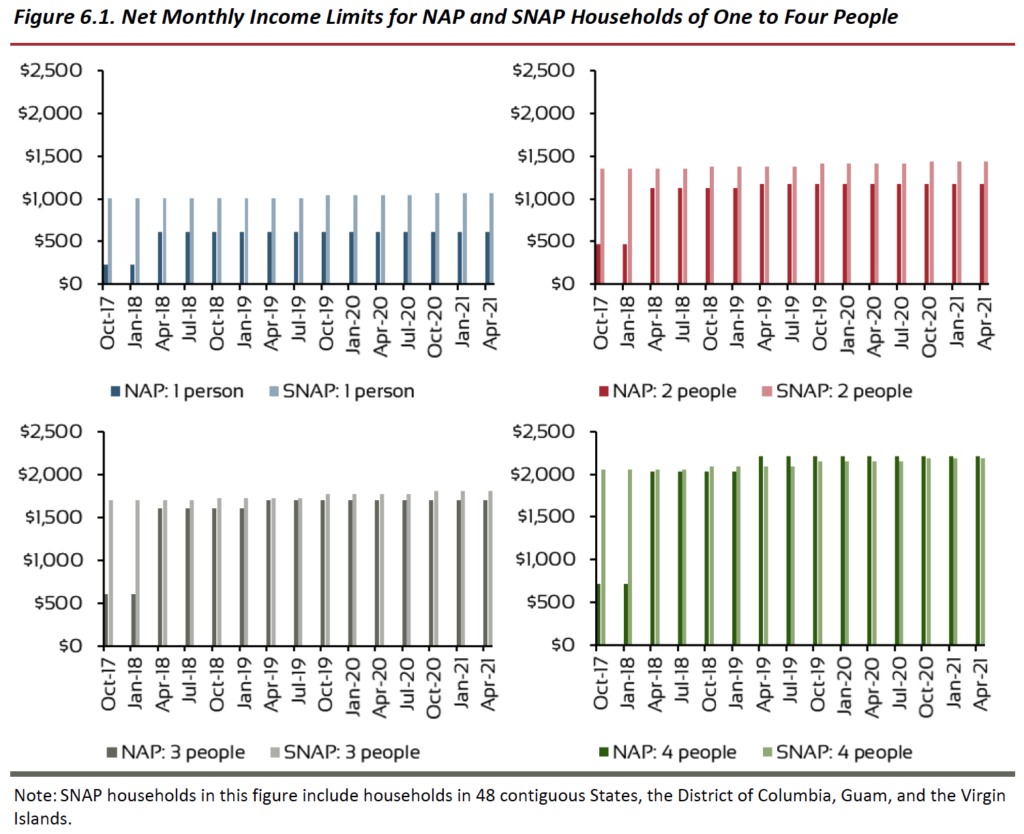
    Source: Feasibility Study, p. 37.For example, as shown in the graph above, income limits under NAP are lower than SNAP’s for households of one to three people. So, everything else being equal, this would mean that a larger amount of smaller households in Puerto Rico would qualify for benefits under SNAP than under NAP.
  • Work Requirements – Currently there are no work requirements under NAP. SNAP, however, has a general work requirement as well as a specific work requirement for Able Bodied Adults Without Dependents (“ABAWDs”). In general, “all SNAP participants aged 16–59 who do not meet Federal exemption criteria are required to register for work, participate in workfare or SNAP E&T if required by the State agency, accept a bona fide offer of employment, and not voluntarily quit or reduce hours of employment below a 30-hour work week.” In addition, “ABAWDs are required to work or participate in a work program 80 hours per month unless they receive discretionary exemptions or live in an area where the time limit is waived. ABAWDs who do not meet the ABAWD work requirement face a time limit on their benefit receipt of 3 months in a 36-month period.” (Feasibility Study, p. 31) The government of Puerto Rico would be required to implement these work requirements under SNAP. In most cases failure to comply with work requirements results in losing eligibility for SNAP. While a full discussion of work requirements is beyond the scope of this newsletter we note that (1) their application in the U.S. has been controversial; (2) their impact on labor force participation has been weak or negligible in many states; and (3) their implementation would require a significant investment on the part of the government of Puerto Rico in IT, data management, and additional human resources to adequately implement and enforce these requirements.
  • Several Groups May Lose Eligibility or Receive Lower Benefits – Among these groups, the Feasibility Study highlights the following:
    • Older adults or adults with disabilities who are allowed to form their own “household” for NAP purposes, even if they live and purchase and prepare food with others; in most cases, this would not be allowed under SNAP;
    • Older adults participating in NAP currently receive an extra 20% of the maximum benefit for a one-person household, the payment of this additional amount, which is used mostly to compensate for the inapplicability of SSI to residents of Puerto Rico, would not be allowed under SNAP;
    • Postsecondary students in Puerto Rico qualify for NAP benefits; under SNAP those enrolled half-time or more would be eligible to receive nutrition benefits only if they meet certain restrictive criteria;
    • Households with modest assets may be ineligible for SNAP because asset limits under SNAP are considerably lower than under NAP; and
    • NAP allows income deductions for older adults, people with disabilities, postsecondary students, farmers and farmworkers, and veterans that have no equivalent in SNAP; these groups may have a higher net income under the SNAP methodology and could therefore see their benefit levels or eligibility adversely affected.

    In sum, the authors of the Feasibility Study conclude that “further research is needed to determine which NAP participants would be most likely to lose nutrition assistance benefits.”

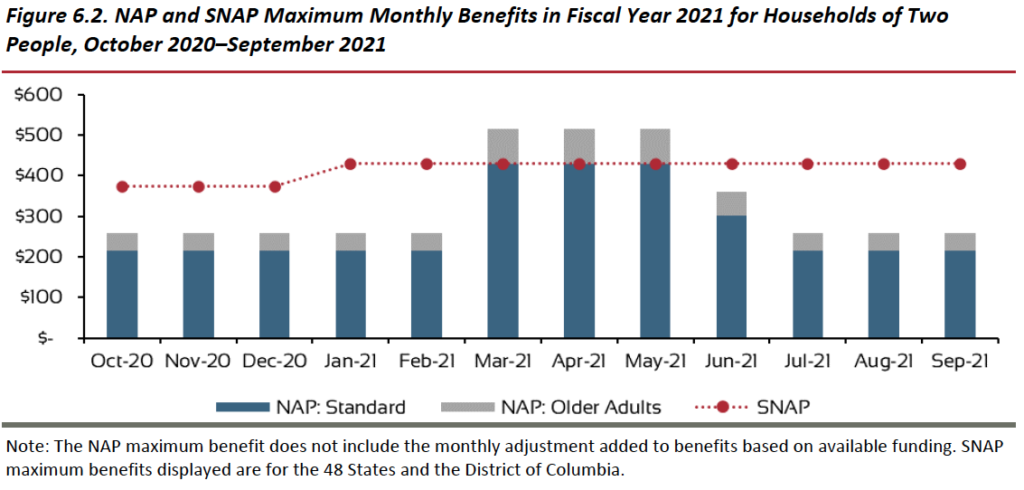
  • Benefit Calculation – Maximum benefits under SNAP are based on the Thrifty Food Plan, while NAP maximum benefits are based on available funding and program participation. According to the Feasibility Study, “in 2021, in the absence of relief funding, the SNAP maximum benefit was 1.8–2.1 times higher than the NAP maximum benefit.” (Feasibility Study, p. 38) See chart below.
    Source: Feasibility Study, p. 39.
  • Estimated SNAP Participation in Puerto Rico – The authors of the Feasibility Study estimated SNAP participation in Puerto Rico using 2019 Puerto Rico Community Survey data in a microsimulation model applying both the standard federal SNAP rules and the BBCE rules. They found that under the standard SNAP rules the number of participating households would increase from an average of 723,435 under NAP to 838,418, an increase of 114,983 households, or 15.9%; the number of participating individuals would increase from an average of 1,330,902 to 1,449,360, an increase of 118,458 persons, or 8.9%; and the percentage of the total population in Puerto Rico covered by nutritional assistance would increase from 41.7% to 45.4%. Applying the BBCE rules they found that the number of participating households would increase from an average of 723,435 under NAP to 860,866, an increase of 137,431 households, or 19%; the number of participating individuals would increase from an average of 1,330,902 to 1,488,620, an increase of 157,718 persons, or 11.9%; and the percentage of the total population in Puerto Rico covered by nutritional assistance would increase from 41.7% to 46.6%.

Conclusion

So, what is the bottom line? As with many things in life, it’s complicated. In fact, the transition from NAP to SNAP could be a case study in the difficult trade-offs between costs and benefits, flexibility and standardization of program eligibility criteria, and discretionary and mandatory program administration rules and regulations, which policymakers face on a daily basis.

On the positive side of the ledger, we find: (1) funding for nutritional assistance would increase significantly under SNAP, from approximately $2.6 billion in FY2023 to $4.5 billion in FY2031; (2) the number of beneficiaries would increase between 9 and 12 percent (depending on the final set of rules adopted); (3) the maximum amount of benefits would increase, in some cases they may actually be double the amount currently available under NAP; and (4) the increased spending in nutrition expenditures would have a positive income multiplier effect on the local economy in both the food retail and the local agricultural sectors as well as a positive impact on overall employment.

On the other side of the ledger we need to take into account the following: (1) implementation costs could exceed $400 million dollars over a ten-year period, at a time when the Fiscal Oversight and Management Board has been implementing budget cuts across the government; (2) administering SNAP after rollout would cost an estimated $249 million to $414 million, on an annual basis (but FNS would cover approximately 54% of these costs); (3) some groups could lose eligibility for nutritional assistance or qualify only for lower benefits; and (4) the government of Puerto Rico would have to gear up for the implementation of several components of SNAP which currently don’t operate in Puerto Rico, such as the SNAP Employment and Training program (“SNAP E&T”); the SNAP Nutritional Education program (“SNAP-Ed”); and Disaster SNAP.

What about work requirements, are they a benefit or a cost? In a narrow monetary sense work requirements impose new programmatic costs as the government has to set up new employment and training programs as well as systems for monitoring compliance. In a broader sense, though, many advocates of work requirements argue that they produce a net social benefit as people who were otherwise unemployed become “useful” members of society. In practice, however, many nutritional assistance beneficiaries end up in lousy, dead-end jobs from which they cannot escape without losing benefits. This is what some scholars have called the “employment trap.”

The debate regarding the imposition of work requirements for recipients of public assistance is as old as the Bible itself (“Whoever will not work should not be allowed to eat”, 2 Thessalonians 3:10). And recurs throughout Western history, for example, in Thomas More’s Utopia (1516), the Elizabethan Poor Laws of 1601, and the first social insurance schemes in Bismarck’s Germany, all the way through the 1996 welfare reform in the U.S., and current debates regarding the federal Child Tax Credit.

While this newsletter is not the venue to fully address this debate, we do note that work requirements appear to be more effective in theory than in practice for several reasons. First, as we have mentioned, many people subject to these requirements end up in low-skill, low-wage jobs that provide little opportunity for advancement or for acquiring valuable skills. Second, studies of work requirements find that their economic impact has been meager at best, and statistically insignificant at worse. Third, some political philosophers argue that these kinds of requirements are an affront to and a violation of human dignity. In the end, we respectfully disagree with the authoritative St. Paul and prefer the gentler commands of the Man from Galilee, who advocated for feeding the hungry, giving water to the thirsty, and welcoming strangers. (Matthew 25:35)

Regardless of where the government stands in the debate over work requirements, it appears that the benefits of implementing SNAP in Puerto Rico outweigh the costs, provided that adequate measures are taken to try to protect, or reduce the impact on, those who may be negatively affected by the transition from NAP to SNAP. In a transition such as the one proposed, there will always be winners and losers, but we must try to minimize the negative consequences that particular groups would face.

However, there is another argument in favor of extending SNAP to Puerto Rico, beyond a purely utilitarian cost-benefit analysis. Ending Congressional discrimination against the residents of Puerto Rico in the application of nutritional assistance programs is a good in and of itself. There is just no rational basis for Congress’s arbitrary and capricious decision to exclude or limit the application of social safety net programs in the U.S. territories.

While some may have justified such treatment in the past using outdated racial and ethnic stereotypes such thinking should have no purchase in the 21st century.

People born in Puerto Rico are U.S. citizens by birth. That should be enough to warrant equal treatment.