Comments to the U.S. Census Bureau on the Proposed Rule for the 2030 Census

Comments to the U.S. Census Bureau on the Proposed Rule for the 2030 Census

Published on October 23, 2026

Sergio portrait
Policy Director
DOWNLOAD
SHARE

U.S. Census Bureau
U.S. Department of Commerce
4600 Silver Hill Road
Designation: ADDEMO/FRN
Washington, DC 20746

Submitted electronically via the Federal eRulemaking Portal (www.regulations.gov)

Re: Comments of the Center for a New Economy on the Proposed Rule, “Decennial Census of the Population of Americans; Proposed Residence Criteria and Proposed Regulations for Demographic Questions,” 91 Fed. Reg. 57,524 (Sept. 10, 2026); Docket No. USBC-2026-0628; RIN 0607-AA75

To the Census Bureau:

The Center for a New Economy (“CNE”) respectfully submits these comments on the proposed rule that would add 15 C.F.R. Parts 60 and 70 to govern the decennial census (the “Proposed Rule”).[1] CNE is a not-for-profit, nonpartisan think tank based in San Juan, Puerto Rico. Our research on Puerto Rico’s public finances, health care financing, energy, and federal–territorial affairs relies on decennial census counts and on the statistical products built on them, including the Puerto Rico Community Survey (“PRCS”) and the Census Bureau’s annual population estimates.

CNE opposes the Proposed Rule as drafted. The more than three million residents of Puerto Rico are enumerated in every decennial census under the same statutory authority the Proposed Rule invokes, yet the Proposed Rule does not mention Puerto Rico once, and the accompanying Preliminary Regulatory Impact Analysis (“PRIA”) mentions it only in passing.[2] That omission is not a mere technicality. It leaves the public unable to determine which rules will govern the 2030 Census of Puerto Rico, and the Bureau has given no indication that it considered how its two central innovations—(1) a day-count residence standard “evidenced by” tax records, which the preamble indicates the Bureau would obtain from the IRS, and (2) a prohibition on race and ethnicity questions—would operate in a jurisdiction where most residents owe no federal income tax on Puerto Rico–source income and many file no federal return, where a large share of addresses cannot be reliably matched to a dwelling, where tens of thousands of people move between the island and the States each year and many more move back and forth within the year, and where the decennial census is the only full-count source of demographic data. The count that results will set, for the next decade, the population base for Puerto Rico’s legislative districts, the PRCS, federal formula funding, and the island’s certified fiscal plan.

These comments address three specific defects of the Proposed Rule:

  1. The Proposed Rule does not state whether or how Parts 60 and 70 apply to Puerto Rico.
  2. The residence standard in proposed § 60.2, a day count “evidenced by” tax records, is structurally mismatched to Puerto Rico’s tax system, address frame, and migration patterns.
  3. Proposed Part 70 would eliminate Puerto Rico’s only full-count race and ethnicity benchmark, and could thin its small-area tables, without any analysis of the impact on Puerto Rico.

These comments are limited to the Proposed Rule’s effects on Puerto Rico. CNE’s silence on other aspects of the Proposed Rule should not be construed or interpreted as agreement with them.

1. The Proposed Rule Does Not State Whether or How It Governs the Census of Puerto Rico

Congress has directed that each census authorized under chapter 5 of Title 13 of the U.S. Code shall include the Commonwealth of Puerto Rico.[3] Puerto Rico has been included in every decennial census since 1910.[4] The Proposed Rule rests on 13 U.S.C. § 141, which is part of that same chapter.[5]

The Proposed Rule’s justification, however, is framed almost entirely around apportionment among the States. The preamble describes apportionment as the “sole Constitutional purpose” of the decennial census;[6] proposed § 60.1 defines the residence criteria as those needed to count each individual “for purposes of apportionment”;[7] and proposed § 70.1 justifies the question restrictions by reference to “congressional apportionment.”[8] None of these rationales reaches Puerto Rico, which has no apportioned seats.

The operative text, by contrast, is broader than its rationale. The summary describes residence criteria that determine where to count people “throughout the United States,” and proposed § 70.2(a) extends the question ban to “any questionnaire used for the enumeration of the population.”[9] One purpose the rule itself names also cuts against the apportionment framing. Proposed § 70.3(a) directs the Bureau to prioritize the accuracy of the count “for purposes of apportionment and (re)districting,”[10] and Puerto Rico’s Constitution requires that its legislative districts be revised after each decennial census.[11] The rule thus recognizes at least one use of the count that applies fully in Puerto Rico, yet says nothing about whether or how it would apply to Puerto Rico.

The Proposed Rule also abandons the definitional clarity of the criteria it would replace. The 2020 residence criteria defined “stateside” as the 50 States and the District of Columbia, expressly classified Puerto Rico as “outside the United States” solely for purposes of those criteria, and noted that redistricting data include Puerto Rico’s resident population.[12] The Proposed Rule retains the term “stateside census” in proposed § 60.5(a), but defines neither “stateside” nor “United States” and offers no explanation for dropping the prior definitions.[13]

At least three readings of the Proposed Rule are therefore available: (i) Parts 60 and 70 govern the Puerto Rico enumeration in full; (ii) neither part applies, and the enumeration will be governed by criteria that have not been published; or (iii) Part 70 applies through its “any questionnaire” language while Part 60, limited by its apportionment purpose, does not. The preamble’s regulatory analyses do not resolve the question; they address small governmental entities, States, and tribes, but not territories.[14] Under any of these readings, the Proposed Rule would affect how Puerto Ricans are counted: at a minimum, Part 60’s day count would decide whether residents who divide their time between the island and the States are counted in a State or in Puerto Rico (Part II.C).

The only indications of the Bureau’s intent appear outside the rule, in the PRIA, which observes that “the decennial census includes all 50 states, Puerto Rico, the District of Columbia, and the U.S. Island Areas” and states in a footnote that the Bureau conducts the census in Puerto Rico “operationally the same as the stateside decennial census.”[15] The same footnote describes Puerto Rico as “an Island Area under 13 U.S.C. § 191,” a characterization the statute does not support. Section 191 does not use the term, and it treats Puerto Rico differently from the Virgin Islands, Guam, and the Northern Mariana Islands by omitting it from subsection (b), which allows the Secretary to rely on census information collected by those territories’ governors.[16] The PRIA’s very next footnote lists the Island Areas without listing Puerto Rico.[17] If the Bureau intends Parts 60 and 70 to govern the Puerto Rico enumeration, then the rule itself must state so clearly.

CNE therefore respectfully requests that the Bureau:

  1. State expressly whether, and to what extent, Parts 60 and 70 govern the 2030 Census of Puerto Rico.
  2. If the Bureau intends either part to apply, publish a supplemental notice that addresses the Puerto Rico–specific issues set out in Parts II and III of these comments and invite comment on them.
  3. If neither part is intended to apply, publish for notice and comment the residence criteria and questionnaire content that will govern the Puerto Rico enumeration, with definitions of “stateside” and “United States” at least as clear as those in the 2020 criteria.

2. The Residence Standard in Proposed § 60.2 Is Structurally Mismatched to Puerto Rico

To the extent Part 60 governs the census of Puerto Rico, as the PRIA’s description of the Puerto Rico enumeration suggests, its proposed residence standard would fail there for the reasons that follow. Proposed § 60.2(a) provides that a person’s usual residence “should be consistent with, and evidenced by, their tax records (e.g., tax returns, W-2 forms).” The Bureau states that the weight it assigns to tax and other administrative records will be “situation dependent,” taking into account each data element’s “purpose, timing, and reliability.”[18] Puerto Rico is a situation in which that standard has unusually little to work with, for two independent reasons, and the day-count test to which that standard is attached raises a third problem, discussed in Part II.C.

A. Residents’ Puerto Rico–source income is, by design, outside the federal income tax, and many residents file no federal return.

Under section 933 of the Internal Revenue Code, income from Puerto Rico sources is excluded from the federal gross income of bona fide residents of Puerto Rico.[19] Such residents generally must file a federal income tax return only if their income subject to U.S. tax (income from sources outside Puerto Rico or wages as a federal government employee working in Puerto Rico) exceeds the applicable filing threshold, or if they wish to claim certain federal tax credits. Residents report their Puerto Rico–source income instead to the Puerto Rico Department of the Treasury (“Hacienda”).[20]

Some island residents do file federal returns, but federal filing turns on income source and credit eligibility, not on where a person lives. For a resident whose income is entirely from Puerto Rico sources, the absence of a federal return is the expected result and says nothing about their residence. Since tax year 2021, moreover, families with children have had reason to file to claim the refundable Child Tax Credit,[21] so federal returns now cover some households, such as families with children, far better than others, such as retirees and workers without children. That makes them a biased measure of residence.

The Proposed Rule does not address this issue. The only legal channel for tax data it describes is 26 U.S.C. § 6103(j)(1), which governs federal returns and return information.[22] Its list of the records available to the Bureau includes “certain state, local, and tribal records,” but is silent as to territorial records.[23] Although Title 13 permits the Secretary to acquire records from other units of government,[24] the Proposed Rule does not say whether the Bureau holds or intends to seek Hacienda data, under what agreement, or with what coverage.

The principal wage record that crosses the federal–territorial line is Form 499R-2/W-2PR, which employers in Puerto Rico file with Hacienda and transmit to the Social Security Administration.[25] The Proposed Rule’s reference to “W-2 forms” does not state whether Form 499R-2/W-2PR qualifies. Even if it does, it covers only wage employment. It says nothing about residents without wage income during the enumeration period, such as retirees and dependents, or about workers in the informal economy. One econometric study estimated that sector at about 36 percent of Puerto Rico’s GDP in 2014, and a recent field survey of low-income communities found more employment than official statistics report.[26]

Notably, the Bureau’s own assessment of the 2010 Census of Puerto Rico recommended that the Bureau “[r]esearch the coverage of administrative records” for the Puerto Rico enumeration.[27] Neither the Proposed Rule nor the PRIA cites or summarizes any such research. The PRIA analyzes the residence criteria principally in terms of which foreign citizens would be excluded from apportionment; it does not discuss the tax-record standard, the coverage of the records on which that standard depends, or the standard’s effect on where residents are counted.[28]

B. Puerto Rico’s address system thwarts reliable matching of records to dwellings.

A records-based residence standard is only as reliable as the link between a record’s address and a housing unit. In Puerto Rico that link is weak, and the Bureau has documented the reasons for that weakness. According to the Bureau’s 2010 assessment, 36 percent of the Puerto Rico Master Address File (“MAF”) units had non-city-style addresses at the start of 2010 Census operations, and 25 percent still did at the end.[29] Even in the San Juan-Caguas-Guaynabo metropolitan area, only about 77 percent of addresses were classified as city-style.[30] By comparison, a 2013 Bureau study of administrative-record matching found that non-city-style addresses made up about 3 percent of the roughly 225 million MAF addresses eligible for matching nationwide.[31] The Bureau has also described the features that weaken matching on the island: rural-route addresses, several houses on a single family lot sharing one address, and cluster-box addresses whose numbers and street names do not identify the location of the associated housing units.[32]

These features matter because administrative-record matching works almost exclusively on city-style addresses. In the Bureau study just cited, which matched the Bureau’s Statistical Administrative Records System to the MAF, 99 percent of the matched records had an address sourced from the IRS. Of roughly 119 million unit-level matches, only about 3,100 involved non-city-style addresses.[33] The Bureau’s current address guidelines for Puerto Rico state that it does not attempt to match or add to the MAF any record containing only non-city-style address information.[34] And the Bureau acknowledges that variant forms of the same Puerto Rico address can generate duplicate MAF records.[35] Variant forms can arise even for city-style addresses, because a complete Puerto Rico address often includes the name of an urbanization, which the Postal Service treats as “an important part of the address,” but which administrative records may omit or record inconsistently.[36]

The 2030 Local Update of Census Addresses (LUCA) operation, in which eligible governments, including Puerto Rico’s municipios as county equivalents, may review the address list and suggest additions and corrections between October 2027 and March 2028, is the principal opportunity for local governments to close these gaps before the count. The Bureau’s published description of that operation refers to “descriptive information about the location where people live” and to geographic coordinates, but it does not address Puerto Rico or non-city-style addresses.[37]

The 2020 Census bears out the risk. Following Hurricane María, the Bureau enumerated all of Puerto Rico through its Update Leave operation.[38] The Post-Enumeration Survey then estimated a net overcount of 5.7 percent, or about 174,000 people, and erroneous enumerations of 9.8 percent, or about 319,000. Those erroneous enumerations included an estimated 9.1 percent, or about 294,000, duplicate records, and a Bureau official explained that the duplicates went undetected in part because “[w]e didn’t have the same quality of administrative records in Puerto Rico to conduct that unduplication effort.”[39] The net figure masks errors in both directions: the survey also estimated that the census omitted about 217,000 residents entirely, 7.1 percent of the population the survey estimated. The 2020 net overcount was not statistically different from the 4.5 percent overcount measured in 2010, so the problem predates Hurricane María.[40]

Puerto Rico’s coverage problem, in other words, was not the number of people counted but records that could not be reconciled with one another or with dwellings: real residents were missed while others were counted twice, and the administrative records needed to reconcile them were weaker on the island than in the States. A tax-record standard keyed to mailing addresses would not cure that problem. It is more likely to compound it, either by leaving out residents whose records cannot be matched without corroborating evidence of residence, or by placing them at a mailing address in a different block, barrio, or municipio. CNE is not aware of any Bureau analysis of how the tax-record standard would perform in Puerto Rico. The available evidence, including the Bureau’s own coverage and address data, indicates that it would increase both omissions and misplacements.

C. The day-count test does not account for residents who divide their time between Puerto Rico and the States.

The tax-record standard is attached to a new residence test. Under proposed § 60.2, a person’s usual residence is the residence at which the person has “lawfully spent the greatest number of days” during a “census enumeration period” running from January 3 to April 1, and a person spends a day at a residence by being “physically and lawfully present there” for at least one hour.[41] The 2020 criteria, by contrast, counted people at “the place where a person lives and sleeps most of the time.”[42] The preamble ties the January 3 start date to the congressional term under the Twentieth Amendment, a rationale grounded in congressional representation, and states that the Bureau “intends to consider tax records filed after April 1 insofar as they are probative” of residence during the period.[43] Beyond stating that “[a] person may spend a certain day at more than one residence,” the Proposed Rule does not address people who divide their time between residences or who move during the period. Unlike the 2020 criteria, which counted people who could not identify where they live most of the time “where they are staying on Census Day,” it provides no fallback rule for ties, and it does not say what records would establish how many days a person spent at a given address.[44]

That gap is particularly important in Puerto Rico. Migration between the island and the States is large and runs in both directions. In 2024, an estimated 38,000 people moved from Puerto Rico to the States and about 24,000 moved from the States to Puerto Rico, and since 2005 about 68 percent of those moving to the island have been return migrants born there.[45] Those annual estimates capture only changes of residence. They do not capture residents who move back and forth during the year, a pattern of circular migration that researchers have long documented.[46] For each such resident, the proposed test would turn on where the person spent more days between January 3 and April 1.

If Part 60 governs the census of Puerto Rico, then that determination would decide where on the island a person is counted. It would also decide whether the person is counted in a State, and therefore in the apportionment base, or in Puerto Rico. The 2020 criteria drew that line expressly, treating Puerto Rico as “outside the United States.”[47] The Proposed Rule keeps the “stateside census” language of § 60.5(a), which turns on where a person was “living outside the United States on Census Day,” but drops the definition, and it does not say whether a person is “living” outside the United States on Census Day by reference to § 60.2’s count of days or by some other measure.[48] The records on which the Proposed Rule would rely are of little use in making these determinations on the island: federal returns record addresses and income sources rather than days present, the Proposed Rule describes no access to Hacienda returns (Part II.A), and many island addresses cannot be reliably tied to a dwelling (Part II.B). And because dependents without a consistent separate residence would be counted at whichever of their providers’ usual residences they spent the most days, the same uncertainty would extend to children.[49]

D. Errors in the base count would propagate through Puerto Rico’s statistics, funding, and representation.

Errors in the decennial base do not remain isolated in the decennial file. PRCS weights are controlled to the Bureau’s official population estimates,[50] which are carried forward from the decennial base. In Puerto Rico, where migration flows are large (Part II.C), errors in that base compound over the decade, and the PRIA itself acknowledges that without new decennial data to recalibrate those estimates, ACS weights and estimates become less reliable.[51] Puerto Rico’s official labor statistics rest on the same base. Puerto Rico is outside the Current Population Survey,[52] which is designed to represent each State and the District of Columbia; its labor force estimates come instead from the Encuesta de Grupo Trabajador, a household survey whose results are controlled each year to population estimates by age and sex that the Puerto Rico Institute of Statistics prepares from the 2020 Census.[53]

In fiscal year 2021, 353 federal assistance listings used Decennial Census Programs data, in whole or in part, to distribute more than $2.8 trillion.[54] In Puerto Rico, those data also determine which areas qualify for Community Development Block Grant area-benefit activities, through low- and moderate-income summary data that HUD derives from five-year ACS estimates, which for Puerto Rico are PRCS estimates.[55] Tract-level income and poverty estimates from the PRCS also determine eligibility for place-based incentives, including the New Markets Tax Credit, HUBZone designations (for which a special Puerto Rico rule expires in December 2027), and, beginning in 2027, qualified opportunity zones. The statutory rule that deemed every low-income census tract in Puerto Rico an opportunity zone is repealed effective December 31, 2026, so Puerto Rico tracts will no longer be designated automatically; they must qualify on PRCS income and poverty estimates and be nominated, as tracts in the States are.[56] The certified fiscal plan of the Financial Oversight and Management Board for Puerto Rico also builds its population projections on census results, and the projected rate of population change drives its forecasts of several revenue streams, including excise revenues from alcoholic beverages, tobacco, and petroleum.[57]

The Constitution of Puerto Rico requires that the island’s senatorial and representative districts be reviewed after each decennial census, a review conducted with Census Bureau population figures.[58] Because the constitutional board that redraws the island’s 8 senatorial and 40 representative districts assigns territory down to the barrio level, households omitted or placed at the wrong address under Part 60 would distort the districts drawn from the 2030 Census, which would govern elections beginning in 2032.[59] The Proposed Rule’s statement that any effect on governmental entities would be “indirect”[60] does not account for any of these channels as they operate in Puerto Rico.

CNE therefore respectfully requests that the Bureau:

  1. Provide that, in Puerto Rico, the absence of a federal income tax return shall not be treated as evidence against residence.
  2. Confirm that Form 499R-2/W-2PR is a “W-2 form” acceptable for purposes of proposed § 60.2(a).
  3. State whether it will use Hacienda or other territorial records and, if so, under what authority and agreement and with what safeguards.
  4. Before relying on any administrative source in Puerto Rico, publish that source’s coverage and address-match rates for the island, together with the current share of Puerto Rico MAF units with non-city-style addresses.
  5. Retain self-response and field enumeration as the primary evidence of residence wherever records cannot be matched to a dwelling.
  6. Conduct a Post-Enumeration Survey for Puerto Rico in 2030 and report omissions, erroneous enumerations, and duplicates separately, as it did for 2020.
  7. Because proposed § 60.2(a) would make address-matched records evidence of residence, confirm that, in the 2030 LUCA operation, submissions from Puerto Rico that identify housing units by physical description or geographic coordinates will be used to add and locate units, notwithstanding the statement in the Bureau’s Minimum Address Data Submission Guidelines for Puerto Rico that it does not match or add records containing only non-city-style address information.
  8. (i) Explain how the day count in proposed § 60.2 would determine whether a person who divides time between Puerto Rico and the States is counted in what proposed § 60.5(a) calls the “stateside census” or in the census of Puerto Rico, including whether a person whose day count favors a Puerto Rico residence is “living outside the United States on Census Day,” given that Part 60 does not define “United States”; (ii) identify the records that would establish days present; and, absent that explanation, (iii) apply a single rule on both sides of that line: the 2020 standard of “the place where a person lives and sleeps most of the time,” with the 2020 fallback to where the person is staying on Census Day.

3. Proposed Part 70 Would Eliminate Puerto Rico’s Only Full-Count Demographic Benchmark Without Considering Puerto Rico

A. Part 70 would change Puerto Rico’s questionnaire without consulting Puerto Rico or weighing the reliance interests built on it.

By its terms, proposed § 70.2(a) bars race and ethnicity questions on “any questionnaire used for the enumeration of the population,” language broad enough to reach Puerto Rico’s questionnaire (see Part I). Before 2000, Puerto Rico’s questionnaire was developed with the Puerto Rico Planning Board, the Government of Puerto Rico’s liaison under a 1958 Memorandum of Agreement with the Bureau; the race question had been dropped from it in 1960, and it did not include the Hispanic-origin question asked in the States. For Census 2000, the Government of Puerto Rico asked the Bureau to use the same questionnaire content as in the States, and since then Puerto Rico’s questionnaire, data processing, and data products have tracked those of the States.[61]

Part 70 would take away by regulation the race and Hispanic-origin content that Puerto Rico requested, without mentioning that history and without indicating whether the Government of Puerto Rico was consulted. That the prohibition would also apply in the States does not settle the point. Whatever its reasons, Puerto Rico’s request gave the island the same race and Hispanic-origin data the States receive, now spanning three decennial censuses and two decades of PRCS estimates. Losing those data would also cost Puerto Rico more than the States: the island has few other sources of race data, and the surname-based method used elsewhere to estimate race cannot distinguish Puerto Rico’s residents by race (Part III.B). An agency that changes course must show awareness that it is doing so and take serious reliance interests into account.[62] The Proposed Rule and the PRIA do neither as to Puerto Rico.

B. The 2020 results make a comparable 2030 count indispensable.

Puerto Rico’s race data changed sharply between 2010 and 2020. The share of residents identifying as White alone fell from 75.8 percent to 17.1 percent, and nearly half of the population identified with two or more races.[63] The Bureau has attributed the nationwide 2010–2020 shifts largely to improvements in question design, data processing, and coding, and has said that comparisons between 2020 and 2010 race data “should be made with caution.”[64] Others have attributed part of Puerto Rico’s shift to changing self-identification, including campaigns urging residents to embrace their African heritage.[65] Which explanation holds for Puerto Rico is an open empirical question. A 2030 full count under comparable methods is the only full-count way to answer it. Part 70 would leave Puerto Rico with a single, methodologically discontinuous full-count observation and no full-count means of resolving it. As one scholar of race in Puerto Rico, Yarimar Bonilla, has asked: “Will we see an intensification of this pattern, or will 2020 have been kind of a blip moment?”[66] The answer matters beyond social science research.

Apart from the decennial census and the PRCS sample, Puerto Rico has few sources of race data; the government does not collect racial data on populations such as people who are homeless or incarcerated, and during the COVID-19 pandemic there was, as the Associated Press reported, “no racial data on coronavirus testing, hospitalizations or fatalities” on the island.[67] A comparable decennial count is the only full-count benchmark for the size and distribution of Puerto Rico’s population by race. Section 70.2 would also eliminate the Hispanic-origin question, including its “Puerto Rican” response. Although nearly all residents identify as Hispanic, that question is the only full-count source on the composition of the island’s Hispanic population, including the size of its Dominican and other communities, at the municipio and tract level. It is also the only full-count source identifying people of Puerto Rican origin in the States.[68]

The PRCS cannot fill that role. Proposed § 70.4 preserves race and ethnicity questions on the American Community Survey and similar surveys, but the PRCS samples approximately 36,000 addresses a year, and its person weights are controlled to population estimates by total population, age, and sex, not by race or ethnicity.[69] Its race and ethnicity estimates for municipios, barrios, and tracts would therefore be sample estimates with no full-count benchmark against which to evaluate them.

The PRIA concedes this point. It acknowledges that decennial population totals for race and ethnicity groups are more reliable than ACS estimates, that ACS one-year estimates are available only for areas of at least 65,000 people, and that dropping race and ethnicity from the 2030 questionnaire would force estimates onto outdated or less accurate data because there are “no other comparably accurate, comprehensive, and reliable sources of this information.”[70] Only 11 of Puerto Rico’s 78 municipios had 65,000 or more residents in the 2020 Census.[71] Yet the PRIA’s distributional analysis names only the Island Areas, where the ACS is not conducted on an ongoing basis,[72] and it proposes consultation only with tribes, on the ground that the ACS cannot produce accurate estimates for small tribal populations.[73] The PRIA offers no reason why the reasoning that leads the Bureau to consult tribes does not also lead it to consult the Government of Puerto Rico.

The PRIA also identifies, but does not assess, a further category of cost. It acknowledges that the intercensal race and ethnicity estimates built on decennial counts serve as “population controls for major federal surveys” and as “denominators for crucial social and economic indicators,” and that without decennial race and ethnicity data those estimates would rest on “outdated and/or less accurate data.”[74]

The same benchmarks are also used to test statistical models and automated decision systems, including those built with artificial intelligence, for bias. Testing whether a system treats a group fairly requires knowing who belongs to the group; where records do not say, analysts infer it from census distributions of race and ethnicity by surname and geography. As the National Institute of Standards and Technology has observed, “[d]emographic group membership, necessary for bias testing purposes, is often inferred using the Bayesian improved surname geocoding (BISG) process.”[75] The Centers for Medicare & Medicaid Services developed and distributes a version of that method for comparing the health care received by Medicare beneficiaries of different racial and ethnic groups, and fair-lending regulators have used it because lenders generally may not ask applicants for non-mortgage credit their race or ethnicity.[76] Weaker census benchmarks mean a weaker ability to detect discriminatory outcomes. The Bureau “seeks public comment on . . . the various ways in which Census data is utilized across the country,”[77] yet the PRIA does not address these uses.

The gap is widest in Puerto Rico. The Consumer Financial Protection Bureau’s published version of that method covers only “the contiguous U.S., Alaska, and Hawaii,”[78] and it treats Hispanic origin as a category separate from race.[79] Because nearly all of Puerto Rico’s residents identify as Hispanic,[80] the method cannot distinguish them by race or color. Testing for disparities by race and color on the island therefore relies more heavily on direct population benchmarks, and for municipios, barrios, and tracts the decennial census is the only full-count source of them. Part 70 would remove that benchmark where it is least replaceable.

C. Proposed § 70.3(b) threatens small-area tables and does not say how it applies to Puerto Rico.

Proposed § 70.3(b) provides that the Bureau “shall not disclose or publish any individual demographic data if such disclosure or publication necessitates introducing uncertainty into the population count data, at either the national or the state level.”[81] The Proposed Rule does not define “individual demographic data.” The preamble acknowledges that in 2020 the Bureau introduced uncertainty into population counts below the state level, and it cites a Department order prohibiting noise infusion.[82] Because the 2020 masking was applied to published tables, the provision appears aimed at those tables, not only at records about individuals. If counts cannot be perturbed, then confidentiality must be protected by other means, most plausibly by suppressing or coarsening demographic tables. That burden would fall hardest on small geographies, including the municipio, barrio, tract, and block tables used by planners, municipal governments, and disaster-recovery programs in Puerto Rico. The Bureau treated Puerto Rico as a state equivalent for 2010 Census data products,[83] but proposed § 70.3(b) does not say whether Puerto Rico is “the state level” for this purpose.

D. The PRIA’s own cost-benefit framework weighs against applying Part 70 in Puerto Rico.

The PRIA’s own framework also weighs against applying Part 70 in Puerto Rico. It identifies two core benefits: a more accurate count for apportionment, which has no application in Puerto Rico, and reduced disclosure risk, which it does not evaluate for Puerto Rico.[84] The costs it describes, by contrast, would fall on Puerto Rico in full. The PRIA’s remaining benefit, reduced respondent burden, is modest (it removes the race and Hispanic-origin items from the short form) and cannot offset the loss of the only full-count race and ethnicity data for Puerto Rico. The only alternative the PRIA considers is no action.[85] It does not consider applying Part 70 differently in Puerto Rico, although OMB Circular A-4, on which the PRIA relies, directs agencies to consider different requirements for different geographic regions where benefits and costs vary significantly by region.[86]

CNE therefore respectfully requests that the Bureau:

  1. Exclude the Puerto Rico enumeration from proposed § 70.2(a) and retain the race and Hispanic-origin questions on Puerto Rico’s questionnaire; in any event, consult the Government of Puerto Rico, including the Puerto Rico Planning Board and the Puerto Rico Institute of Statistics, before applying any part of Part 70 to Puerto Rico.
  2. State whether Puerto Rico is “the state level” under proposed § 70.3(b), and publish the disclosure avoidance approach it would apply to Puerto Rico’s small-area tables.
  3. Explain how comparable municipio-, tract-, and block-level race and ethnicity data for Puerto Rico would be produced after 2030.
  4. Assess, in the final regulatory impact analysis, the cost of degraded race and ethnicity benchmarks for statistical models and automated decision systems, including the methods used to test those systems for bias, and the consequences for Puerto Rico.

Conclusion

The Proposed Rule would change how more than three million residents of Puerto Rico are counted, where they are placed, and what is known about them, yet it is defective in each of the three respects identified at the outset. First, it never states whether or how Parts 60 and 70 govern the census of Puerto Rico (requests (1)–(3)). Second, its proposed residence standard rests on federal tax records that many residents of Puerto Rico are not required to file; on addresses that often cannot be matched to a dwelling; and on a day count that does not account for residents who divide their time between the island and the States (requests (4)–(11)). Third, Part 70 would eliminate Puerto Rico’s only full-count race and ethnicity benchmark, and could thin its small-area tables, without any analysis of those losses and without any indication that the Government of Puerto Rico was consulted (requests (12)–(15)).

A final rule adopted on this record could govern the census of Puerto Rico without any analysis of its effects there. CNE therefore respectfully requests the Bureau to withdraw the Proposed Rule or, at a minimum, to re-propose it with an express statement of its application to Puerto Rico, an analysis of its effects there, and consultation with the Government of Puerto Rico. CNE would welcome the opportunity to provide additional information and can be reached at the contact information below.

Respectfully submitted,

/s/Sergio M. Marxuach
Policy Director and General Counsel
Center for a New Economy


Endnotes

[1] Decennial Census of the Population of Americans; Proposed Residence Criteria and Proposed Regulations for Demographic Questions, 91 Fed. Reg. 57,524 (proposed Sept. 10, 2026) (to be codified at 15 C.F.R. pts. 60, 70) [hereinafter Proposed Rule].

[2] U.S. Census Bureau, Preliminary Regulatory Impact Analysis: Decennial Census of the Population of Americans; Proposed Residence Criteria and Proposed Regulations for Demographic Questions, Docket No. 260903-0005 (Docket ID USBC-2026-0628-0002) (posted Sept. 10, 2026), https://www.regulations.gov/document/USBC-2026-0628-0002 [hereinafter PRIA].

[3] 13 U.S.C. § 191(a).

[4] U.S. Census Bureau, 2010 Census of Puerto Rico Assessment Report, 2010 Census Planning Memoranda Series No. 238, at 2 (Sept. 18, 2012) [hereinafter 2010 Puerto Rico Assessment].

[5] Proposed Rule, 91 Fed. Reg. at 57,529 (authority for proposed Part 60: 13 U.S.C. §§ 4, 141); id. at 57,530 (authority for proposed Part 70: 13 U.S.C. §§ 4, 5, 141).

[6] Id. at 57,524.

[7] Proposed 15 C.F.R. § 60.1, 91 Fed. Reg. at 57,529.

[8] Proposed 15 C.F.R. § 70.1, 91 Fed. Reg. at 57,530.

[9] Proposed Rule, 91 Fed. Reg. at 57,524 (summary); proposed 15 C.F.R. § 70.2(a), 91 Fed. Reg. at 57,530.

[10] Proposed 15 C.F.R. § 70.3(a), 91 Fed. Reg. at 57,530.

[11] P.R. Const. art. III, § 4.

[12] Final 2020 Census Residence Criteria and Residence Situations, 83 Fed. Reg. 5525, 5526 n.1, 5533 n.9 (Feb. 8, 2018).

[13] Proposed 15 C.F.R. § 60.5(a), 91 Fed. Reg. at 57,529–30.

[14] Proposed Rule, 91 Fed. Reg. at 57,528.

[15] PRIA, supra note 2, at 12, 14 & n.12.

[16] 13 U.S.C. § 191(a)–(b).

[17] PRIA, supra note 2, at 14 n.13.

[18] Proposed 15 C.F.R. § 60.2(a), 91 Fed. Reg. at 57,529; Proposed Rule, 91 Fed. Reg. at 57,528 n.7.

[19] 26 U.S.C. § 933(1).

[20] Internal Revenue Serv., Publ’n 1321, Special Instructions for Bona Fide Residents of Puerto Rico Who Must File a U.S. Individual Income Tax Return (rev. Oct. 2025).

[21] Internal Revenue Serv., More Puerto Rico Families Qualify for Child Tax Credit (May 16, 2022), https://www.irs.gov/newsroom/more-puerto-rico-families-qualify-for-child-tax-credit.

[22] Proposed Rule, 91 Fed. Reg. at 57,529 n.17.

[23] Id. at 57,526.

[24] 13 U.S.C. § 6(b).

[25] Internal Revenue Serv., Form W-3 (PR), Transmittal of Withholding Statements (2026) (directing employers to send Forms 499R-2/W-2PR to the Social Security Administration).

[26] Segundo Castro-González & Julio C. Medina León, Economic Crisis’s Influence over the Quantification of Puerto Rico’s Shadow Economy: Parsimonious Econometric Proposal, 19 J. Applied Bus. & Econ., no. 8, 2017, at 59 (estimating Puerto Rico’s shadow economy at 36.47% of GDP in 2014); José Caraballo-Cueto, Informal Labor Markets After Disasters: Evidence from Rural and Urban Low-Income Communities in Puerto Rico, 107 Soc. Sci. Q. e70148 (2026).

[27] 2010 Puerto Rico Assessment, supra note 4, at xii.

[28] PRIA, supra note 2, at 11–13.

[29] 2010 Puerto Rico Assessment, supra note 4, at xi. These figures count Master Address File units with non-city-style addresses. They do not capture city-style addresses that fail to match because of local address formats, and local estimates of structures lacking an address that federal systems can validate are higher. See, e.g., Puerto Rico Cuenta, Impacto en PR, https://prcuenta.com/impacto (last visited Oct. 21, 2026) (citing estimates by iCasaPR that 40 to 60 percent of structures lack such an address).

[30] 2010 Puerto Rico Assessment, supra note 4, at xii.

[31] Christine Gibson Tomaszewski, Updating the U.S. Census Bureau’s Master Address File via Administrative Records, in JSM Proceedings, Government Statistics Section 3638, 3640 tbl.1 (Am. Statistical Ass’n 2013).

[32] 2010 Puerto Rico Assessment, supra note 4, at 31.

[33] Tomaszewski, supra note 31, at 3641 tbl.3, 3643.

[34] U.S. Census Bureau, Minimum Address Data Submission Guidelines – Puerto Rico, https://www2.census.gov/geo/pdfs/partnerships/data_guidelines/Minimum_Address_Guidelines_PR.pdf (last visited Oct. 16, 2026).

[35] U.S. Census Bureau, Puerto Rico Community Survey: Accuracy of the Data (2024), at 23 [hereinafter PRCS Accuracy].

[36] U.S. Postal Serv., Publ’n 28, Postal Addressing Standards § 295.5, https://pe.usps.com/text/pub28/28c2_045.htm (last visited Oct. 21, 2026).

[37] U.S. Census Bureau, Local Update of Census Addresses (LUCA) Operation, https://www.census.gov/programs-surveys/decennial-census/about/luca.2030.html (last updated Aug. 12, 2026).

[38] U.S. Census Bureau, 2020 Census Plans for the Commonwealth of Puerto Rico, 2020 Census Memorandum Series No. 2018.13 (2018).

[39] Press Release, U.S. Census Bureau, Census Bureau Releases Results of Post-Enumeration Survey for Puerto Rico From 2020 Census (Aug. 16, 2022) (reporting an estimated 9.1% or 294,000 duplicate records); Nicole Acevedo, 2020 Census Overcounted People in Puerto Rico, Hinting at Larger Population Loss, NBC News (Aug. 17, 2022) (quoting Timothy Kennel, U.S. Census Bureau).

[40] U.S. Census Bureau, 2020 Census Post-Enumeration Survey in Puerto Rico slides 11–15 (Sept. 2022), https://www.census.gov/content/dam/Census/newsroom/press-kits/2022/09142022-presentation-2020-pes-pr-english.pdf (estimating 217,000 omissions, 7.1% of the survey’s population estimate); Press Release, U.S. Census Bureau, supra note 39 (reporting that the 2020 overcount was not statistically different from the 4.5% overcount in 2010); see also Fin. Oversight & Mgmt. Bd. for P.R., Second Revised 2024 Fiscal Plan for Puerto Rico 36 (certified June 19, 2026) [hereinafter Fiscal Plan] (attributing Puerto Rico’s historical overcounts to “challenges linked to Puerto Rico’s administrative records, which make de-duplication of responses more difficult than on the U.S. mainland”).

[41] Proposed 15 C.F.R. § 60.2(a)–(c), 91 Fed. Reg. at 57,529.

[42] Final 2020 Census Residence Criteria and Residence Situations, 83 Fed. Reg. at 5526.

[43] Proposed Rule, 91 Fed. Reg. at 57,526.

[44] Proposed 15 C.F.R. § 60.2(b), 91 Fed. Reg. at 57,529; Final 2020 Census Residence Criteria and Residence Situations, 83 Fed. Reg. at 5533.

[45] Inst. de Estadísticas de P.R., Perfil del Migrante 2023-2024, at 5–6, 15, 39 tbl.A1 (Apr. 29, 2026) (estimates from the American Community Survey and the Puerto Rico Community Survey).

[46] See Jorge Duany, Mobile Livelihoods: The Sociocultural Practices of Circular Migrants Between Puerto Rico and the United States, 36 Int’l Migration Rev. 355 (2002).

[47] Final 2020 Census Residence Criteria and Residence Situations, 83 Fed. Reg. at 5533 n.9.

[48] Proposed 15 C.F.R. § 60.5(a), 91 Fed. Reg. at 57,529–30.

[49] Proposed 15 C.F.R. § 60.3(a)–(b), 91 Fed. Reg. at 57,529.

[50] PRCS Accuracy, supra note 35, at 11, 15.

[51] PRIA, supra note 2, at 12–13.

[52] U.S. Bureau of Lab. Stat., Effects of Hurricanes Harvey, Irma, and Maria on BLS Data Collection and Reporting, https://www.bls.gov/bls/hurricanes-harvey-irma-maria.htm (last updated Jan. 30, 2019) (“Puerto Rico conducts its own monthly household survey, patterned after the Current Population Survey, to produce labor force information.”).

[53] U.S. Bureau of Lab. Stat., Current Population Survey, https://www.bls.gov/cex/cecomparison/cps_profile.htm (last modified Jan. 24, 2023) (describing a sample designed “to represent each state and the District of Columbia”); P.R. Dep’t of Lab. & Hum. Res., Empleo y Desempleo en Puerto Rico (Encuesta de Grupo Trabajador): Agosto 2026 (Sept. 18, 2026), https://mercadolaboral.pr.gov/lmi/pdf/Default/Grupo%20Trabajador/EMPLEO%20Y%20DESEMPLEO%20EN%20PUERTO%20RICO.pdf.

[54] Ceci Villa Ross, U.S. Census Bureau, Uses of Decennial Census Programs Data in Federal Funds Distribution: Fiscal Year 2021 (Working Paper, June 2023).

[55] U.S. Dep’t of Hous. & Urb. Dev., Notice CPD-24-04, Low- and Moderate-Income Summary Data Updates (June 6, 2024) (describing summary data based on 2016–2020 ACS five-year estimates, except for American Samoa, Guam, the Northern Mariana Islands, and the U.S. Virgin Islands, which use the 2020 Island Areas Census); U.S. Census Bureau, Puerto Rico Community Survey, https://www.census.gov/programs-surveys/acs/about/puerto-rico-community-survey.html (last visited Oct. 21, 2026) (describing the PRCS as “part of the Census Bureau’s American Community Survey, customized for Puerto Rico”).

[56] Cmty. Dev. Fin. Insts. Fund, U.S. Dep’t of the Treasury, CDFI Fund to Release Updated Program Eligibility Information: 2016-2020 American Community Survey Census Bureau Data (June 30, 2022); Off. of Tax Analysis, U.S. Dep’t of the Treasury, Eligibility Criteria for Determining Census Tracts Eligible to be Nominated as 2027 Qualified Opportunity Zones (Mar. 2026) (applying 2020–2024 ACS five-year estimates to tracts in the 50 States, the District of Columbia, and Puerto Rico); 26 U.S.C. § 1400Z-1(b)(3), repealed by Pub. L. No. 119-21, § 70421(a)(3), (a)(5)(B), 139 Stat. 72, 223–24 (2025) (effective Dec. 31, 2026); 13 C.F.R. § 126.103 (2026) (defining HUBZones to include qualified census tracts, which HUD designates using census household income and poverty data, and suspending the 20 percent population limit for Puerto Rico’s metropolitan areas until December 22, 2027); HUBZone and Puerto Rico Oversight, Management, and Economic Stability Act (PROMESA) Amendments, 82 Fed. Reg. 48,903 (Oct. 23, 2017) (implementing PROMESA § 412(a)).

[57] Fiscal Plan, supra note 40, at 36–37 & exh. 20.

[58] P.R. Const. art. III, § 4; Junta Constitucional de Revisión de los Distritos Senatoriales y Representativos de Puerto Rico, Principios para la Revisión de los Distritos Senatoriales y Representativos (Nov. 16, 2021).

[59] AsĂ­ quedĂł el nuevo mapa electoral de distritos senatoriales y representativos, Noticel (July 21, 2022) (describing the map, in effect for the 2024 and 2028 elections, and its assignment of individual barrios to districts).

[60] Proposed Rule, 91 Fed. Reg. at 57,528.

[61] 2010 Puerto Rico Assessment, supra note 4, at 2–3, 8; Dánica Coto, Puerto Rico Ponders Race Amid Surprising Census Results, Associated Press (Oct. 15, 2021) (reporting that “[f]rom 1960 to 2000, the island conducted its own census and never asked about race”).

[62] FCC v. Fox Television Stations, Inc., 556 U.S. 502, 515 (2009); Encino Motorcars, LLC v. Navarro, 579 U.S. 211, 221–22 (2016).

[63] Damayra Figueroa-Lazu, Jennifer Hinojosa & Yarimar Bonilla, Ctr. for Puerto Rican Studies, Hunter Coll., Puerto Rico’s 2020 Race/Ethnicity Decennial Analysis (2022) (analyzing 2010 and 2020 Census redistricting data); see also U.S. Census Bureau, 2020 Census Redistricting Data (Pub. L. 94-171), tbl. P1 (Puerto Rico).

[64] Nicholas Jones, Rachel Marks, Roberto Ramirez & Merarys RĂ­os-Vargas, U.S. Census Bureau, 2020 Census Illuminates Racial and Ethnic Composition of the Country (Aug. 12, 2021).

[65] Coto, supra note 61 (reporting that “grass-roots organizations in Puerto Rico launched campaigns to urge people to embrace their African heritage”).

[66] Id. (quoting Yarimar Bonilla).

[67] Id. (reporting the absence of racial data on COVID-19 outcomes).

[68] U.S. Census Bureau, 2020 Census Informational Questionnaire question 8, https://www2.census.gov/programs-surveys/decennial/2020/technical-documentation/questionnaires-and-instructions/questionnaires/2020-informational-questionnaire-english_DI-Q1.pdf (Hispanic-origin question, including “Yes, Puerto Rican”); see supra note 61 and accompanying text.

[69] PRCS Accuracy, supra note 35, at 6, 16.

[70] PRIA, supra note 2, at 12–15.

[71] U.S. Census Bureau, 2020 Census Redistricting Data (Pub. L. 94-171), tbl. P1 (Puerto Rico municipios).

[72] PRIA, supra note 2, at 17.

[73] Id. at 10, 14–15.

[74] Id. at 15.

[75] Reva Schwartz et al., Nat’l Inst. of Standards & Tech., Special Publ’n 1270, Towards a Standard for Identifying and Managing Bias in Artificial Intelligence 30 (Mar. 2022), https://nvlpubs.nist.gov/nistpubs/SpecialPublications/NIST.Sp.1270.pdf.

[76] Ctrs. for Medicare & Medicaid Servs., Chronic Conditions Warehouse, Medicare Bayesian Improved Surname Geocoding (MBISG) File User Guide §§ 2.0, 3.4 (version 1.4, June 2026); Research Data Assistance Ctr., Medicare Bayesian Improved Surname Geocoding (MBISG) Data Now Available (Mar. 27, 2024) (describing MBISG as “developed by CMS”); Consumer Fin. Prot. Bureau, Using Publicly Available Information to Proxy for Unidentified Race and Ethnicity 3–4, 7–8 (Summer 2014), https://files.consumerfinance.gov/f/201409_cfpb_report_proxy-methodology.pdf; 12 C.F.R. § 1002.5(b).

[77] PRIA, supra note 2, at 9.

[78] Consumer Fin. Prot. Bureau, supra note 76, at 8 n.15.

[79] Id. at 7 & n.9.

[80] U.S. Census Bureau, 2020 Census Redistricting Data (Pub. L. 94-171), tbl. P2, Hispanic or Latino, and Not Hispanic or Latino by Race (Puerto Rico) (98.9% Hispanic or Latino).

[81] Proposed 15 C.F.R. § 70.3(b), 91 Fed. Reg. at 57,530.

[82] Proposed Rule, 91 Fed. Reg. at 57,527; id. at 57,529 n.13 (citing Department Administrative Order 216-26); see U.S. Dep’t of Com., Dep’t Admin. Order 216-26, Disclosure Avoidance for Statistical Products (effective June 4, 2026).

[83] 2010 Puerto Rico Assessment, supra note 4, at ix, 28.

[84] PRIA, supra note 2, at 16.

[85] Id. at 16–17.

[86] Off. of Mgmt. & Budget, Exec. Off. of the President, Circular A-4, Regulatory Analysis 8 (Sept. 17, 2003); see PRIA, supra note 2, at 6 n.1.
The Supreme Court’s Removal Decisions and What They Mean for Puerto Rico

The Supreme Court's Removal Decisions and What They Mean for Puerto Rico

Published on June 30, 2026 / Leer en español

Sergio portrait
Policy Director
SHARE

On June 29, 2026, the Supreme Court issued two removal-power decisions that point in opposite directions. Together, they raise a direct question about the tenure protection of the Financial Oversight and Management Board (“FOMB” or “Board”) for Puerto Rico’s seven appointed members, whom PROMESA permits the President to “remove … only for cause.”

In Trump v. Slaughter, the Court held that the for-cause limitation on the President’s power to remove Commissioners of the Federal Trade Commission is “contrary to the separation of powers enshrined in the Constitution,” effectively overruling Humphrey’s Executor v. United States. 

In Trump v. Cook, decided the same day, the Court declined to permit the immediate removal of Federal Reserve Governor Lisa D. Cook, holding both that she had not received due process and that the Government’s reading would “transform the Federal Reserve’s for-cause protection into at-will employment—an interpretive leap out of step with the statute Congress enacted and our Nation’s tradition of central banking protected from political interference.” 

Neither decision is squarely controlling, because the FOMB is neither the FTC nor the Federal Reserve. By statute the Board “shall not be considered to be a department, agency, establishment, or instrumentality of the Federal Government,” and is instead “an entity within the territorial government.”  The answer must therefore be reached by analogy and, more importantly, through the distinctive Article IV lens the Supreme Court has already applied to this very Board. 

On balance, the for-cause protection in PROMESA § 101(e)(5)(B) is more likely than not to survive Slaughter, but for a reason different from, and stronger than, the FTC-versus-Fed framing. The decisive point is that, in Financial Oversight & Management Board for Puerto Rico v. Aurelius Investment, LLC, the Court held that FOMB members exercise “primarily local” powers and so are not “Officers of the United States,” and Justice Thomas, concurring in the judgment, described them as “Article IV executives” who “do not exercise the national executive power.” 

The removal principle reaffirmed in Slaughter is rooted in Article II’s vesting of “the executive Power” in the President and his duty to “take Care that the Laws be faithfully executed”—as confirmed by the Decision of 1789, historical practice, and the Court’s removal precedents—and it reaches only those who wield the executive power of the United States. Because Aurelius holds that FOMB members do not wield that power, the structural premise of the Slaughter rule is absent, and Congress’s plenary authority over the territories under the Territory Clause supplies an independent basis for the tenure protection. 

This conclusion is quite uncertain: it depends on the durability of Aurelius and on how the majority chooses to characterize a “territorial” Board that administers a federal statute. A reasonable jurist could reach the opposite result by treating the FOMB as functionally indistinguishable from the FTC. 

What is clear is that Puerto Rico enters this legal uncertainty at a critical moment. The Board’s tenure protection is one piece of a larger institutional architecture; and the durability of that architecture matters for everything from debt restructuring to the pace of federal recovery spending. CNE will be monitoring developments closely and will publish updated analysis as the legal landscape evolves. 

Now Is the Time for Utility-Scale Renewable Energy

Now Is the Time for Utility-Scale Renewable Energy

Published on May 29, 2026 / Leer en español

Sergio portrait
Policy Director
SHARE

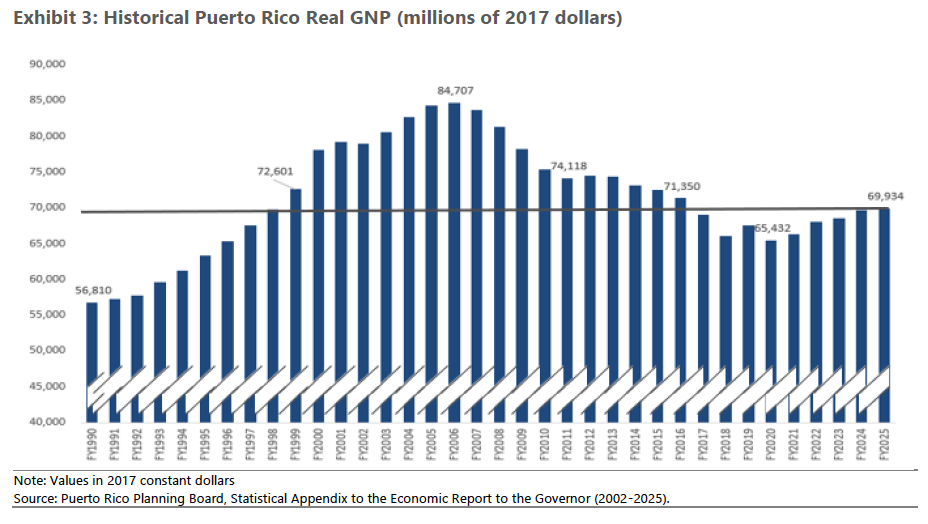
Recently, the Financial Oversight and Management Board published the Puerto Rico government’s financial report for the second quarter of the current fiscal year. On page 8 of that report, we found a chart showing Puerto Rico’s gross national product in constant 2017 dollars, between 1990 and 2025. Three clear trends emerge immediately across those 35 years.

First, an upward trend between 1990 and 2006. Second, a downward trend between 2007 and 2020. And third, a modest rebound between 2021 and 2025. What stands out most, however, is that the GNP level in 2025 was the same as in 1998, just under $70 billion, in 2017 dollars. Although the economy grew in some years during that period (1998–2025), the overall trend is clearly one of stagnation at best and contraction at worst. That is the only economy a 26- or 27-year-old Puerto Rican has ever known. In 2016, we spoke of a lost decade; today we must speak of a generation of Puerto Ricans who have known only crisis.

Much has changed since 1998, and although the factors that contributed to this stagnation are many — the opening of India and China to the global market, the elimination of Section 936, the government’s bankruptcy, Hurricane MarĂ­a — the fact remains that during that period we also stopped investing in our physical infrastructure, particularly the electrical grid. Today, in a world of digital transactions and emerging artificial intelligence, we tend to underestimate the importance of physical infrastructure, but the reality is that access to reliable, low-cost energy is a necessary, though not sufficient, condition to reverse the contractionary trend of our economy.

The Puerto Rico government has already taken steps to promote new investment in our electrical system. Among these is Executive Order 2025-047 of September 22, 2025. The order modifies and extends the scope of the electrical system state of emergency and establishes an expedited process to evaluate and negotiate power purchase agreements for renewable energy projects that qualify for federal renewable energy investment tax credits, known as “ITCs.” To qualify for these credits, renewable energy projects must begin construction before July 4, 2026, or be operational on or before December 31, 2027.

Puerto Rico’s electrical system requires billions of dollars in investment. In the area of generation, the most effective strategy is to diversify energy sources and promote renewable energy to reduce our dependence on fossil fuels that we do not produce. And the fastest and most efficient way to implement that strategy is by approving utility-scale solar generation projects.

These projects have several advantages over those that use natural gas. The cost of solar panels and batteries has fallen significantly over the past decade. Meanwhile, the costs of natural gas generation projects have increased by 66% and the time to bring them online has increased by 23%, both between 2023 and 2025, according to a BloombergNEF analysis.

Second, natural gas generation depends on a vast global infrastructure to extract the gas, transport it to a port where it is liquefied, ship it to Puerto Rico, and regasify it upon arrival. Infrastructure that Puerto Ricans do not control, and whose use is subject to the economic and geopolitical shifts of the global market.

Finally, the availability of ITCs makes this investment even more attractive by effectively reducing construction costs. That reduction in infrastructure costs ultimately translates into cheaper energy, which in turn helps generate greater investment and economic activity. Everyone wins. What are we waiting for?

This content was translated from Spanish to English using artificial intelligence and was reviewed by a human editor before being published. The Spanish version of this column was originally published in El Nuevo Día on May 29, 2026.

The Road to the Tobin Report

The Road to the Tobin Report

Published on September 16, 2025

Puerto Rico: A Child of the Postwar World (1947-1974)

Puerto Rico’s modern economic history begins with the end of the Second World War in 1945. It is perhaps quite difficult for people living in 2025 to imagine the state of the world at that time. Europe was shattered, full of ruins from the coast of Normandy all the way to the outskirts of Moscow; Britain was exhausted after six years of war; Germany was literally split in four parts; France was still traumatized by the shame of Nazi occupation and the guilt of those who collaborated with it; Japan had just witnessed the nuclear obliteration of two of its most important commercial and industrial cities; China was in the midst of a civil war; and India was still a colony of the British Empire. There was little trade, almost no international investment, transnational capital flows had slowed down to a trickle, and migration consisted of refugees displaced by the war, returning prisoners of war (POWs), and people escaping from the Soviet army in Eastern Europe. It is safe to say that globalization was then at a low point.

That was the global context that shaped the thinking of a group of relatively young technocrats who set out to modernize Puerto Rico in the 1940s. Back then, Puerto Rico was a small agricultural economy with a large labor surplus, little or no local capital, and an undeveloped local market. The basic idea was to exploit Puerto Rico’s advantages in that de-globalized world, namely, the ability to use the dollar as its currency, its cheap labor, the unrestricted flow of capital to and from the mainland, its privileged duty-free access to the U.S. market, and its political stability to attract U.S. capital to the island, match it with the excess pool of local labor, and export the resulting products to the United States, and, to a lesser extent, the rest of the world.

After a short stint trying a state-driven development strategy based on state-owned enterprises (cement, glass, cardboard, shoes, and bricks), Puerto Rico went ahead with the export-led strategy beginning in 1947: enacting tax exemptions and attracting U.S. capital to invest in light manufacturing operations. That investment, in turn, provided jobs to the thousands of under- or unemployed Puerto Ricans who lived in rural areas. Profits made by U.S. firms were also exempted from Federal income taxes until repatriation.

By most accounts, this “industrialization by invitation” model, with some later refurbishing, was relatively successful. Puerto Rican economic growth rates soared between 1947 and 1974, with real GNP increasing by an annual average of 6.9% during this period. Living standards increased as well, as measured by most standard indicators: literacy rates and educational attainment; health outcomes and life expectancy; infant mortality; access to clean water, electricity, and safer housing; and persons per physician all improved significantly.

Yet, by other measures, the structural transformation of Puerto Rico’s economy and society fell short of the mark. Rapid jobs growth in the manufacturing sector did not replace all the jobs lost in the agricultural/traditional sector, and total employment in 1960 was lower than in 1950. The apparent contradiction between rapid growth and relatively high unemployment is explained by a very low participation rate and a large reservoir of underutilized labor. Even with strong internal growth, Puerto Rico experienced a massive out-migration. Over 650,000 people left the island during the period between 1945 and 1964, out of a total population of 2.2 million in 1950.

By the mid to late 1960s, then, the government of Puerto Rico had already identified several deficiencies of its industrialization project: persistent high unemployment, which never fell below 10-11 percent; competition from other low-wage areas for the labor-intensive operations of U.S. companies; the over-concentration of industrial activities in a few urban areas; the abandonment of the agricultural sector; and the existence of large pockets of urban poverty.

The proposed solution was to build a massive capital-intensive petrochemical complex in the southern part of the island, spurred by a presidential Executive Order that exempted Puerto Rico from U.S. crude oil import quotas. The objective was to move to higher-value-added, capital-intensive manufacturing operations that created high-wage jobs as well as backward and forward linkages with the local economy. This plan succeeded in bringing some of the largest firms in the petrochemical industry to the island.

Yet it suffered from one obvious weakness: Puerto Rico’s new industrialization strategy was based on cheap access to raw materials, petroleum, which Puerto Rico neither produced nor controlled. This weakness became palpably clear with the Organization of the Petroleum Exporting Countries (OPEC) embargo following the Yom Kippur War of 1973.

Response to the Crisis

The oil shock, the ensuing global recession, and the impact of Federal anti-inflationary policies all contributed to a deep contraction in the Puerto Rican economy, increased unemployment, ballooning government deficits, the closing of the bond markets for Puerto Rico debt issues, and a significant reduction in productive investment. The Puerto Rican government responded with a traditional Keynesian program to stimulate demand: increasing government spending; acquiring privately held telephone and maritime shipping companies; lobbying for increases in Federal transfers; and continuing the subsidization of mainland companies that opened factories in the island. These demand-side policies, however, were generally ineffective in addressing the supply-side nature of the oil shock.

It is in that context that then-Governor Rafael Hernández Colón created several working groups to help him develop policies to address the crisis. First, he set up a Finance Council composed of cabinet-level secretaries. He also appointed an Interagency Committee to study and propose a general economic development strategy for the island. Finally, he appointed a Committee to Study Puerto Rico’s Finances in March 1974, which was chaired by James Tobin, Sterling Professor of Economics, Yale University. This Committee has been known in Puerto Rico ever since as the Tobin Committee. Other Committee members were: William Donaldson, Dean, School of Organization and Management, Yale University; Kermit Gordon, President, The Brookings Institution; Wilfred Lewis, Executive Director, National Planning Association; Sidney Robbins, Professor of Finance, Columbia University, Graduate School of Business; and William F. Treiber, Consultant, Federal Reserve Bank of New York.

The Tobin Committee began its work in May 1974. Its staff prepared 13 background papers, and the Committee submitted its final Report on December 11, 1975 (the “Tobin Report”). The Tobin Report is considered a seminal document in the economic history of the island for several reasons. First, it highlighted that while Puerto Rico’s political relationship with the United States had some advantages for the island in the form of “a common currency, a customs union, the unrestricted movement of funds, capital and persons between the two economies, exemptions from Federal income taxes, and eligibility for federal grants to the island’s government and its citizens”, this arrangement also implied “some constraints which must be recognized.” Back then, this was the quiet part that no one dared to say out loud.

Second, it correctly identified the growing gap between the island’s Gross Domestic Product (“GDP”) and its Gross National Product (“GNP”) due to the remittance of profits and interest to mainland firms and creditors and warned that “from the viewpoint of Puerto Rican residents’ welfare, high levels and rapid growth of GDP are of little merit if not accompanied by a high and rising GNP.” It also called for caution when dealing with multinational capital-intensive enterprises that are more interested in “profit shifting, rather than [in the] real and durable cost advantages of [its] Puerto Rican location.”

Third, the authors stressed the risks and downsides associated with a development strategy that placed an extreme reliance on external resources, especially as Puerto Rico had “gone further in two important respects: (1) tax exemption and other subsidies to attract Mainland industry, and (2) dependence on imports of capital from the Mainland rather than internal public or private saving.” They also stated very clearly that “Puerto Rico will be able to increase influence over its economic development when it reduces its dependence on external capital.”

Finally, the Report’s serious concerns about the increase in Federal transfers to individuals were right on point. Federal transfers for individuals contribute extraordinarily little to Puerto Rico’s growth, increase consumption mostly of imports, and do not provide additional resources for investment. The Report was also prescient when it warned that “probably the time is ending when Federal aid of Puerto Rico grows more rapidly than total Federal aid to states and local governments.”

In addition to identifying key shortcomings, limitations, and constraints of Puerto Rico’s economic development strategy, the Tobin Report is also an important document from an economic history perspective, as it preceded the “neoliberal turn” in macroeconomic policy in the U.S. and Europe by several years, at a time when left-leaning “dependencia” theorists were quite in vogue. Professor Tobin did not mince words or try to cover his tracks when he stated right in the transmittal letter to Governor Hernández Colón that “Puerto Rico faces several years of fiscal, financial, and economic austerity.”

Indeed, many of the Report’s recommendations later became associated with the IMF’s “structural reform programs” or “austerity policy packages.” Among these, we find the following:

  • Generate budget surpluses through the “drastic restraint of expenditure and additional tax effort.”
  • Limit the annual growth of the Commonwealth’s budget to 3 to 4 percentage points below the U.S. rate of price inflation.
  • Freeze government wages and salaries for a three-year period.
  • Reduce government employment, if only by attrition.
  • Require government-owned enterprises to produce current surpluses.
  • Review public enterprise pricing policies.
  • Ask Congress to allow suspension or reduction of minimum wages for persons under 20 employed in Puerto Rico.
  • Implement wage controls on all wages in Puerto Rico.
  • Review all legislation that raises labor costs, including many compulsory holidays; vacations and sick leave; year-end bonuses; and overtime and free time.
  • Reduce the issuance of new government debt.

In some ways, Puerto Rico has never fully recovered from the first oil shock, which ended Puerto Rico’s petrochemical dreams and highlighted the danger of Puerto Rico’s dependence on imported fuel oil for electricity. Events in 1974 called for a thorough questioning of the prevailing economic strategy. Yet, instead of rethinking the existing economic model and restructuring the productive basis of the economy, the Puerto Rican government essentially refurbished the existing one: obtaining a new federal tax exemption for U.S. firms operating in Puerto Rico (Section 936), increasing government employment, seeking ever-larger increases in federal transfers (food stamps, among others), and issuing public debt in ever larger amounts.

By the early 21st century it was evident that this “economic model” had run its course: Section 936 was phased-out by the federal government; government employment increased to its upper limits; federal transfers became increasingly contingent on the economic and political dynamics in Washington, DC—and thus could not be a reliable basis of future growth—and public indebtedness reached historic highs in excess of 100% of GNP, eventually triggering a large-scale fiscal crisis.

With hindsight, it is clear that Puerto Rico’s growth in the early years of the new millennium was built on an unstable foundation. Lacking the tariff preferences that drove growth in the 1950s and 1960s, or the tax preferences that supported growth after the early 1970s, globalization eroded the advantages linked to Puerto Rico’s special access to the U.S. market that drove Puerto Rico’s post-war growth, without giving rise to new opportunities that Puerto Rico was able to capitalize on, given its subordinated political status.

The Puerto Rican economy entered a period of sharp decline beginning in 2006, characterized by stagnant or negative growth rates, high unemployment, chronic budget deficits, significant population loss, and increasing indebtedness. By 2015, bonded debt exceeded $70 billion, more than 100% of the island’s GNP, and unfunded pension liabilities exceeded an additional $50 billion. At that time, the Governor declared the island’s public debt to be “unpayable” and, among other things, hired a group of consultants led by economist Anne Krueger. This team drafted a report that, not surprisingly, rehashed many of the recommendations set forth in the Tobin report.

The government of Puerto Rico was understandably reluctant to cut current expenses even as revenues slumped. Laying off government employees when the private economy was contracting would not only have left many families without any source of income but also added to the country’s general economic woes. The island, however, needed a mechanism to adjust its debts, and Congress eventually provided one by enacting the Puerto Rico Oversight, Management, and Economic Stability Act (“PROMESA”) in 2016.

PROMESA provided for (a) the establishment of an unelected Financial Oversight and Management Board (FOMB) with ample powers (known locally as “la Junta”) to impose fiscal discipline on Puerto Rico, and (b) a court-supervised process for the orderly adjustment of the territory’s debts and obligations. The FOMB, in general, has implemented a broad fiscal consolidation program to stabilize the island’s public finances and managed to restructure most of Puerto Rico’s debt. The process, however, has been slow and expensive, as the FOMB enters its 10th year of operation.

As the island slowly progresses along the road of fiscal stability, the question arises as to what happens once the FOMB ceases its work. There appears to be no economic plan to sustain medium to long-term economic growth in Puerto Rico, and financial stability by itself will not be a source of growth.

It is in this context that revisiting the Tobin Report and its recommendations is important and relevant. That reconsideration, however, has to take into account the economic experience of the last fifty years, in Puerto Rico and abroad. The current economic environment is quite different than the one in 1974. Globalization seems to be slowing down, while support for international trade, investment, and migration has declined significantly among both advanced and developing economies. It is in this challenging time that we need to evaluate what policy recommendations make sense and which ones do not, which ones are still relevant, and which ones have not aged well, and eventually, which economic path makes sense for a small, open economy like Puerto Rico in the 21st century.

The Rum Excise Tax Cover-Over: A proposal for investing in the future of Puerto Rico

The Rum Excise Tax Cover-Over: A proposal for investing in the future of Puerto Rico

Published on July 16, 2025 / Leer en español

Sergio portrait
Policy Director
DOWNLOAD
SHARE

In our latest policy brief, we break down the origins of the rum cover-over, how the money flows, where it goes, and how to make the most of it. 

Spoiler alert: CNE proposes an innovative alternative: the creation of the Puerto Rico Economic Development Fund for the 21st Century (PREDF), modeled after Alaska’s successful Permanent Fund. 

Executive Summary

For over a century, the federal government has refunded to Puerto Rico the federal excise tax revenues collected on rum sold in the mainland U.S. This refund, known as the rum excise tax cover-over, brings approximately $200 million annually into Puerto Rico’s general fund, even after subsidies to local rum producers and other allocations. The recently enacted domestic policy bill increases the amount annually refunded to Puerto Rico by approximately $100 million. 

This policy brief proposes redirecting that additional annual income stream into a new investment vehicle, the Puerto Rico Economic Development Fund for the 21st Century (PREDF). Modeled after the successful Alaska Permanent Fund, the PREDF would gradually build long-term capital to finance economic development and reduce dependence on federal transfers. 

The proposal calls for: 

  • Seeding the PRDEF exclusively with the portion of rum excise tax “cover-over” revenue that would otherwise be deposited into Puerto Rico’s general fund. All distributions currently required by law that are already supporting economic development efforts—such as those to local rum producers, science and technology initiatives, conservation efforts, and other statutory allocations—would remain unchanged. This revenue stream is expected to increase to $13.25 per proof gallon after December 31, 2025. 
  • Establishing the fund through a constitutional amendment to ensure its independence and long-term viability. 
  • Using the fund for co-investments and industrial policy initiatives that aim to restructure Puerto Rico’s economy toward greater productivity and resilience. 

While the fund would start modestly, its long-term goal is to become a self-sustaining engine for economic transformation, enabling Puerto Rico to invest in its future rather than relying on external support and would complement any industrial policy implemented by Puerto Rico.

The shift will require political will, fiscal discipline, and public consensus, but it offers a rare opportunity to turn a federal funding stream into a tool for self-directed, long-term development. 

CNE Review – March 2025

Published on March 27, 2025 / Leer en español

See all editions of the
CNE Review
SHARE

In This Issue

When a new president is elected in the United States, their transition team is quickly assembled to propose and implement policies that will define the trajectory of the Administration. The performance of the Administration during its first 100 days has been used since the time of Franklin D. Roosevelt as a benchmark to assess its effectiveness.

Though we have yet to reach the 100-day mark of the second Trump administration, it is no exaggeration to suggest it has already made a significant impact, in less than the average or expected timeframe. Puerto Rico’s history has shown that institutional destruction (or dismantling) is far easier and occurs quite faster than institutional building or rebuilding, a lesson we should remember when comparing the policy proposals of different presidential administrations. Click here to read more on the approaches of previous U.S. administrations towards Puerto Rico.

In this edition of the CNE Review, we examine the impact of the new administration’s policies on Puerto Rico and the U.S. economy. In our Guest Spotlight, as part of a special collaboration with Spain’s esteemed think tank Real Instituto Elcano, we partnered with Carlota García Encina, Principal Investigator, to explore the ripple effects across Europe. Finally, we wrap up with a Data Snapshot on tariffs.

Insights + Analysis from CNE

By Sergio M. Marxuach, Policy Director

On January 20, 2025, Donald J. Trump was sworn in as the 47th president of the United States and he and his policies have taken Washington, DC by storm. President Trump has issued (at last count) more than 90 Executive Orders that seek to implement, without Congressional action, any number of unprecedented policies.

Click here for examples of what President Trump’s orders seek.

Impact to Puerto Rico

To the best of our knowledge, no Executive Order has singled out or focused on programs or government funding earmarked specifically for Puerto Rico. However, state and municipal governments, as well as certain NGOs, could be adversely affected to the extent they had already been assigned federal funding for DEI initiatives, green energy projects, or climate change programs, all of which seem to be high on the list of federal programs to be eliminated immediately.

In addition, federal employees working and living in Puerto Rico have been subject to layoffs, just like their counterparts in the U.S. These reductions in federal employment would have an adverse impact on the Puerto Rican economy as well as a negative effect on the availability of certain federal services on the island, depending on the magnitude of the cuts and the specific agencies affected.

Finally, many private sector companies in Puerto Rico receive or are paid with federal funds for goods and services they sell to Puerto Rico state agencies in their role as contractors, suppliers, or merchants. Significant cuts to federal expenditures in Puerto Rico would, therefore, have a direct negative effect on these firms, as well as an indirect impact, to the extent that a reduction in overall economic activity further decreases other demand for these firms’ goods and services.

Looking forward over the next few months, three areas are cause for particular concern:

  1.  Ongoing reconstruction efforts
  2. Education
  3. Medicaid

Click here to read more on these.

So far, Puerto Rico has avoided the worst effects of President Trump’s policies, in large part because federal courts have temporarily stayed the implementation of many of the recently signed Executive Orders. However, we note that keeping a low profile and hoping for the best is not a strategy. The government of Puerto Rico would be well advised to start thinking about its strategies to curtail the foreseeable economic and social damage that could befall the island during the next three years and ten months.

Guest Spotlight

A European Response

by Carlota GarcĂ­a Encina, Senior Analyst at Real Instituto Elcano

Donald Trump wants a safe and prosperous United States. These are core interests for any country, and in this regard, the new U.S. president is no different from any of his predecessors or current European leaders. What sets him apart is how he seeks to pursue these interests. Trump shows little regard for values, and his political instincts lean toward isolationism over than international engagement, and protectionism over free trade. As for his approach, he favors deals and transactions over crafting rules, working through international organizations, or traditional diplomacy.

With Trump in the White House and his disruptive approach to global affairs, everything suggests that the U.S. may be undergoing its most significant foreign policy shift since 1945. His second term in office could fundamentally reshape how future generations of American politicians, military leaders, business executives, and citizens interpret the country’s strategic priorities—both domestically and internationally. These priorities increasingly focus on China and the Indo-Pacific region, a trend that has been brewing for years and has bipartisan support in Washington. However, for the first time, the future foundations of U.S.-Europe relations are under debate. For decades, the U.S. invested unprecedented resources and reputation in Europe, motivated by national interest, prosperity, and economic growth, and Europe remains grateful. Yet, the new administration seems willing to abandon that investment and break ties with its European allies.

Data Snapshot

Potatoes and Beer: When Trade Wars Hit Home

By Enrique Figueroa Grillasca, Research Associate

The next four years are expected to be marked by economic uncertainty and shifting trade policies. One key issue is the brewing trade war between the U.S., Canada, and Mexico.

Click here for consumer & producer responses to tariffs.

Puerto Rico imports a significant volume of goods from Canada and Mexico, both as final products for consumption—such as $72 million worth of Canadian potatoes or $26 million worth of beer from Mexico —and as intermediate inputs for local manufacturing, including $24 million in compressors from Mexico.

Any increase in tariffs will affect the prices of goods, employment, and economic output. However, predicting the precise impact is difficult due to their dependence on consumer and producer responses, which in turn depend on income and price elasticities, the availability of substitute goods, and shifting production strategies.

However, these tariffs, if they become permanent, would mark a major shift in U.S. economic policy, and will have global consequences. The ultimate effects, though, will depend on the final policies adopted by all countries involved and how markets adapt in response.

Puerto Rico: Analyzing Federal Policy Changes

Puerto Rico: Analyzing Federal Policy Changes

Published on March 26, 2025 / Leer en español

Sergio Portrait
Policy Director
Headshot EFG
Research Associate
DOWNLOAD
SHARE

Introduction

When a new president is elected in the United States, their transition team is quickly assembled to propose and implement policies that will define the trajectory of the Administration. The performance of the Administration during its first 100 days has been used since the time of Franklin D. Roosevelt as a benchmark to assess its effectiveness.

Though we have yet to reach the 100-day mark of the second Trump administration, it is no exaggeration to suggest it has already made a significant impact, in less than the average or expected timeframe. Puerto Rico’s history has shown that institutional destruction (or dismantling) is far easier and occurs quite faster than institutional building or rebuilding, a lesson we should remember when comparing the policy proposals of different presidential administrations.

For many decades the knowledge and understanding in the federal sphere of the U.S.’s role in Puerto Rico and the historical factors that contribute to its current challenges has been limited. Over the last 125 years or so, the White House has attempted to delegate these matters to various actors within its purview, but the efforts have often been superficial – a mile wide and an inch deep with inadequate results.

Initially, Puerto Rico and other territories acquired after the Spanish-American War were under the jurisdiction of the War Department (now the Department of Defense). After thirty or so years, jurisdiction over Puerto Rico was transferred to the U.S. Department of the Interior, which traditionally had jurisdiction over tribal and territorial affairs. However, in 1961, President John F. Kennedy reshaped this approach for Puerto Rico by directing that all matters concerning the island’s relationship with the U.S. be handled by the Office of The President. Over the years, multiple administrations sought to address issues related to Puerto Rico by establishing interagency task forces aimed at examining and managing federal engagement with the island.

In 1992, President George H.W. Bush mandated that all executive departments, agencies, and officials treat Puerto Rico administratively “as if it were a state,” to the extent possible. Amid ongoing debates over Puerto Rico’s political status and how it directly impacts its governance, limits decision-making authorities, and shapes federal intervention, the Clinton administration established the President’s Task Force on Puerto Rico’s Status in 2000. Its goal was to guide discussions on potential status options and the processes required to implement them.  Following suit, the George W. Bush Administration issued two reports expanding on the relationship with the Government of the United States and explored possible future directions for U.S.-Puerto Rico relations. The Obama administration continued this approach in 2011, undertaking a more in-depth review of federal policies toward Puerto Rico. However, the island’s fiscal crisis prompted negotiations between the Executive and Congress, which ultimately led to the approval of the PROMESA law in 2016—a measure widely opposed by Puerto Ricans—which imposed an unelected financial oversight board in exchange for access to a court-supervised debt restructuring mechanism for Puerto Rico.

Given the scope and complexities that stem from a prolonged economic recession, back-to-back hurricanes, earthquakes, and a global pandemic, the prior Administration took some targeted steps to help understand Puerto Rico and accelerate long-term recovery efforts.  The Biden Administration appointed a Director for Puerto Rico and the Territories in the White House; officially delegated Puerto Rico’s energy grid recovery and modernization to a top cabinet-level official, the Secretary of Energy; and designated an Economic Growth Coordinator for Puerto Rico, assembling a mixed team of both career and civil servants to oversee a whole-of-government effort.

Now, in the early weeks of a new Trump Administration, Puerto Rico no longer has these dedicated resources within federal agencies -and because they were designed to focus on long-term results, the jury is still out regarding the policies that were planned and partially implemented by the previous administration. This kind of abrupt shift between administrations is all too familiar to Puerto Rico, where government leadership—and, with it, a significant portion of senior staff and policies—change every four years. However, as far as we can tell, keeping a low profile at the federal level is perhaps the preferable strategy, especially when the alternative could mean being singled out or specifically targeted for some of the harmful, cost-cutting policies currently under implementation across the federal government.

Executive Orders

On January 20, 2025, Donald J. Trump was sworn in as the 47th president of the United States and he and his policies have taken Washington, DC by storm. President Trump has issued (at last count) more than 90 Executive Orders that seek to implement, without Congressional action, any number of unprecedented policies.

Some of the Executive Orders signed by President Trump are just performative, such as changing the name of the Gulf of Mexico to the “Gulf of America,” but others are quite substantive, such as those that seek to stop billions in federal funding.

Among other things, his orders seek to eliminate birthright citizenship to all those born in the United States (ignoring language of the 14th Amendment to the U.S. Constitution); impose tariffs on both geopolitical adversaries and allies; cut back on both legal and undocumented immigration; reduce the career, nonpartisan federal workforce; reduce by 50% the amount of overhead costs that can be covered with funds from NIH research grants; paralyze almost all foreign aid programs, including in sensitive areas such as public health, nutrition, and access to clean water; erase all federal Diversity, Equity, and Inclusion (“DEI”) programs; and “pause” all federal spending regarding loans and grants to state and local governments, as well as to NGOs and in some cases private companies.

Impact to Puerto Rico

To the best of our knowledge, no Executive Order has singled out or focused on programs or government funding earmarked specifically for Puerto Rico. However, state and municipal governments, as well as certain NGOs, could be adversely affected to the extent they had already been assigned federal funding for DEI initiatives, green energy projects, or climate change programs, all of which seem to be high on the list of federal programs to be eliminated immediately.

In addition, federal employees working and living in Puerto Rico have been subject to layoffs, just like their counterparts in the U.S. These reductions in federal employment would have an adverse impact on the Puerto Rican economy as well as a negative effect on the availability of certain federal services on the island, depending on the magnitude of the cuts and the specific agencies affected.

Finally, many private sector companies in Puerto Rico receive or are paid with federal funds for goods and services they sell to Puerto Rico state agencies in their role as contractors, suppliers, or merchants. Significant cuts to federal expenditures in Puerto Rico would, therefore, have a direct negative effect on these firms, as well as an indirect impact, to the extent that a reduction in overall economic activity further decreases other demand for these firms’ goods and services.

Looking forward over the next few months, three areas are cause for particular concern. First, Congress has allocated funding of approximately $52 billion through FEMA to finance Puerto Rico’s reconstruction after Hurricanes Irma and Maria. According to the Puerto Rico Central Office for Recovery, Reconstruction, and Resiliency, as of late February 2025, about $23 billion of the amount allocated had been spent. In theory, the other $30 billion or so, should be safe from rescission or clawback to the extent they have been legally “obligated,” which represents a binding commitment. However, as mentioned above, we know of several instances where the disbursement of federal funds already has been withheld or frozen, even when the money has been already legally obligated. In the case that reconstruction funds are rescinded or clawed back, the Government of Puerto Rico’s sole recourse would be to file a lawsuit against the federal government.

The Trump Administration has also stated its intention to dismantle FEMA. Right now, it is unclear where all this would land and how it could affect Puerto Rico, but that is the point: the island government must be vigilant and keep abreast of developments in Washington. Needless to say, the rescission of any federal reconstruction funds would have a material adverse effect on Puerto Rico’s reconstruction process and its economy.

Second, the Trump administration has announced its intention to eliminate the U.S. Department of Education, and several thousand employees have already been informed of their dismissal. The effect of these layoffs on the operations of the Department of Education is unknown at this time but attempts to dismantle the Department could impact the disbursement of billions of dollars under Title I of the Elementary and Secondary Education Act and the Individual with Disabilities Education Act, which are currently managed by the federal government. In turn, $2.4 billion, or 45%, of the $5.3 billion FY2025 budget of the Puerto Rico Department of Education is provided by the U.S. federal government. Any significant changes in that funding could affect the education of some of the most vulnerable children in Puerto Rico.

Finally, federal Medicaid funding is another area of concern in the short term. The U.S. House of Representatives approved a budget resolution for FY2026 that orders the House Energy and Commerce Committee to cut $880 billion in federal spending. Achieving that spending objective is essentially mathematically impossible without cutting the Medicaid program, which is under the jurisdiction of that committee. Currently, approximately 72% of the cost (some $3.4 billion out of a total cost of $4.7 billion) of Puerto Rico’s Medicaid program, which provides health care insurance to about 50% of the island’s population, is funded by the federal government. Again, any significant cuts in federal funding for Medicaid in Puerto Rico or the imposition of a lower cap on federal spending would directly affect access to healthcare for an estimated 1.5 million beneficiaries in Puerto Rico and would have dire effects on the primary balance of the central government. For instance, if Congress decides to revert Medicaid funding for Puerto Rico to its pre-ACA formula during FY2028, federal funding would be capped at 55% of total costs up to a maximum of approximately $500 million. The FOMB estimates the cost of Puerto Rico’s Medicaid program for that year to be $5.3 billion. This means the government of Puerto Rico would, somehow, have to (1) come up with $4.8 billion just to keep the program going as is, or (2) cut back sharply the number of people covered or the services offered.

So far, Puerto Rico has avoided the worst effects of President Trump’s policies, in large part because federal courts have temporarily stayed the implementation of many of the recently signed Executive Orders. However, we note that keeping a low profile and hoping for the best is not a strategy. The government of Puerto Rico would be well advised to start thinking about its strategies to curtail the foreseeable economic and social damage that could befall the island during the next three years and ten months.

Blitz of Executive Decrees

The Executive Orders have created a lot of uncertainty among many grant recipients, service providers, and federal workers. The order regarding the “pause” on the spending of federal financial assistance has been particularly damaging. That order was followed by a memorandum from the Office of Management and Budget (“OMB”), dated January 27, 2025, which set forth the parameters for the spending freeze. According to the January 27 memo,

Financial assistance should be dedicated to advancing Administration priorities, focusing taxpayer dollars to advance a stronger and safer America, eliminating the financial burden of inflation for citizens, unleashing American energy and manufacturing, ending “wokeness” and the weaponization of government, promoting efficiency in government, and Making America Healthy Again. The use of Federal resources to advance Marxist equity, transgenderism, and green new deal social engineering policies is a waste of taxpayer dollars that does not improve the day-to-day lives of those we serve.

As shown above, the language of the memo was extremely broad, many terms were left undefined and at least in theory, the pause could affect as much as $3 trillion of federal spending. Many state and local governments, as well as NGOs, were left scrambling to figure out whether the spending pause impacted their funding and which programs were covered (or not). A later memo sought to “clarify” the scope of the spending freeze, but it only added to the confusion.

Many recipients of federal assistance ran to the courts to file petitions for injunctive relief, temporarily staying the application of several Executive Orders, while the courts figured things out. The OMB eventually withdrew the January 27 memorandum and at least two courts have ordered the federal government to leave the pause without effect until the courts had time to hear arguments on the merits of the issues.

Nonetheless, several organizations and grant recipients still complained their funding was missing, withheld, or impossible to access through traditional means (mostly web-based portals that went offline). For example, Politico reports that eight nonprofit groups, which were awarded $20 billion in funds from the Greenhouse Gas Reduction Fund administered by the Environmental Protection Agency, “have been shut out of their accounts at Citibank since Feb. 18 because of a still-unexplained freeze imposed amid criticism from President Donald Trump’s administration.” In addition, many organizations, out of an abundance of caution or perhaps acts of anticipatory obedience, have stopped providing certain services or refrained from engaging in certain actions. This type of self-imposed spending freeze has already affected financing for green energy projects, and the provision of services to vulnerable populations, such as low-income women and children, seniors, and HIV patients, among other groups.

To give you an idea of the potential magnitude of the impact, the Congressional Research Service (“CRS”) estimates the federal government “sent state governments $1.112 trillion in FY2022, 36.1% of total state government revenue (in some cases, portions of this funding was passed through to local governments). That same year, states provided $662.3 million to local governments, 28% of local government revenue, (some of this funding was federal funding “passed through” states to local governments.” (see chart below) That figure does not include direct funding to NGOs and nonprofits that provide direct services to people.


Source: U.S. Census Bureau, Annual Survey of State and Local Government Finances.

As mentioned before, the only recourse local government, recipients, or grantees have is to file a judicial action against the federal government. As of this writing, the organization Just Security has identified through its litigation tracker at least 129 lawsuits against the federal government arising out of or in connection with the issuance of executive orders. It will take a while for this docket to get through the court system. In the meantime, uncertainty prevails and the administration keeps pushing on its extremist agenda.

The damage inflicted by these decisions will be long-term, and in some cases, we fear, permanent. During a recent press conference, Elon Musk, who leads the Department of Government Efficiency, reorganized by Executive Order, stated that they expected to make mistakes and to reverse them if and when called out on them. The problem is that this “move fast and break things” philosophy, regardless of its merit in the tech world, is not a good guide to streamlining government services. Do we really want to eliminate the jobs of those who work on regulating aircraft security, the use of hazardous chemicals, or the maintenance of nuclear weapons? In the words of Martin Wolf, Chief Economics Commentator at the Financial Times, “one does not make a complex system more efficient by hacking away at it at random.” And in some cases, it just could be too late to reverse the damage already inflicted by reckless budget cuts.

To be sure, the Federal government, which is on track to spend $6.9 trillion during the current fiscal year, is bound to have operational inefficiencies and some of its spending can probably be described as wasteful. It is also true that federal regulations accumulate much like sediment in an old riverbed as time goes by. As far as we can tell, though, no one opposes reasonable efforts to make the federal government more effective or to eliminate real waste, fraud, and abuse.

As Jennifer Pahlka and Andrew Greenway write in a recent paper for the Niskanen Center, the federal government’s capacity to execute and implement public policy has decreased significantly during the last forty years or so. The challenge of “rebuilding our state capacity — the how of our government — is an arduous task that requires a stomach for learning and fixing the rules and culture of the bureaucracy.” However, blindly cutting programs and reducing the federal workforce does not improve operations nor does it build the state capacity we need. According to Pahlka and Greenway, smartly building state capacity requires a whole new approach to how the government works by focusing on (1) hiring the right people, (2) reducing excessive procedures, (3) investing in digital infrastructure, and (4) implementing continuous “test and learn” approaches in the pursuit of policy outcomes. A very different approach from the Trump Administration’s method of government reform.

In the short term, in addition to the damage done to the federal government’s capacity to function and to important government agencies and programs that are negligently and unwisely cut, some economists are openly wondering about the risk that the United States could be sleepwalking into a financial crisis. According to Wendy Edelberg and Ben Harris, from the Brookings Institution, the “true risk” to our economy “is our political leaders doing something wildly irresponsible that unnerves financial markets.” For example, “the president declaring he can pick and choose which holders of United States Treasury securities should be paid.” With Elon Musk running loose around Washington, gaining access to the Treasury payment system, taxpayer information at the IRS, and social security data for heretofore unknown and undisclosed purposes, the occurrence of a grave mistake cannot be ruled out.

There is also some evidence regarding the negative economic effect of all the uncertainty created by the Trump Administration’s new policies. The GDPNow forecast from the Federal Reserve Bank of Atlanta estimates “real GDP growth (seasonally adjusted annual rate) in the first quarter of 2025 is -1.8 percent on March 18, up from -2.1 percent on March 17.

While we should be careful not read too much into one short-term indicator, it is only fair to point out that President Trump’s actions to reduce the civil workforce, to cut back billions of dollars’ worth of federal investments, to punish trade partners with new tariffs, and to crack down on migrant workers do not bode well for the health of the U.S. economy nor do these policies inspire the confidence necessary to sustain long-term consumption and investment in the United States. It also clear that, some of the soft economic indicators, such as consumer confidence, labor market prospects, and inflation expectations, are pointing in a negative direction.

Take the issue of tariffs on products from Canada and Mexico. According to Brad Setser from the Council on Foreign Relations, “The 25% tariffs on Mexico and Canada [are] a move that is likely to be considered one of the most self-destructive economic policy steps in recent history. Tariffing the U.S. auto supply chain—and imports of autos from Canada and Mexico that have a ton of embedded U.S. content—while leaving the market for imports from [South] Korea and Japan open is a bit mad…Tariffing Mexico but not Southeast Asia is equally crazy—it is a massive gift to all the Chinese firms using Chinese parts to supply the U.S. consumer market from [Southeast] Asia.”

Over the long term, the main threat is the potential damage to American institutions such as the rule of law, due process, and the separation of powers. The Trump Administration has taken a maximalist view of the scope of executive, specifically presidential, power. This perspective runs contrary to American constitutional law and well-established democratic norms and practices. For example, the President’s assertion in an Executive Order issued on February 18 that the “President and the Attorney General (subject to the President’s supervision and control) will interpret the law for the executive branch, instead of having separate agencies adopt conflicting interpretations” is simply flat-out wrong and unconstitutional.

Under the American constitutional system, it is up to the courts to interpret what the law means. Congress also has the power of the purse (the spending power) under Article I, section 9, clause 7 of the U.S. Constitution. The president doesn’t get to rewrite appropriation laws, impose additional requirements or conditions on spending not legislated by Congress, or refuse to spend duly appropriated funds. Yet, Congress has been surprisingly acquiescent to President Trump’s strong assertion of executive power.

This is a dangerous situation. As Steven Levitsky and Daniel Ziblatt have pointed out in How Democracies Die (Crown, 2018), the American political system is not designed to withstand this kind of “Constitutional hardball”, which they define as a “form of institutional combat aimed at permanently defeating one’s partisan rivals—and not caring whether the democratic game continues.”

They also note that adherence to two informal norms is key for the functioning of American democracy: (1) mutual toleration, defined “as the idea that as long as our rivals play by constitutional rules, we accept they have an equal right to exist, compete for power, and govern”; and (2) institutional forbearance, which they define as restraining from exercising a legal right or institutional prerogative to its full extent if “such an action could imperil the existing system.” In the six weeks or so since January 20, the Trump Administration has shown little willingness to exercise either tolerance or institutional forbearance. Instead, it has chosen, over and over again, to test the limits of the resilience of the American political system.

To be fair, the Trump Administration has not yet flat-out refused to comply with a court order, but is coming close to crossing that line. So far, according to the New York Times, 41 court rulings have paused Trump’s initiatives, at least temporarily. And, recently, the Supreme Court refused to reverse a lower court ruling ordering the Trump Administration to disburse $2 billion in foreign aid that had been frozen. Thus, the courts appear to be doing their job, but many lawyers and scholars are concerned we may be heading towards a constitutional crisis. That moment would arrive, for example, if the Supreme Court permanently reverses an Executive Order cutting spending or orders the president to implement a specific spending law and then the president decides to ignore the court order.

In this sense, the stability of the American political system is wholly contingent on elected officials abiding by a sort of honor code: we all agree the courts have the last word regarding the constitutionality or legality of any action or omission on the part of the executive or the legislative branch. Undermining the courts’ authority or legitimacy to act could cause the collapse of the entire house of cards. That is why in the event Trump decides to challenge the rule of law this time around, the only effective remedy available to the opposition could be to “shut down the country” in the words of Anthony Romero, Executive Director of the A.C.L.U. At that point, the only deterrent available would be an impeachment proceeding, a threat that has been ineffective in the past against President Donald Trump.

Potatoes and Beer: When Trade Wars Hit Home

By: Enrique Figueroa Grillasca, Research Associate

The next four years are expected to be marked by economic uncertainty and shifting trade policies. One key issue is the brewing trade war between the U.S., Canada, and Mexico.

Estimating the impacts of changes in tariffs is a complex task. When we add the current high level of uncertainty and take into account the constantly evolving situation, deciphering the specific regional effects of these tariffs becomes even more difficult, amounting to nothing more than a shot in the dark. This is because effects from a tariff shift cannot simply be assumed to be a straight-line increase in prices by the amount of the tariff.

Both consumers and producers respond to price shifts through a variety of mechanisms, primarily substitution. As prices for any one good increase, consumers will substitute it with a comparable good at a lower price. In the case of tariffs and their impacts one could imagine that as the price of Mexican beer increases due to tariffs, consumers will buy less Mexican beer and shift towards other alternatives, say Dominican or Spanish beer. These are known as first order effects, or the immediate response to a change in conditions.

Similarly, producers substitute their inputs where possible. One example could be local environmental control system manufacturers and suppliers who import a large amount of their compressors and related components from Mexico. These substitutions are not immediate, perfect, nor necessarily possible (the degree of this is measured econometrically by estimating elasticities), which can lead to temporary increases in prices and supply disruptions. These same dynamics apply to producers in the US which Puerto Rico imports goods from making yet another channel through which tariffs will impact the island’s economy. There are subsequent responses as well, as consumers modify their preferences and producers reallocate their resources to shift their product mix in response.

As events unfold and policies stabilize it will become more feasible to tease out the effects of these tariffs. Although the following is not an analysis of the potential impacts of any specific tariff, we believe that understanding the trading relationship between Puerto Rico, Canada, and Mexico is a crucial first step.

Puerto Rico imports a significant volume of goods from Canada and Mexico, both as final products for consumption—such as $72 million worth of Canadian potatoes or $26 million worth of beer from Mexico —and as intermediate inputs for local manufacturing, including $24 million in compressors from Mexico.

Any increase in tariffs will affect the prices of goods, employment, and economic output. However, predicting the precise impact is difficult due to their dependence on consumer and producer responses, which in turn depend on income and price elasticities, the availability of substitute goods, and shifting production strategies.

However, these tariffs, if they become permanent, would mark a major shift in U.S. economic policy, and will have global consequences. The ultimate effects, though, will depend on the final policies adopted by all countries involved and how markets adapt in response.

A European Response

A European Response

Published on March 26, 2025 / Leer en español

GUEST COLLABORATOR
Senior Analyst, Real Instituto Elcano
SHARE

Donald Trump wants a safe and prosperous United States. These are core interests for any country, and in this regard, the new U.S. president is no different from any of his predecessors or current European leaders. What sets him apart is how he seeks to pursue these interests. Trump shows little regard for values, and his political instincts lean toward isolationism over international engagement, and protectionism over free trade. As for his approach, he favors deals and transactions over crafting rules, working through international organizations, or traditional diplomacy.

With Trump in the White House and his disruptive approach to global affairs, everything suggests that the U.S. may be undergoing its most significant foreign policy shift since 1945. His second term in office could fundamentally reshape how future generations of American politicians, military leaders, business executives, and citizens interpret the country’s strategic priorities—both domestically and internationally. These priorities increasingly focus on China and the Indo-Pacific region, a trend that has been brewing for years and has bipartisan support in Washington. However, for the first time, the future foundations of U.S.-Europe relations are under debate. For decades, the U.S. invested unprecedented resources and reputation in Europe, motivated by national interest, prosperity, and economic growth, and Europe remains grateful. Yet, the new administration seems willing to abandon that investment and break ties with its European allies.

Perhaps Europeans have taken for granted for too long that Atlanticism was the cornerstone of U.S. foreign policy. Like a long-standing marriage, what once seemed obvious now needs to be clearly redefined—or risk falling apart.

The U.S. administration has begun to tighten the screws on trade. The European Union—one of the world’s most open regions to trade and investment and a staunch advocate of economic interdependence through rules—seems prepared to negotiate a mutually beneficial deal that Trump can present as a victory to his voters. However, the EU also wants to make it clear that pushing Europe too hard could backfire, potentially hurting U.S. interests. One strategy that seems to be gaining ground is to let the cost of U.S. tariffs fall on American businesses and households, hoping that domestic backlash will put pressure on Trump. Yet, what matters most to Trump 2.0 is power. Therefore, any European response must be rooted primarily in power rather than economics, rules, or U.S. domestic politics. Trade is just one piece of the broader challenges he is throwing Europe’s way.

Donald Trump has also challenged Europe’s territorial sovereignty—by suggesting the annexation of Greenland; its digital model—by attacking European tech regulations; and its political party systems—by courting far-right European political forces. He is also pressuring Ukraine and its European supporters to agree to a peace deal favorable to Russia, while hinting at withdrawing significant parts of the U.S. security commitments on the continent.

Trump is determined to exploit Europe’s economic, technological, political, and security vulnerabilities for coercive purposes because he believes Europe neither holds “the cards” nor has the will to play them—a euphemism he uses to refer to power and influence. But Europe does have cards to play, and they should carefully consider how to strengthen its hand and use them effectively.

Europe possesses the economic strength of a collective GDP, a vast internal market, along with labor and technology resources that complement the U.S. While Europe may not be a primary exporter of raw materials like the U.S., it serves as an indispensable intermediary—meaning that a break with Europe could make it much harder for the U.S. to sell its resources globally. Thanks to European contributions, NATO achieves both American and European objectives at an acceptable cost, not to mention that Europe’s geography allows the U.S. to project power to several critical theaters. Moreover, European companies are integrated into the U.S. defense supply chain—one-quarter of the F-35 fighter jet’s components are manufactured in Europe.

Faced with the new administration, Europe’s goal should be to develop a clear and realistic strategy for the transatlantic game that Donald Trump has initiated. Europeans must determine in which areas they should continue to align with Washington, where the relationship needs to be rebalanced, and where they should distance themselves from the U.S. The answers, however, are not easy.

This content was translated from Spanish to English using artificial intelligence and was reviewed by a human editor before being published.