
Upcoming Federal Priorities for Puerto Rico

Upcoming Federal Priorities for Puerto Rico

Published on May 9, 2024 / Leer en español

Director, Washington D.C. Office
SHARE

A brief note from yours truly:

I’m back! During the last two years, I served Puerto Rico from within the U.S. federal government.  I carried the work with a sense of pride and deep responsibility. It was the first Administration to appoint Senior Advisors across federal agencies to look out for Puerto Rico specifically.  And I was one of them.  Our collective efforts have undeniably ensured great strides in the Puerto Rico policy arena. Undoubtedly, as a wise Congresswoman once told me: “we have matured politically and are better prepared to flex our muscles to get attention”.

During my time at the U.S. Department of Housing and Urban Development (HUD), I worked tirelessly to ensure there was a recognition and deeper understanding of how historical circumstances, program shortcomings and cultural differences have resulted in an uneven playing field for Puerto Rico – and all U.S. territories.  While it’s been tough at times to tackle the deeply entrenched inadequacies, I’m proud of the progress we’ve made and the lessons we’ve learned. I remain hopeful that one day every federal agency will have dedicated personnel working to correct the many historical wrongs.

The Center for a New Economy’s (CNE) mission in DC is clear: shape and inform debates around Puerto Rico and put serious research and policy recommendations directly into the hands of decision-makers. But we are facing many challenges in doing this work. The political environment in Washington, DC has become increasingly contentious. For the most part, opposition to policy solutions stems from ideological stances rather than empirical evidence. Instead of fostering unity, it’s looking far more like the Divided States of America. For Puerto Rico policymaking, it’s a stark dichotomy:  either in favor of supporting its needs or you’re vehemently opposed to it.

At times, we find ourselves addressing urgent issues before even having the chance to propose solutions. Even now, after more than five years of laying the groundwork for Puerto Rico’s transition to SNAP, we’re faced with a proposal that not only denies access to SNAP but also slashes $700M from our existing program.

In the real world, challenges run even deeper. Before misinformation was widely promoted by social media and all the “clicks”, there was a whole effort to challenge knowledge altogether – to in fact, create ignorance: “via advertising, duplicitous press releases, funding of decoy research, establishment of scientific front organizations, manipulation of legislative agendas, organization of ‘friendly research’ for publication in popular magazines, and myriad additional projects from the dark arts of agnotology.” Those same mechanisms have grown exponentially and now infiltrate our daily lives. I was recently in NYC and came across this mosaic in one of MTA’s stations.

I stopped and thought of the implications of the iceberg analogy vis a vis our role in society.  Are we trusting our feelings above facts and evidence?  Imagine if we just trusted pilots to know what they are doing instead of requiring intensive training before putting our lives in their hands?

We are at a tipping point, grappling with deep ideological divisions, legislative gridlock, entrenched income inequality, and a global rise of authoritarianism. The role of think tanks is more important now than ever. And that’s why I’m back.

CNE has earned its reputation by doing the hard work and abstaining from politically-driven agendas. We are Puerto Rico’s objective brokers of expertise. We are here to help you understand issues and ideas through analysis.

“Getting and staying informed takes time and energy, but the results for individuals and the country make it worthwhile. When it comes to our obligation to be informed, those in the position to influence the views of others have a special responsibility to get their facts right and to distinguish carefully among facts, assessments, predictions, and recommendations.”

Richard Haas, Bill of Obligations


So, what’s next?

The way federal programs are designed in Congress requires Puerto Rico to repeatedly return to Congress every few years and put in our requests. That includes increased appropriations, changes to benefit levels, inclusion in certain programs we have been denied access to, and or, in addition to certain waivers for unreasonable requirements.  But that also lays out some predictability in our calendar.

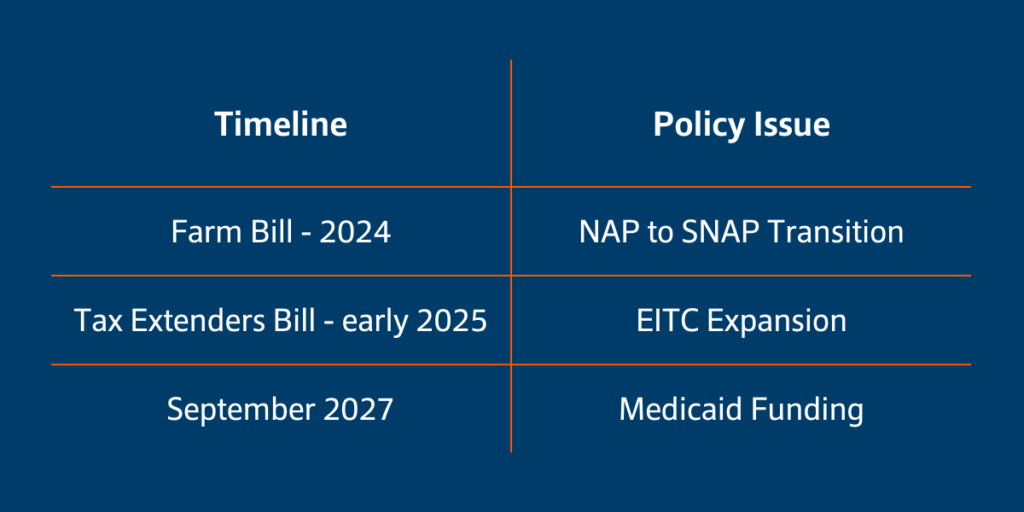
Below is a list of federal policy issues that CNE will pursue over the coming years.
NAP to SNAP

The United States government balances food production and food access for people living in poverty through its Farm Bill, revisited every five years by Congress. In addition to its revisions to aid and subsidies provided to farmers and agricultural corporations due to technological advancements, environmental concerns, and consumer preferences, it is also an opportunity to look at and review the effectiveness of U.S. food security programs. It gives Puerto Rico a unique opportunity to advocate for its own needs.

For many years now, a wide coalition of actors from Puerto Rico and the U.S., both public and private, have come together to push for Puerto Rico’s full incorporation into the Supplemental Nutrition Assistance Program (SNAP). As a result of that collection of efforts, the Senate Chairwoman for the Agriculture Committee recently released a framework for the new legislation that authorizes Puerto Rico to transition to SNAP, allocates necessary funding to be able to do so, and mandates a Government Accountability Office (GAO) study on the adequacy and availability of nutrition programs in isolated US states and territories. This release, a response to the House proposal, aims to foster bipartisan collaboration for a successful legislative outcome, and we’re committed to being part of the process.

Click here to read the latest column by Sergio M. Marxuach, Policy Director.

Changes to the Tax Code

In December 2017, Congress passed the Tax Cuts and Jobs Act of 2017, known on the Hill as the TCJA.  While certain provisions of the TCJA were made permanent, many are slated to expire by December 31, 2025. This means Congress will need to negotiate another major tax package in 2025, opening the door for Puerto Rico to advocate for necessary federal tax adjustments.

One area we are paying close attention to is the federal supplement to the local Earned Income Tax Credit (EITC). In 2021, the American Rescue Plan Act (ARPA) included an annual, federal supplement that bolstered Puerto Rico’s local EITC program. Nationally, the EITC plays a crucial role in enhancing economic security, improving children’s educational performance and attainment, and enhancing overall family well-being.

The last three years have been somewhat experimental for Puerto Rico as it evaluates the uptake and effectiveness of the recent expansion. Early data demonstrates that nearly 125,000 individuals that directly benefited from the EITC have been able to overcome poverty because of the EITC and other important anti-poverty programs included in ARPA. This success provides a compelling case for expanding the program further.

Given how critical this program has been to alleviating poverty and boosting labor force participation, we will be working with other partners to prioritize increased funding for Puerto Rico’s EITC in the upcoming year’s tax bill discussions.  participation, we will be working with other partners to prioritize increased funding for Puerto Rico’s EITC in the upcoming year’s tax bill discussions. 

Medicaid Funding

Over the years, the federal government has financed healthcare programs for the poor differently between the U.S. states and its territories. After years of advocacy and unproductive cycles of insufficient block grants, Congress finally took action in 2022 by authorizing a five-year funding package with the highest-ever allotments for Puerto Rico’s Medicaid program. These unprecedented funding levels have allowed Puerto Rico to expand eligibility and services to those in greatest need.

While the five-year package represents an improvement over the previous short-term patches Puerto Rico had grudgingly become accustomed to, it remains temporary and is set to expire in September 2027. It was also not sufficient to cover all the programs provided in the U.S. For example, it does not cover long-term services and support (LTSS) and non-emergency medical transportation for Puerto Rico’s increasingly aging population.

We will continue to stress the importance of providing Puerto Rico with equitable, permanent, and open-ended Medicaid funding to ensure the health and well-being of its residents.

In addition to Puerto Rico’s inclusion in critical health and economic programs available to residents in the U.S. (territories not included), there are many other investigations and good policy we will dive deeper into and pursue.

Food Security for Puerto Rico Now

Food Security for Puerto Rico Now

Published on May 8, 2024 / Leer en español

Sergio portrait
Policy Director
SHARE

Federal nutrition assistance for residents of Puerto Rico began in November 1974 under the old Food Stamp Program (“FSP”). Initially and during the first eight years of the implementation of the FSP in Puerto Rico it functioned just like in the United States: all eligible participants received coupons to purchase food items on the island.

In 1982, though, Congress arbitrarily replaced the FSP in Puerto Rico with an annual block grant through the Nutrition Assistance Program (“NAP”). The annual block grant was initially capped at $825 million or 75% of the projected FSP funding need for Puerto Rico in 1982. This cap was kept in place for the first five years of the program.

During FY2021, core block grant funding for the NAP was approximately $2 billion and provided benefits to 1.5 million low-income individuals. This core funding was supplemented with special one-time appropriations in 2017, after Hurricane María, and in 2020 due to the Covid-19 pandemic. Today, Puerto Rico’s block grant is $2.9 billion due to recent federal increases in the Thrifty Food Plan, which also determines nutrition benefits under the Supplemental Nutrition Assistance Program (“SNAP”). The USDA estimates that if Puerto Rico were currently under SNAP, it would receive at least an additional $1 billion in nutrition assistance.

While the recent increase in the annual amount allocated to Puerto Rico was sorely needed and greatly appreciated, the NAP’s capped block grant structure still results in stricter eligibility requirements and lower maximum monthly benefits when compared to the SNAP. According to a 2022 Feasibility Study commissioned by the Food and Nutrition Service (the “Feasibility Study”), while the NAP asset limits are higher than the SNAP asset limits, the result is the implementation of drastically lower net income limits and benefit levels in Puerto Rico. For example, to receive benefits today a single-person household in Puerto Rico must have a monthly net income below $691 compared with $1,251 under the SNAP in the states. The maximum benefit level for the same size household is $183 in Puerto Rico compared to $291 in the States.

Furthermore, the current NAP block grant is not needs-based, does not allow for access to emergency benefits after natural disasters (D-SNAP), and precludes Puerto Rico from accessing other programs and initiatives available to the states, D.C., Guam, and USVI through the SNAP. These disparities place families living in Puerto Rico in an unacceptable and indefensible situation.

Puerto Rico definitely needs additional nutrition funds but consideration of just another increase in NAP funding, without providing for a systematic transition to the SNAP, would be insufficient and continue to subject island residents to funding gaps, food insecurity, and second-class citizenship status. It is not the long-term solution to which Puerto Ricans, as U.S. citizens, have a right through this Farm Bill.

The Feasibility Study claims the NAP was created “in part to control nutrition assistance costs in Puerto Rico”, but we disagree. There is no rational relationship between the general desire or necessity to cut the costs of any given federal program and the decision to cut only those benefits accruing to a particular group of persons. In this sense, the decision to implement the NAP in Puerto Rico as a capped block grant is yet another example in a long history of Congressional discrimination against territories based on a “racialized order of territorial exceptionalism”, as documented by Professor Andrew Hammond from the University of Florida law school.

While current members of Congress are not to blame for the inequities visited on Puerto Rico over the last forty-odd years due to the discriminatory and unfair provisions of the NAP, they are both legally and morally responsible to amend and correct them and have an obvious opportunity to do so now.

There are currently two bills pending before Congress to rectify the discriminatory and unequal treatment of Puerto Rico under the NAP. Both H.R. 253 and S. 949 set out a timeline and process for Puerto Rico’s transition from the NAP into the SNAP, which would address systemic flaws in the NAP block grant funding. A broad coalition of over 80 organizations representing private industry, respected national non-profits, academic think tanks, and religious organizations has been strongly advocating for the inclusion of the language set forth in H.R. 253/S. 949 in the text of the Farm Bill currently being drafted.

As members of Congress consider the text of the Farm Bill, we remind them of Matthew Croasmun and Miroslav Volf’s beautiful words in The Hunger for Home: Food and Meals in the Gospel of Luke: “A loaf of bread is the most ordinary and most miraculous of things…It results from and sustains a set of relations between God, peoples, and the whole of creation. All three are made at home with one another in bread that is not just bread.” Simply put, food is not merely food and bread is never just bread. They are also physical representations of a transcendent relationship. Unfortunately, under the NAP, low-income Puerto Ricans are unable to fully participate in this physically and spiritually nourishing meal.

Congress should not make U.S. citizens in Puerto Rico wait to receive a fair portion of their daily bread until the next Farm Bill deliberations in 2028. The time for Congress to discharge its legal and moral obligations to Puerto Rico is now.

Healthcare Justice for Puerto Rico

Healthcare Justice for Puerto Rico

Published on December 21, 2022 / Leer en español

Sergio portrait
Policy Director
Ayan Goran
Policy Analyst at the Georgetown Center on Poverty and Inequality
SHARE

It has become a bit of an end of year tradition: Congress is scrambling again to enact legislation to keep the federal government open. Unfortunately for the U.S. citizens of Puerto Rico, Congress is also scrambling to provide additional funding for the island’s Medicaid program and avoid a so-called “Medicaid cliff.”

Medicaid is a core pillar of the U.S. healthcare infrastructure that helps ensure that everyone — regardless of income — can have access to quality care. This support helps build a stronger, healthier future for all of us. It is financed partly by each state and partly by the federal government. Importantly, the total amount of federal support for Medicaid in the states and D.C. is based on need: it expands and contracts as the total number of eligible people changes.

But in Puerto Rico, Medicaid is financed differently than it is in the states. For decades the federal government treated Puerto Rico unequally, covering only half the share of the cost (in comparison to a maximum of 83 percent for states). And the amount of federal funding is subject to an extremely low, arbitrary and unstable cap set by Congress. As a result, Puerto Rico was forced to spend all its federal Medicaid funding well before the end of the fiscal year. The territorial government then made the difficult decision to use a disproportionate amount of local funding that would otherwise be available to address other critical needs, just to keep Medicaid working.

The perverse result is that one of the poorest jurisdictions in the United States is treated as one of the wealthiest states for Medicaid funding — a program specifically designed to help low-income individuals and families access quality medical care.

Congress has made some progress in recent years toward improving Medicaid funding for Puerto Rico. In 2011 the Patient Protection and Affordable Care Act increased the federal share to 55 percent and approved additional supplemental funding for several fiscal years. After Hurricane María in 2017, Congress temporarily increased the federal share to 100 percent and allocated additional funding to fully finance the program for two fiscal years. Since 2019, however, both the federal share percentage and the amount of federal funding have fluctuated significantly, and that is the essence of the current problem.

In the absence of a permanent solution to address Puerto Rico’s Medicaid needs, the island’s government faces recurring funding “cliffs,” every 18 months or so, which make long-term healthcare planning almost impossible. This uncertainty regarding Medicaid funding for Puerto Rico is also emblematic of a larger problem: the U.S. territorial classification system. This system is a legally sanctioned discriminatory scheme under which the American citizens of the U.S. territories have been treated as separate and unequal subjects — in data collection, health care, voting, and more — for far too long. The foreseeable outcomes in Puerto Rico have been a rise in preventable premature deaths, increased use of expensive emergency room care, and more migration to the mainland.

Ideally, Congress would eliminate all Medicaid funding caps for Puerto Rico and the other territories and align their matching rates with those applicable to the states. Currently, the House leadership is considering a proposal to be included in a year-end omnibus bill that is a step in the right direction. It would set the federal share of the costs for Puerto Rico at 76 percent and allocate the corresponding amounts to fund the program at that level during the next five fiscal years. After 2027, the federal share would increase with inflation–but it still wouldn’t expand and contract with need.

This proposal is an encouraging development. If enacted, it would provide some stability to Puerto Rico by setting forth clear funding levels for the next five years, allowing Puerto Rico to sidestep the painful and potentially tragic need to cut back coverage or reduce the number of participants. Perhaps most important of all, it would deliver a measure of long-delayed justice to the 1.3 million Puerto Ricans who rely on Medicaid to pay for quality, affordable healthcare.

But the proposed five-year deal does not address the real problem with Medicaid for Puerto Rico. It falls short of parity with the states and it perpetuates the separate and unequal treatment of Medicaid participants in the territories, who are being told once again to accept a “good enough” deal. We hope Congress realizes soon that the U.S. citizens in Puerto Rico deserve better treatment than that.

This column was originally published in The Hill on December 21, 2022.

A Year Marked by Fiscal Progress and Economic Uncertainty

A Year Marked by Fiscal Progress and Economic Uncertainty

Published on December 18, 2022 / Leer en español

Sergio portrait
Policy Director
SHARE

This year is ending with a balance of fiscal progress and economic uncertainty. In the fiscal arena, the most important news was the implementation of the central government’s Plan of Adjustment (“POA”) on March 15. The POA cut debt by 50%, a significant amount indeed, and eliminated the annual fluctuation in debt service.

Equally important is the completion of the Title III process that changes the narrative about Puerto Rico from one emphasizing a bankrupt government to one that highlights the stability of public finances. It would be premature, however, to conclude that the POA has achieved its objectives successfully since it has only been in effect for nine months, less than a full budget cycle.

The pending debt restructuring is that of the Puerto Rico Electric Power Authority (“PREPA”). Part of the problem with that negotiation is that the parties have diametrically opposed positions on the scope of the lien that the bondholders claim to have on PREPA’s revenues and the legal remedies that the bondholders are requesting. These are matters of law that will eventually be adjudicated by the court. What is clear is that any settlement with PREPA’s creditors will lead to an increase in the electricity bill for consumers. PREPA has not serviced its debt for more than five years. Therefore, even if that debt is reduced by a significant amount, debt service will have to be added to consumer bills. This will lead to increases, unless PREPA manages to reduce other costs by an amount equal to the annual payment due on the renegotiated debt. We very much doubt that PREPA will be able to achieve such cost reductions.

In terms of the real economy, the Planning Board indicates that Puerto Rico’s economy grew 1.0%, at constant prices, during 2021. That is certainly good news after so many years of contraction. A large part of that growth is due to an increase in federal transfers to Puerto Rico for the reconstruction. According to an analysis by Juan Castañer of Estudios Técnicos, net federal transfers to Puerto Rico (after subtracting payments made by Puerto Ricans) increased from $16.453 billion in 2017 to $21.294 billion in 2021, an increase of $4.841 billion, or 29%.

It seems, then, that the reconstruction of the real capital stock destroyed by natural phenomena is what is driving economic activity on the island. It is foreseeable that this pattern will continue for the duration of the reconstruction. According to figures released by COR3, out of a total of $73.640 billion allocated to address the damage caused by Irma, Maria and the earthquakes, only $21.442 billion, or 29%, has been spent. Therefore, an increase in that spending over the next few years will have a positive impact on the economy. What we do not yet know is (1) whether that spending will be made according to current projections and (2) what will happen to our economy once those non-recurring funds are depleted.

The lack of certitude regarding the reconstruction is just one of the sources of uncertainty that characterize the economic outlook. In the short term, inflationary pressures dominate economic headlines throughout the world. Rising prices are a consequence of the economic effects caused by the pandemic, the public policies implemented to address those economic effects, especially the massive injection of liquidity into the global financial system during 2020 and 2021, and Russia’s invasion of Ukraine.

Central banks have responded by raising interest rates. As rates increase, demand for credit decreases because car loans, mortgages and credit card balances become more expensive. In addition, some new investments in machinery, equipment and construction may not be financially feasible given the rising cost of capital. The risk is that the dramatic rise in interest rates will produce a recession in advanced economies in 2023.

Geopolitical changes are the other major source of uncertainty. The war in Ukraine has affected the prices of natural gas, oil, and food products. In addition, the apparent convergence of the geopolitical interests of Russia, China and Iran have generated a robust response from Western powers. NATO has been strengthened and has two new members. The United States has also taken the lead in strengthening other alliances, participating in the Quadrilateral Security Dialogue with Australia, India, and Japan; in a trilateral pact with Australia and the United Kingdom (“AUKUS”); and in the I2U2 grouping, which includes India, Israel, and the United Arab Emirates. The main risk is that the world will again be divided into rival blocs as it was during the Cold War.

The economic effects of these geopolitical events are already being felt in the global economy. The European Union and the United States have concluded that the benefits of economic integration and interdependence have been reduced relative to the national security risks of dependence on strategic rivals. Europe is seeking to diversify its energy suppliers to reduce its dependence on Russia, while U.S. multinational companies are reducing their operations in China to diversify, regionalize, and relocate their supply chains. These changes in global production patterns represent an opportunity for Puerto Rico to attract new foreign direct investment.

In short, Puerto Rico is at an economic inflection point. The convergence of the end of the government’s bankruptcy process, the Biden administration’s support for the reconstruction, and the stabilization of economic activity after the pandemic has created an opportunity for Puerto Rico to get its economy back on track. On the other hand, there are certainly substantial risks. Inflation is at its highest level in forty years. Fuel and energy costs have skyrocketed due to the Russian invasion of Ukraine. And rising interest rates will tighten credit and slow down growth.

Our net assessment, however, is that the upside factors currently outweigh the downside risks, primarily due to projected federal investment in infrastructure. But that investment is not entirely within our control and it is not recurrent. It is imperative, then, that Puerto Rico begin to design a medium- and long-term economic growth strategy for 2023.

The Spanish language version of this column was originally published in El Nuevo Día on December 18, 2022.

CNE Review – November 2022

Published on November 17, 2022 / Leer en español

See all editions of the
CNE Review
SHARE

In This Issue

We present a summary of the current state of U.S. politics after the midterm elections and what the outlook is for Puerto Rico.

We also include some highlights of our most recent event, Puerto Rico’s Colonial Conundrum.

Insights + Analysis from CNE

The Midterm Election and Its Implications for Puerto Rico

By Sergio M. Marxuach, Policy Director

The Big Picture

Election results in the U.S. midterm elections are still coming in as we write this CNE Review but the big picture is fairly clear.

The Democrats apparently will lose control of the House. On the other side of the Capitol, contrary to expectations, the Democrats have managed to scratch out victories in Arizona and Nevada. In Georgia, there will be a second-round election on December 6. So, right now the Democrats control 50 Senate seats and the Republicans 49. That margin is enough to control the Senate, given that Vice President Harris would vote to break any ties in favor of the Democrats. It would be a mistake, though, to think that the race in Georgia doesn’t matter. In fact, given how close the midterms have been and the arcane rules of the Senate, it would make a significant difference.

Click here for more on this and what we can expect during the upcoming lame duck session and after New Year’s Day.

Priorities for Puerto Rico

In the immediate term, that is before the end of 2022, the federal legislative priorities for Puerto Rico are:

  • Medicaid: The federal share of the funding for Puerto Rico’s Medicaid program is scheduled to decrease from 76% to 55% on December 16. It is imperative for Puerto Rico’s fiscal stability and the adequate operation of the island’s Medicaid program that this scenario does not come to pass.
  • Hurricane Fiona Disaster Relief Funding: The Pierluisi Administration has preliminarily estimated damages caused by Hurricane Fiona at approximately $10 billion. That money would need to be appropriated by Congress, hopefully through the expected emergency appropriations supplemental bill to be taken up during the lame duck session.

Broader Implications for Puerto Rico

Given the new correlation of forces in Washington, Puerto Rico’s strategy in D.C. will have to shift from one seeking parity in federal funding for programs such as Medicare and Supplemental Security Income, to one of defending what we have already gained. For example, Rep. Cathy McMorris Rodgers (WA) is expected to become Chairwoman of the House Energy and Commerce Committee, which has primary jurisdiction in that chamber over Medicaid. She has already stated her opposition to a Centers for Medicare & Medicaid Services (“CMS”) interpretation of 2019 legislation which provided significantly increased federal annual capped funding for Medicaid to the territories for FY2020 and FY2021. The CMS interpretation extended the duration of the higher Medicaid capped funding beyond FY2021. As Chairwoman of the Energy and Commerce Committee, she may challenge the CMS interpretation and probably seek to lower the amount of capped Medicaid funding available to Puerto Rico.

Congress is also expected at some point during the spring of next year to take up a massive five-year Farm Bill, which will cover everything from farmer subsidies to nutritional assistance. The main Farm Bill policy objective of the government of Puerto Rico and many NGOs on the island is to seek a transition from the current Nutritional Assistance Program to the nationwide Supplemental Nutritional Assistance Program, known as SNAP. The transition to SNAP would entail higher nutritional assistance funding, as well as other benefits, for Puerto Rico. Given the expected new majority in the House, that will certainly be a challenge. With the help of our supporters CNE, and other NGOs, will continue to advocate for this issue.

It would be a mistake, though, to think that there is no space for Puerto Rico to obtain some wins in the federal policy arena. Those policy wins can be achieved if advocacy organizations and the island’s government adapt to the new reality in Washington. That adaptation implies learning to play interstitial politics, navigating between and staying away from the most extreme factions in both parties, while moving towards those members from both parties that are closer to the center. Granted, that is a tight political space given the expected composition of both chambers, but that is where any deals between the Biden Administration and Congress are most likely to be made.

Policy success under the new balance of power in D.C. will also entail learning and using a new language to communicate our message on the Hill. The fact that 55% of Puerto Rican voters in Florida voted for Gov. DeSantis signals that the Puerto Rican community in the states has become ideologically diverse and is not reflexively liberal or progressive. That political change could be very useful when approaching Senators Rubio and Scott or members of the Florida delegation in the House.

These new conditions probably make many people in Puerto Rico quite uncomfortable, perhaps rightly so. But we really don’t have an option given the nature of the political relationship between Puerto Rico and the United States; our nominal representation in Congress; the new political dynamics in Washington; and Puerto Rico’s great economic and social needs. Adapting to the new political conditions in the U.S. is the only strategy likely to be successful in avoiding two years of stagnation and achieving some policy victories in Washington.

CNE Holds Conference on Puerto Rico’s Status Conundrum

On October 21st, CNE held a conference on Puerto Rico’s perennial status problem. However, instead of focusing on the traditional analysis and discourse about this issue, CNE, together with UPR professor Jaime Lluch, decided to apply the lens of comparative political science to Puerto Rico’s colonial dilemma.

Using a comparative perspective would allow the comparison of Puerto Rico’s autonomy with other autonomic entities from around the world; permit the comparison of the U.S. federalist system with other federalist systems; facilitate the analysis of national movements in Puerto Rico with other national movements around the world; provide for the examination of constitutional accommodation in Puerto Rico in a comparative perspective; allow for the use of quantitative methods to compare the degree of Puerto Rico’s self-government with that of other sub-state national entities; and permit the evaluation of options for Puerto Rico’s future in light of normative political theory.

The attendees of the conference heard from several distinguished scholars and political scientists from around the world. The two main panels consisted of Nicola McEwen, Ph.D., from the University of Edinburgh; André Lecours, Ph.D., from the University of Ottawa; Jordi Argelaguet, Ph.D., from the Universidad Autonoma de Barcelona; Rogers M. Smith, Ph.D., from the University of Pennsylvania; André Fazi, Ph.D., from Università di Corsica Pasquale-Paoli; and Héctor López-Bofill, Ph.D., from the Universitat Pompeu Fabra in Barcelona. In addition to these distinguished visitors, Jaime Lluch, Ph.D., from the University of Puerto Rico; and Jennifer Wolff, Ph.D., Deepak Lamba Nieves. Ph.D., and Sergio M. Marxuach from CNE, also participated in the event.

The presentations covered the political status of jurisdictions such as Quebec, Scotland, Barcelona, and Corsica and highlighted many important concerns that Puerto Ricans have discussed for decades. The event, coordinated by CNE’s Madrid Policy Bureau and professor Lluch, was the beginning of a long overdue conversation and represents a novel approach to Puerto Rico’s long-standing political status issue.

To watch the presentations click here.

The Midterm Election and Its Implications for Puerto Rico

The Midterm Election and Its Implications for Puerto Rico

Published on November 16, 2022 / Leer en español

Sergio portrait
Policy Director
SHARE

The Big Picture

Election results in the U.S. midterm elections are still coming in as we write this CNE Review but the big picture is fairly clear. The Democrats apparently will lose control of the House but relative to historical standards and expectations set prior to the election, it could have been worse. Republicans picked up 54 House seats against Bill Clinton in 1994 and 63 seats against Barack Obama in 2010. In contrast, according to Politico, the Republican Party’s internal estimates have them gaining anywhere between 7 and 12 seats in the House. Enough to give them a small majority but clearly a weak performance by historical benchmarks and given President Biden’s low approval ratings and the highest inflation rate since the early 1980s.

Ironically, the thin margin will hand a lot of leverage to fringe elements in the Republican Party. A handful of five or six representatives in the House will have the ability to hold hostage any legislation the leadership wants to puts through. The Republican Freedom Caucus in the House has already stated it will “hold hostage” must-pass legislation, for example, to keep the government open or to raise the debt limit.

In addition, according to the Washington Post, while the MAGA crowd had a bad night on Tuesday, at least 145 “Republican election deniers running for the House had won their races as of Wednesday afternoon”. Here is where things get complicated for the presumptive speaker, Kevin McCarthy. The problem with the MAGA crowd is not that they are conservative or uber-Republican. In fact, they are neither in any ideologically meaningful way. Their real problem is that they live in an alternate reality of conspiracy theories and misinformation uploaded to digital platforms by groups affiliated with Russia and China. How do you even begin to negotiate policy issues with someone who denies reality? I guess we will find out in real time pretty soon.

On the other side of the Capitol, contrary to expectations, the Democrats have managed to scratch out victories in Arizona and Nevada. In Georgia, Raphael Warnock with 49.4% of the vote, is slightly ahead of the Republican challenger, Herschel Walker, who has 48.5% with more than 95% of ballots counted. A third-party candidate has 2.1%. The problem is that Georgia law requires a runoff election if no candidate gets more than 50% of the vote. Given that Warnock is about half a percentage point below that threshold, there will be a second-round election in Georgia on December 6.

So, right now the Democrats control 50 Senate seats and the Republicans 49. That margin is enough to control the Senate, given that Vice President Harris would vote to break any ties in favor of the Democrats. It would be a mistake, though, to think that the race in Georgia doesn’t matter. In fact, given how close the midterms have been and the arcane rules of the Senate, it would make a significant difference.

If the Democrats manage to reelect Sen. Warnock the 51-49 margin will allow them to have clear majorities in the membership of Senate committees, as opposed to splitting them 50/50 with Republicans, which has been the case for the last two years. This would make it easier to push through appointments and legislation because any ties at the committee level are resolved by discharging the matter to the floor. Presumably, that would not be the case if the Democrats have a “clean” majority. It would also significantly decrease the leverage that more conservative Democrats, like Senators Manchin and Sinema, have exercised over the last two years, because Majority Leader Schumer would have the flexibility of losing at least one vote and still be able to move legislation.

In the final analysis, though, a two-vote majority is not a mandate and the slim margin will certainly keep Sen. Schumer busy holding Democrats in line to support the Biden administration’s legislative priorities, but it certainly makes his job just slightly easier.

The Lame Duck Session

In the meantime, Congress is scheduled to return to Washington on November 14 for a month-long lame duck session. Along with conducting leadership elections and determining committee assignments for the 118th Congress, a handful of important legislative priorities will be considered.

Government Funding

The most pressing issue for the returning Congress is passing a bill to fund the federal government for the rest of FY23. Currently, government funding expires on December 16. To avoid a shutdown, Democratic leadership is likely to push a massive omnibus spending package by the end of the year. As has been the case in recent years, this will be the legislative vehicle for all sorts of year-end items legislators want to move before adjourning, a “Christmas Tree” kind of legislation containing all sorts of unrelated items in one bill. Some Republicans are likely to object to the omnibus approach, but it appears that appropriators on both sides of the aisle agree on pushing it through.

Congress is also expected to take up an emergency appropriations supplemental bill during the lame duck session. This legislation will include funding supporting Ukraine and providing assistance to communities impacted by natural disasters.

Healthcare

Several healthcare provisions also expire on December 16. According to analysts at the Prime Policy Group, “among these are largely non-controversial extensions to Medicare and

Medicaid programs”, such as extending funding for:

  • Low Volume Hospitals;
  • The Medicare-Dependent Hospital Program;
  • Programs related to the Public Health Service; and
  • Early childhood programs such as the Maternal, Infant, and Early Childhood Home Visiting (MIECHV) programs and the Promoting Safe and Stable Families (PSSF) program.

Most, if not all of these issues will be addressed in the expected end-of-year omnibus legislation.

Debt Ceiling

The U.S. is expected to hit its debt ceiling at some point next year. This means Congress would have to enact legislation to raise the debt ceiling to allow new borrowing. Traditionally, this was not a controversial issue. According to the U.S. Treasury, “Congress has always acted when called upon to raise the debt limit. Since 1960, Congress has acted 78 separate times to permanently raise, temporarily extend, or revise the definition of the debt limit — 49 times under Republican presidents and 29 times under Democratic presidents. Congressional leaders in both parties have recognized that this is necessary.”

Recently, however, top Republican lawmakers have suggested using the debt legislation as leverage to get some concessions policy from the Biden Administration. This type of legislative brinksmanship, which was also used against President Obama, is quite dangerous. Failure to raise the debt limit would lead to a default by the United States with potentially catastrophic financial consequences. According to a study by Moody’s analytics published last year when the U.S. hit its previous debt limit, such a default  “would cost the U.S. economy up to 6 million jobs, wipe out as much as $15 trillion in household wealth, and send the unemployment rate surging”. So, in general, it is not a good idea to play petty politics with this issue.

That’s why some Democrats are pushing to have the debt limit increased during the lame duck session, using the complicated reconciliation procedures which require only a simple majority to close debate and move to a final vote in the Senate. The problem is that reconciliation is a time-consuming procedure and some Democrats may balk at investing precious floor time on an issue that while extremely important is not urgent. That’s why we think there is only a slim chance that Congress will take up this issue during the lame duck, but the political calculation is complex. Kicking the can until next year on the debt limit essentially hands the financial equivalent of a nuclear bomb to the MAGA crowd in the House. Financial markets around the world may have an adverse reaction to that decision.

After New Year’s Day

If the most likely scenarios for the House and the Senate materialize, with the Republicans running the House with a slight majority and the Democrats holding the Senate by the thinnest of threads, the following are some of the things we can expect when the calendar turns and the new year begins:

  • Complex New Political Dynamics in D.C.: The Biden legislative agenda will stall. The opportunities for major legislation will be few and far between, if any. Nominations will keep moving through the Senate, but we can expect hard negotiations around deadlines for must-pass legislation to keep the government open or raise the debt limit. Given the expected irrationality of the MAGA faction in the House, Senate Republicans will hold most of the leverage during these negotiations. Legislative gridlock, though, will be the order of the day.
  • Forceful Executive Action: In the absence of Congressional space to enact significant legislation, the Biden Administration will probably try to maximize the powers of the Executive Branch, through executive orders and the enactment of sweeping new rules and regulations. Republicans will challenge many of these actions in the courts, with the hope that the majority of Republican-appointed Justices in the Supreme Court will eventually invalidate some of them.
  • Hand-to-Hand Political Combat in the House: The MAGA faction in the House has already made it clear they will use Congressional oversight powers to conduct investigations of, and to issue subpoenas to, members of the cabinet and other officials of the Biden Administration. Some have even talked about investigating the president’s son. The reality is that the MAGA crowd doesn’t really believe government can do much good and could care less about most substantive policy issues. If their primary objective is to “own the libs”, then we can expect plenty of hostile investigations and high-risk legislative brinkmanship during the next two years. That will make for some hard-hitting tweets but would be terrible for American democracy.

Priorities for Puerto Rico

In the immediate term, that is before the end of 2022, the federal legislative priorities for Puerto Rico are:

  • Medicaid: The federal share of the funding for Puerto Rico’s Medicaid program is scheduled to decrease from 76% to 55% on December 16. It is imperative for Puerto Rico’s fiscal stability and the adequate operation of the island’s Medicaid program that this scenario does not come to pass.
  • Hurricane Fiona Disaster Relief Funding: The Pierluisi Administration has preliminarily estimated damages caused by Hurricane Fiona at approximately $10 billion. That money would need to be appropriated by Congress, hopefully through the expected emergency appropriations supplemental bill to be taken up during the lame duck session.

Broader Implications for Puerto Rico

Given the new correlation of forces in Washington, Puerto Rico’s strategy in D.C. will have to shift from one seeking parity in federal funding for programs such as Medicare and Supplemental Security Income, to one of defending what we have already gained. For example, Rep. Cathy McMorris Rodgers (WA) is expected to become Chairwoman of the House Energy and Commerce Committee, which has primary jurisdiction in that chamber over Medicaid. She has already stated her opposition to a Centers for Medicare & Medicaid Services (“CMS”) interpretation of 2019 legislation which provided significantly increased federal annual capped funding for Medicaid to the territories for FY2020 and FY2021. The CMS interpretation extended the duration of the higher Medicaid capped funding beyond FY2021. As Chairwoman of the Energy and Commerce Committee, she may challenge the CMS interpretation and probably seek to lower the amount of capped Medicaid funding available to Puerto Rico.

Congress is also expected at some point during the spring of next year to take up a massive five-year Farm Bill, which will cover everything from farmer subsidies to nutritional assistance. The main Farm Bill policy objective of the government of Puerto Rico and many NGOs on the island is to seek a transition from the current Nutritional Assistance Program to the nationwide Supplemental Nutritional Assistance Program, known as SNAP. The transition to SNAP would entail higher nutritional assistance funding, as well as other benefits, for Puerto Rico. Given the expected new majority in the House, that will certainly be a challenge. With the help of our supporters CNE, and other NGOs, will continue to advocate for this issue.

It would be a mistake, though, to think that there is no space for Puerto Rico to obtain some wins in the federal policy arena. Those policy wins can be achieved if advocacy organizations and the island’s government adapt to the new reality in Washington. That adaptation implies learning to play interstitial politics, navigating between and staying away from the most extreme factions in both parties, while moving towards those members from both parties that are closer to the center. Granted, that is a tight political space given the expected composition of both chambers, but that is where any deals between the Biden Administration and Congress are most likely to be made.

Policy success under the new balance of power in D.C. will also entail learning and using a new language to communicate our message on the Hill. The fact that 55% of Puerto Rican voters in Florida voted for Gov. DeSantis signals that the Puerto Rican community in the state has become ideologically diverse and is not reflexively liberal or progressive. That political change could be very useful when approaching Senators Rubio and Scott or members of the Florida delegation in the House.

These new conditions probably make many people in Puerto Rico quite uncomfortable, perhaps rightly so. But we really don’t have an option given the nature of the political relationship between Puerto Rico and the United States; our nominal representation in Congress; the new political dynamics in Washington; and Puerto Rico’s great economic and social needs. Adapting to the new political conditions in the U.S. is the only strategy likely to be successful in avoiding two years of stagnation and achieving some policy victories in Washington.

Coordinating the reconstruction

Coordinating the reconstruction

Published on October 7, 2022 / Leer en español

Sergio portrait
Policy Director
SHARE

Hurricane Fiona once again laid bare the substantial vulnerability of Puerto Rican society. The impact of a weather event is not only a function of its force or potency, it is also a function of the pre-existing level of vulnerability of a given society. Puerto Rico was extremely vulnerable before Fiona since only 30% of all permanent reconstruction work related to Hurricane Maria had begun; thousands of people still lived in flood-prone areas; and essentially nothing had been done to strengthen the power grid and other critical infrastructure or increase their resilience. Given all that, the key question to ask is: why, five years after Hurricane Maria, is the reconstruction process so far behind?

This question is particularly relevant in the case of Puerto Rico’s electricity system. Over the past eight years, Puerto Rico has passed laws and adopted state-of-the-art regulations in the energy policy sector. In addition, the federal government has committed almost $12 billion for the reconstruction of the grid. Therefore, we have clear public policy objectives and the money to achieve them. The obvious question, then, is what is the flaw?

The short answer is that even before Fiona struck, the lack of coordination between the federal government, Puerto Rico’s government agencies, and the island’s municipalities was evident. For example, at a September 15 public hearing in Congress, representatives from FEMA, the GAO, and COR3, could not agree on the number of long-term projects underway and the amount of money that had been spent to strengthen the power grid.

The FEMA representative emphasized that it had committed some $9.5 billion for the long-term reconstruction of the network; while the GAO representative pointed out that of that amount only about $40 million had been spent; shortly thereafter, however, the director of COR3 described as “progress” that some $183 million had been spent on the reconstruction of the grid. It is obvious, then, that the parties are either not speaking the same language, or using the same definitions, or both. There is a clear lack of communication, which ultimately requires coordination.

In addition, in the case of the power grid, there appears to be no agreement on what the plan is to rebuild it. The Puerto Rico Energy Bureau argues that the grid should be rebuilt according to Puerto Rico’s Integrated Resource Plan (“IRP”), while PREPA appears to be working to implement a different plan called the “Ten Year Modernization Plan” and LUMA appears to be working on its own “System Remediation Plan.” Likewise, the federal Department of Energy (“DOE”) is currently working on another grid modernization plan for Puerto Rico, which should be completed by the end of 2023.

It is important to note that while the IRP establishes the legal requirements for the modernization and operation of the grid over the long term (twenty years), it was not written specifically for Maria’s reconstruction and recovery process. On the other hand, the plans submitted by PREPA and LUMA assume a shorter time frame and are proposals made specifically in relation to the ongoing reconstruction process. The DOE initiative appears to be an attempt to present a roadmap for achieving 100% of generation using renewable sources by 2050. Clearly, then, there is a failure of coordination, because while these plans have partial overlaps and intersect in some respects, they are based on different assumptions, have different implementation timelines, and, in the end, seek to achieve different goals.

President Biden recently visited Puerto Rico and announced that the DOE would be in charge of coordinating the work of the federal agencies to accelerate the electricity grid’s reconstruction. Even though we don’t have all the details this seems to be a step in the right direction. However, we believe the current confluence of events calls for President Biden to take bold action and order the creation of an entity similar to the Hurricane Sandy Rebuilding Task Force, which was created by President Obama under Executive Order 13632 of 7 December 2012 and encompass the entire reconstruction process, not just the energy sector.

A Puerto Rico Recovery Task Force would: have an explicit mandate to coordinate recovery efforts among and between the federal agencies and among and between the federal government and the government of Puerto Rico; provide for the inclusion of Puerto Rican elected officials at all levels and their representatives, including the COR3, through an advisory group; promote subsidiarity and inclusiveness by engaging local stakeholders, municipalities, community organizations, NGOs active in Puerto Rico, and business leaders; and strengthen the local economy by ensuring that residents of Puerto Rico and local business enterprises are hired on a priority basis.

In several weeks we will move on from the immediate response to Hurricane Fiona to planning for the reconstruction of the damage caused by that natural phenomenon. When the cameras are turned off, the international media stops covering Puerto Rico, and life on the island begins to resume its daily rhythms, it is imperative that we not forget those who lost their homes, the communities that were left inaccessible, and the small business owners who lost everything. At this juncture, the need to carefully define precise planning, coordination and execution frameworks, and to improve the flow of information, becomes clear. In other words, an entity is needed to comprehensively coordinate and manage Puerto Rico’s recovery.

This column was originally published in Spanish in El Nuevo Día on October 7, 2022.

The Help Puerto Rico Needs

The Help Puerto Rico Needs

Published on October 5, 2022 / Leer en español

Sergio portrait
Policy Director
SHARE

On September 18, on the eve of the fifth anniversary of Hurricane Maria and as Puerto Rico prepared to commemorate the lives lost and reflect on the devastation caused by one of the strongest storms ever seen in these latitudes, Mother Nature played one of her unexpected tricks by sending Hurricane Fiona our way. Fiona hit the island as a Category 1 hurricane with sustained winds of approximately 85 miles per hour. The storm is estimated to have dumped 1 trillion gallons of water on Puerto Rico over 48 to 60 hours. Damage from flooding and the storm surge was severe, life-threatening in some cases, and widespread.

Hurricane Fiona once again laid bare the substantial vulnerability of Puerto Rican society. The impact of a weather event is not only a function of its force or potency, it is also a function of the pre-existing level of vulnerability of a given society. Puerto Rico was extremely vulnerable before Fiona because only 30% of all permanent reconstruction work related to Hurricane Maria had begun; thousands of people still lived in flood-prone areas; and essentially nothing had been done to strengthen the power grid and other critical infrastructure or increase their resilience. Given all that, the key question to ask is: why, five years after Hurricane Maria, is the reconstruction process so far behind?

The short answer is that five key challenges to Puerto Rico’s reconstruction process have not been addressed, namely: (1) the lack of effective coordination among the agencies in charge of reconstruction, (2) poorly designed public participation platforms, (3) superficial transparency efforts, (4) the failure to implement adequate oversight mechanisms, and (5) the extremely slow disbursement of reconstruction funds.

Even before Fiona struck, the lack of coordination between the federal government, Puerto Rico government agencies, and the island’s municipalities was evident. For example, at a September 15 public hearing in Congress, representatives from FEMA, the GAO, and Puerto Rico central office for reconstruction, known as “COR3”, could not agree on the number of long-term projects underway and the amount of money that had been spent to strengthen the power grid. The FEMA representative emphasized that it had committed some $9.5 billion for the long-term reconstruction of the network; while the representative of the GAO pointed out that of that amount only about $40 million had been spent; shortly thereafter, however, the director of COR3 described as “progress” that some $183 million had been spent on the reconstruction of the grid. It is obvious, then, that the parties are either not speaking the same language, or using the same definitions, or both. There is a clear lack of communication, which is ultimately a coordination failure.

The damage caused by Hurricane Fiona will add another layer of complexity to what was already a difficult and complicated endeavor. We are now faced with the challenge of managing three different types of projects: projects to repair the damage caused by Maria and that did not suffer additional damage from Fiona; projects to repair the damage caused by Fiona; and projects that were already underway to repair damage caused by Maria and that were affected by Fiona. Therefore, another reconstruction and recovery process begins parallel to the one that was already taking place, but which must be synchronized with the one already going on, to avoid delays, the duplication of efforts, and the misuse of public funds.

Paradoxically, this complicated situation also provides us with an opportunity to rethink key plans and programs; identify existing deficiencies; and take effective actions to remediate them. In several weeks we will move on from the immediate response to Hurricane Fiona to planning for the reconstruction of the damage caused by that natural phenomenon. When the cameras are turned off, the international media stops covering Puerto Rico, and life on the island begins to resume its daily rhythms, it is imperative that we not forget those who lost their homes, the communities that were left inaccessible, and the small business owners who lost everything. At this juncture, the need to carefully define precise planning, coordination and execution frameworks, and to improve the flow of information, becomes clear. In other words, an entity is needed to comprehensively coordinate and manage Puerto Rico’s recovery.

President Biden recently visited Puerto Rico and expressed his support and solidarity with all those who have suffered so much since Hurricane Maria. That support is greatly appreciated by all in the island. However, we believe the current confluence of events calls for President Biden to take bold action and order the creation of an entity similar to the Hurricane Sandy Rebuilding Task Force, which was created by President Obama under Executive Order 13632 of 7 December 2012.

A Puerto Rico Recovery Task Force would: have an explicit mandate to coordinate recovery efforts among and between the federal agencies and among and between the federal government and the government of Puerto Rico; provide for the inclusion of Puerto Rican elected officials at all levels and their representatives, including the COR3, through an advisory group; promote subsidiarity and inclusiveness by engaging local stakeholders, municipalities, community organizations, NGOs active in Puerto Rico, and business leaders; and strengthen the local economy by ensuring that residents of Puerto Rico and local business enterprises are hired on a priority basis.

That is the help Puerto Rico needs.

This column was originally published in The Hill on October 5, 2022.