CNE Review – September 2022 – 2

Published on September 29, 2022 / Leer en español

See all editions of the
CNE Review
SHARE

In This Issue

Hurricane Fiona has opened a window of opportunity for government officials in Washington, D.C. and Puerto Rico to streamline the ongoing Hurricane María recovery process and to correctly frame the Hurricane Fiona response.

In this Review, we will emphasize the need for: (1) creating a distinct recovery coordination mechanism: the Puerto Rico Recovery Task Force; (2) implementing specific principles that allow for reflection, flexibility, and adaptability; and (3) executing some key policy priorities to promote equitable economic growth and enhancing local capacity.

In advocating for the Puerto Rico Recovery Task Force, we have identified a very specific and particular kind of coordination mechanism that satisfies a discrete set of procedural, equity, and inclusion principles. CNE would not support any similar entity that does not satisfy the principles or fails to implement the policy priorities stated here.

For the sake of clarity and the avoidance of any doubt, we are not advocating for the “federalization of the recovery process” (whatever that may mean); the appointment of a “recovery czar” in the White House; or the “takeover” of the recovery process by the Fiscal Oversight and Management Board.

To achieve a just recovery, Puerto Rico needs coordination and oversight that works — not punitive measures. Successful recoveries require ongoing deliberation and dialogue between all involved stakeholders to ensure that all relevant perspectives are heard and have a chance to influence the process. Moreover, appointing a “recovery czar” or “federalizing” the process would not provide opportunities for local capacity-building.

When an isolated office dictates the recovery process from the top down, the opportunity for local actors to be involved in decision-making and learn key lessons in recovery management is lost. Centralizing the recovery also centralizes information flows, and can pose a threat to accountability and transparency if the newly created entity is not answerable to other actors involved in the recovery.

Click here to read the complete Policy Brief or continue reading for a summary.

–Sergio M. Marxuach, Editor-in-Chief

Insights + Analysis from CNE

By Sergio M. Marxuach, Policy Director

With contributions from:
Deepak Lamba-Nieves, Ph.D. – Research Director
Francis G. Torres – Senior Policy Analyst

A Failure to Communicate

Disaster recovery efforts are usually fraught with uncertainty and complexity at every level —economic, political, and emotional — and also stress-test the capacity of local governments and relief organizations to respond and advance reconstruction efforts in a prompt and equitable fashion. Rebuilding devastated communities under a compressed timeframe, often juggling competing demands and problems that arise on a daily basis, and that are equally urgent, can prove challenging even in the best-prepared jurisdictions.

In addition, at any given time in a post-disaster context, there are many actors working rapidly and independently, which need to coordinate their actions while relying on imperfect information, and their interactions and intersections are important throughout every stage of the process.

Unfortunately, in Puerto Rico after Hurricane María, this coordination process has been flawed, at best. Click to read about the communication and coordination challenges with which Puerto Rico has been contending.

At this juncture of Puerto Rico’s recovery, the haze surrounding the status of the recovery process highlights the need to carefully define precise planning, coordination and implementation frameworks, and improve the flow of information. In other words, there is a need for an entity to comprehensively coordinate and manage Puerto Rico’s recovery. 

Statement of Principles

As we stated five years ago, CNE believes that any entity or mechanism designed to manage the recovery process should comply with the following principles:

  • Promote coordination and cooperation
  • Legitimacy — Provide a forum for the participation of the democratically elected government of Puerto Rico
  • Comply with the principle of subsidiarity
  • Inclusiveness — Provide for the participation of stakeholders from the private and the NGO sector
  • Maximize the economic impact and strengthen the local economy

Click to read more about these principles.

Policy Priorities for the Recovery

In keeping with the principles above, CNE has identified three policy priorities to ensure that the next phase of the recovery process promotes equitable economic growth and enhances local capacity.

These priorities incorporate best practices from the recovery processes in New Orleans and New York in the aftermath of Hurricanes Katrina and Sandy, respectively, as well as lessons learned from the Hurricane María response through CNE’s ReImagina Puerto Rico project

  • The recovery requires a “bottom-up”, comprehensive, and unified planning effort,
  • Municipalities need to be engaged, and
  • Island contractors need to be prioritized in the recovery process.

Click to read more about these priorities. 

A Proposal to Implement Principles and Policy Priorities for the Reconstruction: the Puerto Rico Recovery Task Force

One way to implement these principles and priorities would be by creating an entity similar to the Hurricane Sandy Rebuilding Task Force, which was created by President Obama pursuant to Executive Order 13632 of December 7, 2012 (the “Sandy Executive Order”). Click here to read more on the Sandy Executive Order.

In our view, if a similar entity were to be created to coordinate the recovery process for Hurricanes María and Fiona, it would comply with the principles and policy priorities set forth above because:

  • It would have an explicit mandate to coordinate recovery efforts among and between the federal agencies and among and between the federal government and the government of Puerto Rico.
  • It would provide for the inclusion of Puerto Rican elected officials at all levels and their representatives, including the COR3, through an advisory group.
  • It would promote subsidiarity and inclusiveness by engaging local stakeholders, municipalities, community organizations, NGOs active in Puerto Rico, and business leaders.
  • And it would strengthen the local economy by ensuring that residents of Puerto Rico and local business enterprises are hired on a priority basis.

Conclusion

We have learned much during these five years after Hurricane María, and our recommendations reflect this. If properly designed and implemented the proposed mechanism would facilitate effective coordination among stakeholders at different levels of government, insure adequate public participation in the planning and oversight process, provide greater transparency and accountability in the project selection phase and the use of funds, and speed up the outlay of recovery funds.

To move forward, Puerto Rico must seize this opportunity to evaluate the hurricane recovery process and modify the existing recovery governance framework. In the final analysis, every disaster is “a time of desperate loss, yet also a time of distinct possibility.”[1] Let’s make the most of this time of possibility.

[1] Lynne B. Sagalyn, Power at Ground Zero: Politics, Money, and the Remaking of Lower Manhattan, (Oxford, 2016), p. 5.

CNE in the News

On Our Radar

The Far Right Wins In Italy – Italians went to the polls on September 26th and returned a parliamentary plurality for the Brothers of Italy, a party with fascist roots, and the leader of a right-wing coalition with the League, led by Matteo Salvini, and Forza Italia, headed by Silvio Berlusconi. It is widely expected that this coalition will ask the leader of the Brothers, Ms. Giorgia Meloni, to form a government. Meloni has made some headline-grabbing statements questioning the legitimacy of Western-style, liberal democracy. However, as Yascha Mounk writes in The Atlantic, some of that may just be Corona talk at the Cantina. Meloni has already broken with fellow autocrats wanna-bes with respect to their support of the Russian invasion of Ukraine and with their anti-EU stance: Italy receives millions in subsidies from Brussels. However, her policies against immigrants, LGBTT+ rights, Islam, and the “secularization” of Italian society may mean a sharp right turn in terms of domestic Italian politics. For all her bluster, tough, many Italians remain skeptical of Meloni and her party. Mounk quotes a 70-year-old woman as saying: “It’ll fail to get much of anything done. And then it’ll collapse”. We certainly hope she is right.

What’s Breaking Democracy? – “The internationalization of economic and financial relationships has undermined the authority of the nation-state and created the conditions for today’s confluence of global crises. Worse, the unraveling of neoliberalism has led not to a progressive revival, but to something more politically contingent and uncertain”, writes William H. Janeway for Project Syndicate.

The Child Tax Credit is Smart Policy – According to the Center on Budget and Policy Priorities, “the Child Tax Credit expansion drove child poverty sharply downward in 2021. On top of other relief efforts, the expansion helped lower child poverty by more than 40 percent between 2020 and 2021, reaching a record low of 5.2 percent, Census Bureau data released last week show. The credit’s expansion expired at the end of last year, but policymakers can renew this successful poverty-fighting policy in year-end bipartisan tax legislation.”

Puerto Rico Recovery Task Force

Puerto Rico Recovery Task Force

Published on September 28, 2022 / Leer en español

Sergio portrait
Policy Director

With contributions from:
Deepak Lamba-Nieves, Ph.D.
Research Director
Francis G. Torres
Senior Policy Analyst

DOWNLOAD
SHARE

Introduction

On September 18th, on the eve of the fifth anniversary of Hurricane María and as Puerto Rico was preparing to commemorate the lives lost and reflect on the destruction caused by one of the strongest storms ever seen around these latitudes, Mother Nature played one of her devious tricks on us by sending Hurricane Fiona on our way. Fiona hit the island as a category 1 hurricane with sustained winds of around 85 miles per hour. It is estimated the storm poured 1 trillion gallons of water on Puerto Rico over approximately 48 to 60 hours. The damage caused by flooding and the storm surge was serious, life-threatening in some instances, and widespread.

Fiona, therefore, laid bare once again the substantial vulnerability of Puerto Rican society to these kinds of events. For the impact of such a storm is not only a function of its force or strength, it is also a function of a given society’s pre-existing level of vulnerability. Puerto Rico was extremely vulnerable prior to Hurricane Fiona because only 30% of all permanent reconstruction work related to Hurricane María had started; thousands of people still lived in flood-prone areas; and basically, nothing had been done to strengthen the electric grid and other critical infrastructures or increase their resiliency. Given all of that, the key question to ask is: why five years after Hurricane María is the reconstruction process still at such an early stage?

The short answer, as we stressed three years ago, is that we have failed to address five key challenges to Puerto Rico’s recovery process, namely: (1) the lack of effective coordination among stakeholders, (2) poorly designed public participation platforms, (3) superficial transparency efforts, (4) the failure to implement adequate oversight mechanisms, and (5) the extremely slow outlay of recovery funds, especially for long-term permanent works.[1]

The damage caused by Hurricane Fiona will certainly add another layer of complexity on top of what was already a difficult and complicated effort. Ironically, though, it also provides us with an opportunity to rethink key plans and programs; identify existing deficiencies; and take effective actions to remediate them.

This Policy Brief will focus on the lack of effective coordination among the relevant stakeholders, set forth principles to guide the recovery process, present policy priorities for both the emergency response to Fiona and the ongoing reconstruction related to María, and suggest a mechanism for effective coordination among and between all the relevant parties.

A Failure to Communicate

Disaster recovery efforts are usually fraught with uncertainty and complexity at every level —economic, political, and emotional — and also stress-test the capacity of local governments and relief organizations to respond and advance reconstruction efforts in a prompt and equitable fashion. If the scale of the damage provoked by Hurricanes María and Fiona is considered, the complexities of Puerto Rico’s disaster recovery process become evident. All of Puerto Rico suffered massive damage.

Rebuilding devastated communities under a compressed timeframe, often juggling competing demands and problems that arise on a daily basis, and that are equally urgent, can prove challenging even in the best-prepared jurisdictions. After María, these stresses were magnified in Puerto Rico because it was not only managing a large-scale recovery process, it was also simultaneously going through the largest municipal bankruptcy in U.S. history. And now, of course, we have to address the damage caused by Hurricane Fiona.

In addition, at any given time in a post-disaster context, there are many actors working rapidly and independently, while relying on imperfect information, and their interactions and intersections are important throughout every stage of the process. In the aftermath of Hurricane Katrina in New Orleans, post-disaster recovery experts Robert B. Olshansky and Laurie A. Johnson highlighted the importance of overcoming unanticipated problems: “Coordination is critical to recovery, due to many actors working in a compressed time environment and with constrained information flow. The only way to function effectively in a chaotic and uncertain environment is to provide information to actors systematically and coordinate with them regularly.”[2]

The government of Puerto Rico sought to address this issue when, back in October 2017, the Governor established the Central Office of Recovery, Reconstruction and Resilience, or COR3, to oversee all disaster recovery efforts. The government set the expectation that this new agency would lead, coordinate and implement long-term recovery and reconstruction efforts.[3]

Key to that role was its capacity to coordinate efforts among all relevant actors. In the case of Puerto Rico, coordinating recovery and reconstruction efforts involves navigating a complex series of administrative frameworks which include a series of local and federal actors: the Puerto Rico Housing Department and numerous other Puerto Rico government agencies with key responsibilities in reconstruction efforts; FEMA and several other agencies of the federal government; municipal governments; local and foreign non-governmental organizations; hundreds of thousands of residents affected by the hurricane; and myriad external consultants. Thus, the María recovery process required coordination, first, among the relevant federal agencies; second, among and between those federal agencies and their counterparts in Puerto Rico; and third, among and between federal and state agencies on one side, and municipalities on the other.

Unfortunately, this coordination process has been flawed, at best. All this can sound awfully abstract at first so let’s use a concrete example. At a recent hearing of the Subcommittee on Economic Development, Public Buildings, and Emergency Management of the Committee on Transportation and Infrastructure of the U.S. House of Representatives, Ms. Anne Bink, Associate Administrator of the Office of Response and Recovery at FEMA, stated that “the largest ever public infrastructure project was obligated at nearly $9.5 billion to the Puerto Rico Electric Power Authority (“PREPA”), which will not just rebuild Puerto Rico’s power grid, but will build it back better.”[4]

At the same hearing, however, Mr. Chris Currie, Director of Homeland Security and Justice at the United States Government Accountability Office (“GAO”), stressed that while a significant amount of money has been obligated to rebuild the electric grid, precious little has actually been spent. As shown in the chart below, only $40 million of the $9.5 billion obligated by FEMA has been spent as of August 2022 (see “Category F” in the chart below).[5]
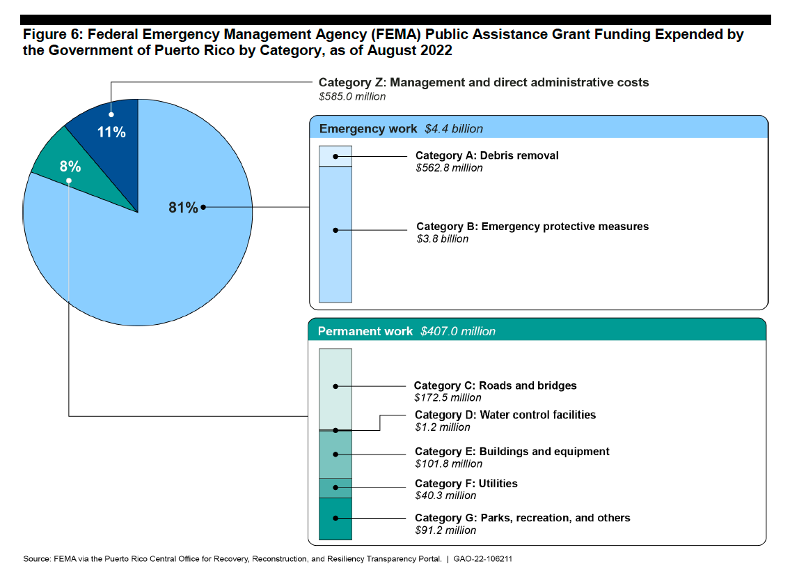

Source: Statement of Chris Currie, September 15, 2022, p. 15, GAO-22-106211

Minutes later, though, Mr. Manuel Laboy, Executive Director of the COR3, confidently stated that some 29 projects to repair some parts of the electric grid have been approved and a total of $183 million have been disbursed.[6]
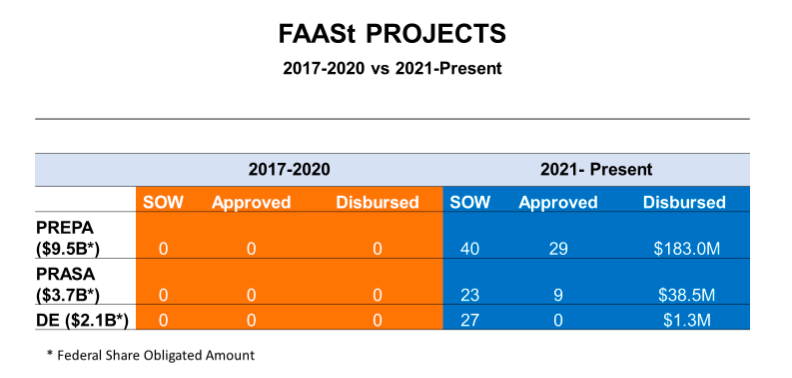
Source: Statement of Hon. Manuel Laboy September 15, 2022, p. 26.

Thus, an independent observer seeking to judge the progress to rebuild Puerto Rico’s grid would face a disparate set of figures. If the correct benchmark is the amount of money obligated to repair the grid, then it would appear that significant progress has been done. However, if, as many experts believe, the appropriate benchmark is how much money has actually been spent on projects to strengthen the grid, then progress has been painfully slow.[7]

Even if we agree that the spending rate is the right benchmark, we don’t know which figure is the correct amount: the GAO states that $40 million has been spent, while the COR3 states it has been $183 million. It is obvious to us, then, that the parties are not speaking the same language, or using the same definitions, or both. There is a clear failure to communicate, which in the final analysis is a failure of coordination.

In the case of the electric grid, there are at least two other factors that point to a large-scale coordination failure. First, it appears there is no agreement as to what is the plan to rebuild the grid. The Puerto Rico Energy Bureau argues that the grid has to be rebuilt in accordance with Puerto Rico’s Integrated Resource Plan (“IRP”), while PREPA appears to be working to implement a different plan called the “Ten-Year Modernization Plan” and LUMA seems to be working off its own “System Remediation Plan”. In addition, the federal Department of Energy is currently working on yet another grid modernization plan for Puerto Rico, which should be finalized by the end of 2023.

Please note that while the IRP sets the statutory requirements for the long-term (twenty years) modernization and operation of the grid, it was not drafted specifically for the María reconstruction and recovery process. On the other hand, the plans put forward by PREPA and LUMA assume a shorter timeframe and are proposals specifically made in connection with the ongoing reconstruction process. The DOE plan appears to be an attempt to both steer the grid reconstruction process and present a path forward for achieving 100% generation from renewables by 2050. Clearly, then, there is a coordination failure, because while these plans may partially overlap and intersect in certain aspects, they are based on different assumptions, have different implementation timelines, and, in the end, seek to achieve different objectives.

Second, as was pointed out by Mr. Currie during the September 15th hearing, LUMA and FEMA have had serious disagreements about

making repairs beyond the damages sustained during Hurricane María. Specifically, the private operator and FEMA disagree on which aspects of the agency’s proposed project the Public Assistance funding will cover. FEMA officials note that there are nuances involved in developing a complex project and ensuring it is eligible under federal laws and regulations.[8]

Finally, and this applies to all recovery projects, not only those related to the electric grid, the GAO found that oftentimes Puerto Rican government officials were not sure about how to proceed in accordance with FEMA policy because they did not know which set of guidelines were then currently in effect. Without access to relevant, up-to-date guidance, recovery stakeholders were exposed to the risk of acting in accordance with guidance that had been revised or replaced.[9]
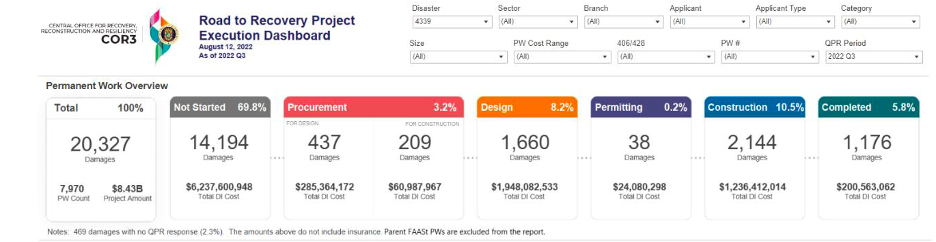

Source: Statement of Hon. Manuel Laboy September 15, 2022, p. 27

That last point would go a long way in explaining why, as shown in the chart above, only 5.8% of all permanent works projects have been completed as of August 2022.

In a similar fashion, coordination difficulties and bureaucratic hurdles have been at the center of significant delays in the approval and disbursement of funds assigned to complete municipal reconstruction projects. Local mayors argue that they confront sizeable delays (sometimes reaching 120 days) in the receipt of reimbursements for public works carried out. In addition, many municipalities on the island face serious budget constraints due to declining economic activity and austerity measures imposed by the FOMB.[10]

As a result, many cash-strapped municipalities have had to delay and at times halt much-needed reconstruction projects. Mr. Laboy has admitted that unnecessary bureaucratic processes and the substandard performance of certain multinational firms contracted to assist the COR3 in handling administrative procedures are a big part of the problem. [11] Thus, we should carefully analyze and diagnose the problem before making suggestions to impose quick fixes, without thinking through how they will interact with other processes affecting this massive reconstruction effort.

At this juncture of Puerto Rico’s recovery, the haze surrounding the status of the recovery process highlights the need to carefully define precise planning, coordination and implementation frameworks, and improve the flow of information. In other words, there is a need for an entity to comprehensively coordinate and manage Puerto Rico’s recovery.

Statement of Principles

As we stated five years ago, CNE believes that any entity or mechanism designed to manage the recovery process should comply with the following principles[12]:

  • Coordination and Cooperation — The management structure for the recovery effort should serve as a forum to coordinate the spending of all federal recovery funding allocated to Puerto Rico, not only FEMA funds, and to provide for coordination first, among federal agencies; second, among and between federal agencies and their counterparts in Puerto Rico; and third, among and between federal and state agencies on one side, and municipalities on the other. It should also allow for the effective coordination of the work to be done by a plurality of groups and stakeholders working with different visions for the new Puerto Rico.
  • Legitimacy — Provide a Forum for the Participation of the Democratically Elected Government of Puerto Rico: Any solution to this conflict has to provide a space for the effective and meaningful participation of the duly elected government of Puerto Rico. Otherwise, the reconstruction effort will be perceived as illegitimate and lack support from key political stakeholders on the island.
  • Subsidiarity — This principle essentially requires that decisions that affect a certain community be taken at the government level closest to that community. According to the Compendium of the Social Doctrine of the Catholic Church, the principle of subsidiarity is one of the most important principles of social philosophy:

“Just as it is gravely wrong to take from individuals what they can accomplish by their own initiative and industry and give it to the community, so also it is an injustice and the same time a grave evil and disturbance of right order to assign to a greater and higher association what lesser and subordinate organizations can do. For every social activity ought of its very nature to furnish help to the members of the body social, and never destroy and absorb them.”

Furthermore, “on the basis of this principle, all societies of a superior order must adopt attitudes of help (“subsidium”)—therefore of support, promotion, development—with respect to lower-order societies.  In this way, intermediate social entities can properly perform the functions that fall to them without being required to hand them over unjustly to other social entities of a higher level, by which they will end up being absorbed and substituted, in the end seeing themselves denied their dignity and essential place.”[13]

The principle of subsidiarity is also defined in Article 5 of the Treaty on European Union. “It aims to ensure that decisions are taken as closely as possible to the citizen and that constant checks are made to verify that action at the EU level is justified in light of the possibilities available at the national, regional, or local level.  Specifically, it is the principle whereby the EU does not take action (except in the areas that fall within its exclusive competence) unless it is more effective than action taken at the national, state, or local level.”[14]

  • Inclusiveness — Provide for the Participation of Stakeholders from the Private and the NGO Sector: Puerto Rico’s private sector and non-governmental organizations should be provided with a platform to express their visions and make their own proposals for a new Puerto Rico when the time comes to translate the rhetoric of resilience into concrete plans, architectural realities, political decisions, building priorities, and economic and financial costs. Otherwise, the whole effort will be bound to fail as the “new Puerto Rico” will inevitably not satisfy the expectations of the private sector and civil society and the net result will be increased migration to the mainland.
  • Economic Impact and Strengthening the Local Economy — The entity(ies) in charge of rebuilding Puerto Rico should hire residents of Puerto Rico and local organizations on a priority basis to ensure that disaster survivors participate in recovery activities and directly benefit from recovery funds. This is especially important given Puerto Rico’s high poverty rate and low labor force participation.

Policy Priorities for the Recovery

In keeping with the principles above, CNE has identified three policy priorities to ensure that the next phase of the recovery process promotes equitable economic growth and enhances local capacity.

These priorities incorporate best practices from the recovery processes in New Orleans and New York in the aftermath of Hurricanes Katrina and Sandy, respectively, as well as lessons learned from the Hurricane María response through CNE’s ReImagina Puerto Rico project[15]

  • The recovery requires a “bottom-up”, comprehensive, and unified planning effort, much like what was done in New Orleans after Katrina (via the Unified New Orleans Plan) and in the State of New York following Superstorm Sandy (via NY Rising). At present, the Government of Puerto Rico has centralized all planning efforts in the COR3 office. There are highly complicated issues, like land titling, mitigation vs. housing relocation, among others, that have to be addressed to avoid political pushback from municipalities and local communities. Moreover, if planning and implementation are performed in a piecemeal manner (bypassing certain localities or without the proper sequencing) coordination failures will occur and potentially lead to a longer and costlier reconstruction.
  • Municipalities need to be engaged. Although the Commonwealth government has designed a centralized recovery and reconstruction process, largely controlled by the executive branch, the participation of municipal governments is essential for the success of these pursuits. Municipalities are the “first responders” in the emergency response period and play a fundamental role in the provision of basic services. They are also the government entity closest to local communities. However, not all municipalities are capable of administering reconstruction funds or managing large-scale projects. The key to engaging municipalities is knowing which ones have the capacity to lead, and which ones require capacity building. Nonetheless, the recovery and reconstruction processes offer numerous opportunities for municipalities to devise and implement creative and cost-saving solutions.
  • Island contractors need to be prioritized in the recovery process. Traditionally, federal disaster response has been understood as the “silver lining” that stems from a catastrophic event, given the millions of U.S. government dollars that are pumped into the local economy. Federal funding for recovery, according to this logic, will have a multiplier effect that could potentially steer Puerto Rico’s economic growth rate into positive territory. Although much of the optimism is tied to potential investments funded by the federal government in Puerto Rico, the bulk of federal expenditures for both relief and recovery efforts is not flowing into Puerto Rico-based businesses, and therefore such spending has not been very effective in stimulating the local economy. As it stands the recovery process, is neither fostering local hiring nor focusing on high-impact industrial sectors. CNE has begun to analyze the contracting data, with a focus on key agencies like the DHS, USDA, and USACE, amongst others. Hiring a greater number of local firms for a longer period of time could also provide learning and capacity-building opportunities for many of these actors, which could improve their ability to address future natural events in Puerto Rico or elsewhere in the mainland U.S. Thus, local firms should be given priority and mainland firms should be compelled to hire local subcontractors when appropriate.

A Proposal to Implement Principles and Policy Priorities for the Reconstruction

One way to implement these principles and priorities would be by creating an entity similar to the Hurricane Sandy Rebuilding Task Force, which was created by President Obama pursuant to Executive Order 13632 of December 7, 2012 (the “Sandy Executive Order”). The Sandy Executive Order:

  • Created a Task Force chaired by the Secretary of Housing and Urban Development. In addition, it included the head of 23 other federal executive departments, agencies, and offices involved in the recovery process.
  • Stated that the principal function of the Task Force was to provide the coordination necessary to support the rebuilding of the area affected by Hurricane Sandy, including “working closely with FEMA within the scope of the National Disaster Recovery Framework (“NDRF”).”
  • Ordered the Task Force to “identify and work to remove obstacles to resilient rebuilding in a manner that addresses existing and future risks and vulnerabilities and promotes the long-term sustainability of communities and ecosystems”.
  • Mandated that the Task Force “coordinate with entities in the affected region in efforts to: (i) ensure the prompt and orderly transition of affected individuals and families into safe and sanitary long-term housing;  (ii) plan for the rebuilding of critical infrastructure damaged by Hurricane Sandy in a manner that accounts for current vulnerabilities to extreme weather events and increases community and regional resilience in responding to future impacts; (iii) support the strengthening of the economy; and (iv) understand current vulnerabilities and future risks from extreme weather events, and identify resources and authorities that can contribute to strengthening community and regional resilience as critical infrastructure is rebuilt and ecosystem functions are restored”.
  • Required the Task Force to “engage local stakeholders, communities, the public, Members of Congress, and other officials throughout the areas affected by Hurricane Sandy to ensure that all parties have an opportunity to share their needs and viewpoints to inform the work of the Task Force”.
  • Authorized the Chair to create an “Advisory Group to advise the Task Force and invite individuals to participate in it. Participants shall be elected State, local, and tribal officials and may include Governors, Mayors, County Executives, tribal elected officials, and other elected officials from the affected region as the Chair deems appropriate.”
  • Provided for the Task Force to have a staff, “headed by an Executive Director, which shall provide support for the functions of the Task Force.”
  • Allowed the Task Force to “establish technical working groups of Task Force members, their representatives, and invited Advisory Group members and elected officials, or their designated employees, as necessary to provide advice in support of their function.”

In our view, if a similar entity were to be created to coordinate the recovery process for Hurricanes María and Fiona, it would comply with the principles and policy priorities set forth above because:

  • It would have an explicit mandate to coordinate recovery efforts among and between the federal agencies and among and between the federal government and the government of Puerto Rico.
  • It would provide for the inclusion of Puerto Rican elected officials at all levels and their representatives, including the COR3, through an advisory group.
  • It would promote subsidiarity and inclusiveness by engaging local stakeholders, municipalities, community organizations, NGOs active in Puerto Rico, and business leaders.
  • And it would strengthen the local economy by ensuring that residents of Puerto Rico and local business enterprises are hired on a priority basis.

Notice that we are advocating for a very specific and particular kind of coordination mechanism that satisfies a discrete set of procedural, equity, and inclusion principles. CNE would not support any similar entity that does not satisfy the principles or fails to implement the policy priorities set forth herein.

For the sake of clarity and the avoidance of any doubt, we are not advocating for the “federalization of the recovery process” (whatever that may mean); the appointment of a “recovery czar” in the White House; or the “takeover” of the recovery process by the Fiscal Oversight and Management Board.

To achieve a just recovery, Puerto Rico needs coordination and oversight that works — not punitive measures. Successful recoveries require ongoing deliberation and dialogue between all involved stakeholders to ensure that all relevant perspectives are heard and have a chance to influence the process. Moreover, appointing a “recovery czar” or “federalizing” the process would not provide opportunities for local capacity-building.

When an isolated office dictates the recovery process from the top down, the opportunity for local actors to be involved in decision-making and learn key lessons in recovery management is lost. Centralizing the recovery also centralizes information flows, and can pose a threat to accountability and transparency if the newly created entity is not answerable to other actors involved in the recovery.

Conclusion

Hurricane Fiona has opened a window of opportunity for government officials in Washington, D.C. and Puerto Rico to streamline the ongoing Hurricane María recovery process and to correctly frame the Hurricane Fiona recovery. Throughout this Policy Brief we have emphasized the need for: (1) creating a distinct recovery coordination mechanism; (2) implementing specific principles that allow for reflection, flexibility, and adaptability; and (3) executing some key policy priorities to promote equitable economic growth and enhancing local capacity.

If properly designed and implemented the proposed mechanism would facilitate effective coordination among stakeholders at different levels of government, insure adequate public participation in the planning and oversight process, provide greater transparency and accountability in the project selection phase and the use of funds, and speed up the outlay of recovery funds.

To move forward, Puerto Rico must seize this opportunity to evaluate the hurricane recovery process and modify the existing recovery governance framework. In the final analysis, every disaster is “a time of desperate loss, yet also a time of distinct possibility.”[16] Let’s make the most of this time of possibility.

Endnotes

[1] Center for a New Economy, Oversight that Works, August 2019, available at https://grupocne.org/wp-content/uploads/2019/08/CNE-Policy-Memo-Oversight-That-Works.pdf

[2] Olshansky, R. B., & Johnson, L. A. (2010). Clear as Mud: Planning for the Rebuilding of New Orleans, Washington, DC: American Planning Association.

[3] See Executive Order OE-2017-65

[4] Statement of Anne Bink before the Subcommittee on Economic Development, Public Buildings, and Emergency Management of the Committee on Transportation and Infrastructure of the U.S. House of Representatives, “Recovery Update: Status of FEMA Recovery Efforts in Puerto Rico and U.S. Virgin Islands 5 Years After Hurricanes Irma and Maria”, September 15, 2022, p. 2.

[5] Statement of Chris Currie before the Subcommittee on Economic Development, Public Buildings, and Emergency Management of the Committee on Transportation and Infrastructure of the U.S. House of Representatives, “Recovery Update: Status of FEMA Recovery Efforts in Puerto Rico and U.S. Virgin Islands 5 Years After Hurricanes Irma and Maria”, September 15, 2022, p. 15, GAO-22-106211.

[6] Statement of Hon. Manuel Laboy before the Subcommittee on Economic Development, Public Buildings, and Emergency Management of the Committee on Transportation and Infrastructure of the U.S. House of Representatives, “Recovery Update: Status of FEMA Recovery Efforts in Puerto Rico and U.S. Virgin Islands 5 Years After Hurricanes Irma and Maria”, September 15, 2022, p. 26.

[7] According to Mr. Currie’s statement “An obligation is a definite commitment that creates a legal liability of the government for the payment of goods and services ordered or received. For the purposes of this statement, obligations represent the amount of grant funding FEMA provided through the Public Assistance program and the Hazard Mitigation Grant Program for specific projects in Puerto Rico and the USVI. An expenditure is an amount paid by federal agencies, by cash or cash equivalent, during the fiscal year to liquidate government obligations. For the purposes of this statement, an expenditure represents the actual spending by the government of Puerto Rico government or the USVI government of money obligated by the federal government.”

[8] Statement of Chris Currie, September 15, 2022, p. 19, GAO-22-106211

[9] Id. at p. 12.

[10] Many FEMA programs work on a reimbursement basis, which presents a difficulty to many municipalities and government agencies that may not have the required cash flow available to finance long-term permanent work projects.

[11] See: “Truenan los alcaldes por situaciones con desembolso para la reconstrucción en los municipios”, Primera Hora, February 1, 2022; “Nuevo director de COR3 acepta responsabilidad en atrasos de los fondos de recuperación a municipios”, Centro de Periodismo Investigativo, February 12, 2021.

[12] Sergio M. Marxuach, Expediting the Recovery Process: A Proposal to Create a Puerto Rico Development Authority, Center for a New Economy, December 2017, available at https://grupocne.org/wp-content/uploads/2017/12/PRDA-Policy-Brief.pdf

[13] Compendium of the Social Doctrine of the Catholic Church, 186; see also, Leo XIII, Encyclical Letter Rerum Novarum (1892); Pius XI Encyclical Letter Quadragesimo Anno (1931); John Paul II Encyclical Letter Centesimus Annus (1991); and Catechism of the Catholic Church, 1882 and 1883.

[14] See Lisbon Treaty, Article 5, (2007) (ratified 2009) and http://eur-lex.europa.eu/summary/glossary/subsidiarity.html

[15] The goal of Reimagina Puerto Rico was to devise a process whereby the people of Puerto Rico could effectively participate in defining recovery priorities. Through a wide ranging and inclusive public participation effort—which included 77 meetings and activities with over 700 participants in island communities and the diaspora—both specialists and community stakeholders identified close to 500 recovery opportunities. The top ideas are contained in a detailed report recently produced by Reimagina, which provides 97 priority actions across six key sectors. Funding from the Ford Foundation, Open Societies Foundation and technical assistance from the 100 Resilient Cities project were instrumental in these efforts.

[16] Lynne B. Sagalyn, Power at Ground Zero: Politics, Money, and the Remaking of Lower Manhattan, (Oxford, 2016), p. 5.

CNE Review – Hurricane Fiona Briefing

Published on September 22, 2022 / Leer en español

See all editions of the
CNE Review
SHARE

CNE continues to receive messages of support and questions of how to best help Puerto Rico. Despite the lack of power and water in many areas, businesses are open and have enough supplies to cover local demand. We encourage everyone to buy local.

The Puerto Rico Recovery Fund has worked on three strategic and interrelated areas after the extensive devastation caused by Hurricane Maria:

1.   Addressing immediate humanitarian needs
2.   Advocacy efforts in San Juan and Washington, D.C., to ensure maximum federal support and efficient resource coordination
3.   Medium and long-term economic development

Your donation will help us continue that work now, after Hurricane Fiona.

Insights from CNE

Hurricane Fiona Update

By Sergio M. Marxuach, Policy Director

The Big Picture

As the waters literally begin to recede, we are starting to get a better picture of the damage caused by Hurricane Fiona. One question I have been asked several times over the last few days is why the damage is so bad if Fiona was “only a category 1 storm”. While it is true that Fiona ranked in the lower end of the scale meteorologists use to evaluate tropical storms, that is both the wrong way to analyze what happened and also the wrong question to ask.

The Saffir-Simpson Hurricane Scale is based only on a hurricane’s maximum sustained wind speed. It does not take into account other factors that could intensify the impact of the hurricane, for example, the amount of rain that could fall on any given location, any storm surge related to the hurricane, or the weather system’s translation speed. Hurricane Fiona poured an estimated 1 trillion gallons of water on Puerto Rico and it was moving very slowly, at approximately 8 miles per hour. That’s why we have seen such catastrophic flooding across the island.

Perhaps more important, as my colleagues who teach planning at the University of Puerto Rico Graduate School of Planning explained to me after Hurricane Maria, the physical and social impact of a weather system is not only a function of the storm’s force or strength, it is also a function of a given society’s pre-existing level of vulnerability. Puerto Rico was extremely vulnerable prior to Fiona as only 30% of all permanent reconstruction work related to Hurricane Maria had started; thousands of people still lived in flood-prone areas; and basically nothing had been done to strengthen the electric grid or increase its resiliency. Given all of that, the right question to ask is why was Puerto Rico so vulnerable five years after Hurricane Maria. Several books could be written to answer that one.

The Data

Given that the response to Hurricane Fiona is barely beginning, it is difficult to provide hard data about damages. Here is a summary of some indicators we could gather from the official government information website:

  • Consumer Goods – According to the government there is plenty of gasoline available and there are no reported shortages of food.
  • Hospitals – The Puerto Rico Department of Health reports that all public hospitals and outpatient clinics are open and providing regular medical services.
  • Housing – There is no data yet as to the number of homes that suffered damage due to Hurricane Fiona.
  • Schools and Universities – The University of Puerto Rico is scheduled to reopen on the 26th of September. Public schools are still closed pending evaluation of the physical facilities.
  • Shelters – Some 92 shelters remain open and approximately 474 people are still living there.
  • Telecommunications – Approximately 71% of all cell phone users have service and there have been no reports of major internet or broadband interruptions.
  • The Electric System – LUMA is walking back on its statement that power would be restored across the island “in a matter of days”. The most recent data reported by the government shows that approximately 38% of LUMA customers have electric service.
  • Transportation – Maritime ports have opened. Buses and trains are operating normally. The Luis Muñoz Marín International Airport is operating as usual. Many roads remain flooded or inaccessible due to the accumulation of debris or landslides.
  • Water – As of the time of this update, 36% of the clients of the Puerto Rico Aqueduct and Sewer Authority were without water service. This is partly due to the lack of electric power, as electric water pumps are needed to transport water across the island.

The Takeaway

As the emergency response continues it is important that the federal government provide adequate support to local and state authorities. After Hurricane Maria, federal assistance was provided with too many strings attached and oftentimes was not delivered effectively as evidenced by this report from the United States Commission on Civil Rights. The Biden administration appears, so far, to be more receptive to providing the necessary assistance to Puerto Rico and his personal history gives us reason to believe that he can identify and sympathize with the pain and suffering of others. We certainly hope that is the case.

Update from Washington, D.C.

By Francis G. Torres, Senior Policy Analyst

The state of play in D.C. is constantly shifting, and we expect ongoing developments to impact both the immediate response to Hurricane Fiona and long-running disaster relief programs in Puerto Rico.

Here are three takeaways regarding the federal role in disaster recovery.

1. President Biden issued a Major Disaster Declaration for Puerto Rico.

After an official request by Governor Pierluisi and calls from Members of Congress to provide greater support for Puerto Rico, President Biden authorized a Major Disaster Declaration yesterday to address the impact of Hurricane Fiona.

Major Disaster Declarations allow federal agencies to provide funding and resources for long-term disaster recovery programs. Traditionally, they authorize the following key FEMA programs:

  • Individual Assistance – Assistance to individuals and households
  • Public Assistance – Assistance to governments and nonprofit organizations for emergency work and the repair or replacement of disaster-damaged facilities
  • Hazard Mitigation Assistance – Assistance to governments and nonprofit organizations to prevent or reduce long-term risk to life and property from natural hazards

2. FEMA will likely play more of an auxiliary role and focus on recovery funding for Hurricane Maria.

FEMA’s capacity to address hurricane impacts is greater than in 2017. After one of the largest local hiring processes in the history of the agency, it now has roughly 700 staffers in Puerto Rico. Crucially, it does not have to stretch resources across multiple disasters—as it had to do in September 2017 in the aftermaths of Hurricanes Harvey, Irma, Maria, and the California wildfires. FEMA Administrator Deanne Criswell has also committed to sending hundreds of additional staffers to help with the recovery.

This expanded capacity will not necessarily lead to greater involvement for FEMA than it had after Maria, however. The agency’s traditional role is to provide support to state and local governments rather than lead the relief and recovery process itself. Fiona did not cause Puerto Rico’s government to collapse, meaning that the Puerto Rico Emergency Management Agency and other key government institutions will play a more central role in the response.

Importantly, FEMA still has its hands full with the Hurricane Maria recovery. Per a GAO report published on September 15, FEMA obligated approximately $28 billion for Public Assistance and $162.7 million for Hazard Mitigation programs in Puerto Rico. As of August 2022, only about 19 percent of Public Assistance funding and 13 percent of Hazard Mitigation funding had been disbursed.
The gap between the obligation of FEMA funds and disbursement—when the federal government actually pays for a program—is a longstanding cause of concern for the post-Maria recovery. GAO analysts found that spending delays are due to many factors, ranging from a lack of institutional capacity to manage federal grants to difficulties in reaching agreements with FEMA on project scopes of work.

FEMA must also work to speed up the disbursement of the $9.4 billion in obligated funds to rebuild the electrical system. Anne Blink, Associate Administrator for FEMA’s Office of Response and Recovery, told a Congressional panel last week that the agency has only disbursed $40 million in energy grid funding so far.

3. Supplemental disaster funding may be coming down the pike — though the timing is not clear.

There has been significant chatter in D.C. about supplemental funding measures for Puerto Rico.

In a floor speech, Senate Majority Leader Schumer pledged greater support for the island. On the House side, Rep. Nydia Velázquez and House Majority Leader Rep. Steny Hoyer have told the press that a supplemental package is in the works—although the timing is uncertain.

Federal relief efforts rely on FEMA’s Disaster Relief Fund (DRF). In the past, Congress has used supplemental appropriations to provide more funding for the DRF when needed.

The DRF currently has about $15 billion. It is unclear if this amount will cover the full cost of Fiona recovery—especially taking into account the damage to infrastructure such as roads, bridges, and urban centers. The likelihood of a supplemental appropriation may depend on whether the damages exceed available DRF funding, as well as whether or not officials in Puerto Rico advocate for the increased support.

Recovery after Fiona

Data Snapshot

CNE in the News

From NAP to SNAP

From NAP to SNAP

Published on September 1, 2022 / Leer en español

Senior Policy Analyst
SHARE

At a time when many are discussing the transformative possibilities of the use of federal funds in Puerto Rico, we must not lose sight of one of the proposals that has the greatest potential impact for our island: the transition from the Nutrition Assistance Program (NAP) to the Supplemental Nutrition Assistance Program (SNAP).

The Center for a New Economy is strongly in favor of extending SNAP to Puerto Rico. We recently published a report analyzing the transition, where we emphasized the benefits it would bring. SNAP would not only increase the federal nutrition assistance for poor people in Puerto Rico, but it would also ensure more funds during economic crises or following natural disasters. The transition to SNAP would also increase the size of the population that is eligible for nutrition assistance, and end a shameful legacy of discrimination by the U.S. Congress against residents of Puerto Rico.

Currently, NAP relies on new congressional action every time a crisis or natural disaster puts the government’s finances in check or the economic situation for Puerto Rican families worsens. Under SNAP, we would have a program that is flexible and responsive to the needs of communities that suffer from food insecurity.  

That same flexibility would ensure a much more robust nutritional assistance for the vast majority of beneficiaries. As an entitlement or a right that every U.S. citizen has, SNAP provides resources based on the level of need, not on a defined amount like NAP. Under SNAP, the number of people receiving nutritional assistance in Puerto Rico, currently around 1.5 million, could increase by 9 to 12%. In other words, SNAP would provide assistance to an additional 100,000 people who currently do not receive any support under NAP. The subsidy would also increase significantly, even doubling that of NAP in certain cases.

The benefits of extending SNAP to Puerto Rico will be felt not only by the homes that receive the assistance. According to the federal Department of Agriculture, SNAP has a multiplier effect on the economy. Each additional dollar increases economic activity in supermarkets, businesses, farms and many other sectors, which in turn creates jobs and generates new investment opportunities.

All of these benefits are important, but we must also address this issue from the perspective of justice. The extension of SNAP would bring down one of the most insidious discriminatory practices of the federal government towards our island. How can we justify that Puerto Rican families, living with a lack of economic opportunities and dealing with the typical precariousness of life in Puerto Rico, receive nutrition assistance that is barely half of what a similar family in Florida, Texas or any other state can receive? The answer is that there is no justification. Even more so when one takes into account that Puerto Rico’s nutritional assistance program used to operate the same as it does in the states, but Congress replaced it with NAP in 1982 in an effort to cut down the federal budget.

Like with any other change in public policy, the transition from NAP to SNAP may be challenging. However, the benefits of SNAP far outweigh the cost of the transition. Moreover, it is up to the federal and local governments to ensure a responsible implementation of SNAP so that the new policy benefits all those who currently rely on nutrition assistance in Puerto Rico.

The Spanish language version of this column was originally published in El Nuevo Día on September 1, 2022.

CNE Review – August 2022

Published on August 11, 2022 / Leer en español

See all editions of the
CNE Review
SHARE

In This Issue

The cost of food has been in the headlines recently due to a set of intersecting crises. The still ongoing COVID-19 pandemic; the Russian invasion of Ukraine; supply chain disruptions; and natural disasters have combined to generate an overall spike in food prices. According to the Food and Agriculture Organization of the United Nations, “global food prices were 23 percent higher in May 2022 than they were a year earlier.”

Puerto Rico has not been exempted from this trend. According to the most recent release of the consumer price index for the island, the cost of “general foodstuffs” increased in June 2022 by 10.3% relative to the same month in 2021. We note this increase is probably underestimated due to problems with the construction of the price index for Puerto Rico. In any event, even if it is true that the rate of inflation for food in Puerto Rico is half the rate for the entire world, many households in Puerto Rico were already food insecure prior to the pandemic due to the relatively high cost of living in the island; little local production of basic dietary staples; the requirement to use costly U.S. flag vessels to transport food and other cargo from the U.S.; low wages; and high rates of poverty and income inequality.

This is the context, then, in which Puerto Rican and federal elected officials, members of the Biden administration, and civil society organizations have been advocating for a transition from the Nutrition Assistance Program (“NAP”) currently in effect in Puerto Rico to the Supplemental Nutrition Assistance Program (“SNAP”) currently operating in the 50 states, the District of Columbia, and the U.S. territories of Guam and the Virgin Islands.

As part of that advocacy effort, Congress ordered the Food and Nutrition Service (“FNS”) of the U.S. Department of Agriculture (“USDA”) in 2021 to undertake an update of a 2010 study of the feasibility of implementing SNAP in Puerto Rico. The USDA, in turn, hired two consulting firms, Insight Policy Research and Mathematica, to carry out this update for FNS. The USDA released the final report of the Update to Feasibility Study of Implementing SNAP in Puerto Rico in July 2022 (the “Feasibility Study”).

For years, CNE has advocated for equal treatment in regards to federal programs such as Medicaid, Supplemental Security Income, Earned Income Tax Credit, and a transition from NAP to SNAP. In this month’s CNE Review we take a look at some of the most important findings of the Feasibility Study and analyze their implications for the full implementation of SNAP in Puerto Rico.

–Sergio M. Marxuach, Editor-in-Chief

We are excited to announce a new team member


Francis G. Torres
Senior Policy Analyst
CNE Washington, D.C. Office

Francis has been a member of the CNE family for some time. He worked as a Communications and Content Specialist at our D.C. Office, where he learned about Puerto Rico’s most urgent policy problems and helped develop advocacy strategies to shape federal solutions. Francis returns to CNE after earning his Master in Public Affairs degree from the Princeton School of Public and International Affairs. During his time at Princeton, he led a team of MPA students in researching and drafting Puerto Rico’s Moonshot Opportunity: Recommendations for the U.S. Territory’s Economic Future, a policy report commissioned by the Office of the Governor of Puerto Rico and focused on optimizing federal funding for Puerto Rico’s economic recovery. More recently, he served as Master of Ceremonies for CNE’s 2021 Growth Policy Summit.

Francis joins CNE at a crucial juncture for federal involvement in Puerto Rico. He will strengthen CNE’s advocacy, thought leadership, and presence among networks of key stakeholders and decision-makers in Washington, D.C., and help place the Growth Project’s proposals at the center of federal debates on Puerto Rico.

We are certain that he will make significant contributions to the success of the Growth Project, and we’re happy to have him back on the team!

Insights + Analysis from CNE

By Sergio M. Marxuach, Policy Director

Nutritional Assistance in Puerto Rico

Federal nutrition assistance for residents of Puerto Rico began in November 1974 under the old Food Stamp Program (“FSP”). Initially and during the first eight years of the implementation of the FSP in Puerto Rico it functioned just like in the U.S.: all eligible participants received paper coupons which could then be used to purchase food items from certified food retailers on the island.

In 1982, Congress replaced the FSP in Puerto Rico with an annual block grant through the NAP. In general, the capped block grant structure of the NAP has generated discrepancies in eligibility criteria and benefit levels relative to SNAP.

Click here for details on how these discrepancies play out in reality.

Transition to SNAP

The transition from NAP to SNAP would be a complicated and costly process. It will be necessary, among other things, to enact federal and local legislation, issue new regulations, implement new requirements and provide for the operation of several components of SNAP that currently do not operate in Puerto Rico.

Click here for details on the process and costs of a transition to SNAP.

What to Expect Under SNAP in Puerto Rico

According to the Feasibility Study, the following are some of the effects that can be expected if SNAP is implemented in Puerto Rico:

  • Asset Limits – The implementation of SNAP asset limits would result in a lower number of beneficiaries in Puerto Rico. However, the Feasibility Study states that this effect could be mitigated, at least in part, by adopting broad-based categorical eligibility (“BBCE”) rules. Click here for details.
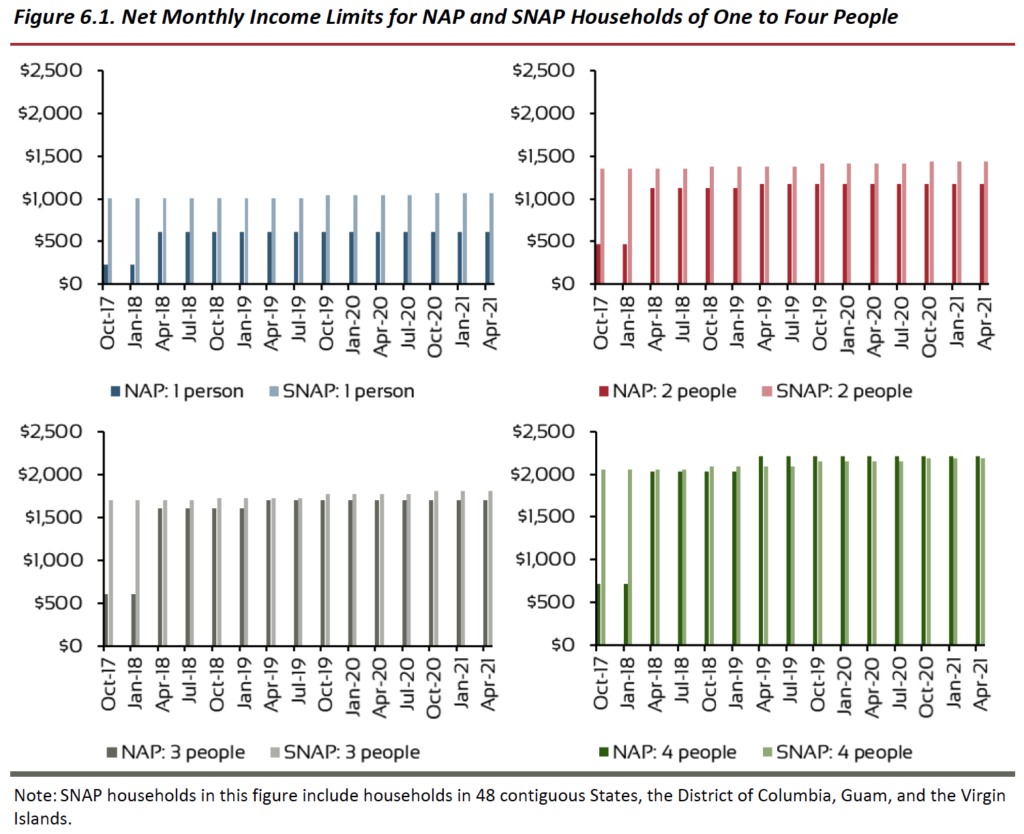
  • Income Limits –As shown in the graph below, income limits under NAP are lower than SNAP’s for households of one to three people. So, everything else being equal, this would mean that a larger amount of smaller households in Puerto Rico would qualify for benefits under SNAP than under NAP. Click here for details.Source: Feasibility Study, p. 37.

  • Work Requirements – Currently there are no work requirements under NAP. The government of Puerto Rico would be required to implement work requirements under SNAP. Click here for details.
  • Several Groups May Lose Eligibility or Receive Lower Benefits – The authors of the Feasibility Study conclude that “further research is needed to determine which NAP participants would be most likely to lose nutrition assistance benefits.” Click here for details.
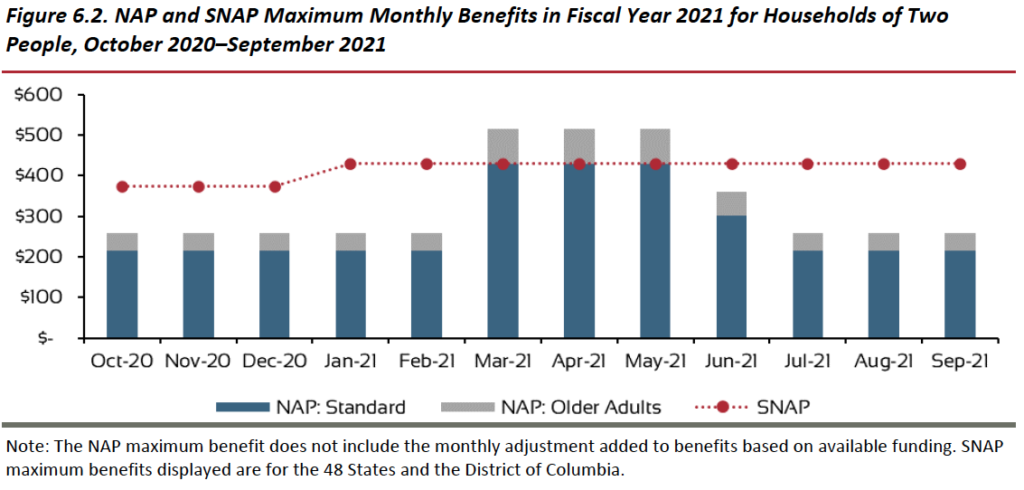
  • Benefit Calculation – According to the Feasibility Study, “in 2021, in the absence of relief funding, the SNAP maximum benefit was 1.8–2.1 times higher than the NAP maximum benefit.” (Feasibility Study, p. 38) Click here for details.
  • Estimated SNAP Participation in Puerto Rico – The authors of the Feasibility Study found that the number of participating households, individuals, and percentage of covered population would increase under SNAP. Click here for details.

So, what is the bottom line?

On the positive side of the ledger, we find: (1) funding for nutritional assistance would increase significantly under SNAP, from approximately $2.6 billion in FY2023 to $4.5 billion in FY2031; (2) the number of beneficiaries would increase between 9 and 12 percent (depending on the final set of rules adopted); (3) the maximum amount of benefits would increase, in some cases they may actually be double the amount currently available under NAP; and (4) the increased spending in nutrition expenditures would have a positive income multiplier effect on the local economy in both the food retail and the local agricultural sectors as well as a positive impact on overall employment.

On the other side of the ledger, we need to take into account the following: (1) implementation costs could exceed $400 million over a ten-year period, at a time when the Financial Oversight and Management Board has been implementing budget cuts across the government; (2) administering SNAP after rollout would cost an estimated $249 million to $414 million, on an annual basis (but FNS would cover approximately 54% of these costs); (3) some groups could lose eligibility for nutritional assistance or qualify only for lower benefits; and (4) the government of Puerto Rico would have to gear up for the implementation of several components of SNAP which currently don’t operate in Puerto Rico.

What about work requirements, are they a benefit or a cost?

While this newsletter is not the venue to fully address this debate, we do note that work requirements appear to be more effective in theory than in practice for several reasons. Click here for a brief analysis.

Regardless of where the government stands in the debate over work requirements, it appears that the benefits of implementing SNAP in Puerto Rico outweigh the costs, provided that adequate measures are taken to try to protect, or reduce the impact on, those who may be negatively affected by the transition from NAP to SNAP. In a transition like the one proposed, there will always be winners and losers, but we must try to minimize the negative consequences that particular groups would face.

On Our Radar...

The National Security Case for Industrial Policy – Industrial policy in the United States has been closely related to the achievement of national security objectives at least since World War II. During the post-Cold War era, however, the U.S. Government’s economic policies encouraged the offshoring of production to help companies maximize profits, even as such policies benefited potential geopolitical rivals, such as China. Now, as the authors of this paper published by the Center for a New American Security argue, “the relationship between American industry and the U.S. government must change. The nature of the U.S.-China strategic competition, one centered on technology, requires a reset in how America’s policymakers and corporate leaders engage. Matters of economic competitiveness and security are increasingly indistinguishable.”

The Strange Economy of 2022 – Economic indicators appear to be out of sync. There is soaring demand and high inflation. Yet GDP in the U.S. has contracted for two quarters in a row. Economists have spent the last couple of weeks debating whether or not the U.S. is in recession. The crux of the matter is, as Ben Casselman explains in this piece for the New York Times, that “Typically, in recessions, the problem is that businesses don’t want to hire and consumers don’t want to spend. Right now, businesses want to hire, but can’t find the workers to fill open jobs. Consumers want to spend, but can’t find cars to buy or flights to book. Recessions, in other words, are about too much supply and too little demand. What the U.S. economy is facing is the opposite.”

The Costs of Kleptocracy – Public sector corruption has been in the local news recently after the arrest of several government officers and persons with close connections to them. This primer from Chatham House explains what is a kleptocracy and the economic and social costs it creates.

NAP vs. SNAP: An Analysis on Federal Nutrition Assistance for Residents of Puerto Rico

NAP vs. SNAP: An Analysis on Federal Nutrition Assistance for Residents of Puerto Rico

Published on August 10, 2022 / Leer en español

Sergio portrait
Policy Director
DOWNLOAD
SHARE

Introduction

The cost of food has been in the headlines recently due to a set of intersecting crises. The still ongoing COVID-19 pandemic; the Russian invasion of Ukraine; supply chain disruptions; and natural disasters have combined to generate an overall spike in food prices. According to the Food and Agriculture Organization of the United Nations, “global food prices were 23 percent higher in May 2022 than they were a year earlier.”

Puerto Rico has not been exempted from this trend. According to the most recent release of the consumer price index for the island, the cost of “general foodstuffs” increased in June 2022 by 10.3% relative to the same month in 2021. We note this increase is probably underestimated due to problems with the construction of the price index for Puerto Rico. In any event, even if it is true that the rate of inflation for food in Puerto Rico is half the rate for the entire world, many households in Puerto Rico were already food insecure prior to the pandemic due to the relatively high cost of living in the island; little local production of basic dietary staples; the requirement to use costly U.S. flag vessels to transport food and other cargo from the U.S.; low wages; and high rates of poverty and income inequality.

This is the context, then, in which Puerto Rican and federal elected officials, members of the Biden administration, and civil society organizations have been advocating for a transition from the Nutrition Assistance Program (“NAP”) currently in effect in Puerto Rico to the Supplemental Nutrition Assistance Program (“SNAP”) currently operating in the 50 states, the District of Columbia, and the U.S. territories of Guam and the Virgin Islands.

As part of that advocacy effort, Congress ordered the Food and Nutrition Service (“FNS”) of the U.S. Department of Agriculture (“USDA”) in 2021 to undertake an update of a 2010 study of the feasibility of implementing SNAP in Puerto Rico. The USDA, in turn, hired two consulting firms, Insight Policy Research and Mathematica, to carry out this update for FNS. The USDA released the final report of the Update to Feasibility Study of Implementing SNAP in Puerto Rico in July 2022 (the “Feasibility Study”).

For years, CNE has advocated for equal treatment in regards to federal programs such as Medicaid, Supplemental Security Income, Earned Income Tax Credit, and a transition from NAP to SNAP. In this policy brief, we take a look at some of the most important findings of the Feasibility Study and analyze their implications for the full implementation of SNAP in Puerto Rico.

Nutritional Assistance in Puerto Rico

Federal nutrition assistance for residents of Puerto Rico began in November 1974 under the old Food Stamp Program (“FSP”). Initially and during the first eight years of the implementation of the FSP in Puerto Rico it functioned just like in the U.S.: all eligible participants received paper coupons which could then be used to purchase food items from certified food retailers on the island.

In 1982, Congress replaced the FSP in Puerto Rico with an annual block grant through the NAP. The annual block grant was initially capped at $825 million or 75% of the projected FSP costs for Puerto Rico in 1982. (Feasibility Study, p. 17) This cap was kept in place for the first five years of the program.

While the Feasibility Study claims this was done “in part to control nutrition assistance costs in Puerto Rico,” we disagree. There is no logical or rational relationship between the desire or necessity to cut the costs of any given program and the decision of whose benefits are cut, especially when it is decided to cut the benefits of a discrete group of beneficiaries. In this sense, it appears to us that the decision to implement the NAP in Puerto Rico as a capped block grant is yet another example in a long list of Congressional discrimination against territories based on a “racialized order of territorial exceptionalism” as documented by Andrew Hammond, professor of law at the University of Florida law school. (See Andrew Hammond, Territorial Exceptionalism and the American Welfare State, 119 MICH. L. REV. 1639 (2021))

Be that as it may, it appears that in exchange for lower funding and the implementation of the funding cap, Congress granted Puerto Rico greater flexibility in administering the program by shifting many regulatory decisions and functions to Puerto Rico. For example, when first implemented, NAP benefits were disbursed through paper checks that could be cashed at any food retailer, bank, or financial institution. However, on the negative side, eligibility requirements were stricter and benefit levels were reduced under NAP to adjust program costs to the lower funding level. Households with incomes of more than 85 percent of the Federal Poverty Guidelines (in July 1982) became ineligible, and benefit levels were reduced. The maximum NAP benefit for a household of four was $199, compared with the previous maximum of $221 under the FSP. (Feasibility Study, p. 17)

In 2001, the government of Puerto Rico began delivering benefits through an electronic benefit transfer system (“EBT”) and limited the amount that could be redeemed in cash to 25% of benefits. In 2015, Congress directed Puerto Rico to phase out the option of the 25% cash benefit and since the beginning of 2021, all benefits have been delivered using EBT cards that can be used only at authorized NAP retailers.

During FY2021, core block grant funding for the NAP was approximately $2 billion and provided benefits to 1.5 million low-income individuals. This core funding was supplemented with special appropriations in 2017, after Hurricane Maria, and in 2020 due to the COVID-19 pandemic. For FY2022, the NAP block grant amount was increased by 23% to reflect similar changes to SNAP benefits due to a revision of the federal Thrifty Food Plan. As a result, block grant funding for FY2023 is expected to be approximately $2.6 billion. Finally, two bills are pending in Congress to fully transition Puerto Rico to SNAP.

In general, the capped block grant structure of the NAP has generated discrepancies in eligibility criteria and benefit levels relative to SNAP. According to the Feasibility Study, NAP asset limits are higher than the SNAP asset limits but net income limits and maximum benefits levels are lower under NAP. For example, during FY2021, while the net income limit for a family of three was slightly lower for NAP than SNAP…smaller households [saw] a greater disparity in net income limits: A single-person household in Puerto Rico could have a monthly net income of up to $619 compared with $1,064 for SNAP. Alternatively, “larger households (of four or more) had higher net income limits for NAP than SNAP.”

Furthermore, “excluding adjustments to NAP and SNAP benefits resulting from COVID-19, the maximum NAP benefit in FY 2021 was 59 percent of the maximum SNAP benefit; this trend was similar for all household sizes.”(Feasibility Study, p. 18).

Transition to SNAP

The transition from NAP to SNAP would be a complicated process. It will be necessary, among other things,

  • To enact federal legislation to authorize the operation of SNAP in Puerto Rico;
  • To enact Puerto Rico legislation to conform with federal requirements for SNAP;
  • For both the USDA and the government of Puerto Rico to issue new regulations for the operation of SNAP in Puerto Rico and to bring into alignment asset limits, income limits, work requirements, and other program parameters;
  • To implement new quality control, compliance, and reporting requirements; and
  • To provide for the operation of several components of SNAP that currently don’t operate in Puerto Rico, such as the SNAP Employment and Training program (“SNAP E&T”); the SNAP Nutritional Education program (“SNAP-Ed”); and Disaster SNAP.

In addition, Puerto Rico will have to hire and train new program officers (approximately 550 new hires just to process new applications), implement new procedures, and roll out new IT systems to manage the program.

According to the Feasibility Study, implementing SNAP in Puerto Rico could cost between $341 million and $426 million over an estimated 10-year implementation period; while administering SNAP after rollout would cost an estimated $249 million to $414 million, on an annual basis (FNS would cover approximately 54% of these costs).

The estimated cost of benefits issued to SNAP participants in Puerto Rico would be $4.5 billion annually, based on an average monthly SNAP participation of 861,000 households. (Feasibility Study, p. 155)

What to Expect Under SNAP in Puerto Rico

In general, a transition to SNAP in Puerto Rico is expected to increase the number of eligible individuals and households and raise the benefit levels of participants. However, some types of households may gain nutrition assistance eligibility and/or benefits under SNAP, while others may lose eligibility and/or benefits. The final distribution of winners and losers under SNAP will depend, in part, on policy decisions made by the government of Puerto Rico, and in part on the implementation of SNAP criteria instead of NAP criteria.

According to the Feasibility Study, the following are some of the effects that can be expected if SNAP is implemented in Puerto Rico:

  • Asset Limits – In general, the NAP asset limits are higher than the SNAP asset limits. To be eligible for NAP, households with no members 60 or older may have no more than $5,000 in assets. Households with only members 60 or older have an asset limit of $15,000. (Feasibility Study, p. 31). While for SNAP, households with at least one member who is 60 or older or has a disability had an asset limit of $3,500. For all other households, the asset limit was $2,250. Thus, everything else being equal, the implementation of SNAP asset limits would result in a lower number of beneficiaries in Puerto Rico. However, the Feasibility Study states that this effect could be mitigated, at least in part, by adopting broad-based categorical eligibility (“BBCE”) rules. Under BBCE, states have been able to use asset and gross income limits for TANF noncash benefits to confer categorical eligibility for SNAP, for example, by eliminating asset limits or increasing the gross income limit up to 200% of the Federal Poverty Guidelines.
  • Income Limits – According to the Feasibility Study, “The types and sources of income included in eligibility determination are generally similar for NAP and SNAP, including income of ineligible household members, but the exemptions, deductions, and income thresholds differ. The effect of a transition from NAP to SNAP on the overall amount deducted from gross income would vary by household and could affect various groups’ eligibility and benefit levels differently (e.g., older adults compared with parents with school-aged children).” (Feasibility Study, p. 36).
    Source: Feasibility Study, p. 37.For example, as shown in the graph above, income limits under NAP are lower than SNAP’s for households of one to three people. So, everything else being equal, this would mean that a larger amount of smaller households in Puerto Rico would qualify for benefits under SNAP than under NAP.
  • Work Requirements – Currently there are no work requirements under NAP. SNAP, however, has a general work requirement as well as a specific work requirement for Able Bodied Adults Without Dependents (“ABAWDs”). In general, “all SNAP participants aged 16–59 who do not meet Federal exemption criteria are required to register for work, participate in workfare or SNAP E&T if required by the State agency, accept a bona fide offer of employment, and not voluntarily quit or reduce hours of employment below a 30-hour work week.” In addition, “ABAWDs are required to work or participate in a work program 80 hours per month unless they receive discretionary exemptions or live in an area where the time limit is waived. ABAWDs who do not meet the ABAWD work requirement face a time limit on their benefit receipt of 3 months in a 36-month period.” (Feasibility Study, p. 31) The government of Puerto Rico would be required to implement these work requirements under SNAP. In most cases failure to comply with work requirements results in losing eligibility for SNAP. While a full discussion of work requirements is beyond the scope of this newsletter we note that (1) their application in the U.S. has been controversial; (2) their impact on labor force participation has been weak or negligible in many states; and (3) their implementation would require a significant investment on the part of the government of Puerto Rico in IT, data management, and additional human resources to adequately implement and enforce these requirements.
  • Several Groups May Lose Eligibility or Receive Lower Benefits – Among these groups, the Feasibility Study highlights the following:
    • Older adults or adults with disabilities who are allowed to form their own “household” for NAP purposes, even if they live and purchase and prepare food with others; in most cases, this would not be allowed under SNAP;
    • Older adults participating in NAP currently receive an extra 20% of the maximum benefit for a one-person household, the payment of this additional amount, which is used mostly to compensate for the inapplicability of SSI to residents of Puerto Rico, would not be allowed under SNAP;
    • Postsecondary students in Puerto Rico qualify for NAP benefits; under SNAP those enrolled half-time or more would be eligible to receive nutrition benefits only if they meet certain restrictive criteria;
    • Households with modest assets may be ineligible for SNAP because asset limits under SNAP are considerably lower than under NAP; and
    • NAP allows income deductions for older adults, people with disabilities, postsecondary students, farmers and farmworkers, and veterans that have no equivalent in SNAP; these groups may have a higher net income under the SNAP methodology and could therefore see their benefit levels or eligibility adversely affected.

    In sum, the authors of the Feasibility Study conclude that “further research is needed to determine which NAP participants would be most likely to lose nutrition assistance benefits.”

  • Benefit Calculation – Maximum benefits under SNAP are based on the Thrifty Food Plan, while NAP maximum benefits are based on available funding and program participation. According to the Feasibility Study, “in 2021, in the absence of relief funding, the SNAP maximum benefit was 1.8–2.1 times higher than the NAP maximum benefit.” (Feasibility Study, p. 38) See chart below.
    Source: Feasibility Study, p. 39.
  • Estimated SNAP Participation in Puerto Rico – The authors of the Feasibility Study estimated SNAP participation in Puerto Rico using 2019 Puerto Rico Community Survey data in a microsimulation model applying both the standard federal SNAP rules and the BBCE rules. They found that under the standard SNAP rules the number of participating households would increase from an average of 723,435 under NAP to 838,418, an increase of 114,983 households, or 15.9%; the number of participating individuals would increase from an average of 1,330,902 to 1,449,360, an increase of 118,458 persons, or 8.9%; and the percentage of the total population in Puerto Rico covered by nutritional assistance would increase from 41.7% to 45.4%. Applying the BBCE rules they found that the number of participating households would increase from an average of 723,435 under NAP to 860,866, an increase of 137,431 households, or 19%; the number of participating individuals would increase from an average of 1,330,902 to 1,488,620, an increase of 157,718 persons, or 11.9%; and the percentage of the total population in Puerto Rico covered by nutritional assistance would increase from 41.7% to 46.6%.

Conclusion

So, what is the bottom line? As with many things in life, it’s complicated. In fact, the transition from NAP to SNAP could be a case study in the difficult trade-offs between costs and benefits, flexibility and standardization of program eligibility criteria, and discretionary and mandatory program administration rules and regulations, which policymakers face on a daily basis.

On the positive side of the ledger, we find: (1) funding for nutritional assistance would increase significantly under SNAP, from approximately $2.6 billion in FY2023 to $4.5 billion in FY2031; (2) the number of beneficiaries would increase between 9 and 12 percent (depending on the final set of rules adopted); (3) the maximum amount of benefits would increase, in some cases they may actually be double the amount currently available under NAP; and (4) the increased spending in nutrition expenditures would have a positive income multiplier effect on the local economy in both the food retail and the local agricultural sectors as well as a positive impact on overall employment.

On the other side of the ledger we need to take into account the following: (1) implementation costs could exceed $400 million dollars over a ten-year period, at a time when the Fiscal Oversight and Management Board has been implementing budget cuts across the government; (2) administering SNAP after rollout would cost an estimated $249 million to $414 million, on an annual basis (but FNS would cover approximately 54% of these costs); (3) some groups could lose eligibility for nutritional assistance or qualify only for lower benefits; and (4) the government of Puerto Rico would have to gear up for the implementation of several components of SNAP which currently don’t operate in Puerto Rico, such as the SNAP Employment and Training program (“SNAP E&T”); the SNAP Nutritional Education program (“SNAP-Ed”); and Disaster SNAP.

What about work requirements, are they a benefit or a cost? In a narrow monetary sense work requirements impose new programmatic costs as the government has to set up new employment and training programs as well as systems for monitoring compliance. In a broader sense, though, many advocates of work requirements argue that they produce a net social benefit as people who were otherwise unemployed become “useful” members of society. In practice, however, many nutritional assistance beneficiaries end up in lousy, dead-end jobs from which they cannot escape without losing benefits. This is what some scholars have called the “employment trap.”

The debate regarding the imposition of work requirements for recipients of public assistance is as old as the Bible itself (“Whoever will not work should not be allowed to eat”, 2 Thessalonians 3:10). And recurs throughout Western history, for example, in Thomas More’s Utopia (1516), the Elizabethan Poor Laws of 1601, and the first social insurance schemes in Bismarck’s Germany, all the way through the 1996 welfare reform in the U.S., and current debates regarding the federal Child Tax Credit.

While this newsletter is not the venue to fully address this debate, we do note that work requirements appear to be more effective in theory than in practice for several reasons. First, as we have mentioned, many people subject to these requirements end up in low-skill, low-wage jobs that provide little opportunity for advancement or for acquiring valuable skills. Second, studies of work requirements find that their economic impact has been meager at best, and statistically insignificant at worse. Third, some political philosophers argue that these kinds of requirements are an affront to and a violation of human dignity. In the end, we respectfully disagree with the authoritative St. Paul and prefer the gentler commands of the Man from Galilee, who advocated for feeding the hungry, giving water to the thirsty, and welcoming strangers. (Matthew 25:35)

Regardless of where the government stands in the debate over work requirements, it appears that the benefits of implementing SNAP in Puerto Rico outweigh the costs, provided that adequate measures are taken to try to protect, or reduce the impact on, those who may be negatively affected by the transition from NAP to SNAP. In a transition such as the one proposed, there will always be winners and losers, but we must try to minimize the negative consequences that particular groups would face.

However, there is another argument in favor of extending SNAP to Puerto Rico, beyond a purely utilitarian cost-benefit analysis. Ending Congressional discrimination against the residents of Puerto Rico in the application of nutritional assistance programs is a good in and of itself. There is just no rational basis for Congress’s arbitrary and capricious decision to exclude or limit the application of social safety net programs in the U.S. territories.

While some may have justified such treatment in the past using outdated racial and ethnic stereotypes such thinking should have no purchase in the 21st century.

People born in Puerto Rico are U.S. citizens by birth. That should be enough to warrant equal treatment.

Who Gets Emergency Housing Relief? An Analysis of FEMA Individual Assistance Data After Hurricane María

Who Gets Emergency Housing Relief? An Analysis of FEMA Individual Assistance Data After Hurricane María

Published on May 10, 2022

Deepak portrait
Research Director
Research Fellow
DOWNLOAD
SHARE

In May of 2022, the Housing Policy Debate journal published a research article carried out by CNE’s research unit on FEMA’s Individual Assistance Program after Hurricane María. Following, an abstract of the article:

In the months after Hurricane María’s devastation of Puerto Rico, press outlets and advocacy groups documented how Puerto Rico’s experience with housing repair and reconstruction programs was rife with complaints and inconsistencies regarding approval of applications and denial of support, especially among vulnerable communities. These problems are not unique to Puerto Rico and have been frequently raised by numerous communities in the United States that have endured disasters. This article contributes to the critical task of revealing postdisaster damages and reconstruction trends through a detailed examination of housing and personal property damages and benefits received through the Federal Emergency Management Agency (FEMA)’s Individual Assistance (IA) Program after Hurricane María. It also shows which municipalities were most affected and have the greatest housing needs. We demonstrate that, in the aggregate, poor or geographically vulnerable households were not likely to be underserved. Nonetheless, poor households are left with a greater burden in the form of pending housing needs after aid relief has been allocated, rendering them more vulnerable to being displaced. Furthermore, households that lacked clear tenure status were unable to access IA aid because of administrative and procedural burdens.

Heatmap of total household damage, as estimated by FEMA’s Individual Assistance program.
Source: FEMA & Puerto Rico Planning Board.

Click the link in the sidebar to download the paper.

The Version of Record of this manuscript has been published and is available in Housing Policy Debate, 10 May 2022, https://www.tandfonline.com/doi/full/10.1080/10511482.2022.2055612

CNE Review – January 2022

Published on January 27, 2022 / Leer en español

See all editions of the
CNE Review
SHARE

In This Issue

It seems like it was only yesterday we were hearing for the first time about a strange new virus that affected the respiratory system. The past two years have gone by in a blur of adaptation (social distancing, wearing masks, using Zoom, mass vaccinations), upended routines (working from home, long-distance learning), and much COVID-related suffering.

As we begin the new year, you would be justified in being perhaps just a touch apprehensive about what 2022 has in store. No one really knows when the pandemic will be “over” (if we can use that term) and its economic, political, and social effects will play out only after several years. In light of such uncertainty, it is perfectly normal to be anxious about, well, pretty much everything.

Yet, as 2022 begins there is reason to believe that while we may need to keep adapting to new realities, the new year may also bring some positive developments for Puerto Rico. With that in mind, we present some themes to watch out for in 2022.

–Sergio M. Marxuach, Editor-in-Chief

Insights + Analysis from CNE

Six Topics to Watch in 2022

By Sergio M. Marxuach, Policy Director

  1. The Pandemic – The SARS-CoV-2 virus has consistently confounded some of the brightest scientific minds since it was first identified two years ago. It is also true, though, that our knowledge about the virus has grown exponentially during that time. In addition, we also have a better clinical understanding of the disease’s progression and have developed vaccines as well as new treatments for COVID-19. Nonetheless, we still have a ways to go before we can claim that COVID-19 is just another disease we can live with, like the flu. This is particularly true in the global South, where vaccination rates are still pitifully low. In the meantime, we know what we have to do: wear masks, keep social distancing, get vaccinated, and carry on.
  1. Puerto Rico’s Debt Restructuring – After five years of litigation and negotiation, Judge Laura Taylor Swain has confirmed a Plan of Adjustment for the debt of Puerto Rico’s central government. The proposed Plan of Adjustment is not perfect and it has been the subject of significant criticism. But it does offer some debt relief and lifts the bankruptcy cloud from Puerto Rico, which should be a net positive for people looking at potential investment in Puerto Rico. It is a really difficult task to determine, with any certainty, whether the proposed plan is adequate, the time horizon is too long and there are too many variables. We believe that both the best case scenario put forward by the FOMB and the worst case scenario favored by those who oppose the Plan are unlikely to occur. In real life, it is likely some things will be in our favor and others against. The difficulty lies in forecasting which variables will go which way. What we do know, is that everything depends on jumpstarting economic growth and that depends, in the short term, on the Hurricane Maria reconstruction process and, over the long term, on developing and implementing an economic growth plan for Puerto Rico.
  1. Hurricane Maria Reconstruction – It appears that 2022 will finally be the year when we start to see some significant new spending on reconstruction projects, especially in the housing and energy sectors. Hopefully, some of the obstacles imposed by the federal government have been cleared and the money can start flowing. Some difficult decisions regarding what gets rebuilt and what not and about energy generation technologies still lie ahead, though. In this sense, some of the most difficult questions in the reconstruction process are not technical but rather political in nature, as different groups vie with each other to push their own (interested) vision of how the reconstruction should play out.
  1. Mid-Term Elections – The entire U.S. House of Representatives and about a third of the Senate are up for reelection this fall. Most analysts and polls forecast that Republicans will gain control of at least one Congressional chamber, if not both. If that scenario is realized, any pending federal legislation extending or increasing federal spending in Puerto Rico, for example, extending SSI benefits to Puerto Rico or increasing the federal share (FMAP) of Medicaid costs, could be in jeopardy. In addition, under a Republican majority, Puerto Rico could even face the rescission of budgetary authority for certain programs or the reduction of funds already appropriated for certain uses. Thus, it is important that the Pierluisi administration move aggressively to push the Puerto Rican agenda in Washington, D.C. during the next few months. Once campaigning starts in earnest after the summer break, it may be too late.
  1. Inflation – Consumer prices are increasing at a rate not seen in forty years. This is due, in part, to the success of economic support measures in propping up demand when the COVID-19 pandemic struck. Central bankers provided huge amounts of liquidity to financial markets. Governments borrowed on a scale unseen since the second world war. In the United States alone, budget deficits exceeded 12% of GDP in both 2020 and 2021. All this stimulus prevented demand from plunging. Supply has been a different story, as the pandemic disrupted production worldwide. Supply chain bottlenecks and scrambled logistic networks led to unprecedented backlogs and delays, even as demand for physical goods increased relative to demand for services as people sheltered in place. Hence the price increases. In addition, firms in the developed world face a labor shortage, as workers, for reasons we don’t really fully understand, don’t return to work—there are 3.6 million fewer people working in the United States today than in February 2020. Economists disagree (big surprise here) as to whether this recent inflationary trend is a temporary or permanent phenomenon. On the former camp are those who emphasize supply dislocations that should eventually reverse themselves, while those on the latter side point to the risk of an inflationary wage spiral taking hold. Jay Powell, chairman of the Federal Reserve, stated recently that he (and the Fed Board of Governors) are uncomfortable with current price trends and the expectation is that interest rate increases are in the offing. It remains to be seen whether the Fed can tame inflationary pressures without inducing a recession or provoking a plunge in asset prices.
  1. The Return of Geopolitics – As 2022 begins, Russia is threatening to invade Ukraine, China is taking an increasingly assertive position in the South China Sea, and North Korea has tested new missiles. In addition, illiberal autocratic forces seem to be on the rise around the world. The strength of these movements will be tested in general elections in Brazil, France, Hungary, and in the midterms in the United States. At the same time, China is increasingly confident that its system is superior at promoting stability, growth, and innovation, especially in contrast with a divided and dysfunctional United States. Any intensification of the rivalry between China and the U.S. will affect us, as Puerto Rico’s future, for better or worse, is tied to the United States.
Puerta de Alcalá. Madrid, España.

From Madrid: On the Radar for 2022

By Jennifer Wolff, Ph.D., Director, Madrid Policy Bureau

The first month of the year is a good time to review, so we take this opportunity to outline some of the discussions that we will be following closely from Spain that may shed light on key issues for Puerto Rico during this year that has just begun.Click here to read the article in Spanish.

Growth Policy Summit 2021 Highlights

Click the video to watch highlights from the Growth Policy Summit 2021

On Our Radar...

Conflicts to Watch in 2022 – The Biden administration is confronting several acute humanitarian crises this year amid growing tensions with China, Iran, and Russia, according to the Council on Foreign Relations’ (CFR) fourteenth annual Preventive Priorities Survey. The survey “finds an alarming trend: severe food shortages, diminished foreign aid, political instability, and deteriorating economic conditions are accelerating humanitarian and refugee crises around the world.”

Schools and COVID – ”Children face learning loss, with studies showing that they are behind in math and reading, and face setbacks in social-emotional development due to disrupted in-person instructional time. A third-grader hasn’t had regular school since kindergarten, for example. A 12th-grader hasn’t had a regular year since ninth grade. Missed milestones for younger children include skills like learning to work in groups, lining up and moving into classrooms and eating lunch in cafeterias,” according to a recent story from the Wall Street Journal.

The Decline of American Conservatism – Writer David Brooks laments the current state of the American conservative movement in general, and the Republican Party in particular, in this interesting essay for The Atlantic.