The Morning After: When the Board Leaves Puerto Rico

The Morning After: When the Board Leaves Puerto Rico

Published on June 25, 2026 / Leer en español

Rosanna
President
SHARE

Ten years have passed since Congress passed PROMESA and, with it, imposed a Fiscal Oversight Board on Puerto Rico. There will be no shortage of events, speeches, and protests to debate what a decade of external control over our public finances has meant.

It is a necessary conversation, and I hope it serves to address a troubling notion: the idea that we depend on the Board to manage our finances, to give us direction, and to develop the technical expertise our government needs. While it is true that the Board plays an active role on all those fronts, that does not mean we are incapable of doing those things ourselves.

What is troubling is that, after ten years, we seem to have internalized the idea that solutions must come from the outside because we frequently rely on them; the dependence has started to feel normal.

When did we start losing the conviction that Puerto Rico can do great things? They are not easy. They require discipline, effort, and perseverance. But as my grandfather used to say: “más vale maña que fuerza”, which loosely translates to wit will take you further than muscle.

In 2016, Congress decided that Puerto Rico needed external oversight to correct years of fiscal disorder. It was an imposed solution. A punitive response to a real problem. And although the Board has played a decisive role in our public finances over the past decade, it has left a fundamental task unfinished: developing our institutional capacity to govern ourselves better.

The question we must ask ourselves is not when the Board will leave. The question is what will remain when it does.

Will we have a legislature capable of imposing fiscal discipline without external oversight? Agencies that plan beyond the next electoral cycle? Public officials with the proper tools and resources to administer and be accountable efficiently? Citizens who understand how fiscal decisions affect their opportunities and quality of life?

After a decade of external oversight, little has been done to advance that work.

And time is of the essence.  Puerto Rico still faces significant fiscal risks. Federal recovery funds will not last forever, especially if we keep dragging our feet in putting them to use. Beyond that, our situation is nothing short of outrageous: there are families and businesses that have gone months, not days, without something as basic as running water. And the problem runs much deeper. The fragility of the electrical grid continues to limit economic growth, drive up operating costs for businesses, and disrupt the daily lives of thousands of families.

As if that were not enough, uncertainty over the future funding of essential programs such as Medicaid remains. None of that will disappear when the Board leaves.

Faced with these challenges, resignation is a tempting response. We often repeat that “Puerto Rico will never change.” But resignation is not a diagnosis; it’s a bad habit.

What we need is not another layer of oversight, surveillance, or control. What we need is to strengthen the institutions we already have. Lasting reforms are not the ones imposed from the outside. They are the ones built from within, by those who know our realities and how our government works. They are the ones that become everyday practice and survive changes in administration.

We must prepare for the morning after the Board leaves. Not because its departure will solve our problems, but because Puerto Rico cannot indefinitely depend on others to make its decisions.

That work has to start now. Transformations imposed by force rarely produce lasting, meaningful results. For that, you need something more complex, more subtle, and more valuable: capacity, learning, and above all, the will to do it.

That is why, as my grandfather used to say, wit will take you further than muscle.


This content was translated from Spanish to English using artificial intelligence and reviewed by a human editor before publishing. The Spanish version of this column was originally published in El Nuevo Día on June 25, 2026.

The Opportunity of a Generation for Puerto Rico

The Opportunity of a Generation for Puerto Rico

Published on December 4, 2024 / Leer en español

Sergio portrait
Policy Director
DOWNLOAD
SHARE

Introduction

At the end of the Second World War the United States together with a handful of allies undertook the hard task of establishing a new rules-based order to promote international diplomacy and multilateral security (the United Nations and NATO); reestablish orderly international capital flows (the IMF); jumpstart international investment (the World Bank); and foster international trade (the General Agreement on Tariffs and Trade). Building these institutions, among others, was a long process subject to many setbacks. Yet, over the long term, it was largely successful.

In domestic policy terms, most nations in the West adopted a version of a managed or “mixed” economy with a relatively large welfare state, implementing industrial policies to favor “national champions”, promoting export-led growth policies, and incurring significant spending on defense and infrastructure. These mixed economies avoided the “waste of Great Depressions through activist fiscal and monetary policies to keep production near capacity, total demand near to the economy’s productive potential, and employment nearly full.”[1]

In the United States, which was somewhat more averse to direct state intervention in the economy, the government still invested significantly in defense technologies, infrastructure (the national highway system for example), basic science research, and intervened indirectly in the market through government guarantees of private debts. Furthermore, if you “add a progressive tax system, federal and state efforts to increase access to education, robust regulation of the economy, and expansionary fiscal and monetary policies…you have an American mixed economy that looks different from those of continental Europe or Great Britain…but is not in any sense a smaller or less comprehensive set of governmental interventions in the economy.”[2]

The Reagan/Thatcher Era 

However, by the mid-1970s, the postwar social contract regarding state intervention in the economy through Keynesian counter-cyclical policies, strong regulation of the economy, state-ownership of enterprises (mostly in Europe), a large welfare state, and the “idea of social progress as a collective project” was increasingly questioned.[3] The combination of high inflation and unemployment, low productivity growth, outright economic recession and stagnation, price controls, deindustrialization, and the poor performance of nationalized industries, essentially “discredited what was increasingly seen as an unworkably interventionist approach to the economy.”[4]

The crisis of the existing economic order in conjunction with the political unrest generated by opposition to the Vietnam War, the Watergate scandal, racial conflict in the cities, and the unfulfilled expectations of the Great Society programs, generated a reaction, variously called “the Reagan Dispensation”; the “Reagan-Thatcher Counterrevolution”, or the “Neoliberal Order”.[5]

The neoliberal or Thatcher/Reagan model was based, at least at the level of political rhetoric, on privatization, low taxes, deregulation, cutting back the social safety net, balanced budgets, trade liberalization, the implementation of strongly pro-market “structural reforms”, the maximization of “shareholder value”, and limited government intervention in the economy.

President Reagan tried to implement this neoliberal vision with the support of movement partisans, conservative academics, and inside-the-beltway think tanks, which provided a lot of the policy ideas floated during the 1980s. By the time he left office, though, his legacy was mixed. Reagan did succeed in lowering taxes, reducing or eliminating some regulatory schemes, and cutting a few social assistance programs. But his broader attacks on the welfare state, the size and scope of the U.S. government, and deficit spending fell flat or outright failed.

Where President Reagan did achieve an unalloyed victory was at the level of political discourse and values. His vision, in the words of Mark Lilla, was very attractive to the “relatively affluent, hyperindividualized, and suburbanized society America had become.” Furthermore, it reinforced the feeling that “Americans no longer needed one another as much or owed much to one another.”[6]

The “market” became the measure of all social values. This vision also became very popular across corporate boardrooms, where many C-level executives started preaching the virtues of Hayek and Friedman, the “efficiency” of downsizing, outsourcing, and offshoring, and generally focusing on maximizing “shareholder value” at the expense of corporate obligations to other social stakeholders and the communities (and the nation) where these companies operated.

Globalization in High Gear 

After 1991, globalization forces (increases in the flows of goods, services, capital, and people) went into high drive, with the lowering of transaction costs associated with the end of the Cold War and qualitative and quantitative innovations in information technology, transportation, and telecommunications, facilitating the transfer of massive amounts of financial capital and direct investment flows from the United States and other countries to Eastern Europe, Russia (for a few years), China, and India.

According to Gerstle, during the 1990s alone, China’s exports quintupled, while world trade in manufactured goods doubled in the 1990s and doubled again in the 2000s. Furthermore, between roughly 1985 and 2005, “capital flows as a percentage of world income soared to nearly 20 percent from under 10 percent during the early part of the twentieth century.”[7] In sum, “capitalism had become aggressively global in a way it had not been since the First World War.”[8] It is safe to say the globalization cycle was then at a high point.

However, there were costs. By some estimates, “import competition from China between 1999 and 2011 may have cost in the range of 2 to 2.4 million jobs, which was roughly half of the actual job losses in manufacturing over that period.”[9] This was largely foreseeable. According to Richard Freeman, the opening of the former Soviet bloc, China, and India in the 1990s duplicated the size of the global pool of labor from approximately 1.46 billion workers to 2.93 billion.[10] This massive increase in the amount of available labor worldwide shifted the global balance of power between capital and labor in favor of capital. American firms rushed to invest overseas to take advantage of low-wage labor. This large investment outflow resulted in the hollowing out of America’s industrial base and caused many low-wage workers to lose ground as real wages stagnated for decades.

During the period roughly between 1991 and the Great Recession of 2007-08 income and wealth inequality in the United States increased to pre-1930 levels, and “vast sections of the country had become deserted, heartbroken, and angry.”[11] The 2008 financial crisis only highlighted the existing fractures in the neoliberal model and stressed the need for massive government intervention, in the form of extremely low interest rates, and the enactment of the Troubled Asset Relief Program and the American Recovery and Reinvestment Act, among other measures. The neoliberal dream was wilting away.

The Backlash Since 2008 

Since the 2008 financial crisis, critics from both the left and the right have acutely questioned the Thatcher/Reagan model of economic growth. And several trends are currently converging, both worldwide and in Puerto Rico, to create the conditions for a rethinking of the process of economic growth and development.

First, in retrospect, it has become obvious that the Thatcher/Reagan model is a tautology. Its internal logic essentially states that the “way to have an economy like Denmark’s is to become Denmark”. In other words, it suffers from one of the “most common misconceptions of economic development theories: the misguided notions that economic prosperity can only occur in places with an excellent business environment and that growth is the result of painful and politically difficult reforms.”[12] Indeed, the challenge for policy practitioners is to jumpstart economic growth and development precisely in places where, by definition, the preconditions for success are missing or suboptimal.

Second, the Thatcher/Reagan model approach to economic growth is ahistorical and failed to take into account local conditions. In the words of economist Dani Rodrik, it favored a simplistic “cookbook recipe” approach to economic growth. This limitation was highlighted as early as 2008 in The Growth Report: Strategies for Sustained Growth and Inclusive Development, drafted by the Commission on Growth and Development led by Nobel Prize-winning economist, Michael Spence.

While the Commission identified some stylized facts associated with sustained and inclusive growth, namely, access to capital in all its forms, openness to the global economy, macroeconomic stability, robust spending in innovation, research, and development, and stable institutions, it also pointed out that:

We do not know the sufficient conditions for growth. We can characterize the successful economies of the postwar period, but we cannot name with certainty the factors that sealed their success, or the factors they could have succeeded without. It would be preferable if it were otherwise. Nonetheless, the commissioners have a keen sense of the policies that probably matter— the policies that will make a material difference to a country’s chances of sustaining high growth, even if they do not provide a rock-solid guarantee. Just as we cannot say this list is sufficient, we cannot say for sure that all the ingredients are necessary…A list of ingredients is not a recipe, and our list does not constitute a growth strategy.[13]

Yet the Thatcher/Reagan model was based precisely on this kind of one-size-fits-all formula and on the premise that economic growth is nothing more than the sum of the aggregate effects of a disparate set of structural reforms, which if implemented would somehow generate growth anywhere and everywhere, regardless of local conditions, history, or institutional framework.

It should not be surprising, then, that these policies did not yield the widespread growth its proponents promised. For instance, Professor James K. Galbraith describes the European experience with structural reforms in the following terms:

Europe’s economy today makes nonsense of claims that “structural reform” is the key to growth. Structural reform has been tried throughout Europe; it has produced growth nowhere. Granted, the enactments often fall short of the promises; but each shortfall and each failure to show results sparks a call for more reforms—the true mark of fanaticism. The governments that continue to comply do so cynically: in Greece to escape (unsuccessfully, so far) from the bailout; in Italy to strengthen Mr. Renzi’s EU negotiating stance. Very few in countries stricken by structural reforms delude themselves into thinking they will work.[14]

Furthermore, both the IMF and the OECD have also concluded that supply-side structural reforms have, at best, a marginal effect on growth, and at worst, no or negative effects on medium to long-term growth rates. [15]

Yet, by deepening existing inequalities and eroding the social safety net, structural reform programs created the conditions for the emergence of anti-system politics that have fueled the political polarization and social unrest we have seen around the globe and which have been articulated in the United States, specifically, first by the Tea Party and the Occupy Wall Street movements, and more recently, by the conservative populism of the Republican Party and by a radically progressive faction within the Democratic Party. [16]

The Post-COVID Reassessment 

The global COVID-19 pandemic triggered a re-evaluation of the role of the state in the economy and called into question the benefits of overly-globalized supply chains. Many households (though by no means all) in the highly developed economies managed to escape the worst economic effects of the pandemic only due to the timely implementation of robust fiscal and monetary policy support. While on the supply side, many multinational firms began to consider simplifying as well as adding a layer of redundancy to their supply chains.

These actions, in turn, led many governments to reassess the role of national industrial policies, not only as part of traditional Great Power geopolitical competition but also as a matter of securing access to both key intermediate inputs and final products in the case of a global emergency. The COVID-19 pandemic made it painfully clear that there are problems that require the collaboration of government and the private sector when just letting the “market work its magic” is not enough. The development of the COVID-19 vaccine is a good example. Addressing the challenges of climate change is another.

Since 2021 the U.S. has started to turn away from the neoliberal dogma as Congress enacted about $1.1trillion in direct spending and approximately $551 billion in tax credits to: address the remaining challenges of the COVID-19 pandemic; revitalize the U.S. semiconductor industry; jumpstart the green energy economy; and modernize a significant part of America’s infrastructure, through the American Rescue Plan, the CHIPS and Science Act, the Inflation Reduction Act, and the Bipartisan Infrastructure Act.

The Opportunity for Puerto Rico 

It is, then, in this global context that Puerto Rico faces the next stage in its economic development. After 15+ years of economic stagnation, a fiscal and debt crisis, the bankruptcy of its government, the damage caused by Hurricanes Irma and María in 2017 and a series of earthquakes beginning in December 2019, and the pain inflicted by the COVID-19 pandemic, Puerto Rico has a once in a generation opportunity to turn its economy around.

First, the debt restructuring process is over. The certified Plan of Adjustment provided significant debt relief to the island by cutting the Commonwealth’s debt by approximately 50%. The jury is still out on whether this amount of debt relief is sufficient. What is clear is that the medium to long-term viability of the Plan depends on jumpstarting economic growth in Puerto Rico.

Second, the Biden Administration has been willing to disburse the money (in excess of $20 billion) appropriated by Congress several years ago to finance hurricane reconstruction efforts, which will allow Puerto Rico to significantly upgrade a large part of its physical infrastructure endowment to 21st century standards in a relatively short period of time (or so we hope).

Finally, the intellectual and political turn towards a more activist state affords Puerto Rico the necessary policy space to develop and implement creative solutions to its economic problems. The zeitgeist is favorable for the development and implementation of a carefully crafted industrial policy for Puerto Rico. Although several key actors have initiated efforts to stimulate growth in individual sectors, no one is looking at the entire puzzle. Here we would do well to follow the advice of Michael Spence when he said “we shouldn’t slip into the mistake of equating something useful, like financial-sector development or anything else, with a sufficient condition for growth.”[17] Without an integrated approach, we risk missing key opportunities for alignment between sectors, along with the lasting synergies that accompany these efforts.

Similarly, we shouldn’t make the mistake of equating a set of structural reforms with an economic strategy. Simply stated, the structural reforms set forth in the Fiscal Plan are not guaranteed to generate the economic growth Puerto Rico requires, both for increasing the living standards of its people and to pay off its restructured debt, unless they are embedded or framed within a larger economic strategy or vision. What Puerto Rico needs, then, is an industrial policy.

New Thinking on Industrial Policy 

Over the last decade or so, several scholars have challenged the traditional paradigm of industrial policy as limited to activities mostly related to fixing market failures and coordination problems. Indeed, many countries are pursuing innovation-led “smart” growth, which requires certain types of long-run strategic investments. Mariana Mazzucato, among others, argues that “such investments require public policies that aim to create markets, rather than just ‘fixing’ market failures (or system failures).” The countries following this path, have “public agencies [that] not only ‘de-risked’ the private sector, but also led the way in terms of shaping and creating new technological opportunities and market landscapes” while finding “ways in which both risks and rewards can be shared so that ‘smart’ innovation-led growth can also result in ‘inclusive’ growth.”[18]

A few years ago, we had the opportunity to meet with one of those scholars who are rethinking the field of industrial policy. Robert Devlin was then a professor at the Johns Hopkins School of Advanced International Studies and the co-author of the book Breeding Latin American Tigers: Operational Principles for Rehabilitating Industrial Policies (UNECLAC /World Bank, 2011). In this book, Professor Devlin sets forth a comparative analysis of the industrial policies implemented in Australia, the Czech Republic, Finland, Ireland, South Korea, Malaysia, New Zealand, Singapore, Spain, and Sweden; identifies common principles among them; and proposes various ways to implement those principles in Latin America.

First, it is important to clarify that the meaning of the term “industrial policy” has expanded since the early post-war era. It now generally refers broadly to a group of institutions, programs, and public and private organizations working together to achieve an economic transformation in a given country or region.

Furthermore, the objectives of a modern industrial policy are not limited to promoting the transition from a traditional agricultural economy to a modern industrial economy based on manufacturing, but rather it seeks to identify economic sectors, for instance, high technology agriculture, advanced or specialized services, or sophisticated manufacturing, in which a country has an opportunity to create greater added value and thus generate economic growth, as well as new and better jobs.

In this sense, modern industrial policy can be described as a process of discovery and continuous learning that requires close collaboration and coordination between the public sector, the private sector, academia, labor unions, and other non-governmental organizations, in order to generate a structural economic transformation in the medium and long term. 

Three Strategic Components 

According to Devlin, effective industrial policies have at least three elements in common. First, it is necessary to establish a national strategic vision for the medium and long term. Second, effective collaboration with the private sector, broadly defined, is a critical element. And third, consistency in the execution of industrial policy over time is essential for success.

The first component, the strategic vision, in turn, requires a deep and intellectually honest analysis of the country’s economic situation, its advantages and disadvantages, areas of opportunity, and the capacity of its institutions and organizations to learn, collaborate, and evolve.

After carrying out this introspection exercise, the objective is to determine the strategic orientation of industrial policy in the medium and long term. Devlin has cataloged four strategic orientations, which are not mutually exclusive: (1) the attraction of foreign direct investment; (2) the internationalization of small and medium-sized national companies; (3) the promotion of exports; and (4) innovation.

The capabilities identified in the first part of the analysis determine the strategic orientation of the industrial policy. Thus, we see that some of the ten countries analyzed by Devlin, such as Ireland and Singapore, decided to work on all four strategic directions at the same time, while others such as Australia and Sweden were more selective and decided to focus their resources on only one or two strategic areas.

The second element — collaboration with the private sector — is extremely complex since it requires the capacity on the part of the state to coordinate initiatives and programs, first, among and between the different government agencies in charge of industrial policy and, second, among and between those agencies and key actors in the private sector.

In Ireland, for example, the office of the Prime Minister, coordinates this work, with the help of a permanent secretariat, the National Economic and Social Council, the National Economic and Social Forum, the Department of Enterprise, Trade and Employment, the organization “Enterprise Ireland”, the Irish Development Agency, Forfás, a kind of government “think tank”, and the Advisory Council on Science, Technology and Innovation, among other agencies. Each of these agencies implements a part of the socioeconomic development plan that is updated every three years.

The state, in addition, must have the capacity to establish a productive collaborative relationship with employers, academics, union leaders, and other organizations. The participation of private sector organizations is very important because, while the state retains the power to implement public policy, it is the private sector that has the knowledge and information about the potential of new opportunities for economic development. However, the state, while establishing cooperation mechanisms with the private sector, also has to ensure the common good and avoid rent-seeking or the capture of state institutions by private actors. Executing all these functions is an extremely complex task.

And precisely, the third element is the execution of industrial policy. According to Devlin, it is at this stage that many governments fail catastrophically. A country can design the best economic strategy in the world, but if its state institutions and the private sector cannot execute it, then the effort will not have any significant impact on the economy.

Again, it is necessary to think of industrial policy as an interactive process of strategic cooperation between the private sector and government; which on the one hand, serves to elicit information on business opportunities and constraints and, on the other hand, generates policy initiatives in response. The challenge is to find a middle ground for government bureaucrats between full autonomy and full embeddedness in the private sector. Give too much autonomy to the bureaucrats and you minimize corruption but fail to provide what the private sector really needs. But if bureaucrats become too embedded with the private sector, then they may end up in the pocket of business interests and rent seekers.

And One More 

In addition to the elements set forth by Devlin, implementing a successful industrial policy in the 21st century requires a fair apportionment of both risks and rewards between the state and the private sectors. According to Mazzucato:

Having a vision of which way to drive an economy requires direct and indirect investment in particular areas, not just creating the conditions for change. Crucial choices must be made, the fruits of which will create some winners, but also many losers…This situation suggests that it is necessary for such investments to be made in a portfolio approach with some of the upside gains covering the downside losses. In other words, if the public sector is expected to fill in for the lack of private venture capital (VC) money going to early-stage innovation, it should at least be able to benefit from the wins, as private VC does. Otherwise, the funding for such investments cannot be secured.[19]

In an economic environment where the government shapes markets, relying solely on tax revenues may not be sufficient to continually fund a dynamic industrial policy that entails making high-risk investments, many of which will probably fail. Therefore, as Dani Rodrik has suggested, using a portfolio approach to industrial policy means the state should be “able to reap a reward from the wins, in order to fund the losses and the next round. Such direct return-generating mechanisms must be explored, including retaining equity, a share of the IPR [intellectual property rights], and income-contingent loans.”[20]

Reasons for Failure 

Industrial policy can fail due to multiple causes. For example, in some countries, the capacity of the state or the private sector to implement a given industrial policy could be overestimated. This lack of capacity in turn produces an implementation gap between the plan’s objectives and the economic reality. That gap, eventually, translates into distrust, apathy, and skepticism between the various social actors and the government.

In other countries, the cause of the failure lies in the extreme politicization of the process and the denial of spaces for participation in the development of the strategy to the political opposition or representatives of other important sectors. It is this participation deficit that eventually causes what Devlin calls the “refounding syndrome” that occurs when a political party comes to power and feels compelled to eliminate all the initiatives of the previous government as it perceives them as illegitimate. A phenomenon with which we are, unfortunately, quite familiar in Puerto Rico.

Finally, failure can result from the lack of an independent system for evaluating and measuring results. In a process as complicated as this, it is inevitable that mistakes will be made or the potential of an economic sector to be overestimated. The important thing is to identify the error in a timely manner, analyze what and why it happened, and promptly redirect resources to other sectors with greater potential. In other words, the key is to “fail fast”.

Traditional Objections in Puerto Rico 

When talking about industrial policy in Puerto Rico, two objections immediately arise, both of which are false. The first is that Puerto Rico does not have the political powers or the economic resources to carry out an industrial policy. In fact, Puerto Rico has spent decades negotiating investment agreements with multinational companies and, in terms of resources, the consolidated budget already allocates billions of dollars, both in direct spending and tax incentives, for “economic development”. Where Puerto Rico has failed has been in establishing linkages between the foreign and domestic sectors, in enabling effective knowledge transfers to domestic producers, and in efficiently coordinating government spending on economic development, which is generally carried out in a fragmented way.

The second objection is that the concept of industrial policy is foreign to the political economy of the United States. This statement could not be further from the truth. From its inception to the present day, both the federal government and many states have implemented various kinds of industrial policies, either in a formal and structured way or in an informal and tacit manner. For example, on December 5, 1791, Alexander Hamilton presented to Congress his “Report on the Subject of Manufactures” recommending an economic policy to stimulate the economic growth and industrialization of the newly created nation and which set American economic policy at least through the Civil War.

In more recent times, U.S. industrial policy has been carried out through various agencies, such as NASA, the Department of Defense, and the National Institutes of Health. In fact, many scientific advances, from the creation of the Internet and GPS to basic research in biology and chemistry for the production of medicines, have been funded or partially subsidized by the federal government. On the other hand, at the state level, almost all states, both large ones like Florida and Texas, and small ones like South Carolina, have developed industrial policies to grow and develop the state economy, and in some cases, the surrounding region.

Conclusion

In summary, if Puerto Rico truly wishes to straighten the course of its economy, it is imperative to design a modern industrial policy that puts us at the forefront of global economic activity. The end of the government’s bankruptcy; the full roll-out of the reconstruction efforts; the end of the COVID-19 pandemic; and the intellectual turn in support of a more economically active state, all converge to create the opportunity of a generation for Puerto Rico to turn around its economy and start a process that would generate long-term economic growth and development. It would be a pity if we let this opportunity go to waste.

Endnotes

[1] Stephen S. Cohen and J. Bradford DeLong, The End of Influence: What Happens When Other Countries Have the Money, (Basic Books, New York, 2010), p. 36.

[2] Id. at p. 43.

[3] Mark Mazower, Dark Continent: Europe’s Twentieth Century, (Vintage Books, New York, 2000), pp. 327-360.

[4] Martin Wolf, The Crisis of Democratic Capitalism, (Penguin Press, New York, 2023), p. 57.

[5] I use the term neoliberalism reluctantly, as it has been defined in any number of sometimes contradictory ways over time. See, for example, Harold James, The War of Words: A Glossary of Globalization, (Yale University Press, New Haven, 2021), pp. 237-261; Mark Lilla, The Once and Future Liberal: After Identity Politics, (HarperCollins, New York, 2017); Wolf, The Crisis of Democratic Capitalism; Gary Gerstle, The Rise and Fall of the Neoliberal Order: America and the World in the Free Market Era, (Oxford University Press, New York, 2022); and Sebastian Edwards, The Chile Project: The Story of the Chicago Boys and the Downfall of Neoliberalism, (Princeton University Press, Princeton, 2023).

[6] Lilla, The Once and Future Liberal, p. 38.

[7] Michael Weinstein, “Introduction”, Globalization: What’s New?, (Columbia University Press, New York, 2005), p. 2.

[8] Gary Gerstle, The Rise and Fall of the Neoliberal Order: America and the World in the Free Market Era, (Oxford University Press, New York, 2022), pp. 145-146.

[9] Wolf, The Crisis of Democratic Capitalism, pp. 141-142.

[10] Richard Freeman, “The Great Doubling: The Challenge of the New Global Labor Market”, in Ending Poverty in America: How to Restore the American Dream, edited by John Edwards, Marion Crain, and Arne Kallenberg, (New Press, New York, 2007), p. 55.

[11] Mark Lilla, The Once and Future Liberal: After Identity Politics, (HarperCollins, New York, 2017), p. 52.

[12] Justin Yifu Lin and Célestine Monga, Beating the Odds: Jump-Starting Developing Countries, (Princeton University Press, Princeton, 2017), p. 6.

[13] Commission on Growth and Development, The Growth Report: Strategies for Sustained Growth and Inclusive Development, (World Bank, Washington, DC, 2008), p. 33.

[14] James K. Galbraith, Welcome to the Poisoned Chalice: The Destruction of Greece and the Future of Europe, (Yale University Press, New Haven, 2016), p. 43.

[15] See, for example, Dereck Anderson, Bergljot Barkbu, Luisine Lusinyan, y Dirk Muir, “Assessing the Gains from Structural Reforms for Jobs and Growth” in Jobs and Growth: Supporting the European Recovery, (International Monetary Fund, Washington, DC, 2014); Romain Duval, Davide Furceri, Alexander Hijzen, João Jalles and Sinem Kiliç Celiç, “Time for a Supply-Side Boost? Macroeconomic Effects of Labor and Product Market Reforms in Advanced Economies” in World Economic Outlook (International Monetary Fund, Washington DC, April 2016), p. 103; Luiza Antoun de Almeida and Vybhavi Balasundharam, On the Impact of Structural Reforms on Output and Employment: Evidence from a Cross-country Firm-level Analysis, IMF Working Paper, WP/18/73, April 2018, p. 13; and Ana Fontura Gouveia, Silvia Santos, and Inês Gonçalves, The Impact of Structural Reforms on Productivity: The Role of the Distance to the Technological Frontier, OECD Productivity Working Papers No. 8, May 2017, p. 13.

[16] See Jonathan Hopkin, Anti-System Politics: The Crisis of Market Liberalism in Rich Democracies, (Oxford University Press, New York, 2020).

[17] Commission on Growth and Development, p. 33.

[18] Mariana Mazzucato, From Market Fixing to Market Creating: A New Framework for Economic Policy, University of Sussex, Science Policy Research Unit, Working Paper Series, SWPS 2015-25 (September), p. 1.

[19] Id. at p. 13.

[20] Dani Rodrik, “Green Industrial Policy”, Oxford Review of Economic Policy, Volume 30, Number 3, 2014, pp. 469–491.

Who will celebrate the Planning Board?

Who will celebrate the Planning Board?

Published on April 10, 2023 / Leer en español

Deepak portrait
Research Director
SHARE

It seems rather strange that a few months ago, in May of last year to be precise, the Puerto Rico Planning Board (PB) celebrated its 80th anniversary and little or almost nothing was said about this event in a country accustomed to celebrating and recognizing anything that our public officials can think of. For decades, the PB was considered one of the crown jewels of Puerto Rico’s government institutions. According to what some veterans of the Manos a la Obra era told me, working at the PB, Fomento or the Government Development Bank was like reaching the pinnacle of the public technocratic corps. Certainly, a lot has happened during these decades, but it is worth asking how such a revered agency fell from grace and into oblivion.

Conceived and founded in 1942 by Rexford Guy Tugwell, the last U.S. governor to be chosen by presidential appointment, the PB was envisioned as a “fourth power” that would facilitate Puerto Rico’s socioeconomic transformation. According to Tugwell, to accomplish this, foresight, good judgment, the identification of available resources and a great deal of coordination were needed: “If there was to be growth, it ought to be orderly growth, not a proliferation of miscellaneous efforts many of which might cancel out others.” The creation of the PB and the implementation of its various programs caused amazement and fascination in different parts of the world. In great part, because social and economic planning on a national scale was a relatively new and uncommon practice in capitalist countries.

Seen from our chaotic and bewildering present, there is definitely a need for a public entity that develops long-term plans, sets accurate budgets and makes public policy recommendations based on data and detailed research, among other things—as the PB did years ago. And perhaps by examining the political dimension of the PB’s history, we will understand why we currently long for that idealized version of the agency.

From its inception, the PB was seen as a key agency for advancing a colonial development project. For Tugwell and other federal officials, Puerto Rico was a social laboratory where they could pilot programs and projects that were politically unpalatable or inappropriate for the states of the Union (such as efforts to control population growth, the massive elimination of “slums” and the creation of state owned enterprises), but that could be useful in other countries where they sought to impose the worldview of the United States during the Cold War. In this context, the PB served as a factory of ideas that served to internationalize U.S. hegemony.

The PB was not exempt from the tug of war of local politics. Tugwell was not a fan of the inefficiencies and cunning of the municipalities and their mayors, and the large landowners opposed his proposals to define land uses throughout the island. The agency also failed to achieve a place atop the hierarchy of governmental powers that its proponents dreamed of. Eight years after its creation, it came under the control of the executive branch. No matter how hard its employees worked to produce the best plans and analyses, its proposals and designs were subordinated to the partisan chess game.

As time passed, the PB lost key responsibilities and the country neglected and ignored its most sensible ideas. The economic advances of the 1950s and 1960s were accompanied by large and numerous construction projects, which went against the guiding idea of orderly growth. The growing urban population needed houses, schools, parks and other amenities. As Lucilla Marvel explains in her book “Listen to What They Say: Planning and Community Development in Puerto Rico,” in 1961, the PB attempted to curb urban sprawl by halting the approval of new permits for residential development in the San Juan metropolitan area until a sensible plan was developed. Predictably, developers, landowners, and construction trade associations were up in arms, and decided to put the screws on the PB. The result was the adoption of new policies that did little to control the advance of sprawling housing developments and shopping malls. The message was clear: the best proposals and intentions of the urban planners could not compete with the powerful developmentalist interests and partisan pressures.

In 1975, the PB lost the power to granting building permits and, in the 1990s, with the Autonomous Municipalities Law, even more responsibilities were transferred to the municipalities. The planning discipline was also significantly and positively transformed,  during these decades. The idea that the organization and transformation of space was gestated solely by specialized technicians, behind closed doors and without consulting the public, was replaced by a more participatory vision that valued the input and proposals of local communities. Despite this paradigm shift, which transformed the practice and education of planners in different parts of the world, here, the PB’s methodology remained trapped, for too many years, in the outdated and misleading practice of the omniscient planner.

Taking these facts into account, it is not surprising then that the octogenarian PB finds itself today, once again, in the midst of a controversy over how to plan and manage our land uses, and that in the past seven years the courts have thrown out three different versions of the Joint Regulations—a hefty tome that the PB prepares to assist in the issuance of permits in Puerto Rico—for procedural errors. The agency’s institutional decay has been constant, and this has enabled its capture by various interest groups, contributed to the demoralization of its best employees and turned the PB into a mere facilitator of the whims of whoever is in power. Perhaps that is why, on its anniversary, there was no pomp and circumstance, because, in reality, there is nothing to celebrate.

The Spanish version of this column was originally published in El Nuevo Día on April 10, 2023.

Three key elements for an electric network that works

Three key elements for an electric network that works

Published on October 13, 2022 / Leer en español

Director, Madrid Policy Bureau
SHARE

The most recent massive outage caused by Hurricane Fiona in Puerto Rico, the disenchantment with LUMA’s performance, and the general frustration with the reconstruction and transformation process of the island’s electric infrastructure led me to ask two Spanish experts about the keys to having a functional electric system. In this Apuntes desde Madrid I spell out the learnings I derived from separate conversations with Diego Rodríguez Rodríguez, economist, professor at Universidad Complutense de Madrid and part of the Spanish think tank FEDEA; and with Ricardo Guerrero Lemus, applied physicist, professor, and part of the research group on renewable energies at Universidad de la Laguna in Tenerife, Canary Islands. Both hail from the Canary Islands Archipelago and thus understand the workings of isolated, antiquated and vulnerable island systems such as Puerto Rico’s.

The lessons point in three directions: normative (regulation, metrics), institutional (the effectiveness of government supervision, the collaboration between actors, innovation, research), and technical (digitalization, capacity of the network).

Electric outage in the aftermath of Hurricane Fiona. Image: El País

1. Spanish regulation establishes the guarantee of electric supply as a priority; non-compliance has concrete consequences for companies

The creation of an electricity market in 1977  after the integration of Spain into the European Union’s energy sector transformed the country’s electric sector from one in which one company, UNESA, coordinated the totality of the electric system and rates were fixed by the State, to a liberalized one in which private actors played within the framework of market competition. The regulatory framework associated with this change incorporated the notion of “supply guarantee”. This notion establishes the responsibility of these new actors to supply electric demand at all times and gives rise to a multiplicity of regulations that encompass from the generation of electricity in insular territories and the faculties of the operator of the electric grid during emergencies, to the ability of public administrations to impose sanctions against companies in cases of “energy zeros” (electric outages).

There are few “zeros” in Spain – the availability index in the peninsular network was of 98.5% in 2021 and the average time of outages was less than 25 seconds. Insular systems are more fragile: in 2021 the Canary Islands Archipelago had 4 electric outages of an average of 2.33 minutes each (Red Eléctrica, The Spanish Electricity Report). Outages, when they do happen, are severely sanctioned and include not only million-euro fines to companies, but compensation to consumers. During the last few years, the island of Tenerife, for example, has issued over € 64 million in sanctions for major “energy zeros”:

  • September 2019 – an electric interruption left the 950-thousand inhabitants of the island in the dark for 9 hours. Endesa, the company in charge of generation, and Red Eléctrica de España, the grid’s operator , were imposed fines of € 10 million and € 30 million Residents of urban areas were entitled to a € 21 credit for the electricity they did not receive (in Spain one pays not only for electricity consumed but for the maximum capacity the household can consume at any given moment). Consumers were urged to submit compensation claims for lost foodstuff or damaged appliances.
  • June 2020 – this time, Red Eléctrica was fined € 8 million for a 54 minute “zero” that affected almost 150-thousand consumers.
  • July 2020 – a “zero” of more than 16 hours brough a € 6 million fine to producer Unelco and another one of € 10 million to E-distribución Red, distribution company.

In Puerto Rico no fines have been imposed for outages (despite the fact that the law allows them): the April 2022 outage, for example, is still under evaluation by the Energy Bureau/Negociado de Energía (NEPR) as we write in October.

Click on the following video (in Spanish) to listen to Ricardo Guerrero Lemus about the guarantee of electric supply

2. The company in charge of the electric grid is actively supervised by the State and operates under clear performance parameters

In Spain, the operator of the electric network is a publicly-traded private company, Red Eléctrica de España (REE). Nonetheless, the Spanish state maintains a 20% participation through the Industrial Participation State Society/Sociedad Estatal de Participaciones Industriales (SEPI), a public corporation with investments in key sectors (naval construction, rural development, infrastructures, among others).  Supervision over REE is made by the Ministry of Ecologic Transition and Demographic Challenge/Ministerio de Transición Ecológica y Reto Demográfico, which is in charge of the energy sector, and the National Commission for Markets and Competition/Comisión Nacional de Mercados y Competencia (CNMC); supervision by both agencies is particularly active. In Puerto Rico, public oversight over the company in charge of the network (LUMA) falls on the Authority for Public Private Alliances/Autoridad para las Alianzas Público Privadas (AAPP) and the Energy Bureau/ Negociado de Energía de Puerto Rico (NEPR).  According to press reports, public oversight over LUMA has suffered from lack of coordination between these agencies, laxity, and, in some instances, lack of expertise.

Red Eléctrica’s remuneration system in Spain has been designed to incentivize good performance. Only operational costs related to “an efficient and well-managed company” are considered. Clear metrics have been incorporated into the system, including incentives related to compliance and penalties for failures in service.  In Puerto Rico, CNE has alerted about flaws in the contract subscribed between PREPA and LUMA and about the lack of precision of the performance parameters included in the contract.  The process to determine performance parameters for LUMA did not start in the NEPR until December 2020 – six months after the contract was signed – and even today, more than two years later, the process continues and is the subject of multiple motions and counter-motions. The performance report prepared in May 2022 by the NEPR (NEPR-MI-2019-007/June 2021-May 2022, 12-Month Metrics Summary) lacks data for almost 90 of the 565 parameters, both for generation and distribution, as well as in the area of financial performance. Specifically, in the area of transmission and distribution (in charge of LUMA), the NEPR found “compliance” in only 4 of the 14 parameters, “non-compliance” in 6, and lacked data for 4.

As a comparison:

  • Red Eléctrica manages 27,300 miles of electric circuits in Spain; LUMA manages 2,500 miles of transmission and distribution lines in Puerto Rico.
  • In Spain, Red Eléctrica has one operating group in charge of electricity transport and another one in charge of construction and maintenance of the transmission and distribution network; in Puerto Rico both functions have been delegated to LUMA.
  • During 2020-2022 Red Eléctrica de España’s yearly compensation for electricity transport was fixed at between € 71.8 y  € 74.6 million; that is, incentives could represent some € 2.8 million to the company. LUMA’s base compensation for this coming (first) year of the contract is set at $ 70 million in 2020 dollars adjusted for inflation; incentives can be of up to an additional $ 13 million. LUMA currently operates Puerto Rico’s grid under a Supplementary Agreement that allows it to receive a base compensation of  $115 million in 2020 dollars adjusted to inflation. The first adjustment for inflation has already resulted in an increase of  $7 million over the base compensation.

Click on the following video (in Spanish) to listen to Rodríguez Rodríguez about state supervision over the grid’s operator

3. Spain’s electric grid is digitalized and is managed transparently in order to facilitate the integration of renewables

The penetration of renewable sources for the generation of electricity in Spain has reached important levels: it represents 57% of installed capacity and 48% of produced electricity.  It thus exceeds the 39% of renewable electricity generated in the totality of the European market. In contrast, in the USA electricity generated from renewable sources stands at 24%; in Puerto Rico, renewable generation in large-scale facilities under contract by PREPA is of 2%.

These achievements in Spain have been possible, among other things, thanks to the creation of a pioneer system for managing the integration of renewable sources that has set the standard for Europe. Through the digitalization of the electric grid (a smart grid), Spain has an REE-operated Control Center for the Integration of Renewables that every 12 seconds obtains from renewable generation sources, information on their production, voltage and connection quality. Working in tandem with a state-of-the-art energy storage system, this digital control center brings stability to the generation of energy from renewable sources, which by nature fluctuates with climatic conditions. Moreover, information on connection nodules available for new connections to the grid is open-sourced, something that facilitates planning and the entry of new renewable generation suppliers (see for example, the list of the 920 nodules that were available on October 3 throughout the country).  Planning is a live, dynamic and continuous process: it integrates Autonomous Communities and private actors from the sector with proposals for expansion and enhancement of the grid (in 2019, 1,335 proposals were received, most of them related to renewables.

At the consumer level, the use of “smart” (digitized) electric meters for “net metering”, ie, the technical aspect, has run parallel to changes in regulation. These facilitate both the production of energy at the point of consumption, as well as the interconnection between consumers and prosumers (consumers that produce their own energy). The need for permitting for self-consumption facilities was eliminated, as well as the so-called “sun-tax”, which required prosumers to pay for their connection to the electric grid. Electric toll charges for use of low-voltage lines were also eliminated. Consumers continue to contribute to the electric system through a fixed potency charge that is included in their bills and is calculated by the National Commission for Markets and Competition based on the cost of maintaining and modernizing the distribution and transmission network. The juridical figure of an “energy community” was also created.  “Energy communities” can be of two types: a sort of cooperative in which partners put up capital to install an energy facility, or that of an association between a consumer who buys the electricity from a prosumer neighbor, all facilitated by the digitalization of the electric grid.

Click on the following video (in Spanish) to listen to Ricardo Guerrero Lemus on energy communities

This normative and technical push has coincided with massive European Union funding, a key element in growing self-consumption into a large massive scale. Grants are allowing consumers to amortize their investment in photovoltaic panels in three to five years, instead of one or two decades. The European Union has at least 12 funds available to promote the evolution of the energy sector. Spain has assigned  € 660 millions of these funds to the Autonomous Communities in order to facilitate self-consumption, which still has a relatively low level of penetration in the peninsula (the Spanish Photovoltaic Union/Unión Española Fotovoltaica says that there are only 150,000 self-consumption facilities in the country versus 2 million in Germany; in Puerto Rico self-consumption reached 18% in January 2022). It is expected that these regulatory changes and increased public funding will give impulse to the sector, something that is already occurring in the Canary Islands Archipelago.

The Canary Islands, like Puerto Rico, is still dependent on petroleum for most of its electric generation. Located near the African coast, its distance from the Iberian peninsula (more than 1,200 miles) makes its electric system an isolated one (like Puerto Rico’s). During the first five months of 2022, the Canary Islands Archipelago tripled its installed capacity for electric self-consumption (mostly solar), and although still small in numbers, the sector is expected to grow exponentially.  Local public administrations and universities have started betting strongly on renewable sources and the creation of prosumers. The islands have 4,800 yearly hours of solar light and 200 square km of idle surfaces (rooftops, parking spaces): some venture that self-generation could become a key anchor for the islands’ electric system.  The University of La Laguna, in Tenerife, for example, is actively undertaking research on renewable sources for energy and on the development of intelligent electric grids in island contexts.   It has also started an outreach effort with the island’s Town Hall to guide the population on the formation of energy communities and on the use of rooftops for the production of photovoltaic energy.

Coordinating the reconstruction

Coordinating the reconstruction

Published on October 7, 2022 / Leer en español

Sergio portrait
Policy Director
SHARE

Hurricane Fiona once again laid bare the substantial vulnerability of Puerto Rican society. The impact of a weather event is not only a function of its force or potency, it is also a function of the pre-existing level of vulnerability of a given society. Puerto Rico was extremely vulnerable before Fiona since only 30% of all permanent reconstruction work related to Hurricane Maria had begun; thousands of people still lived in flood-prone areas; and essentially nothing had been done to strengthen the power grid and other critical infrastructure or increase their resilience. Given all that, the key question to ask is: why, five years after Hurricane Maria, is the reconstruction process so far behind?

This question is particularly relevant in the case of Puerto Rico’s electricity system. Over the past eight years, Puerto Rico has passed laws and adopted state-of-the-art regulations in the energy policy sector. In addition, the federal government has committed almost $12 billion for the reconstruction of the grid. Therefore, we have clear public policy objectives and the money to achieve them. The obvious question, then, is what is the flaw?

The short answer is that even before Fiona struck, the lack of coordination between the federal government, Puerto Rico’s government agencies, and the island’s municipalities was evident. For example, at a September 15 public hearing in Congress, representatives from FEMA, the GAO, and COR3, could not agree on the number of long-term projects underway and the amount of money that had been spent to strengthen the power grid.

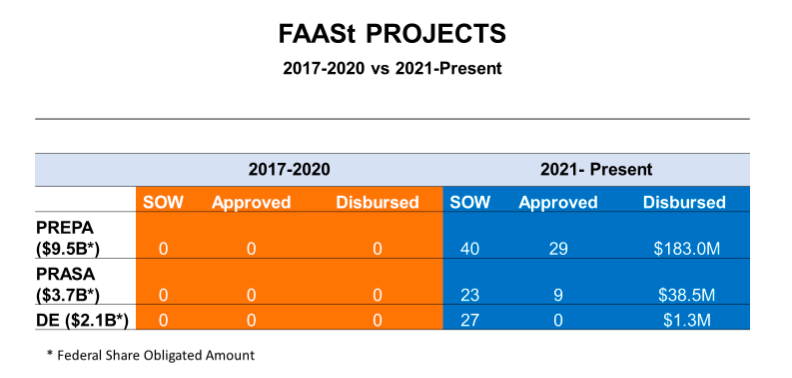
The FEMA representative emphasized that it had committed some $9.5 billion for the long-term reconstruction of the network; while the GAO representative pointed out that of that amount only about $40 million had been spent; shortly thereafter, however, the director of COR3 described as “progress” that some $183 million had been spent on the reconstruction of the grid. It is obvious, then, that the parties are either not speaking the same language, or using the same definitions, or both. There is a clear lack of communication, which ultimately requires coordination.

In addition, in the case of the power grid, there appears to be no agreement on what the plan is to rebuild it. The Puerto Rico Energy Bureau argues that the grid should be rebuilt according to Puerto Rico’s Integrated Resource Plan (“IRP”), while PREPA appears to be working to implement a different plan called the “Ten Year Modernization Plan” and LUMA appears to be working on its own “System Remediation Plan.” Likewise, the federal Department of Energy (“DOE”) is currently working on another grid modernization plan for Puerto Rico, which should be completed by the end of 2023.

It is important to note that while the IRP establishes the legal requirements for the modernization and operation of the grid over the long term (twenty years), it was not written specifically for Maria’s reconstruction and recovery process. On the other hand, the plans submitted by PREPA and LUMA assume a shorter time frame and are proposals made specifically in relation to the ongoing reconstruction process. The DOE initiative appears to be an attempt to present a roadmap for achieving 100% of generation using renewable sources by 2050. Clearly, then, there is a failure of coordination, because while these plans have partial overlaps and intersect in some respects, they are based on different assumptions, have different implementation timelines, and, in the end, seek to achieve different goals.

President Biden recently visited Puerto Rico and announced that the DOE would be in charge of coordinating the work of the federal agencies to accelerate the electricity grid’s reconstruction. Even though we don’t have all the details this seems to be a step in the right direction. However, we believe the current confluence of events calls for President Biden to take bold action and order the creation of an entity similar to the Hurricane Sandy Rebuilding Task Force, which was created by President Obama under Executive Order 13632 of 7 December 2012 and encompass the entire reconstruction process, not just the energy sector.

A Puerto Rico Recovery Task Force would: have an explicit mandate to coordinate recovery efforts among and between the federal agencies and among and between the federal government and the government of Puerto Rico; provide for the inclusion of Puerto Rican elected officials at all levels and their representatives, including the COR3, through an advisory group; promote subsidiarity and inclusiveness by engaging local stakeholders, municipalities, community organizations, NGOs active in Puerto Rico, and business leaders; and strengthen the local economy by ensuring that residents of Puerto Rico and local business enterprises are hired on a priority basis.

In several weeks we will move on from the immediate response to Hurricane Fiona to planning for the reconstruction of the damage caused by that natural phenomenon. When the cameras are turned off, the international media stops covering Puerto Rico, and life on the island begins to resume its daily rhythms, it is imperative that we not forget those who lost their homes, the communities that were left inaccessible, and the small business owners who lost everything. At this juncture, the need to carefully define precise planning, coordination and execution frameworks, and to improve the flow of information, becomes clear. In other words, an entity is needed to comprehensively coordinate and manage Puerto Rico’s recovery.

This column was originally published in Spanish in El Nuevo Día on October 7, 2022.

The Help Puerto Rico Needs

The Help Puerto Rico Needs

Published on October 5, 2022 / Leer en español

Sergio portrait
Policy Director
SHARE

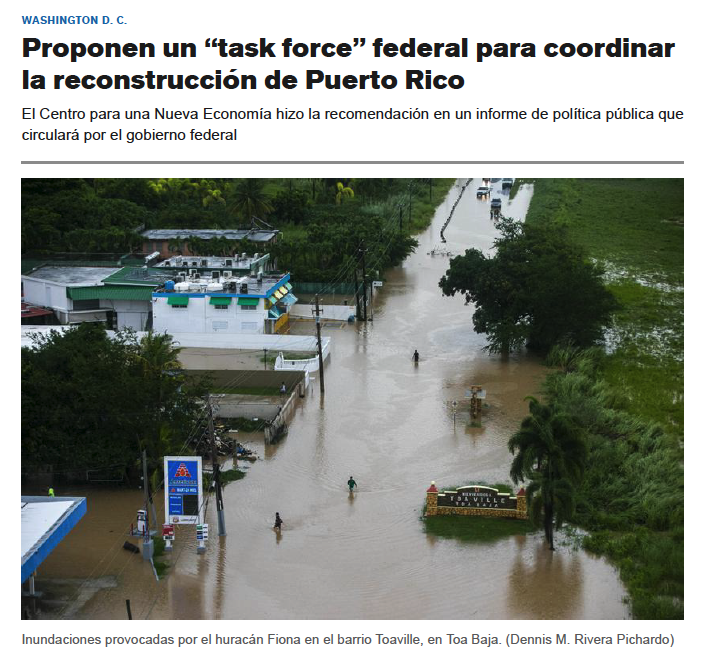
On September 18, on the eve of the fifth anniversary of Hurricane Maria and as Puerto Rico prepared to commemorate the lives lost and reflect on the devastation caused by one of the strongest storms ever seen in these latitudes, Mother Nature played one of her unexpected tricks by sending Hurricane Fiona our way. Fiona hit the island as a Category 1 hurricane with sustained winds of approximately 85 miles per hour. The storm is estimated to have dumped 1 trillion gallons of water on Puerto Rico over 48 to 60 hours. Damage from flooding and the storm surge was severe, life-threatening in some cases, and widespread.

Hurricane Fiona once again laid bare the substantial vulnerability of Puerto Rican society. The impact of a weather event is not only a function of its force or potency, it is also a function of the pre-existing level of vulnerability of a given society. Puerto Rico was extremely vulnerable before Fiona because only 30% of all permanent reconstruction work related to Hurricane Maria had begun; thousands of people still lived in flood-prone areas; and essentially nothing had been done to strengthen the power grid and other critical infrastructure or increase their resilience. Given all that, the key question to ask is: why, five years after Hurricane Maria, is the reconstruction process so far behind?

The short answer is that five key challenges to Puerto Rico’s reconstruction process have not been addressed, namely: (1) the lack of effective coordination among the agencies in charge of reconstruction, (2) poorly designed public participation platforms, (3) superficial transparency efforts, (4) the failure to implement adequate oversight mechanisms, and (5) the extremely slow disbursement of reconstruction funds.

Even before Fiona struck, the lack of coordination between the federal government, Puerto Rico government agencies, and the island’s municipalities was evident. For example, at a September 15 public hearing in Congress, representatives from FEMA, the GAO, and Puerto Rico central office for reconstruction, known as “COR3”, could not agree on the number of long-term projects underway and the amount of money that had been spent to strengthen the power grid. The FEMA representative emphasized that it had committed some $9.5 billion for the long-term reconstruction of the network; while the representative of the GAO pointed out that of that amount only about $40 million had been spent; shortly thereafter, however, the director of COR3 described as “progress” that some $183 million had been spent on the reconstruction of the grid. It is obvious, then, that the parties are either not speaking the same language, or using the same definitions, or both. There is a clear lack of communication, which is ultimately a coordination failure.

The damage caused by Hurricane Fiona will add another layer of complexity to what was already a difficult and complicated endeavor. We are now faced with the challenge of managing three different types of projects: projects to repair the damage caused by Maria and that did not suffer additional damage from Fiona; projects to repair the damage caused by Fiona; and projects that were already underway to repair damage caused by Maria and that were affected by Fiona. Therefore, another reconstruction and recovery process begins parallel to the one that was already taking place, but which must be synchronized with the one already going on, to avoid delays, the duplication of efforts, and the misuse of public funds.

Paradoxically, this complicated situation also provides us with an opportunity to rethink key plans and programs; identify existing deficiencies; and take effective actions to remediate them. In several weeks we will move on from the immediate response to Hurricane Fiona to planning for the reconstruction of the damage caused by that natural phenomenon. When the cameras are turned off, the international media stops covering Puerto Rico, and life on the island begins to resume its daily rhythms, it is imperative that we not forget those who lost their homes, the communities that were left inaccessible, and the small business owners who lost everything. At this juncture, the need to carefully define precise planning, coordination and execution frameworks, and to improve the flow of information, becomes clear. In other words, an entity is needed to comprehensively coordinate and manage Puerto Rico’s recovery.

President Biden recently visited Puerto Rico and expressed his support and solidarity with all those who have suffered so much since Hurricane Maria. That support is greatly appreciated by all in the island. However, we believe the current confluence of events calls for President Biden to take bold action and order the creation of an entity similar to the Hurricane Sandy Rebuilding Task Force, which was created by President Obama under Executive Order 13632 of 7 December 2012.

A Puerto Rico Recovery Task Force would: have an explicit mandate to coordinate recovery efforts among and between the federal agencies and among and between the federal government and the government of Puerto Rico; provide for the inclusion of Puerto Rican elected officials at all levels and their representatives, including the COR3, through an advisory group; promote subsidiarity and inclusiveness by engaging local stakeholders, municipalities, community organizations, NGOs active in Puerto Rico, and business leaders; and strengthen the local economy by ensuring that residents of Puerto Rico and local business enterprises are hired on a priority basis.

That is the help Puerto Rico needs.

This column was originally published in The Hill on October 5, 2022.

CNE Review – September 2022 – 2

Published on September 29, 2022 / Leer en español

See all editions of the
CNE Review
SHARE

In This Issue

Hurricane Fiona has opened a window of opportunity for government officials in Washington, D.C. and Puerto Rico to streamline the ongoing Hurricane María recovery process and to correctly frame the Hurricane Fiona response.

In this Review, we will emphasize the need for: (1) creating a distinct recovery coordination mechanism: the Puerto Rico Recovery Task Force; (2) implementing specific principles that allow for reflection, flexibility, and adaptability; and (3) executing some key policy priorities to promote equitable economic growth and enhancing local capacity.

In advocating for the Puerto Rico Recovery Task Force, we have identified a very specific and particular kind of coordination mechanism that satisfies a discrete set of procedural, equity, and inclusion principles. CNE would not support any similar entity that does not satisfy the principles or fails to implement the policy priorities stated here.

For the sake of clarity and the avoidance of any doubt, we are not advocating for the “federalization of the recovery process” (whatever that may mean); the appointment of a “recovery czar” in the White House; or the “takeover” of the recovery process by the Fiscal Oversight and Management Board.

To achieve a just recovery, Puerto Rico needs coordination and oversight that works — not punitive measures. Successful recoveries require ongoing deliberation and dialogue between all involved stakeholders to ensure that all relevant perspectives are heard and have a chance to influence the process. Moreover, appointing a “recovery czar” or “federalizing” the process would not provide opportunities for local capacity-building.

When an isolated office dictates the recovery process from the top down, the opportunity for local actors to be involved in decision-making and learn key lessons in recovery management is lost. Centralizing the recovery also centralizes information flows, and can pose a threat to accountability and transparency if the newly created entity is not answerable to other actors involved in the recovery.

Click here to read the complete Policy Brief or continue reading for a summary.

–Sergio M. Marxuach, Editor-in-Chief

Insights + Analysis from CNE

By Sergio M. Marxuach, Policy Director

With contributions from:
Deepak Lamba-Nieves, Ph.D. – Research Director
Francis G. Torres – Senior Policy Analyst

A Failure to Communicate

Disaster recovery efforts are usually fraught with uncertainty and complexity at every level —economic, political, and emotional — and also stress-test the capacity of local governments and relief organizations to respond and advance reconstruction efforts in a prompt and equitable fashion. Rebuilding devastated communities under a compressed timeframe, often juggling competing demands and problems that arise on a daily basis, and that are equally urgent, can prove challenging even in the best-prepared jurisdictions.

In addition, at any given time in a post-disaster context, there are many actors working rapidly and independently, which need to coordinate their actions while relying on imperfect information, and their interactions and intersections are important throughout every stage of the process.

Unfortunately, in Puerto Rico after Hurricane María, this coordination process has been flawed, at best. Click to read about the communication and coordination challenges with which Puerto Rico has been contending.

At this juncture of Puerto Rico’s recovery, the haze surrounding the status of the recovery process highlights the need to carefully define precise planning, coordination and implementation frameworks, and improve the flow of information. In other words, there is a need for an entity to comprehensively coordinate and manage Puerto Rico’s recovery. 

Statement of Principles

As we stated five years ago, CNE believes that any entity or mechanism designed to manage the recovery process should comply with the following principles:

  • Promote coordination and cooperation
  • Legitimacy — Provide a forum for the participation of the democratically elected government of Puerto Rico
  • Comply with the principle of subsidiarity
  • Inclusiveness — Provide for the participation of stakeholders from the private and the NGO sector
  • Maximize the economic impact and strengthen the local economy

Click to read more about these principles.

Policy Priorities for the Recovery

In keeping with the principles above, CNE has identified three policy priorities to ensure that the next phase of the recovery process promotes equitable economic growth and enhances local capacity.

These priorities incorporate best practices from the recovery processes in New Orleans and New York in the aftermath of Hurricanes Katrina and Sandy, respectively, as well as lessons learned from the Hurricane María response through CNE’s ReImagina Puerto Rico project

  • The recovery requires a “bottom-up”, comprehensive, and unified planning effort,
  • Municipalities need to be engaged, and
  • Island contractors need to be prioritized in the recovery process.

Click to read more about these priorities. 

A Proposal to Implement Principles and Policy Priorities for the Reconstruction: the Puerto Rico Recovery Task Force

One way to implement these principles and priorities would be by creating an entity similar to the Hurricane Sandy Rebuilding Task Force, which was created by President Obama pursuant to Executive Order 13632 of December 7, 2012 (the “Sandy Executive Order”). Click here to read more on the Sandy Executive Order.

In our view, if a similar entity were to be created to coordinate the recovery process for Hurricanes María and Fiona, it would comply with the principles and policy priorities set forth above because:

  • It would have an explicit mandate to coordinate recovery efforts among and between the federal agencies and among and between the federal government and the government of Puerto Rico.
  • It would provide for the inclusion of Puerto Rican elected officials at all levels and their representatives, including the COR3, through an advisory group.
  • It would promote subsidiarity and inclusiveness by engaging local stakeholders, municipalities, community organizations, NGOs active in Puerto Rico, and business leaders.
  • And it would strengthen the local economy by ensuring that residents of Puerto Rico and local business enterprises are hired on a priority basis.

Conclusion

We have learned much during these five years after Hurricane María, and our recommendations reflect this. If properly designed and implemented the proposed mechanism would facilitate effective coordination among stakeholders at different levels of government, insure adequate public participation in the planning and oversight process, provide greater transparency and accountability in the project selection phase and the use of funds, and speed up the outlay of recovery funds.

To move forward, Puerto Rico must seize this opportunity to evaluate the hurricane recovery process and modify the existing recovery governance framework. In the final analysis, every disaster is “a time of desperate loss, yet also a time of distinct possibility.”[1] Let’s make the most of this time of possibility.

[1] Lynne B. Sagalyn, Power at Ground Zero: Politics, Money, and the Remaking of Lower Manhattan, (Oxford, 2016), p. 5.

CNE in the News

On Our Radar

The Far Right Wins In Italy – Italians went to the polls on September 26th and returned a parliamentary plurality for the Brothers of Italy, a party with fascist roots, and the leader of a right-wing coalition with the League, led by Matteo Salvini, and Forza Italia, headed by Silvio Berlusconi. It is widely expected that this coalition will ask the leader of the Brothers, Ms. Giorgia Meloni, to form a government. Meloni has made some headline-grabbing statements questioning the legitimacy of Western-style, liberal democracy. However, as Yascha Mounk writes in The Atlantic, some of that may just be Corona talk at the Cantina. Meloni has already broken with fellow autocrats wanna-bes with respect to their support of the Russian invasion of Ukraine and with their anti-EU stance: Italy receives millions in subsidies from Brussels. However, her policies against immigrants, LGBTT+ rights, Islam, and the “secularization” of Italian society may mean a sharp right turn in terms of domestic Italian politics. For all her bluster, tough, many Italians remain skeptical of Meloni and her party. Mounk quotes a 70-year-old woman as saying: “It’ll fail to get much of anything done. And then it’ll collapse”. We certainly hope she is right.
What’s Breaking Democracy? – “The internationalization of economic and financial relationships has undermined the authority of the nation-state and created the conditions for today’s confluence of global crises. Worse, the unraveling of neoliberalism has led not to a progressive revival, but to something more politically contingent and uncertain”, writes William H. Janeway for Project Syndicate.

The Child Tax Credit is Smart Policy – According to the Center on Budget and Policy Priorities, “the Child Tax Credit expansion drove child poverty sharply downward in 2021. On top of other relief efforts, the expansion helped lower child poverty by more than 40 percent between 2020 and 2021, reaching a record low of 5.2 percent, Census Bureau data released last week show. The credit’s expansion expired at the end of last year, but policymakers can renew this successful poverty-fighting policy in year-end bipartisan tax legislation.”

Puerto Rico Recovery Task Force

Puerto Rico Recovery Task Force

Published on September 28, 2022 / Leer en español

Sergio portrait
Policy Director

With contributions from:
Deepak Lamba-Nieves, Ph.D.
Research Director
Francis G. Torres
Senior Policy Analyst

DOWNLOAD
SHARE

Introduction

On September 18th, on the eve of the fifth anniversary of Hurricane María and as Puerto Rico was preparing to commemorate the lives lost and reflect on the destruction caused by one of the strongest storms ever seen around these latitudes, Mother Nature played one of her devious tricks on us by sending Hurricane Fiona on our way. Fiona hit the island as a category 1 hurricane with sustained winds of around 85 miles per hour. It is estimated the storm poured 1 trillion gallons of water on Puerto Rico over approximately 48 to 60 hours. The damage caused by flooding and the storm surge was serious, life-threatening in some instances, and widespread.

Fiona, therefore, laid bare once again the substantial vulnerability of Puerto Rican society to these kinds of events. For the impact of such a storm is not only a function of its force or strength, it is also a function of a given society’s pre-existing level of vulnerability. Puerto Rico was extremely vulnerable prior to Hurricane Fiona because only 30% of all permanent reconstruction work related to Hurricane María had started; thousands of people still lived in flood-prone areas; and basically, nothing had been done to strengthen the electric grid and other critical infrastructures or increase their resiliency. Given all of that, the key question to ask is: why five years after Hurricane María is the reconstruction process still at such an early stage?

The short answer, as we stressed three years ago, is that we have failed to address five key challenges to Puerto Rico’s recovery process, namely: (1) the lack of effective coordination among stakeholders, (2) poorly designed public participation platforms, (3) superficial transparency efforts, (4) the failure to implement adequate oversight mechanisms, and (5) the extremely slow outlay of recovery funds, especially for long-term permanent works.[1]

The damage caused by Hurricane Fiona will certainly add another layer of complexity on top of what was already a difficult and complicated effort. Ironically, though, it also provides us with an opportunity to rethink key plans and programs; identify existing deficiencies; and take effective actions to remediate them.

This Policy Brief will focus on the lack of effective coordination among the relevant stakeholders, set forth principles to guide the recovery process, present policy priorities for both the emergency response to Fiona and the ongoing reconstruction related to María, and suggest a mechanism for effective coordination among and between all the relevant parties.

A Failure to Communicate

Disaster recovery efforts are usually fraught with uncertainty and complexity at every level —economic, political, and emotional — and also stress-test the capacity of local governments and relief organizations to respond and advance reconstruction efforts in a prompt and equitable fashion. If the scale of the damage provoked by Hurricanes María and Fiona is considered, the complexities of Puerto Rico’s disaster recovery process become evident. All of Puerto Rico suffered massive damage.

Rebuilding devastated communities under a compressed timeframe, often juggling competing demands and problems that arise on a daily basis, and that are equally urgent, can prove challenging even in the best-prepared jurisdictions. After María, these stresses were magnified in Puerto Rico because it was not only managing a large-scale recovery process, it was also simultaneously going through the largest municipal bankruptcy in U.S. history. And now, of course, we have to address the damage caused by Hurricane Fiona.

In addition, at any given time in a post-disaster context, there are many actors working rapidly and independently, while relying on imperfect information, and their interactions and intersections are important throughout every stage of the process. In the aftermath of Hurricane Katrina in New Orleans, post-disaster recovery experts Robert B. Olshansky and Laurie A. Johnson highlighted the importance of overcoming unanticipated problems: “Coordination is critical to recovery, due to many actors working in a compressed time environment and with constrained information flow. The only way to function effectively in a chaotic and uncertain environment is to provide information to actors systematically and coordinate with them regularly.”[2]

The government of Puerto Rico sought to address this issue when, back in October 2017, the Governor established the Central Office of Recovery, Reconstruction and Resilience, or COR3, to oversee all disaster recovery efforts. The government set the expectation that this new agency would lead, coordinate and implement long-term recovery and reconstruction efforts.[3]

Key to that role was its capacity to coordinate efforts among all relevant actors. In the case of Puerto Rico, coordinating recovery and reconstruction efforts involves navigating a complex series of administrative frameworks which include a series of local and federal actors: the Puerto Rico Housing Department and numerous other Puerto Rico government agencies with key responsibilities in reconstruction efforts; FEMA and several other agencies of the federal government; municipal governments; local and foreign non-governmental organizations; hundreds of thousands of residents affected by the hurricane; and myriad external consultants. Thus, the María recovery process required coordination, first, among the relevant federal agencies; second, among and between those federal agencies and their counterparts in Puerto Rico; and third, among and between federal and state agencies on one side, and municipalities on the other.

Unfortunately, this coordination process has been flawed, at best. All this can sound awfully abstract at first so let’s use a concrete example. At a recent hearing of the Subcommittee on Economic Development, Public Buildings, and Emergency Management of the Committee on Transportation and Infrastructure of the U.S. House of Representatives, Ms. Anne Bink, Associate Administrator of the Office of Response and Recovery at FEMA, stated that “the largest ever public infrastructure project was obligated at nearly $9.5 billion to the Puerto Rico Electric Power Authority (“PREPA”), which will not just rebuild Puerto Rico’s power grid, but will build it back better.”[4]

At the same hearing, however, Mr. Chris Currie, Director of Homeland Security and Justice at the United States Government Accountability Office (“GAO”), stressed that while a significant amount of money has been obligated to rebuild the electric grid, precious little has actually been spent. As shown in the chart below, only $40 million of the $9.5 billion obligated by FEMA has been spent as of August 2022 (see “Category F” in the chart below).[5]


Source: Statement of Chris Currie, September 15, 2022, p. 15, GAO-22-106211

Minutes later, though, Mr. Manuel Laboy, Executive Director of the COR3, confidently stated that some 29 projects to repair some parts of the electric grid have been approved and a total of $183 million have been disbursed.[6]

Source: Statement of Hon. Manuel Laboy September 15, 2022, p. 26.
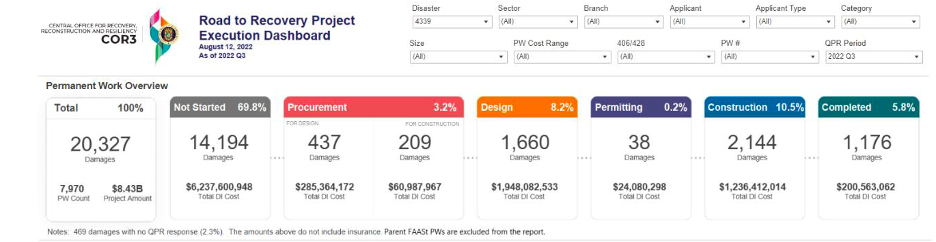
Thus, an independent observer seeking to judge the progress to rebuild Puerto Rico’s grid would face a disparate set of figures. If the correct benchmark is the amount of money obligated to repair the grid, then it would appear that significant progress has been done. However, if, as many experts believe, the appropriate benchmark is how much money has actually been spent on projects to strengthen the grid, then progress has been painfully slow.[7]

Even if we agree that the spending rate is the right benchmark, we don’t know which figure is the correct amount: the GAO states that $40 million has been spent, while the COR3 states it has been $183 million. It is obvious to us, then, that the parties are not speaking the same language, or using the same definitions, or both. There is a clear failure to communicate, which in the final analysis is a failure of coordination.

In the case of the electric grid, there are at least two other factors that point to a large-scale coordination failure. First, it appears there is no agreement as to what is the plan to rebuild the grid. The Puerto Rico Energy Bureau argues that the grid has to be rebuilt in accordance with Puerto Rico’s Integrated Resource Plan (“IRP”), while PREPA appears to be working to implement a different plan called the “Ten-Year Modernization Plan” and LUMA seems to be working off its own “System Remediation Plan”. In addition, the federal Department of Energy is currently working on yet another grid modernization plan for Puerto Rico, which should be finalized by the end of 2023.

Please note that while the IRP sets the statutory requirements for the long-term (twenty years) modernization and operation of the grid, it was not drafted specifically for the María reconstruction and recovery process. On the other hand, the plans put forward by PREPA and LUMA assume a shorter timeframe and are proposals specifically made in connection with the ongoing reconstruction process. The DOE plan appears to be an attempt to both steer the grid reconstruction process and present a path forward for achieving 100% generation from renewables by 2050. Clearly, then, there is a coordination failure, because while these plans may partially overlap and intersect in certain aspects, they are based on different assumptions, have different implementation timelines, and, in the end, seek to achieve different objectives.

Second, as was pointed out by Mr. Currie during the September 15th hearing, LUMA and FEMA have had serious disagreements about

making repairs beyond the damages sustained during Hurricane María. Specifically, the private operator and FEMA disagree on which aspects of the agency’s proposed project the Public Assistance funding will cover. FEMA officials note that there are nuances involved in developing a complex project and ensuring it is eligible under federal laws and regulations.[8]

Finally, and this applies to all recovery projects, not only those related to the electric grid, the GAO found that oftentimes Puerto Rican government officials were not sure about how to proceed in accordance with FEMA policy because they did not know which set of guidelines were then currently in effect. Without access to relevant, up-to-date guidance, recovery stakeholders were exposed to the risk of acting in accordance with guidance that had been revised or replaced.[9]


Source: Statement of Hon. Manuel Laboy September 15, 2022, p. 27

That last point would go a long way in explaining why, as shown in the chart above, only 5.8% of all permanent works projects have been completed as of August 2022.

In a similar fashion, coordination difficulties and bureaucratic hurdles have been at the center of significant delays in the approval and disbursement of funds assigned to complete municipal reconstruction projects. Local mayors argue that they confront sizeable delays (sometimes reaching 120 days) in the receipt of reimbursements for public works carried out. In addition, many municipalities on the island face serious budget constraints due to declining economic activity and austerity measures imposed by the FOMB.[10]

As a result, many cash-strapped municipalities have had to delay and at times halt much-needed reconstruction projects. Mr. Laboy has admitted that unnecessary bureaucratic processes and the substandard performance of certain multinational firms contracted to assist the COR3 in handling administrative procedures are a big part of the problem. [11] Thus, we should carefully analyze and diagnose the problem before making suggestions to impose quick fixes, without thinking through how they will interact with other processes affecting this massive reconstruction effort.

At this juncture of Puerto Rico’s recovery, the haze surrounding the status of the recovery process highlights the need to carefully define precise planning, coordination and implementation frameworks, and improve the flow of information. In other words, there is a need for an entity to comprehensively coordinate and manage Puerto Rico’s recovery.

Statement of Principles

As we stated five years ago, CNE believes that any entity or mechanism designed to manage the recovery process should comply with the following principles[12]:

  • Coordination and Cooperation — The management structure for the recovery effort should serve as a forum to coordinate the spending of all federal recovery funding allocated to Puerto Rico, not only FEMA funds, and to provide for coordination first, among federal agencies; second, among and between federal agencies and their counterparts in Puerto Rico; and third, among and between federal and state agencies on one side, and municipalities on the other. It should also allow for the effective coordination of the work to be done by a plurality of groups and stakeholders working with different visions for the new Puerto Rico.
  • Legitimacy — Provide a Forum for the Participation of the Democratically Elected Government of Puerto Rico: Any solution to this conflict has to provide a space for the effective and meaningful participation of the duly elected government of Puerto Rico. Otherwise, the reconstruction effort will be perceived as illegitimate and lack support from key political stakeholders on the island.
  • Subsidiarity — This principle essentially requires that decisions that affect a certain community be taken at the government level closest to that community. According to the Compendium of the Social Doctrine of the Catholic Church, the principle of subsidiarity is one of the most important principles of social philosophy:

“Just as it is gravely wrong to take from individuals what they can accomplish by their own initiative and industry and give it to the community, so also it is an injustice and the same time a grave evil and disturbance of right order to assign to a greater and higher association what lesser and subordinate organizations can do. For every social activity ought of its very nature to furnish help to the members of the body social, and never destroy and absorb them.”

Furthermore, “on the basis of this principle, all societies of a superior order must adopt attitudes of help (“subsidium”)—therefore of support, promotion, development—with respect to lower-order societies.  In this way, intermediate social entities can properly perform the functions that fall to them without being required to hand them over unjustly to other social entities of a higher level, by which they will end up being absorbed and substituted, in the end seeing themselves denied their dignity and essential place.”[13]

The principle of subsidiarity is also defined in Article 5 of the Treaty on European Union. “It aims to ensure that decisions are taken as closely as possible to the citizen and that constant checks are made to verify that action at the EU level is justified in light of the possibilities available at the national, regional, or local level.  Specifically, it is the principle whereby the EU does not take action (except in the areas that fall within its exclusive competence) unless it is more effective than action taken at the national, state, or local level.”[14]

  • Inclusiveness — Provide for the Participation of Stakeholders from the Private and the NGO Sector: Puerto Rico’s private sector and non-governmental organizations should be provided with a platform to express their visions and make their own proposals for a new Puerto Rico when the time comes to translate the rhetoric of resilience into concrete plans, architectural realities, political decisions, building priorities, and economic and financial costs. Otherwise, the whole effort will be bound to fail as the “new Puerto Rico” will inevitably not satisfy the expectations of the private sector and civil society and the net result will be increased migration to the mainland.
  • Economic Impact and Strengthening the Local Economy — The entity(ies) in charge of rebuilding Puerto Rico should hire residents of Puerto Rico and local organizations on a priority basis to ensure that disaster survivors participate in recovery activities and directly benefit from recovery funds. This is especially important given Puerto Rico’s high poverty rate and low labor force participation.

Policy Priorities for the Recovery

In keeping with the principles above, CNE has identified three policy priorities to ensure that the next phase of the recovery process promotes equitable economic growth and enhances local capacity.

These priorities incorporate best practices from the recovery processes in New Orleans and New York in the aftermath of Hurricanes Katrina and Sandy, respectively, as well as lessons learned from the Hurricane María response through CNE’s ReImagina Puerto Rico project[15]

  • The recovery requires a “bottom-up”, comprehensive, and unified planning effort, much like what was done in New Orleans after Katrina (via the Unified New Orleans Plan) and in the State of New York following Superstorm Sandy (via NY Rising). At present, the Government of Puerto Rico has centralized all planning efforts in the COR3 office. There are highly complicated issues, like land titling, mitigation vs. housing relocation, among others, that have to be addressed to avoid political pushback from municipalities and local communities. Moreover, if planning and implementation are performed in a piecemeal manner (bypassing certain localities or without the proper sequencing) coordination failures will occur and potentially lead to a longer and costlier reconstruction.
  • Municipalities need to be engaged. Although the Commonwealth government has designed a centralized recovery and reconstruction process, largely controlled by the executive branch, the participation of municipal governments is essential for the success of these pursuits. Municipalities are the “first responders” in the emergency response period and play a fundamental role in the provision of basic services. They are also the government entity closest to local communities. However, not all municipalities are capable of administering reconstruction funds or managing large-scale projects. The key to engaging municipalities is knowing which ones have the capacity to lead, and which ones require capacity building. Nonetheless, the recovery and reconstruction processes offer numerous opportunities for municipalities to devise and implement creative and cost-saving solutions.
  • Island contractors need to be prioritized in the recovery process. Traditionally, federal disaster response has been understood as the “silver lining” that stems from a catastrophic event, given the millions of U.S. government dollars that are pumped into the local economy. Federal funding for recovery, according to this logic, will have a multiplier effect that could potentially steer Puerto Rico’s economic growth rate into positive territory. Although much of the optimism is tied to potential investments funded by the federal government in Puerto Rico, the bulk of federal expenditures for both relief and recovery efforts is not flowing into Puerto Rico-based businesses, and therefore such spending has not been very effective in stimulating the local economy. As it stands the recovery process, is neither fostering local hiring nor focusing on high-impact industrial sectors. CNE has begun to analyze the contracting data, with a focus on key agencies like the DHS, USDA, and USACE, amongst others. Hiring a greater number of local firms for a longer period of time could also provide learning and capacity-building opportunities for many of these actors, which could improve their ability to address future natural events in Puerto Rico or elsewhere in the mainland U.S. Thus, local firms should be given priority and mainland firms should be compelled to hire local subcontractors when appropriate.

A Proposal to Implement Principles and Policy Priorities for the Reconstruction

One way to implement these principles and priorities would be by creating an entity similar to the Hurricane Sandy Rebuilding Task Force, which was created by President Obama pursuant to Executive Order 13632 of December 7, 2012 (the “Sandy Executive Order”). The Sandy Executive Order:

  • Created a Task Force chaired by the Secretary of Housing and Urban Development. In addition, it included the head of 23 other federal executive departments, agencies, and offices involved in the recovery process.
  • Stated that the principal function of the Task Force was to provide the coordination necessary to support the rebuilding of the area affected by Hurricane Sandy, including “working closely with FEMA within the scope of the National Disaster Recovery Framework (“NDRF”).”
  • Ordered the Task Force to “identify and work to remove obstacles to resilient rebuilding in a manner that addresses existing and future risks and vulnerabilities and promotes the long-term sustainability of communities and ecosystems”.
  • Mandated that the Task Force “coordinate with entities in the affected region in efforts to: (i) ensure the prompt and orderly transition of affected individuals and families into safe and sanitary long-term housing;  (ii) plan for the rebuilding of critical infrastructure damaged by Hurricane Sandy in a manner that accounts for current vulnerabilities to extreme weather events and increases community and regional resilience in responding to future impacts; (iii) support the strengthening of the economy; and (iv) understand current vulnerabilities and future risks from extreme weather events, and identify resources and authorities that can contribute to strengthening community and regional resilience as critical infrastructure is rebuilt and ecosystem functions are restored”.
  • Required the Task Force to “engage local stakeholders, communities, the public, Members of Congress, and other officials throughout the areas affected by Hurricane Sandy to ensure that all parties have an opportunity to share their needs and viewpoints to inform the work of the Task Force”.
  • Authorized the Chair to create an “Advisory Group to advise the Task Force and invite individuals to participate in it. Participants shall be elected State, local, and tribal officials and may include Governors, Mayors, County Executives, tribal elected officials, and other elected officials from the affected region as the Chair deems appropriate.”
  • Provided for the Task Force to have a staff, “headed by an Executive Director, which shall provide support for the functions of the Task Force.”
  • Allowed the Task Force to “establish technical working groups of Task Force members, their representatives, and invited Advisory Group members and elected officials, or their designated employees, as necessary to provide advice in support of their function.”

In our view, if a similar entity were to be created to coordinate the recovery process for Hurricanes María and Fiona, it would comply with the principles and policy priorities set forth above because:

  • It would have an explicit mandate to coordinate recovery efforts among and between the federal agencies and among and between the federal government and the government of Puerto Rico.
  • It would provide for the inclusion of Puerto Rican elected officials at all levels and their representatives, including the COR3, through an advisory group.
  • It would promote subsidiarity and inclusiveness by engaging local stakeholders, municipalities, community organizations, NGOs active in Puerto Rico, and business leaders.
  • And it would strengthen the local economy by ensuring that residents of Puerto Rico and local business enterprises are hired on a priority basis.

Notice that we are advocating for a very specific and particular kind of coordination mechanism that satisfies a discrete set of procedural, equity, and inclusion principles. CNE would not support any similar entity that does not satisfy the principles or fails to implement the policy priorities set forth herein.

For the sake of clarity and the avoidance of any doubt, we are not advocating for the “federalization of the recovery process” (whatever that may mean); the appointment of a “recovery czar” in the White House; or the “takeover” of the recovery process by the Fiscal Oversight and Management Board.

To achieve a just recovery, Puerto Rico needs coordination and oversight that works — not punitive measures. Successful recoveries require ongoing deliberation and dialogue between all involved stakeholders to ensure that all relevant perspectives are heard and have a chance to influence the process. Moreover, appointing a “recovery czar” or “federalizing” the process would not provide opportunities for local capacity-building.

When an isolated office dictates the recovery process from the top down, the opportunity for local actors to be involved in decision-making and learn key lessons in recovery management is lost. Centralizing the recovery also centralizes information flows, and can pose a threat to accountability and transparency if the newly created entity is not answerable to other actors involved in the recovery.

Conclusion

Hurricane Fiona has opened a window of opportunity for government officials in Washington, D.C. and Puerto Rico to streamline the ongoing Hurricane María recovery process and to correctly frame the Hurricane Fiona recovery. Throughout this Policy Brief we have emphasized the need for: (1) creating a distinct recovery coordination mechanism; (2) implementing specific principles that allow for reflection, flexibility, and adaptability; and (3) executing some key policy priorities to promote equitable economic growth and enhancing local capacity.

If properly designed and implemented the proposed mechanism would facilitate effective coordination among stakeholders at different levels of government, insure adequate public participation in the planning and oversight process, provide greater transparency and accountability in the project selection phase and the use of funds, and speed up the outlay of recovery funds.

To move forward, Puerto Rico must seize this opportunity to evaluate the hurricane recovery process and modify the existing recovery governance framework. In the final analysis, every disaster is “a time of desperate loss, yet also a time of distinct possibility.”[16] Let’s make the most of this time of possibility.

Endnotes

[1] Center for a New Economy, Oversight that Works, August 2019, available at https://grupocne.org/wp-content/uploads/2019/08/CNE-Policy-Memo-Oversight-That-Works.pdf

[2] Olshansky, R. B., & Johnson, L. A. (2010). Clear as Mud: Planning for the Rebuilding of New Orleans, Washington, DC: American Planning Association.

[3] See Executive Order OE-2017-65

[4] Statement of Anne Bink before the Subcommittee on Economic Development, Public Buildings, and Emergency Management of the Committee on Transportation and Infrastructure of the U.S. House of Representatives, “Recovery Update: Status of FEMA Recovery Efforts in Puerto Rico and U.S. Virgin Islands 5 Years After Hurricanes Irma and Maria”, September 15, 2022, p. 2.

[5] Statement of Chris Currie before the Subcommittee on Economic Development, Public Buildings, and Emergency Management of the Committee on Transportation and Infrastructure of the U.S. House of Representatives, “Recovery Update: Status of FEMA Recovery Efforts in Puerto Rico and U.S. Virgin Islands 5 Years After Hurricanes Irma and Maria”, September 15, 2022, p. 15, GAO-22-106211.

[6] Statement of Hon. Manuel Laboy before the Subcommittee on Economic Development, Public Buildings, and Emergency Management of the Committee on Transportation and Infrastructure of the U.S. House of Representatives, “Recovery Update: Status of FEMA Recovery Efforts in Puerto Rico and U.S. Virgin Islands 5 Years After Hurricanes Irma and Maria”, September 15, 2022, p. 26.

[7] According to Mr. Currie’s statement “An obligation is a definite commitment that creates a legal liability of the government for the payment of goods and services ordered or received. For the purposes of this statement, obligations represent the amount of grant funding FEMA provided through the Public Assistance program and the Hazard Mitigation Grant Program for specific projects in Puerto Rico and the USVI. An expenditure is an amount paid by federal agencies, by cash or cash equivalent, during the fiscal year to liquidate government obligations. For the purposes of this statement, an expenditure represents the actual spending by the government of Puerto Rico government or the USVI government of money obligated by the federal government.”

[8] Statement of Chris Currie, September 15, 2022, p. 19, GAO-22-106211

[9] Id. at p. 12.

[10] Many FEMA programs work on a reimbursement basis, which presents a difficulty to many municipalities and government agencies that may not have the required cash flow available to finance long-term permanent work projects.

[11] See: “Truenan los alcaldes por situaciones con desembolso para la reconstrucción en los municipios”, Primera Hora, February 1, 2022; “Nuevo director de COR3 acepta responsabilidad en atrasos de los fondos de recuperación a municipios”, Centro de Periodismo Investigativo, February 12, 2021.

[12] Sergio M. Marxuach, Expediting the Recovery Process: A Proposal to Create a Puerto Rico Development Authority, Center for a New Economy, December 2017, available at https://grupocne.org/wp-content/uploads/2017/12/PRDA-Policy-Brief.pdf

[13] Compendium of the Social Doctrine of the Catholic Church, 186; see also, Leo XIII, Encyclical Letter Rerum Novarum (1892); Pius XI Encyclical Letter Quadragesimo Anno (1931); John Paul II Encyclical Letter Centesimus Annus (1991); and Catechism of the Catholic Church, 1882 and 1883.

[14] See Lisbon Treaty, Article 5, (2007) (ratified 2009) and http://eur-lex.europa.eu/summary/glossary/subsidiarity.html

[15] The goal of Reimagina Puerto Rico was to devise a process whereby the people of Puerto Rico could effectively participate in defining recovery priorities. Through a wide ranging and inclusive public participation effort—which included 77 meetings and activities with over 700 participants in island communities and the diaspora—both specialists and community stakeholders identified close to 500 recovery opportunities. The top ideas are contained in a detailed report recently produced by Reimagina, which provides 97 priority actions across six key sectors. Funding from the Ford Foundation, Open Societies Foundation and technical assistance from the 100 Resilient Cities project were instrumental in these efforts.

[16] Lynne B. Sagalyn, Power at Ground Zero: Politics, Money, and the Remaking of Lower Manhattan, (Oxford, 2016), p. 5.