Analysis of PREPA Legacy Assets Public-Private Partnership Agreement

Analysis of PREPA Legacy Assets Public-Private Partnership Agreement

Published on March 15, 2023

Sergio portrait
Policy Director
DOWNLOAD
SHARE

Introduction

On January 24, 2023, the Puerto Rico Power Electric Authority (“PREPA” or the “Owner”), the Puerto Rico Public-Private Partnerships Authority (the “P3 Authority” or the “Administrator”), and Genera PR LLC (the “Operator” or “Genera”), executed the Puerto Rico Thermal Generation Facilities Operation and Maintenance Agreement (the “Generation O&M Agreement”) setting forth the terms and conditions pursuant to which the Operator will operate, maintain, and eventually decommission certain Legacy Generation Assets owned by PREPA.

The execution of the Generation O&M Agreement is the most recent step in the long-term transformation of the Puerto Rico electricity market. Some of the highlights of that transformation process are:

  • The enactment of Act 57 on May 17, 2014, creating the Puerto Rico Energy Commission (now the Puerto Rico Energy Bureau or the “PREB”) to regulate the electricity market in Puerto Rico, among other things;
  • The filing of a petition to restructure PREPA’s financial liabilities pursuant to Title III of the Puerto Rico Oversight, Management, and Economic Stability Act (“PROMESA”) in July 2017, a proceeding that is still pending resolution before the United States District Court for the District of Puerto Rico;
  • The enactment of Act 120 on June 21, 2018 to “establish a path for a more reliable, efficient, and low-cost electric system”;
  • The enactment of Act 17 of April 11, 2019 setting forth “the Puerto Rico Energy Public Policy”; and
  • The execution of the Transmission and Distribution Operation and Management Agreement (the “T&D O&M Agreement”) entered into on June 22, 2020, by and among PREPA, the Administrator, LUMA Energy LLC and LUMA Energy ServCo, LLC (collectively, the “T&D Operator” or “LUMA”), pursuant to which the T&D Operator “shall operate, maintain, and modernize PREPA’s transmission and distribution system (the “T&D System”).

This ten-year transformation process was prompted by PREPA’s failure to provide affordable, reliable, and efficient electric service to the people of Puerto Rico after decades of mismanagement, corruption, and non-compliance with applicable laws, regulations, and industry standards.

Indeed, according to the P3 Authority PREPA currently faces significant operational challenges, including in the following areas:

  • Safety — Since 2003, “PREPA’s safety performance has been more than five times worse that the industry average. Incident Rates for T&D and generation on an annual basis have ranged from 11.0 to 19.0, and averaged approximately 15.0; this compares to a U.S. average for public power [companies] of approximately 4.92.”[1]
  • Reliability — PREPA’s plants operate with Forced Outage Rates that are up to five times worse than the industry average and at low Equivalent Availability Factors, which increases “the likelihood of forced outages leading to an interruption of the delivery of electricity to customers. Indeed, some of these outages resulted in inadequate generation supply and significant loss of adequate power supply to meet customer demand.”[2]
  • Generation Resource Adequacy — Puerto Rico has inadequate supply resources to meet expected demand. In fact, “the load loss expectation for Puerto Rico for 2023 was calculated at 8.81 days per year, which is 88 times higher than the utility industry benchmark of 1 day in 10 years or 0.10 days per year. This means that there will be 8.81 days per year when demand will not be met by generation supply.”[3]
  • Environmental Compliance — PREPA’s record of environmental compliance has been deficient, not to say outright awful. Throughout its history it has failed to comply with the Clean Air Act, the Clean Water Act, the Mercury and Air Toxics Standards, and with several other air and water environmental rules and regulations. As a result, the “Legacy Generation Assets continue to operate at significantly lower capacity than their nameplate capacity and suffer from long-standing operational deficiencies and disrepair.”[4]
  • Corruption — PREPA has long been a source of private and public corruption in the island. PREPA’s suppliers, in many cases thanks to their political donations and influence, have benefited from contracts to provide goods and services to the public utility, sometimes at inflated, not to say borderline extortionate, prices. See, for example, the nefarious history of PREPA’s fuel and equipment procurement practices.[5]

It has become fashionable in certain circles of the self-described political avant-garde to claim that PREPA was once considered the “crown jewel” of Puerto Rico’s government (a particularly obnoxious figure of speech given our colonial history). A closer look at the historical record, though, reveals that for many years appointment to senior management positions at PREPA depended more on partisan politics than on personal merit. Technical and managerial decisions, in turn, were often subordinated to short-term political interests. PREPA survived for decades largely by postponing capital expenditures, delaying payment to suppliers, using accounting gimmicks to muddle its true financial condition, and by borrowing billions at relatively low, tax-exempt rates in the U.S. municipal bond markets, in many cases just to make the debt service on other maturing debt. That all these shenanigans eventually ended in a bankruptcy filing should not be surprising to anyone that was paying attention. Nonetheless, it is still difficult to think of other monopolies that have managed to bankrupt themselves, with the exception, perhaps, of the state-owned enterprises in the former Soviet Union.

Given all of the above, the incontrovertible conclusion is that PREPA simply cannot continue operating the way it has up until now. It has become a decrepit, some would say half-dead, zombie public utility that stifles economic activity in Puerto Rico. The time has come to take drastic action with respect to PREPA, as it has proven incapable of reforming itself and has been immune to the efforts of several administrations to modernize and improve its operations. Those who would infuse this moribund public corporation with the breath of new life bear the burden of proof to demonstrate by a preponderance of the evidence why that should be the case.

In this Policy Brief, we will present an analysis of the principal components of the Generation O&M Agreement, including the basic structure of the transaction; the compensation of the Operator (including any incentives and penalties provided for therein); the estimated savings to be generated as a result of hiring a private operator to operate and maintain the Legacy Generation Assets; the planned decommission of most of the existing facilities that currently use fossil fuels to generate electricity in Puerto Rico; and the resulting structure of Puerto Rico’s electricity market.

Structure of the Generation O&M Agreement

Genera is a wholly-owned subsidiary of New Fortress Energy (“NFE”). NFE, in turn, is “an integrated gas-to-power energy infrastructure company”, whose “business model spans the entire production and delivery chain from natural gas procurement and liquefaction to shipping, logistics, facilities and conversion or development of natural gas-fired power generation.”[6]

Genera is being hired by PREPA, as owner of the Legacy Generation Assets, to provide (either directly or through subcontractors) four classes of services, namely: (i) the Mobilization Services, (ii) the O&M Services commencing on the Service Commencement Date, (iii) the Decommissioning Services, and (iv) the Demobilization Services. In exchange for providing those services, the Operator is entitled to receive certain compensation, subject to any applicable Incentive Payments or Penalties, during the term of the Generation O&M Agreement, which is initially expected to last ten (10) years.

The Mobilization Services

The Operator is required to provide a specific set of services during the period between the Effective Date of the Generation O&M Agreement and the O&M Services Commencement Date, which is expected to be about 100 days after the Effective Date (the “Target Service Commencement Date”). The Mobilization Services, which are described in the Mobilization Plan outline set forth in Annex VII to the Generation O&M Agreement, are intended to “ensure an orderly transfer of the care, custody and control of the Legacy Generation Assets to Operator”.[7]

Those services include, among others, the evaluation and hiring of personnel; the hiring of subcontractors, if any; executing the tasks set forth in the Handover Checklist included in Annex VII; obtaining the requisite insurance; preparing a Procurement Manual; developing a Communications Plan; preparing a Fuel Optimization Plan, setting forth the Fuel Cost Savings Initiatives; and preparing a Federally Funded Generation Project Plan “listing and describing those projects proposed by Operator for priority in the receipt of any funding for the Legacy Generation Assets, received or to be received by or for the benefit of Owner from any U.S. federal agency.”[8]

During the Mobilization Period the Operator is entitled to be reimbursed for all reasonable costs and expenses (including the compensation of current employees of the Operator and any subcontractors) incurred during the course of providing the Mobilization Services, subject to a cap of $15 million. [9] If the Target Service Commencement Date is delayed by 90 days or more, except in the case of a Force Majeure Event or an event caused by Owner’s fault, then the Operator shall pay damages to PREPA in the amount of $1 million per week for each week the Target Service Commencement Date is further delayed, up to a maximum of $15 million.[10]

The O&M Services

Commencing on the Service Commencement Date, Operator shall (i) provide management, operation, maintenance, repair, restoration, replacement, and other related services for the Legacy Generation Assets, as well as any optimization procedures (including for improving fuel and efficiency) approved by the PREB, and (ii) establish policies, programs and procedures with respect thereto, to the extent not already established.[11]

The scope of the O&M Services is set forth in Annex IX to the Generation O&M Agreement. These services include, but are not limited to, the following:

(1) day-to-day operation and maintenance (including any major maintenance) services, including operation of the Legacy Generation Assets to generate electricity and deliver it into the T&D System;

(2) identifying, justifying and managing any required maintenance capital expenditures;

(3) providing routine inspections of the Legacy Generation Assets;

(4) providing annual operating tests (the Annual Performance Test) of the Legacy Generation Assets in coordination with T&D Operator;

(5) establishing appropriate and customary safety work rules and practices;

(6) developing an operation and maintenance training program;

(7) provisioning, storing and maintaining the inventory of spare and consumable parts, including Capital Spare Parts, for the Legacy Generation Assets;

(8) establishing and maintaining a computerized maintenance management system for the Legacy Generation Assets;

(9) performing scheduled and emergency maintenance, repair and replacement of equipment, including any balance of plant equipment, painting, and cleaning, among others;

(10) managing Planned Outages, Unplanned Outages and Forced Outages and restoration of power supply to the transmission grid;

(11) coordinating business continuity and emergency planning and storm restoration and recovery in coordination with T&D Operator;

(12) procuring and managing water or auxiliary power supply, as applicable;

(13) maintaining and repairing fuel and water systems, including tanks, pumps, filters, and piping, as required;

(14) procuring and managing the delivery and quality testing of fuel;

(15) liaising with the T&D Operator or any of their assignees or successors regarding dispatch, dispatch planning and related T&D system matters and providing required information;

(16) interfacing with and providing reports to regulators including PREB and with environmental compliance agencies such as the EPA, the Puerto Rico Department of Natural and Environmental Resources, the Occupational Safety and Health Administration and others, as may be required;

(17) obtaining, complying with and maintaining licenses, permits, consents and the Consent Decree, as necessary;

(18) providing periodic reports regarding programmed and non-programmed operations, maintenance, repairs, services and modifications performed and to be performed;

(19) preparing for and assisting in, or subcontracting for and overseeing, the decommissioning of the relevant plants as outlined in the Integrated Resource Plan (including any future integrated resource plans) in coordination with PREPA/the T&D Operator, Owner and PREB;

(20) participating in emergency planning and drills led by the T&D Operator, as needed;

(21) conducting emergency planning and drills independent of T&D Operator;

(22) assisting with the transition of the plants to third parties or to new uses (synchronous condensers, etc.) to the extent certain of the plants are removed from the O&M Agreement; and

(23) developing and maintaining a good neighbor program.[12]

Genera has already stated it will make extensive use of subcontractors to perform the O&M Services; specifically it intends to hire the PIC Group, “a global power and energy service provider”, and Black & Veatch, “an engineering, procurement, and consulting construction firm”.

Compensation for the O&M Services

Pass-Through Expenditures — The Operator shall be reimbursed for any reasonable and documented costs and expenses incurred by the Operator in connection with the performance of its obligations pursuant to the Generation O&M Agreement, including employee compensation, the cost of all subcontracted and seconded employees, the cost of professional services, insurance premiums, any taxes owed to the Commonwealth or any municipality, and fuel costs, among other costs and expenditures set forth in Annex XII to the Generation O&M Agreement.

However, Pass Through Expenditures do not include Disallowed Costs, as such term is defined in Section 7.7(a) of the Generation O&M Agreement, including but not limited to, any costs incurred as a consequence of the Operator’s gross negligence or willful misconduct; any fines or penalties imposed on the Operator by a governmental body; any expenditures in excess of the approved Operating Budget then in effect; or Operator Overhead costs which are included in the applicable Service Fee.[13]

O&M Fixed Fee — In addition, in exchange for providing the O&M Services, the Operator is entitled to receive an annual O&M Fixed Fee in the amount of $22.5 million, adjusted for inflation (subject to a 3% annual cap), during the term of the Generation O&M Agreement.[14]

Adjustments to the O&M Fixed Fee Upon Decommissioning of Assets — Commencing in contract year 6, the O&M Fixed Fee shall be gradually reduced to take into account the decommissioning of generation assets, subject to a $5 million floor. The amount of this reduction is calculated pursuant to a formula set forth in Section I.B. of Annex II to the Generation O&M Agreement. Incentive Payments and Penalties are also adjusted on a pro-rata basis as the O&M Fee is gradually adjusted to account for the decommissioning of the Legacy Generation Assets.

O&M Services Incentives and Penalties — During each contract year the Operator is (i) eligible to receive additional financial compensation in the form of an Incentive Payment and (ii) subject to the payment of potential Penalties, in each case based on the Operator’s performance in providing the O&M Services. For each contract year the aggregate amount of any Incentive Payments minus any Penalties shall not exceed $100,000,000, provided, however, that any excess over that amount carries over to the next contract year.[15] An amount equal to the maximum amount of the Incentive Payments available in any given Contract Year shall be included in the Operating Budget for that year. If any Penalties are determined to be due, then in accordance with Section 7.1(c)(v) of the Generation O&M Agreement, PREPA shall deduct the Penalty from the next payment of the applicable Service Fee due to the Operator following such determination.

The Operator’s performance of the O&M Services will be evaluated in six categories: (1) Operation Cost Efficiency, (2) Equivalent Availability Factor (“EAF”), (3) Safety Compliance, (4) Environmental Compliance, (5) Reporting Obligations and (6) Fuel Savings, as set forth in Section III.B of Annex II to the Generation O&M Agreement.

  1. Operation Cost Efficiency — The Operator’s cost efficiency will be measured using the applicable Operating Budget as the benchmark. Operator shall receive an O&M Incentive Payment based on a percentage of the total amount of cost savings achieved by the Operator in the delivery of the O&M Services, if any, as compared to the approved Operating Budget. The measurement parameter for this Incentive Payment consists of actual expenditures incurred as a percentage (%) of the approved Operating Budget, where actual savings equal the Operating Budget minus actual expenditures. The table below sets forth the criteria for payment:
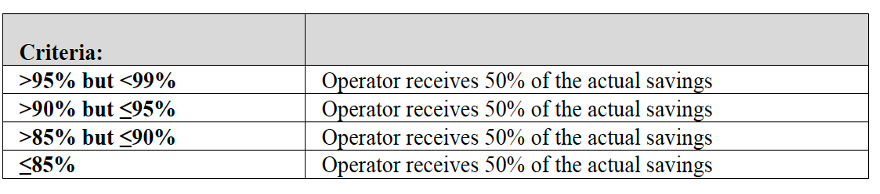

Source: Section III.B.1. of Annex II to the Generation O&M Agreement

  1. Equivalent Availability Factor — In general, the availability factor of a power plant is the amount of time that it is able to produce electricity over a certain period, divided by the amount of the time in the period. For purposes of the Generation O&M Agreement, the term Equivalent Availability Factor (“EAF”) is defined as:

EAF = (AH-EPDH-EUDH) x 100 %
PH

where:

    • AH = Available Hours
    • EPDH= Equivalent Planned Derated Hours
    • EUDH = Equivalent Unplanned Derated Hours
    • PH = Period Hours or number of hours that the Legacy Generation Asset was in active state

For every contract year, the target EAF will be calculated for each baseload and peaking unit pursuant to an annual performance test to be carried out pursuant to Section 5.22 of the Generation O&M Agreement.[16] Incentive Payments or Penalties, as the case may be, will be calculated in accordance with the criteria set forth below.

For Baseload Units:
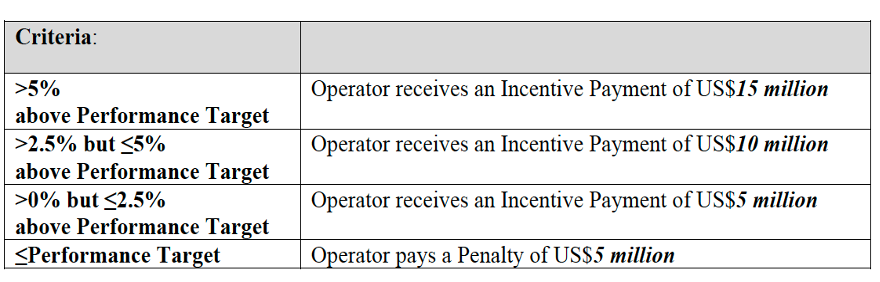

Source: Section III.B.2. of Annex II to the Generation O&M Agreement

For Peaking Units:
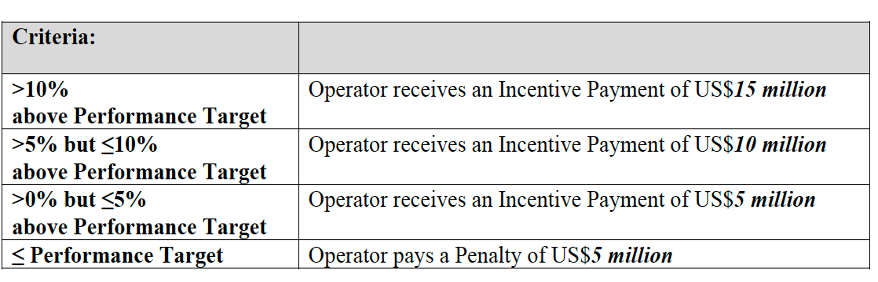

Source: Section III.B.2. of Annex II to the Generation O&M Agreement

The Minimum Performance Threshold for the annual EAF for the applicable Baseload Units and for the Peaking Units shall be established pursuant to Section 5.22 of the Generation O&M Agreement. Failure by the Operator to achieve either Minimum Performance Threshold in two (2) consecutive Contract Years shall trigger a Minimum Performance Threshold Default pursuant to Section 14.1(l) of the Generation O&M Agreement.[17]

  1. Safety Compliance — Operator shall receive an Incentive Payment or be subject to a Penalty based on its performance for each contract year with respect to the safety compliance targets described below.

OSHA Lost Time Incidents (“LTI”):


Source: Section III.B.3. of Annex II to the Generation O&M Agreement

OSHA Recordable Injury or Illness (“I&I”):


Source: Section III.B.3. of Annex II to the Generation O&M Agreement

OSHA Fatality or Severe Injury:


Source: Section III.B.3. of Annex II to the Generation O&M Agreement

For each contract year, the maximum aggregate Penalty that the Operator may incur shall be US$100,000, in each case with respect to the parameters of the Safety Compliance category. The payment of penalties by Operator on any of the safety compliance measurement parameters in two (2) consecutive Contract Years shall trigger a Minimum Performance Threshold Default pursuant to Section 14.1(l) of the Generation O&M Agreement.

  1. Environmental Compliance — The Operator shall receive an Incentive Payment or be subject to a Penalty based on its performance with respect to the environmental targets described below.

Violation of Consent Decrees and/or Notice of Violations (NOVs):


Source: Section III.B.4. of Annex II to the Generation O&M Agreement

For each contract year, the maximum aggregate Penalty that the Operator may incur shall be US$100,000, in each case with respect to the parameters of the Environmental Compliance category. The payment of a Penalty by Operator under the Environmental Compliance category for two (2) consecutive contract years shall trigger a Minimum Performance Threshold Default pursuant to Section 14.1(l) of the Generation O&M Agreement.

  1. Reporting Obligations — Operator shall be subject to a charge based on its timeliness in responding to a reasonable request for information from the Administrator. For every fifteen (15) sequential days during which the Operator fails to provide a response to Administrator, Operator shall pay a penalty of US$100,000, up to a maximum aggregate of $1 million for each contract year.[18]
  2. Fuel Optimization — Operator shall receive a “Fuel Optimization Payment” of fifty percent (50%) of any Actual Fuel Savings achieved during the relevant contract year.[19] For the purpose determining Actual Fuel Savings and the corresponding Fuel Optimization Payment for any contract year that commences after one or more Fuel Cost Savings Initiatives have been implemented or are otherwise already accounted for in the relevant Budget, the Budgets for such contract year(s) shall include an addendum setting forth hypothetical budget allocations for the Fuel Costs that would be incurred in the absence of the Fuel Cost Savings Initiatives.[20] The detailed methodologies to be used to calculate Actual Fuel Savings and any Fuel Optimization Payment shall be included in the Fuel Optimization Plan to be developed during the Mobilization Period.

Decommissioning Services

In general, the Decommissioning Services are services provided pursuant to the Generation O&M Agreement to complete the dismantlement and removal of the structures comprising PREPA’s Legacy Generation Assets, and all other activities indispensable for the retirement, dismantlement, decontamination or storage of the legacy generation assets.

At any point after the Service Commencement Date, the Administrator may deliver to the Operator a decommissioning notice to commence the Decommissioning Services for one or more of the Legacy Generation Assets. In addition, in the event that the Operator determines that all or a portion of a Legacy Generation Asset cannot continue to be safely operated and maintained, the Operator may deliver to the Administrator and the PREB a request to commence Decommissioning Services for the applicable Legacy Generation Asset.[21]

Once the parties agree that a Legacy Generation Asset or Assets will be decommissioned, then the Operator shall prepare a Decommissioning Plan consistent with the Decommissioning Plan outline set forth in Annex XV to the Generation O&M Agreement.

The Decommissioning Plan shall provide for:

  • the permitting, demolition, decontamination, waste disposal and dismantling/or preparation for conversion to such other future use as the Administrator and the PREB may designate, as applicable, of the Legacy Generation Asset, and waste disposal, for achievement of end-state conditions within a prescribed time;
  • the development of the Decommissioning Budget, as set forth in Section 16.2 of the Generation O&M Agreement;
  • reasonably acceptable arrangements to facilitate the transition of the Operator employees, into new jobs or industries, including a training and/or severance plan (to be funded by the Owner) for any Operator Employees not hired into a successor job or industry; and
  • a timeline setting forth when Decommissioning Services shall be provided, including the date on which the Decommissioning Services shall commence and the date on which the Decommissioning Services for such legacy generation asset shall be completed.[22]

Compensation for Decommissioning Services

Once an asset has been selected for decommissioning the parties have to agree on the Decommissioning Budget for that asset. The Decommissioning Budget, subject to the approval of the Administrator and in certain cases the PREB, will include all the Pass-Through Expenditures the Operator expects to incur in connection with the decommissioning process.

The Owner then will pay the Operator all Pass-Through Expenditures required to perform the Decommissioning Services and shall continue to pay the O&M Fixed Fee in full (subject to any applicable adjustments) for the duration of the term of the Generation O&M Agreement.

The Operator could earn an Incentive Payment or incur a Penalty based on the Operator’s performance of the Decommissioning Services.[23]

Decommissioning Services Incentives and Penalties — The Operator’s performance of the Decommissioning Services will be evaluated in the category of Operation Cost Efficiency. Upon completion of the Decommissioning Services with respect to any decommissioned legacy asset:

  • If (i) the Operator’s actual expenditures are consistent with or exceed the estimates included in the applicable Decommissioning Budget and (ii) the Operator successfully completes the applicable Decommissioning Services on or before the relevant Decommissioning Completion Date, no Incentive Payment shall be applicable.
  • If (i) the Operator’s actual expenditures are below the estimates included in the applicable Decommissioning Budget and (ii) the Operator successfully completes the applicable Decommissioning Services on or before the relevant Decommissioning Completion Date, the Operator shall be eligible to receive a Decommissioning Incentive Payment consisting of a percentage of the actual cost reduction as compared to the estimates included in the applicable Decommissioning Budget.[24]

The performance of the Operator in executing the Decommissioning Services will be measured by calculating the actual expenditures as a percentage (%) of the approved Decommissioning Budget, where actual savings equal the Decommissioning Budget minus actual expenditures, as set forth in the table below:
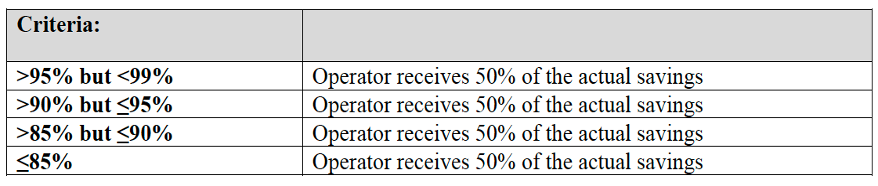

Source: Section III.C.1. of Annex II to the Generation O&M Agreement

  • If the Decommissioning Services with respect to a Legacy Generation Asset are not completed by the applicable Decommissioning Completion Date, then Operator shall be subject to a Decommissioning Penalty consisting of one million dollars ($1,000,000) for each week by which the completion of the Decommissioning Services is delayed past the applicable Decommissioning Completion Date, up to a maximum of fifteen million dollars ($15,000,000) in the aggregate across all Legacy Generation Assets and Generation Sites.[25]
  • In the event the Operator (i) exceeds the costs and expenses included in the applicable Decommissioning Budget and/or (ii) fails to complete the Decommissioning Services before the Decommissioning Completion Date for any two (2) Legacy Generation Assets, the Administrator may, in its sole discretion, engage an independent third party to perform any future Decommissioning Services with respect to any Legacy Generation Assets without either Party incurring, or becoming liable for, the payment of any penalty, premium or termination fee.

Demobilization Services

The Operator shall provide certain Demobilization Services upon the expiration or early termination of the Generation O&M Agreement to ensure the orderly transfer of any remaining Legacy Generation Asset from the Operator to the Owner or to a successor operator. The Operator has agreed to perform the Demobilization Services in accordance with a Demobilization Plan to be developed in accordance with the requirements set forth in Annex XVI to the Generation O&M Agreement.

In general, “the Demobilization Plan shall enable the seamless, safe, and effective transfer of the Legacy Generation Assets to the Owner, the Administrator, or their successor operator. The Operator’s principal objective shall be to complete any demobilization activities in the time frame and on the terms that are most suitable to Owner and Administrator in a way that will achieve an orderly handover or return of the Legacy Generation Assets.”[26]

Compensation for the Demobilization Services

During the Demobilization Period, which is estimated to last about a year, the Operator is entitled to receive a “Demobilization Service Fee”. The Demobilization Service Fee shall be an aggregate amount equal to:

  • the hourly fully allocated cost rate for each category of Operator employee or Affiliate personnel providing Demobilization Services multiplied by
  • the number of hours worked by each Operator employee or Affiliate personnel in such category providing Demobilization Services, plus
  • ten percent (10%) of the product of (i) and (ii), plus
  • all other reasonable and documented costs and expenses incurred by Operator (without markup for Operator profit) that are necessary and reasonable in the course of providing the Demobilization Services and/or implementing the Demobilization Plan, including the cost of any Subcontractors providing Demobilization Services.[27]

Expected Savings

As we have seen above, the Generation O&M Agreement contains a fairly well-developed set of incentives, penalties, and performance metrics to evaluate the performance of the Operator. In this sense, the Generation O&M Agreement is an improvement over the T&D O&M Agreement.

Indeed, the inclusion of measurable benchmarks, the requirement to engage in good faith negotiations with current PREPA employees, the cap on the fees that the Operator can earn during the Mobilization Period, and other requirements set forth in the Scope of O&M Services, for example the obligation to develop a fully fleshed out communications plan prior to the handover of operations to the Operator, demonstrates that governments can and indeed do learn from prior experiences, notwithstanding what anti-government zealots may say or think to the contrary.

Having said that, though, the fact remains that executing and entering into the Generation O&M Agreement makes sense only if the expected savings to be generated exceed the expected costs of the agreement. The government of Puerto Rico has stated that it expects to generate “significant savings” from transferring the operation and management of the Legacy Generation Assets to Genera. However, the evidence it offers to back up that assertion is rather thin, as we will demonstrate below.

The P3 Authority hired FTI Consulting (“FTI”) to carry out an analysis of the expected benefits of selecting a third party operator for the Legacy Generation Assets. FTI set forth its findings in a report (the “FTI Report”) that is included as Exhibit B to the P3 Report, which the P3 Authority is statutorily required to prepare and publish in connection with the execution of any public-private partnership transaction.

According to the FTI Report:

  • Genera estimates achievable O&M savings of $19 million per year, mostly from labor and more efficient maintenance activities.
  • Genera also estimates fuel savings (without plant conversions or equipment replacement) of approximately $85 million per year, “which would come from optimizing existing fuel contracts” ($56 million), “achieving better risk and credit terms on the existing oil contracts” ($20 million), and “making operational changes at the Legacy Generation Assets to increase fuel efficiency” ($9 million).
  • Genera also “believes” that, subject to PREB approval, “there are additional fuel savings”, in excess of $100 million, “achievable through fuel conversion of units”…These “conversions would involve commissioning of gas fuel operation for units that are dual fuel capable or conversions of units that are able to be converted.”
  • The “combined estimated savings from O&M and fuel range from $100 million to $200 million annually (including conversion savings if approved by PREB).” Under the terms of the Generation O&M Agreement those “savings would be shared 50%/50% between Genera and the electric ratepayers of Puerto Rico. That would result in $50 million to $100 million per year to Puerto Rico electric system customers.”
  • In sum, concludes FTI, “Puerto Rico is guaranteed a benefit and Genera’s incentive compensation pays for itself. Given the low fixed fee, high incentive fee component and the 50%/50% sharing of [the savings], Genera is more than motivated to perform and operate the plants well and as fuel-efficiently as possible.”[28]

So, according to FTI’s analysis this transaction is a clear win-win situation and everybody will live happily ever after the Effective Date. Pardon our skepticism, but it seems to us that FTI is being too clever by half, as the British would say.

First, FTI relies on representations made by Genera to the Partnership Committee and the P3 Authority and their advisors. There is no indication, at least in the text of the FTI Report, that FTI carried out an independent evaluation or executed any standalone due diligence to validate or verify Genera’s claims of expected savings.

Second, even if it is arguably reasonable to take Genera’s representations at face value, FTI should have requested that Genera provide the documentation of the methodology it used to calculate those expected savings. However, the FTI Report includes no explanation of the assumptions, the methodology used, or the variables analyzed by Genera to estimate expected savings. The people of Puerto Rico, in essence, are being asked to believe these ostensible savings on faith alone.

Third, Puerto Rico is a “price taker” in the global oil and natural gas markets due to the relatively small volume of fuel it buys. And while we don’t doubt the negotiating acumen of NFE’s traders, there are limits to how much savings can be generated from obtaining “better risk credit and credit terms”. Even NFE’s most perspicacious traders are subject to the capricious ebbs and flows of the global oil and natural gas markets.

In this context, it is relevant to point out that Section 9.2(b) of the Generation O&M Agreement politely prohibits Genera, NFE, and their affiliates from engaging in business with any person located, organized, or resident in a Sanctioned Country, which is defined in Section 20.2(g)(iv) of the Generation O&M Agreement as “the Crimea (sic), Cuba, Iran, North Korea and Syria.” We note, though, that Russia is conspicuously absent from this list. This omission, we assume, is probably nothing more than just a harmless drafting lapse that obviously will be remedied by counsel in due course.

Fourth, Genera insists on pointing to potential savings to be extracted from the conversion of existing oil-burning plants to facilities that burn natural gas. In fact, according to the FTI report, such conversions would generate approximately 50% of total expected savings from the Generation O&M Agreement. Genera and FTI, however, are silent as to who would pay for the capital expenditures necessary to convert existing oil-burning units to burn natural gas.

To be sure, pursuant to Section 5.6(b) of the Generation O&M Agreement Genera may “propose to PREB certain capital improvements, taking into account the Integrated Resource Plan and the Federally Funded Generation Project Plan, that would be (x) federally funded and owned by Owner, (y) made, owned and funded by Owner or (z) made, owned and funded by Operator or its designated Affiliate.” However, Genera and FTI fail to disclose, in the case of capital improvements not financed by the federal government, (i) how the profile of expected savings is affected once the expected cost of capital is taken into account and (ii) how the expected useful life of a legacy asset converted to burn natural gas would be extended in order to amortize the capital expenditure over time — an extension that, presumably, would be in contravention of the stated objective of decommissioning most of the Legacy Generation Assets as soon as possible.

Furthermore, Genera, as we stated above, is a wholly-owned subsidiary of NFE, which is a “full service” natural gas company that operates along the entire supply chain, from procurement, to shipping, to the development of natural gas-fired power generation. This presents at least two conflicts of interest.

First, it would be only natural for Genera to seek to do business with its parent company or its affiliates and there will be pressure to accept whatever terms are imposed by the “friends of the house.”

To be fair, the Generation O&M Agreement sets forth in Annex VI a fully developed policy to address organizational conflicts of interest arising from or in connection with affiliate or related-party transactions, including the requirement to hire a third party to execute the procurement process in certain cases (yet more evidence that governments do learn). It remains to be seen, though, whether this process will be thoroughly and consistently implemented and enforced throughout the term of the Generation O&M Agreement.

The other conflict arises from the fact that Fuel Cost Savings Initiatives is defined in the Generation O&M Agreement to mean any initiatives undertaken by the Operator, its Affiliates or Subcontractors in connection with the Generation O&M Agreement, that reduce Fuel Costs, including by:

  • improving the fuel efficiency of any Legacy Generation Assets;
  • converting any Legacy Generation Assets to be able to operate on any new alternative fuel(s) (including natural gas and hydrogen);
  • supplementing Legacy Generation Assets with power generation equipment at or in the vicinity of the relevant Generation Site that is more fuel efficient and/or operates on any new alternative fuel(s) (including natural gas and hydrogen);
  • reducing transportation, testing, delivery or storage (including tank maintenance) costs; or
  • pursuing savings opportunities related to credit and portfolio optimization, in each case whether such initiatives are implemented as Pass-Through Expenditures, at the Operator’s cost as the Operator’s own capital improvements pursuant to Section 5.6(b), by replacement or renegotiation of Fuel Contracts or Facility Contracts, or otherwise.

This definition poses several problems. First, it clearly allows the conversion of oil burning units to burn natural gas as a cost-saving initiative (subject to PREB approval), which would be contrary to the stated public policy goal of fully transitioning to renewable fuels by 2050.

Second, by allowing the switch to natural gas as a fuel cost saving measure, the Generation O&M Agreement confronts Genera with a set of potentially incompatible incentives. On one hand, Genera gets to keep 50% of any fuel savings generated by its implementation of any Fuel Cost Savings Initiative. On the other hand, Genera keeps 50% of any savings it generates when the process for decommissioning a legacy asset ends up costing less than originally budgeted.

In most, if not all instances, the amount of money represented by the right to get paid 50% of any realized fuel cost savings will exceed the amount of money represented by the right to get paid 50% of the savings generated from successfully decommissioning a legacy asset 10 or 15% under budget. Thus, Genera probably will have a strong preference for projects that switch generation units to burning natural gas, especially if the fuel is provided by NFE or any of its affiliates , and against decommissioning assets that could be converted to burn natural gas. It will be up to the P3 Authority and the PREB to prevent this risk from becoming a reality.

Third, the definition of Fuel Cost Savings Initiatives also includes any savings generated by switching to the burning of hydrogen. Now, this is interesting because NFE stated in its annual report for the year ended December 31, 2021 “that low-cost hydrogen will play an increasingly significant role as a carbon-free fuel to support renewables and displace fossil fuels across power, transportation and industrial markets.”

To that end, NFE has formed a new division, which it calls Zero, “to evaluate promising technologies and pursue initiatives that will position us to capitalize on this emerging industry.” In addition, it has signed an agreement “to transition a power plant to be capable of burning 100% green hydrogen over the next decade”, and it has made its “first hydrogen-related investment in H2Pro, an Israel-based company developing a novel, efficient, and low-cost green hydrogen production technology.”[29]
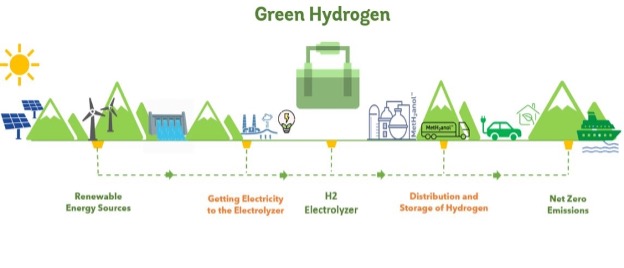

Source: Michael Kobina and Stephanie Gil, Green Hydrogen: A key investment for the energy transition, World Bank Blogs, June 23, 2022

However, true green hydrogen production, which consists of using renewably generated electricity to split water molecules into hydrogen and oxygen (see chart above), is not yet a commercially viable technology. Most of the current hydrogen production in the world consists of so-called “gray hydrogen”, which is produced by splitting natural gas into carbon dioxide and hydrogen. This process is energy intensive and emits a significant amount of CO2. “Blue” hydrogen is sometimes presented as an alternative. The process for making blue hydrogen is the same as the one for making gray hydrogen, with the difference that the resultant CO2 is “captured” and stored underground and thus is not released into the atmosphere. Most environmental groups, however, are skeptical about the alleged benefits of producing gray or blue hydrogen.

The risk for Puerto Rico here is twofold. First, we have to be vigilant that the island is not used once again as a “laboratory” for testing some half-baked harebrained idea, the brainchild of some demented trafficker of high-tech scams out on the prowl to make a quick buck in the crumbling colonial backwaters of the American Empire, and which imposes high costs and produces little or no benefits for Puerto Rico’s residents — as has happened so often in our history.[30]

And, second, if the production of green hydrogen eventually becomes commercially feasible, we have to ensure that both the technology and the know-how is transferred to Puerto Rican firms and engineers so the island does not end depending yet again on a resource we do not produce and do not control to generate our energy.

Finally, even if it is true that the implementation of the Generation O&M Agreement generates savings of $200 million per year and half of that amount is passed on to Puerto Rican ratepayers, is that amount “significant”? According to an unaudited financial report prepared by PREPA’s management for its governing board, it spent approximately $2.1 billion on fuel during fiscal year 2022, while total expenses for that year added up to $4 billion.[31] Therefore, savings of $100 million are equivalent to 4.7% of fuel expense and 2.5% of total expenses for that period.

Those savings are worth something but they do not by any means represent a paradigm-shattering change. To put this issue in perspective, the amount of expected savings ($100 million) probably will not be enough to fully offset the debt service on PREPA’s restructured bonds, which is estimated will be around $300 million per year, depending on the details of the final deal to be entered into with bondholders under the aegis of the Title III court.[32]

The objective truth is that Puerto Rico’s electricity costs will not decrease significantly until most of PREPA’s Legacy Generation Assets are decommissioned and replaced with new generation capacity using renewable sources. According to PREPA’s Certified Fiscal Plan for Fiscal Year 2022 generation “expenses are projected to decline over the Certified Fiscal Plan period as PREPA-owned generation units are retired, and the mix shifts to third-party owned generation, specifically renewable generation, which will be contracted through PPAs”.[33] Interestingly, neither the P3 Report nor the FTI Report provide an estimate of those savings.

Numerous factors have contributed to delaying the transition to and deployment of renewable generation in Puerto Rico: PREPA’s bankruptcy; lack of access to capital; federal and state bureaucratic requirements; the loss of state capacity to perform complex tasks due to years of austerity policies; the political influence of groups with fossil fuel interests; disagreements among advocates for renewable power who favor building utility-scale capacity and those who propose rooftop-based solar systems (we need both); and a general lack of coordination among and between government agencies, private sector stakeholders, local and community leaders, representatives of NGOs, and other non-profit entities which promote their own projects in a zero-sum fashion.

To be fair, we should not underestimate the difficulty and complexity of decommissioning fossil fuel generation while simultaneously deploying large scale renewable generation. As shown in the chart below, which is from PREPA’s Management Presentation to participants in the RFP process for awarding the Generation O&M Agreement, the scale of the transition to renewable generation is enormous. And while the timeline needs to be updated, it does makes us wonder whether the government of Puerto Rico has the requisite state capacity to execute this mega-project on time, on budget, and delivering the estimated benefits.
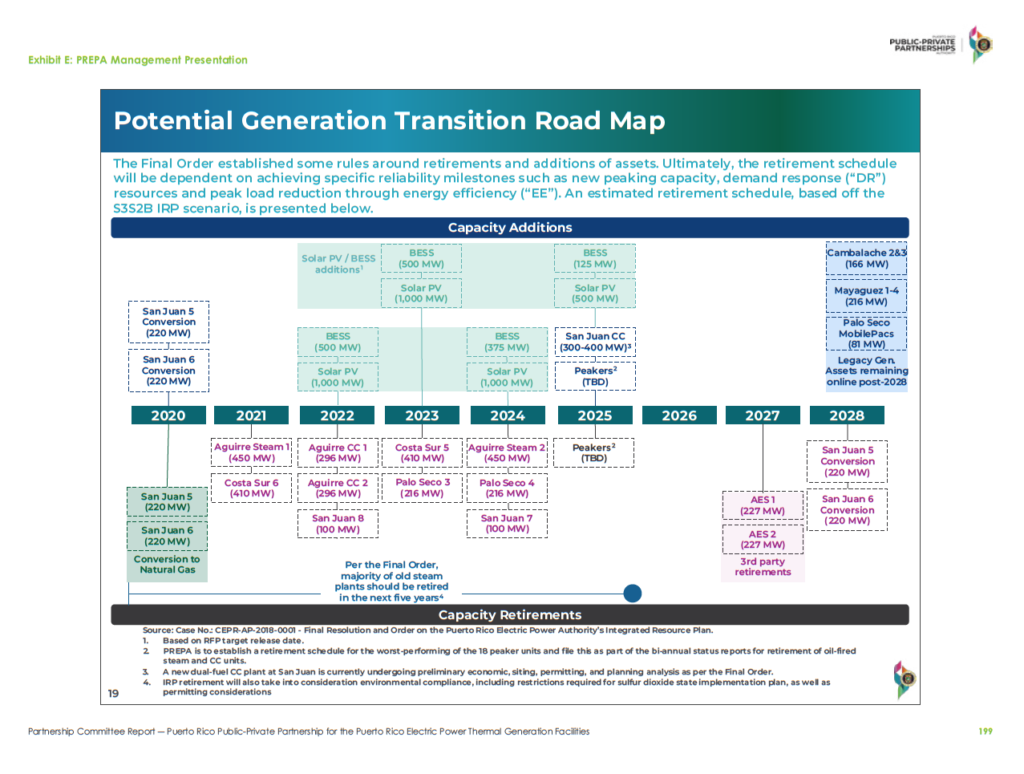

Source: Exhibit E to the P3 Report, p. 19.

Finally, we note that this “potential transition road map” prepared by PREPA includes the addition of up to 400 MW of new combined cycle capacity using natural gas in the San Juan plant, presumably to be paid by the federal government, and forecasts the continued used of legacy assets in Cambalache, Mayaguez, and Palo Seco beyond 2028.

Market Structure

Act 17-2019 calls for “transitioning from the current, vertically integrated monopoly comprising PREPA, to an energy system with multiple players as well as changes to the roles and responsibilities that have historically been concentrated within PREPA, and their reallocation across multiple entities.” According to that Act, one of the objectives of unbundling PREPA’s vertically integrated monopoly is to introduce an element of competition into Puerto Rico’s electricity market. To that end, according to the P3 Report, the Legacy Generation Assets Project is “intended to ‘promote market competition’ by harnessing private sector creativity and resources to help fully deliver on economic, infrastructure, and societal goals identified by the Government.”[34]

At first glance it appears that the execution of the T&D O&M Agreement and the Generation O&M Agreement satisfies the basic requirements of Act 17. While PREPA retains the naked title to the transmission and distribution system and to the legacy generation assets (for purposes of qualifying for federal funding), their respective day to day operation and management have been unbundled and legally transferred to two private operators.
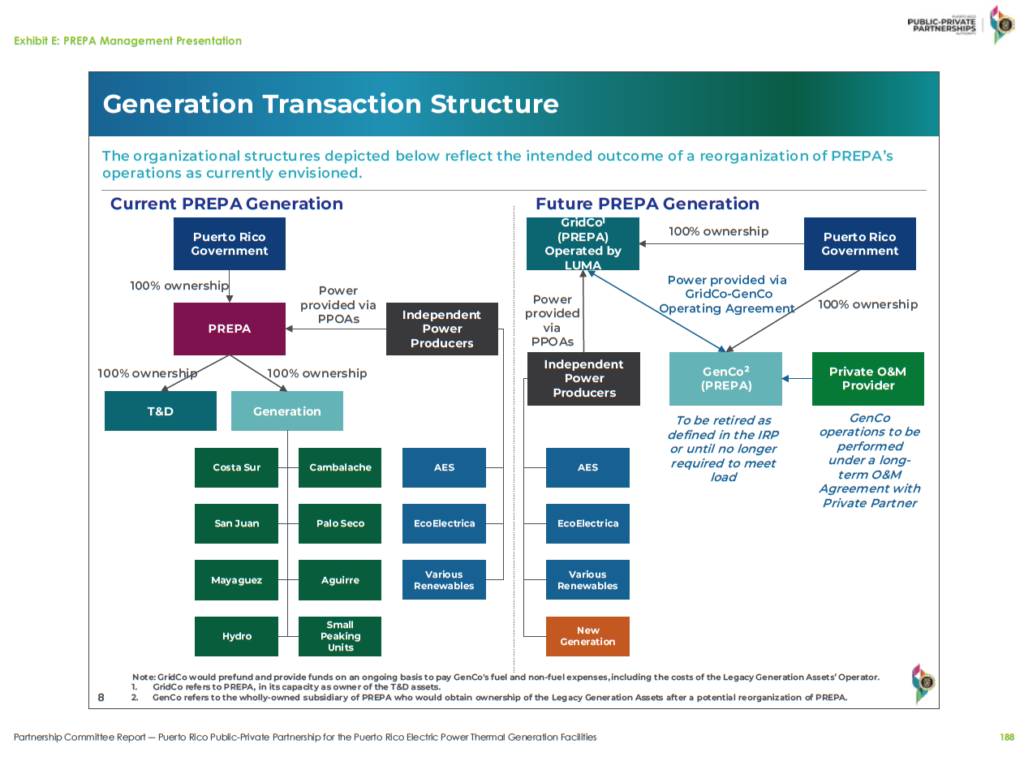

Source: Exhibit E to the P3 Report, p. 8.

However, a closer look at the structure of Puerto Rico’s electric power market after the execution of the T&D and the Generation agreement makes us wonder whether it achieves the policy objectives set forth in Act 17.

First, as shown in the chart above, after the Service Commencement Date of the Generation O&M Agreement, Puerto Rico would have an oligopoly of utility-scale generation companies: Genera, AES, EcoEléctrica, various renewable generators, and whatever new renewable generation is eventually deployed. On oligopoly can be defined as “an economic condition where only a few companies sell substantially similar or standardized products” and “oligopoly markets often exhibit the lack of competition, high prices and low output of monopoly markets.”[35]In oligopolistic markets, prices tend to be set by the firm with the largest market share. In the instant case, the generation market in Puerto Rico will be dominated, at least during the next five years, by Genera which will be operating the most inefficient, and hence the most costly, generation fleet in the island. Thus, we can expect the transfer of the operation and management of PREPA’s generation assets to have only a marginal, if any, effect on prices and reliability, at least in the medium-term.

Second, those oligopoly producers can sell their product (electricity) only to LUMA. Therefore, LUMA will have a monopsony with respect to independent power producers in Puerto Rico. A monopsony can be defined as “a market condition in which there is but one buyer for a particular commodity.”[36]Monopsonies can result in lower wages for workers, lower quality products, and higher prices for the consumer. Now, LUMA would probably argue that these risks are mitigated because they are required to buy power from independent power producers that have long-standing power purchase agreements (“PPAs”) with PREPA, in the case of AES and EcoElectrica, or that will be negotiated in the future, in the case of new entrants to the market. In any event, LUMA would argue, everything is subject to regulation by the PREB. That is true up to a point and good as far as it goes, but the situation could still lead to any number of market failures. For example, if a corporate affiliate of LUMA or Genera, or of their respective parent companies, wins the bid to build and operate the new combined cycle units (up to 400 MW) that will be located in the San Juan plant, what’s to stop LUMA or Genera from granting priority to their affiliate in connecting and dispatching electricity to T&D System?

Third, to complicate matters even further, LUMA has a monopoly on the other side of the market, namely the sale of electricity to retail, commercial, and industrial clients. Consumers in Puerto Rico can only buy electricity from LUMA, unless they set up their own generation capacity (in which case they can sell any excess generation, if they have net metering capabilities, only to LUMA).

While it is true that Puerto Rico has developed regulations to allow “wheeling” (the direct sale of excess electricity generated by say a manufacturing firm with in-house industrial scale generation to another industrial client), to our knowledge there has been little no wheeling sales executed in Puerto Rico. A single company, therefore, exercises de facto control of both sides of the electricity market in Puerto Rico: generators can sell and buyers can buy electricity only from LUMA. We question whether that result was intended by the drafters of Act 17.

Given this complicated market structure, any element of market competition will be promoted only indirectly if and when the time comes to renegotiate existing, or to negotiate any prospective, power purchase agreements between LUMA and independent power producers. We note that neither the P3 Report nor the FTI Report analyze whether competition prompted by the new market structure for the electricity sector in Puerto Rico would generate lower prices for ratepayers in the island.

In sum, the resulting market structure is fertile ground for any number of anticompetitive practices, such as collusion, price fixing, exclusive dealing, and price discrimination, among others, to arise. To prevent LUMA from unduly exercising its market power it will be necessary (1) to closely supervise the implementation of the T&D O&M Agreement; (2) for the PREB to conduct robust regulatory oversight of LUMA; (3) to establish a well-regulated and orderly wheeling market in Puerto Rico; and (4) to consider creating an independent system operator that would be in charge of managing the economic dispatch of generation units and supervising interconnections with the T&D System.

Buy Local Provisions

A novel feature (for Puerto Rico) of the Generation O&M Agreement is that it requires Genera to use “commercially reasonable” efforts to ensure that local companies, or foreign companies with a significant presence in Puerto Rico, are included in the procurement process for materials and services under the agreement.[37] In addition, the Generation O&M Agreement requires Genera to use “commercially reasonable” efforts to select companies established under the Commonwealth of Puerto Rico or companies that have “a significant presence in the Commonwealth of Puerto Rico” as material subcontractors.[38] These provisions, if implemented, have the potential to generate local economic activity and allow local firms and workers to obtain valuable experience working on a complex multi-year project.

Conclusion

Shakespeare’s words to the effect that “the web of our life is of a mingled yarn, good and ill together”, are perhaps an apt description of the Generation O&M Agreement.[39]

Several elements of the new agreement are clearly superior to the LUMA T&D O&M Agreement. Among these we can mention a well-developed system of incentives and penalties to motivate the Operator; the inclusion of clear benchmarks to measure Genera’s performance; stronger filters to analyze transactions with affiliates and related-parties, including a fully fleshed-out policy to address organizational conflicts of interest; the requirement to engage in good faith negotiations with current PREPA employees so as to minimize the learning curve of the new operator; and setting a cap on the fees that the Operator can earn during the Mobilization Period; all point to the conclusion that this is an agreement that offers better protections to the people of Puerto Rico from some of the foreseeable risks associated with this transaction.

Other aspects of the agreement are not as good. For example, most of the services will be provided by subcontractors (wouldn’t it be more efficient just to contract directly with them?); the analysis of the expected savings is clearly deficient and we would like to see a more rigorous examination of those professed savings; and it is not clear to us that the resultant market structure will lead to lower prices, generate allocative efficiencies, and/or produce significant increases in consumer welfare.

So, relative to the status quo, is the post-Genera electricity market in better shape in Puerto Rico? Probably yes, but that is an awfully low bar. Everybody who has objectively analyzed PREPA’s performance over the last 30 or 40 years has concluded that it is mess, the financial and operational equivalent of a long-smoldering dumpster fire. By that standard, trying anything new, no matter how outlandish it may seem, would probably constitute progress.

However, if we set a higher bar, if we ask whether this transaction will really help Puerto Rico achieve its long-standing goals of generating affordable, cleaner, and reliable electricity, then the answer is not quite as clear, for the good is indeed mingled with the ill. The fact is that there is a lot uncertainty surrounding this transaction and it is hard to avoid the unsettling feeling we are being presented with a fait-accompli on a take it or leave it basis.

Maintaining the status quo, though, is not an option. The real question is whether there is a better alternative to a negotiated agreement in this instance. The answer, when taking into account the totality of the circumstances, appears to be no. The available alternatives seem to be (1) worse, for example, resuscitating PREPA; (2) unrealistic, entailing, for instance, the creation of a new Tennessee Valley Authority-like entity to provide electricity in Puerto Rico; or (3) downright utopian, involving extremist schemes reminiscent of Mao’s Great Leap Forward.[40]

After assessing the risks and benefits of the Generation O&M Agreement we face a dilemma in the classical sense of making a decision with no good options. But in a situation with no objectively good options, taking a calculated risk may, perhaps, be the best option. Again, in the words of the Bard of Avon: “there is a tide in the affairs of men which, taken at the flood, leads on to fortune; omitted, all the voyage of their life is bound in shallows and in miseries. On such a full sea are we now afloat, and we must take the current when it serves, or lose our ventures.”[41]

Endnotes

[1] Puerto Rico Public-Private Partnerships Authority, Partnership Committee Report regarding the Puerto Rico Public-Private Partnership for the Puerto Rico Electric Power Thermal Generation Facilities, October 17, 2022, amended January 18, 2023 (the “P3 Report”), p. 16.

[2] P3 Report, p. 17-18.

[3] P3 Report, p. 18.

[4] P3 Report, p. 19.

[5]See Beatriz de la Torre, “AEE pasa con fichas”, El Vocero, 21 de marzo de 2013; “Nebuloso financiamiento de ‘mareducto’”, El Vocero, 23 de mayo de 2013; and “Denuncian ‘chanchullo’ en AEE”, El Vocero, 22 de julio de 2013; and  Mary Williams Walsh, “At Puerto Rico’s Power Company, A Recipe for Toxic Air, and Debt”, New York Times, February 15, 2016; and “In Scandal at Puerto Rico Utility, Ex-Fuel Buyer Insists He Took No Bribes”, New York Times, March 2, 2016.

[6] New Fortress Energy, Inc., Annual Report for the Year Ended December 31, 2021, filed with the United States Securities and Exchange Commission on Form 10-K, p. 3.

[7] Generation O&M Agreement, Section 4.1(a).

[8] Generation O&M Agreement, Section 4.2(u).

[9] Generation O&M Agreement, Section 4.6(b).

[10] Generation O&M Agreement, Section 4.8(a).

[11] Generation O&M Agreement, Section 5.1.

[12] Section 1.A. of Annex IX to the Generation O&M Agreement.

[13] Generation O&M Agreement, Section 7.7(a).

[14] Section 1.A. of Annex II to the Generation O&M Agreement.

[15] Section III.B of Annex II to the Generation O&M Agreement.

[16] Generation O&M Agreement, Section 5.22.

[17] Section III.B.2. of Annex II to the Generation O&M Agreement.

[18] Section III.B.5. of Annex II to the Generation O&M Agreement.

[19] Section III.B.6.(a) of Annex II to the Generation O&M Agreement.

[20] Section III.B.6.(c) of Annex II to the Generation O&M Agreement.

[21] Generation O&M Agreement, Section 16.1(a).

[22] Generation O&M Agreement, Section 16.1(b).

[23] Generation O&M Agreement, Section 16.2(d).

[24] Section III.C.1. of Annex II to the Generation O&M Agreement.

[25] Section III.C.1. of Annex II to the Generation O&M Agreement.

[26] Section 1 of Annex XVI to the Generation O&M Agreement.

[27] Generation O&M Agreement, Section 17.3(b).

[28] FTI Consulting, Benefits of a Third-Party Generation Operator of the Puerto Rico Legacy Generation Assets, September 22, 2022, p. 18-19, included as Exhibit B to the Partnership Committee Report regarding the Puerto Rico Public-Private Partnership for the Puerto Rico Electric Power Thermal Generation Facilities, October 17, 2022, amended January 18, 2023.

[29] New Fortress Energy, Inc, Annual Report for the Year Ended December 31, 2021, filed with the United States Securities and Exchange Commission on Form 10-K, p. 16.

[30] See Juan R. Torruella, “Why Puerto Rico Does Not Need Further Experimentation with its Future: A Reply to the Notion of Territorial Federalism”, Harvard Law Review Forum, Vol. 131, No. 3, (January, 2018).

[31] Puerto Rico Electric Power Authority, Monthly Report to the Governing Board: June 2022, p. 7, available at https://aeepr.com/es-pr/investors/FinancialInformation/Monthly%20Reports/2022/June%202022.pdf

[32] Assuming PREPA’s bonded debt is cut approximately by 50% to $5 billion and a 6% coupon.

[33] 2022 Certified Fiscal Plan for the Puerto Rico Electric Power Authority As certified by the Financial Oversight and Management Board for Puerto Rico on June 28, 2022, p. 164.

[34] P3 Report, p. 29.

[35] Black’s Law Dictionary, Sixth Edition, (St. Paul, MN; West Publishing Co., 1990), p. 1086.

[36] Black’s Law Dictionary, Sixth Edition, (St. Paul, MN; West Publishing Co., 1990), p. 1007.

[37] Generation O&M Agreement, Section 21.19(c).

[38] Generation O&M Agreement, Section 21.19 (d).

[39] William Shakespeare, All’s Well that Ends Well, Act IV, Sc. 3, (1603-1604).

[40] Julia Lovell, Maoism: A Global History, (London: The Bodley Head, 2019), pp. 133-168.

[41] William Shakespeare, Julius Caesar, Act IV, Sc. 2 (1599).
CNE Review – Hurricane Fiona Briefing

Published on September 27, 2022 / Leer en español

See all editions of the
CNE Review
SHARE

Insights from CNE

Hurricane Fiona Update

By Sergio M. Marxuach, Policy Director

The Big Picture

Nine days after Hurricane Fiona made landfall in Puerto Rico there are still approximately 500,000 customers without electricity in Puerto Rico. This situation has generated a heated public debate as to who is at fault for the lack of electric power in Puerto Rico. Some blame PREPA, others point the finger at LUMA, the private operator of the grid. In our view, this kind of finger-pointing is not very helpful, especially in the midst of the emergency response to Hurricane Fiona. In general, the demand and supply of electricity in a given electrical system have to balance at all times in order to avoid dangerous disturbances in the system that can cause it to shut down. If all generation units are working perfectly but there are breakdowns in the transmission and distribution grid, it will not be possible to deliver electricity to satisfy all demand. Conversely, if the transmission and distribution system is in tip-top shape, but there is insufficient generation, some clients will inevitably go without electric power. Prior to Fiona, both PREPA’s generation fleet and the transmission and distribution grid were in bad shape. The hurricane made things worse: it caused widespread damage to the grid and the rainfall it brought apparently also affected some generation units. Given what I mentioned above, you can imagine the difficulties involved in bringing the entire system back online. It has to be done carefully and in a piecemeal fashion. Electric service cannot be restored to a given area or region until both the transmission and distribution loop for that area has been repaired and there is sufficient generation capacity to meet the expected demand from that area. In the case of Puerto Rico, we also have to keep in mind that PREPA operates most of the generation capacity (although there are two big independent power producers) while LUMA is in charge of the operation and maintenance of the grid. In addition, pursuant to Section 5.13 of its agreement with PREPA, LUMA is in charge of coordinating the dispatch of electricity over the grid. In other words, it determines which units connect with the grid, at what time, and in which order. In the best of times, thus, keeping the lights on requires close coordination between LUMA and all large-scale power generators in Puerto Rico. After a devastating storm, such coordination is not only indispensable, it is vital.

The Data

Here is the latest data on the emergency response so far:

  • Consumer Goods – Press reports during the past few days have highlighted problems with diesel distribution around the island. Apparently, sufficient supplies have been delivered to Puerto Rico but there are problems unloading the fuel from the transport ships to tanks onshore and delivery trucks. This situation is creating problems for supermarkets, hospitals, and businesses that currently depend on generators to keep operating at a normal pace.
  • Hospitals – The local press reports that at least 16 hospitals still depend on generators for electricity and some of them are facing difficulties in obtaining adequate supplies.
  • Housing – There is no data yet as to the number of homes that suffered damages due to Hurricane Fiona.
  • Schools and Universities – The University of Puerto Rico was scheduled to reopen on the 26th of September but has been forced to postpone the date due to the lack of electric service, including at the main campus in Rio Piedras. Many public schools are still closed pending evaluation of the physical facilities.
  • Shelters – Some 92 shelters remain open and approximately 178 people are still living there.
  • Telecommunications – The government has changed the metric for cell phone service. Instead of clients with service, they are now reporting the percentage of “functional telecommunications antennas”. According to the official government data, “85.96% of sites are in service.” There have been reports of some areas without either cell phone or internet service in the south and western parts of the island.
  • The Electric System – The most recent data is that 67% of clients have electric service.
  • Transportation – Maritime ports have opened. Buses and trains are operating normally. The Luis Muñoz Marín International Airport is operating as usual. Many roads remain inaccessible due to the accumulation of debris or landslides.
  • Water – As of the time of this update, 87% of the clients of the Puerto Rico Aqueduct and Sewer Authority had water service.

The Takeaway

Rebuilding devastated communities under a compressed timeframe, often juggling competing demands and problems that arise on a daily basis, and that are equally urgent, can prove challenging even in the best-prepared jurisdictions. After Hurricane María, these stresses were magnified in Puerto Rico because it was not only managing a large-scale recovery process, it was also simultaneously going through the largest municipal bankruptcy in U.S. history. And now, of course, we have to address the damage caused by Hurricane Fiona. In addition, at any given time in a post-disaster context, there are many actors working rapidly and independently, while relying on imperfect information, and their interactions and intersections are important throughout every stage of the process. In the aftermath of Hurricane Katrina in New Orleans, post-disaster recovery experts Robert B. Olshansky and Laurie A. Johnson highlighted the importance of overcoming unanticipated problems:

“Coordination is critical to recovery, due to many actors working in a compressed time environment and with constrained information flow. The only way to function effectively in a chaotic and uncertain environment is to provide information to actors systematically and coordinate with them regularly.”

Fiona and the Caribbeanization of Puerto Rico

By Jennifer Wolff, Ph.D. – Director, Madrid Policy Bureau

During these times plagued by climate change, extreme natural phenomena impact both sides of the Atlantic. In Spain, it was feared that the same circulatory system that pushed Fiona into the Caribbean from Africa could cause a “dana” or “planetary trough” as Fiona interacted with the polar zone. But beyond the meteorological aspect, Fiona has attracted attention in Europe for several reasons:

1. The magnitude of the devastation it left behind in the Caribbean

Hurricanes Caribbeanize Puerto Rico and Fiona placed the island in the same catastrophic realm as the Dominican Republic and Guadalupe, also affected by the hurricane. Puerto Rico rarely pays attention to its West Indian neighbors, but, for the European media, Fiona has repositioned the island in its tropical Caribbean setting (“El huracán Fiona arrasa República Dominicana y Puerto Rico”, Euronews, 20/September/2022).

2. The precariousness of Puerto Rico’s reconstruction

The fact that Fiona coincided with the anniversary of Hurricane María has highlighted the island’s surprising lack of preparedness (“what an unlucky streak,” commented a Spanish friend), as well as the staggering delay in the reconstruction process five years after María.

The island’s perceived dependence on the U.S. for its reconstruction is a recurring theme in the Spanish media. El País, for example, reported: “Puerto Rico is a U.S. territory, so it depends on the federal government to mitigate the effects of an emergency such as this one.” In this sentence, territoriality is equated with economic and institutional dependence. (“De María a Fiona: la pesadilla que se repite en Puerto Rico”, El País, 20/September/2022).

3. The repeated collapse of the island’s electric grid

This has been one of the main focal points of the European media (“El huracán Fiona provoca un apagón general y daños ‘catastróficos’ en Puerto Rico”, RTVE, 19/September/2022). The mere fact that the island was left in the dark for a long and indefinite period of time, that the electrical system has not been rebuilt five years after María, and that there are no institutional consequences for those responsible is unusual on this side of the Atlantic. By contrast, last April the government of the Canary Islands imposed a fine of €16million (about $16million) on two Endesa subsidiaries for a blackout that left the island of Tenerife in the dark in 2020 for 16.44 hours (yes, 16.44 HOURS).

4. Vulnerability to climate change

The British newspaper The Guardian has covered Fiona’s passage through Puerto Rico as part of its climate justice section. The article highlights that much of the island’s electrical infrastructure has been built in areas that are flood prone or susceptible to sea level rise, despite the fact that Puerto Rico happens to be one of three places in the world that have been most affected by extreme weather events in the past two decades. We occupy this sad distinction of climate vulnerability along with Haiti and Myanmar. (Climate Risk Index, 2021, German Watch).

“[C]ritics state…that authorities have learned nothing since the 2017 hurricanes,” the article reads, contrasting the simultaneous collapse of the island’s electricity and drinking water systems with FEMA’s “unprecedented” allocation of $16 billion for the reconstruction. (“Puerto Rico battles blackout and lack of water in wake of Hurricane Fiona”, The Guardian, 20/September/2022. “We have not recovered: Puerto Rico’s water supply remains vulnerable to hurricane fury”, The Guardian, 21/September/2022).

5. Comparisons with surrounding islands

The French press makes the same criticism for Guadeloupe that the English press does about Puerto Rico: the practice of building homes and infrastructure in flood-prone zones and the lack of will of the political class to address the issue has made the population particularly vulnerable to climate hazards (“Construction en zones inondables: le courage de dire la verité aux citoyens”, Franceinfo/Outremer, 21/September/2022).  By way of comparison, in Guadeloupe, water production remained critical (50%) due to the damage caused by the floods to the drinking water pipes, but the electrical system had been restored to 90% 48 hours after the hurricane hit.

For those of you interested in reading that helps put things into historical context:

  • Stuart B. Shwartz. Sea of Storms: A History of Hurricanes in the Greater Caribbean from Columbus to Katrina (Princeton University Press, 2015)
  • Francisco Moscoso. El gran huracán. Las deudas y la Resistencia en Puerto Rico en 1530 (Publicaciones Gaviota, 2018).

CNE in the News

September 20, 2022
Jim Sciutto interviews Sergio Marxuach on CNN Newsroom to discuss the effects of Hurricane Fiona on Puerto Rico’s electric grid.

September 25, 2022
Alicia Menendez interviews Deepak Lamba-Nieves on MSNBC’s American Voices to discuss humanitarian efforts happening on the ground and what more needs to be done.

CNE Review – Hurricane Fiona Briefing

Published on September 20, 2022 / Leer en español

See all editions of the
CNE Review
SHARE

Insights from CNE

Hurricane Fiona Update

By Sergio M. Marxuach, Policy Director

Hurricane Fiona struck Puerto Rico on Sunday, September 18th, almost five years to the day of Hurricane Maria. Thankfully, Fiona’s sustained winds were substantially lower than Maria’s. However, certain areas have reported higher rainfall totals than five years ago and there has been widespread flooding across the island.

The number one priority right now is to preserve human life, evacuate all those living in flooded zones, and provide food, water, and any necessary medical treatment to people living in isolated communities.

In terms of damages, we are still in the early stages of the damage assessment process. However, press reports and government data allow us to make some preliminary estimates.

  • Consumer Goods – There have been no reports of fuel, food, or other shortages of basic consumer goods.
  • Hospitals – Patients at the Comprehensive Cancer Center had to be evacuated due to the lack of electric power. However, according to the Puerto Rico Health Department, all other treatment facilities are working normally with backup generation.
  • Schools and Universities – These are currently closed across the island.
  • Shelters – Currently, the government has opened 113 shelters and approximately 1,301 people have sought temporary refuge there.
  • Telecommunications – In general, the telecommunication system has performed substantially better this time around. Approximately 76% of all cell phone users have service and there have been no reports of major internet or broadband interruptions.
  • The Electric System – Was badly damaged. There was an island-wide blackout at 1:00 pm on Sunday, which left 100% of the island without electric power. The most recent generation data reported by the government is that current generation is at 464 megawatts or approximately 18% of the normal amount. Both the government and LUMA have ceased offering estimates of the number of clients without power.
  • Transportation – Maritime ports are closed. Bus and train service has been suspended. Operations have resumed at the Luis Muñoz Marin International Airport. The list of flooded or damaged roads and bridges is long. At least two bridges are reported to have collapsed.
  • Water – As of the time of this update, 60% of the clients of the Puerto Rico Aqueduct and Sewer Authority were without water service. This is partly due to the lack of electric power, as electric water pumps are needed to transport water to the higher areas of the island.

The next steps are to continue search and rescue operations in flooded or isolated areas; prepare a preliminary damage assessment; request a presidential disaster declaration; and work with FEMA and other agencies to begin the delivery of individual assistance to people affected by the hurricane.

In sum, the damage caused by Hurricane Fiona was devastating to some areas of Puerto Rico. The island has suffered a significant hit, with some areas reporting rainfall well north of 10 inches. Perhaps the most lasting consequences of Fiona will be its effects on the still ongoing long-term recovery and reconstruction operations related to the devastation caused by Hurricane Maria, which at this time are difficult to assess.

We will keep you posted as events develop.

Blackstart 2022

CNE in the News

Beyond PREPA & LUMA

Blackstart 2022: The Zero Hour

Blackstart 2022: The Zero Hour

Published on September 20, 2022 / Leer en español

Sergio portrait
Policy Director
SHARE

Hurricane Fiona has caused the collapse of Puerto Rico’s electricity system, again. After the storm, the island essentially had to reactivate its power system from what is called a “blackstart” in the industry, which is the technical term that describes the process of reactivating the power generation system after a total blackout.

The sad thing is that we know what we have to do and we haven’t done it. After the ravages caused by Maria, a new vision for the system was developed and laws and regulations were amended to upgrade transmission and distribution networks and encourage consumer use of renewable energy sources. Puerto Rico already has a forward-looking vision for the energy sector and the legislation and regulations to implement it. We also have clear guidelines for regulators regarding environmental goals, renewable energy standards, energy efficiency, and energy demand management.

We know that, in terms of generation, large generation facilities with payback cycles of more than 30 years are increasingly a thing of the past. We also know that, on the transmission and distribution side, the grid must evolve to efficiently and reliably incorporate distributed generation with renewable sources, and the use of batteries at the grid level, as well as at the retail level, to allow the storage of electricity when its immediate use is not required and thus promote and increase the value of intermittent generation resources.

However, we have fully failed in the execution. Emergency repairs for Maria’s damage to the system ended in 2018. Since then, we have done little or nothing to redesign and modernize our electric system. We should not be surprised, then, that we are facing another general blackout and the need to evacuate cancer patients from the most advanced treatment center in Puerto Rico. This is unacceptable.

The first step now after Fiona is to conduct a thorough assessment of the damage to the energy system. It is imperative to know which parts failed, when, how, and why. Once we have that analysis, we must take advantage of this juncture to bring the island’s stagnant power system into the 21st century. In other words, we must use the “blackstart” to make a major qualitative leap.

Second, we need to have a serious conversation as a country about this issue and identify where we have failed in the implementation process. Part of the problem is that PREPA is bankrupt, highly inefficient, has been used by political parties for decades to reward their members, insists on using fossil fuels as if we were in the 1950s, and is perhaps the second most corrupt agency in government after the Department of Education. If we were starting from scratch this would not be the organization to be in charge of the process.

Another factor that explains the lack of progress is that several complex processes that affect Puerto Rico’s electrical system are running concurrently and it seems that there is no one coordinating them to avoid that what is being done on one side adversely affect what is being done on the other. Among these processes are the restructuring of PREPA’s debt; the transfer of the operation of the transmission and distribution system to LUMA; the possible privatization of PREPA’s generation assets; the slow reconstruction and modernization of the transmission and distribution system; and the incorporation of renewable sources.

These processes have been affected by the multiplicity of federal and state agencies with partial jurisdiction over Puerto Rico’s energy sector, for example, the U.S. Department of Energy, FEMA, the U.S. Department of Housing and Urban Development (HUD), the Puerto Rico Energy Bureau, PREPA, LUMA, the P3 Authority, COR3, the Puerto Rico Housing Department, the Puerto Rico Public Energy Policy Program in the Department of Economic Development and Commerce, a recently appointed Assistant Secretary to the Governor in charge of energy issues, and the Financial Oversight and Management Board for Puerto Rico. It seems, then, that no one entity is in charge of the whole, no one agency is really looking at the complete puzzle.

Finally, we should not kid ourselves, rebuilding the grid involves the expenditure of a lot of money. Between FEMA and HUD, nearly $12 billion has been allocated for this project. This has caused many entities, both for-profit and NGOs, to lobby for a portion of that money, each extolling the recommendations of their “experts” and the merits of their “plan” for the system.

The result of all of the above has been total paralysis. We need to put aside the petty politics, get the contract hacks out of the way, identify the obstacles and bottlenecks that have impeded progress, and rethink how we are going to implement what we already know we need to do. Enough of hospitals without electricity. The zero hour is here.

This column was originally published in Spanish in El Nuevo Día on September 20, 2022.

CNE Review – September 2022

Published on September 14, 2022 / Leer en español

See all editions of the
CNE Review
SHARE

SPECIAL EDITION

Another Look at the PREPA-LUMA Agreement

For more than 20 years, CNE has stressed that the transformation of Puerto Rico’s energy sector is one of the most important processes for the future of our people and the economy. This work takes time, commitment, and sometimes the courage to say what no one wants to hear.

In August 2020, CNE published an extensive analysis of the operation and maintenance agreement between the Puerto Rico Electric Power Authority & LUMA. We stated then that the complex contract had deficiencies and should be revised. We presented the 14 key areas where we found risks and offered recommendations to address them.

Unfortunately, time has proven us right again. We find ourselves at another frustrating and challenging juncture.

In this edition of the CNE Review, we present several pieces for our readers: a summary of the policy brief by our Policy Director, the policy brief, and a webpage. Click the links below to access them.

Again, we offer our expertise – first to clarify misunderstandings and facilitate the navigation of a complex transaction and also, to provide a route forward for the benefit of Puerto Rico.

The only option is to work through this together.

Insights + Analysis from CNE

Another Look at the PREPA-LUMA Agreement

Our objective with this new analysis is to provide a succinct evaluation of the situation today, analyze some of the options available to the government of Puerto Rico and hopefully clarify some of the confusion surrounding the operation of this public-private partnership agreement.

Beyond PREPA & LUMA

This webpage aims to place the PREPA & LUMA agreement in the broader context of the transformation of Puerto Rico’s energy sector. Many other processes are going on simultaneously, and CNE has been monitoring and analyzing them.

Another Look at the PREPA-LUMA Agreement

By Sergio M. Marxuach, Policy Director

Where are we today?

To understand where we are today, we need to understand the series of events that brought us here and the timeline that was triggered by the execution of two agreements by the Puerto Rico Electric Power Authority (“PREPA”) and LUMA. These are the Operation and Maintenance Agreement (the “O&M Agreement”) and the Supplemental Agreement. This means that:

  • First, LUMA has been operating the Puerto Rico transmission and distribution system (“T&D System”) for approximately 15 months now pursuant to the terms and conditions of the O&M Agreement as amended by the Supplemental Agreement.
  • Second, the Supplemental Agreement established an interim period of operation, which ends on November 30, unless the government of Puerto Rico requests its extension.
  • Third, the clock has not started running on the 15-year term of the O&M Agreement, as Section 2.4 of the Supplemental Agreement clearly states “the occurrence of the Interim Period shall not in any way reduce or be applied against the Initial Term.” Thus, assuming the Title III Exit occurs by December 31, 2022, the first full year of the O&M Agreement 15-year term would be 2023.
  • Fourth, the fixed Service Fee payable to LUMA in accordance with the Supplemental Agreement is significantly higher than the fixed fee it would receive under the O&M Agreement. According to Section 3.3 the “Interim Period Service Fee” shall be $115,000,000 in 2020 dollars, adjusted for inflation in accordance with Annex VIII of the O&M Agreement, in contrast with the Service Fee payable under the O&M Agreement which is $70,000,000 in 2020 dollars, adjusted for inflation in the same manner, for the first year of the contract. Click here for more information on the timeline and its implications.

After 15 months of operation, it is clear that LUMA is not measuring up to expectations. Both the Puerto Rico Energy Bureau and the P3 Authority have been critical of various aspects of LUMA’s performance. So far LUMA: has incurred budget overruns; has failed to meet key performance metrics regarding the duration and frequency of outages; is behind schedule in meeting certain maintenance goals (for example, controlling vegetation growth around important lines); and has shown little evidence that it is achieving the savings it represented it would generate from more efficient management of the T&D System. It is up to the government of Puerto Rico, then, to defend the interests of the Puerto Rican people.

Given the current state of play and the growing dissatisfaction with LUMA’s performance…

…what are some of the most likely scenarios and their consequences?

1. Run Out the Clock

The government of Puerto Rico could just wait until November 30, 2022, and both agreements would terminate. This would have at least two consequences:

  • PREPA would be required to pay LUMA a termination fee of $115,000,000 in 2020 dollars, adjusted for inflation.
  • A transition period would begin, during which LUMA would wind up its operations and transfer them to a successor operator. PREPA would be responsible for paying a transition fee to cover the cost of LUMA’s operations during this period.

The problem with this scenario is that it appears there are no candidates to be a successor operator in the event of termination. That is, there appears to be no Plan B. Click here for details on Scenario 1.

2. Go the Long Way

The government of Puerto Rico could seek to terminate the O&M Agreement by claiming, through a written notification, the occurrence of at least one Event of Default due to LUMA’s failure to perform a material obligation under the O&M Agreement. A notification of this kind will trigger a long and winding dispute resolution process to terminate the O&M Agreement.

But even if the O&M Agreement is successfully terminated, the same problem remains, who would take over the operation and maintenance of the Puerto Rico T&D System?

3. Play Hardball

Under this scenario, the objective would not be to terminate the O&M Agreement but to turn up the heat on LUMA.

The government of Puerto Rico could do this in any number of ways, but the most effective probably would be by withholding a portion of the Interim Period Service Fee payable to LUMA.

In that event, LUMA would probably argue that such withholding constitutes an Owner Event of Default under the O&M Agreement. The government of Puerto Rico could then seek to start the long and complex dispute resolution process described in Scenario 2.

The idea is that the tedious negotiation and mediation process will force the parties to the table and agree on a set of actions to be undertaken by LUMA to improve its performance. Click here for details on Scenario 3.

The Consequences of Having No Plan B

As we have mentioned above, Scenarios 1 and 2 both suffer from the same fatal defect: there is no obvious candidate to take over the operation of the T&D System in the event of a termination.

Returning the operation of the T&D System to PREPA, a criminally corrupt and extremely inefficient corporation, would be a regression, instead of progress towards meeting Puerto Rico’s energy objectives.

In the alternative, seeking a new operator under the law would be cumbersome and could take up to two years and it is not clear there would be much interest in taking over LUMA’s role.

In addition, we have to consider the impact that a termination could have on the disbursement of the FEMA and CDBG-DR funds allocated for the reconstruction of the grid.

In the end, it is just as irresponsible to grant LUMA a blank check as it is to terminate the O&M Agreement without identifying a viable successor operator. Thus, the most practical scenario is Scenario 3 or a variation thereof. Click here for details.

When Can I Expect My Electricity Bill to Decrease Significantly?

Many factors affect the cost per kWh in Puerto Rico, some of which are within our control and some that are not. Yet, the most important in terms of lowering the cost of electricity in Puerto Rico is the transition to large-scale renewable sources of generation.

According to unaudited financial information available from PREPA’s website, during the period between July 2021 and May 2022, PREPA spent $1.85 billion on fuel and $758 million on purchased power, which is equivalent to 73% of total expenditures of $3.568 billion incurred during that period. Thus, our monthly bill will not significantly decrease in the short term unless (1) the world price of oil and natural gas suddenly plunges; or (2) Puerto Rico significantly increases its capacity to generate electricity from large-scale renewable sources. That is why we emphasize and underscore the need to start rolling out large-scale renewable energy projects.

Conclusion

As we have seen, it is possible to terminate the Agreement with LUMA but there will be some severely adverse consequences, especially if there is no Plan B. Under current circumstances, we would counsel against that course of action. That does not mean, however, that there is nothing that the government can do. Scenario 3 described above is one possible alternative. At a minimum, though, we recommend that the P3 Authority hire an independent firm of world-class engineers, with no business or political connections to Puerto Rico, to relentlessly and unwaveringly supervise LUMA’s performance of its obligations under the Agreement.

Finally, we warn our readers against believing those who are already peddling easy fixes and trafficking in false hopes with the expectation of financial or political gains, or both. There are no effortless solutions to Puerto Rico’s energy problems. It will take several years of steadfast hard work to rebuild the system and decrease energy rates. There are no shortcuts, no easy answers, and no straightforward ways out. The only option is to work through it. Otherwise, we face the unpleasant prospect of several more years of economic decline and social stagnation that would entail.

PREPA and LUMA Agreement: Where are we now?

PREPA and LUMA Agreement: Where are we now?

Published on September 13, 2022 / Leer en español

Sergio portrait
Policy Director
SHARE

We live in a complicated and oftentimes confusing world. Faced with that reality, it is only to be expected that people will oversimplify complex problems. We then divide solutions to economic, political, or social problems into two groups and with a heavy sigh of relief we declare ourselves decidedly in favor of this set of solutions and most definitely against that other set of proposals. While that simplicity may help us feel better, this kind of binary thinking is not helpful in advancing real solutions to difficult problems. What usually happens is that the public discourse degrades into a screaming contest between those ferociously in favor of one “solution” and those rabidly against it. As the opposing groups talk past each other little thinking and even less analysis about the underlying problem gets done.

This is precisely the situation with respect to the public-private agreement between the government of Puerto Rico and LUMA. In recent days, the public debate on this issue has devolved into a silly shouting match between those who support LUMA and those who oppose it. But to paraphrase Pope Francis, who knows a thing or two about hard-nosed negotiations, reducing complex reality to simple binaries is the result of mediocre thinking and when faced with such a reductive, partial mental scheme we must try to transcend it and see the world as it really is, in all its wonderful and confusing complexity.

In the case of the agreement between LUMA and the Puerto Rico Electric Power Authority (“PREPA”) after 15 months of operation it is clear that LUMA is not measuring up to expectations. Both the Puerto Rico Energy Bureau (“PREB”) and the Puerto Rico Public-Private Partnerships Authority (“P3 Authority”) have been critical of various aspects of LUMA’s performance. So far LUMA: has incurred in budget overruns; has failed to meet key performance metrics regarding the duration and frequency of outages; is behind schedule in meeting certain maintenance goals (for example, controlling vegetation growth around important lines); and has shown little evidence that it is achieving the savings it represented it would generate from a more efficient management of the transmission and distribution system (“T&D System”). It is up to the government of Puerto Rico, then, to defend the interests of the Puerto Rican people.

However, this is not the whole story. While we fully sympathize with and support the demands for affordable and more reliable electric service in Puerto Rico, the objective reality is that all of our electric power troubles cannot be blamed on LUMA. The T&D System, while functional, has been in a fragile state since the emergency repairs related to the damage caused by Hurricane Maria were finalized in 2018.

In addition, PREPA’s generation fleet, with the exception of a handful of units that have been retrofitted to burn natural gas, has not been modernized. It still relies mostly on oil and diesel fuel for the generation of electricity. This means that Puerto Rico is at the mercy of oil and natural gas markets, which have been roiled recently by the unexpectedly rapid economic recovery from the COVID-19 pandemic, the strong post-pandemic shift towards the consumption of manufactured goods (instead of services), other constraints on energy supply, and the invasion of Ukraine by Russia.

Therefore, a share of the outages, at least those related to the patched-up state of the grid, and the rate increases, which are mostly, if not wholly, a function of increases in fuel costs, cannot be properly charged to LUMA.

Given this complicated reality the government of Puerto Rico has several options, some of which we explore and explain in the accompanying Policy Brief. To make a long story short, the answer to those who ask whether the operation agreement with LUMA can be terminated is yes. The contract provides several ways for doing so.

Perhaps the easiest course of action, in procedural terms, would be not to seek the extension of the interim operation period that ends on November 30. The Supplemental Agreement currently in effect provides for the automatic termination of both agreements (the Operation and Maintenance Agreement (“O&M Agreement”) as well as the Supplemental Agreement) on that date, unless the government of Puerto Rico seeks to extend its effectiveness.

However, each proposed solution carries with it some consequences that must be analyzed beforehand to avoid mistakes or making an already difficult situation even worse. In the case of the scenario we just described, the automatic termination of the agreements would trigger the occurrence of several events.

First, pursuant to Section 7.2(c)(i) of the Supplemental Agreement, PREPA would be required to pay LUMA a termination fee, which in this case would be equal to the Interim Period Service Fee (see Section 4.2(d) of the Supplemental Agreement). This fee would amount to $115,000,000 in 2020 dollars, adjusted for inflation.

Second, the termination of both agreements would trigger the clock on the Back-End Transition period, which could last up to twelve months and during which LUMA would wind up its operations and transfer them to a successor operator. PREPA would be responsible for paying a Back-End Transition Fee to cover the cost of LUMA’s operations during this period.

The problem with this and any other termination scenario is that it appears there are no candidates to be a successor operator in the event of termination. That is, there appears to be no Plan B. Who will then be in charge of Puerto Rico’s transmission and distribution system?

Devolving the operation of the T&D System to PREPA, a criminally corrupt and extremely inefficient corporation, would be a regression, instead of progress towards meeting Puerto Rico’s energy objectives. In addition, most of PREPA’s employees with experience in transmission and distribution have either retired or moved on to other government agencies. Thus, even if it were desirable to return the operation of the grid to PREPA it may be unable to do so.

In the alternative, seeking a new operator pursuant to the Puerto Rico P3 law would be a cumbersome process that could take up to two years. Given the experience with LUMA, it seems highly unlikely to us that many world-class companies will be lining up to take up its place as operator under the same terms and conditions granted to LUMA. If anything, any such interested company would probably seek even more favorable terms than the ones currently set forth in the agreement with LUMA. There is also the risk that a hastily put together fly-by-night operator with political connections may obtain the new contract, leaving Puerto Rico with the worst of both worlds: a fragile transmission and distribution system and an incompetent, corrupt operator. A scenario that would be absurd in almost any other country, but which cannot be categorically ruled out in Puerto Rico today.

In addition, we have to take into account the impact that terminating the O&M Agreement now could have on the disbursement of the FEMA and CDBG-DR funds allocated for the reconstruction of the grid. The likely scenario is that both agencies would adopt a wait-and-see attitude with respect to such disbursement as legal and operational wrinkles are worked out. This means that the reconstruction of the grid would take even longer than the currently projected 10 years.

Therefore, it appears to us that the best case scenario would be to make the agreement between LUMA and the P3 Authority work. The current public debate is a sideshow because both sides are wrong: it is just as irresponsible to grant LUMA a blank check as it is to terminate the Operation and Maintenance Agreement without identifying a viable successor operator. In our view, the key questions are (1) why has LUMA been unable to meet basic performance objectives during the past 15 months?; (2) what is the government of Puerto Rico willing and able to do about it?; (3) what are the consequences of terminating the current agreement?; and (4) what are the viable alternatives to LUMA, that is what is Plan B? These are the questions we are asking and analyzing.

Going forward, we recommend, at a minimum, that the P3 Authority hire an independent world-class firm of engineers, preferably from the United States or from Europe, with no business or political connections to Puerto Rico, to relentlessly and unwaveringly supervise LUMA’s performance of its obligations pursuant to its agreement with the P3 Authority.

Finally, we warn our readers against believing those who are already peddling easy fixes and trafficking in false hopes with the expectation of financial or political gains, or both. There are no effortless solutions to Puerto Rico’s energy problems. It will take several years of steadfast hard work to rebuild the system and to decrease energy rates. There are no shortcuts, no easy answers, no straightforward ways out. The only option is to work through it. Otherwise, we face the unpleasant prospect of several more years of economic decline and the social stagnation that would entail.

Another Look at the PREPA-LUMA Agreement

Another Look at the PREPA-LUMA Agreement

Published on September 13, 2022 / Leer en español

Sergio portrait
Policy Director
DOWNLOAD
SHARE

Introduction

Puerto Rico’s energy system has been in the news again. Rate increases, widespread outages, and generally unreliable service have combined to generate street protests as well as calls by politicians, artists, and other stakeholders for the government of Puerto Rico to cancel or terminate the public-private partnership agreement with LUMA Energy for the operation of the island’s electric grid.

As of the date of this Policy Brief, it is clear that LUMA has not performed up to expectations. A recent analysis by the Puerto Rico Energy Bureau (the “PREB”) found that both the duration and frequency of outages had increased during the six months between January and June of the current calendar year. This is a particularly disappointing finding because, while we understand that bringing the performance of the system up to world-class standards will take years, so far we have not seen even nominal progress towards achieving that objective. Indeed, according to the PREB’s analysis, the needle is moving in the opposite direction. Instead of seeing modest and continuous progress, say a 3 or 4 percent reduction in the duration of outages, we are, in a sense, in negative territory.

In addition, LUMA has faced difficulties in operating within approved and established budgets, and any savings it may have generated so far from the more efficient operation of the grid appear to be negligible. This is unacceptable.

However, while we fully sympathize with and support the demands for affordable and more reliable electric service in Puerto Rico, the objective reality is that not all of our electric power troubles can be blamed on LUMA. The transmission and distribution system, while functional, has been in a fragile state since the emergency repairs related to the damage caused by Hurricane Maria were finalized in 2018.

In addition, PREPA’s generation fleet, with the exception of a handful of units that have been retrofitted to burn natural gas, has not been modernized. It still relies mostly on oil and diesel fuel for the generation of electricity. This means that Puerto Rico is at the mercy of oil and natural gas markets, which have been roiled recently by the unexpectedly rapid economic recovery from the Covid-19 pandemic, the strong post-pandemic shift towards the consumption of manufactured goods (instead of services), other constraints on energy supply, and the invasion of Ukraine by Russia.

Therefore, a share of the outages, at least those related to the patched-up state of the grid, and the rate increases, which are mostly, if not wholly, a function of increases in fuel costs, cannot be properly charged to LUMA.

CNE already published an extensive analysis of the operation and maintenance agreement, back on August 2o2o. Our objective with this new analysis is to provide a succinct evaluation of the situation today, analyze the options available to the government of Puerto Rico, and hopefully clarify some of the confusion surrounding the operation of this public-private partnership agreement.

Where Are We Today?

In order to understand where we are today, we need to understand the series of events that brought us here and the timeline that was triggered by the execution of the operation and maintenance agreement. This review may be a little tedious but it is absolutely necessary to understand the nature of the transaction Puerto Rico executed in 2020, as well as the options available today. So, let’s take it from the top, as music teachers say.

On June 22, 2020, the Puerto Rico Electric Power Authority (“PREPA” or “Owner”), the Puerto Rico Public-Private Partnerships Authority (the “P3 Authority” or the “Administrator”), and LUMA Energy LLC (“LUMA” or “Operator”), entered into an Operation and Maintenance Agreement (the “O&M Agreement”).

  • The execution of the O&M Agreement started the clock on a transition period (the “Front-End Transition Period”), defined in the O&M Agreement as the period between the Effective Date of the O&M Agreement (June 22, 2020) and the “Service Commencement Date.”
  • The Service Commencement Date, in turn, is defined in Section 4.7(b) of the O&M Agreement as the date on “which a handover to Operator of the O&M Services occurs, which shall be (i) the first (1st) Business Day of a calendar month that is at least three (3) Business Days following the date on which Administrator delivers a certificate to Operator confirming that all Service Commencement Date Conditions have been met or (ii) such other date as the Parties may agree. The satisfaction or waiver of all the Service Commencement Date Conditions is required for the achievement of the Service Commencement Date.”
  • So, in theory, the Service Commencement Date under the O&M Agreement should have been June 1, 2021.
  • But that is not the entire story. The parties also executed on June 22, 2020 a Supplemental Agreement, at the behest of the Fiscal Oversight and Management Board (“FOMB”). The Supplemental Agreement amended parts of the O&M Agreement and entered into effect on June 1, 2021 (the “Supplemental Agreement Effective Date”).
  • Among the most significant of those amendments, we find the following in Section 6.1 of the Supplemental Agreement: “in addition to the Service Commencement Date Conditions set forth in the O&M Agreement, it shall be a Service Commencement Date Condition that the Title III Exit shall have occurred and that the Title III Plan and order of the Title III Court confirming same shall be reasonably acceptable to Operator. The Parties shall follow the process set forth in the O&M Agreement for establishing the Service Commencement Date, upon which date this Supplemental Agreement shall terminate and be null and void.”
  • Thus, the Supplemental Agreement changed the Service Commencement Date under the O&M Agreement, added a key condition to the Service Commencement Date under the O&M Agreement (the Title III Exit,) and partially substituted the timeline set forth in the O&M Agreement by creating an “Interim Period” of operation.
  • Pursuant to Section 2.3 of the Supplemental Agreement the “Interim Period Service Commencement Date” shall be the first (1st) Business Day of a calendar month that is at least three (3) Business Days following the date on which the Administrator delivers a certificate to the Operator” confirming that certain conditions set forth in the Supplemental Agreement have been satisfied. That date was June 1, 2021.
  • In turn, Section 2.4 of the Supplemental Agreement defines the “Interim Period” of operation as the period between the effective date of the Supplemental Agreement and “the earlier of (a) the Service Commencement Date [under the O&M Agreement] and (b) the Interim Period Termination Date [under the Supplemental Agreement].”
  • The “Interim Period Termination Date” occurs automatically in the event that the Service Commencement Date under the O&M Agreement does not occur on or prior to the date that is eighteen (18) months after the Supplemental Agreement Effective Date (June 1, 2021). In that case, “the Supplemental Agreement and the O&M Agreement shall automatically terminate without further action by Operator, and without need for a court decision or arbitral award confirming such termination.”
  • However, “the Interim Period Termination Date may, if requested by Administrator, be extended by the mutual agreement of the Parties prior to the then-current Interim Period Termination Date.”

So, where does that leave us? First, LUMA has been operating the Puerto Rico transmission and distribution system (the “T&D System”) for approximately 15 months now pursuant to the terms and conditions of the O&M Agreement as amended by the Supplemental Agreement.

Second, this means that the clock has not started running on the 15-year term of the O&M Agreement, as Section 2.4 of the Supplemental Agreement clearly states “the occurrence of the Interim Period shall not in any way reduce or be applied against the Initial Term.” Thus, assuming the Title III Exit occurs by December 31, 2022, the first full year of the O&M Agreement’s 15-year term would be 2023.

Third, the fixed Service Fee payable to LUMA in accordance with the Supplemental Agreement is significantly higher than the fixed fee it would receive under the O&M Agreement. According to Section 3.3 the “Interim Period Service Fee” shall be $115,000,000 in 2020 dollars, adjusted for inflation in accordance with Annex VIII of the O&M Agreement, in contrast with the Service Fee payable under the O&M Agreement which is $70,000,000 in 2020 dollars, adjusted for inflation in the same manner, for the first year of the contract. The same pattern prevails during the entire Interim Period.

This higher fee could be interpreted in two ways. First, it could be construed as a pressure mechanism on bondholders to reach a Title III agreement as soon as possible because the Interim Period Service Fee is considered an “administrative expense” that has priority over payments to bondholders. In theory, the sooner the Interim Period ends, the more cash available to bondholders as the obligation to pay the higher Interim Period Fee ends.

The other way to interpret this clause could be as a pressure mechanism on the government of Puerto Rico, specifically PREPA, to exit the Title III process as soon as possible, again to save money on the Service Fee payable to LUMA.

Whichever way it cuts, however, it does not appear to have had much of an effect on the Title III negotiations. It has certainly benefitted LUMA.

Finally, the Supplemental Agreement sets forth additional causes for termination that could be invoked by either the P3 Authority or LUMA.

What Are Some of the Most Likely Scenarios?

Given the current state of play and the growing dissatisfaction with LUMA’s performance, what are some of the most likely scenarios and their consequences?

Scenario 1: Run Out the Clock

Section 7.1(a) of the Supplemental Agreement provides for the automatic termination of both the O&M Agreement and the Supplemental Agreement in the event that the Service Commencement Date under the O&M Agreement does not occur within 18 months of the Supplemental Agreement Effective Date. Given that the Supplemental Agreement Effective Date is June 1, 2021, the Section 7.1(a) term expires on November 30, 2022.

In addition, since it is likely that at least one condition precedent to the Supplemental Agreement Effective Date, namely a Title III Exit ¾ which requires that a Title III Plan be approved by creditors and the issuance of an order of the Title III Court confirming the same ¾ will NOT occur on or prior to November 30, 2022, the government of Puerto Rico will have to make a policy decision regarding the extension of the Interim Period Termination Date under the Supplemental Agreement.

The language of Section 7.1(a) is quite clear:

This Supplemental Agreement and the O&M Agreement shall automatically terminate without further action by Operator, and without need for a court decision or arbitral award confirming such termination, in the event that the Service Commencement Date does not occur on or prior to the date that is eighteen (18) months after the Supplemental Agreement Effective Date (such date, the “Interim Period Termination Date”), which Interim Period Termination Date may, if requested by Administrator, be extended by the mutual agreement of the Parties prior to the then-current Interim Period Termination Date.

From a reading of the plain language of the agreement, we can reach the following conclusions:

  • First, the termination of both agreements is automatic on the Interim Period Termination Date.
  • Second, a close reading of the relevant language shows that it is within the discretion of the government of Puerto Rico to let the clock run out on both agreements. The Supplemental Agreement clearly states that the Interim Period Termination Date may (instead of “shall”), if requested by the P3 Authority (as Administrator of the O&M Agreement), be extended by mutual agreement. If the government of Puerto Rico does not request the extension of the Interim Period, then the automatic termination language becomes effective.
  • Third, contrary to popular belief, there is no requirement to obtain the prior approval of the FOMB to let both contracts expire pursuant to Section 7.1(a) of the Supplemental Agreement.

The termination of both the O&M Agreement and the Supplemental Agreement would have at least two consequences. First, pursuant to Section 7.2(c)(i) of the Supplemental Agreement, PREPA would be required to pay LUMA the Operator Termination Fee, which in this case would be equal to the Interim Period Service Fee (see Section 4.2(d) of the Supplemental Agreement). As we explained above, the Interim Period Service Fee is $115,000,000 in 2020 dollars, adjusted for inflation.

Second, the termination of both agreements would trigger the clock on the Back-End Transition period, which could last up to twelve months and during which LUMA would wind up its operations and transfer them to a successor operator. PREPA would be responsible for paying a Back-End Transition Fee to cover the cost of LUMA’s operations during this period. The problem with this scenario is that it appears there are no candidates to be a successor operator in the event of termination. That is, there appears to be no Plan B.

Scenario 2: Go the Long Way

In the alternative, the government of Puerto Rico could seek to declare the occurrence of an Operator Event of Default under section 14.1 of the O&M Agreement. That section describes several events any one of which would constitute an Event of Default under the O&M Agreement. In all likelihood, the government would probably seek to declare an Event of Default pursuant to Section 14.1(d), for the failure of the Operator to perform a material obligation under the O&M Agreement.

This process would begin with the government of Puerto Rico sending a notification to LUMA describing what it deems to be at least one Operator Event of Default. Delivery of the notification then triggers a long and winding process to terminate the O&M Agreement:

  • First, the Operator would have 60 days to “cure” the default and an additional 30 days if it is “diligently attempting in good faith to cure such failure and it is reasonably expected that such failure is curable”.
  • If the default is not cured within the 90-day period, then the Administrator may terminate the O&M Agreement upon not less than one hundred twenty (120) days prior written notice to Operator, subject, to the extent required by law, to the prior approval of the PREB or the FOMB (if then in existence). Notice that in this scenario, in contrast with termination pursuant to the Supplemental Agreement, obtaining prior approval from the FOMB may be necessary to the extent required by applicable law.
  • At this point, however, LUMA has the right to contest, pursuant to a Dispute Resolution mechanism set forth in Article 15 of the O&M Agreement, whether an Event of Default has actually occurred.
  • The Article 15 Dispute Resolution Process begins with a Notice of Dispute setting forth the subject of the Dispute Resolution Process. Once the Notice of Dispute is delivered, the Designated Persons of the parties have 30 days to negotiate in good faith a solution to the dispute.
  • If after 30 days of negotiations the dispute is still unresolved, then the parties have two options: (1) if it is a “Technical Dispute”, they must submit it to an independent expert who shall have 60 days to make his determination, which shall be binding upon the parties; or (2) if it is a dispute other than a Technical Dispute, then the dispute could be referred to Mediation by either the Administrator or the Operator.
  • If the parties choose Mediation, then the parties shall appoint a mediator, who shall have 90 days to mediate the dispute. If the dispute is not resolved within 90 days, then the Mediation process shall be terminated.
  • At this point, either party may file a civil lawsuit seeking relief in the courts of the Commonwealth of Puerto Rico.
  • If the government of Puerto Rico obtains a decision in its favor, subject to any appeals, then it could proceed to terminate the O&M Agreement.

If the government of Puerto Rico successfully terminates the O&M Agreement due to an Operator Event of Default it is entitled, depending on the reason for the termination, to receive payment from the Operator of the Owner Termination Fee, which is equal to $20,000,000 in 2020 dollars, adjusted for inflation, if the termination occurs during the first five years of the term of the contract, or $10,000,000 in 2020 dollars, adjusted for inflation, if the termination occurs on any other year thereafter.

The termination of the O&M Agreement pursuant to Article 14 would also trigger the clock on the Back-End Transition period, which could last up to twelve months and during which LUMA would wind up its operations and transfer them to a successor operator. PREPA would also be responsible for paying the Back-End Transition Fee to cover the cost of LUMA’s operations during this period.

But the same problem remains, who would take over the operation and maintenance of the Puerto Rico T&D System?

Scenario 3: Play Hardball

Under this scenario, the objective would not be to terminate the O&M Agreement but to turn up the heat on LUMA to get it to improve its performance. The government of Puerto Rico could do this in any number of ways, but the most effective probably would be by withholding a portion of the Interim Period Service Fee payable to LUMA. In that event, LUMA would probably argue that such withholding constitutes an Owner Event of Default under Section 14.3 of the O&M Agreement.

At that point, however, the government of Puerto Rico could invoke the provisions of the Dispute Resolution mechanism pursuant to Article 15, which would set in motion the same dispute resolution process described in Scenario 2. The idea is that the tedious negotiation and mediation process will force the parties to the table and agree on a set of actions to be undertaken by LUMA to improve its performance. It remains to be seen, however, whether the government of Puerto Rico has the backbone and the resolve to execute this Scenario.

The Consequences of Having No Plan B

As we have mentioned above, Scenarios 1 and 2 both suffer from the same fatal defect: there is no obvious candidate to take over the operation of the T&D System in the event the O&M Agreement is terminated.

Devolving the operation of the T&D System to PREPA, a criminally corrupt and extremely inefficient corporation, would be a regression, instead of progress towards meeting Puerto Rico’s energy objectives. In addition, most of PREPA’s employees with experience in T&D have either retired or moved to other government agencies. Thus, even if it were desirable to return the operation of the grid to PREPA it may be unable to do so.

In the alternative, seeking a new operator pursuant to the Puerto Rico P3 law would be a cumbersome process that could take up to two years. Given the experience with LUMA, it seems highly unlikely to us that many world-class companies will be lining up to take up its place as operator under the same terms and conditions granted to LUMA. If anything, any such interested company would probably seek even more favorable terms than the ones currently set forth in the O&M Agreement. There is also the risk that a hastily put together fly-by-night operator with political connections may obtain the new contract, leaving Puerto Rico with the worst of both worlds: a fragile T&D System and an incompetent, corrupt operator. A scenario that would be absurd in almost any other country, but which cannot be categorically ruled out in Puerto Rico today.

In addition, we have to take into account the impact that terminating the O&M Agreement now could have on the disbursement of the FEMA and CDBG-DR funds allocated for the reconstruction of the grid. The likely scenario is that both agencies would adopt a wait-and-see attitude with respect to such disbursement as legal and operational wrinkles are worked out. This means that the reconstruction of the grid would take even longer than the currently projected 10 years.

All of the above leads us to conclude that the most practical scenario is Scenario 3 or a variation thereof. After 15 months of operation, it is clear that LUMA is not measuring up to expectations. Both the PREB and the P3 Authority have been critical of various aspects of LUMA’s performance. So far LUMA: has incurred budget overruns; has failed to meet key performance metrics regarding the duration and frequency of outages; is behind schedule in meeting certain maintenance goals (for example, controlling vegetation growth around important lines); and has shown little evidence that it is achieving the savings it represented it would generate from more efficient management of the T&D System. It is up to the government of Puerto Rico, then, to defend the interests of the Puerto Rican people.

When Can I Expect My Electricity Bill to Decrease Significantly?

This is a difficult question to answer both honestly and with any accuracy due to several reasons. There are many factors that could affect the cost per kWh in Puerto Rico, some of which are within our control and some that are not. Some of these factors are, for example:

  • The restructuring of PREPA’s debts in a court-supervised process pursuant to Title III of PROMESA, the settlement of which may require an increase in rates to pay creditors;
  • The privatization of PREPA’s generation fleet, which probably will require the payment of a service fee to a private operator and thus perhaps result in another rate increase;
  • The modernization and reconstruction of the grid, which is necessary to maximize the interconnection of renewable energy generation resources;
  • The transition to large-scale renewable generation resources, which is taking longer than expected and is being opposed by special interests from the oil and natural gas sector;
  • The war in Ukraine, which has generated a spike in the price of both oil and natural gas;
  • The increased world demand for and high cost of rare earth metals, which are necessary for manufacturing batteries, certain kinds of solar panels, and wind turbines;
  • Puerto Rico’s government lack of capacity to successfully execute complex policies and, unfortunately, complex problems oftentimes, not to say almost always, require complex solutions; and
  • Perhaps related to the prior point, the multiplicity of federal and state agencies with partial jurisdiction over Puerto Rico’s energy sector ¾ among others we can name the DOE, FEMA, HUD, the PREB, PREPA, LUMA, the P3 Authority, COR3, the Puerto Rico Department of Housing, the Puerto Rico Energy Policy Office in the Department of Economic Development and Commerce, a recently appointed Deputy Chief of Staff to the Governor in charge of energy issues, and the FOMB ¾ means that no entity is really in charge, no agency is actually looking at the entire puzzle.

Of all the factors mentioned above, perhaps the most important in terms of lowering the cost of electricity in Puerto Rico is the transition to large-scale renewable sources of generation. According to unaudited financial information available from PREPA’s website, during the period between July 2021 and May 2022, PREPA spent $1.85 billion on fuel and $758 million on purchased power, which is equivalent to 73% of total expenditures of $3.568 billion incurred during that period. This means that your monthly bill will not significantly decrease in the short term unless (1) the world price of oil and natural gas suddenly plunges; or (2) Puerto Rico significantly increases its capacity to generate electricity from large-scale renewable sources.

To put the situation in perspective, even if we assume that terminating the O&M Agreement would immediately generate $115,000,000 in savings, which is not necessarily true because, as we have seen, PREPA would still have to cover LUMA’s costs of operation during the Back-End Transition Period, the savings per client would amount to $6.42 per month, or 21 cents per day, on average.

That is why we emphasize and underscore the need to start rolling out large-scale renewable energy projects. Rooftop solar systems can be a part of the solution but it is unlikely that building an island-wide reliable “grid of grids” consisting solely of interconnected rooftop solar systems can be accomplished in Puerto Rico in a financially feasible manner. Puerto Rico’s relatively large-scale industrial sector calls into question the reliability of such a grid, while its high poverty rates and low wages cast a shadow on its financial viability.

Conclusion

As we stated at the beginning, we empathize with those who are advocating for a more reliable, affordable, and dependable electric power system in Puerto Rico. Unfortunately, the public debate on this issue has devolved into a silly shouting match between those who support LUMA and those who are against it. But to paraphrase Pope Francis, reducing complex reality to simple binaries is the result of mediocre thinking and when faced with such a reductive, partial mental scheme we must try to transcend it.

The current public debate is a circus sideshow because both sides are wrong: it is equally irresponsible to grant LUMA a blank check as it is to terminate the O&M Agreement without identifying a viable successor operator. In our view, the key questions are (1) why has LUMA been unable to meet basic performance objectives during the past 15 months?; (2) what is the government willing and able to do about it?; (3) what are the consequences of terminating the O&M Agreement?; and (4) what are the viable alternatives to LUMA, that is what is Plan B? These are the questions we should be asking and analyzing.

As we have seen, it is possible to terminate the agreement with LUMA but there will be some severely adverse consequences, especially if there is no Plan B. Under current circumstances, we would counsel against that course of action. That does not mean, however, that there is nothing that the government can do. Scenario 3 described above is one possible alternative.

At a minimum, though, we recommend that the P3 Authority hire an independent firm of world-class engineers, preferably from the mainland or from Europe, with no business or political connections to Puerto Rico, to relentlessly and unwaveringly supervise LUMA’s performance of its obligations pursuant to the O&M Agreement.

Finally, we warn our readers against believing those who are already peddling easy fixes and trafficking in false hopes with the expectation of financial or political gains, or both. There are no effortless solutions to Puerto Rico’s energy problems. It will take several years of steadfast hard work to rebuild the system and decrease energy rates. There are no shortcuts, no easy answers, and no straightforward ways out. The only option is to work through it. Otherwise, we face the unpleasant prospect of several more years of economic decline and social stagnation that would entail.

CNE Review – March 2022

Published on March 25, 2022 / Leer en español

See all editions of the
CNE Review
SHARE

In This Issue

The recently terminated PREPA Restructuring Support Agreement (“RSA”) was the third failed attempt to restructure at least a portion of PREPA’s debt. Judge Taylor Swain, in her March 8 Order, expressed her concern that “the termination announcement presents the risk of a major setback in progress toward readjustment of PREPA’s liabilities.” She also imposed a tight deadline for the Financial Oversight and Management Board to commence a mediation process and file a plan of adjustment, or a term sheet thereof; submit a schedule for the litigation of pending issues; or show cause as to why the Court should not dismiss the Title III case. Time, therefore, is of the essence.

However, while we fully understand the desire to expeditiously conclude this process after five years of expensive and drawn-out negotiations, it is just as important to get right both the process and the substance of the debt restructuring.

In this Review, we offer some recommendations that hopefully will provide a useful framework to thoughtfully analyze any new proposal to restructure PREPA’s debt. Click here for the complete analysis which also includes a deeper look at the current state of PREPA’s debt restructuring process.

–Sergio M. Marxuach, Editor-in-Chief

Insights + Analysis from CNE

Five Recommendations for PREPA’s Debt Restructuring

By Sergio M. Marxuach, Policy Director

  1. Any new plan of adjustment for PREPA has to be comprehensive in nature – This means the plan of adjustment must take into account the complicated environment in which PREPA operates, Puerto Rico’s weak economy, the fragility of the island’s transmission and distribution system, PREPA’s aging generation fleet, the politicization of its management, and PREPA’s prior history of mismanaged initiatives to reduce costs.
  1. A restructured PREPA should be a solvent entity – This is more than a mere accounting technicality. If PREPA is still insolvent, even after exiting the negotiation process, then it is questionable whether the plan of adjustment would be confirmable by the Court. While PROMESA does not require that solvency be established to confirm a plan of adjustment, it does require that it be “viable” and certainly solvency is at least one component of any “viability” analysis.
  1. Debt reduction has to be drastic – According to PREPA’s Monthly Report to its Governing Board for the Month of December 2021, PREPA’s liabilities totaled $18.1 billion, while its assets added to $10.1 billion, a difference of $8 billion. In theory, then, that is the minimum amount — $8 billion or 44% of all liabilities — by which all of PREPA’s obligations would have to be reduced in order to keep it as a minimally sustainable going concern post-restructuring. It would be extremely ironic, not to say utterly irrational, to finish this expensive five-year process with an entity that is still technically insolvent.
  1. Eliminate the securitization structure – Securitization would have guaranteed the repayment of the new PREPA bonds regardless of PREPA’s operational situation and would have represented a significant upgrade of the bondholder’s collateral package. The repayment guarantee for any new PREPA bonds, as is the case with the existing PREPA bonds, should be a lien against the net revenues (after payment of the operating costs of the issuer) generated by PREPA. We see no reason for upgrading this security structure or for substantially modifying PREPA’s current relative repayment priorities, unless creditors provide an infusion of new money, something analogous to a debtor in possession financing, or some other similar consideration.
  1. Any rate increase to pay off debt will have negative economic consequences – Electricity prices affect economic activity and economic activity affects electricity prices. Any significant rate increases to pay off debt would reduce economic activity and employment, which, in turn, would reduce demand for electricity. Lower demand for electricity would force PREPA to further increase its rates to cover operating costs and meet its obligations. Failure to do so would result in the deferment of capital investments and/or maintenance costs, which would adversely affect the quality of service. And under that scenario, we could expect an increase in “grid defection.” That is, we could expect an increase in the number of customers switching to their own generation sources or connecting “informally” to the PREPA grid.

CNE's Impact in Transforming PREPA

Click on the image below to explore our recent work on the energy sector.

On Our Radar...

War in Ukraine – The Russian invasion of Ukraine threatens the post-1945 rules-based international order that brought peace and prosperity to the West (and Japan) over the last 75 or so years. Beyond his immediate aims in Ukraine, Putin seeks to overturn the post-Second World War settlement in Europe, to rebuild the greatness, at least in his mind, that was the Russian Empire. Opening that door only leads to dark paths that end in some very scary places. Here are some books to help you understand the larger forces of history at play in Europe right now:

  • Timothy Snyder, Bloodlands: Europe Between Hitler and Stalin, (Basic Books, 2010);
  • Anne Applebaum, Red Famine: Stalin’s War on Ukraine, (Doubleday, 2017);
  • Tony Judt, Postwar: A History of Europe Since 1945, (Penguin, 2006);
  • Anna Reid, Borderland: A Journey Through the History of Ukraine (Basic Books, 2015);
  • Serhii Plokhy, The Gates of Europe: A History of Ukraine, (Basic Books, 2021);
  • Svetlana Alexievich, Secondhand Time: The End of the Soviets (Random House, 2017);
  • Charles Clover, Black Wind, White Snow: The Rise of Russia’s New Nationalism (Yale, 2016); and
  • Timothy Snyder, The Road to Unfreedom: Russia, Europe, America, (Tim Duggan Books, 2018).

Russian Geopolitics – Stephen Kotkin, professor of History and International Affairs at Princeton, wrote this synthesis of the history driving Russia’s geopolitics for Foreign Affairs in 2016. According to Professor Kotkin, “for half a millennium, Russian foreign policy has been characterized by soaring ambitions that have exceeded the country’s capabilities.” Throughout the past five hundred years, “the country has been haunted by its relative backwardness, particularly in the military and industrial spheres. This has led to repeated frenzies of government activity designed to help the country catch up, with a familiar cycle of coercive state-led industrial growth followed by stagnation. Most analysts had assumed that this pattern had ended for good in the 1990s, with the abandonment of Marxism-Leninism and the arrival of competitive elections and a buccaneer capitalist economy. But the impetus behind Russian grand strategy had not changed. And over the last decade, Russian President Vladimir Putin has returned to the trend of relying on the state to manage the gulf between Russia and the more powerful West.”

The European Response – In times of geopolitical crisis, security and sovereignty prevail over everything else. The European Union struggles with the demons of that defensive reflex even as it faces Russia over its invasion of Ukraine: “As a paranoid dictator, Vladimir Putin has survived by eliminating anyone who could pose a threat to him. But now that he has triggered the survival instinct of Europe and the broader West, the world is entering a dangerous new phase of existential conflict”, writes Mark Leonard, Director of the European Council on Foreign Relations, for Project Syndicate.